Ponds Cannot Conserve Water

50715+
Aquatic plants provide shelter for goldfish who eat mosquitoes.

During a drought, there really is no way to use less water in a garden pond. Aquatic plants can not survive without adequate water; not to mention fish! Pumps that circulate water must stay submerged to operate properly, and to not get damaged by operating without water. Some degree of water needs to be added regularly to compensate for evaporation.

Water does not evaporate from below the surface of the water. Therefore, depth is irrelevant to water loss. The area of the surface of the water is more important. Sunlight and wind accelerate evaporation. So do fountains or pumps that broadcast water through the air for circulation. Aquatic plants that stand above the surface of the water lose water to evaporation from foliar surfaces.

Yet, most of us who enjoy gardening cannot resist growing aquatic plants if a pond is available. Not only do they provide distinctive foliage and bloom, they also provide shelter for goldfish or minnows that control mosquitoes. They keep water clearer by competing with algae.

Submerged aquatic plants, like anacharis, do everything in the water. Some do not even need soil to root into. Because they do not come above the surface of the water, they do not affect evaporation. None of the floating plants, like water hyacinth, water lettuce and duck weed, have any use for soil either, although some of the leafiest sorts can accelerate evaporation.

Water lilies and lotus are emergent aquatic plants, which naturally live in mud on the bottom of ponds, but develop foliage and flowers that emerge and float on the surface. Although they have the potential to affect evaporation, most are more likely to inhibit evaporation by keeping water shaded. In garden ponds, they must be potted, and should be under at least a foot of water.

Relative to other aquatic plants, bog plants such as cattails, aquatic cannnas, and blue or yellow flag iris consume the most water from saturated soil at or just below the surface of a pond. They produce the most foliage that stands well above the water. Like water lilies and lotus, bog plants need to be potted, but with the tops of their soil barely below the surface of the water.

Pots should be low and wide, and obviously do not need drainage holes. Unnecessary holes only spill a bit of soil, and allow roots to escape and grab onto the bottom of a pond. Good old fashioned soil (yes, dirt from the garden) is fine. Good quality potting soil merely floats away.
Nursery Cans Are Only Temporary

00722thumb
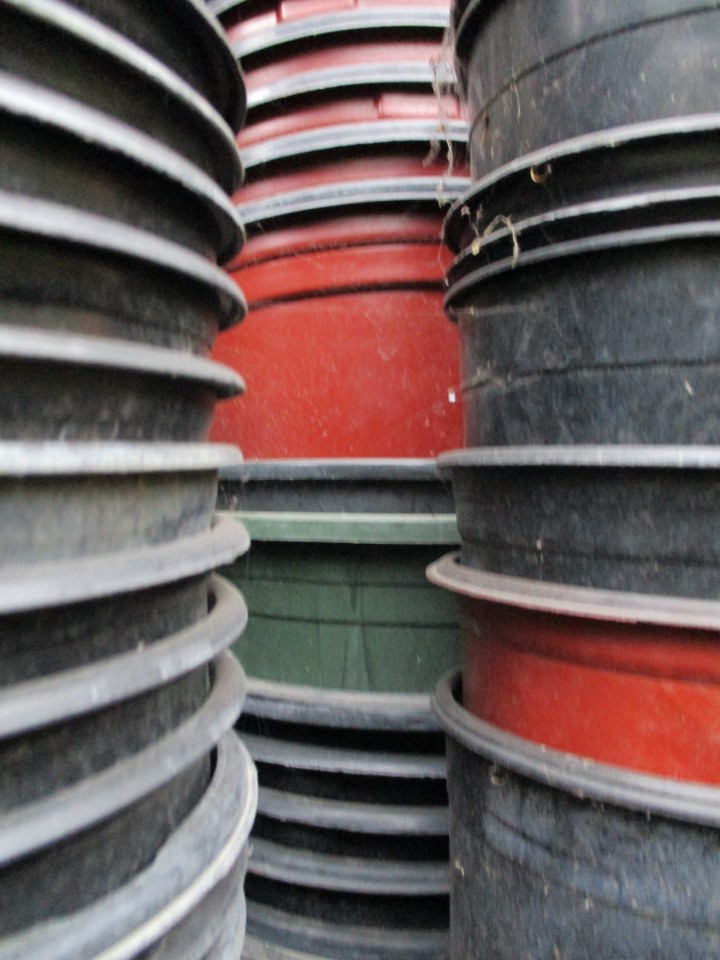
Nursery cans are not permanent pots.

Garden enthusiasts would understand the temporary nature of nursery cans better if they knew more about how plants grow in nurseries. Few plants actually grow in the retail nurseries that market them. They grow in production nurseries, where efficiency is a priority. Nursery cans, which retailers and consumers refer to as ‘pots’, are the most efficient means with which to contain the crops.

Most nursery cans are thin black vinyl. While plants are small, crowded ‘can to can’ arrangement shades the black vinyl so that it does not get too hot from sunlight exposure. Those on the western and southern edges of a crop might get shade from a temporary row of empty cans or a plank leaned against them. As plants mature and need more space, their growing foliage shades the vinyl.

As plants become marketable, they go from production nurseries to retail and wholesale nurseries. From there, they go to new landscapes and home gardens. Only then do they finally escape the nursery cans that they grew up in, to disperse their roots into real soil. The nursery cans have finished their job. Plants can not live in them forever, even if they continue to live in other types of pots.

Nursery cans are efficient, but not necessarily comfortable. By the time they are marketable, the plants that they contain are generally about as big as they can get within their cans. If they get any bigger, their roots will be crowded. If too exposed to sunshine, the black vinyl gets hot enough to cook the roots within. Plants prefer to be in the ground, or at least pots that are more comfortable.

Potted plants that will grow bigger should live in pots, planters or other containers that are bigger than the nursery cans that they grew in. Some will want even larger containers as they grow more later. Annuals and plants that will not grow much bigger are not so critical. However, all potted plants that will not shade their own pots appreciate containers that are better insulated than thin vinyl.

Clay pots, wooden planters and even concrete urns are as practical as they are appealing.

Pots Make More Out Of Less

00627-1
Half barrels are a bit elevated, and seem to show off their flowers better.

With conservation of water being so important right now, annuals are not a priority. Many of us are trying to use as little water as possible, and only to keep the more significant trees, shrubbery and perennials alive until winter. Lawn and annuals are usually the first to succumb, mainly because they use more water than anything else.

They are also somewhat expendable. Lawn is certainly expensive, but realistically, can be replaced as soon as water becomes available. Hopefully, new lawns will be more conservative with water, like they should have been since the last “drought” (and the one before that). Annuals are planted annually (duh), so they get replaced anyway.

Annuals as bedding plants over large areas were already somewhat passé before the last few dry winters. Even the more indulgent landscapes used annuals merely as relatively modest borders around or in front of more substantial, but less consumptive, perennials and shrubbery. Pots and planters are already more appropriate.

Some of the trendiest big pots are so ornate that they do not need flowers to provide more color. Besides, with a few striking perennials for colorful foliage or form, there is not much space left for annuals. What matters with annuals is that fewer in a pot can be flashier than more in the ground. Fewer annuals mean less water is required.

Elevated planters may not be as ornate, but display flashy annuals just as effectively. Petunia, million bells, lobelia and alyssum can cascade over the edges, to be colorful both on top and on the sides. Marigold, zinnia, celosia and any interesting foliar or sculptural perennials get a bit more height. It all helps to get a bit more out of less.

Pots and planters are not necessarily less work. They just need less water than larger beds, because they are smaller. Relative to their area, they actually need more water, and must be watered very regularly to sustain the confined roots within. Hanging pots need the most water. All confined plants benefit from fertilizer.

Culinary Herbs With Landscape Appeal

00715thumb
Culinary herbs work well within landscapes.`

Vegetables grow mostly in designated vegetable gardens because they are not appealing enough for the rest of the landscape. Flowers for cutting might grow in designated cutting gardens, from which they are not missed after harvest. Culinary herbs can grow in herb gardens for the same reasons. Some might not be very pretty. After harvest, some might be too shabby for the landscape.

Of course, such perceptions are debatable. Home gardens are casual and customized. If Swiss chard, artichoke and other vegetables can grow in front yard landscapes, then culinary herbs can too. In fact, some already do. Rosemary, thyme, lavender and a few other culinary herbs happen to be popular for landscapes because they are so appealing and practical. There is a slight catch.

Culinary cultivars of herbs are distinct from landscape cultivars. Trailing rosemary is a landscape cultivar with sprawling growth that works well as a resilient ground cover. Another cultivar exhibits more sculptural upright growth. Both are well flavored. However, neither is as richly flavored as culinary cultivars of the same species. Yet, culinary cultivars are not so remarkable for landscaping.

Most of us are satisfied with landscape cultivars of rosemary for culinary application. Alternatively, culinary cultivars, which are rare in nurseries and landscapes, can adapt to landscape functions. Cultivars of culinary rosemary happen to make nice low and mounding hedging. Infrequent shearing or selective pruning does not constantly deprive it of too much of its more flavorful new foliage.

The same applies to several herbs that have both culinary and landscape applications. Compromise might be in order.

Incidentally, two culinary herbs, Grecian bay and bronze fennel, are presently quite trendy. Grecian bay or sweet bay (which is not California bay) is a very popular potted plant. In the ground, it can grow into a midsized tree. Bronze fennel is supposedly comparable to common fennel, but with sepia toned foliage. Chive, parsley and borage all work nicely with mixed perennials and annuals.

Covering New Ground Or Old With Groundcover

50506
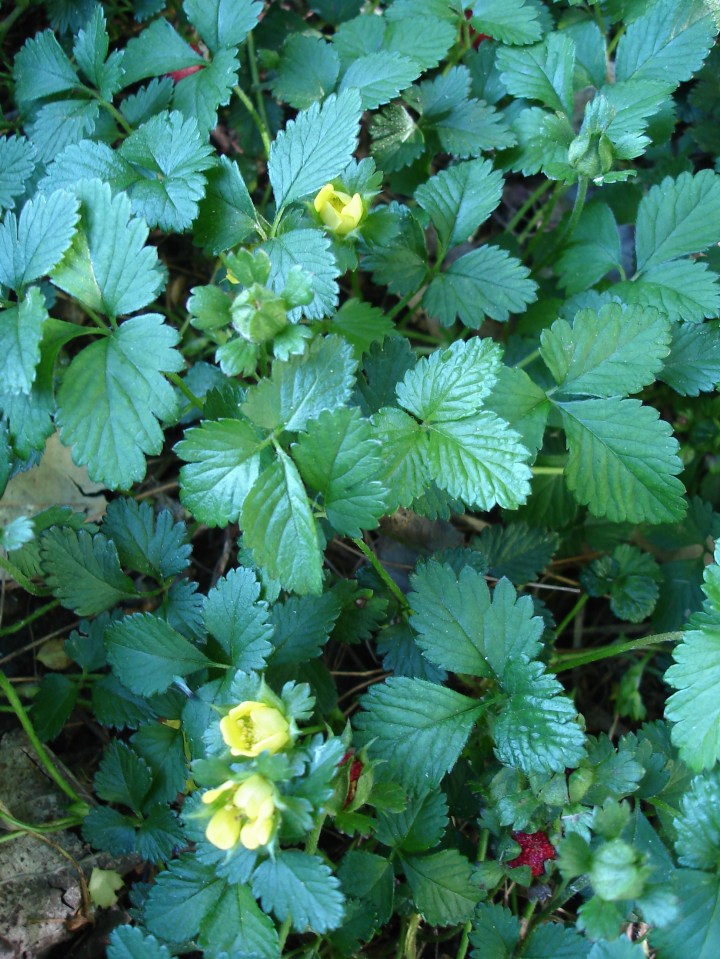
Mock strawberry covers shallowly but densely.

As the simple name implies, ‘groundcover’ covers the ground. Groundcover plants stay lower than shrubbery, and function something like mulch. They insulate shallow roots of other plants, inhibit weeds, and some groundcovers inhibit erosion. Besides all their utilitarian functions, they provide appealing foliage, and some bloom nicely.

Lawn is probably the most common groundcover, and is also the most useful; but that is an entirely different and involved topic! Other groundcover plants are spreading perennials, plants with sprawling stems, or vines grown without support. Most are evergreen, since defoliated plants do not cover much of anything too well.

Gazanias and iceplants are popular perennial groundcovers. Their old stems tend to die out and decompose as efficiently as new stems pile up over them, which is why they do not get too deep. Gazanias can eventually get bald spots that need to be patched with new plants, or ‘plugged.’

(The debris from pruning the edges of easily rooted perennial groundcovers can be processed into cuttings known as ‘plugs’, which can go directly into bald spots. Plugs can be taken from dense spots if no edging is necessary. They should be watered regularly, or plugged in autumn to take advantage of rain while roots develop.)

Groundcover forms of ceanothus (wild lilac), juniper and contoneaster are really shrubs that extend their stems more horizontally than vertically. Honeysuckle and both Algerian and English ivies are vines that spread over the ground until they find something to climb. Their stems root into the ground wherever they need to.

Since most groundcover plants are naturally understory plants that grow below larger plants, many tolerate considerable shade. Periwinkle and the ivies are remarkably happy in partial shade. However, vines, particularly the ivies, will climb walls and trees for more sunlight if they get the chance.

Many of the perennial groundcovers and some of the vines are neater if mown or cut low annually. Periwinkle does not need to be mown, but can get rather unkempt before new growth overwhelms the old through winter. Mowing eliminates the old stems, and makes the new growth fluffier. Dwarf periwinkle stays too low to mow.

Sun Scald Happens Here Too

00708thumb
Sun scald ruins otherwise good stems.

Those who enjoy gardening where winter weather is harsh likely know what sun scald is. It happens late in winter, if exposed bark warms enough to prematurely resume vascular activity during the day. Vascularly active tissue then succumbs to hard frost at night. Wintry sunlight is not sufficiently intense to scald bark; but the damage suggests otherwise. Glare from snow enhances exposure.

Of course, without hard frost or snow, this sort of sun scald is not a concern here. However, there is another sort of sun scald that happens during the warmth of summer. It truly is scald, caused by exposure to sunlight that is sufficiently intense to literally cook vascular tissue just below thin bark. Although induced by opposite extremes of seasonal weather, the damage is remarkably similar.

Since even deciduous trees are foliated during summer, most bark is safe from summertime sun scald. Bark becomes more exposed and susceptible if deprived of some of what shades it. That can easily happen if aggressive pruning diminishes the foliar canopy above. Removal of a nearby tree also eliminates significant shade. Painting an adjacent wall a light color can enhance glare.

White paint applied to the trunks of susceptible orchard trees reflects most of the damaging sunlight, but is too unsightly for landscape trees. Stubble of small twiggy stems can shade the trunks of some young trees until their canopies are broad enough to provide shade. Sun scald typically develops on southwestern and upper exposures that are more exposed to the most intense sunlight.

Maple, oak, ash, birch, flowering cherry, flowering crabapple, English walnut and almost all deciduous fruit trees are innately susceptible to sun scald. The interior stems of privet, holly and English laurel are more resilient to sun scald if exposed by major pruning during late winter rather than during summer. Although, with only a few exceptions, any thin bark can be susceptible to sun scald.

Foliage of many plants can be damaged by enhanced exposure too, but that is known as ‘scorch’, and is another topic.

Summer Is Not For Planting

P00104K
New plants are less reliant on irrigation if installed at the beginning of the rainy season.

Autumn is the time for planting. Cooling weather slows plants down so that they do not mind disruption so much. Increasing rain (hopefully) keeps the soil evenly moist while roots slowly disperse. The combination of cooling weather, increasing rain and shorter days keeps plants well hydrated so they can slowly ease into spring.

Why is this important now? Well, it probably is not important. It merely demonstrates why this is not the best time for planting. Only a few warm season annuals and vegetables get planted this time of year. Seeds for certain autumn vegetables get sown now. Otherwise, more substantial plants should wait until autumn if possible.

Mid summer in some ways is the opposite of autumn. While the weather is warm, plants are too active to be bothered. Even minor disruption can be stressful. Soil moisture provided by irrigation is often too irregular and unreliable for dispersion of many new roots. There is less time to recover from stress during shorter nights.

Smaller plants and seeds survive summer planting better than larger plants do. Seeds need to disperse all new roots anyway, so they  will adapt to what they get. They certainly need regular watering, but are quite talented at putting their roots wherever the moisture goes. With a bit more time, smaller plants will do the same.

Larger plants have more difficulty with the planting process because they need to disperse so many more roots to get established. When they get planted, all their roots are initially confined to the volume of media (potting soil) that they were grown in. They are susceptible to whatever happens within  that limited volume.
For example, a small plant in a four inch wide pot is initially confined to less than sixty-four cubic inches of soil. It can double its soil volume to one hundred forty-four cubic inches by merely dispersing roots less than one inch laterally. A tree in a 24-inch wide box needs to disperse roots ten inches laterally to do the same!
It would seem that drought tolerant plants would be less susceptible to the stress of planting in summer.

However, they are more sensitive because they are so reliant on extensive root dispersion. Until they disperse their roots, they actually need to be watered as frequently as other plants do.

Summer Squash Excel All Summer

00701thumb
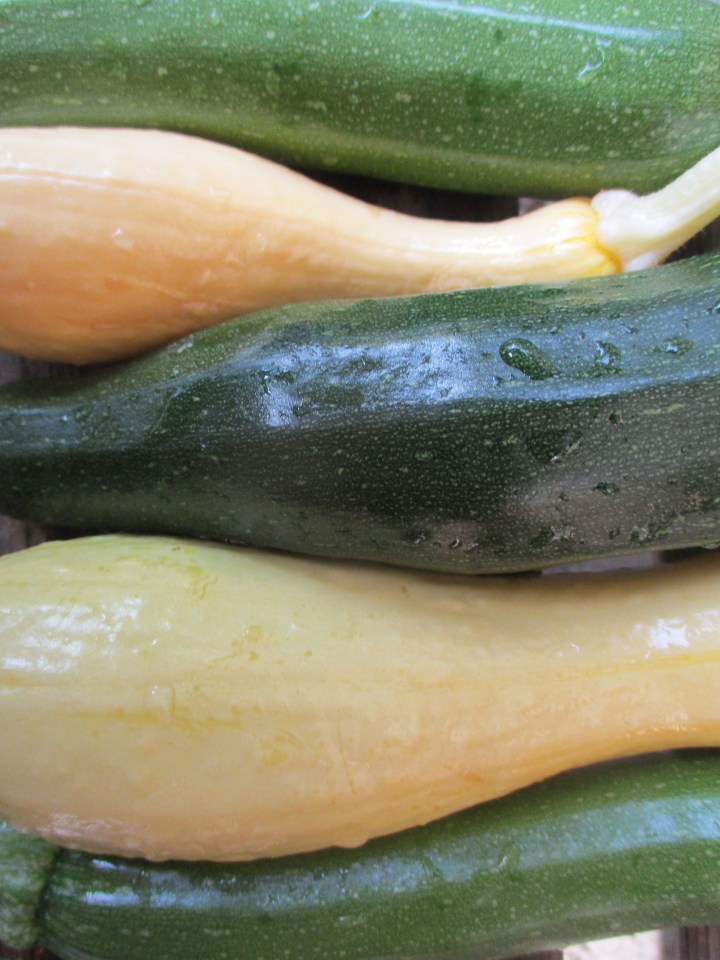
Tender young summer squash are best.

Summer is for warm season vegetables like tomatoes, beans, corn, okra, and of course, summer squash. The name says it all. Summer squash are the sort of squash that develop and are ready for harvest through summertime. The season continues until the plants succumb to cooling autumn weather. The abundant squash fruits are best while young and tender, before they actually ripen.

Related winter squash grow through summer too. However, they ripen completely through the growing season before harvest in autumn. By the time they are ripe, their foliage will be succumbing to frost. They are much less perishable than summer squash are, so last for months if stored properly. Instead of producing abundant small fruits, winter squash plants produce only a few big fruits.

Summer squash plants can produce big fruits too, but at the expense of preferred tender juvenile fruits. They simply will not divert resources to new small fruits while concentrating their effort into a big fruit full of viable seed. After all, seed production is their priority. Regular harvest of juvenile fruits actually stimulates the production of more fruits. It forces the plants to redirect their resources.

There is certainly nothing wrong with summer squash fruits that have matured a bit more than they should. Stuffed zucchini is merely medium sized zucchini sliced in half lengthwise, hollowed out, stuffed and baked. Some people actually prefer to leave the last summer squash fruits of the season out in the garden to get as big as they can before frost. Such fruits are tough, but not too bad.

Common zucchini and its varieties are the most poplar of the summer squash. They are generally the most reliable and most productive. Crookneck squash are likely the second most popular of summer squash locally. They are slightly less productive, but provide variation of flavor. Pattypan squash have good flavor, and a slightly firmer texture that is an advantage for soups and freezing.

Other interesting varieties of summer squash are too numerous to list. Each exhibits its own distinct characteristics.

Know The Time To Conserve Water

P00418K-1
Automated irrigation is certainly not perfect.

In the wild, plants take water when it comes as rain. Native plants and plants that are from similar climates might be happy to get almost all of their water through winter, and almost none through summer. However, lawns and many other plants want some degree of water through summer. This is why most landscapes are irrigated.

Obviously, irrigation is unnatural. The main disadvantage is that it uses water that must be taken unnaturally from natural sources, which are often, and are presently depleted. The advantages (even during a drought) is that irrigation can be applied where needed, as needed, and when it is most appropriate.

Irrigation systems can be designed to deliver more water to plants that need it, and less water to those that are less consumptive. Watering by hose can of course be similarly tailored to the plants. The volume of water applied can be increased through warm and dry summer weather, and decreased or discontinued through winter.

Automated irrigation can be set to operate very early in the morning when no one is likely to be out in the landscape. The water gets used when the need for water in the home is minimal, so fluctuation in water pressure should not be a problem. If it operates early enough, irrigation can finish before anyone gets out to see it.

Furthermore, early morning also happens to be the best and most efficient time to apply water. Less water evaporates while the air is cooler and more humid. Therefore, more water soaks into the soil. Evapotranspiration (evaporation from foliage) is a bit subdued, so plants cycle through their own moisture a bit slower.

Many plants can just as easily be irrigated in the evening. This would allow even more time for water to soak in before the sun comes up. However, the problem for some plants and lawn is that moisture lingering on foliage all night long can promote the proliferation of all sorts of fungal diseases, including mildew.

Drip and similar irrigation is still the most efficient, simply because water is applied directly, with minimal evaporation. Broadcast irrigation from lawn sprinklers, especially fine mist, is much more susceptible to evaporation. Water evaporates as it gets sprayed through the air, and as it lingers on any wet surfaces.

Bronze Is The New Green

00624thumb
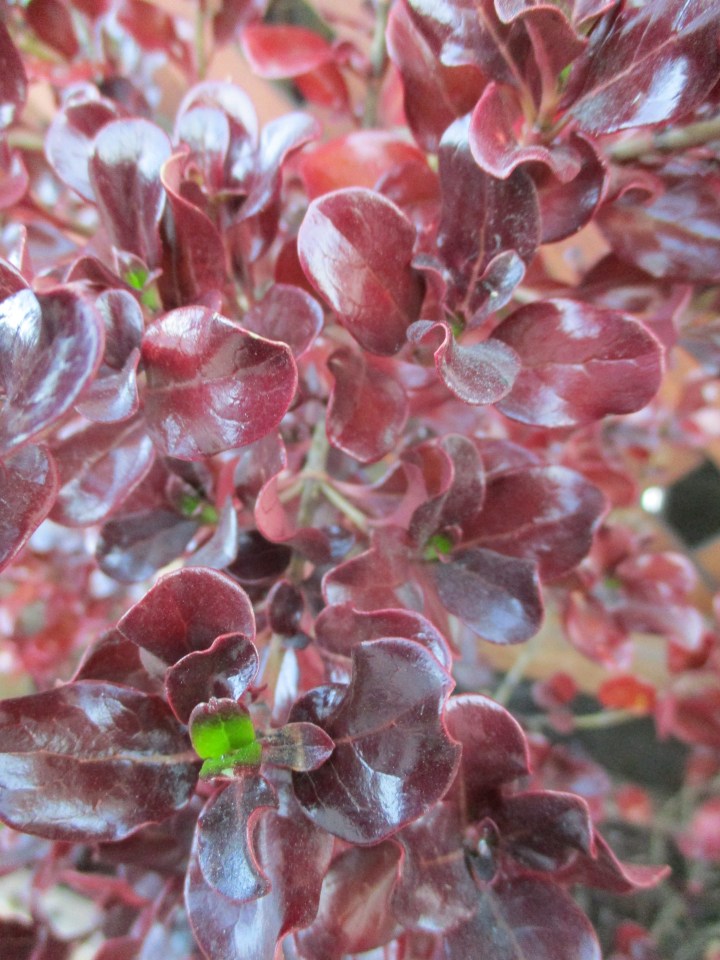
Color like this needs no bloom.

Bronze foliage will never actually replace green foliage. Even if there were enough variety of plants with bronze foliage to do so, too much bronze would look dreary. Bronze is just another option for foliar color in landscapes with significant vegetation. It is distinct from simpler green, and contrasts nicely with gold, blue, gray and variegated foliage. Some bronze foliage is variegated too.

There is all sorts of bronze foliage. Some is brownish bronze. Some is reddish. The most popular bronze foliage is rather purplish. It can be evergreen or deciduous. Annuals, perennials, shrubs, vines, trees and houseplants can provide bronze foliage. Most plants that provide bronze foliage are variants of plants that also provide bloom or fruit. Some are common. Others are rather rare.

Bronze foliage is not an advantage to plants that produce it. The most efficient foliage is green. Gray or bluish foliage has the advantage of reflecting some of the harsh sunlight that could scald it in severe climates. Otherwise, foliage that is a color other than green reflects more of the useful sunlight than it should. Incidentally, dark foliage also absorbs more of the sunlight that can scald it.

This is why many bronze plants are noticeably less vigorous than their greener counterparts. Although it would not be an advantage in the wild, diminished vigor makes some bronze plants more adaptable to compact home gardens. For example, the brownish bronze ‘Summer Chocolate’ silk tree will not get half as high and wide as the common silk tree. It can fit nicely into a cozy atrium.

Cultivars of purple leaf plum, Japanese maple and Eastern redbud are more familiar complaisant bronze trees. ‘Ruby Lace’ honeylocust is still quite rare. Bronze shrubbery includes smokebush, Chinese fringe flower, elderberry, barberry and ninebark. New Zealand flax, canna, houseleek, ajuga, mondo grass and coral bells are popular bronze perennials. Cordyline is a larger perennial.

Bronze foliage adds a bit more color than typical green foliage. In the right situations, it is appealing bold.