Arboriculture: Deep Space Nine

P71231The “Poly” in Cal Poly is for “Polytechnic”, as in there are multiple schools within “California Polytechnic State University” at San Luis Obispo. There were seven school when I was there between 1985 and 1990. I was a student of the “School of Agriculture”. “Horticulture” was my “Major”, or major realm of study within this school. Within this major, I selected “Floriculture and Nursery Production” as my “Concentration” of study. That certainly is a lot of quotation marks.

While majoring in horticulture at Cal Poly, I studied with students whose concentrations of study were within “Landscaping” or “Floral Design”. Withing the School of Agriculture, we studied with students who majored in “Crop Science” or “Animal Science” and so on. Like horticulture, each of those other majors was divided into other concentrations.

Then there were all those students of the other six schools, which I will not even get into because I am wearing out the quotation mark key.

In the summer of 1988, while many of my colleagues were going to Australia, New Zealand or South Africa for their internships, I stayed right here in California, and took a job with a Lee’s Tree Surgeons in Saratoga. My colleagues thought that was a bad idea. Not only was that sort of internship for those in the landscaping concentration, but it was for the lowliest among them. They climbed trees and used chain saws and ropes and such. They were primitive. They were barbaric. They were not like us.

As it turned out, I was not like them. Fortunately, they did not mind. They took very good care of me, and trained me as best they could about arboriculture in the three months I was with them. They realized pretty quickly that I was not a good candidate for the job they gave me, but made accommodations for me. Although I was never proficient at climbing, and was not really good for much at all during that summer, I later went back to work for some of them, and eventually became a somewhat proficient groundsman; but that is another story for another time.

In my fourth year at Cal Poly, San Luis Obispo, after my internship with Lee’s Tree Surgeons, I relocated from my semi-rural home back into town, and lived in a big apartments with three roommates. We made a tradition of watching “Star Trek: the Next Generation” on television. One of the roommates, who is now a very respected professor at Cal Poly, made cornbread for the weekly event. Although I did not continue the tradition after we all graduated and went our separate ways, I did sometimes watch “Star Trek: Deep Space Nine” when it came out a few years later. I really need to stop with the quotation marks.

In Star Trek: Deep Space Nine, I liked the concept of so many different species living together in an society in which it was very necessary to make accommodations for those who are different. Everyone needed to respect everyone else. Some even learned to appreciate the differences. Even the bad guys had redeeming and very often likeable traits.

In my career, I am primarily a nurseryman. That means I grow things. Other horticultural professionals might compare my people to the Vulcans. They think that we are too uptight, efficient and plain to be much fun. Factory growers (who work for the big corporate growers) would be more like Romulans, and are therefore less dedicated to what is right and logical if it is to their disadvantage. Some of the better artistic landscape designers are likened to the Bajorans. Unscrupulous maintenance gardeners who will do what they must to make a buck are comparable to the Ferengi. Some of them work for the larger and imperialistic Cardassian landscape corporations.

Arborists are the most excellent of all; or perhaps the second most excellent after Vulcan nurseryman. They are like the Klingons; honorable, noble, independent, passionate and boisterous! I can understand why my colleagues think of them as barbaric and primitive, but I also believe that my colleagues should be more accommodating. When I consider what arborists must have though of me what I did my internship, I realize that it must not have been easy for them to accommodate me. Yet, they did, and in the most excellent way. They still respect that I have my own career in my own world, but to this day, thirty light years later, they are still pleased to invite me to their world.

Very Bad Houseplants

P71230Just because it ‘can’ be grown as a houseplant does not meant that it ‘should’ be. That is a lesson that Brent and I never learned in college. He and I were roommates in the dorms at Cal Poly in San Luis Obispo, which, as you can imagine, was a problem. Our room on the top floor of Fremont Hall was known as the Jungle Room. It was so stuffed full of weird houseplants, as well as a few plants that had no business inside. We had a blue gum eucalyptus bent up against the ceiling, an espaliered Southern magnolia, a Monterey cypress, and a herd of camellias that we rescued from a compost pile on campus.

After college, our own homes were no better. Because my dining room was rather small, Brent gave me tall weeping figs that had unobtrusively bare trunks down low, and plenty of fluffy foliage pressed up against the ceiling; a technique we did not quite perfect with our Jungle Room blue gum. I had a giant yucca in the guest suite, a redwood in my bedroom, king palms in the parlor, and a lemon gum eucalyptus over my desk in the office. The bathroom was the worst, with pothos and Algerian ivy hanging over the shower curtain, and billbergias up over the shower. A pair of small birds nested in the billbergias, and before I realized that they were there and evicted them, they started a family!

At least Brent kept most of his plants outside where they belong. The staghorn ferns grab onto the walls when they get the chance. Wisteria vines grab onto anything else. The flame vine climbed up the chimney (appropriately), and before Brent knew it, had sneakily spread to the opposite side of the parapet roof! Then there was the giant timber bamboo. Yes, that is what I said; giant timber bamboo. I know what you are thinking right now, so there is no need to say it.

There is a narrow space between north side of Brent’s home and the concrete driveway next door. It is almost three feet wide. Brent though that if he planted the bamboo there, it would not get to the other side of the driveway. He was actually correct.

Did I ever mention how vain Brent is? Well, that is another topic for another time. I will say for now that he has more clothes than his teenaged daughter Grace. A lot more. They do not all fit in his big closet. He hangs some of his longer coats that he does not need very often in Grace’s much smaller closet. One day, he was reaching around the clutter that is common in a teenaged girl’s room, and groping for one of his coats in Grace’s closet, when he grabbed a hold of something that should not have been there. He was not certain what it was at first, but when he found his coat and pulled it out, a few dried bamboo leaves came with it and fell onto the floor!

The bamboo did not even try to go under the neighbor’s driveway. Instead, it went under the foundation of the house. Where it came up, it had nowhere to go, so somehow weaseled in next to a water pipe, and followed it up behind the bathroom washbasin. Once inside, it somehow weaseled past a valve access panel behind Grace’s closet, and straight up to the ceiling. What is even funnier is that Grace knew it was there, but figured that it was just another one of Brent’s crazy landscaping ideas!

Just in case you are wondering, giant timber bamboo is a very bad houseplant!

The bamboo is gone now. It got so tall that the wind would blow it against the terracotta tiles on top of the parapet wall. Also, the foliar litter was too messy on the parapet roof and the neighbor’s driveway. It did not contribute much to the landscape anyway, and shaded only a driveway that is seldom used.

Merry Christmas!

P71225Does anyone else think that it is odd that Baby Jesus got only some frankincense, myrrh and gold for His first Christmas? I mean, it was the first Christmas ever, and that was the best that anyone could do? Well, maybe those gifts were something important back then. Maybe it was a good heap of gold. It just seems to me that three ‘wise’ men could have procured better gifts. More than two thousand years later, some of us are disappointed if we do not get a new Lexus on Jesus’ birthday, after He got only frankincense, myrrh and gold. (Get your own birthday!)

Although I do not remember my first Christmas, I know that my parents and others got excellent Christmas gifts for us kids when we were young. Our stocking that hung over the fireplace were filled with a mix of nuts, mandarin oranges, cellophane wrapped hard candies and small wooden toys. This is a tradition that dates back to a time when citrus fruits and certain nuts were something fancy that needed to be imported to Northern Europe from Mediterranean regions.

Of course, citrus grows quite well in our region, and almonds and walnuts still grew in the last remnants of local orchards. Our great grandparents had two mature English walnut trees in their gardens. Only pecans and hazelnuts were exotic. I happened to like pecans because they are from Oklahoma. (I did not know where or what Oklahoma was back then, but I knew it was an excellent place.) Hazelnuts were from Vermont, which is twice as far away as Oklahoma is, if you can believe that!

The gifts under the Christmas trees were even more excellent! One year, I got packets of seed for a warm season vegetable garden the following spring. There were seed for pole beans, corn, pumpkins, cucumbers and zucchini. (The cabbage incident that I will write about later happened in the cool season garden the following autumn.) Under the Christmas tree at my grandparents house, I got all the gardening tools that I would need in my garden, including a small shovel, garden rake, leaf rake and hoe. But wait, there’s more! Under the Christmas tree at my great grandparent’s house, I got flower seed for bachelor button, alyssum and a few others, as well as bare root rhubarb plants (from my great grandfather’s rhubarb that he had been growing longer than anyone can remember). I had already learned about seed from my first nasturtiums (https://tonytomeo.wordpress.com/2017/10/07/dago-pansies/), so I could not have been more pleased with my cache of gifts.

For later Christmases, and also birthdays, I got all sort of other things that were much more excellent than frankincense, myrrh and gold, including an incense cedar (how appropriate) that my grandparents brought back from the summer house near Pioneer, and a young ‘Meyer’ lemon tree. My Radio Flyer wagon was the biggest and most excellent in the neighborhood, and was more than sufficient to haul all my gear around the garden with. My big watering can was a bit too big, and was too heavy for me to move when it was full of water.

I would not say that these gifts were extravagant. They were just . . . okay, so they were extravagant. It was a long time ago. Unfortunately, my parents figured out that their gifts were somewhat excessive just prior to buying me the Buick I wanted. The wagon is still around. My mother uses it to bring in firewood. She also uses the little shovel to clean ash from the stove.

(The gardening article that is regularly scheduled for Mondays is scheduled for tomorrow. The featured species that is regularly scheduled for Tuesdays is scheduled for Wednesday.)P71225+

Scofield Tree Update

P71212+KThe sad little Scofield Tree in Felton Covered Bridge Park did not do much this year. (https://wordpress.com/read/blogs/135014809/posts/322 and https://tonytomeo.wordpress.com/2017/12/02/felton-covered-bridge/) In fact, it grew only about five inches taller, so is now only about four feet tall. The damage from the weed whacker really set it back. Growth was healthy on the side shoots, but that growth will need to be tucked back to promote apical dominance. The good news is that the vigor and health of the foliage of the sideshoots indicated that root dispersion was likely adequate to sustain healthier and normal vigorous growth next year.

Although the sideshoots will get tucked back to limit their competition with vertical growth of the main trunk, the stubble will remain to promote caliper growth of the trunk.

The trunk will be bound like a tree in a nursery; and the bound trunk will be staked for stability. Binding outside of a production nursery may not seem to be horticulturally correct, but is necessary for a straight trunk. The staking is done more to protect the tree in such a high traffic area than to support the tree. It would be better for the tree to do without binding and staking so that it can learn to support its own weight. Once the straight section of trunk is taller than about six feet, the bindings will be loosened, and eventually eliminated as the trunk lignifies into form.

A bit of fertilizer will be added to the soil around the tree before the last rains of winter. This might seem like cheating, bur for right now, the tree is too small to be safe in such a high traffic area. It will also be irrigated occasionally after the rain stops. It does not get much water, but will get enough to keep it vascularly active through the growing season. Too much water promotes shallower roots, which might damage the nearby concrete curbs and asphalt pavement. Valley oaks naturally disperse their roots very deeply, so the curbs and pavement should be quite safe for a century or so.

Dead Box Elder Update

P71223P71223+What is killing the box elders? (https://tonytomeo.wordpress.com/2017/10/04/what-is-killing-the-box-elders/) I still do not know. I know that does not sound like much of an update. All I can share is some pictures of secondary symptoms observed now that the affected trees are deteriorating.

The two pictures above, although not relevant to any symptoms, are important to our Community because the historic Felton Covered Bridge just got a new roof! (https://tonytomeo.wordpress.com/2017/12/02/felton-covered-bridge/) Dead box elders that are already starting to destabilize and collapse are now leaning onto the edge of the new shingles! They really need to be removed before winter storms move them around, and they dislodge any shingles.

The first of the two pictures below show basidiocarps associated with fungal decay of the trunks and roots. This decay destabilized and compromised the structural integrity of the necrotic trees with remarkably efficiency. The trees died only last spring, and are already collapsing! The second of the two pictures below simply shows decaying bark peeling from a necrotic trunk.P71223++P71223+++

This all happened so suddenly. Like SODS (Sudden Oak Death Syndrome) it is likely to be misdiagnosed a few times before the primary pathogen is actually identified. Also like SODS, it may be ignored as an isolated situation affecting a few trees that are not very popular anyway. When SODS first started killing a few of the unpopular tanoaks, it did not seem like much of a problem. It did not get much attention until it started taking out majestic coast live oaks that had been healthy for centuries.

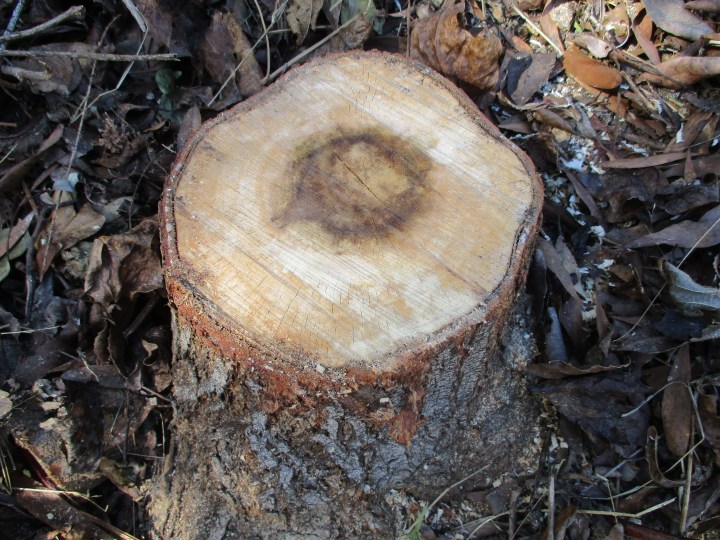
The two pictures below show a cross section of a necrotic trunk that needed to be cleared from a bridle trail. Galleries have been excavated by the larvae of unidentified boring insects. The second picture is merely a closeup of the first.P71223++++P71223+++++

Santa Ana Winds

P71221+They have been a part of life in Southern California longer than anyone can remember. The Santa Ana Winds have been blowing down from the high deserts to coastal plains long before people arrived in the region. They are arid and usually warm before they leave the Great Basin and Mojave Desert, and they get even warmer as they flow downhill through mountain passes. That is what makes them so dangerous during fire season. Wind alone accelerates wildfire. Warming arid wind desiccates fuel, making it more combustible before wildfire arrives.

Santa Ana Winds are so regular that they affect how tall trees grow within the regions of the mountain passes where Santa Ana Winds move the fastest. Tall Mexican fan palms that grew up straight where sheltered from wind near the ground innately lean with the prevailing wind as they grow up and become more exposed. Those closer to the narrow canyons lean the most. It is something that arborists recognize everywhere around the Los Angeles Basin. They can tell how strongly the Santa Ana Winds blow in any particular neighborhood by how Mexican fan palms lean.

Santa Ana Winds can be strong enough to break tree limbs, and blow trees down. In the past few days, they have been making quite a mess in the Los Angeles region; although not as much of a mess as they are making in conjunction with the Thomas Fire in Santa Barbara and Ventura Counties, which may already be the biggest wildfire in the modern history of California.

Overnight, Santa Ana Winds blew this California pepper tree onto a swimming pool in Los Angeles. Tree services, landscapers, gardeners and those who enjoy gardening will be busy cleaning up such problems for the next few days, as Santa Ana Winds continue.

Mistletoe Un-Update

oklahomaThere is still no news about why mistletoe disappeared this last year in our area. No one really noticed it missing until late in summer. The absence of mistletoe became more apparent as deciduous trees that had been infested with it last year defoliated in autumn. What is even more strange is that the dead mistletoe plants deteriorated so quickly and efficiently that they are completely absent, as if something ate all the mistletoe, or took it away. The only evidence of former infestation in some trees are the swollen portions of stems where mistletoe had been attached. An article about this mysterious absence of mistletoe can be found here; https://tonytomeo.wordpress.com/2017/09/24/where-has-all-the-mistletoe-gone/ .

Someone who harvests mistletoe from local trees, both to eradicate it from a few trees, and also to sell it in local markets, made an interesting observation about the absence of mistletoe just within the past few day. He found that some mistletoe survives, but only in the upper extremities of tall trees. Most of the trees are locust trees, perhaps because they happen to be taller than most of the other trees that had been infested. One infested tree is a black walnut. The viable mistletoe plants are somewhat young and small. Larger plants or colonies that were as high as the smaller surviving plants are gone. Specie of mistletoe that infest coast live oak and some conifers have not been observed.

There are several variables that could account for the survival of relatively small mistletoe plants high in the canopies of host trees. Some pathogens that could affect mistletoe might proliferate in congested growth that limits air circulation, but not where air circulates efficiently through sparse and exposed growth higher up. Some pathogens that proliferate in cool and damp situations are inhibited by drier and sunnier situations. Some pathogens are more likely to infect hosts that are closer to the ground. If rodents are taking mistletoe vegetation, they prefer the shelter of more congested lower growth, and avoid the vulnerability of more exposed higher growth.

Tree Monster

P71203Matthew McDermott got this picture, which was actually part of a video, of a tree burning from within during the devastating fires in Sonoma County last October 9. Many of us saw it in the news. It is actually not as uncommon as it would seem to be. Interior wood is more combustible, and sometimes already well aerated from decay, so can burn if exposed to fire through wounds or cavities, while the exterior of the same tree resists combustion. This is why there are so many big and healthy coastal redwoods with burned out hollow trunks. Of course, trees more commonly burn from the outside.

Once burned, charred wood is resistant to decay. Redwoods and cedars are resistant to decay anyway, so once charred and doubly resistant, they can stand for decades.

When my younger brother and I were little tykes, one such charred cedar lived at our maternal Grandparent’s summer house outside of Pioneer. That is, it ‘lived’ there before it got charred by a fire a very long time before the forest that was there in the early 1970s grew up around it. I never actually saw it living. It was VERY dead long before my time.

The problem was that my younger brother and I did not KNOW for certain that it was dead. It was a big charred trunk at the bottom of the clearing downhill from the house. We could see it from almost anywhere, except from inside or uphill of the house. It was ominous. It was creepy. It seemed to watch us. The rest of the pines, firs, cedars and everything else in the forest was so green and lush; but the big black carcass was always there.

We were not totally afraid though. Our Uncle Bill was there too. He was the greatest superhero in the entire universe! He was bigger and stronger than any man. He was tall enough to hang our swing in the big tall black oak tree. He had already protected us from the bats. (We did not know what bats were, but we knew they were scary.) He breathed smoke, and from a white and gold can with a picture of a waterfall and a horseshoe on it, he drank a magical potion that might have given him some of his superpowers. (My brother and I tried it, but it tasted icky.)

Uncle Bill had a chainsaw.

Uncle Bill started to cut the base of the big dead Tree Monster while everyone else watched from a distance. To us kids, it seemed to take a long time. Eventually, the Tree Monster wobbled a bit, and fell forward towards us, landing on the ground with a big dusty thud. The top broke off and slid a bit farther from the rest of the carcass, which only made the secondary death of the Tree Monster seem that much more violent. After a bit of a pause, my brother and I approached in disbelief. It was twice as dead as it was before! Uncle Bill had killed the dead Tree Monster!

We walked on top of the fallen carcass just to be certain, and found no signs of life. We inspected the low and wide dead stump and found only sawdust. When we looked back at where the Tree Monster had always been, we saw only lush green pine, fir and cedar foliage.

Through the following year, Uncle Bill cut and split the Tree Monster into firewood for my Grandmother to cook with. It kept us warm at night. Uncle Bill kept us safe.

What’s In A Name? Sometimes, Not Much.

P71209Newer developments are often named after what was destroyed to procure space for them. Writers and historians have been making that observation for decades.

There are obviously no remnants of a ranch in the McCarthy Ranch Marketplace in Milpitas. Heck, there are no little cornfields left in Milpitas, which is what ‘Milpitas’ means. Cherry Orchard Shopping Center in Sunnyvale? Give me a break! The Pruneyard Shopping Center in Campbell is no better.

I just happen to find the Pruneyard to be less objectionable than the others because it was built about the time I was born. It has been there as long as I can remember. My parents can remember when it was a drying yard for the prunes harvested in the surrounding orchards. I remember the last remnants of prune orchards, but by my time, there were not enough of them to justify the less lucrative use of real estate for drying, which could be done elsewhere.

The Pruneyard Towers are an office complex just to the west of the shopping center. The original Pruneyard Tower might still be the tallest building between San Francisco and Los Angeles. I know it was only a few decades ago. (Downtown San Jose has a ceiling on the heights of their skyscrapers because of the flightpath of the Mineta San Jose Airport.) I can remember as a kid, seeing the big black tower standing proudly off in the distance, beyond the blooming apricot orchards. When our parents were shopping there, and we got close to the Pruneyard Tower, we felt a bit more cosmopolitan, as if we lived in a big world class city. Back then, we had no idea that nearby San Jose was well on the way to becoming exactly that!

The shorter tower was added about 1976. The third and lowest of the three bigger towers was added in the 1990s. The late 1960s architecture of the shopping center is still prominent, but several original buildings have been rebuilt with modern architecture, and a few new buildings were added.

As much as I miss the orchards and the horticultural past of the Santa Clara Valley, I can not totally dislike the Pruneyard Shopping Center and the associated big towers. To my generation, they are also part of our history. They have been here as long as we have.

The one thing that I dislike about the Pruneyard Shopping Center is the name. It is a constant reminder that something that was such an important part of our local culture and history was destroyed so that it could be built. Nothing about the site is associated with the orchards, or drying yards or prunes, or anything of the sort.

Someone Got Payed For This?!

P71216See what happens when the plants in the garden are happy? They do pretty things. It is now halfway through December and this honeysuckle is still blooming nicely. The cool weather has inhibited bloom somewhat, but has not totally prevented it yet. By the end of winter, this honeysuckle will get pruned back so that it can regenerate new growth to bloom through next year.

This honeysuckle happens to be growing on a chain link fence behind a small group of apartments. Someone who lives in one of the apartments enjoys tending a few vegetables and flowers, but really does not put too much effort into the surrounding vines and shrubbery that obscure the view of the parking lot next door. That region of the garden gets only the maintenance that is required to keep it under control. The person who does it is no horticultural professional; merely someone who enjoys a bit of home gardening.

Horticultural professionals should know more about horticulture than someone who just enjoys growing a few vegetables and flowers after coming home from working at another profession. That is what they get payed for. That is why they are professionals. . . because it is their profession.

Right across Highway 9 from the homes with the honeysuckled fence is a pharmacy with a parking lot that is ‘maintained’ by ‘gardeners’. It looks like a parking lot. There are some nice young but shady elms that were recently pruned up for clearance by professional arborists who did a rather impressive job. Below the elms is a mixture of typical ‘low maintenance’ plants that are often found in parking lots, including lily-of-the-Nile, African iris, Oregon grape and Indian hawthorn, with a few dwarf Heavenly bamboo to add a slight bit of Japanese ethnic diversity into an otherwise African-American landscape.

Except for the elms and other young trees, none of the plants are exemplary. They are all tough plants that are resilient to the climate and abuse that they get in a pharmacy parking lot. Their main problem is the ‘maintenance’ performed by the ‘professional gardeners’. I could go on about this, but for now, I just want to describe what was done to the Heavenly bamboo.

It never really looks that good. It does not get a chance to. At least this time of year, this particular cultivar of Heavenly bamboo gets some rather nice color on it. Even if the foliage is mutilated and crowed from a lack of ‘proper’ pruning and an excess of ‘improper’ pruning, the reddish or burgundy color is pretty from a distance. At least, it would have been.

The ‘gardeners’ cut all the foliage off, just as it was beginning to color. Yep. It is all gone. The canes were cut into these tightly shorn but somehow awkwardly asymmetrical cylinders with angular edges around the circular and flat tops. How does one put that much effort into shearing something so tightly, and perfecting the flat top, without getting it symmetrical? Why put that much effort into ruining something just before the performance that it waited all year for, and just prior to the longest time of year before the weather warms enough for it to recover?

Shear abuse – with shears.

Perhaps those are questions that Rhody is pondering in the picture. Perhaps he just wants to leave a ‘message’ for the ‘gardeners’.P71216+