Horridculture – Mail Order Glitch

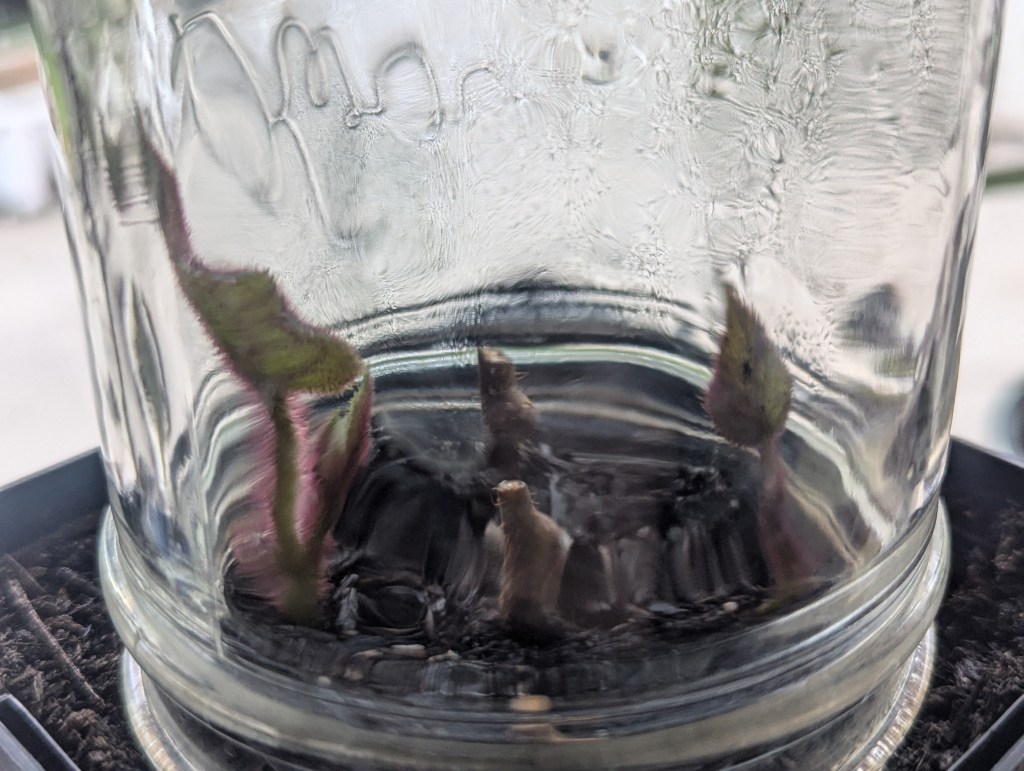
Of a dozen or so items of a mail order purchase that included various cane berries, mulberries, grapes and mayhaws, only a ‘Cumberland Black’ raspberry was less than exemplary. Unfortunately, it was majorly less than exemplary. It was broken at the base of its newest cane, just above where it extended from the older cane that the cutting was made from. If only it had not been broken, it would have been an excellent bare root specimen, with more roots than typical, and a substantial cane with several plump and turgid buds. I realize that it could either extend new canes from latent buds just below where it broke, or extend new roots from the base of the younger cane just above where it broke; so I should simply wait to see what it does. It could even do both, to provide me with two specimens for the price of one. However, I also realize that it could potentially do neither, but instead succumb to its damage. Regardless, its recovery from such damage should not be my concern. It is not in a condition that I intended to purchase it as. The provider should either provide a replacement, or refund what was paid for this particular item. Instead, I was instructed to wait to see if this damaged raspberry cane recovers. Well, at least I got a response. Perhaps that is all that is necessary. I am now more intent on keeping this raspberry cane alive, partly because I doubt that its purchase would be refunded if it succumbs to its damage, and partly because I would likely be to embarrassed to request such a refund if it becomes justifiable. Besides, as I mentioned, all other items of the purchase are of exemplary quality. I should be satisfied with that.

Six on Saturday: Eric

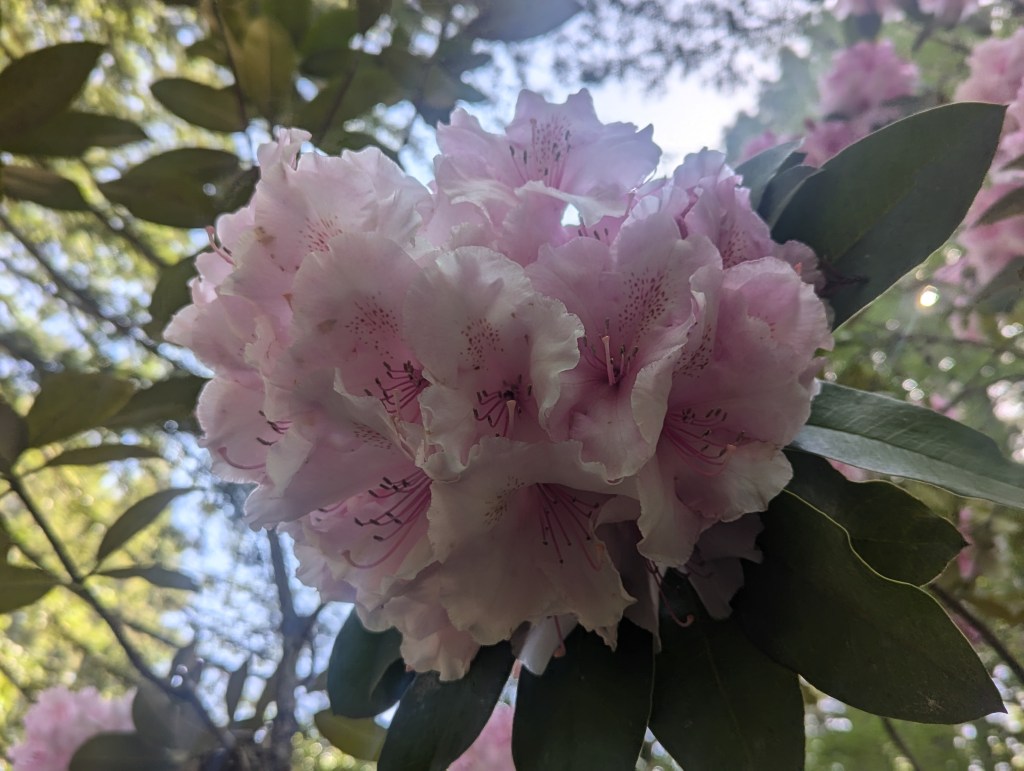
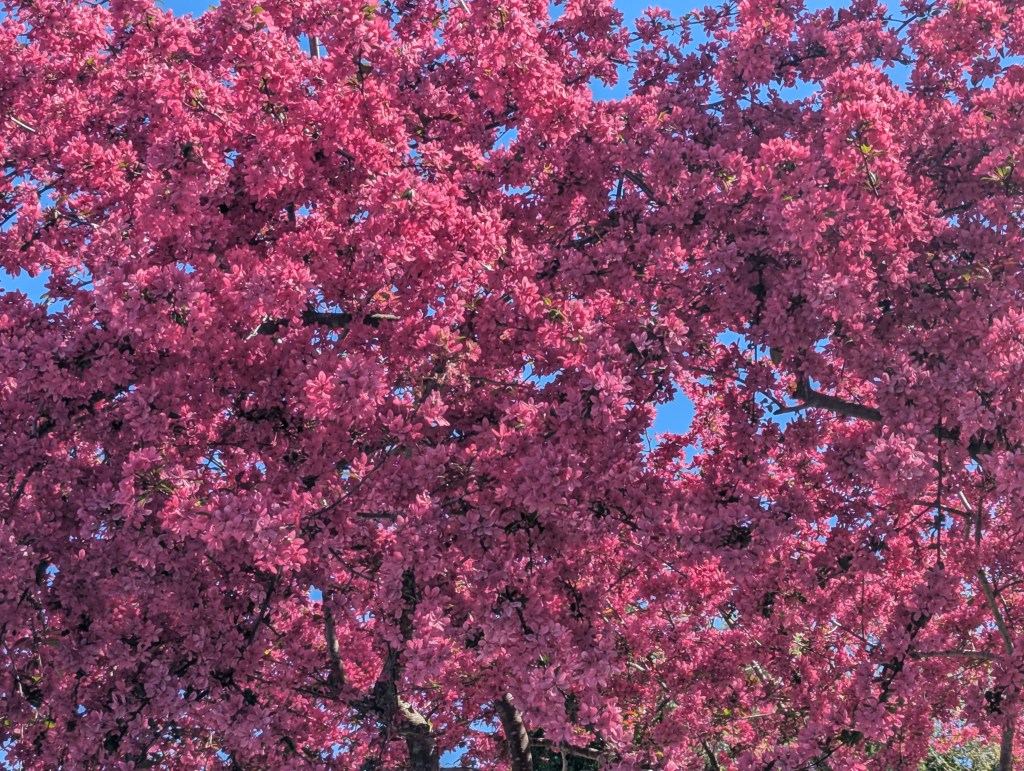
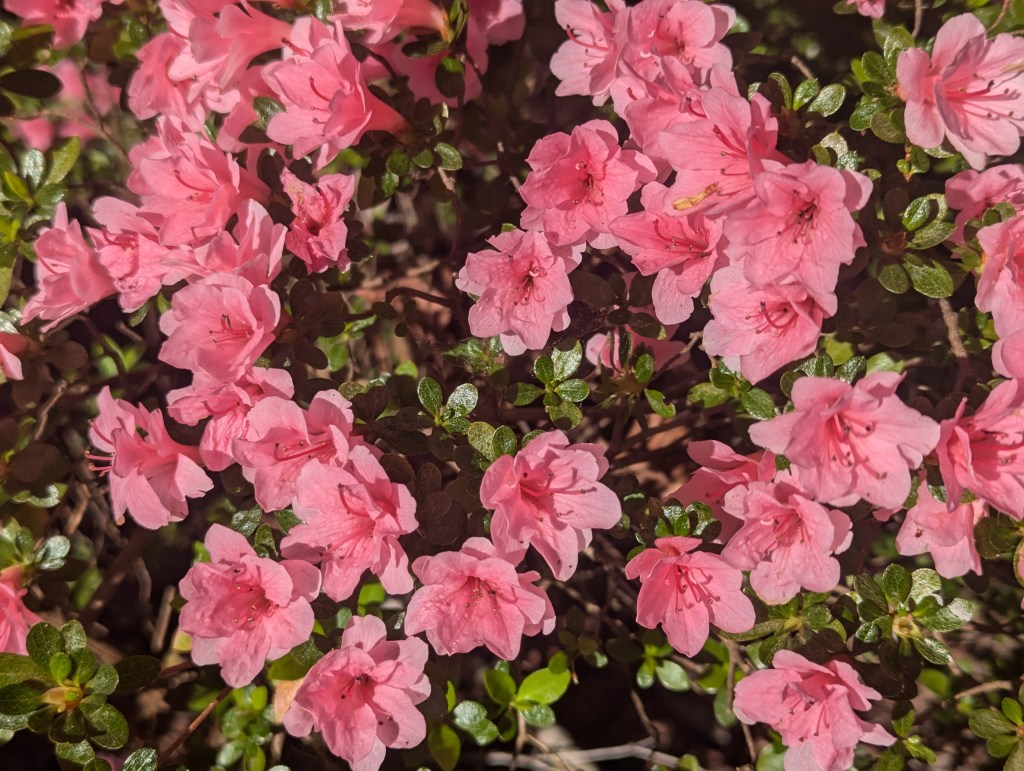
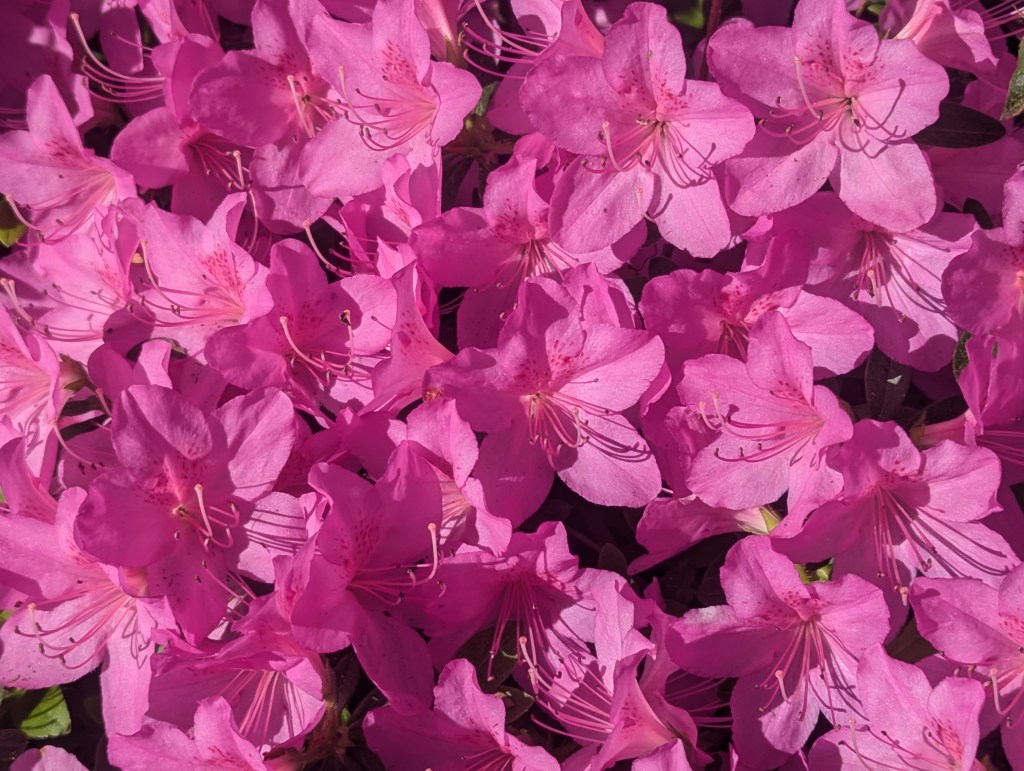
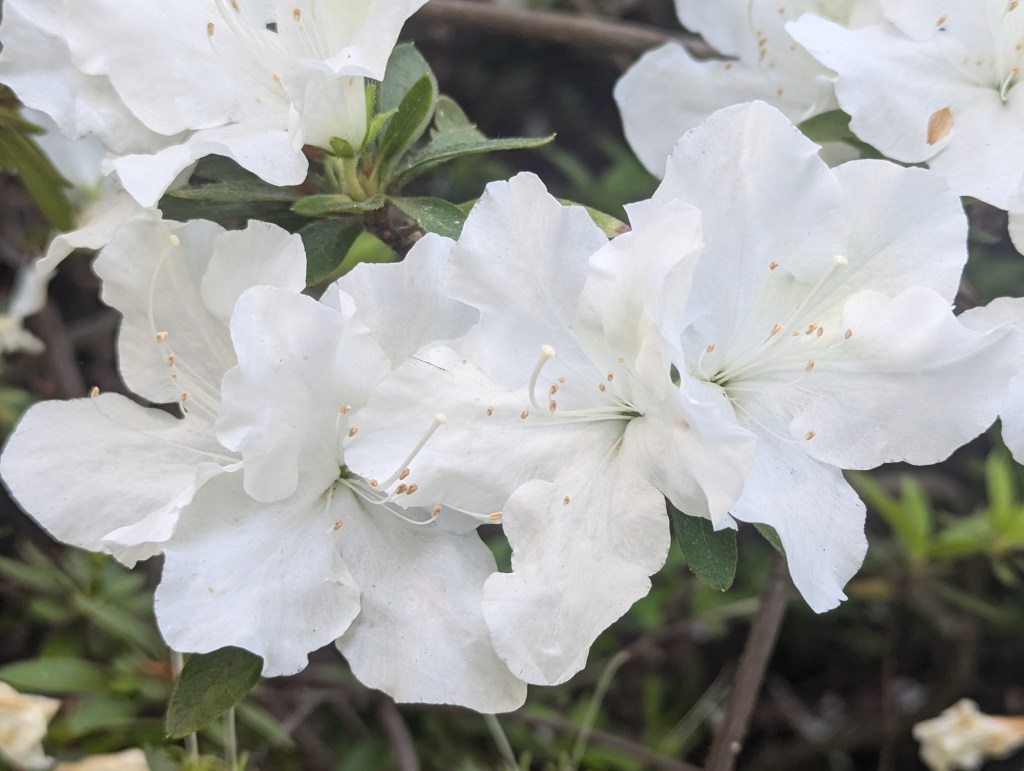
Ericaceae is a prominent family here. Rhododendrons, azaleas and pieris inhabit several of the landscapes. Manzanitas, madrones and, within some situations, huckleberries, are common within the surrounding forests. Even two of my associates, although unrelated to Ericaceae, are named for two members of the family that are popular for landscaping. Half of my Six for this Saturday are azaleas. Just one other is another ericaceous species. Later, I can get better pictures of azaleas as well as rhododendrons. Several impressively large rhododendrons bloom spectacularly in season. Heather would be nice, but is quite rare. I know where abandoned fields of it grew wild, but I have never seen it available in nurseries.

1. Heath is a masculine name. It is of the Erica genus, though; and Erica is the feminine form of Eric. Heather is a similar but feminine name, but is of a different Calluna genus.

2. ‘Coral Bells’ Azalea, like all azaleas, is of the Rhododendron genus, so like heather and heath, is in the Ericaceae family. All of them are also related to madrone and manzanita.

3. Azaleas generally bloom for early spring. These that bloom somewhat too early during the rainy season can get a bit thrashed. They would be prettier if they could delay bloom.

4. Florist azaleas are delightful as fully blooming potted specimens, but generally do not adapt well to landscapes. This specimen is floppy, but otherwise performs impressively.

5. Heather is named for Calluna, which, actually, I have not seen in many years. It grew as a cut flower crop in Montara more than half a century ago. It was abandoned by 1980.

6. Rhody is short, and his name is short for Rhododendron. But of course, he is a terrier, so ignores me regardless of what I call him. He can actually ignore me in four languages!

This is the link for Six on Saturday, for anyone else who would like to participate: https://thepropagatorblog.wordpress.com/2017/09/18/six-on-saturday-a-participant-guide/

Horridculture – Pseudopalm

Strelitzia nicolai, is giant bird of Paradise. Unlike the more familiar bird of Paradise, with basal foliage and its distinctive orange flowers, this species develops several tall trunks and less colorful but interestingly large white flowers. We recycled several into one of the landscapes here from a home garden in Morgan Hill about two years ago. Originally, they were three somewhat mature groups, with rather tall trunks. Then, they were divided into individual trunks and pups. Ultimately about sixteen were installed into the landscape, with a few spare pups canned as spares, just in case some of the others do not recover from their division. I predicted that those with tall trunks would not last long before replacing themselves with basal growth, and then shedding their unusually tall trunks. Not only are they not developing basal growth yet, but their upper foliage on top of their lanky tall trunks is actually growing and developing into new foliar canopies. They sort of look like silly palm trees that are getting less silly as they continue to grow. I mean that they actually look rather appealing, and probably look more appealing to those who do not know what they should look like. They seem to be pretending to be faux palm trees. I can do nothing about their behavior, and even if I could, I would not. I want to see what they do next. I suspect that they will eventually perform as expected. I also suspect that, because they are already so tall, that, for as long as they retain it, their upper foliage will never be as lush as it would be if lower. That is normal for the species, and how those who maintain such specimens know when to cull the taller trunks by cutting them to the ground.

Six on Saturday: This

“This” is the first word of each of these six entries for Six on Saturday this week. There is not much variation among the coast live oak, coastal redwood, California bay, California black oak, big leaf maple and whatever else might be visible in these pictures. Half these pictures happen to feature specific coast live oaks. Therefore, I omitted botanical names. I wanted to show some of what is happening at the new home site, but there is not much to show, and there may not be much to show for a while, except for Rhody.

1. This is where the old home was. The forest wasted no time reclaiming its space. I miss the old home very much, but it was too deteriorated to salvage. I knew it was temporary.

2. This is where the new home will be built. It is less than fifty feet to the west, and faces more to the west instead of south. The upstairs office studio will face into the redwoods.

3. This lofty coast live oak stands high over the new home site, but leans to the north and away from where the house will be. It is the biggest of several big oaks in the grove here.

4. This silly coast live oak leans parallel to the driveway. The contrastingly vertical trunk to its right is the same that is on the right border of the first picture of the old home site.

5. This grand coast live oak arches elegantly over the driveway. It can be seen across the upper left corner of the previous picture. It is about perpendicular to the horizontal oak.

6. This is how I manage the overgrown and overly combustible vegetation here. It needs to be planned in accordance with the weather that has been too dry for much too long.

This is the link for Six on Saturday, for anyone else who would like to participate: https://thepropagatorblog.wordpress.com/2017/09/18/six-on-saturday-a-participant-guide/

Duckweed

Lemna minor is the common duckweed that infests the drainage pond. It is SO extremely prolific that I doubt that a huge herd of koi could eat it all. It appeared within the pond about as soon as the pond started to fill with water. It was undoubtedly brought by the first ducks to arrive while the pond was no bigger than a large puddle. It was no surprise, since duckweed inhabits most ponds. However, its profusion exceeds expectations. It can get so dense that it spreads into the area of the fountain. The turbulence of the dispersed water mixes some of the duckweed below the surface, but it does not stay there for long. If it does, its absence makes no noticeable difference to the density of what floats on the surface. It looks like a very tightly mown lawn. It is not so dense now that it has been frosted through winter, but is nonetheless more dense than expected. It typically disappears after the first few minor frosts, but has not done so yet, even after more minor frosts than typical. It lingers like some sort of unnatural pollution on the surface of the pond. YUCK! At this rate, it may not completely disappear before it is time for it to reappear during warming weather of late winter and early spring. It supposedly makes superb compost, but no one has time to scoop it off the surface of the pond. Besides, I doubt that it would not more than replace whatever we scoop, particularly since it already did so when we tried scooping in in the past. It seems like a harmless weed that is confined to the pond, but is so obnoxiously prolific and persistent within a pond that would likely be more visually appealing without it.

Six on Saturday: el Catedral de Santa Clara de Los Gatos II

El Catedral de Santa Clara de Los Gatos is merely the Mount Hermon Memorial Chapel, which is a more proportionate name that does not trivialize its Memorial status. I prefer it to seem grander than it is. Also, I maintain a strict standard for its minimal landscape. All of its flowers bloom exclusively white. However, most of its flowers have been rather pekid because of aggressive invasion of consumptive redwood roots into irrigated areas. Because I can not stop the encroachment, I removed the soil from four primary planters. Within the front pair of planters, I suspended customized planter boxes. Within the rear pair of planters, I suspended a few nursery cans that contain new plants. Redwood roots can not reach into these planters or cans. The recycled vegetation still looks shabby, but should perform better than ever for this summer.

1. Chlorophytum comosum, spider plant, with Begonia X semperflorenscultorum, wax begonia, are icky through winter, but should perform better than ever by spring without aggressive redwood roots. Their planter within their planter is visible at the front corner.

2. Picea glauca var. albertiana ‘Conica’, dwarf Alberta spruce, and Buxus sempervirens, English boxwood, are within #15 cans within their planters. Crocosmia X crocosmiiflora are in 4″ pots. It is trashy, but is for their own protection from aggressive redwood roots.

3. Pelargonium X hortorum, zonal geranium, within a #5 can that is obscured to the far right of the items described above, is merely cuttings from what was here prior. They, as well as several more within the cans of the other items, should grow to obscure the cans.

4. Pelargonium X hortorum, zonal geranium, that was here prior to this renovation was abundant enough to provide many more cuttings that we could utilize. These few should obscure these bare bases of a pair of lemon cypress, Cupressus macrocarpa ‘Goldcrest’.

5. Collectively, it should look sharp for summer. The Crocosmia X crocosmiiflora is just temporary until the zonal geranium grows to replace it. I do not want their bright orange bloom within this exclusively white garden. Everything in this new landscape is recycled.

6. It only looks puny from across the road because the stone wall is so big and ominous. It will be prettier as the zonal geranium and wax begonia begin to bloom for late spring. The cypress may not conform to a white garden, but their color is foliar instead of floral.

This is the link for Six on Saturday, for anyone else who would like to participate: https://thepropagatorblog.wordpress.com/2017/09/18/six-on-saturday-a-participant-guide/

Fe

ICK!

Ferrum, which is abbreviated as “Fe”, is the chemical and element name of iron. It is apparently too abundant in this well water. Actually though, it is from the lining of the well. It accumulated because the pump has been inactive for so long. I am impressed that it functions at all after being idle for so long. I am concerned about the lining of the well, though. The hydrologic engineer tells me that I must superchlorinate the well to kill most of the iron oxidizing bacteria, and then flush the well by operating the pump for a long time. That all sounds like quite a bit of risky work. I do not like the concept of pouring something into a well that does not belong there. I am also concerned about what to do with the chlorinated water as it gets pumped out. I suppose that I could apply it to undesirable vegetation around the well. There will undoubtedly be a large volume of such water; but there is also a large amount of undesirable vegetation. I suppose that I could collect some or much of the water into an otherwise unusable tank to let the chlorine slowly volatilize from it. For now, until this superchlorination process begins, I suspect that this water is safe for irrigation. I do not mind if it leaves a temporary rusty residue that eventually rinses away. The water was even muckier before, and will get less mucky as more of it is used, so it could appear to be clean before superchlorination. Besides, I suspect that mucky water is less toxic to vegetation than superchlorinated water is. Because the rain stopped as suddenly as the rainy season began, and no rain is forecast for the next week, irrigation is now becoming a priority.