Six on Saturday: Copy Machine

This is not about a machine that makes copies. It is five pictures of copies and a machine that Rhody could make very good use of.

1. Citrus paradisi ‘Marsh’ grapefruit was doing well until some sort of caterpillar that ate much of the foliage off of the passion fruit vines found it. This is an ungrafted cutting, so could eventually grow into a humongous shade tree if it survives this late without leaves.

2. Santolina virens, lavender cotton needed to be removed from one of the landscapes. I did not want it all to go completely, but none of it was salvageable, and I had not grown copies of it earlier. Happily, I found that this single dinky copy somehow got left behind.

3. Kniphofia uvaria, red hot poker is one of those common perennials that I had wanted to grow, but never did. Fancy cultivars are now more common than the common simple species. Finally, I managed to acquire three pups from an old and abandoned landscape.

4. Archontophoenix cunninghamiana, king palm, or bangalow palm or piccabeen palm, is one of the popular palms of coastal Southern California that I would like to grow here. Naturally, but just as naturally without any plans, I procured about two dozen seedlings.

5. Musa acuminata ‘Golden Rhino Horn’ banana pups have grown like weeds since their arrival last June, and now, one of this pair is generating either another pair of pups very closely together, or a single pup that is already extending its first frond away from its tip.

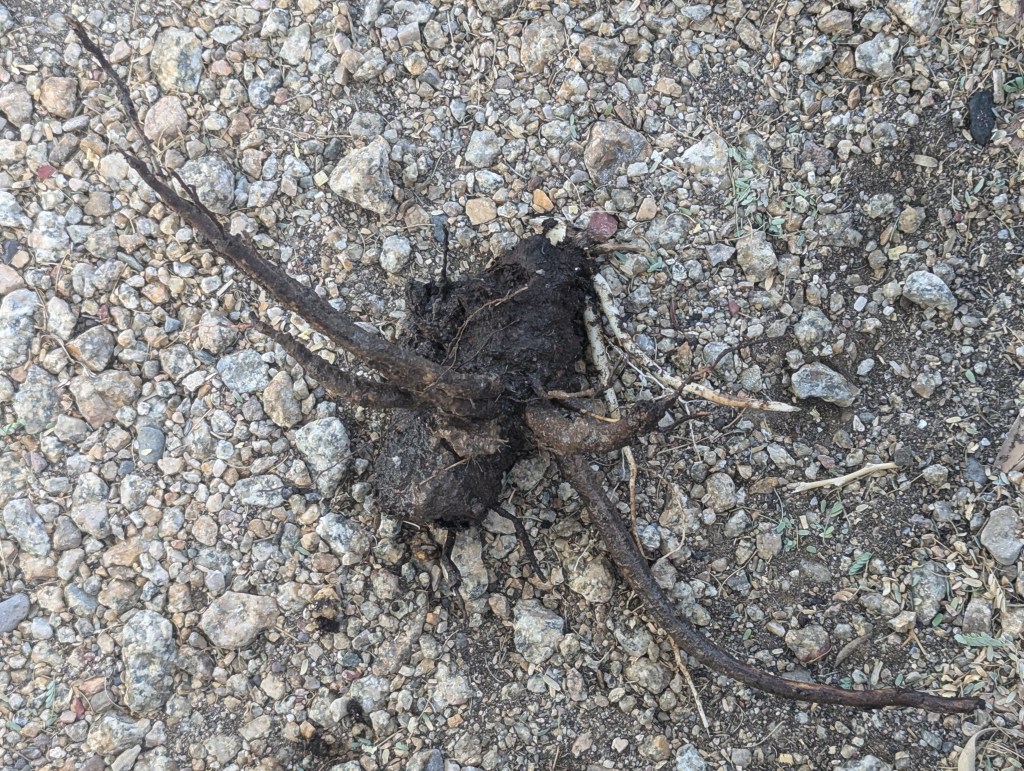
6. Rhody is a terrier. In other words, he is terrestrial. Instinctively, he wants to dig in the earth. His type was bred for pursuit of terrestrial vermin, such as gophers. They need no excuse to dig, of course. Furthermore, Rhody requires no justification for his technique.

This is the link for Six on Saturday, for anyone else who would like to participate: https://thepropagatorblog.wordpress.com/2017/09/18/six-on-saturday-a-participant-guide/

WWF

The World Wrestling Federation is now known as World Wrestling Entertainment because the World Wildlife Fund was already known as the WWF. The dude in the picture above could go either way. Apparently, he, or she, is some sort of aggressively invasive exotic bullfrog. Nonetheless, he or she still qualifies as wildlife, and now inhabits the drainage pond that is within a cultivated landscape that is adjacent to natural forest ecosystems. I mentioned his or her presence to a biologist who then informed me of how much damage this particular species can do to any natural ecosystem that it infests. I then realized that the tree frogs that had been so loud through spring had been silent all summer. Although they naturally get quiet by summer, they are not normally so completely silent. I am now concerned that the bullfrog might eat small fish who might inhabit the pond. Duckweed obscures activity below most of the surface of the pond. I would not mind if the bullfrog ate the duckweed. He or she probably does, but there is just too much of it. This species of bullfrog is omnivorous, so will eat anything that it can get its big mouth around, including mollusks and insects. That could be beneficial, but might also include beneficial insects. Actually though, I am more concerned about any baby fish than insects. Besides, when I met the insect in the picture below, I was actually somewhat concerned about the unwelcome bullfrog. I do not want his or her demise to be as violent as the appearance of this insect suggests it could be. I have no idea what this insect is, but it looks like it should have a Volkswagen hood ornament. Getting it together with the bullfrog could be an event for the WWF!

Banana Republic

Yes! We have more bananas! I can explain. Although there are as many as twenty cultivars of banana here, almost all are individual pups or tissue culture plugs. (Of these twenty, three are unidentified. Of these three, one is likely a redundant copy of one of the other cultivars, one seems to be completely necrotic without possibility of recovery, and only one is notably distinct.) All but a few arrived earlier this year, so have not yet generated pups. ‘Double Mahoi’ has doubled by generating a single pup. ‘Golden Rhino Horn’ arrived as a pair, and one of the pair is only now beginning to generate another pair of pups. Otherwise, there are no spare pups to share. The only spare pups of ‘Double Mahoi’ and ‘Golden Rhino Horn’ (the one which lacks new pups) may be leaving in the next few days. Whatever remains of these two will most certainly go to another colleague at the end of winter. Another colleague would like to add any spares, regardless of cultivar, to his garden. However, until just now, I could not help in that endeavor. The few in the picture above just arrived from Gilroy because they were in need of a new home. The pup to the far left is ‘Blue Java’, which is also known as ‘Ice Cream’, is redundant to a copy that is already here, so can be shared with a colleague. The others, which are sufficiently numerous for all of us to get copies, are unidentified, which merely means that if they produce fruit, it will be a surprise. Even if their fruit is not palatable, their foliage is good for forage and compost. For the colleague who would like to add any spares regardless of cultivar, they can live in a riparian area of his garden that is too steep, damp and shady for gardening. These pups may not look like much in the picture, but their corms are quite plump, so will provide an abundance of foliage after they get into the ground and the weather warms after winter. Soon afterward, they will generate more pups, but we can worry about that later.

Six on Saturday: Yoshino

Yoshino is such an elegant name! It is the middle name of one of my nieces. A few of the flowering cherry trees here are very likely cultivars of Yoshino flowering cherry. Another recently arrived. It is a Commemorative Tree from the Japanese Evangelical Missionary Society, which we know simply as ‘JEMS’, for three quarters of a century of involvement with Mount Hermon Christian Conference Center. Its cultivar name is ‘Akebono’. We do not install many trees here, and we are more concerned with cutting trees down, but this tree is very special. It is situated very prominently on the central Mall at Mount Hermon where its spring bloom will be spectacular. It already seems to be a venerable Historical Tree that lacks only age. Now that it is here, it will acquire that eventually.

1. The Japanese Evangelical Missionary Society, or JEMS commemorated three quarters of a century of involvement with Mount Hermon with this gift of a flowering cherry tree.

2. Unfortunately though, the pair of tiny flowering cherry trees that I installed to replace a very deteriorated and elderly pair of the same is already obsolete before it got to grow.

3. This pair of tiny flowering cherry trees grew from suckers from the original ungrafted pair, so are genetically identical, and are installed within the stumps of the original pair.

4. The new Commemorative Flowering Cherry Tree is much more prominent and better situated than the original pair, which was there prior to some of the adjacent pavement.

5. In other news, seedpods from (Hespero)Yucca whipplei, chaparral yucca, supposedly without its specialized pollinator, generated quite a few of what seems to be viable seed.

6. Also, Hedychium gardnerianum, kahili ginger that bloomed prematurely for the first several days of August is blooming again and more appropriately for the end of summer.

This is the link for Six on Saturday, for anyone else who would like to participate: https://thepropagatorblog.wordpress.com/2017/09/18/six-on-saturday-a-participant-guide/

See Anemone II

Anemone (or Eriocapitella) hupehensis

Sniveling works! Perhaps I should say that it can potentially be effective, and is sometimes more effective than expected. I certainly do not want to make the impression that I recommend it. Nonetheless, and contrary to the typical ‘Horridculture’ theme for Wednesdays, I can not deny recent favorable developments that, although not direct results of my snivelling about my lack of a white Japanese anemone, Anemone (or Eriocapitella) hupehensis, two weeks ago, somehow seem to be relevant to it. Firstly, someone at work brought me a pair of copies of an unidentified cultivar of Japanese anemone that is described as being very similar to that which is already here, with slightly pinkish pale gray bloom. Although not the right color, it is the right species. I intend to grow both the new and the old, and even if they are indistinguishable from each other, will continue to grow both because of their different but important origins. Secondly, a new landscape at a new home in the neighborhood includes several specimens of the most enviable and splendidly white ‘Honorine Jobert’ Japanese anemone! Those installing the landscape are completely unaware of the significance, and, as might be expected from such ‘landscapers’, actually told me that these Japanese anemones are the native bush anemone, Carpenteria californica. Why argue? I now know where I can get copies of ‘Honorine Jobert’ Japanese anemone after it has grown through next year. The other horticulturist here is acquainted with those who will live at the new home seasonally, so will have no problem procuring copies for me. As I intended to do with all of the now overly abundant canna and bearded iris, I plan to limit the number of cultivars of Japanese anemone to the original that was already here, the recent gift that might be the same as the original, and the ‘Honorine Jobert’ that I have yet to acquire.

Mars & Venus

It is much too early to distinguish gender of these carob seedlings.

Phoenix dactylifera, common date palm supposedly became more popular than Phoenix canariensis, Canary Island date palm during the 1990s for two primary reasons. Firstly, it is less susceptible to pink rot that was killing so many Canary Island date palms at that time, and continues to do so. Secondly, mature specimens became so readily available as their orchards were being displaced by urban development, particularly around Las Vegas and Palm Springs. Of course, fruiting date palms would have been too messy for the urban landscapes that they were recycled into. So, to prevent such mess, only female trees were recycled for such landscapes. Without their male pollinators, they are fruitless. Female trees are generally shorter, more lushly foliated, and therefore more appropriate to refined landscapes anyway. Besides, all but between one and five percent of trees in date orchards are female. Male trees were not completely wasted though. Although not as lush, they are taller and statelier, so were recycled to landscape remote desert highway interchanges, where their pollen does not reach female date palms that now inhabit more urban landscapes. It all works out well, although contrary to the original purpose of the date palms involved. It would seem silly to separate genders of most familiar dioecious species, such as kiwifruits and hollies. However, only female carob trees are available from nurseries nowadays because they would be messy with pollination, and also because male floral fragrance is horrid! Male carob trees are only available for agricultural purposes, or grow as feral males from seed. The problem that I will eventually encounter with my carob trees is that I grew them from seed, and will not know what their genders are until they are a few years old. I want a female specimen in a specific location, and a male pollinator in another specific location. I think that I will put three seedlings in each location, select one that matures to be the preferred gender for its particular location, and eliminate the other two. Alternatively, I could allow two genders to grow together in such a manner than the male grafts to the female to become a branch that I could prune to be a small but necessary portion of the collective canopy. Of course, there is a possibility that all within each group of three could be the wrong gender. I will not know until a few years from now.

Historic Bloom

‘Stuttgart’ Canna to the left and an unidentified tall Canna with red bloom and green foliage to the right

It is not as important as it sounds. Two varieties of Canna bloomed for the first time here during the past few weeks. They are important only to me because of their origins. With very few exceptions, such as the still elusive ‘San Jose’ bearded iris, I do not pursue rare or unusual species, varieties or cultivars. Actually, most of my favorites are quite common, and most that are rare here are common where they came from. I obtained some from places I have travelled to. Most were gifts from friends, neighbors and colleagues. The Canna to the left is ‘Stuttgart’ from Tangly Cottage Gardening. This is its second season here, but it did not bloom successfully before autumn chill last year. It is the second of three different Canna musifolia here. The first has moderately bronzed foliage. The third has simple green foliage. ‘Stuttgart’ has the most distinctive foliage that is variegated with variable white bands. All three bloom with similarly subdued and pastel orange flowers, but for this first bloom, ‘Stuttgart’ is blooming with a bit more peachy pink. The Canna to the right was a gift from a friend of a friend last winter. It is the third red Canna here, but the first is an unidentified compact cultivar that gets only about half as tall with garishly big flowers, and the second is ‘Australia’ with darkly bronzed foliage. This new unidentified cultivar is quite tall with simple green foliage, which is actually what I prefer for my own garden. (Although, I like the short cultivar also because it has been here longer than anyone can remember; and I like ‘Australia’ because everyone else likes the impressively darkly bronzed foliar color. Furthermore, I like the moderately bronzed Canna musifolia because it has also been here for a very long time; and I like the simple green Canna musifolia because it was a gift from a neighbor, and it is the biggest Canna here.)

Six on Saturday: Fire Season

Fire season can begin as early as May and continue as late as November. It is defined by the rainy season. It is a long season because the rainy season is not. Summer is naturally warm and arid. Native vegetation is consequently desiccated. It is no coincidence. Fire is unfortunately a natural component of the ecosystems here, and native vegetation knows it. Many exotic species also react to the meteorological influences that affect fire season. Some are from similar chaparral ecosystems. However, some are from other ecosystems that are likely less adapted to fire. Perhaps their native ecosystems are less relevant than associated meteorological influences, which is what they are actually reacting to. A forty percent chance of rain on Monday morning is the first chance of rain in a long time.

1. Sequoia sempervirens, coastal redwood is always messy and gets even messier when a breeze dislodges foliage which got desiccated by arid warmth. It is a bad combination.

2. Adiantum capillusveneris, maidenhair fern also reacted to arid warmth. In the wild, foliar desiccation through summer is normal. It is not so normal in irrigated landscapes.

3. Musa acuminata X balbisiana ‘Blue Java’ banana would enjoy sustained warmth with more humidity. While humidity is inadequate, wind more easily shreds its flimsy foliage.

4. Musa acuminata ‘Kokopo’ or ‘Patupi’ banana is more sheltered from breezes and more generously irrigated, so can exhibit guttation overnight and into the cool early morning.

5. Amaryllis belladonna, naked lady is generating seed as it typically does by now. Seed is very perishable, but grows in soil that is damp from the first rain that ends fire season.

6. Solidago rugosa ‘Fireworks’ goldenrod is only fiery by name. It was a gift from Tangly Cottage Gardening. It is the only bloom I will brag about today, and our first goldenrod!

This is the link for Six on Saturday, for anyone else who would like to participate: https://thepropagatorblog.wordpress.com/2017/09/18/six-on-saturday-a-participant-guide/

Horridculture – Profitable Waste

Surplus should be a useful resource.

There is nothing wrong with this picture yet. It simply shows African daisy as it begins to encroach into a row of lily of the Nile. Because it is already September, we will delay the pruning of the African daisy to maintain clearance from the lily of the Nile. Then, we can process the pruning debris into cuttings that we can plug into areas where we want more African daisy. These cuttings can grow slowly and disperse their roots through cool and rainy autumn and winter weather to be ready for next spring and summer. It is how a bit of something that is undesirable here can be desirable somewhere else. That is how the lily of the Nile arrived here. It needed to be removed from where it had migrated beyond its preferable confinement, so was relocated to become an asset to another landscape.

So called ‘gardeners’ would do this very differently; partly because, within their stringent schedules, they have no time to process cuttings or divide perennials, but partly because it is less profitable. They would be more likely to shear a neat edge for the African daisy whenever it happens to be convenient for them, and then efficiently dispose of all of the debris. If more African daisy is necessary elsewhere, they would purchase and install it, and charge their client accordingly. The lily of the Nile would probably not be here, since they would have likely disposed of it immediately after digging it from where it needed to be removed from. If any were desirable here, they would purchase it from a nursery and install it, and, of course, charge their client accordingly. Ultimately, their technique might not be much more expensive, but it is nonetheless wasteful, and frustrating to those who are aware of it.

Bloomless Hydrangea

This hedge of modern Hydrangea is completely devoid of bloom.

Modern cultivars of Hydrangea were not easy to adapt to. I learned how to prune old fashioned cultivars during their winter dormancy. I knew to retain the terminal buds of their retained canes to bloom for their following season. Pruning canes of modern cultivars back shorter and depriving them of their terminal buds in order to promote shrubbier growth seemed to be more like pruning roses. I did not trust them to bloom without their terminal buds. Not only do they bloom, but they do so a bit more abundantly, and with sturdier floral trusses that last and retain their floral color somewhat longer than those of old fashioned cultivars. Old fashioned cultivars have bloomed so reliably for the past few years that I am not so hesitant about pruning them back. However, this year, they inexplicably did not bloom. I do not mean that they bloomed sparsely, or that a few of the total did not bloom. I mean that none of the modern hydrangeas bloomed at all. The only hydrangeas that bloomed within the landscapes at work this year are the few remaining old fashioned sorts. All of the hydrangeas are healthy with vibrantly green foliage. Neither disease nor insect pathogens have been problematic. I can not explain this odd lack of bloom. With such vigorous canes, pruning should be easy this winter. However, I am more likely to leave awkwardly long canes in order to retain their terminal buds. Even if they are not necessary, terminal buds might provide an earlier prebloom prior to the bloom of stems that grow from lateral buds. I can not help but wonder why, while modern cultivars did not bloom, old fashioned cultivars did. A colony of unpruned feral Hydrangea near the bank of Zayante Creek was unusually prolific in bloom.

Unpruned feral Hydrangea bloomed unusually prolifically.