Sweet Spot

Saccharum officinarum ‘Pele’s Smoke’ sugarcane

‘Pele’s Smoke’ sugarcane has grown enough for installation into the landscapes. I am not certain how happy they will be here through winter, but we will find out. Frost is mild here, but is supposedly enough to kill them to the ground. I expect that. Even if they do not die to the ground, I would prefer to cut them down by the end of winter regardless. Survival of their basal growth is more of a concern. I want them to regenerate next spring. It is difficult to imagine a species as vigorous as this being so vulnerable to the locally mild frost, but all the information that I find about it insists that it is marginal here. There are so many canned specimens that it would be no problem to shelter some through winter to replace any that do not survive in the landscapes. Later, if they get depleted, it would be no problem to take cuttings from those in the landscapes in autumn, and shelter them through winter to put back into the landscapes in spring. However, that is just too much unnatural intervention for me. If they are not happy here, they I do not want to force them. I enjoyed growing them while I did. I got the cuttings from grooming a specimen in Brent’s garden. I was not very careful with them, and did not process them very efficiently because I knew that I would get more than I could accommodate. Ultimately, after sharing a few with friends and neighbors who are aware of the risks, thirty new specimens remain here. Fifteen are in #1 can, including the first three that were just installed into the landscapes. Another fifteen are in four inch pots, which is annoying one less than a full flat of sixteen.

Six on Saturday: Glad

Butterfly gladiolus will not bloom for a while. Abyssinian gladiolus may not bloom at all. Hybrid gladiolus, though, are already finishing. I got these few pictures while I can, and will likely get pictures of butterfly gladiolus as they bloom later. I am glad to do so. They are my favorite gladiolus. They are more like wildflowers than overly bred hybrids. Also, they are very reliably perennial. I hope that the Abyssinian gladiolus perform also. They are also supposedly reliably perennial, but are not in a very good situation here. I should relocate them, perhaps closer to where the butterfly gladiolus are so happy. The hybrids are earning my appreciation too. I was not aware that they had potential to be perennial.

1. Gladiolus papilio, butterfly gladiolus is my favorite, because it is from Tangly Cottage Gardening, is approved by Skooter, is reliably perennial, and it blooms like a wildflower.

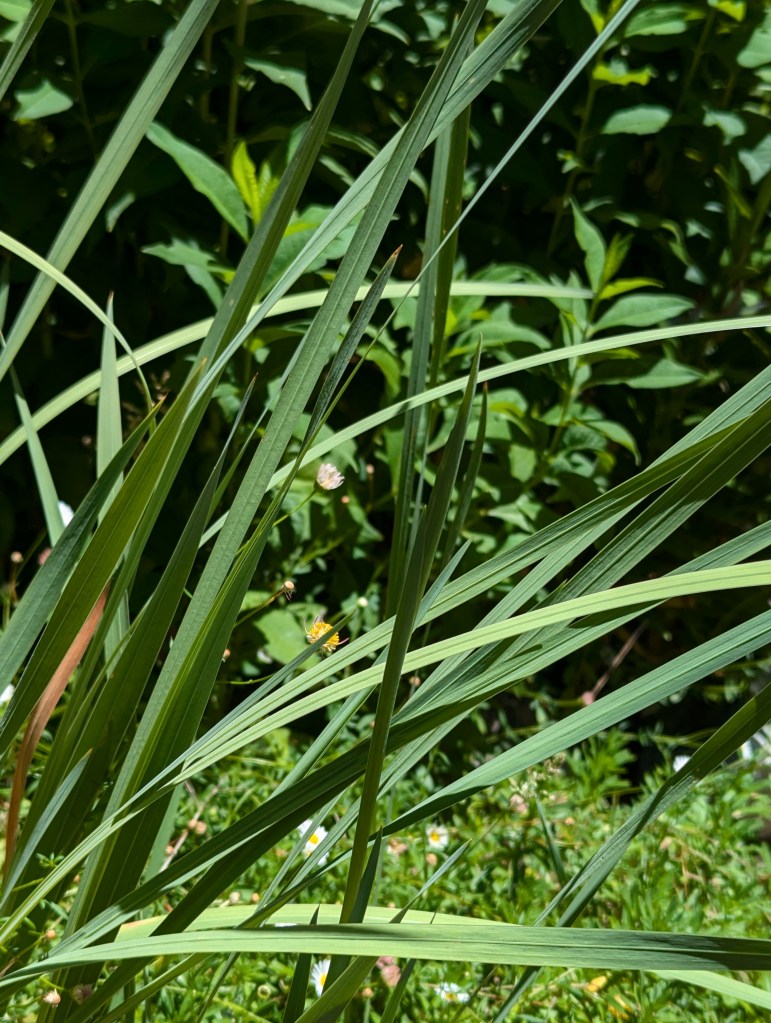
2. Its foliage is rather grassy, which is more compatible with other wildflowers than wide leaves of more garish hybrid gladiolus. The corms multiply and migrate quite efficiently.

3. Gladiolus murielae, Abyssinian gladiolus is my second favorite, even while it is not so much to see. It is a gift from a neighbor. It should bloom for autumn, but I have doubts.

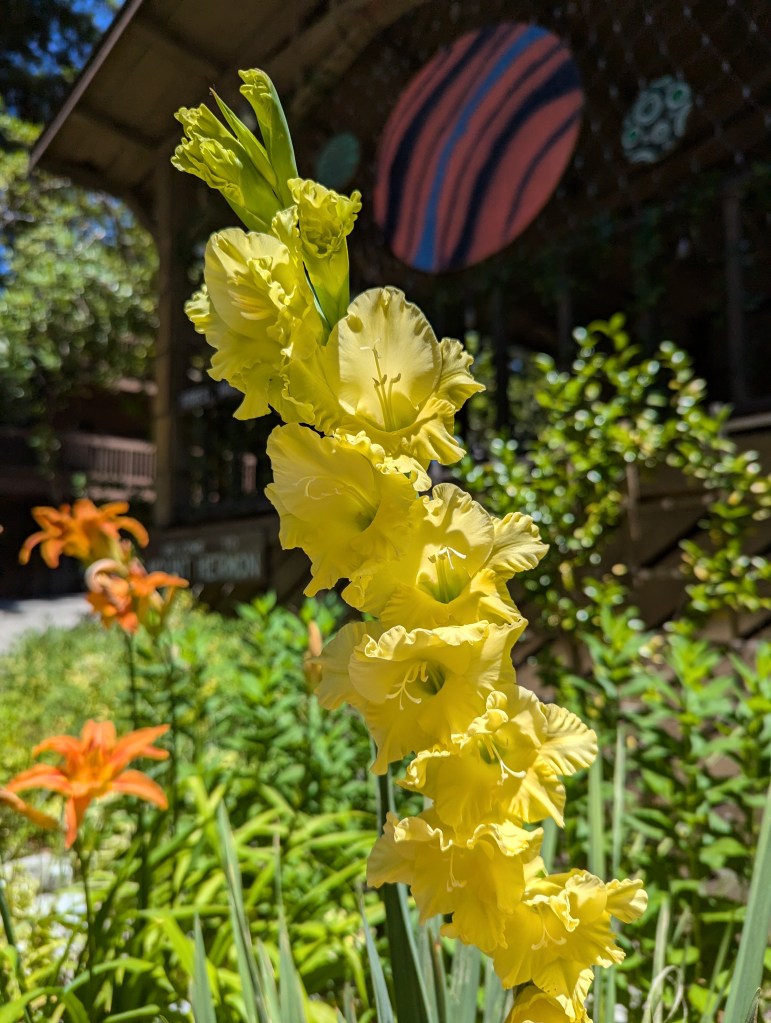
4. Hybrid gladiolus are the most colorful, but are not reliably perennial. However, these and two others have been blooming well here for several years, and actually multiplying.

5. This orange with yellow hybrid gladiolus was one of the first two to bloom again after a few years of producing only foliage. The yellow gladiolus joined them a few years later.

6. This purple hybrid gladiolus is the other of the first pair to resume bloom, although it does not multiply as much as the yellow gladiolus that resumed bloom a few years later.

This is the link for Six on Saturday, for anyone else who would like to participate: https://thepropagatorblog.wordpress.com/2017/09/18/six-on-saturday-a-participant-guide/
Not Ocotillo

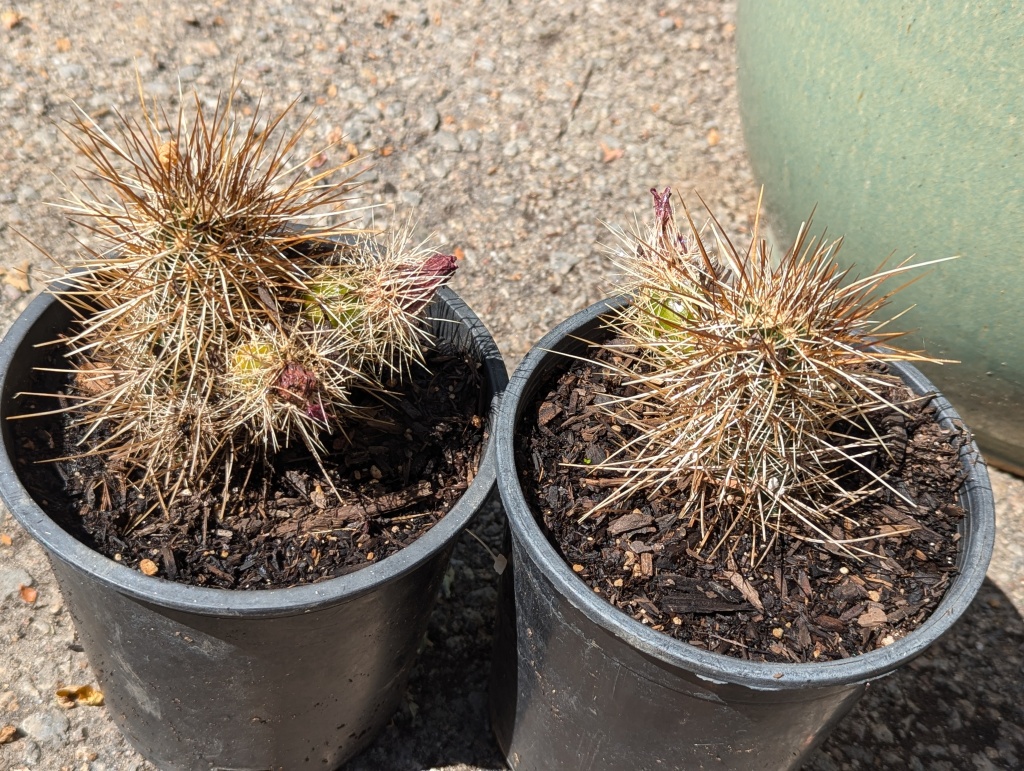
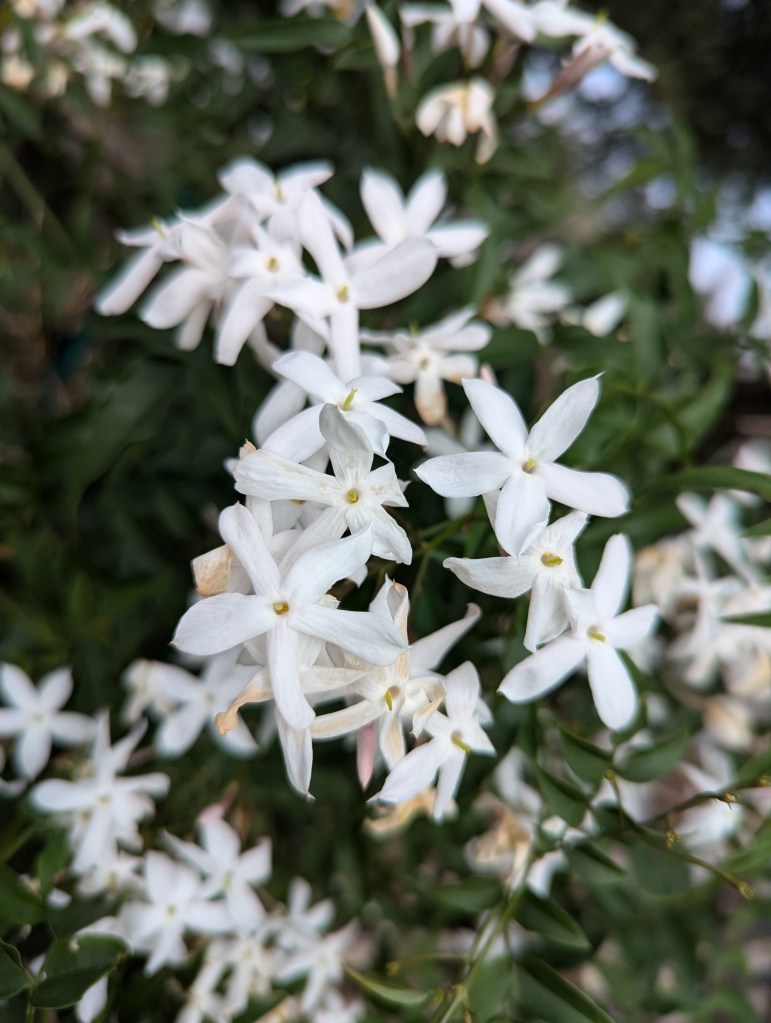
Echinocereus engelmannii, hedgehog cactus?

Ocotillo, Fouquieria splendens, was the species that I intended to procure as Rhody and I walked out and into the desert that surrounded the home we lodged at northwest of Phoenix at the end of last April. I had seen it from the roads on the way there. I should have stopped to procure cuttings or small specimens while I had the chance. Furthermore, I should have stopped for cuttings or small specimens as we left without procuring any earlier. It is a fascinating species that I am completely unfamiliar with.

Hedgehog cactus, Echinocereus engelmannii, is all I procured instead. At least I believe that it is this particular species. I really do not know for sure. A few species of the genus are native to the area. This species just happens to be the most common among them, and its description seems to conform to my observations of this specimen. Other species bloom with floral color that is different from that which I observed with a few remaining shriveled floral carcasses. Most other species exhibit different foliar patterns or textures with their spines. This particular species is distinctly more unappealing than the others, but I got it.

Now, I have no idea of what to do with it. First, I should probably wait to see if it survives. The bits that I got might have been a bit too fresh to root before they rot. I suppose that I should remove the developing fruit to divert resources to vegetative growth and root development. I thought that they would abscise naturally after bloom, in response to the distress of separation from the original specimen. I would prefer natural abscission to unnatural intervention. Pruning wounds from such intervention might promote rot while the cuttings are already vulnerable to rot from below.

Going Bananas! II

‘Double Mahoi’ banana pup with pups

‘Double Mahoi’ banana has been tediously slow. Although I now know why, I am disappointed with its development so far. After the primary pup that I split from the original last year got frosted over winter, I noticed that its central bud survived and was barely beginning to recover. Then, it stopped. I mean, it did nothing for several days or maybe more than a week, even though the weather was warming. Also, the foliage remained pale, as if it had just emerged. Because it was stagnating for so long as the weather was warming, at least one of its leaves got scalded in the middle. Then, because I gave it a bit too much soluble fertilizer, its leaves got bad tip burn. I suspected that it was up to something while seemingly inactive, but did not really know. Finally, the tip of its first pup appeared. Then another appeared, and then a few more! While still just a pup, it had an entire litter of eight pups, which is four times ‘Double Mahoi’, and I do not know if it is finished. Of course, eight pups sharing resources do not grow fast. Also, the tip burn continued as the pups initially emerged, which likely inhabited growth for a while. For now, I can only give them plenty of water, and refrain from giving them more fertilizer. They have good exposure, but I will move them under saran if the weather gets too warm for such small pups to be so exposed. I doubt that all eight pups will survive, but I would have been pleased with merely one. Of course, the one original pup will not survive the process of diverting its resources to its pups, but that is an acceptable consequence of getting a bit more than expected.

Original ‘Double Mahoi’ pup not much more than a month ago

Big Lemons

Ungrafted ‘Eureka’ lemon

All but two of the forty or so cultivars of citrus that I grew in the early 1990s were grafted onto the same dwarfing shaddock rootstock. Only ‘Meyer’ lemon and ‘Seville’ sour orange were not grafted, or ‘on their own roots’. ‘Meyer’ lemon naturally stays compact enough to not need a dwarfing rootstock. it was our most popular cultivar. ‘Seville’ sour orange supposedly grows about as large as the various dwarfed sweet orange with or without a dwarfing rootstock, as if the rootstock does nothing to limit its ultimate size. It was our least popular cultivar.

‘Eureka’ lemon, ‘Lisbon’ lemon and ‘Sanguinelli’ blood orange grow larger than any of the other grafted dwarf citrus that we grew. ‘Eureka’ lemon is actually a variant cultivar of ‘Lisbon’ that produces fruit throughout the year, which is a desirable attribute within home gardens. ‘Lisbon’ lemon may seem to be a bit more productive, but only because it produces all of its fruit within a more defined season, which can be a desirable attribute for orchard production. Otherwise, ‘Eureka’ and ‘Lisbon’ lemons are indistinguishable from each other, and grow quite tall. ‘Sanguinelli’ blood orange grows about as large, with a nearly identical upright form, but with a softer foliar texture.

Without dwarfing understock, ungrafted ‘Eureka’ and ‘Lisbon’ lemon trees can grow as big as small shade trees, and produce more fruit than they can support against gravity. Their broken limbs are a horridly thorny mess to clean up. ‘Sanguinelli’ blood orange trees can grow about as large, although they support the weight of their fruit more efficiently, and any debris that they generate, hopefully from pruning rather than breakage, is not so objectionable to handle.

So, I should have known better than to plug a bunch of ‘Eureka’ lemon cuttings. As cuttings, they lack dwarfing understock. I shared more than half with neighbors, who have been warned. About fourteen remain. One is more than enough.

Six on Saturday: Surprise

Surprise is a town northwest of Phoenix that I encountered between late April and early May. These six are different sorts of horticultural surprises which I encountered at work.

1. Platycerium bifurcatum, common staghorn fern, Tillandsia usneoides, Spanish moss and two other unidentified species of Tillandsia combined for a surprisingly compelling epiphytic platter. The staghorn fern is from Brent’s garden. The Spanish moss should be fuller as it grows. The two unidentified Tillandsia should be displaced as the fern grows.

2. Brugmansia X cubensis ‘Charles Grimaldi’ angel’s trumpet is no surprise. A picture of it posted here last Sunday. Its richer than typical yellow floral color is a surprise though. It is also from Brent’s garden, and was from one of his projects years ago. Brugmansia X candida ‘Double White’ and Brugmansia suaveolens ‘Single White’ both bloom nearby.

3. Brugmansia, angel’s trumpet of an unidentified cultivar demonstrates why the yellow floral color of ‘Charle’s Grimaldi’ is so surprising. Both were about the same pale peachy color last year, with the same fragrance. I thought that they may be the same. Obviously, but actually surprisingly, they are not. I do not know what it is, but I know what it is not.

4. Persicaria amplexicaulis ‘Firetail’ arrived here with Persicaria bistorta ‘Superba’ and perhaps Persicaria affinis ‘Dimity’ from Tangly Cottage Gardening early last April. I can not distinguish the cultivars, which is why I do not know if they include ‘Dimity’. It was a surprise to see ‘Superba’ bloom immediately after relocation. ‘Firetail’ is a surprise now.

5. Mimulus guttatus, seep monkey flower is blooming with surprising abundance where the stream from Redwood Springs flows into the drainage pond. The location should not be a surprise since, as its common name implies, this species prefers damp situations. It is surprising only because I somehow neglected to observe so much bright yellow earlier.

6. Rosa, rose of an unidentified cultivar would not be so surprising if I were not aware of how it got here. Someone who does not work in the landscapes removed it from where it was obstructing access to one of his projects. I saw it in his pickup as he was about to discard it. I am surprised that it survived, blooms well and seems to be a hybrid tea rose.

This is the link for Six on Saturday, for anyone else who would like to participate: https://thepropagatorblog.wordpress.com/2017/09/18/six-on-saturday-a-participant-guide/
Victim of Gravity

Nature is messy.

What goes up must come down. This elderly and deteriorated Shreve oak may have taken more than a century to go up, and then suddenly came down within only a few seconds. Unfortunately, it was not at all graceful about doing so, as it landed on this unoccupied cabin and a nearby bay tree. The cabin can be repaired. The bay tree needed to be removed with the fallen Shreve oak. Nature is messy like that. Some might say that it is also inconsiderate. Regardless, it can be difficult to live and work with. Most of our landscapes are adjacent to natural ecosystems. All are dominated by big natural trees, including coastal redwood, which is the tallest species of tree in the World. Even if none of the big trees are directly within some of the landscapes, some of such trees are big enough to drop debris or limbs within landscapes that are significant distances away; or worse, they can fall into the landscapes. As much as we try to limit such risks, nature, besides being messy and potentially inconsiderate, is also generally unpredictable. However, one of only a few aspects of nature that is always reliably predictable is gravity.

Reveille

Angel’s trumpet, Brugmansia X cubensis ‘Charles Grimaldi’

Summer has been slow to arrive. Now, some flowers that have been waiting for a bit of warmth to bloom are ready to make up for lost time.

These angel’s trumpets are fortunately silent. Even prior to full bloom, so much bloom looks silly with such minimal foliage.This picture is a few days old; so they are in full bloom by now. More foliage will develop as the summer progresses.

This particular cultivar is the common ‘Charles Grimaldi’, with splendidly fragrant single yellow flowers. Two other cultivars are blooming nearby. One is somewhat less vigorous, with single white but perhaps less fragrant flowers. The other is more compact than ‘Charles Grimaldi’, with double white and comparably fragrant flowers.

All were grown from cuttings, and have potential to grow like weeds. Six more of the cultivar with double white flowers were added to another landscape nearby. Several of both cultivars with white flowers are developing in the nursery, and will need homes either in the landscapes or neighbors’ gardens by next year. Another cultivar in the nursery may bloom with mildly fragrant single pastel orange flowers in the next few days, but we will not know until it actually does so. We have not seen it bloom yet. It could actually be another copy of ‘Charles Grimaldi’.

Daylilies are beginning to bloom now also. Like angel’s trumpet, they seem to have been waiting a bit longer than they wanted to, so are ready to bloom simultaneously in atypical profusion. I hope that such profusion does not compromise subsequent bloom, since they continue to bloom throughout summer and until frost. Also like angel’s trumpet, daylilies are so easy to grow and propagate that there has been no incentive to acquire more cultivars than the three or so that are already here.

Six on Saturday: No Rhododendrons

Rhody’s rhodies were spectacular in bloom. This year, I refrained from posting too many pictures of them by posting none at all. I thought that I might get a few at the end of the season; but now find that the few that remain are either shabby or difficult to get a good picture of. There is plenty of other bloom though, even without exploitation of the warm season annuals. Now that daylilies are blooming, they will continue until autumn. Roses continue at least as late, but bloom in phases since most are partially shaded. All but one of these six species were recycled, although one was recycled by remaining where it was.

1. Daylily is not actually a lily. With all the bickering amongst botanists, its classification remains vague. This surplus from thinning a congested colony now borders the iris bed.

2. White climbing rose that was removed from the garden of a renovated cabin has been relocated to el Catedral de Santa Clara de Los Gatos, where merely white flowers bloom.

3. Rose lily that was plumply budded for Six on Saturday two weeks ago is now finishing. It recycled itself from a previous froufrou garden as the rose garden was installed over it.

4. Carpet rose was originally too close to a walkway, so was relocated to a wide roadside embankment. I am none too keen on carpet rose, but it is appropriate for its application.

5. Easter lily that was left from a wedding at el Catedral de Santa Clara de Los Gatos was added to the perennials across the road, but could have remained with the white flowers.

6. Unidentified hybrid tea rose, which had the color but not the form of ‘Double Delight’ before it began to fade, blooms in the rose garden, which was installed over the rose lily.

This is the link for Six on Saturday, for anyone else who would like to participate: https://thepropagatorblog.wordpress.com/2017/09/18/six-on-saturday-a-participant-guide/

Locusts!

the SWARM!

Well, not exactly locusts; although, until they were reclassified within the Order Mantodea, they were of the same Order Orthoptera as locusts. Nor are they affiliated with either honey locust, Gleditsia triacanthos that I wrote about for last Tuesday, or carob, Ceratonia siliqua that I wrote about for the previous Tuesday, and which is the sort of locust that sustained John the Baptist in the desert. These abundant critters are young mantises, which likely hatched shortly before posing for this picture that my niece took on her front porch. My niece had seen a slow moving adult mantis there last autumn, and guessed that it might have deposited eggs, and then later died in privacy. Fortunately, she enjoys all sorts of flora and fauna, and was not too disturbed by this scene, or by the mother last autumn, as even some who work outside might have been. In fact, to the contrary, she was pleased that their mother felt that her porch was safe enough for them to start their lives on. She knows that there are plenty of insects for them to eat within the vegetation that inhabits the landscape there, as well as in nearby landscapes. This many mantises will eventually disperse into the neighborhood to satisfy their voracious appetites as they grow. That is why mantis eggs are available for sale from some nurseries. They are beneficially predatory insects because they consume detrimental insects. Since their arrival, my niece did a bit of research on their sort, and found that some people actually raise certain rare varieties of mantises as pets. As weird as it seems, it is no weirder than pet tarantulas. Anyway, this picture was taken more than a week ago. These baby mantises are likely already growing fast and dispersing elsewhere into Los Angeles.