Six on Saturday: Autumn in the Redwoods

Autumn is not much to brag about here. Not only is the change of the weather mild, but foliar color is limited beyond synthetic landscapes. Redwoods are only a bit messier now because they did not shed as much as typical while summer weather remained atypically mild. Fireplaces at work get a bit more use, but only for ambience. A few autumn flowers bloom between summer flowers and winter flowers.

1. Sequoia sempervirens, coastal redwood is evergreen. Its foliage does not turn colorful for autumn. It certainly sheds though. It sheds mostly while the weather is warmest and driest through summer. However, without such weather, it sheds more as summer ends.

2. Firewood is too mixed for identification of all species that might be involved with this picture. It comes from the various trees that must be removed and pruned here. Because fires at work are more for ambience than heat, the quality of such wood is unimportant.

3. Anemone hupehensis var. japonica, Japanese anemone exhibits why I find ‘Honorine Jobert’ to be so appealing. This is the only anemone here, and it is ghastly pallid, neither pure white nor pinkish. It actually seems to be slightly grayish. Ick! I learned this species as simply Anemone japonica, but now learn that it is supposedly Eriocapitella japonica.

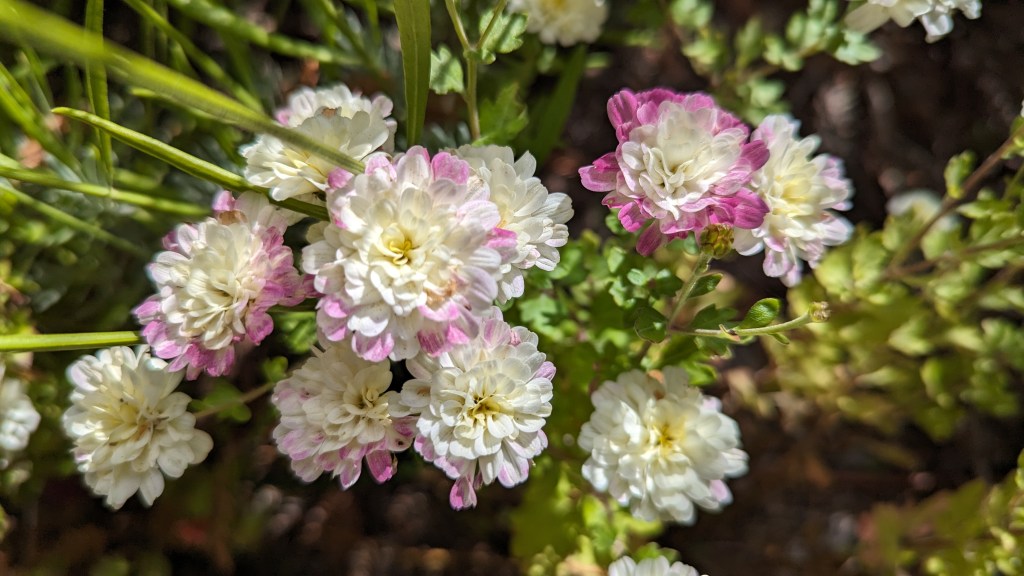
4. Chrysanthemum X morifolium, is more discolored than anemone, but is instead quite pretty. It was likely white when left here after a wedding. It now lives in a garden nearby.
5. Tagetes patula, marigold is as customary for autumn as chrysanthemum is. Its bright yellow and orange are splendid. This one though looks too much like Ronald McDonald.
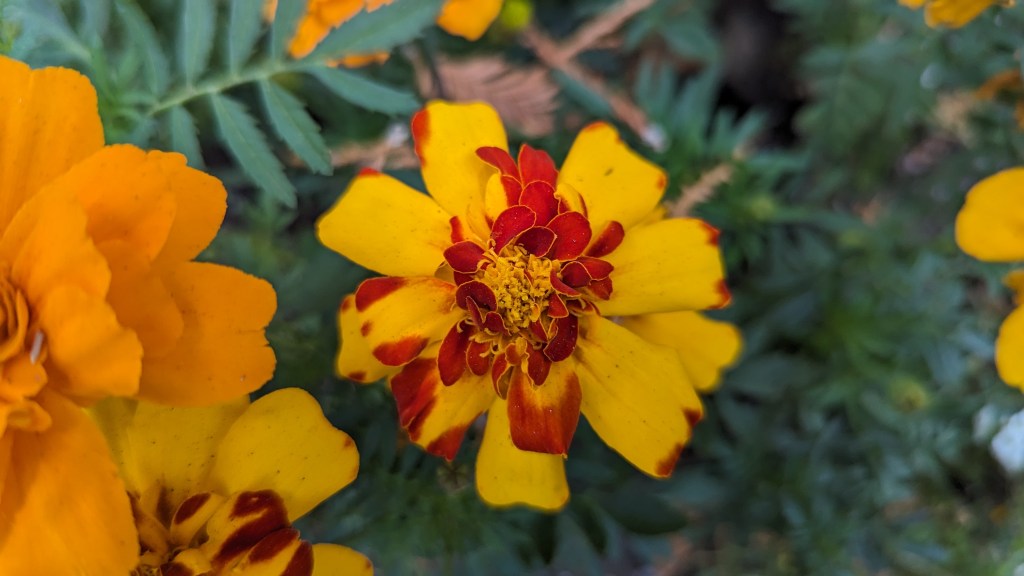
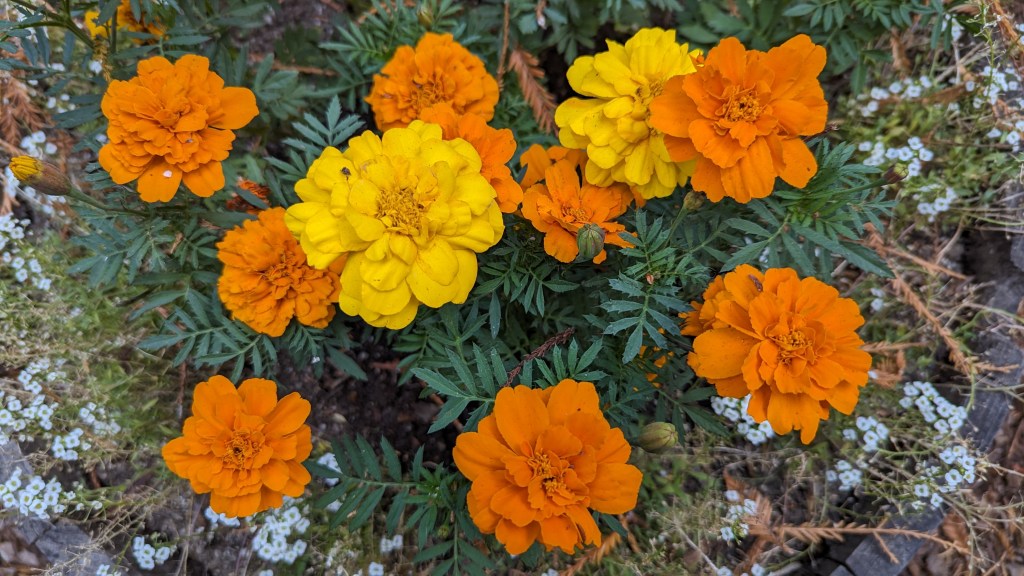
6. Tagetes patula, marigold should look more like these. Brownish red is traditional too. Marigold is the official flower of Dia de los Muertos of the first and second of November.
This is the link for Six on Saturday, for anyone else who would like to participate: https://thepropagatorblog.wordpress.com/2017/09/18/six-on-saturday-a-participant-guide/

Horridculture – Inappropriateness

Vines and annuals are not shrubbery and ground cover.

Vegetation within a planned landscape should serve a purpose. The form of such vegetation should be appropriate to such purpose. Trees provide shade. Shrubbery defines space and obscures undesirable scenery. Vines climb fences and other infrastructure. Annual bedding plants provide more seasonal color than most other vegetation. Turf grows into useful lawns. It is helpful to plan accordingly for a landscape.

Turf can not do much more than become useful lawn. It can not provide shade, obscure undesirable scenery, climb fences or provide more seasonal color than green. Nor can trees, shrubbery or vines become useful lawn. Again, each form of vegetation should be appropriate to its particular application.

Trellised rocktrumpet is not shrubbery. Rose periwinkle is not permanent ground cover.

There is so much other vegetation that would have been appropriate to this particular situation. Star jasmine, trailing lantana, trailing rosemary or even the dreaded English ivy would have been better and more permanent ground cover. Dwarf oleander, barberry, arborvitae or even dwarf New Zealand tea tree would have been better shrubbery.

Rose periwinkle is an annual bedding plant. Although it is somewhat pretty now, it will not likely survive through winter. Even if it does, it will not migrate far enough to reliably function as a ground cover.

Trellised rocktrumpet is a small but vigorous vine that will always be reliant on trellises for support. As its cheap trellises decay and deteriorate, it will eventually develop into shabby mounds of tangled vine stems, but will never be able to support itself as high as the new trellises are now. It can reach out to cover some of the ground that will be vacated by the rose periwinkle, but can not reliably function as a ground cover for this much area. It will bloom less if shorn for neatness.

V8

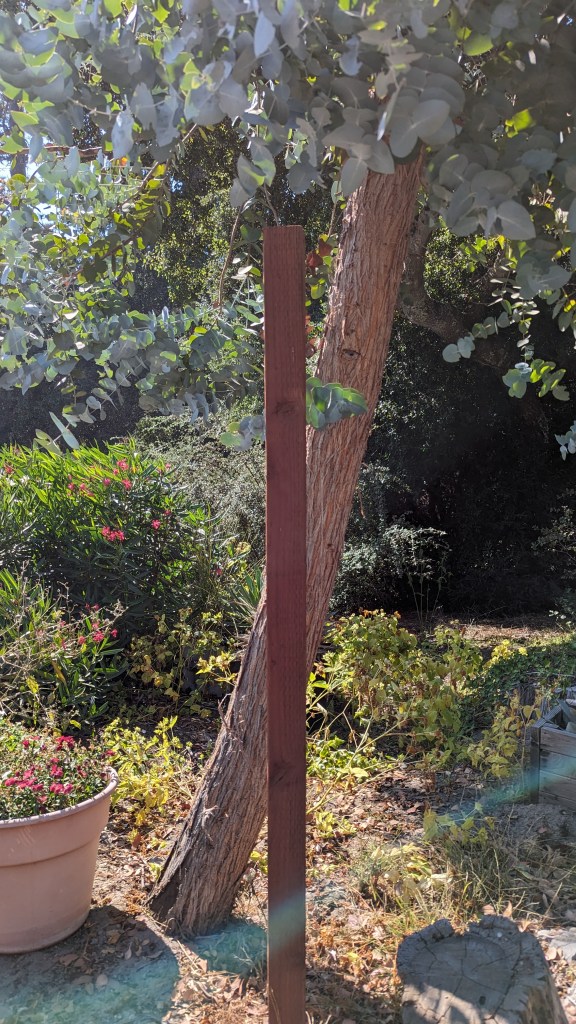
The vertical post demonstrates how much the tree trunk leans.

A few tree species should’ve had a V8. That includes more than a few individual trees. It applies to enough individuals of a species to indicate that the need is almost typical of the particular species.

The need for a V8 is derived from old advertisements for the V8 beverage that depicted those who were deficient in adequate consumption of V8 as leaning prominently. V8 is a juice beverage that is composed of juices of eight vegetables; tomatoes, carrots, celery, beets, parsley, lettuce, watercress and spinach. Hence, V8. It balances a diet so that those who consume it stand upright rather than lean.

In horticultural slang, the need for a V8 refers to a leaning trunk.

Any tree of any species has potential to develop a leaning trunk, and consequently appear to be in need of a V8. Some species innately develop leaning trunks though. No one seems to know why, but specimens of such species with vertical trunks are oddly uncommon or perhaps rare.

For example, so many ginkgo trees lean at such similar angles that, among some groups, their distinctive lean seems to be a normal characteristic of the species. It is variable though. Many individual trees that are isolated from others are quite vertical. So are some groups of street trees. However, many or most specimens of other groups of street trees lean at very similar angles, although in random directions.

Italian stone pines are more likely to lean, also at relatively similar angles, and also in random directions. Locally, vertical trunks are rare among this species. However, within their native range, vertical trunks are typical.

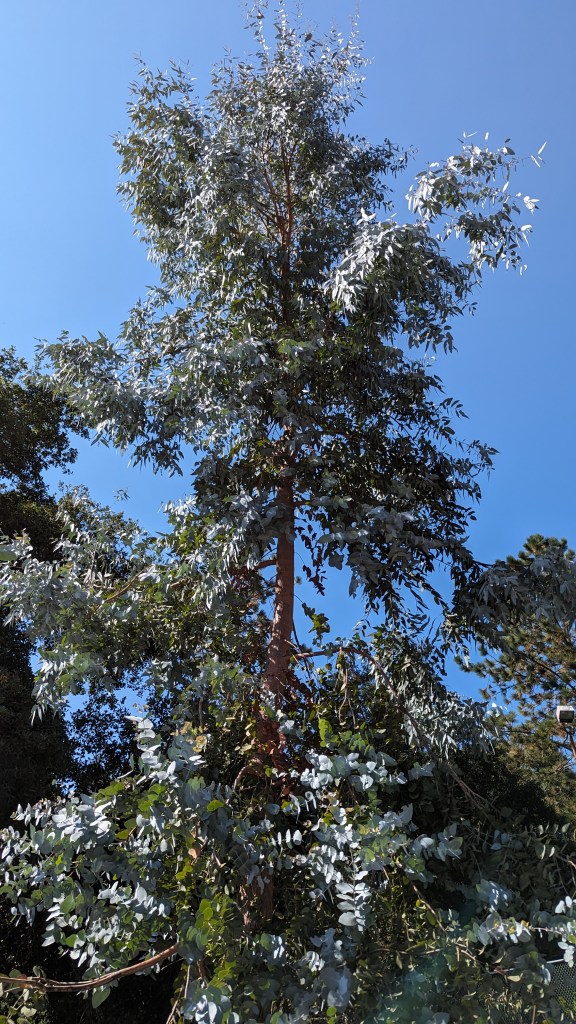
Argyle apple (eucalyptus) is almost comparable to Italian stone pine in regard to its typical need for a v8. I have seen a few with vertical trunks. I was determined for ours to be among them. I bound the trunk to keep it straight as it grew. I installed it with the trunk as vertical as the sign post next to it. When wind caused it to lean slightly while it was smaller than it is now, I pushed it back into position. Actually, I might have done that a few time. However, as it matured, it became more difficult to push back into position. Eventually, it refused to budge from its leaning position. Now, like most of the species, this specimen also seems to be in need of a V8.

After the base of the trunk insisted on leaning, the upper portion of the trunk assumed vertical posture.

What Is This?!

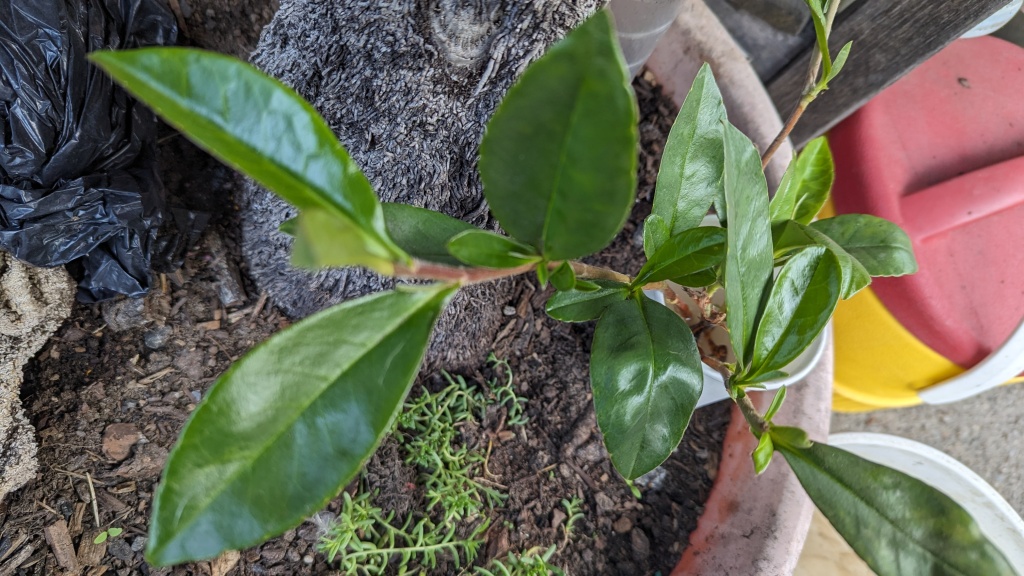
I have no idea what it is, but I intend to grow it.

It is an evergreen vine that seems to sprawl over other vegetation rather than actually climb it. It lacks tendrils or other means with which to hold onto its support. It does not even seem to wrap around its support. Nor does it seem to get very high above the ground. It just sort of sprawls.

Its glossy leaves are rather simple, just like in the picture here.

Its bright yellow and staminate flowers, if I remember correctly, seem to resemble those of Saint John’s wort, but are a bit wider.

This vine, again if I remember correctly, seemed to be more popular years ago. I do not notice it much anymore. I can not remember when I last saw it in a nursery, or if I ever saw it a nursery. The few specimens that I am aware of inhabit old landscapes that have not been renovated in decades. I got these bits from where they were regenerating after their earlier removal from an old landscape.

Now that I have these bits, I intend to grow them, in order to get familiar with the species. I hope that I can eventually identify it. It should not be so difficult for something that had formerly been popular, or at least common enough for me to recognize it as something that had formerly been familiar.

I do not often encounter a species that I can not identify, and I even more rarely admit to it. If I do not recognize a species, I can typically recognize the genus, or at least the family, and then key it out. For this seemingly simple vine, I can not identify its family. I asked Brent, which I almost never do. He recognized it about like I did, but also could not remember its name.

Six on Saturday: the Wrath of Grapes

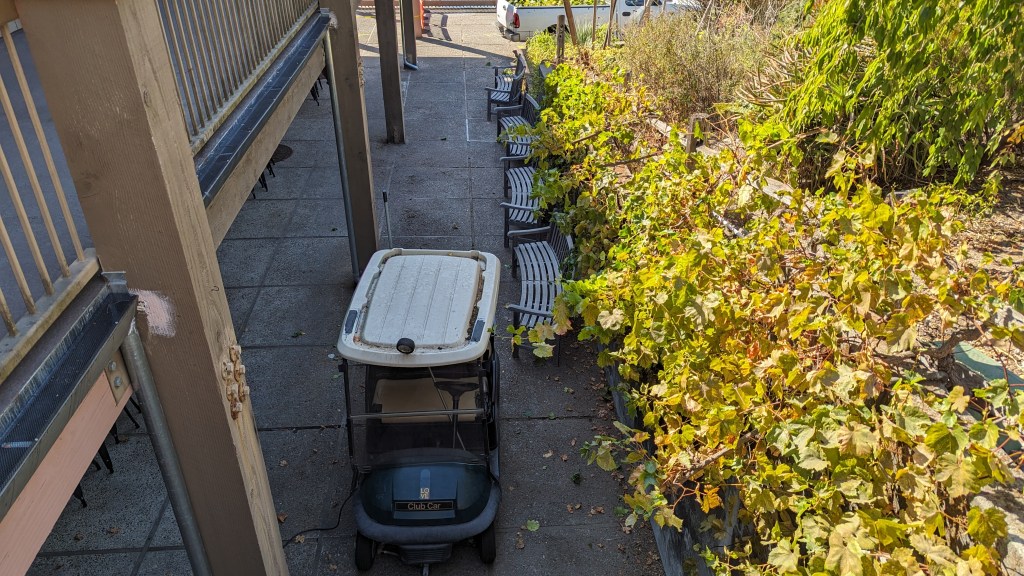
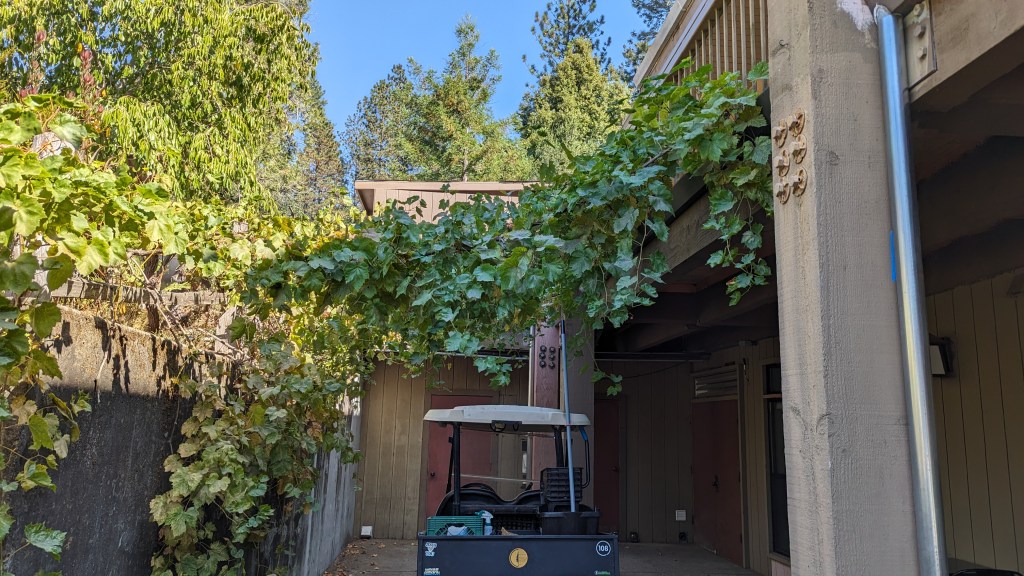
This was no easy project. I started pruning and maintaining this formerly neglected and very overgrown grapevine several years ago. It had been installed a few years earlier, but had never been pruned. Its first pruning may have generated two pickup loads of debris, as well as a dozen or so layers, which were shared with neighbors. I then trained its new growth to span horizontally over a lower deck, from a rail fence that it originally grew on to a parallel banister about twelve feet away. It was like a pergola without a pergola. The problem is that the banister needs to be painted. After training the grapevines for years, I needed to remove them.

1. It looks simpler than it was. Vines needed to grow long enough to reach from the fence to the banister. They then needed to be pulled across with a cord and tied onto balusters.

2. Between the fence and the banister, the vines required no support. They were pruned annually while dormant for winter, and groomed for summer, so did not get very heavy.

3. The vines sagged somewhat, but had plenty of space downstairs to do so. The banister to the left is horizontal. The fence to the right slopes downward away from this vantage.

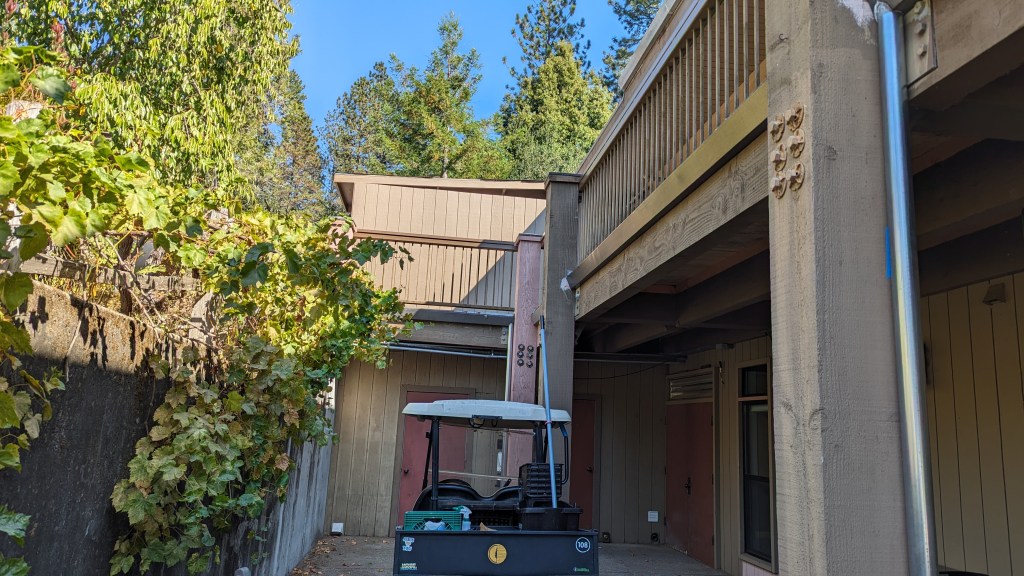
4. From the same vantage without the spanning vines, the scenery is now very different. Old vines will get pruned for neater confinement to the fence while dormant this winter.

5. The vines formerly shaded the pavement downstairs nicely. This area gets quite warm without shade during summer. That was partly why we wanted these vines to span here.

6. As severe as this pruning was, it will be a bit more severe while the vines are dormant this winter. Vines will not extend so far outward, and may not cascade downward either.

This is the link for Six on Saturday, for anyone else who would like to participate: https://thepropagatorblog.wordpress.com/2017/09/18/six-on-saturday-a-participant-guide/
Palm Reading

This is painful to look at.

Not everyone is interested in horticulture. Most enjoy other interests, such as sports, arts or cooking. They may know no more about horticulture than a garden enthusiast knows about the Seattle SeaMonkeys. Unfortunately though, some are not as aware of their lack of horticultural expertise as garden enthusiasts are aware of their lack of proficiency with other interests.

For example, I can grow just about any fruit or vegetable or perhaps grain that can grow here, but if I can not eat some of them fresh, I am aware that I do not know how to cook them. I must rely on someone who does know how. Yet, someone who is proficient with cooking is likely to believe that it is practical to grow fresh vegetables on a kitchen windowsill because it seems so easy on television gardening shows.

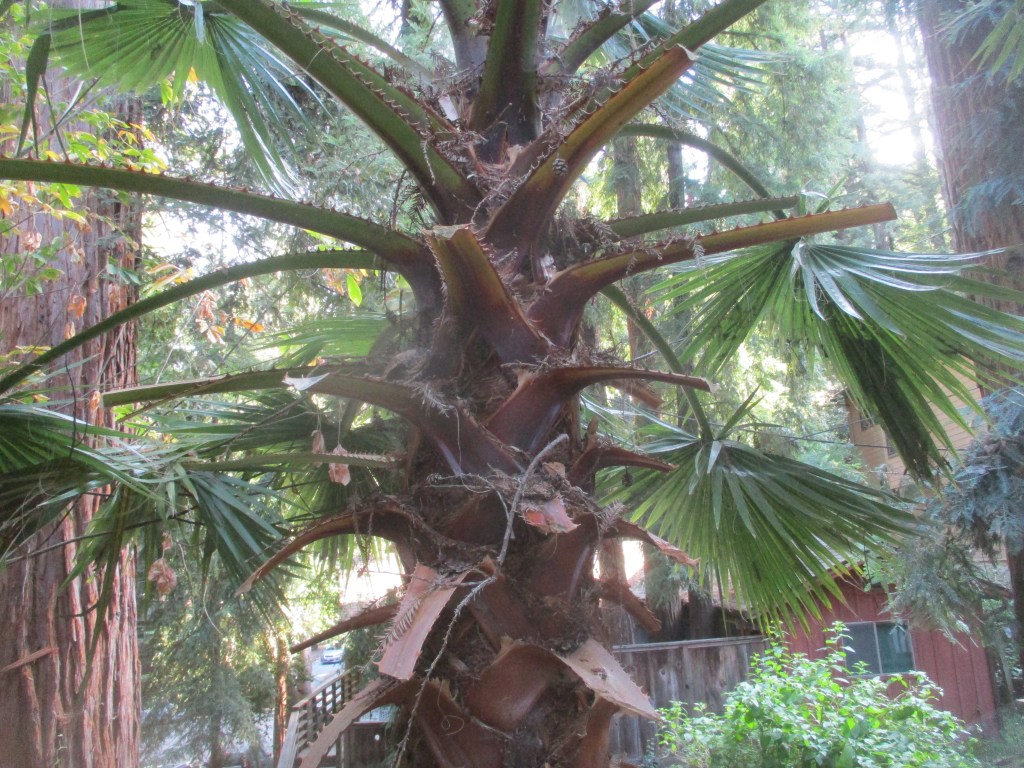
Someone I work with found this young Mexican fan palm to be bothersomely obtrusive to a confined situation within which he was working. He is, incidentally, a sports enthusiast. Naturally, as a sports enthusiast, he believed that he was qualified to groom the obtrusive fronds from the trunk of the Mexican fan palm. This was the result.

The necrotic but nonetheless harmless and relatively pliable foliage was removed to expose the wickedly sharp teeth of its rigid petioles, which extended outwardly in all directions from the trunk. This could have been quite dangerous for anyone who might have been so unfortunate as to bump into it. The thorns curve inward, to maximize damage to victims who pull back, which is, of course, the natural response to an encounter with such thorns. It was painful to merely look at! It seriously reminded me that I am no expert on sports or cooking. I pruned the petioles cleanly back to the main trunk.

2 / 3

This is the wimpiest of the sixteen survivors.

Sixteen of the twenty-four mixed dinnerplate dahlias that I did not expect favorable performance from have survived! Only eight have failed to exhibit any indication of viability. Two thirds are growing. Only one third is not.

I am impressed. I expected less than half to survive. They arrived in embarrassingly shabby condition. I canned all of them regardless, including several that were obviously completely necrotic. I wanted to give all a chance to survive before discarding any. Those that were obviously completely necrotic are among those that have not exhibited any indication of viability. However, I am not ready to discard any yet. Although I still believe that some are completely necrotic, a few others may not be. As I dump any that do not at least try to grow prior to winter, I will inspect their tubers for any indication of viability, no matter how minor.

The survivors will be pampered. I want them to generate as much vegetative growth prior to frost as possible. That should sustain the regeneration of their wimpy tubers so that they will be ready to grow next spring. I am aware that even the healthiest may not survive winter if their tubers are inadequate.

Those that survive through winter are likely to grow and bloom as if they were always healthy. In a few years, they could be ready for division. Perhaps after a few more years, I will regret the procurement of so many.

In this mild climate, it is not necessary to dig dahlia tubers for winter. We only do so because it has become a habit, and perhaps to relocate the dahlias.

Dinnerplate dahlias are certainly not my favorite type, but they are more appropriate to the landscapes that they will inhabit than they types that I would prefer.

This is the most vigorous of the sixteen survivors.

Six on Saturday: Naked or White or Dead

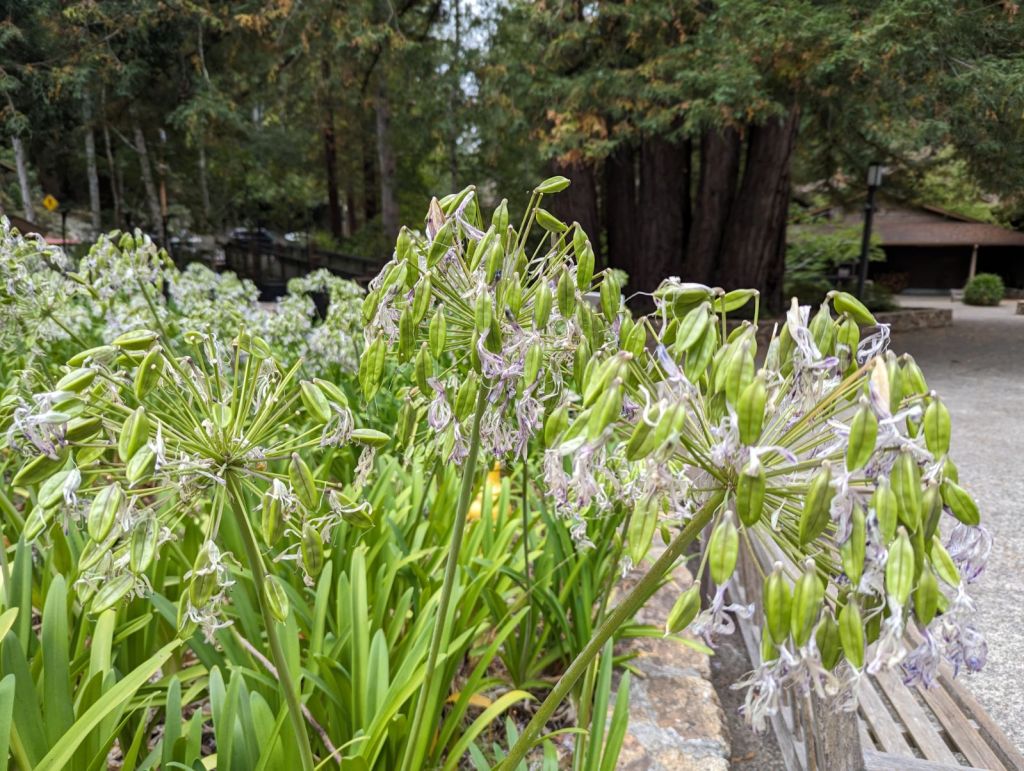
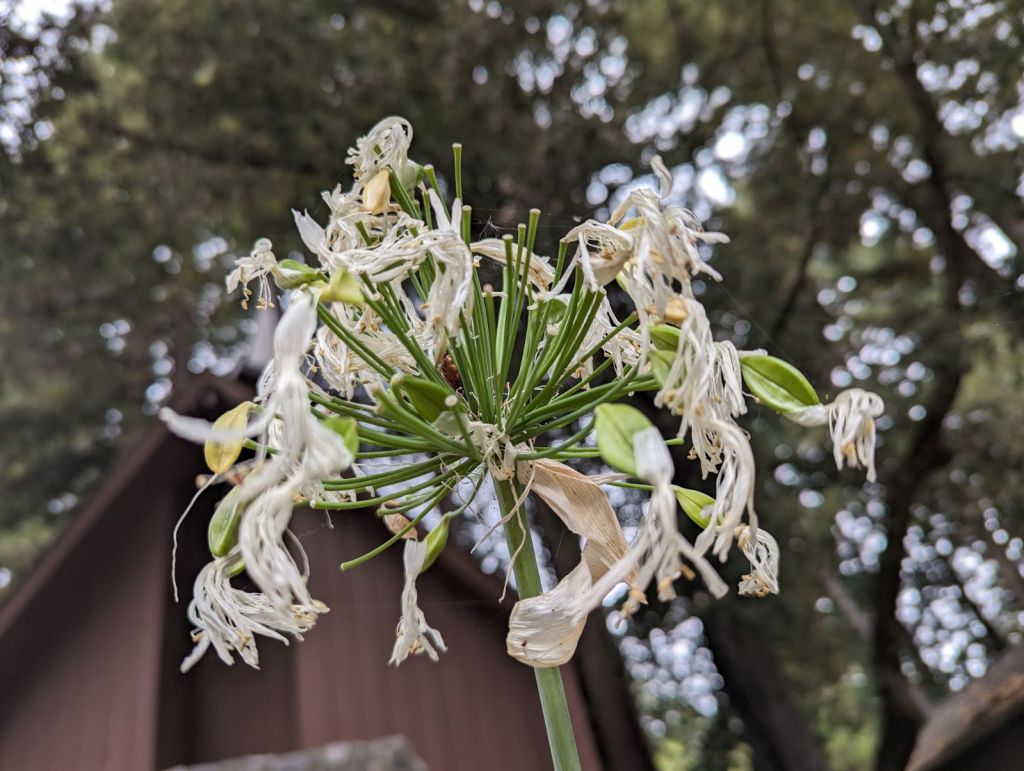
Three of these six are naked ladies, Amaryllis belladonna. Two of these six bloom white. Three of these six need deadheading. Three qualify as two categories. Two qualify as one category. One qualifies as none. None qualify as three. Alternatively, three are lily of the Nile, Agapanthus orientalis, two bloom blue, two bloom pink, and three do not yet need deadheading.

1. 1 – dead but neither naked nor white. Lily of the Nile, with few exceptions, is in need of deadheading at this time of year. All but one cloned colony here are mixed blue varieties.

2. 2 – white and dead but not naked. This deteriorating floral truss is one of merely three that bloomed within the one cloned colony of white lily of the Nile. This colony is young.

3. 0 – not naked, white or dead. This is the lowest score because bloom deteriorates a bit slower in the shade. Blue lily of the Nile could score no more than a single point anyway.

4. 2 – naked and dead but not white. This is the common naturalized naked lady here. It bloomed annoyingly bright pink, but is not the brightest pink. It should be deadheaded.

5. 1 – naked but neither white nor dead. This is a brighter pink naked lady that is not yet in need of deadheading because it blooms a bit later. It has slightly stouter brown stems.

6. 2 – naked and white but not dead. This is merely one of three highest scores, but is my favorite! I had wanted a white version for a long time. It seems to bloom late like #5, but blooms on a green stalk like #4. Its primary bulb already generated four pups, so will be relocated to a more prominent location to develop as a colony. It will not bloom much if split annually, but will multiply most efficiently by such technique. I want more of them!

This is the link for Six on Saturday, for anyone else who would like to participate: https://thepropagatorblog.wordpress.com/2017/09/18/six-on-saturday-a-participant-guide/
Early Rain

This could be a sequel to ‘Late Summer’ from yesterday. It happened shortly afterward. It certainly adds another interesting component to this already odd year of weather. Although not impossible, rain at this time of year is rare. Almost all of the rain here occurs between late autumn and early spring.

Weirdly, if rain does occur during summer, it typically does so around the fifteenth of August. Seriously, it is very prompt about that schedule. It typically either begins or ends on that same date.

The first flash of lightning of the storm that started the CZU Fire occurred at 11:59 p.m. on the night of the fifteenth of August of 2020, less than a minute prior to midnight. So, although the storm occurred during the early morning of the sixteenth, it technically began on the night of the fifteenth.

This brief rain shower was minimal, but by local standards, it was surprising. I sort of wanted it to continue long enough to dampen and contain the dust of summer. It might have done so briefly, but could not prevent the dust from becoming dusty again shortly afterward. The aroma of damp asphalt dissipated even before that happened. It was fun while it lasted.

Perhaps this rain shower will be the last of this unusually autumnish weather. Warm and dry summery weather typically resumes immediately after brief rain showers that happen during the middle of August. Technically, for a summer rain shower, it is only half a month late. So far, the forecast does not suggest that pattern, but it has been wrong before, even here. I doubt that there will be any more rain prior to autumn, even if cool autumnish weather resumes until then. But of course, I have been wrong more often than weather forecasts.

Late Summer

Such weather is early this year.

The change of seasons can be boring here. It might seem as if this climate experiences only two seasons. Summer is the primary season, which seems to extend through most of the year, with what seems to be merely a few days of another brief secondary season which is not summer. Perhaps this brief secondary season is autumn, winter and spring, but that is too many letters and big words for such a small season.

That is how those who are familiar with more distinct seasons might perceive seasons of this innately mild climate. Those of us who are familiar with this climate perceive it quite differently. We are aware of the four seasons, regardless of how mundane the transitions between them seem to be. In fact, some might contend that, if autumn seems to be minimal here, it is merely because this climate experiences a fifth season between summer and autumn, which is known as Indian summer.

Indian summer is an extension of summery weather into autumn, and sometimes occurs after summer seems to have begun to succumb to autumn. It does not happen annually, and does not seem to be happening this year, but certainly could. It is sneaky that way.

For now though, autumn seems to be sneaking into the last two weeks of summer, much like Indian summer sometimes sneaks into autumn. Nights have been interestingly cool. Low clouds have been lingering a bit longer after sunrise than they typically do.

However, vegetation that enjoys warmth does not seem to be decelerating for cooler weather. Perhaps such vegetation knows more than the rest of us do about what to expect. Perhaps it is merely more responsive to photoperiod than weather. Regardless, I get the impression that this is how late summer typically is within other climates.