Is Phlox A Weed?

Phlox seems to be right at home here now.

When it first appeared within one of the landscapes at work four years or so ago, I was not sure of its identity. I guessed that it was some sort of phlox only because it resembled phlox that I had seen in mail order catalogs many years earlier. No one knows where it came from or how it got there. Some sort of Campanula arrived within the same garden only a year or so earlier, and worked out nicely. Therefore, we decided to give what we thought was phlox the same chance to perform.

It performed splendidly! It matured rather quickly, and happened to fill a prominently bare spot. Its bloom is pure white and delightfully fragrant. After getting cut back for winter, it regenerated for spring.

Then, we started noticing that it had seeded while no one noticed. A few seedlings were appearing nearby. At first, we were pleased, but also concerned that it could become invasive. I pulled a few seedlings up from where I did not want them to grow, and was able to relocate them to better situations, but was not sure if I should have done so.

Fortunately, like the campanula, this new plox seemed to want to cooperate. After getting established, it did not seem to be invasive.

Now, it is one of my two favorite perennials within its particular landscape, along with Gladiolus papilio. I am confident that we can allow it to bloom fully without dispersing too many seed afterward. I am very fond of the strikingly bright white bloom and its rich fragrance. It would be great if more feral species developed as assets to their gardens instead of as weeds. I am pleased that we gave this phlox its chance to perform, and will likely relocate more to other landscapes.

Six on Saturday: A Series Of Unfortunate Events

Horticulture can be so challenging. Some challenges are very frustrating. Some are quite infuriating. Some of the worst would be likewise if they were not so weirdly silly. Really, plants naturally present certain innate challenges. So do their pathogens. People though, are special. Their behavior is not completely innate. They should know better than to do so much of what they do. So many of their mistakes are so creatively inane. Yet, some of the most egregiously silly are not even mistakes according to their personal perceptions. Goodness, merely attempting to explain these unfortunate events becomes challenging! Realistically, it is not as bad as it seems. I swatted lily of the Nile buds when I was a kid. The neighbor with the ‘machine’ is unaware of the naked ladies, and will remain as such.

1. Lagerstroemia indica, crepe myrtle is susceptible to powdery mildew. These new specimens of a modern cultivar are more resistant than most but apparently not enough.

2. Hydrangea macrophylla, bigleaf hydrangea changes floral color according to soil pH. However, white is always white. We relocated this white specimen to the White Garden.

3. Canna ‘Cleopatra’ is the strangest Canna here, with mixed red and yellow bloom, and mixed green and bronze foliage. Unfortunately, it shared its virus with the other Canna.

4. Agapanthus orientalis, lily of the Nile is a reliably resilient and neat perennial for the edges of walkways, where kids unfortunately enjoy swatting their floral buds with sticks.

5. Agave americana, century plant is so prolific with pups that they are sneaking out the drainage holes! We can them to give them away, but no one wants them. They are nasty!

6. Amaryllis belladonna, naked lady was about to bloom as profusely as it does annually when this was maneuvered into position, back and forth, back and forth, back and forth.

This is the link for Six on Saturday, for anyone else who would like to participate: https://thepropagatorblog.wordpress.com/2017/09/18/six-on-saturday-a-participant-guide/

Horridculture – Too Busy To Write

The little windmill palm is not so little anymore, and deserves a space in the garden.

It will be a while before I resume blogging as I formerly did, if I resume. I may just continue to share my gardening column here. The situation is too complicated to explain, and too irrelevant to bother with.

So, if I do resume, I hope to write more about my own home garden. I have been negligent in that regard for a few reasons. Firstly, my home garden is not very interesting. I am a nurseryman, so am in the habit of giving away anything in the garden as it becomes appealing. Secondly, my uninteresting home garden has been neglected for too long. I have been too busy with several other obligations that I still can not keep up with. Thirdly, the landscapes where I work part time are far more interesting than what I would grow in my own uninteresting and neglected home garden if it were not so uninteresting and neglected.

In the future, I hope to renovate my home garden and make it more interesting. Seriously, all those interesting species that I bring back but do not give away from Southern California, the Pacific Northwest and even the Phoenix region deserve a comfortable garden in which they can perform as they should. Seven cultivars of banana grow fast! It would be unhealthy for them to remain canned much longer.

Because I know nothing about landscape design, I do not know how to renovate my home garden, but can figure it out as I proceed, even if most of it is as simple and utilitarian as it had formerly been. Palms do not conform to a simply utilitarian garden, so do not leave me much choice about incorporating them as aesthetic elements. It should be fun. At least that is what I continually try to remind myself.

Oem

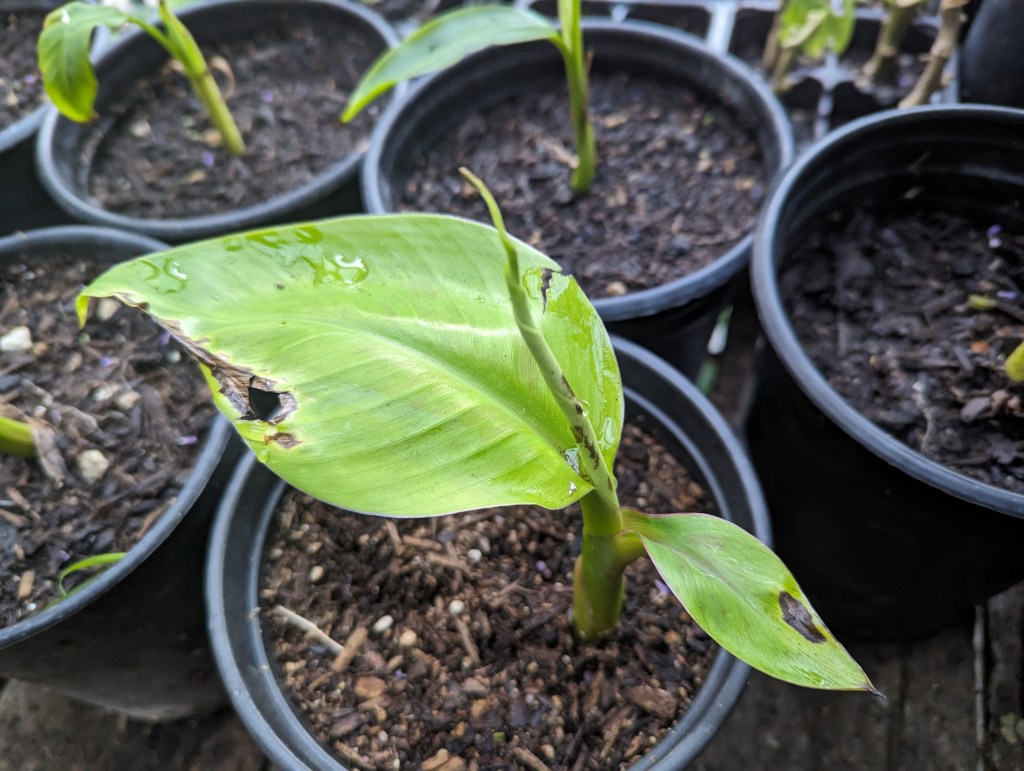
This picture is from my Six on Saturday post for this morning.

Its name is so minimalistic and blunt in the language of the indigenous people who are most familiar with it. Others might know it as the giant highland banana. It seems to me that most of us who find it to be of interest know it by its botanical name of Musa ingens.

Oem, or giant highland banana, or Musa ingens, is native to the tropical montane forests of New Guinea. Because it is endemic to high elevations, it does not perform so well in the sort of continually hot and humid tropical climates that most other species of banana enjoy. It actually prefers the weather to get somewhat cool at night. Therefore, it is more likely to be happier here than in Southern Florida, Hawaii or coastal San Diego County.

Not many horticultural enthusiasts grow it anyway. Actually, I do not know of anyone else who grows it. I have seen only a few comments online regarding germination of the very rare and expensive seed. Furthermore, no one seems to be successful with germination. This particular species does not generate pups as readily as other species of the genus, and even if it did, there are no established specimens from which to procure such pups.

However, its lack of popularity is less likely a result of its rarity and difficulty to propagate, but more likely because of its massive scale. In the wild, oem can grow to a hundred feet tall! It may be limited to about half as tall within cultivation, and without competition from other tall trees, but that is nonetheless a potential to get fifty feet tall! That may not seem like much relative to other trees, particularly the redwoods that are more than a hundred feet tall, with potential to get three times as tall. The concern is that banana trees are not actually trees. They are merely humongous perennials. Their pseudostems do not grow for very long before they begin to deteriorate and collapse. Pseudostems of smaller sorts may complete the process within two years, but are easily removed afterwards. Fifty foot tall pseudostems take significantly more time to mature and then deteriorate, but are not so easily removed from refined landscapes. Arborists can not climb them to cut them into sections. They require space to fall harmlessly. They are full of water, so are very heavy.

Now, oem lives here. It is merely a single dinky pup, but grows very efficiently. I have no idea of what to do with it. It can likely stay canned through this year, but may need to go into the ground next year. Not only does it need plenty of space, but it does not conform to the styles of any of the landscapes here. Consequently, it might eventually inhabit my home garden, regardless of its awkward appearance. This will likely get very interesting.

Six on Saturday: Those Lazy-Hazy-Crazy Days of Summer

Summer is a few days more than half finished. Weather remains noncompliant. Again, I should not get redundant by describing how last spring lingered, with only a few days of summery warm weather. Instead, I can now describe how the weather is beginning to be more like that of autumn. There is still time for some warm weather through September and perhaps even into October here. For now, we can simply appreciate the comfortably mild weather. During a typically warm summer, this is about when we begin to miss the rain. It might finish during March, and might not resume until November. The dew this morning looked almost like raindrops, but even a native Californian can distinguish dew from real rain.

1. Mornings start out atypically cool and damp. It is not exactly hazy. Nor is it uniformly foggy. It almost looks cloudy. It has been doing this for much of this oddly mild summer.

2. Friday morning was so damp that the dew resembled rain. It left spots on windshields of the work pickups, although such spots were not circular as if caused by real raindrops.

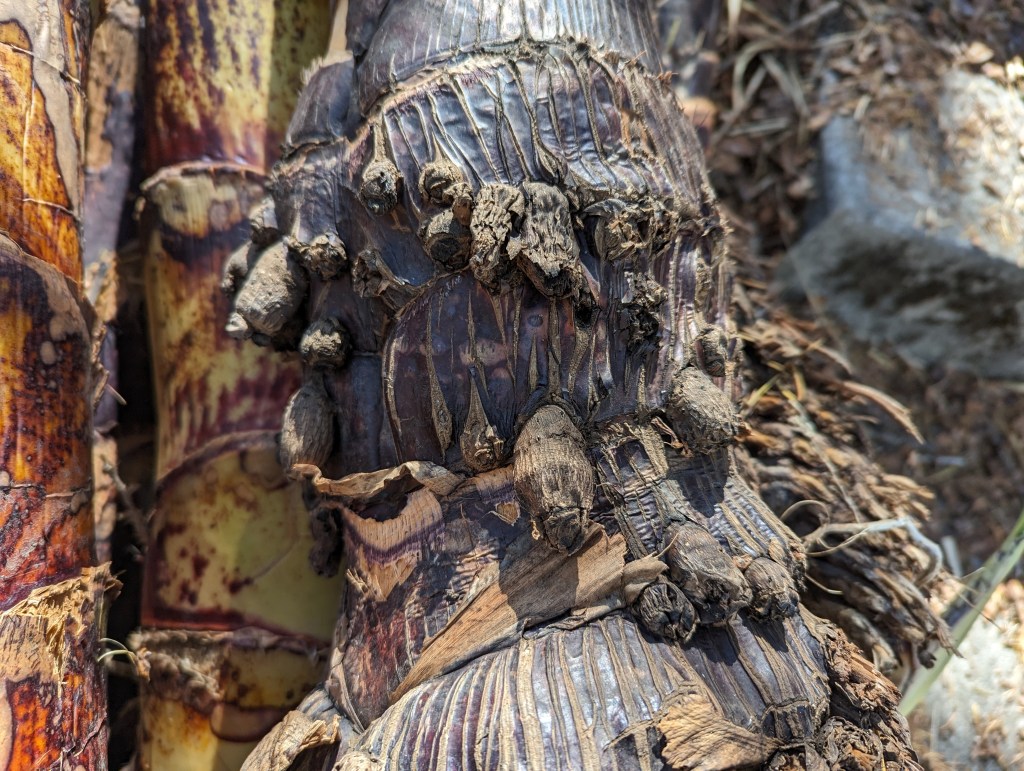
3. Banana trees and other species that appreciate warmth are growing unusually slowly. This happens to be the rare Musa ingens, which is the biggest banana tree in the World.

4. ‘Ponderosa’ lemon is slightly chlorotic, likely because of the lack of summer warmth. I should remove the fruit to redirect resources. One lemon can grow to weigh two pounds.

5. Giant reed is one of the most aggressively invasive exotic species within riparian zones of California. It does not seem so aggressive in cultivation here while the weather is cool.

6. ‘Proud Land’ rose bloomed nicely and nearly on schedule last spring, and continues to bloom, although somewhat reluctantly. I installed this now old specimen in about 1984.

This is the link for Six on Saturday, for anyone else who would like to participate: https://thepropagatorblog.wordpress.com/2017/09/18/six-on-saturday-a-participant-guide/

Horridculture – Deadhead (from last Wednesday)

At least the new growth is healthy.

Property management pays landscape service companies to maintain their landscapes for them. It is expensive. It is certainly fiscally adequate to justify the expectation that this sort of damage would not occur within the landscapes that property management pays landscape service companies to maintain. Now that it did occur, it should be remedied as efficiently as possible by the landscape service company that is justifiably expected to both prevent such damage, and remedy such damage if it occurs. This should not be a complicated concept.

Realistically, this is likely not as egregious as it seems to be. Automated irrigation was likely disabled through the rainy season last winter. It might have been enabled a bit too late into the dry season that began last spring. Hey, it happens. The upper stems of the subject succumbed to desiccation, likely as a result of warm and arid weather. Now that the automated irrigation has been restored, the subject is now attempting to recover from the damage by generating healthy and vigorous new growth relatively low within its canopy. Upper necrosis might remain only because the gardeners are prohibited by their insurance to perform any tasks above a particular height, even with a pole pruner instead of a ladder, and the necrosis is simply too high for them to engage. That task must instead, and perhaps more appropriately, be performed by an arborist. However, the arborist who typically maintains the trees at this particular property would need to charge an expensive minimal fee for this relatively minimal task. It would be more feasible to postpone the task until there is a need for more substantial arboricultural work. The arborist could remove necrosis from this subject within a few minutes, and without charging extra, while at the site to maintain many other larger trees.

Feline Ecology

No one can build a better mousetrap.

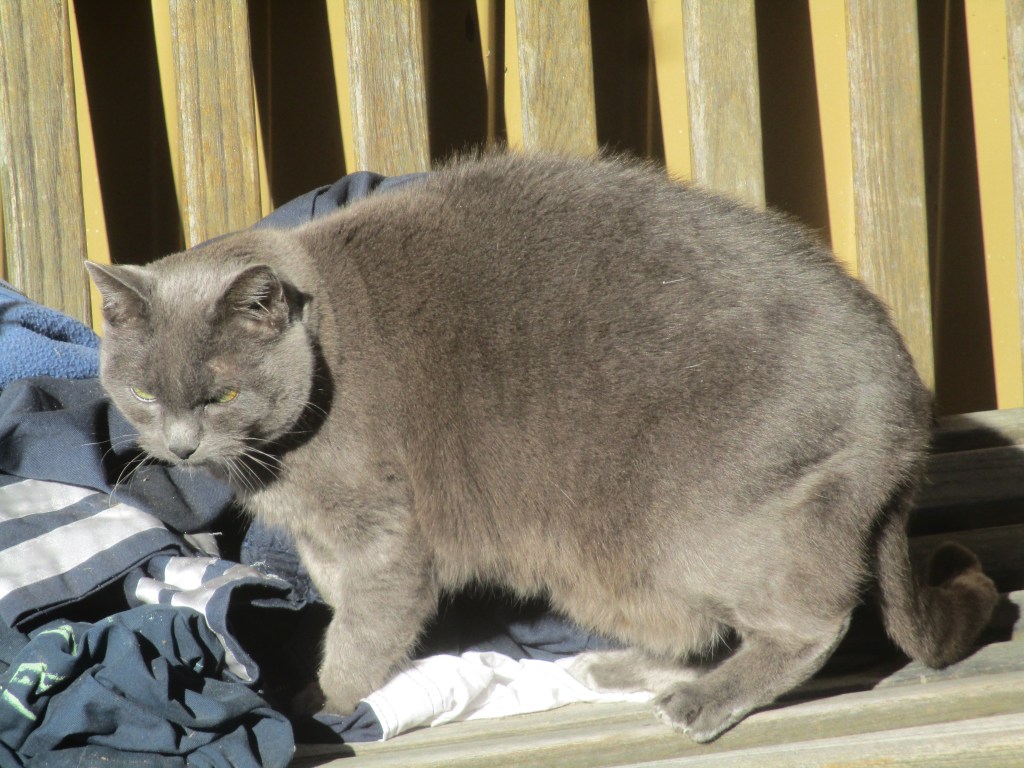
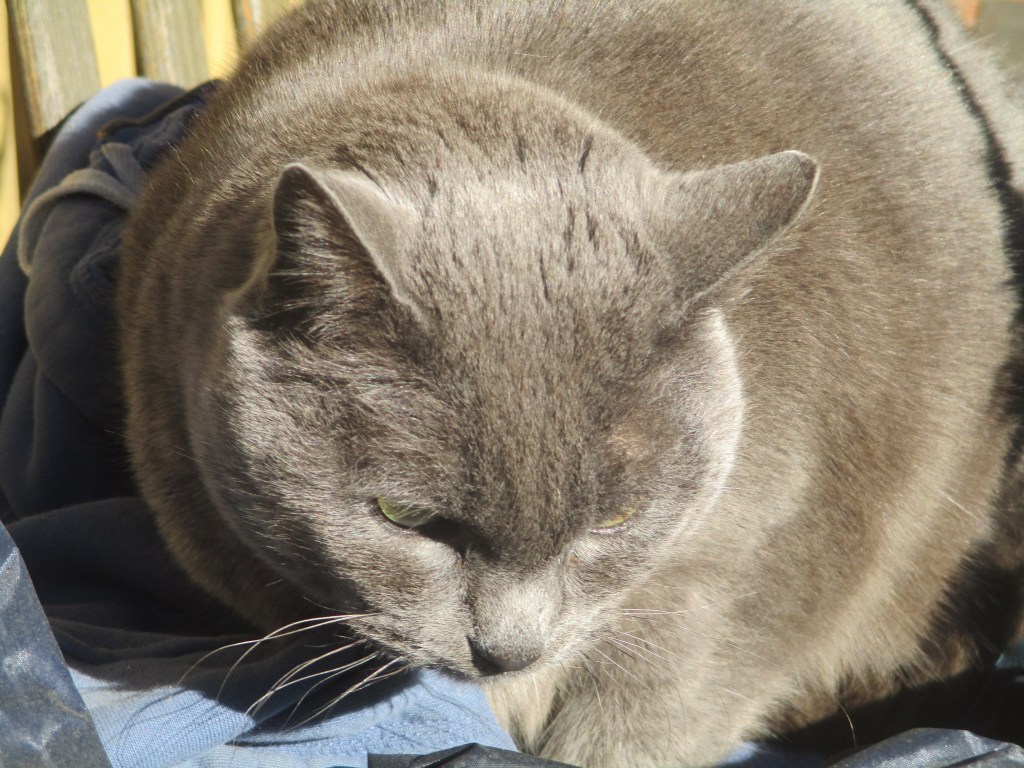
Darla is a feral kitty who used to live here. I believe that she is why no rodents lived here. I never actually saw her do anything to dissuade rodent infestation. Actually, I rarely saw her do anything. She was quite reclusive and disliked almost everyone except Rhody.

Unfortunately, someone else here insisted that fleas were a problem because of Darla. He also insisted that Darla came inside to share her fleas with the carpet and furniture. No one else, including Rhody, ever noticed a flea. Darla never came inside.

While the weather was getting nastier than it had since 1982 last winter, Darla went to live at a home in Santa Clara. After her initial disapproval, she efficiently adapted, and learned to appreciate it. Apparently, she is now happy with her more domestic lifestyle. She is quite elderly, so really deserves safer and more comfortable accommodations.

Rodents are everywhere now! Rats and mice come inside for any scraps of food that the crew leaves out. Ground squirrels have burrowed into much of the exposed soil downstairs. They as well as the rabbits and perhaps tree squirrels eat some of the plant material that is stored in the yard until it goes into the landscapes. The ground squirrels are already digging after the soft buds of the pups my giant bird of Paradise that were heeled in only yesterday! I need to put blood or bone meal out there in an attempt to repel them. I had not considered how horticulturally beneficial a kitty could be.

Of course, with so many rodents here, the fleas have also become a major annoyance, particularly for Rhody!

Now, others at work want me to hire another feral kitty. I do not know how to take care of a kitty, especially a feral kitty!

While the cat is away, the mice and all the other rodents will play.

New York Times

(This article is copied from my other discontinued blog at Felton League. It is not about horticulture, but links to another article about hedges, and features Brent’s garden.)

This is why I have never stayed at Hotel del Flores.

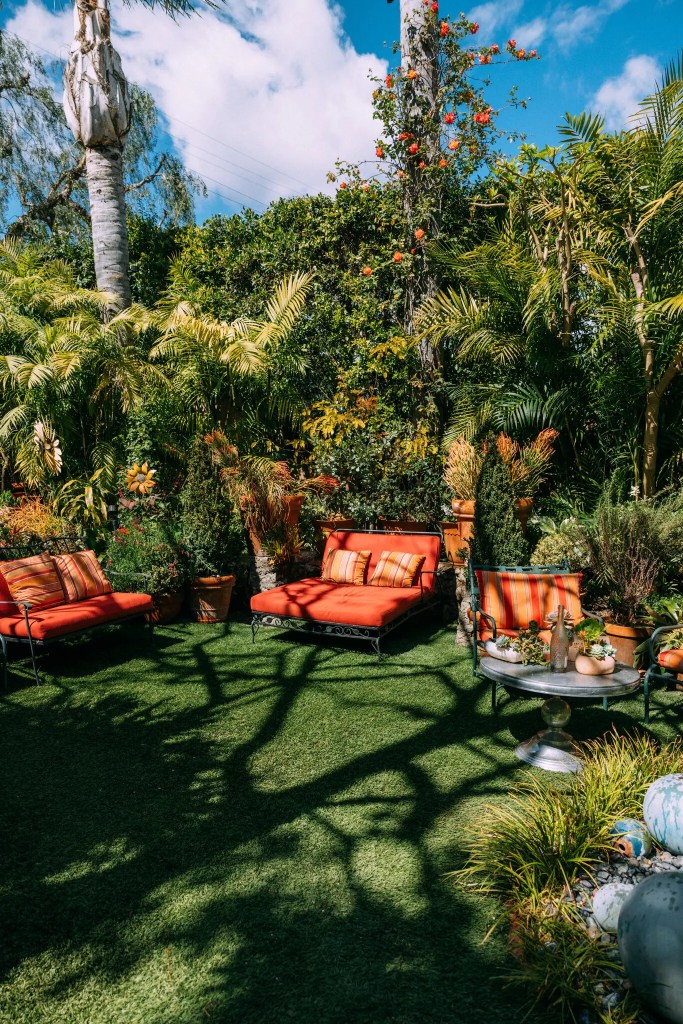
The New York Times featured a picture of my homeless camp! It is the third illustration of this article about landscape hedges. It shows where I camp while in Southern California, including the orange garden daybed where I sleep, and, as the primary topic suggests, a portion of the surrounding hedges.

This illustration should demonstrate why I enjoy being homeless in Southern California. It is quite luxurious. The weather is exemplary for camping. I wake amongst lush tropical foliage and palms, to the gentle sounds of small fountains and wild parrots. It is about as excellent as camping within one of my gardens, but very different, and special because I do it for less than three cumulative weeks annually. For many years, I have been wanting to stay at the famously eccentric Hotel del Flores nearby, but will not do so without inhospitable weather to dissuade homelessness.

Seeing this particular illustration reminds me of why this Felton League blog has been discontinued. For quite a while, there has not been much to write about that would not be intrusive to those involved. Societal difficulties as well as personal difficulties within society certainly remain, but are not as prominent as they had been. My own experience with faux homelessness, albeit within another Community, is strangely appropriate as an illustration for an unrelated article within the New York Times.

Most of those who experienced unemployment, poverty, homelessness or related difficulties here in the past are now enjoying major improvements to their personal situations. Many of those who are not yet benefiting from such improvements appreciate support from this graciously compassionate and generous Community. This has always been a good place to be in a bad situation. Perhaps, now that I no longer blog here, I should write a book about my experiences.

Six on Saturday: Welcome to the Jungle

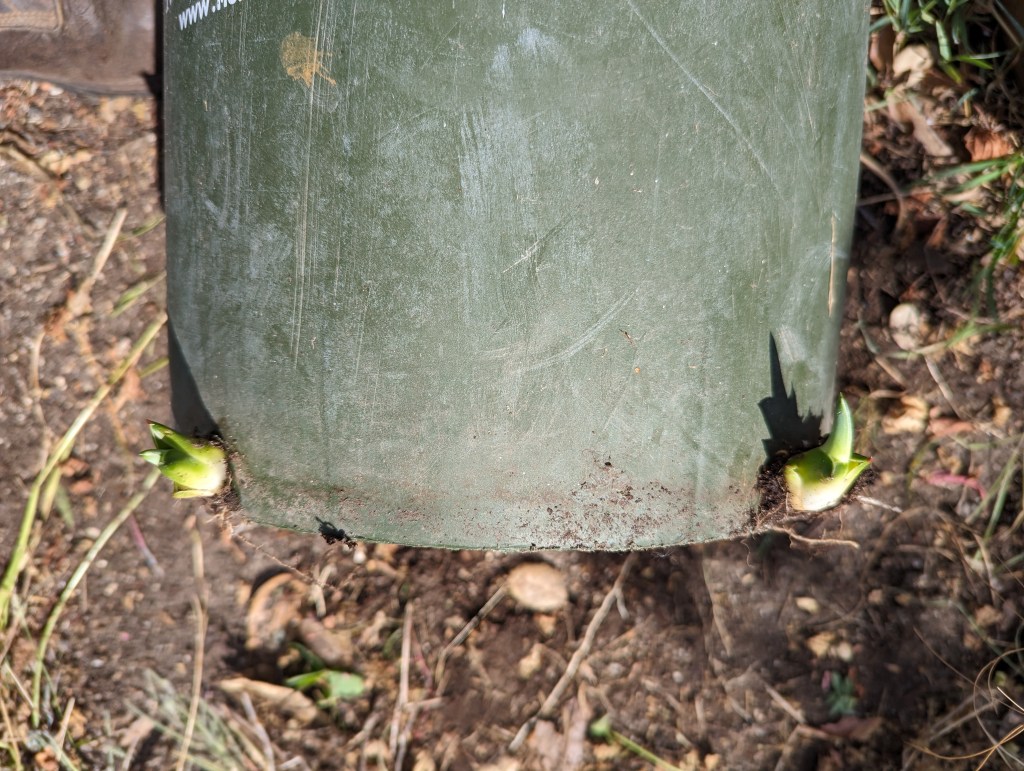
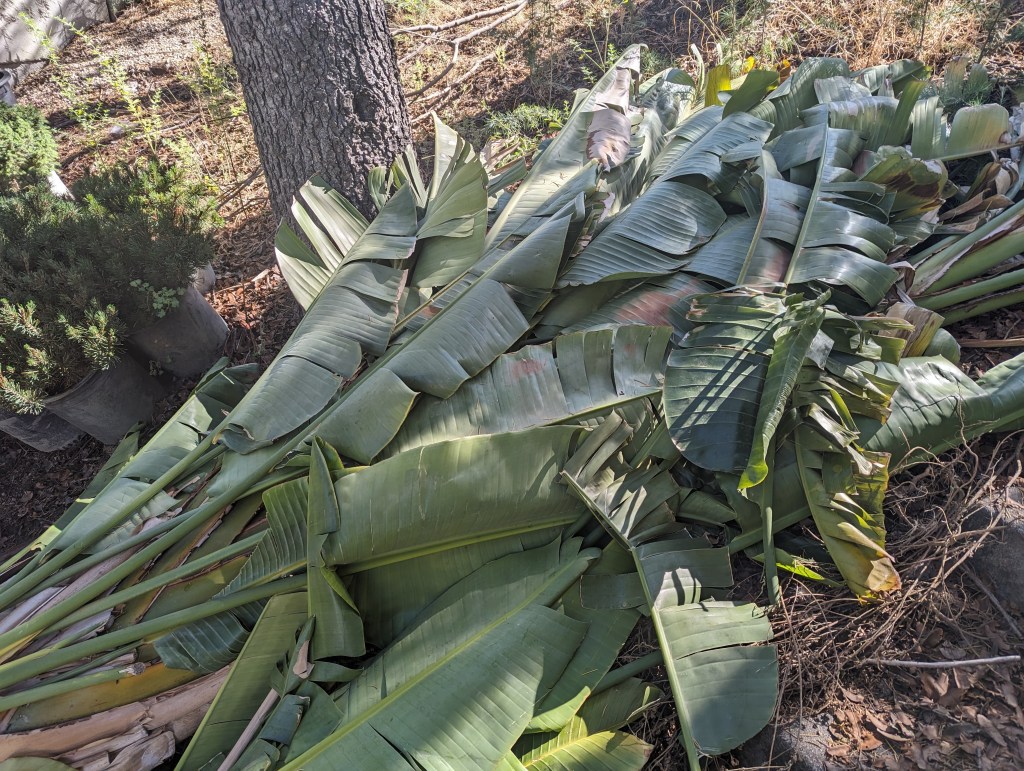
Giant bird of Paradise, Strelitzia nicolai, is a grand perennial. It develops several trunks like those of palms, with lush leaves like those of bananas, and bold white flowers. Their bloom can be messy with its sticky and viscous nectar though. Brent and I refer to them as drooling seagulls. For this reason, these giant bird of Paradise needed to be removed. I was pleased to recycle them. They look pathetic now that most of their foliage has been pruned away to minimize evapotranspiration during their recovery. Most should begin to regenerate roots through summer, and then resume growth for next spring and summer.

1. Giant bird of Paradise does not look so impressive laying on the ground. This is one of two piles of well foliated trunks that must be processed and heeled in until next autumn.

2. ‘A Flock of Seagulls’ demonstrates how abundantly these mature specimens bloomed. They are not just any seagulls, but are dead drooling seagulls. I will glean them for seed.

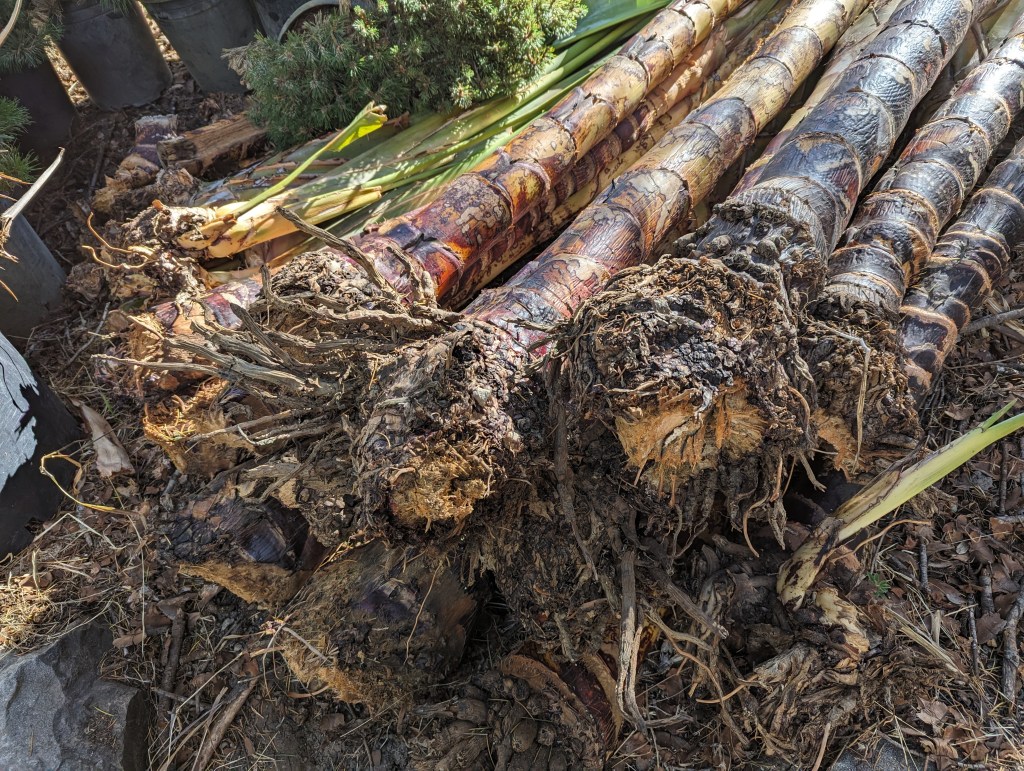
3. Husks make the trunks seem to be bigger than they are. They are the bases of petioles of leaves that were pruned off over the years. Trunks are leaner and tidier without them.

4. Severed roots are unimportant. They merely indicate that a portion of a subterranean rhizome remains attached to the base of a trunk. Trunks are neater without their husks.

5. Adventitious roots grow from portions of rhizome that remain attached to the bases of the trunks, and from the bases of trunks near the rhizomes. These roots are now buried.

6. Lineup shows that there are about a dozen significant trunks, a dozen shorter trunks, and half a dozen pups. They are heeled in here to begin rooting with frequent irrigation. They will be relocated to their permanent landscape after the rain starts during autumn.

This is the link for Six on Saturday, for anyone else who would like to participate: https://thepropagatorblog.wordpress.com/2017/09/18/six-on-saturday-a-participant-guide/

Horridculture – Post Office

Posted!

The Post Office in town is where I go to post or collect mail. For the past few years, this small coast live oak has been getting so low that I must duck under it to get onto the sidewalk from the parking spaces, or even to get past it on the sidewalk. It is particularly annoying because it is in such a prominent location where many other people park and enter the Post Office. I have sometimes considered bringing my pole saw and other pruning tools to prune it for clearance, but because I have not driven the pickup into town for a very long time, and do not intend to do so anytime soon, I would have no means with which to dispose of the debris.

Well, someone else pruned it. Well, sort of pruned it. Well, let us just say that I no longer need to duck under it. What a hot mess of stubs, or should I say, ‘posts’. This is after all, the Post Office. How could anyone think that this was acceptable?! How difficult would it have been to cut these lower limbs properly, without leaving these horrid posts?! Even someone who is not at all concerned about the tree or proper arboriculture can see how hideous this is. Seriously, this goes beyond negligence. Someone put considerable effort into doing this so extremely improperly!

I brought my pole saw the following week to remove these posts without doing any more pruning. I figured that without all the foliage, I could fit them into the trunk of the Roadmaster. However, by the time I go there, someone, likely from the Department of Public Works, had already repaired the damage. The tree could be pruned a bit more, but at least it is not so mutilated.