New View

It may not look like much, but it gets annoying, especially at night.

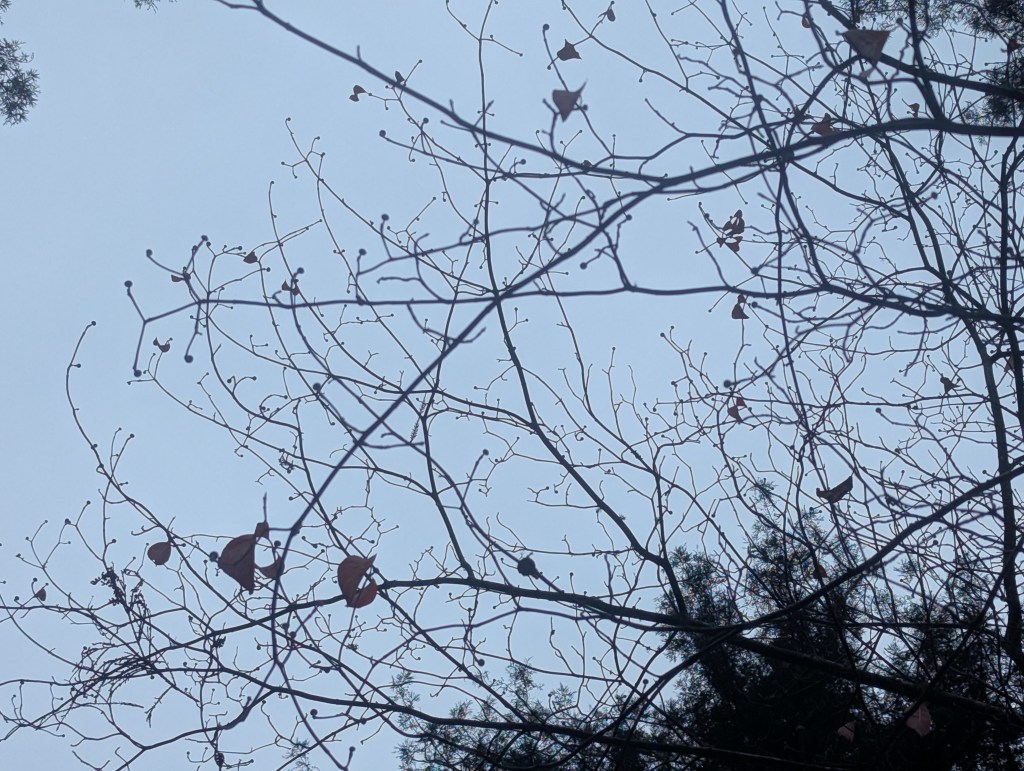
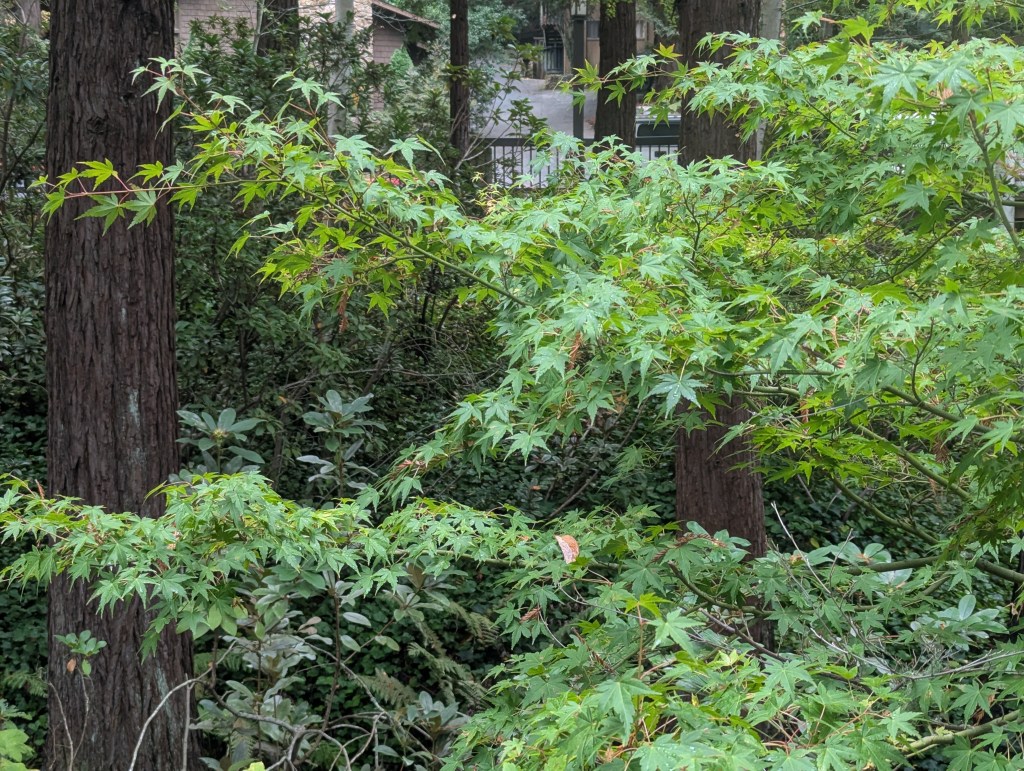
The industrial shop buildings at work are not exactly visually appealing. Fortunately, they are partially obscured from the roads outside by wild forest trees within the adjacent Zayante Creek and a roadside ditch. One road is on the opposite side of Zayante Creek. The other is on the opposite side of the roadside ditch that is perpendicular to Zayante Creek. Their intersection with associated traffic signals is therefore right outside. I added five Arizona cypress trees to the forested area of the roadside ditch, and three Monterey cypress to the forested area of Zayante Creek, to obscure the buildings more in the future. Unfortunately, though, some of the trees beyond needed to be removed for renovations of a major water main for Santa Cruz. One was a mature Monterey cypress between one of the shop buildings and the intersection of the two roads outside. Not only did this reveal the view of the backside of the building from the roads and intersection, but it revealed the view of the intersection from the few windows of the building. Now, from where I do much of my writing, I can see this traffic signal monotonously change from green to yellow to red.

Six on Saturday: More Impressive Roses

Again, it makes sense at the end.

1. Rain dampened the landscapes for the first time since last spring. It was not much and did not last for long, but was fun while it lasted. Actually, it was barely more than drizzle and made only a few tiny and grungy puddles. Pavement had not been rinsed in months.

2. Agapanthus orientalis, lily of the Nile confirms the end of summer by finishing bloom and necessitating deadheading. One last bloom looks silly and lonely at the center of this big colony. It may be cheap and common, but lily of the Nile happily blooms for months.

3. Pelargonium X hortorum, zonal geranium has left the building. The Post Office looks better without its shabby planter boxes that were so predictably bashed by parking cars. Some believe that we must replace them with other prominent potted plants. I disagree.

4. Rosa ‘Sheer Magic’ rose was actually labeled as such. I misidentified another rose that was blooming last week as such because I thought that it looked about right. I found the label afterward. This is the only one of four recycled roses that retained its original label.

5. Rosa, rose is one of the other three recycled roses that did not retain its original label. It looks as if it is about to bloom red. Perhaps I will get a picture of it for next week. Any color would be nice from roses that were not expected to survive an untimely relocation.

6. Rosa ‘Proud Land’ rose is not one of the four relocated roses, but is from my own rose garden. It was too pretty to not show off. I planted it with two others in about the winter of 1984 or 1985. Although I did not choose it, ‘Proud Land’ is likely my favorite red rose.

This is the link for Six on Saturday, for anyone else who would like to participate: https://thepropagatorblog.wordpress.com/2017/09/18/six-on-saturday-a-participant-guide/
Too Much Yucca

Yucca whipplei, which is now also known as Hesperoyucca whipplei, was the first species of Yucca that I met in the wild when I relocated to San Luis Obispo in 1985. Although it is too unpleasantly spiny for me to recommend it for home gardens, it is my favorite species of Yucca.

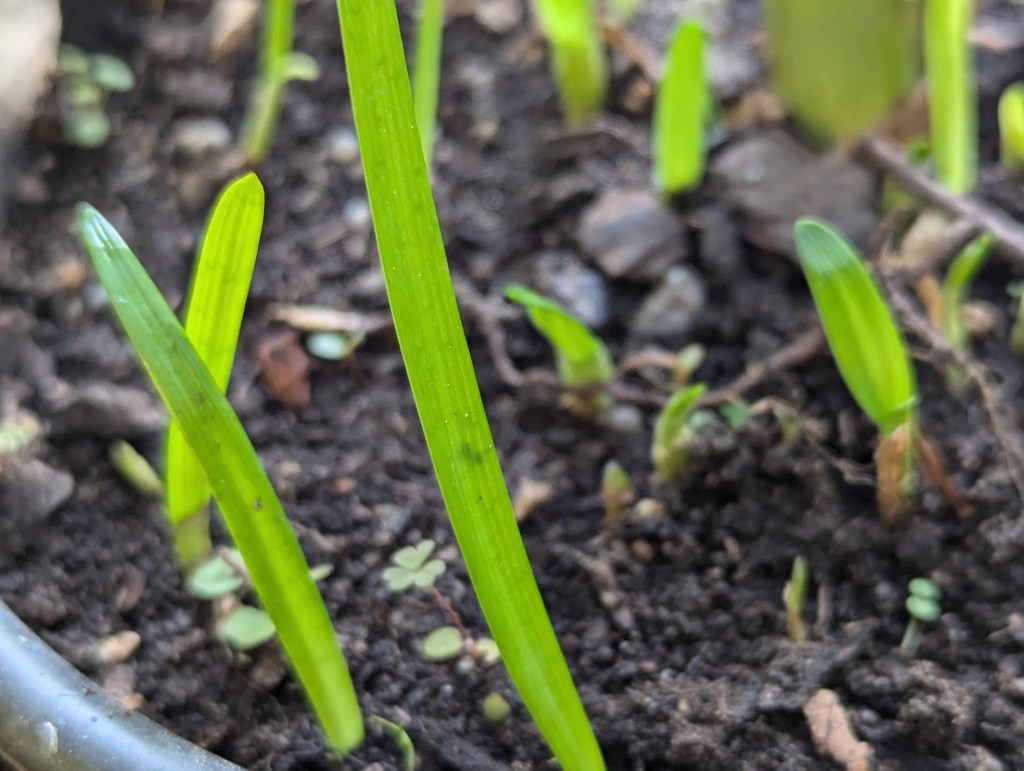
The only specimen of Yucca whipplei that inhabits our landscapes produced a few seed pods two years ago. I dried the seed and sowed them last year. I would have been pleased if a few germinated successfully. Instead, hundreds of them are now growing! Again, I grew too much of a good thing.

I can install several as a deer fence below a portion of my home garden. Although they grow only about three feet tall, deer will not try to jump over them uphill if they can not land beyond their painful foliage on the uphill side. However, if I put them three feet apart, only about twenty seedlings will be needed for approximately sixty linear feet of deer fence. That might be only about a twentieth of the hundreds that are now growing! They are still babies. I can worry about finding homes for them later.

Six on Saturday: Impressive Roses

It will make more sense at the end.

1. Pelargonium citrosum, citronella, like the scented geranium that I featured last week, is one of three scented geraniums here that technically remains unidentified. This name is merely a guess. It is most aromatic, but its bloom is not as pretty as that of the others.

2. Amaryllis belladonna, naked lady is not so cliche or mundane with white bloom. I am so fond of these that I separated their bulbs for relocation to a distinct colony, as well as my home garden. There are not many, so it will be a while before there are any to share.

3. Passiflora edulis, passion fruit vine blooms nicely, but with perpetually shabby foliage and clingy tendrils. Its flowers are really more purplish than this one seems to be in this picture. I have no idea what cultivar this is or even if I like it, but I want to see if it fruits.

4. Anemone hupehensis, Japanese anemone does not bloom quite as white as it seems to be in this picture. It is not exactly blushed with pink either. It is just dingy. I know that a few happier pups in more favorable conditions will eventually bloom more impressively.

5. Rosa spp., rose might not look like much to brag about, but is blooming like this after getting hacked back and removed from its original garden during the middle of summer. Its survival alone is impressive. Its bloom is even more impressive. It is not the only one.

6. Rosa spp., rose is one of the others. A third has floral buds that will likely bloom prior to next Saturday. There are four altogether, so only one is not trying to bloom yet. One is ‘Sheer Magic’, perhaps the pink one above. The other three lack identification otherwise.

This is the link for Six on Saturday, for anyone else who would like to participate: https://thepropagatorblog.wordpress.com/2017/09/18/six-on-saturday-a-participant-guide/
Pair of Pears

‘Beurre d’Anjou’ is to the left. ‘Seckel’ is to the right.

Two new pear trees have grown well this year after being grafted last winter.

‘Seckel’ is to the right in the picture above. I acquired its scion from the Scion Exchange of the Monterey Bay Chapter of the California Rare Fruit Growers on the first of February. It was one of only two cultivars that I wanted to graft onto one of only three quince understock trees that were available at the time.

‘Beurre d’Anjou’ is to the left in the picture above. Because it was unavailable from the Scion Exchange, and also because it was the other of only two cultivars that I wanted to graft, I purchased its scion online.

I wanted to retain one of the three quince understock trees for its fruit, and possibly for cuttings for understock for more pear trees in the future. However, more copies of it grew from cutting from the two trees that were grafted last winter. Now, I have a third quince tree to graft a pear scion onto this winter. I will most likely procure a scion of ‘Bartlett’, because, a very long time ago, that was the most common cultivar within the orchards of the Santa Clara Valley.

Six on Saturday: Major, Minor & Unidentified

Two of my six for this week were purchased, which is rare in my garden. Two were gifts. Two were acquired by other questionable means.

1. Sorbus americana, American mountain ash does not conform to my theme. It is about average and identifiable. I merely wanted to show it off because it is the only seedling to grow from several seed. It can be reasonably productive without another pollinator tree.

2. Cerinthe major, honeywort grew from seed from Tangly Cottage Gardening. This is its first bloom here. Because I did not sow all the seed this year, I could sow more next year. If it self sows here, it will likely only do so within gardens which are generously irrigated.

3. Vinca minor ‘Alba Variegata’, small white variegated periwinkle was another gift from Tangly Cottage Gardening. Although white is my favorite color, these little white flowers do not look very impressive against the background of their yellowish variegated foliage.

4. Pelargonium graveolens, scented geranium, like two other scented geraniums here, is unidentified. I think that the other two are lemon and rose scented geraniums. This one has a less distinct or identifiable foliar aroma, but has prettier and more colorful bloom.

5. Dahlia is also unidentified. I know what it is not, though. It is most definitely not any type of assorted dinnerplate dahlia, which I purchased it as. Although pretty, its flowers are only about three inches wide. Foliage stands about as tall as that of a bedding dahlia.

6. Canna is the third unidentified subject of these six; but it is one of the most important of the many Canna here. It is a souvenir from the funeral of an old friend two years ago. It did not bloom last year, so this is the first time that I confirmed that it blooms yellow.

This is the link for Six on Saturday, for anyone else who would like to participate: https://thepropagatorblog.wordpress.com/2017/09/18/six-on-saturday-a-participant-guide/
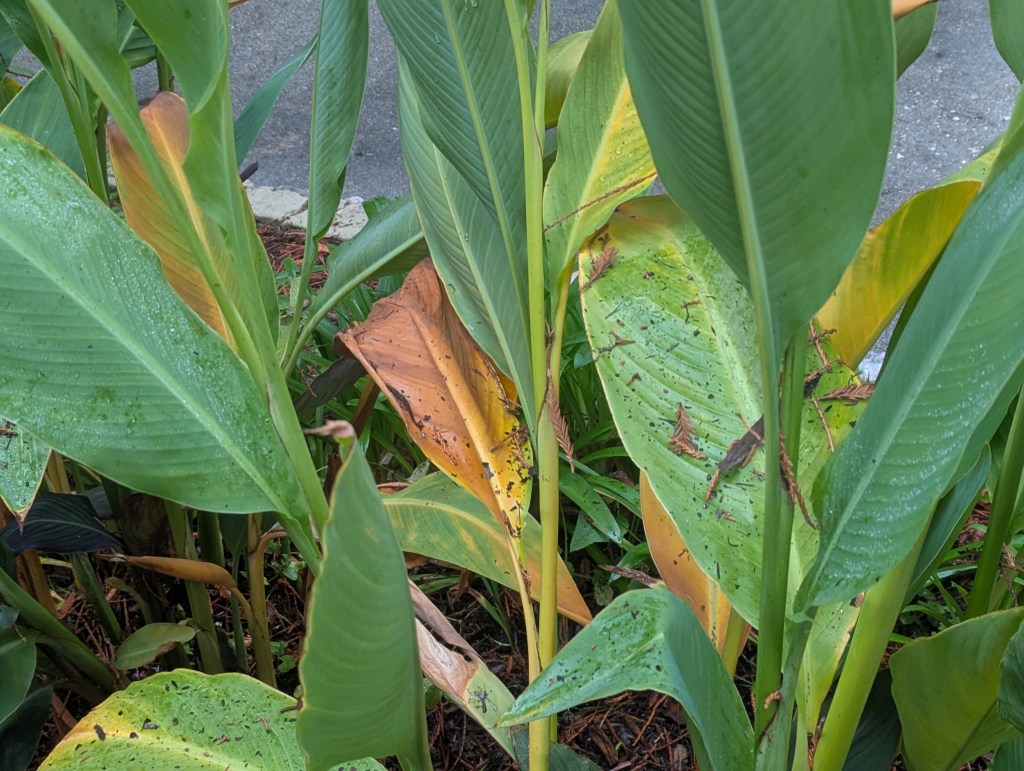
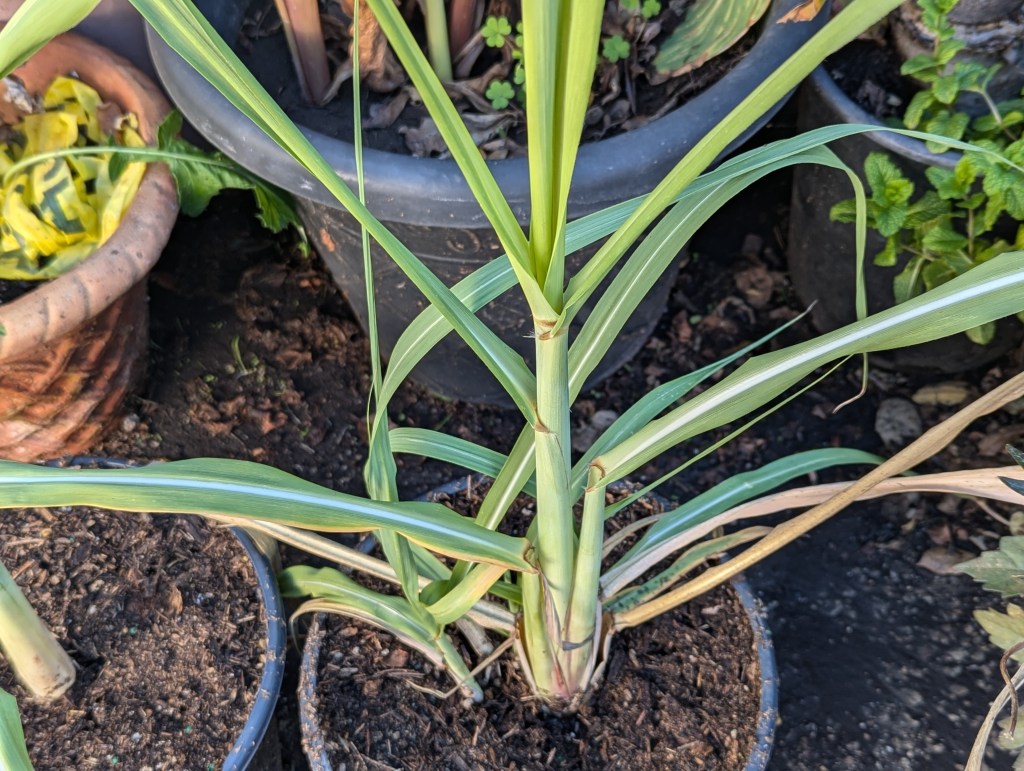
Canna Virus

This is not a new problem, but it is infuriating nonetheless. ‘Cleopatra’ canna expressed symptoms of at least one virus about two years ago. A few other nearby cannas expressed similar symptoms shortly afterward. ‘Australia’ canna is particularly expressive of foliar streaking caused by virus. Isolation and disposal of obviously infected specimens seems to have prevented dispersion of the virus or viruses; but I really am uncertain. Three cultivars of Canna musifolia have suspiciously avoided any infection from adjacent infected cultivars. I can not help but wonder if they are actually infected but merely asymptomatic, and possibly able to transmit viruses to cultivars that are more expressive of symptoms. The canna in this picture is an important cultivar because it is one of only two remaining original cultivars that could have inhabited the landscapes here since about 1968. Because of gophers, very little of it remain, and some of what remains succumbed to virus already. I am quite protective of these few specimens that have not been infected, but would also like them to be able to inhabit the landscapes with the questionable Canna musifolia cultivars. For now, I must wait until they proliferate enough for some to be expendable.