Sunday Best – Unseasonal Azalea


Both work and home gardening were relatively mundane this week. Consequently, these six lack a theme. Irrigation is at that awkward phase when less is necessary, but it is still very necessary. No more rain came after the first storm of the season, but the weather is cooler, and the days are shorter. Autumn is arriving . . . slowly. Maybe I will get pictures of autumn foliar color for next Saturday.
1. Robinia pseudoacacia, black locust is much more out of focus than I was aware of as I took this picture to show how blue the sky is without any rain in the foreseeable forecast.

2. Begonia X semperflorens–cultorum, wax begonia succumbed to a major infestation of fungus gnat larvae. These fresh cuttings were made from their unaffected upper growth.

3. Amaryllis belladonna, naked lady seedlings grew from seed from white flowers. They will not bloom for several more years. I am curious to see if they might also bloom white.

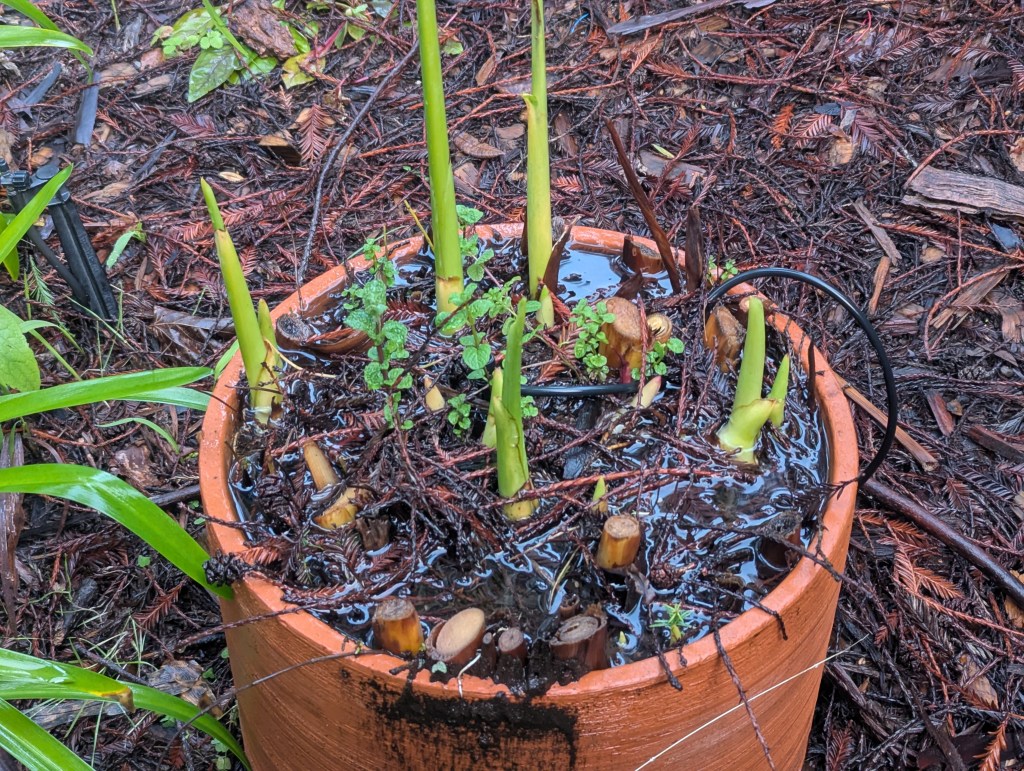
4. Saccharum officinarum, sugarcane probably should not have been bothered until the end of winter, but I separated five clumps. This is the traditional Purple Ribbon cultivar.

5. Acer rubrum, red maple is redundant to a picture of the same two Saturdays ago, but is too pretty to not get a last picture of before the end of its season. It is mostly bare now.

6. Rhody was busy with relaxation while I was at work on Thursday. He is commendably proficient with such tasks, while not being late for petting sessions and treats afterward.

This is the link for Six on Saturday, for anyone else who would like to participate: https://thepropagatorblog.wordpress.com/2017/09/18/six-on-saturday-a-participant-guide/
As mentioned in September of last year, comparisons of the growth of the Memorial Tree of Felton Covered Bridge Park are probably more accurate about now, at the end of its growing season, rather than in the middle of July, as I have been conducting them. So, like last year, I did comparisons at both times this year. A minor difference this year from last year is that this secondary comparison is fourteen weeks after the primary comparison instead of seven weeks, and more completely after the Tree has finished noticeable growth for the year. The first pair of comparison pictures compares the Memorial Tree now to July 12. The second pair of comparison pictures compares the Memorial Tree now to August 30 of last year. While the second pair demonstrates approximately how much the Tree has grown during the past year, the first pair demonstrates how much the Tree has grown since July 12. Strangely, most of the growth seems to have occurred after July 12. This is a good indication that the Tree has extended roots below the nearby lawn, so is exploiting irrigation there. (This species typically exhibits most of its growth during spring and early summer while the endemic soil remains moist from winter rain, but then decelerates its growth as the soil dries through summer.)


Autumn seems to be a bit early this year. The weather is already cooler with a bit of rain. Although no more rain is in the forecast, neither is warm weather. Besides, even if warm weather resumes, it will not last long. Vegetation really should be getting ready for that. A few species, though, are behaving like it is spring or summer. Some were prompted to do so.
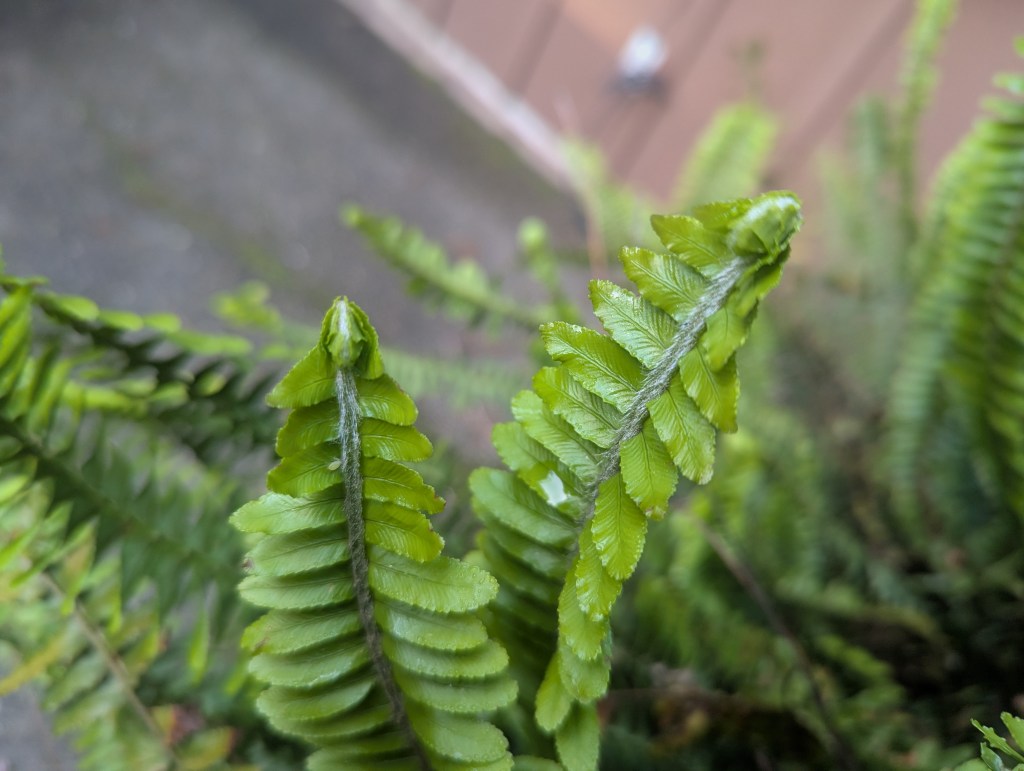
1. Platycerium bifurcatum, staghorn fern has been happy this year, but should not be so active now that the weather is cooling. New growth will be vulnerable to chill this winter.

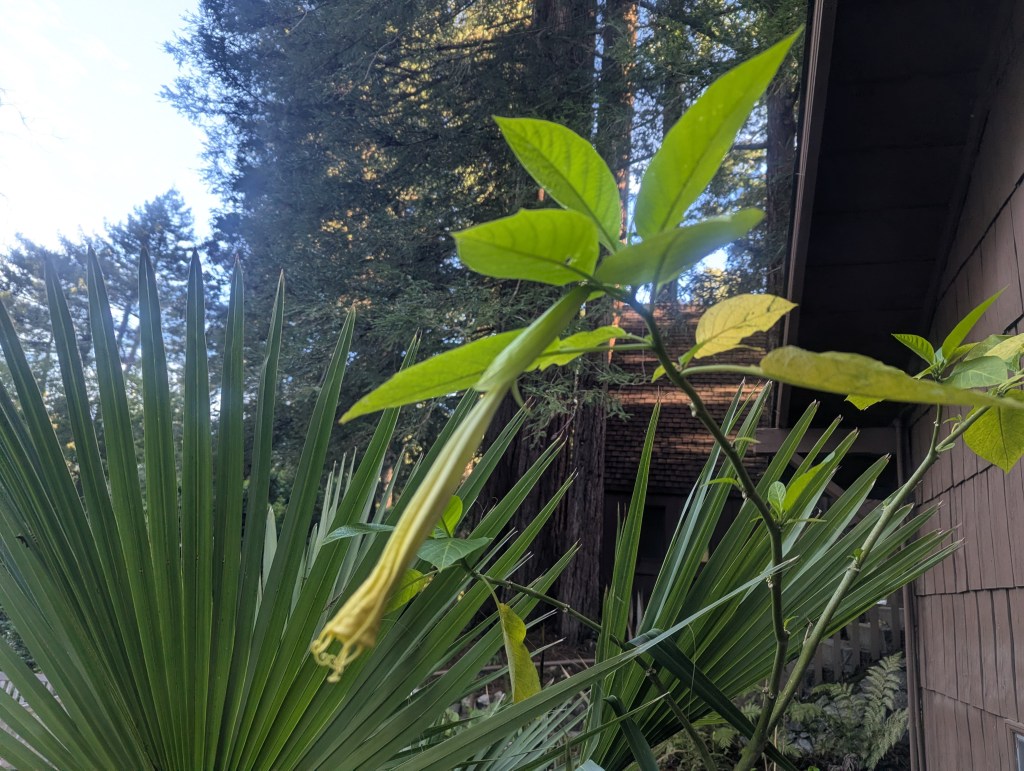
2. Solandra maxima, cup of gold vine cuttings are developing roots now that it will soon be too cool for them to grow. The pruning scrap just happened to become available now.

3. Prosopis velutina, velvet mesquite seedling had all summer to germinate, but decided to do so now. It is the only one of these ‘six’ that is not tropical, so it should know better.

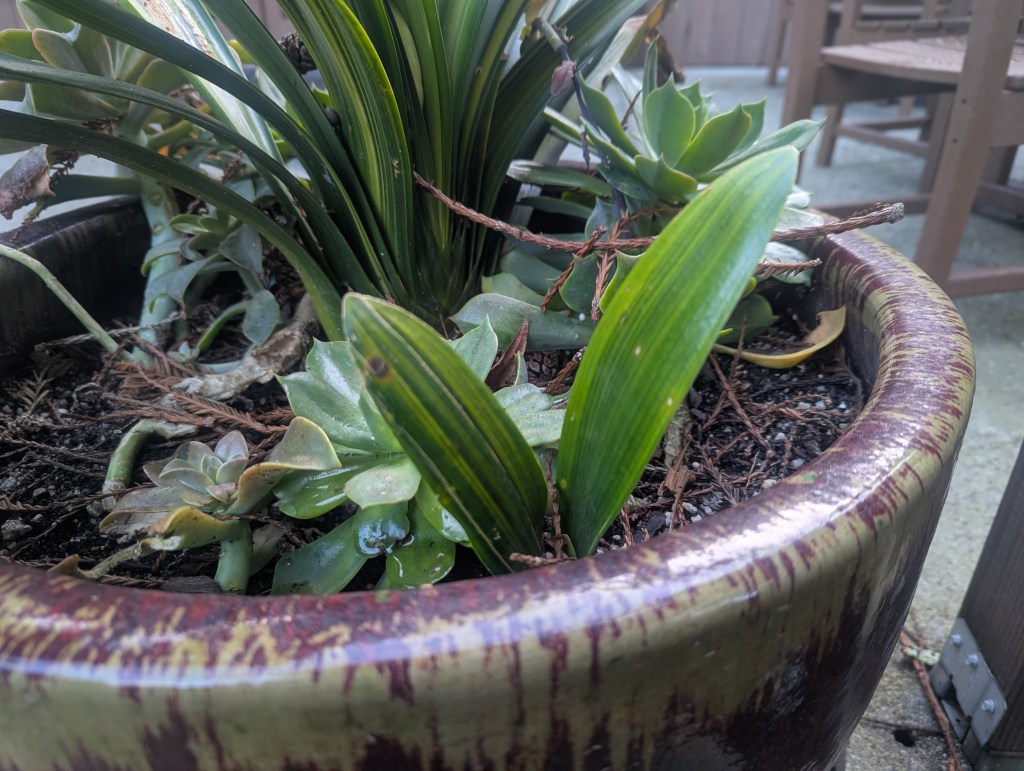
4. Mangifera indica, honey mango seed was sown after its fruits were eaten. Seasonality was not considered. Several seedlings are now growing just prior to autumn and winter.

5. Hibiscus rosa-sinensis, tropical hibiscus cuttings have been growing slowly but surely since the end of last winter, but just as they should be slowing, they are trying to bloom.

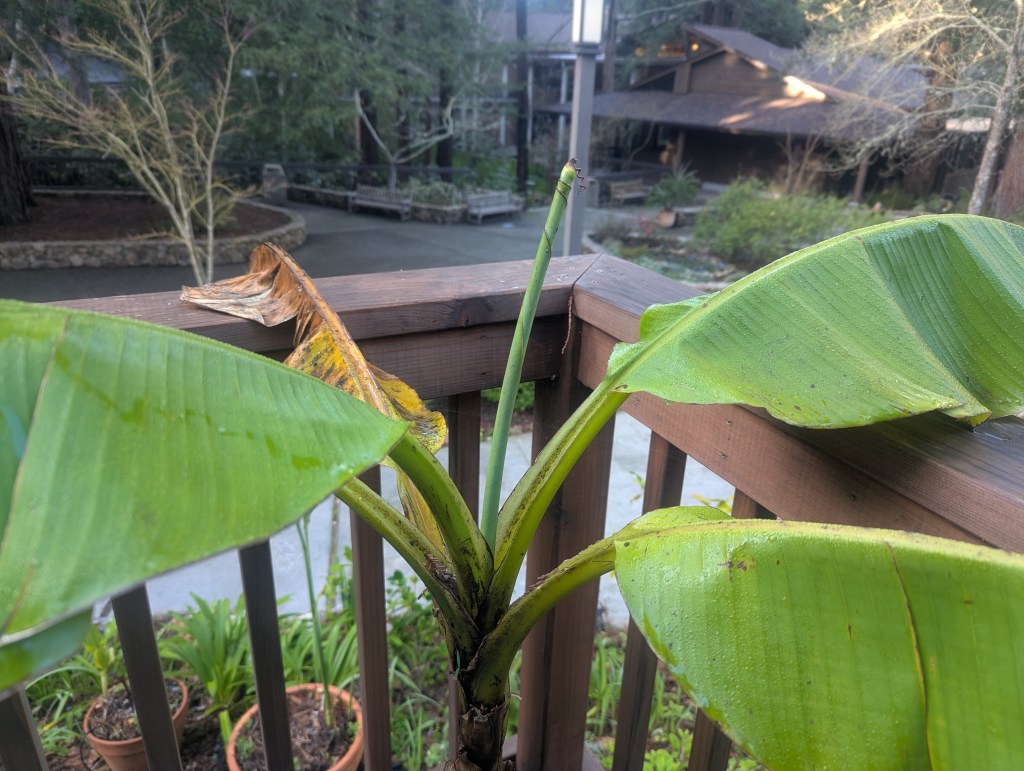
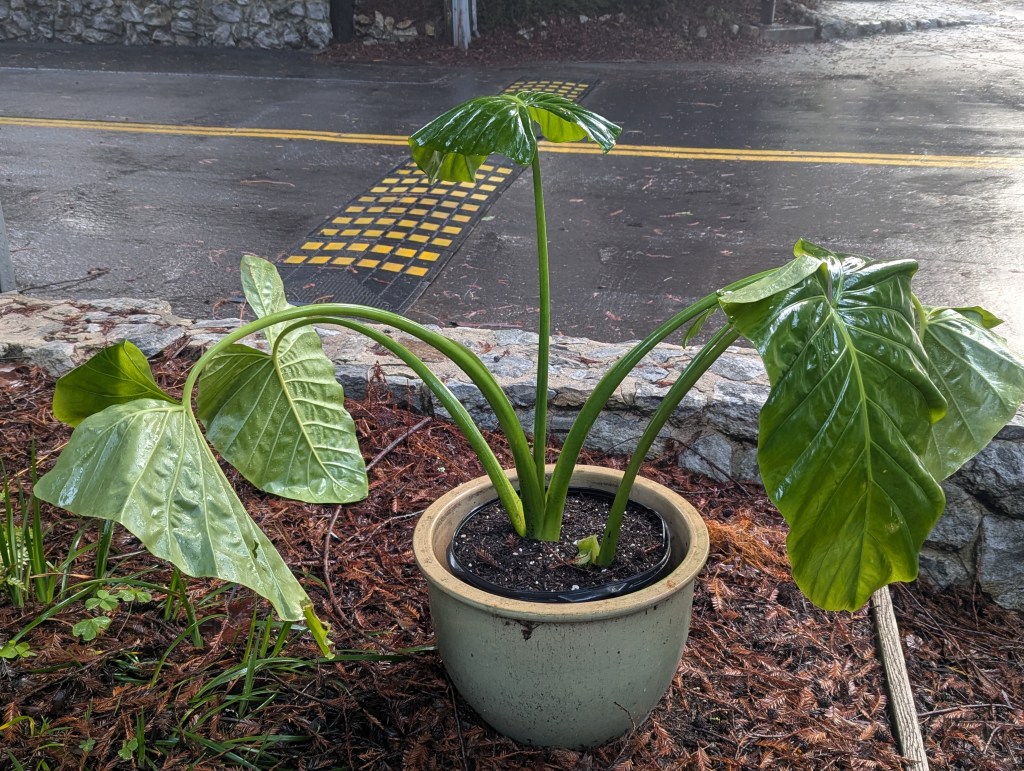
6. Alocasia macrorrhizos, taro is also trying to bloom just as it should be decelerating its growth for autumn and winter. It will be interesting to see how this late bloom proceeds.

This is the link for Six on Saturday, for anyone else who would like to participate: https://thepropagatorblog.wordpress.com/2017/09/18/six-on-saturday-a-participant-guide/
For urban areas, the first rain of the season is typically icky. It mixes with all the crud and filth that has accumulated since the last rinsing rain of the previous spring. Damp roads smell like a mix of automotive fluids and wet tires. Asphalt roofs smell like tar. Even urban trees can initially smell like damp dust. It takes a while and a bit of rain for the crud and filth to rinse away.
This is the second rain of the season, and in a less than urban area. It does not smell objectionable, and is not notably cruddy. However, it still flows with an abundance of pollen that had not rinsed away already. Perhaps this pollen accumulated just since the previous rain, although not much has been blooming visibly at this time of year. It is impossible to say even what species dispersed so much pollen. Nonetheless, here it is, floating in the first few puddles to accumulate. Yuck!
It is no wonder that pollen is as effective at pollination as it is. It is impressively abundant and permeating. It is also no wonder that it is such a pervasive problem for those who are allergic to it.

Autumn foliar color is scarce here, not because the weather is too mild, but because it is not such a priority within landscape design. A few species can develop such color as they do where autumn weather is cooler. Of course, some do not. Native California sycamore is a stately deciduous tree with striking form while bare through winter, but contributes minimal color.
1. Cornus florida, flowering dogwood is just beginning to exhibit foliar color for autumn. It performs surprisingly well in the Santa Cruz Mountains above the Santa Clara Valley.

2. Lagerstroemia indica, crape myrtle is also starting to exhibit foliar color for autumn. It may do so before the weather gets cool, as if it somehow knows what time of year it is.

3. Platanus racemosa, California sycamore does not know or care what time of year it is. It is more likely to yellow in response to hot and dry summer weather than to do so now.

4. Platanus X acerifolia, London plane tree is the sycamore with maple foliage. It is just beginning to yellow, but ultimately, does not do much more than that before defoliation.

5. Acer platanoides, Norway maple is the maple with sycamore foliage. This cultivar has bronze foliage through summer, so develops its yellow foliar color for autumn quite late.

6. Acer rubrum, red maple, like crape myrtle, can develop foliar color for autumn before cool weather, as if it knows what time of year this is. It defoliates relatively early though.

This is the link for Six on Saturday, for anyone else who would like to participate: https://thepropagatorblog.wordpress.com/2017/09/18/six-on-saturday-a-participant-guide/
There are a few reasons to not grow avocado trees from seed. Such trees take a few years to produce fruit. Then, their fruit may be very different from the fruit that provided the seed. It is therefore better to purchase a grafted tree, or at least to graft a seedling. However, some of the best and most productive avocado trees have grown from seed. I have been acquainted with many such trees, and have never met even one that produced inferior fruit. (The primary problem that I notice with seed grown avocado trees is that they grow so tall while young that most of their fruit is out of reach, but that is another topic for later.) Anyway, this is my justification for growing mango trees from seed. I am told that they are much more likely than seed grown avocado trees to produce inferior fruit. I suppose that I will find out now. I am willing to try grafting them if their fruit is not good. They can at least become good understock. Yet, I am also wondering why I get into these situations. I should have known better than to grow something that I know nothing about.