Wild Strawberry?

P00125K
Wild strawberries are worth salvaging.

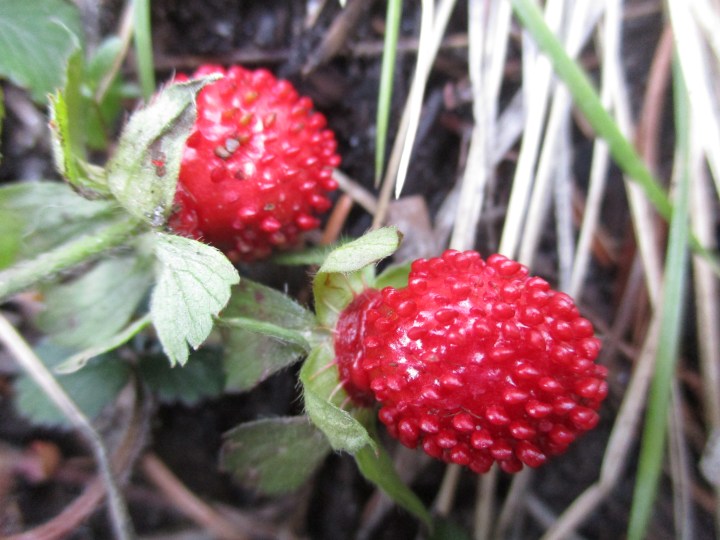
Under a bank of carpet roses that I am none too keen on, this grubby ground cover competes with more aggressive weeds. To me, it looks like common mock strawberry, Potentilla indica. I never gave it much though. It seemed to me that whoever had installed cheap and common carpet roses on that bank would have employed a comparably cheap and common ground cover.

The ground cover was more prolific in open spots that were too narrow for more of the roses, and from there, seemed to have migrated under the roses as a second layer of ground cover. It would not have been installed underneath intentionally. It did not occur to me that it may have grown from seed like so many other weeds there, or migrated in from the surrounding forest.

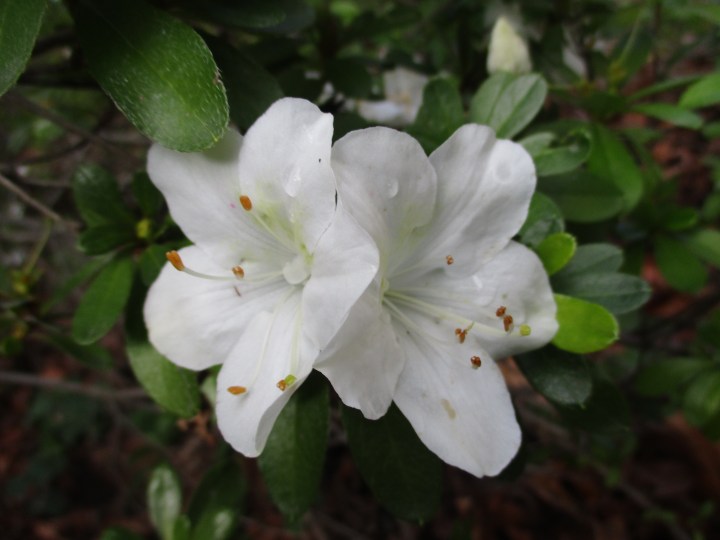
The white flowers did catch my attention though. I was not aware of a mock strawberry that bloomed with white flowers. I really was not concerned enough about it to investigate. This part of the landscape will be getting renovated soon anyway. The roses will be relocated to where they can not extend their thorny canes into an adjacent walkway. Agapanthus will replace them.

Now that I am seeing more of these odd strawberries, I am wondering if this low ground cover that I formerly had no regard for is actually the native wild strawberry, Fragaria californica. Not only should mock strawberry bloom with yellow flowers, but it should also produce more spherical berries. Now I will need to identify it before I either dispose of it, or merely relocate it.

I prefer to not salvage exotic species that exhibit potential to naturalize from landscaped areas into surrounding forests. If this ground cover is wild strawberry, it migrated from surrounding forests into a particular casually landscaped area.
Six on Saturday: Poison Ivy


Poison ivy is not native here. Neither is English ivy. However, English ivy, Hedera helix, is an aggressively naturalized exotic species. Even after it had been designated as a voracious weed in the region, it was installed in some of the landscapes here many years ago. It is so common here now that we know it simply as the standard ‘ivy’. Algerian ivy was planted too, but it is not quite so aggressive.

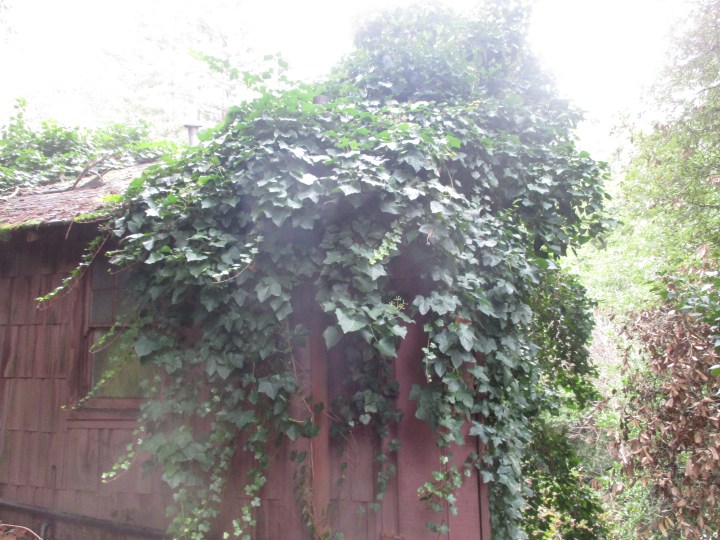
1. English ivy grew up and over this abandoned building, and accelerated the deterioration of the old roof. It would be pointless to remove it now. The building will eventually be demolished.P00125-1

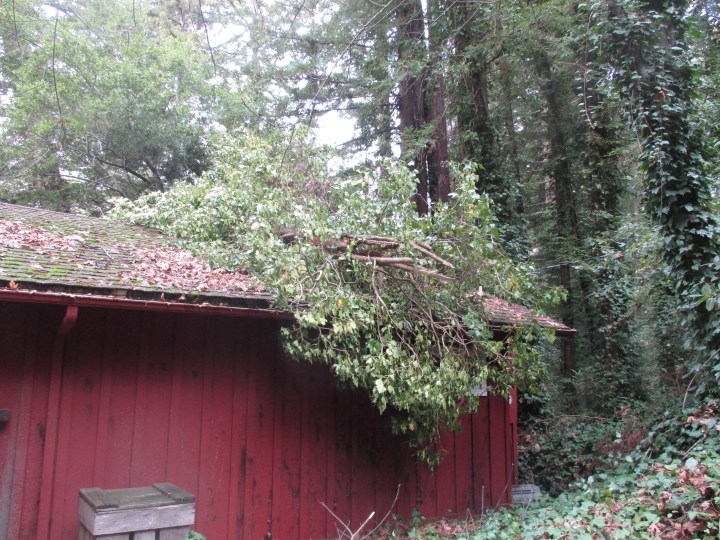
2. This building is not abandoned. No ivy was on this roof just a few days earlier. All this ivy did not grow up and over the building this aggressively since then, but fell from above. Surprise!P00125-2

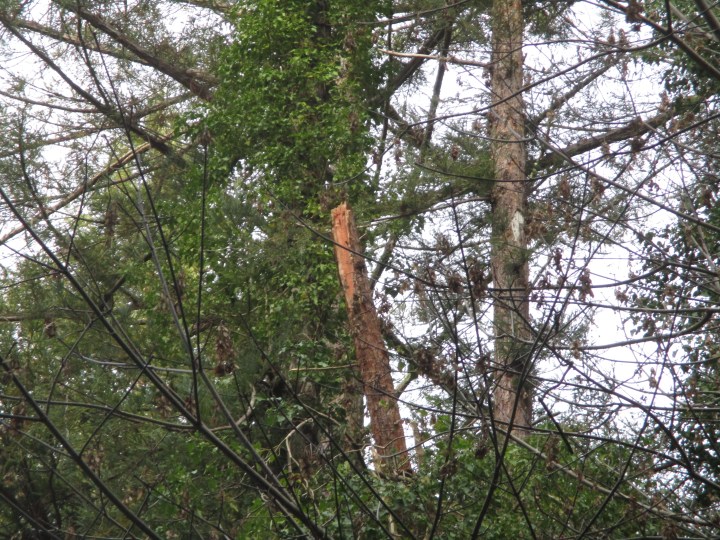
3. The yellow pointer shows where the dead redwood trunk that supported all the ivy broke and dropped the whole mess onto the roof at the bottom of the picture. It is about thirty feet up!P00125-3

4. What a mess! This close up of the same broken dead redwood trunk shows another dead redwood trunk to the right, and a viable trunk with another dense ivy thicket in the background.P00125-4

5. Surprisingly, this is the worst of the damage. It was likely impaled by the rotten redwood trunk. The ivy likely stayed connected to the rest of the thicket long enough to slow the descent.P00125-5

6. Even after getting Ginsu with saws and shears, and getting bounce-house with debris, the pulpy redwood trunk and ivy was still a full load. That was a lot of weight to land on an old roof!P00125-6

This is the link for Six on Saturday, for anyone else who would like to participate:

https://thepropagatorblog.wordpress.com/2017/09/18/six-on-saturday-a-participant-guide/

Horridculture – Dried Plums?

00115
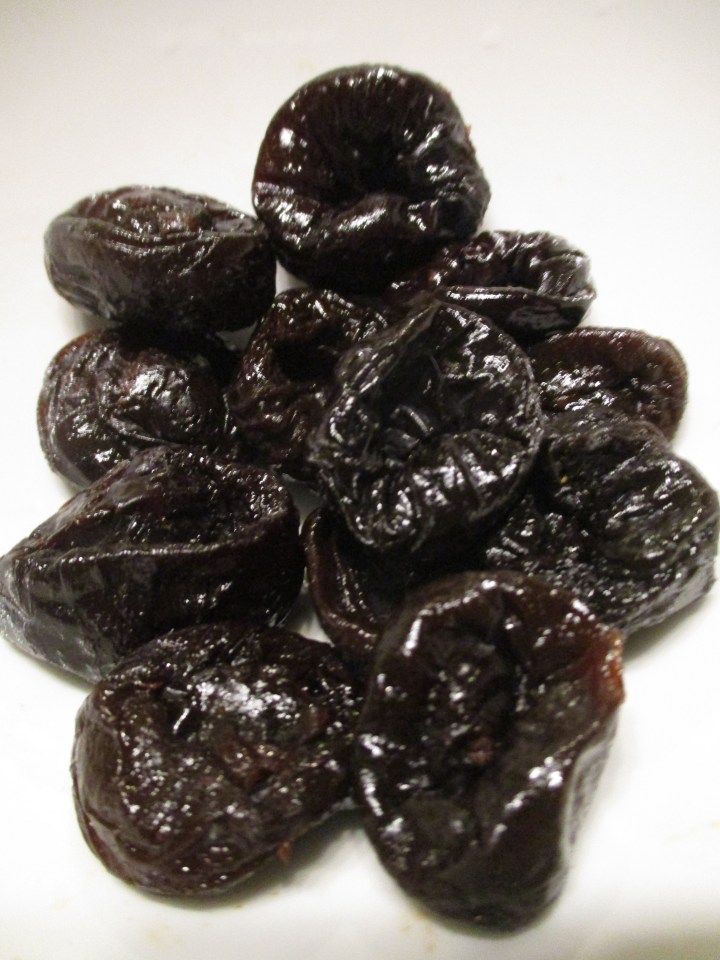
Dried prunes are experiencing something of an identity crisis.

Nomenclature used to be more predictably standardized than it is now. When I write about how it works, I compare it to the names of cars. For example, ‘General Motors’ is just a family. ‘Buick’ is a genus. ‘Electra’ is a species. ‘Limited’ is a variety. Well, my Sebring was labeled as a Chyrsler but made by Mercedes Benz. Modern horticultural nomenclature is no more accurate.

With all the promiscuity going on nowadays, it is impossible to know who the parent of some of our favorite plants are. Many are interspecific hybrids. Some are intergeneric hybrids. Some are so complicated that their species names are merely omitted; and no one seems to notice! That is like driving a Mercury LS without knowing or caring if it is a Grand Marquis or a Lynx.

So, now we can grow such aberrations of traditional stone fruit as as aprium, apriplum, pluot, plumcot, nectaplum, pluerry and peacotum. The first half of the names supposedly indicate who the promiscuous maternal parent is. The second half refers to the male pollinator. Parents who contributed fewer letters to the name were supposedly already hybridized prior to breeding.

For example, an apricot pollinated by a plum creates an aprium; and an aprium pollinated by a plum creates an apriplum. The apriplum gets an extra letter from plum ancestry because it is %75 plum and %25 apricot. A plum pollinated by an apricot creates a pluot; and a plum pollinated by a pluot creates a plumcot. There are, of course, many other complicating combinations.

Sure, the resulting fruit is very good; but is it any better than what it was bred from? If everyone could have tasted the simple, traditional and exemplary stone fruits that formerly grew in the vast orchards of the Santa Clara Valley, there would be no need for all this hooey. Besides, why is there all this interest in creating new and weird fruit while eliminating some of the old?

Prunes and plums, as I explained earlier, are two distinct types of fruits. Japanese plums are the richly flavored and typically more brightly colored fruits that were more popular in home gardens than in orchards, since they are not easy to transport. European prunes are the sweeter but mildly flavored freestone fruits that grew in orchards, generally for drying and canning.

Apparently, the name of ‘prunes’ was not appealing enough . . . or was actually considered to be unappealing. Almost twenty years ago, prunes were consequently reclassified as plums. Dried prunes are now known as dried plums, as if they are dried versions of the classic ‘Santa Rosa’ plums that so many of us grow in our home gardens. Some of them just might be! Who knows?!

Plum juice could be extracted from Japanese plums, which actually make excellently rich juice, but is more likely from fresh (not dried) French or Italian prunes. However, there is still such a beverage that is known as prune juice. It is extracted from, of all things, rehydrated dried plums . . . or dried prunes. These unfortunate fruits get dehydrated, rehydrated, and then juiced!

The juice of rehydraded dehydrated plums or prunes might be the only remaining application of the word ‘prune’. At least it is useful for that; in the sense that it designates the source of the juice as rehydrated dehydrated fruit of some sort, rather than fresh fruit of some sort. Whether such fruit is a plum or what was formerly known as a prune remains something of a mystery.

Corm-ucopia

P00119
Is this part of the secret to their success?

Montbretia showed up here several years ago. Of course, it did not take long for it to get very established. It is too shady for bloom, but not shady enough to inhibit vegetative proliferation. Those nasty stolons get everywhere, and grow into corms. They are so aggressive that they exclude English ivy! Seriously, they are the only species we know that can crowd out English ivy!

Some consider Montbretia to be the the genus name. Some consider it to be a common name for the genus of Crocosmia, or for a particular intergeneric hybrid. What is now so aggressively naturalized here might be Crocosmia paniculata. I really do not know. The few rare and sporadic blooms look like what I am familiar with in other landscapes, with branched inflorescences.

Now, I am aware of how aggressive their stolons are, and that their stolons swell into corms when they get to where they are going. I also know the physiology of simple corms, and that new replacement corms develop on top of old deteriorating corms. They might extend a few more stolons in the process, or put out a litter of cormels off to the side, but their technique is limited.

Well, it should be.

The technique demonstrated by this picture is weird. It seems to show a series of corms from the last twelve years. That makes sense if one corm replaces a previous corm annually. Longer accumulations can be found in older colonies. However, montbretia infested this landscape less than a decade ago, and took a few more years to disperse where these corms were unearthed.

Furthermore, after a decade, the oldest corms should be rotten and decomposed. Except for the stunted four year old corm, those that developed in the last six years seem to be suspiciously fresh.

Six on Saturday: Calm Before The Storm


Six on Saturday‘ is a meme that I participate in on Saturday morning. The link below explains that participants post pictures from our gardens, landscapes, greenhouses, or wherever we find subjects of horticultural interest. You might post six of your own.

I posted this second set of six this afternoon both because these six pictures will be outdated by next Saturday, and because they are more relevant to horticulture than the six that I posted this morning.

1. Rose – Unless there is a rose out there somewhere that I neglected to prune, this is the last rose bloom of last year. It got pruned after I got this picture. Even here, roses get to hibernate.P00118K-1

2. Wallflower – Does it look like it cares that it is the middle of winter? Actually, from a distance, it is more obvious that sporadic bloom is somewhat subdued. It just never stops completely.P00118K-2

3. Sasanqua Camellia – This was one of the few last flowers, and likely disintegrated shortly after the picture was taken and the weather warmed up. That was actually before last Saturday.P00118K-3

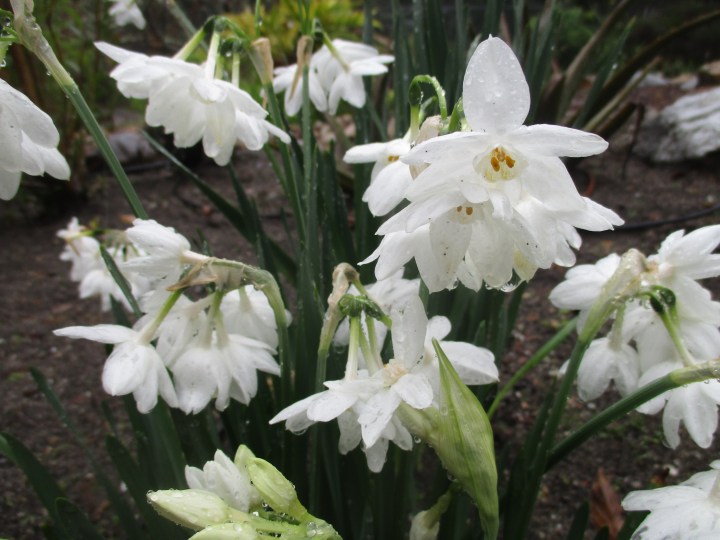
4. Narcissus – Since I so regularly express a preference for white flowers, I tried to find yellow daffodils. They were only beginning to bloom though. These paperwhite narcissus are prettier.P00118K-4

5. Pigsqueak – The name is rad. I intend to grow more in my own garden. It is such a classic winter blooming perennial. More importantly, I want to brag to my friends about my pigsqueak.P00118K-5

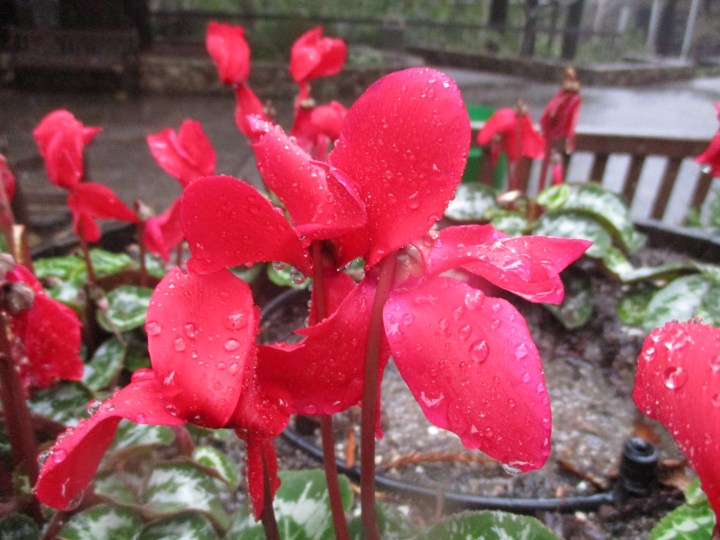
6. Cyclamen – I intentionally got a picture of the red instead of the white. I would prefer them to be more than just common winter annuals. Nevermind the irrigation line in the background.P00118K-6

This is the link for Six on Saturday, for anyone else who would like to participate:

https://thepropagatorblog.wordpress.com/2017/09/18/six-on-saturday-a-participant-guide/

Six on Saturday: When It Rains, It Pours


The frequency and duration of rainy weather here is not very much more than in the rain shadow where the inland base of the Santa Cruz Mountains merges into the Santa Clara Valley. However, the volume is about triple! My former neighborhood in town just about fifteen miles away gets about one foot of rain annually. The average annual rainfall here is about three feet.

That extra two feet sometimes seems to fall all at once.

1. Rain got heavy enough for me to bother recording this first of six brief videos. I do not know why the lights upstairs were pulsating and blinking. The downspout seems to be jet propelled.

2. This was certainly more than I expected. Off to the left, there were only two sandbags to put in front of a doorway that is three sandbags wide. This was a major problem. I did not panic.

3. Now I panicked. I called for help, but my radio was too wet to operate. There was nothing anyone could do anyway; or so I thought. I stopped the camera and went upstairs to investigate.

4. Removal of debris from the grate over this drain fixed everything fast. This was more than I expected too. We all know that this drain is partially clogged. The water and hail was freezing!

5. Within a minute or so, the water drained away surprisingly efficiently, leaving this icy mess on the small patio between the two stairways. It was like a Slurpee mixed with redwood debris.

6. More of the grungy Slurpee remained on the lower patio outside the doorway that lacked adequate sandbags. Water barely crossed the threshold to dampen a few square inches of carpet.

This is the link for Six on Saturday, for anyone else who would like to participate:

https://thepropagatorblog.wordpress.com/2017/09/18/six-on-saturday-a-participant-guide/

Horridculture – NO TRESSPASSING

P00115
NO TRESPASSING? . . . No respect!

Growing fruit takes a bit of effort. Trees that produce the fruit must be planted and maintained for all the many years that they produce. They might need to be irrigated through summer. Most need specialized pruning every winter.

Canning surplus fruit takes a bit of effort too. All the jars must be cleaned. All the fruit must be collected, processed and cooked. The jars must be packed and boiled and so on.

Drying fruit is less work than canning, but takes a bit of effort nonetheless.

Where I lived in town, I grew a peach tree closer to the apartment building to the north, and a fig tree closer to the apartment building to the south. I maintained both trees meticulously. Many of the neighbors appreciated the fresh fruit. At the end of their season, there was (almost) always surplus peaches for canning. Sometimes, there were surplus figs for drying.

I really would not have minded if there had not been surplus fruit. It would have been better to have it consumed by the neighbors while fresh, than after it had been canned. Besides, it would have been less work for me.

One summer, there was a major surplus of peaches. We wanted to can them as efficiently as possible because we know how perishable they are. We planned to do all the canning on a Saturday, so got all the jars from the attic and washed them on Friday afternoon. The canning pots and utensils were ready to go. We had purchased lids and several pounds of sugar.

Also on Friday afternoon, the so-called ‘gardeners’ came to the apartment building next door to the north.

The major surplus of peaches, every last peach, was completely gone when we went to collect early Saturday morning.

Now, really, I don’t mind sharing. That is what the tree is there for. I really don’t even mind if a few people want to take all the surplus fruit. I just want to be told about it before I make plans and prepare to do something else with it. What really angered me was the complete disregard for those of us who put the effort into growing all those excellent peaches.

The fig tree to the south produced an early crop of figs before the peaches, and a late crop of figs after the peaches. Each crop lasted a long time, so there were not often too many figs at any one time that needed to be dried. Most were eaten fresh.

I often noticed an annoying absence of figs each day after the so-called ‘gardeners’ came to the apartment building next door to the south. It was not as bothersome as the missing peaches, since I got quite a bit of figs in between. What angered me was that every fig that could be harvested at the appointed time was taken, leaving none for anyone else.

Unidentified Cyclamen

P00112
What species is this naturalized Cyclamen? hederifoliumcoum – feral persicum – or something else?

Could this be Cyclamen hederifolium? Perhaps it is some sort of Cyclamen coum, or possibly feral Cyclamen persicum. I really do not know. Common florists’ cyclamen is the only cyclamen that I have any experience with. I grew it as a perennial when I was in high school, but never saw any feral colonies growing from self sown seed. I have never met the other species before.

Several colonies of this naturalized species of Cyclamen grow wild in the garden of a colleague. No one knows how they got there. I noticed them while procuring specimens of what might be other species that I have been wanting to grow, even though I am not certain of their identities either. I suspect that one could be Sorbus americana, and that another could be Rhus glabra.

I have been wanting to try growing Cyclamen hederifolium or Cyclamen coum since I saw it in pictures of home gardens in other regions. It looks something like common florists’ cyclamen that I enjoyed growing so many years ago, but more natural and relaxed. As much as I like florists’ cyclamen, the brightly colored flowers look a bit too synthetic for naturalistic landscapes.

Even though interesting species of Cyclamen have been available online and from mail order catalogs for at least the past several years, I have been hesitant to try any. I just do not know if they would be happy in forested landscapes where I want to grow them. Not many perennials perform well with so much overwhelming and mildly toxic debris from redwoods and live oaks.

Now I can see that they perform well enough here to naturalize, even under big and messy coast live oaks. In fact, I am now concerned that they have potential to become invasively naturalized in surrounding forests.

They Don’t Know When To Quit

P00111-6
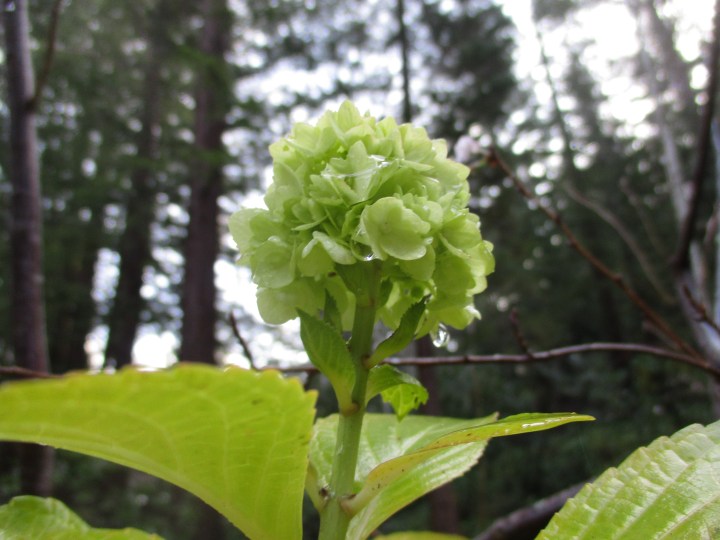
The good news is that these billowy white blooms were not wasted.

The main difficulty with such a mild climate is that many plants do not get sufficient chill in winter. Several types of apples do not perform well here without it. Only a few are productive in Beverly Hills (in the Los Angeles region), where I sometimes need to modify my gardening column accordingly. A few of my neighbors here somehow grow peonies; but I do not even bother.

Even plant that require more chill than they get here seem to be aware that it is cooler at this time of year. Their deciduous foliage turns color and eventually falls to the ground. They just want the weather to get a bit cooler and to stay cooler for a bit longer before they are convinced that it is really winter. Otherwise, they think that autumn simply merges directly into spring.

I really do not know what hydrangeas are thinking though. They perform about as well in milder climates of Southern California, and may not bother to defoliate completely if old foliage can linger until it is replaced by new foliage. In the mildest climates, bloom is merely subdued through winter, but might continue sporadically. I am not convinced that they need any chill at all.

The hydrangeas here get pruned shortly after the roses, and almost as severely. (They are a bit more complicated than roses, and a bit less cooperative, but respond well to their pruning.) I started the process on Thursday with a few that needed to be relocated, and will be finishing on Wednesday or Thursday. Most of the remaining yellowed old foliage falls away in the process.

Their lingering bloom is a bit more disconcerting. I hate to waste what the old hydrangeas put so much effort into producing. Some of the best blooms were outfitted with a bit of eucalyptus foliage (since they lacked their own) and given away to others who work here. However, there were invariably some undeveloped blooms that were just discarded as they got pruned away.

P00111K-2
Undeveloped bloom was merely discarded with the rest of the debris.

Hydrangeas seem to appreciate a good chill, but do not seem to need it, or expect it to last for very long. I sometimes wonder if I could just groom them to remove old canes throughout the year rather than pruning them aggressively in winter. I do not remember ever pruning any in Southern California, but might expect them to be less responsive to the even milder weather.

For me, they would be easier to prune where winter is cool enough for them to be completely dormant. Without foliage, it would not seem like I would be pruning them while they are still active. Without bloom, I would not be concerned about the waste. I could just prune them like so many other deciduous plants. There really are a few disadvantages to mild winter weather.

P00111K-3
Hydrangeas that were transplanted got pruned and dug bare root.

Six on Saturday: White Album


‘Album’ is Latin for ‘white’. That is why ‘album’ or a derivation of it is the species or varietal name for several plants. That does not apply to any of these six though. They are just incidentally . . . and coincidentally white. Even though white is my favorite color, I really did not intentionally select these because they are white. I just wanted to show off some of what is blooming now.

I would say that most are unseasonable, but our mild seasons can be rather vague.

1. Pelargonium hortorum – Two florets managed to bloom on a stunted truss that should have been plucked from rooting cuttings in the nursery. Full trusses are blooming in the landscape.P00111-1

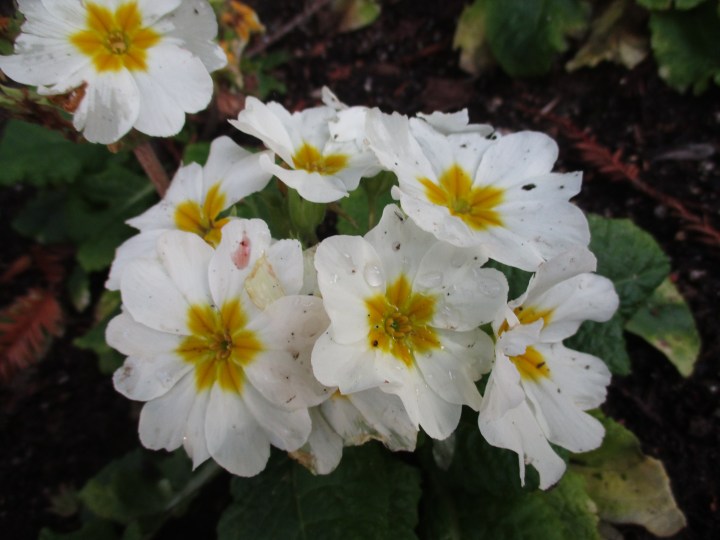
2. Primula vulgaris – Heavy rain overnight splattered a bit of the mulch onto the these and other nearby flowers that are low to the ground. A bit more drizzly rain should rinse them all off.P00111-2

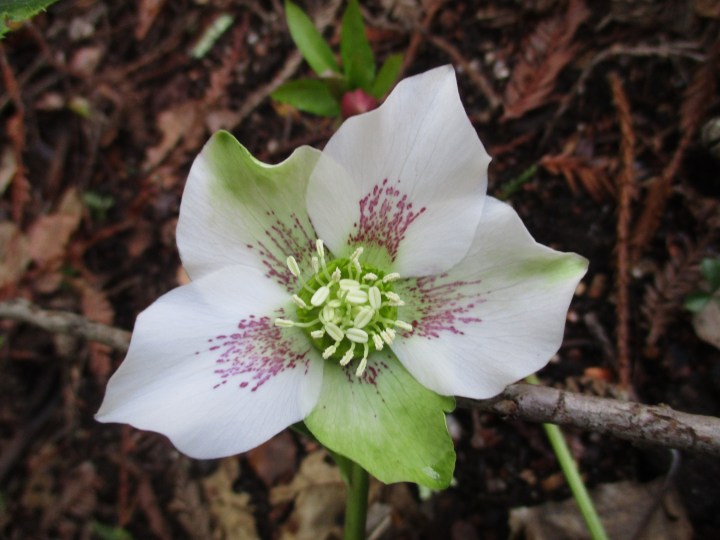
3. Helleborus X hybridus – Of these six subjects, only this and #2 above are actually in season. Their pale bloom is mediocre and faces the ground. This one is turned upward for this picture.P00111-3

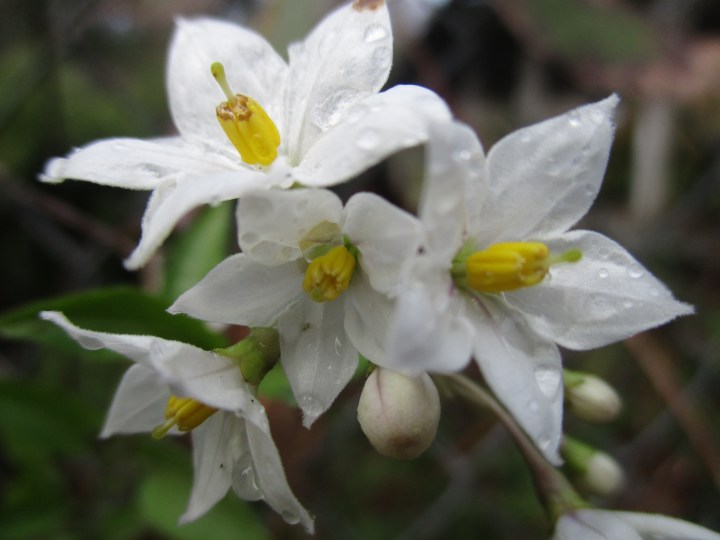
4. Solanum jasminoides – Foliage is pekid through cool winter weather. Vines will get pruned back before growth resumes in spring. Regardless, flowers bloom whenever they get a chance.P00111-4

5. Rhododendron (Azalea) – As delightful as this unseasonable bloom is now, it would have been much better if it had waited until spring as expected. It will not last long in this weather.P00111-5

6. Hydrangea macrophylla – Bloom continues even as the yellowed deciduous foliage is falling to the ground. Other juvenile blooms are still developing. I will elaborate on this topic at noon.P00111-6

This is the link for Six on Saturday, for anyone else who would like to participate:

https://thepropagatorblog.wordpress.com/2017/09/18/six-on-saturday-a-participant-guide/