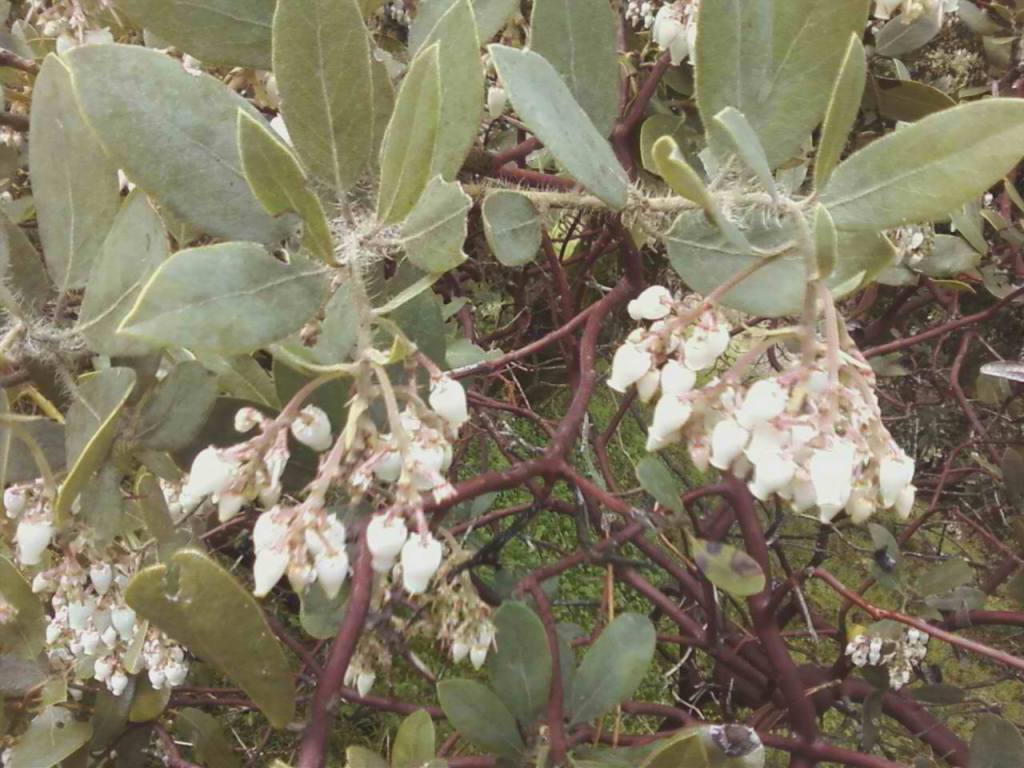
Red Flowering Currant

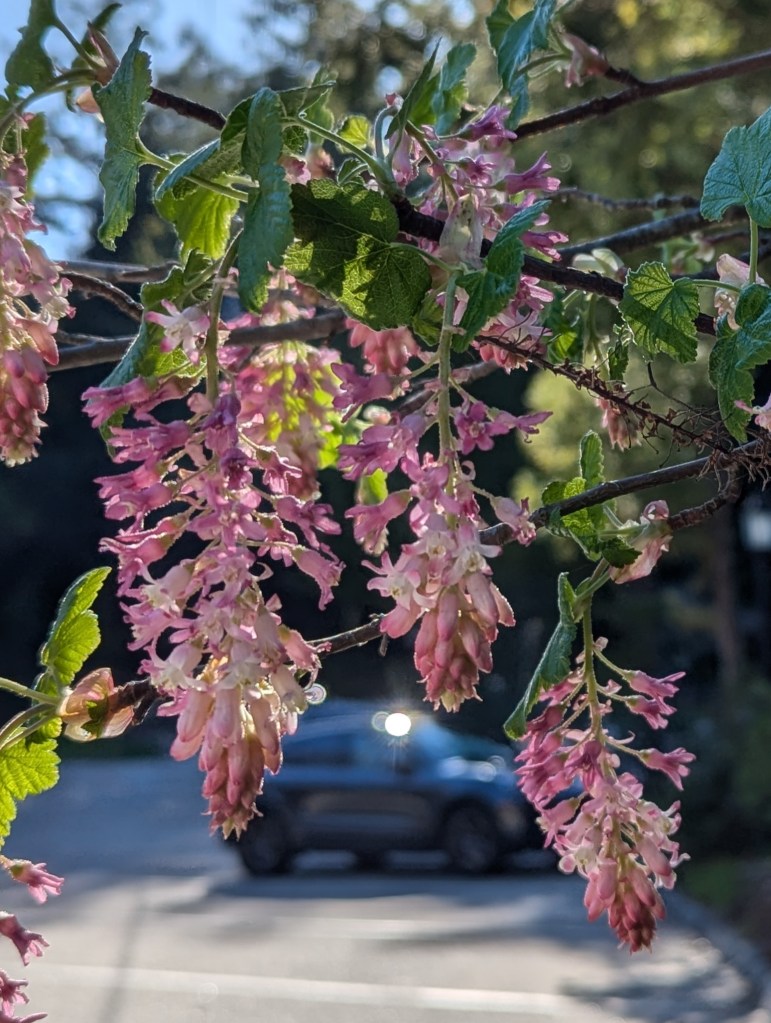
Red flowering currant tolerates some shade.

Its natural range extends from coastal Santa Barbara County to central British Columbia. Yet, red flowering currant, Ribes sanguineum, is elusive in the wild. It is more commonly observable within relaxed landscapes of native species. Individual specimens might not perform for more than a decade but can disperse seed. It behaves as if it is growing wild.

Mature specimens of red flowering currant can grow ten feet high and half as wide. Most stay lower. It is an understory species, so it tolerates a bit of shade. It may prefer shade to warm exposures. Young specimens may be wobbly enough to justify temporary staking. Removal of deteriorating old stems promotes more vigorous growth on fresh new stems.

Pendulous conical trusses of small pink flowers bloom by late winter or very early spring. Before anyone notices, birds are likely to take the few small currants that might develop. Small palmate leaves resemble those of scented geranium, and are somewhat aromatic. They turn yellow as they shed for autumn. Red flowering currant has a foresty character. It suits casual landscapes which border or merge into undeveloped areas.

London Plane

London plane is more common than it should be.

Not many arborists or horticulturists are fond of the unremarkable but very popular London plane tree, Platanus X acerifolia. It soon gets too large for many of the tight situations it gets planted in, more than thirty feet broad and more than forty feet tall. Although it is among the most common of street trees, it can produce aggressive buttressed roots that displace sidewalks and curbs. Fuzz (tomentum) from the leaves is irritating to the skin or if inhaled.

Older trees that were planted prior to the development of disease resistant varieties are very susceptible to anthracnose and mildew, and are likely to infect other susceptible plants. Infected trees often get their foliage late in spring (after earlier new foliage shrivels and falls), or defoliate by late summer. Otherwise, the slightly raspy eight inch wide leaves seem sickly as they turn grungy yellowish brown in autumn.

Landscapers use London plane trees too commonly merely because they are so reliable. They tolerate most soils, smog, severe exposure (such as reflected glare from pavement) and a bit too much watering. Modern varieties are not quite as susceptible to disease. ‘Yarwood’ has large rounded leaves that are resistant to mildew. ‘Bloodgood’ is less susceptible to anthracnose. ‘Columbia’ is less susceptible to both diseases.

Large limbs and trunks with mottled gray and tan bark are rather sculptural while bare through winter. London plane happens to be conducive to annual pollarding, which makes the limbs even more sculpturally gnarly, and produces more vigorous growth with larger leaves that are less susceptible to disease.  

Onion

Onions grow easily from onion sets.

Leek, garlic, shallot and other species of the genus have more distinct growing seasons. Technically, onion, Allium cepa, is a cool season vegetable. It grows through winter to be ready for harvest before summer dormancy. Alternatively, it can grow through spring for a later summer harvest. In cool situations, it can grow through summer for autumn harvest.

Onions do not actually mature within a single season anyway. Most grow from onion sets which are simply small onions that grew from seed earlier. They simply finish growing for another season once plugged into a garden. Those that grow from seed in autumn might go dormant through the middle of winter. Spring is actually their second growing season.

The most popular onions are yellow or brown, red or purple, or white. Each type exhibits a distinct flavor. All develop a few hollow bluish green leaves that stand about a foot tall. Their foliage shrivels as they mature enough for harvest. They are useless if they bloom. Green onions are merely juvenile onions which have not yet developed distended bulbs.

Wild Lilac

Some wild lilac can grow quite large, but lives only about thirty years.

There are many different forms of wild lilac, Ceanothus spp., ranging from low sprawling ground cover types that get only about two feet deep, to dense shrubs that get a few feet tall and broad, to relatively open and irregular shrubs that are a bit larger. The largest can become a small tree with multiple trunks as tall and broad as twelve feet. Wild lilac flowers can be any shade of blue ranging from deep dark blue to soft pale blue. Only a few have white or pinkish flowers. Some wild lilacs have leaves that are glossy and round like nickels. Others have small but thick and roughly textured leaves, like bacon bits.

However, almost all bloom in early spring, are evergreen, and want well drained soil. Only a few lose their leaves where winters are cold. Most prefer infrequent irrigation or none at all, although some of the ground cover types like to be watered occasionally through summer. Wild lilacs do not like to be pruned, and really do not want to be shorn, so should be planted where they have room to develop their natural forms. Sadly, wild lilacs are not permanent, and typically die within ten years or so.

Pacific Hound’s Tongue

Pacific hound’s tongue is reliably perennial.

Cat’s tongue might be a more fitting name. Pacific hound’s tongue, Cynoglossum grande or Adelinia grandis grows where it wants. It can grow from cracks in pavement, and then be difficult to remove. It grows easily through decomposed granite, gravel or wood chips. Yet, it is not readily available from nurseries, or as seed. It is sporadic in its native range.

Pacific hound’s tongue may be uncommon because it takes a few years to bloom well. It does not bloom for its first year from seed and then blooms thinly for its first few years. By its third year though, its resilient perennial taproot should be very established. Its foliage dies back soon after late winter bloom. It stays significantly longer with garden irrigation.

Bloom resembles that of forget-me-not, but relatively sparse and on vertical stems. Floral stems are about a foot tall, or can be two feet tall. They are more numerous in cultivation. The small blue flowers are less than half an inch wide. Foliage develops basal rosettes, which may prefer a bit of partial shade. The biggest leaves are less than six inches long, like a hound’s tongue.

Purple Leaf Plum

Spring bloom is spectacular prior to foliation.

There are actually several different purple leaf plums, Prunus cerasifera, to provide colorful white or pink bloom sometime between the middle of winter and the middle of spring, followed by colorful bronzy or purplish foliage through summer. Some also provide good fruit, which can unfortunately be messy if it is not harvested. Most stay quite compact, less than twenty feet tall and broad, so are proportionate to small garden spaces. ‘Hollywood’ is the largest, but rarely gets more than thirty feet tall, and not quite as broad. Prunus X cistena does not get much more than six feet tall and broad.

Because each cultivar has a distinct personality, it is important to match trees when adding or replacing trees in a grove. The fruitful ‘Atropurpurea’ has single white flowers in spring, followed by bronzy red new growth that turns purplish in summer and reddish brown in autumn. ‘Krauter Vesuvius’ has single pale pink flowers and the darkest foliage, but lacks fruit. ‘Thundercloud’ has similar or paler flowers, lighter or more bronzy foliage, and sometimes produces tangy red fruit about an inch wide. Prunus X blireiana (illustrated) fades to bronzy green by summer, but has handsome branch structure and double pink flowers that are slightly fragrant. Unlike plums that are grown for larger and more abundant fruit, purple leaf plums do not need much pruning.

Summer Squash

Zucchini are the most familiar squash.

Zucchini is the most familiar variety of summer squash, Cucurbita pepo. It is not the only one, though. Several are varieties of Cucurbita moschata. These species are so variable that they seem to be many more than two. Some varieties are winter squash, which also develop through summer, but ripen for winter. Their fruits are plumper but less numerous.

Some summer squash can grow to be very big also. They can likewise remain intact into winter. However, they are best if harvested while small and tender. Frequent harvest that prevents squash from maturing diverts resources to more squash. Some summer squash can almost be too productive. Production should continue until foliage withers with frost.

Yellow crookneck is probably the second most popular summer squash. It can be almost as productive as zucchini. Pattypan squash has firmer texture, which is an advantage for stews and freezing. All summer squash enjoy organically rich soil and frequent irrigation. Their coarsely foliated vines can get almost aggressively vigorous with summer warmth. Seed from mature squash fruits is typically very variable. Only seed from reliable sources is consistent.

Purple Leaf Plum

Purple leaf plum bloom is more colorful than its purplish foliage.

There are actually several different purple leaf plums, Prunus cerasifera, to provide colorful white or pink bloom sometime between the middle of winter and the middle of spring, followed by colorful bronzy or purplish foliage through summer. Some also provide good fruit, which can unfortunately be messy if it is not harvested. Most stay quite compact, less than twenty feet tall and broad, so are proportionate to small garden spaces. ‘Hollywood’ is the largest, but rarely gets more than thirty feet tall, and not quite as broad. Prunus X cistena does not get much more than six feet tall and broad.

Because each cultivar has a distinct personality, it is important to match trees when adding or replacing trees in a grove. The fruitful ‘Atropurpurea’ has single white flowers in spring, followed by bronzy red new growth that turns purplish in summer and reddish brown in autumn. ‘Krauter Vesuvius’ has single pale pink flowers and the darkest foliage, but lacks fruit. ‘Thundercloud’ has similar or paler flowers, lighter or more bronzy foliage, and sometimes produces tangy red fruit about an inch wide. Prunus X blireiana (illustrated) fades to bronzy green by summer, but has handsome branch structure and double pink flowers that are slightly fragrant. Unlike plums that are grown for larger and more abundant fruit, purple leaf plums do not need much pruning.

Stock

Stylishly colorful stock is alluringly fragrant.

Marigold is a warm season annual that gets more popular later than earlier in its season. It is prominent for autumn but does not last for long into winter. Stock, Matthiola incana, is a cool season annual for the opposite extreme of the year. It is popular for late winter and spring but may not perform well into summer warmth. It is unreliable as a perennial here.

Stock bloom can be white, or rich shades or pastels of purple, red, pink, yellow or cream. Most bloom is double, but some is single. Floral fragrance is alluringly rich and complex. It resembles that of carnation, but is notably stronger. The narrow leaves are oblong with pastel grayish green color. Removal of deteriorating bloom promotes subsequent bloom.

Garden varieties of stock are quite different from florist varieties. For home gardens, most popular stock is relatively compact, and blooms freely. Florist stock is taller, and tends to bloom abundantly but at about the same time. In home gardens, florist stock may require staking if it grows as tall as three feet. Home garden stock may grow no taller than a foot.

‘Minneola’ Tangelo

‘Minneola’ tangelo fruit is slightly tart like a grapefruit, but richly flavored like a Mandarin orange.

Of all the citrus that ripen about now in winter and early spring, oranges, lemons, limes, grapefruits and mandarin oranges (or mandarins or tangerines) are the most familiar. (A tangerine is merely a mandarin that was developed in the Americas.) Kumquats, blood oranges, sour oranges, citrons and many of the odd citrus hybrids that are less common are becoming more popular as their fruit becomes more available in markets, and their trees become available in nurseries. Except for the very popular ‘Meyer’ lemon, which is actually a hybrid of an orange and a lemon, the most popular citrus hybrid is likely the ‘Minneola’ tangelo, which is a hybrid of a grapefruit and a mandarin orange. Other tangelos remain somewhat rare.

Like all citrus, ‘Minneola’ tangelo has appealingly glossy evergreen foliage and fragrant flowers. They can be grown in containers if their roots are dug, pruned and planted again every five years or so. They like regular watering, good drainage and mulch. Aphids, mites or scale can become problematic. Suckers from below the graft should be rubbed off as they appear. (The graft union can be identified by the change in bark texture and color on the main trunk just a few inches above the roots.)

‘Minneola’ tangelo trees get a bit larger than mandarin orange trees, but not as large or quite as full as grapefruit trees. The bright reddish orange fruit has all the flavor of mandarin oranges, and is just as easy to peel, but unlike the majority of mandarin oranges, has few seeds, and can be left on the tree through spring. The fruit is a bit smaller than that of ‘Valencia’ orange, and has a distended bump where the stem is attached. Flavor develops best in warmer parts of the garden, particularly after warm summers.