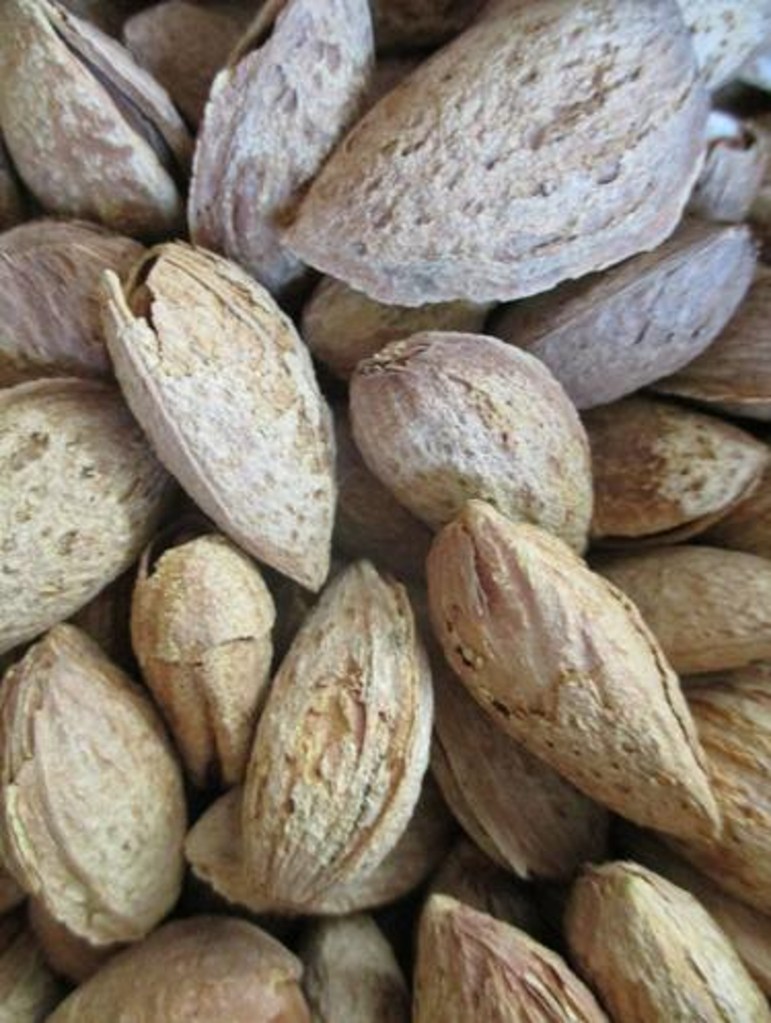
Is the pronunciation of the “al” of almond comparable to that of “salmon” or “palm”? That is about as controversial as the pronunciation of pecan. While pecan is related to walnut, almond, Prunus dulcis, is a stone fruit. That can be controversial also. Unlike other stone fruit, its mesocarp develops as leathery hulls instead of edible flesh. It is fruitless stones.
Like other stone fruit trees, almond trees need maintenance while dormant during winter. Bare root trees that are now available should be in the ground before their spring growth. Established trees need winter pruning before warming spring weather stimulates bloom. Almonds ripen for late summer though, after plums, apricots, peaches or other stone fruit.
Almonds are not as heavy as other stone fruits, and need no gentle handling. Therefore, winter pruning of almond trees may not need to be very aggressive. Such trees can grow as small shade trees with splendid white spring bloom. It is easier to shake unreachable nuts from tall trees than to pick them anyway. A few old fashioned cultivars need compatible pollinator cultivars.
Like the majority of cedars, Eastern redcedar, Juniperus virginiana, is not really a ‘cedar’. According to its genus name, it is a juniper. That may be why it is less common here than within its native range. Even in its native range, most grow wild rather than in cultivation. Junipers gained an unfavorable reputation after becoming overly common decades ago.
Eastern redcedar has traditionally been more utilitarian than merely aesthetic. It can be a delightful Christmas tree, either cut or potted. While old cedar closets are native incense cedar, cedar chests are Eastern redcedar. Baton Rouge derived its name from a red stick demarcation pole. Indigenous people traditionally used Eastern redcedar for such poles.
Wild Eastern redcedar trees are variable and range in height from fifteen to fifty feet high. Cultivars develop compact conical or columnar form. Some are grayish or golden green. The small evergreen foliar scales, particularly juvenile foliage, can be somewhat prickly. The rusty red to grayish brown bark can display a handsomely fibrous or shaggy texture. The ‘silicicola‘ variety of Eastern redcedar is rare.
Such silvery foliage contrasts exquisitely with bronze foliage.
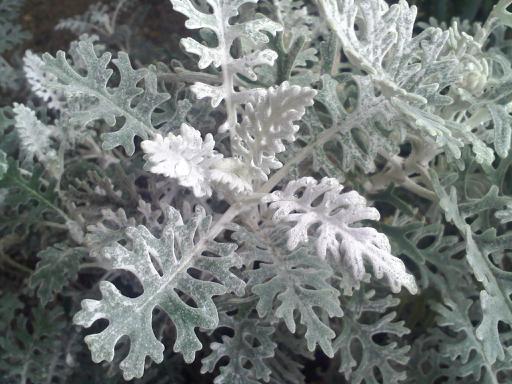
The relaxed trusses of small yellow composite (daisy-like) flowers of dusty miller, Senecio cineraria, can bloom at any time except when winter gets too cold. They are still blooming now. Yet, who cares? Dusty miller is grown more for its fuzzy white foliage than for bloom. It actually looks best and fluffier if occasionally shorn and pruned to remove blooming stems before they bloom. Individual leaves are intricately lobed. Mature plants get taller and wider than two feet. Dusty miller likes full sun exposure, good drainage and moderate water. Too much water causes rot and discoloration.
Stone fruit classification can get confusing. All stone fruit are of the same genus, Prunus. This includes almonds, which are stones or seeds of inedible fruit. Prunes are European fruits that are conducive to juicing and drying. Plums are similar Japanese fruits for fresh consumption, but not for drying. The two are more different than peaches and nectarines.
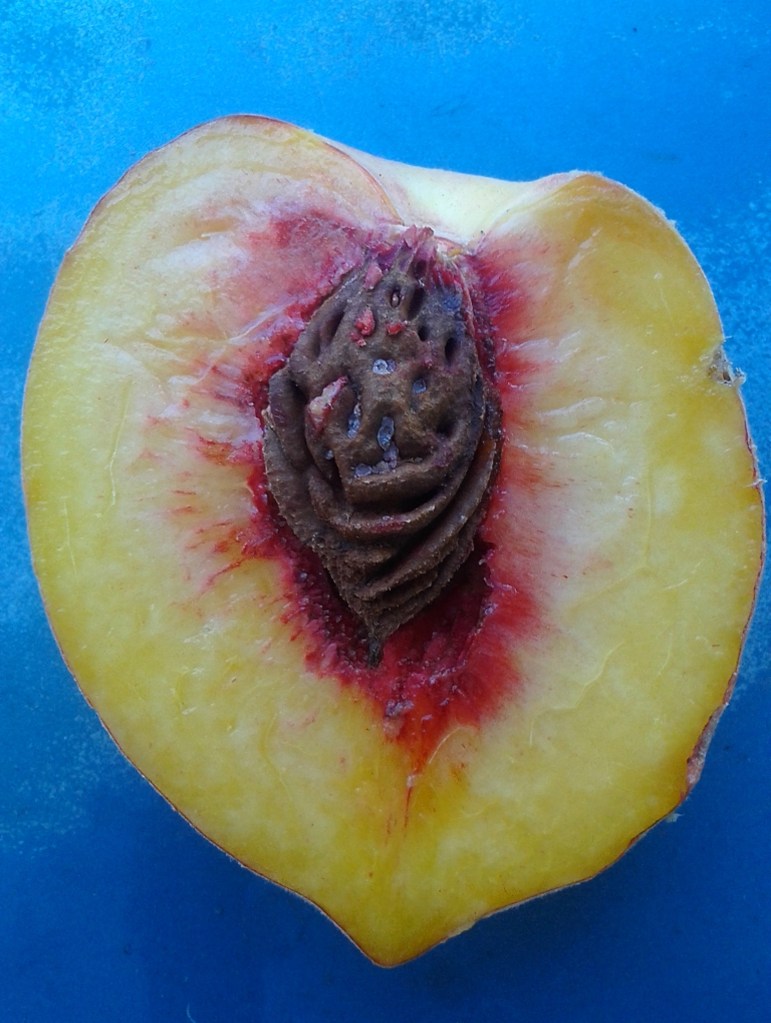
Nectarines, Prunus persicaria var. nucipersica, are simply peaches without fuzz. Cultural requirements are about the same for both. They need only very minor chill through winter to vernalize, and enjoy summery warmth. Trees are not very productive for their first year or two. Then, they may produce for only about twenty years. Thirty year old trees are old.
Both nectarine and peach trees require aggressive pruning while dormant during winter. Otherwise, they can not support the weight of their big and abundant fruit during summer. Semidwarf trees, which are the most popular, can potentially grow twenty feet high. They should stay half as high with adequate pruning. Most of their fruit should be within reach. Bare root trees initially disperse roots more readily than canned trees.
Gold dust plants actually prefers partial shade to full sun exposure.
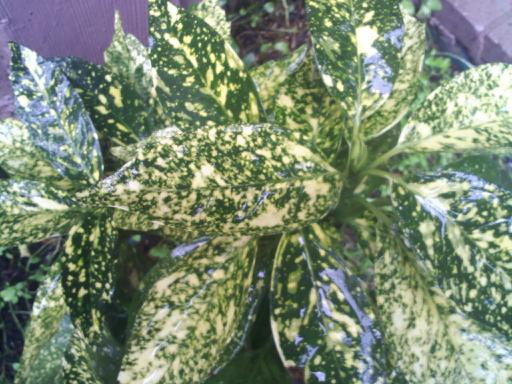
Like so many hollies, the gold dust plant, Aucuba japonica ‘Variegata’, is grown more for its glossy foliage than for flowers or berries. The tiny dark red flowers that bloom in the beginning of spring are barely visible. Clusters of bright red half inch wide berries that ripen in autumn and winter are almost never seen without a male pollinator. Yet, the three inch wide and three to five inch long leaves are colorful enough with their splattering of light yellow spots. Gold dust plant grows rather slowly to about six to eight feet tall and wide, and does better in partial shade. Foliage can get roasted if too exposed to sunlight.
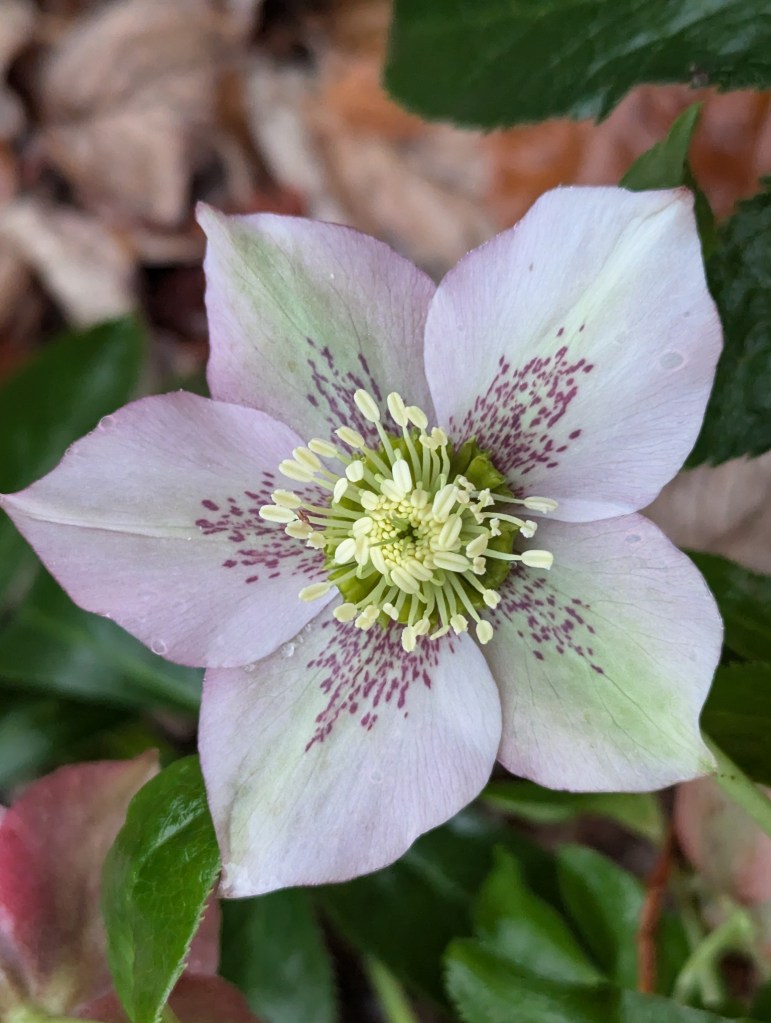
Hellebore may not tolerate much arid warmth, but is impressively tolerant of partial shade.
Suburban gardens are becoming shadier. More modern homes are taller than a single story, so make larger shadows. Taller and more fortified fences likewise create more shade. Smaller garden spaces of modern homes, or of older homes that have been added onto, have less sunny area away from the shadows of the associated homes and fences. Even large gardens of low profile homes lose sunlight as shade trees grow.
Most plants that prefer or at least tolerate shade are ‘understory’ plants; which means that they naturally live in the shade of larger plants. Consequently, most of the few trees that tolerate shade do not get very tall. Vine maple, dogwood, Japanese maple, Eastern redbud and many podocarpus are small to medium sized trees. All palms tolerate some shade, although most grow tall enough to eventually get above it.
Aucuba, boxwood, euonymus, Japanese aralia, holly, Heavenly bamboo and some pittosporums are among the evergreen shrubs that provide foliage in partial shade. Andromeda and Oregon grape have both appealing foliage and flowers. Sarcococca, daphne and gardenia flowers are not quite as showy, but are remarkably fragrant.
Rhododendron, camellia and mountain laurel provide some of the most colorful flowers in partial shade, and have good evergreen foliage while not blooming. Fuchsia and abutilon are rather lanky shrubs, but do have interesting flowers. Hydrangeas are deciduous, so can have good fall color after providing nice foliage and big billowy blooms through summer.
Both Algerian and English ivies, as well as star jasmine, are climbing vines that enjoy partial shade. (Although the ivies cling to whatever they climb, so should be confined to where they will not ruin paint or siding). Star jasmine does not bloom as well or nearly as fragrantly in shade as it does in sunny areas, but has good foliage nonetheless. Any of these vines, as well as periwinkle, is good ground cover for shady spots.
Cast iron plant and arum are not only tough perennials that produce rich deep green foliage in the shade, but can actually become invasive and are difficult to eradicate once established. Bear’s breech is comparable, with the advantage of striking flowers, but the disadvantage that it defoliates through warm summer weather. Various ferns are perhaps the most familiar and complaisant foliar perennials for shade. Lily turf is an evergreen flowering perennial, but realistically, has better foliage than flowers.
Clivia miniata, bergenia and hardier begonias are grown for their colorful flowers as much as for their rich foliage. Clivia miniata is like lily-of-the-Nile for the shade, but blooms with shorter bright reddish orange, red or yellow flowers instead of soft blue and white on tall stems. Some of the various campanulas are delicate shade tolerant perennials with pale blue or white flowers.
Cyclamen, primrose, viola, pansy, forget-me-not, foxglove and impatiens are seasonal annuals that do not mind partial shade. Cyclamen and primrose are actually perennials that can survive through summer to resume bloom the following autumn. Impatiens is actually a warm season annual for summertime that can survive as a perennial through winter.
Where winters are too cool or damp for much else to bloom, hellebore are more popular. The most popular are Helleborus X hybridus, which are hybrids of a few similar species. Most are direct descendants of Helleborus orientalis. They are more resilient to frost than to arid warmth during summer. Actually, that is very likely why they are less popular here.
Locally, hellebore are useful for cool, damp or partly shady situations. However, they are not as substantial as ferns. Also, they can get a bit wimpy as the weather warms through summer. Although evergreen, they shed some of their older yellowing foliage. They grow most during late autumn, winter and perhaps early spring. They crave richly organic soil.
Floral color is typically subdued but interesting. Most common hellebore flowers are pale pink or almost grayish white with spots. Alternatively, they can be rusty red, maroon, pale green, yellow, gray or almost black. Some exhibit more or less spots, blotches, stripes or picotee edges. Double flowers are rufflier than single flowers are. All hellebore are toxic, and for some, can cause dermatitis.
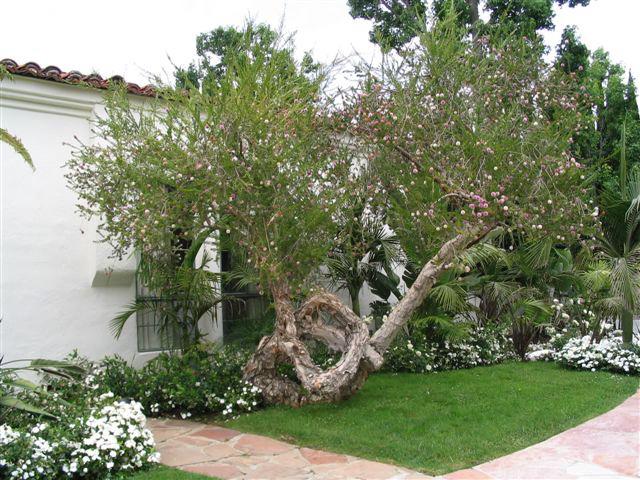
Golden Gate Park in San Francisco has some of the most impressive mature specimens of pink melaleuca, Melaleuca nesophila, outside of their native homeland in Australia. Although most are naturally less than twenty feet tall and wide, their disproportionately bulky trunks are remarkably gnarled and sculptural, as if they have been growing there for centuries. Pink melaleuca actually grows and develops trunk and limb structure rather fast while young, without ever becoming too obtrusively large. Spongy pale tan bark covers the distinguished trunks and limbs like a thick parka.
Sculptural small trees are not the only function of pink melaleuca. They also make nice informal hedges and screens, and can be shorn occasionally if necessary. The round inch long leaves are quite thick. Round inch wide trusses of small staminate flowers bloom slightly purplish pink and fade to pale white through most of the year, except where shorn. (Staminate flowers are showy because of distended stamens instead of petals.) Hummingbirds are grateful for the flowers while not much else blooms through winter. Hard seed capsules that remain in dense cylindrical formation on twigs after blooms are long gone are sometimes used as dried flowers. Like all melaleucas, pink melaleuca is easy to care for, and tolerant of harsh exposure, inferior soil, minimal watering and neglect.
Hollies produced more bright red berries while they were more popular many years ago. Formal and perhaps lengthy hedges of exclusively female cultivars were common. A few or solitary male pollinators grew nearby, often as obscure small trees. Nowadays, males are oddly rare. Not many horticultural professionals are aware that hollies are dioecious.
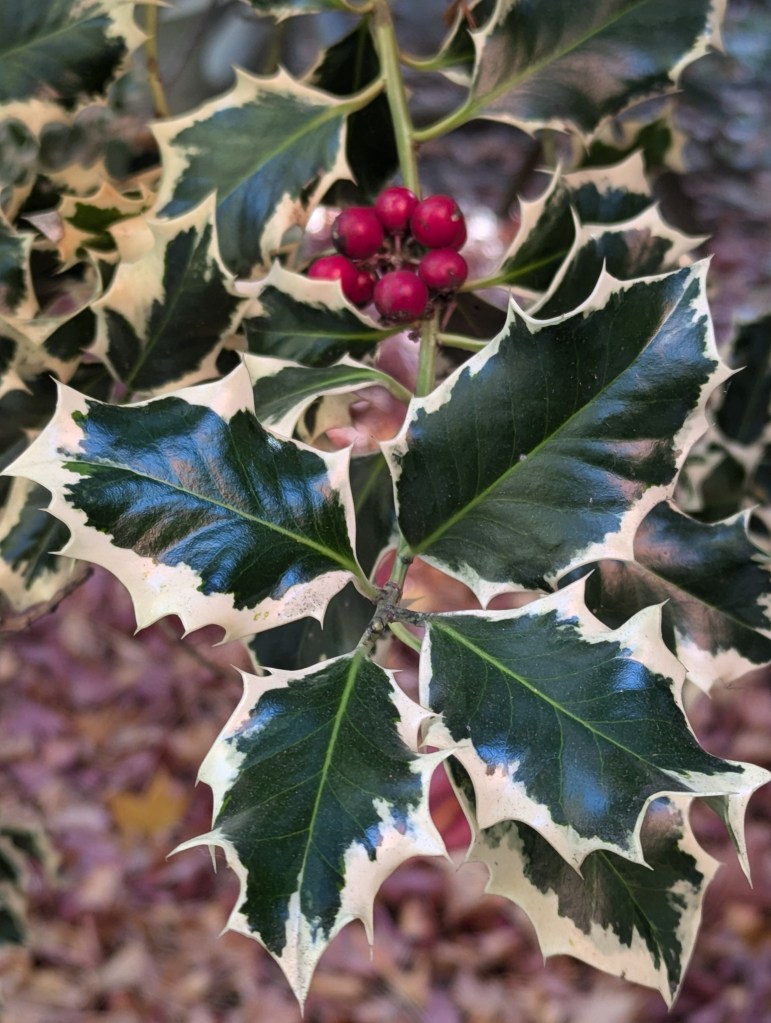
English holly, Ilex aquifolium, is both the most and least favorite holly. Some who grow it appreciate its distinctively intricate foliar texture. Others detest the unpleasant prickliness of the same foliar texture. No other holly is as spiny, although most are somewhat prickly. All hollies exhibit dark green foliar color, remarkably glossy foliar sheen and rigid foliage.
English holly can grow as a small tree with a dense canopy. With pruning, most stay less than ten feet tall. Cultivars with white or yellow variegation grow slower and stay smaller. Berries are common amongst naturalized colonies which naturally include both genders. Nurseries occasionally sell cultivars of both genders, potted together to mature together.
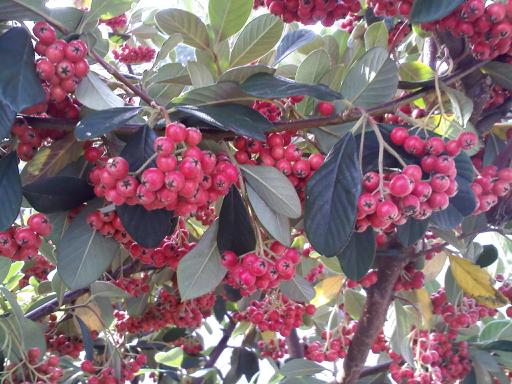
Cotoneaster berries can be as colorful as hawthorn berries, but with evergreen foliage.
Unlike the more popular low growing cotoneasters that are grown as groundcover, the large Cotoneaster lacteus can be grown as large informal hedges or small sculptural trees with multiple trunks. Their limber arching branches can get more than eight feet high and broad. Cotoneaster lacteus are at their best where they have space to grow wild and unshorn, since indiscriminate pruning deprives them of their naturally graceful form; although selective pruning of lower growth exposes trunks and enhances the forms of those grown as small trees. Once established, they do not need much attention or watering anyway.
Abundant two inch wide clusters of small white flowers in spring are not remarkably showy, but develop into comparably abundant clusters of bright red berries in autumn and winter, much to the delight of overwintering birds. The simple two inch long leaves of Cotoneaster lacteus have pale green and slightly tomentose (fuzzy) undersides.