White Sage

White sage is so aromatic that it may be be objectionable to some.

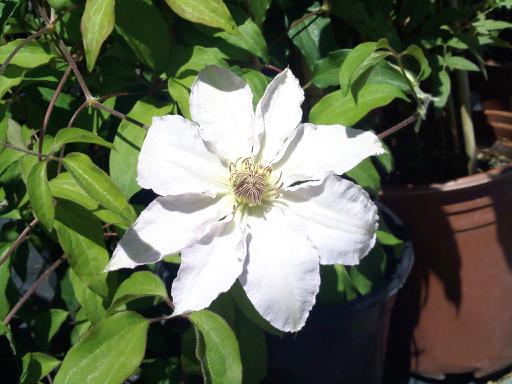
‘White’ is not often associated with ‘sage’, since so many sages are known for the rich shades of purple, blue and red of their flowers. Others have lavender, pale blue, pink, yellow or ‘almost’ orange flowers. Compared to these, the whorls of small, slightly blushed white flowers of white sage, Salvia apiana, are relatively unremarkable, even though they are held as high as a foot and a half above the shrubby foliage on elegantly slender flower spikes.

However, the evergreen silvery foliage of white sage is quite remarkable both visually and aromatically. It is so aromatic that some people may actually find it to be objectionable. Those who initially grow white sage as an herb or for use as incense later realize that it also becomes a prominent ornamental, particularly with dark green foliage, like junipers or arborvitaes, to contrast with its strikingly silvery color. Mature plants get taller and wider than three feet, with simple three inch long leaves. After spring bloom, flower spikes can be shorn off to promote fuller foliar density. I prefer to prune stems back more aggressively to promote more aromatic vigorous vegetative (non-blooming) growth. These vegetative stems become less aromatic as they too eventually bloom.  

Feverfew

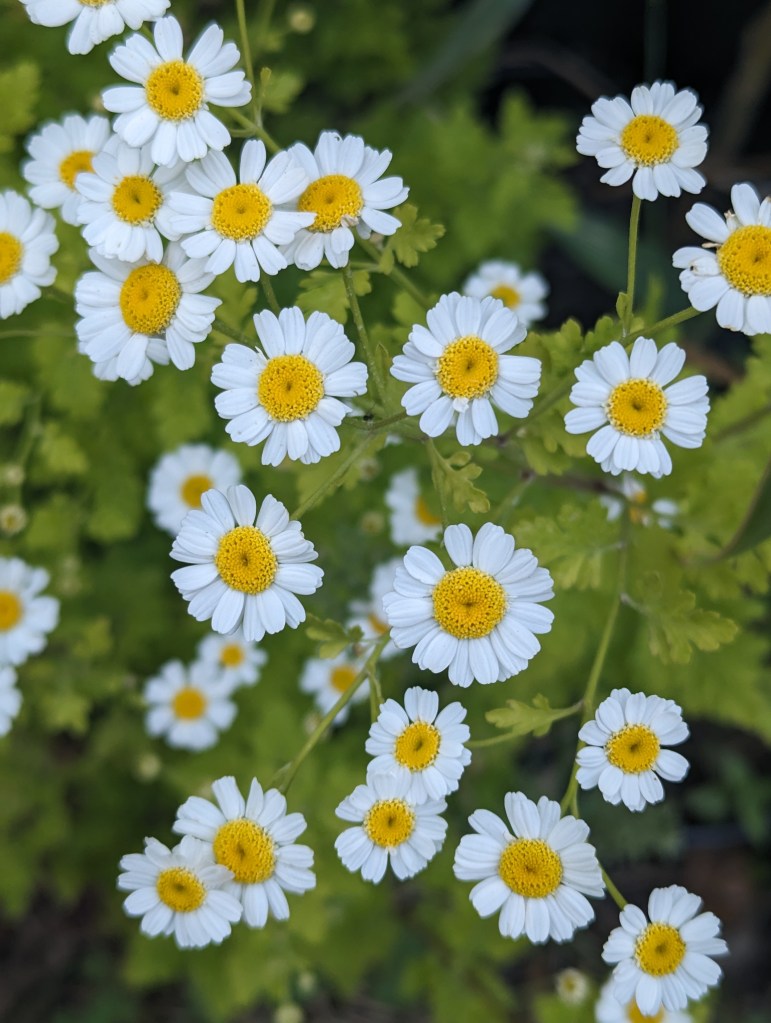
Feverfew blooms with many tiny daisies.

Historical herbal applications were the origin of its now silly name. Feverfew, Tanacetum parthenium, is a relative of chamomile. Its leaves are useful for herbal tea like floral buds of chamomile. Feverfew is delightfully aromatic, although some may disagree about how delightful it is. Some believe that it can repel unwanted insects, but may also repel bees.

Feverfew is likely more popular for its floral display than its aromatic foliage. Its abundant small composite blooms are very similar to those of chamomile. They are nearly as wide as three quarters of an inch. Their yellow centers are a bit flatter. Their ray florets (petals) are a bit wider. They bloom on open trusses that hover loosely above their basal foliage.

Feverfew has lime green foliage with a fine texture. It can stand almost two feet high with bloom standing a bit higher. It migrates slowly, but can slowly get where it should not be. Pruning scraps can root as cuttings. Feverfew prefers rich soil but does not need it. Good sun exposure and even watering are more important. ‘Aureum’ is bright greenish yellow.

Crassula tetragona

Crassula tetragona is more similar to related jade plant than it appears.

Although the narrow and pointed inch long leaves of Crassula tetragona (which lacks a common name) are not at all similar to the plump rounded leaves of the closely related but much more common jade plant, it is much more similar to jade plant than it appears to be. Both enjoy sunlight but will take a bit of shade. Both can be damaged by extreme exposure (reflected glare and heat), as well as the opposite extreme, frost. Their succulent stems are so easy to root as cuttings, that rather substantial pieces that may need to be pruned off can be stuck into the soil as instant new plants. Even leaves of these and various other specie of Crassula can be rooted as very small cuttings. Besides its distinctive foliage, Crassula tetragona differs from jade plant only because it is limited to about a foot and a half high and wide, and blooms with unremarkable white flowers instead of more prominent flower trusses.

Honey Locust

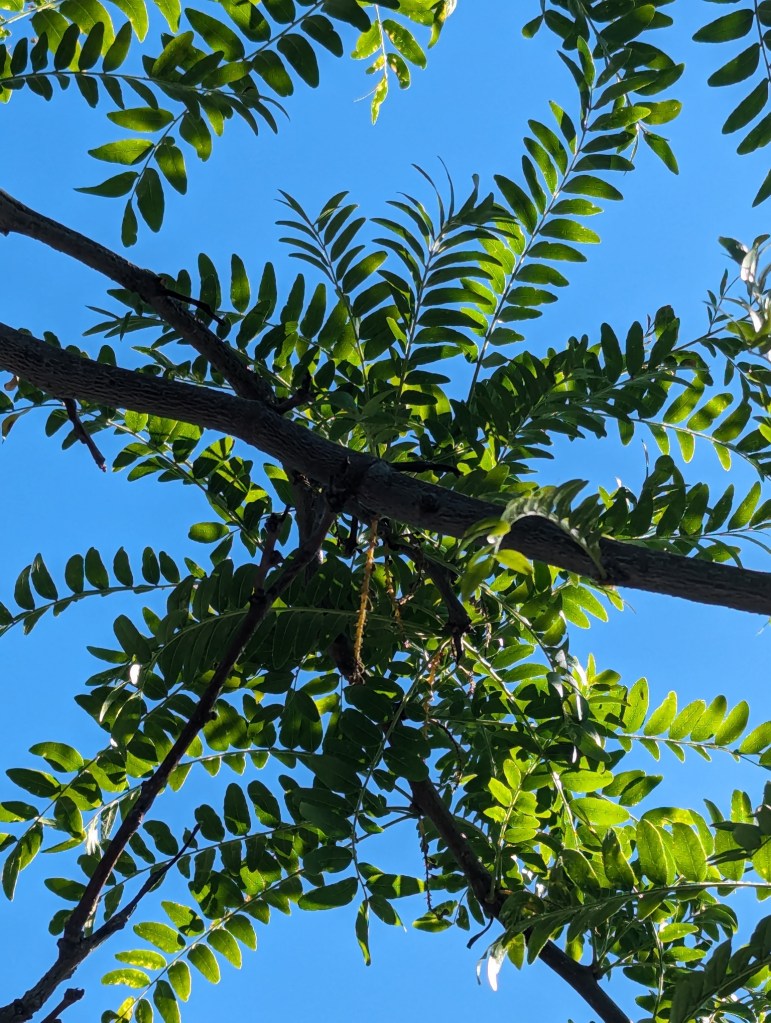
Honey locusts produces delightfully dappled shade.

Within its native range, wild thorny honey locust, Gleditsia triacanthos, is a nasty tree! Its wicked thorns are typically as long as four inches but can be twice as long. Some branch into many thorns or thick clusters of thorns. Thickets of many trees can be impenetrable. Female trees produce a messy abundance of brown pods that are about half a foot long.

Fortunately, its cultivars are much more docile. Most are exclusively male, so produce no pods. Old fashioned cultivars that might produce pods as they mature are now rare. More importantly, cultivars are thornless. That is why their common name is now honey locust rather than thorny honey locust. They are as remarkably resilient as the simpler species.

Most cultivars of honey locust grow no taller or wider than fifty feet here. Some grow only half as tall. Some of the more popular cultivars are brightly yellowish green for spring. At least one is ruddy bronze for spring. The finely textured foliage provides dappled shade. Leaves are pinnately and bipinnately compound, and turn yellow for autumn defoliation. Individual leaflets are less than an inch long, so can be difficult to rake.

Hall’s Honeysuckle

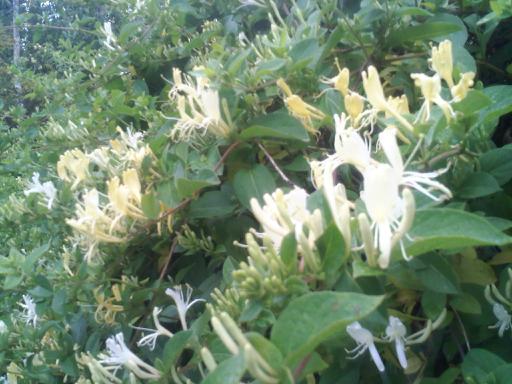
Hall’s honeysuckle climbs aggressively by twining.

The unrefined twining vines of good old fashioned Hall’s (Japanese) honeysuckle, Lonicera japonica ‘Halliana’, seem to fit in so naturally with lilacs, hydrangeas and bearded iris; the sort of plants that grow in grandma’s garden. Grandma may need help controlling it though, since it can climb more than twenty five feet, and get overgrown and invasive. It is best pruned back to main canes or to the ground annually at the end of winter. Even though it is evergreen, it drops some of its foliage and looks rather tired by the end of winter anyway.

Just as the fragrance of the earlier spring blooming flowers gets depleted, Hall’s honeysuckle begins to bloom with its own distinct sweet fragrance, attracting bees and hummingbirds. Bloom is typically most abundant in spring, and followed by sporadic bloom until autumn. Fluctuations of weather or watering can cause subsequent phases of abundant bloom during summer. The pale white tubular (and bisymmetrical) flowers fade to pale yellow that is perhaps the color of French vanilla ice cream. The simple light green leaves are about two inches long. A few leaves on the most vigorous vines may be lobed.

Carob

Carob eventually develops gnarly branch structure.

John the Baptist survived in the Wilderness of Judah by eating locusts and honey. These locusts could have been large orthopteran insects, such as grasshoppers. However, they were more likely fruits of locust trees, such as carob, Ceratonia siliqua. Both possibilities are both nutritious and kosher. The insects got their name from resemblance to the fruit.

That was almost two millennia ago, and more than seven thousand miles away. Carob is much more popular than grasshoppers here and now. Unfortunately though, within home gardens, the fruit is more of a mess than an asset. Male trees are not messy like females, but produce objectionable floral fragrance. Monoecious trees are both messy and stinky.

Mature trees develop broad canopies that are generally less than thirty feet high. Trunks and main limbs eventually become sculpturally gnarly. Densely evergreen foliage is very shady. Pinnately compound leaves are olive drab, glossy and four to seven inches long. Female orchard cultivars should be fruitless without a pollinator, but are rarely available. Besides, it is impossible to know if a male tree is within pollination range.

Spanish Lavender

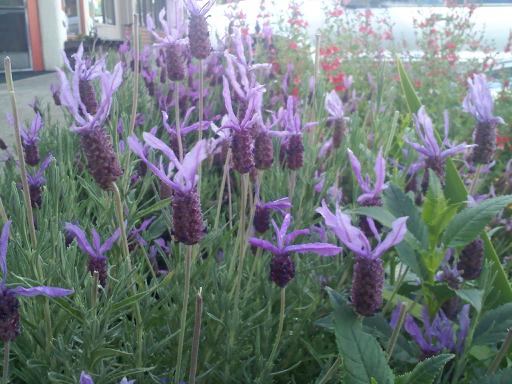
Spanish lavender blooms with bows on top.

It is neither as variable as the many varieties of English lavender, nor as traditional as French lavender, but Spanish lavender, Lavandula stoechas, has the most unusual flower spikes. These short plump spikes are less than two inches long, but are topped with one or two pairs of distended terminal bracts that are almost as long; like simple little packages with big ornate bows. The flower spikes get their color from densely set bracts that surround the minute flowers, and can be various shades of purple or purplish pink or even grayish white. The large terminal bracts are lighter shades of the same colors.

Bloom begins during warm spring weather and continues into summer. Flower may stay close to foliage on stems less than two inches long, or may stand more than six inches above the foliage. The aromatic grayish leaves are narrow and about an inch long.

Mature plants may be three feet wide, and nearly as tall. Aggressive shearing after bloom promotes secondary bloom later, and keeps plants compact. Without pruning, old plants eventually die out in the center.

All lavenders want good drainage and good exposure, but do not want mulch or fertilizer. Inadequate drainage, crowding or mulch can promote rot. Fertilizer can inhibit bloom. Once established, lavenders do not need much water. 

‘Little John’ Bottlebrush

‘Little John’ bottlebrush enjoys warm weather.

Old fashioned lemon bottlebrush would be so practical, if only it did not get so bulky. It is impressively resilient. Although appreciative of occasional watering, it needs none once established. Phases of red bloom continue through warm spring and summer weather. A few sporadic blooms may continue throughout winter. Hummingbirds are very fond of it.

‘Little John’ bottlebrush, Callistemon viminalis ‘Little John’, is all that and less. It remains much more proportionate to compact home gardens. Growth is relatively slow and tame. Mature specimens may grow no bigger than three feet tall and five feet wide. They prefer to assume naturally mounding form without shearing. Any pruning should be quite minor.

More than compact form distinguishes ‘Little John’ bottlebrush from lemon bottlebrush. Its evergreen leaves are relatively small and slightly grayish. Their foliar texture is relatively tidy. Its lemony foliar aroma is relatively subdued and only evident if foliage is disturbed. The fuzzily staminate floral trusses are relatively small with relatively mellowed red color.

Ranunculus

These grew from formerly small and shriveled clumps of tuberous roots.

It is hard to imagine how the small shriveled clumps of tuberous roots of ranunculus, Ranunculus asiaticus, planted last autumn can produce such bright pink, red, orange, yellow and white flowers between late winter and early spring. The two or three inch wide, semidouble or double flowers stand about a foot high, just above their soft deeply lobed foliage. Those of us who did not get ranunculus in the ground last autumn can find blooming plants now. Ranunculus want to be in full sun, in rich, well draining soil.

Deadheading (removal of fading flowers) promotes subsequent bloom; but the season is rather short. Foliage will soon be turning yellow, and will eventually die back. If not watered too much, dormant ranunculus can survive through summer, but should be dug and stored in a cool dry place until next autumn if they are in pots or areas that will get watered regularly.

Mound Lily

Mound lily exhibits stiffly spiny foliage.

Yucca is a genus of about fifty species. However, any two can hybridize. They are more like fifty or so varieties of one species. They maintain distinction by blooming at different times or inhabiting different ranges. Mound lily, Yucca gloriosa, is one of these species. However, it is technically a perpetuating hybrid of Yucca filamentosa and Yucca aloifolia.

Mound lily develops symmetrical foliar rosettes that are only a few feet tall. Stout trunks that develop below can very slowly elevate these rosettes about eight feet. Elegantly tall floral stalks can stand as high as five feet higher. The stiff and evergreen leaves are one to two feet long, and about two inches wide. Their terminal foliar spines are very sharp.

The most popular cultivar of mound lily is variegated with creamy white stripes. Tristis is a variety with more flexible and arching foliage. It formerly classified as a distinct species of Yucca recurvifolia. All yuccas bloom with small, pendulous and creamy white flowers. Such flowers may exhibit a pale purplish or faint pale greenish blush.