Sky Lupine

Sky lupine grows wild here. (This may actually be arroyo lupine.)

If California poppy were not the State Flower of California, sky lupine, Lupinus nanus, might be. Even though the perfect blue of sky lupine is the opposite of the perfect orange of California poppy, both of these brightly colorful flowers have several similarities, and are often sown together in autumn or winter for their early spring bloom. Both are native to western North America, but are very commonly displaced by exotic (non native) plants. As natives, they can easily self sow if competing specie are controlled. Both are satisfied with annual rainfall. As long as they are not watered too much in poorly draining soils, they are not too discriminating about soil. They do want full sun though.

Sky lupine is an annual that does not get very large, no more than two feet high and half as wide. It seems to be more colorful where it is kept less than a foot high by good sun exposure and wind. The finely textured, palmately compound foliage (divided into smaller leaflets that are arranged in a palmate pattern) gives it width, but only the lower half of its height. The upper half is its narrow spikes of small, neatly arranged ‘pea-shaped’ flowers.

Bearded Iris

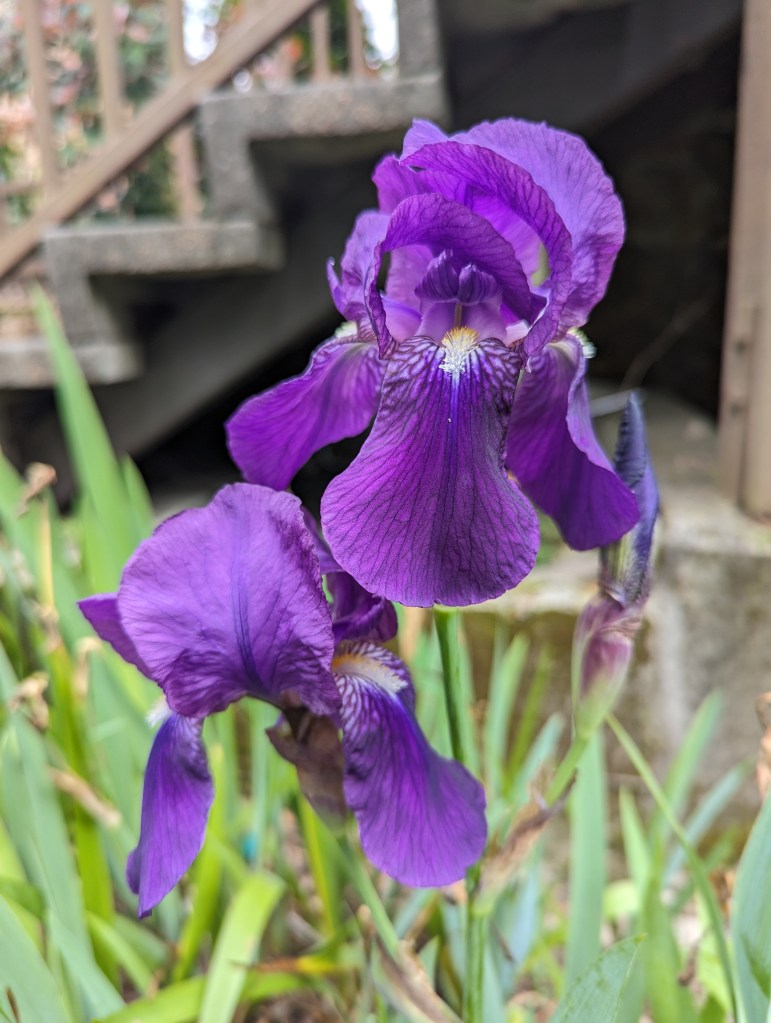
Bearded iris blooms after spring bulbs.

There may be no other flowers that exhibit such a diverse range of floral colors. Bearded iris, Iris X germanica, classifies as a hybrid of Iris pallida and Iris variegata. The genus of Iris derives its name from the Greek word for rainbow. As the name implies, it includes all colors of the spectrum. Floral form, height and, for some, fragrance is also quite variable.

About sixty thousand cultivars of bearded iris are supposedly documentable. It is difficult to estimate how many lack documentation. The smaller miniature cultivars are only a few inches tall. The tallest cultivars may grow four feet tall. Although they classify as summer bulbs, they are fleshy rhizomes that bloom for spring. Some will bloom again for autumn.

Bearded iris multiply whether or not anyone wants them to. Their rhizomes branch in two directions after bloom. Besides that, side shoots develop randomly from plump rhizomes. Congested rhizomes may bloom less. Division during summer promotes bloom. Division may happen annually or every few years. Bearded iris prefer sunny and warm exposure.

Blue Eyed Grass

It is more like an iris (of the floral sort, not the ocular sort) than a grass.

Contrary to its common name, blue eyed grass, Sisyrinchium bellum, is not a grass at all, but is like a diminutive iris. The modern cultivars that are more commonly found in nurseries are somewhat more colorful than the wild plants that are native to coastal areas between about Santa Barbara and Portland. Yet, even these are rather subdued, with small half inch wide blue or light purple flowers delicately suspended above bluish grassy foliage that may be as low as only a few inches, and is rarely higher than a foot. They bloom best in sunny but not too hot areas. Once established, blue eyed grass is not too demanding, but naturalizes and slowly spreads more reliably if watered occasionally through summer. However, they can rot if watered too generously or too frequently.  

Winter Flowering Cherry

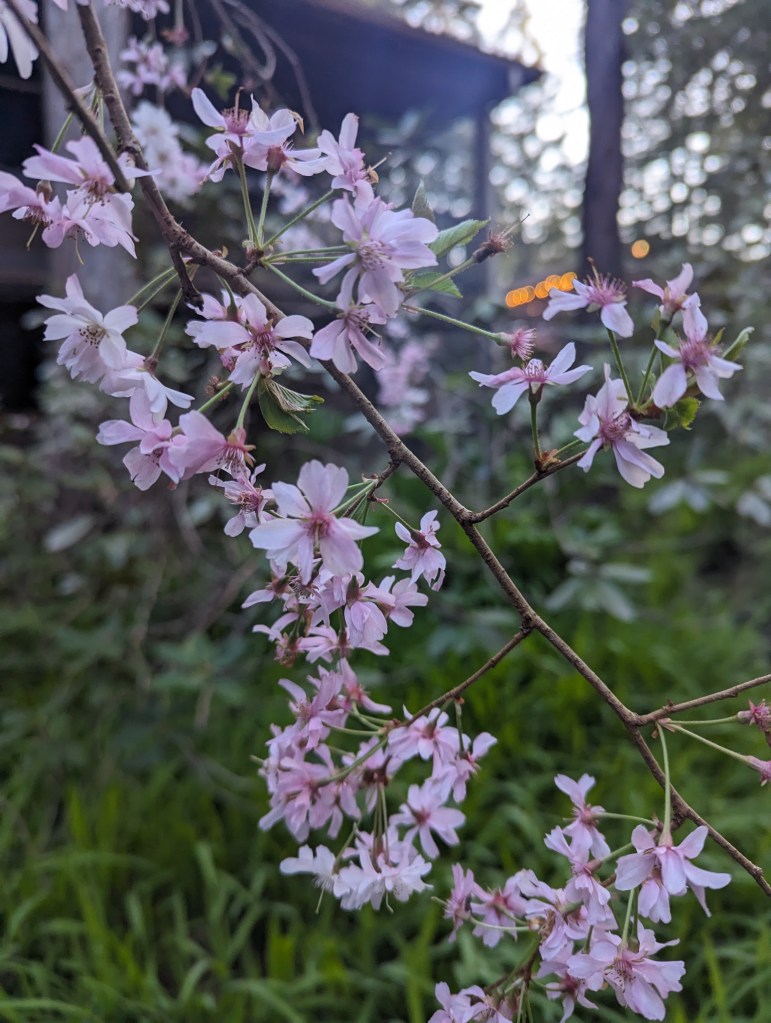
Such bloom seems a bit early.

Its name describes it simply. Winter flowering cherry, Prunus X subhirtella, is a flowering cherry that blooms for winter. It is more popular where winters are cool enough to inhibit other bloom. It is less common here only because of other options for wintry floral color. Besides, slightly more floriferous flowering cherries bloom almost immediately afterward.

WIntertime bloom is actually a bit more reliable here than where it is more popular. Frost is too mild locally to damage it much, and mostly occurs earlier. Rain is mostly too light and too brief to dislodge much of the bloom. Bloom is a bit less profuse than that of other cherries because it is a bit more continuous. Therefore, it recovers from minor damage.

The relatively common sort of this uncommon flowering cherry blooms for late winter. Its bloom is slightly lavenderish pink. Some rare cultivars can bloom as early as autumn or as late as spring. A few are pendulous. Floral color ranges from white to pink. Floral form is mostly single but can be double. Deciduous foliage turns yellow or orange for autumn.

Victorian Box

Victorian box does not get too big.

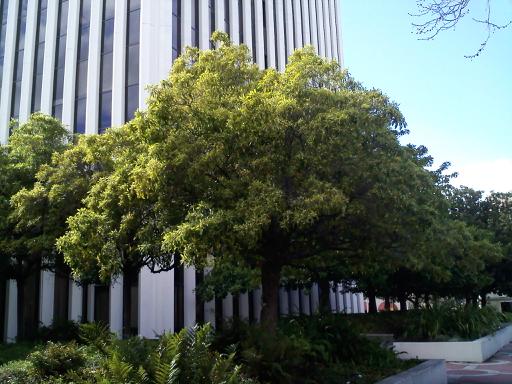
In the right situation, Victorian box, Pittosporum undulatum, is a nice small to mid-sized shade tree with dense foliage, sculptural branch structure and pleasantly fragrant spring bloom. In the wrong situation, it drops enough leaves, flowers and sticky seeds and bits of seed capsules to make quite a mess. This finely textured and sometimes sticky debris is easily absorbed into thick, shade tolerant ground cover like Algerian ivy, but is difficult to rake from pavement and to clean from roof gutters. Besides, even though Victorian box is not a large tree, the roots can eventually become aggressive enough to displace pavement.  

Young trees grow rather vigorously to about ten feet tall and wide, and then slow down somewhat as they continue to grow to as much as three times as tall and wide. They are easily contained with occasional selective pruning. The small, clustered flowers are not as impressive as their fragrance, adding only a bit of pale yellowish white color over the exterior of the rounded canopy. Some people, as well as birds, like the greenish olive-sized fruit that turns orange and eventually splits open to reveal sticky orange seeds within. (‘Pittosporum’ translates into ‘sticky seed’.) Leaves are about two or three inches long, or longer, with ‘undulating’ margins.  

Cabbage

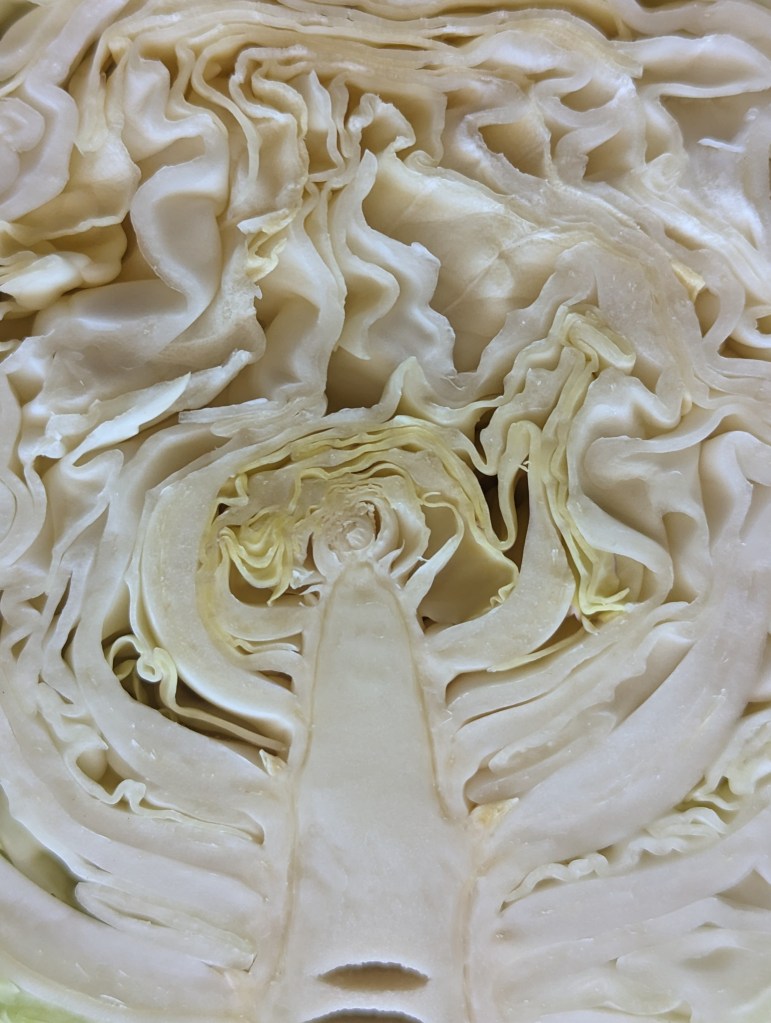
Cabbage is a cool season vegetable.

Resemblance to lettuce is merely coincidental. Cabbage, Brassica oleracea, is instead a close relative of very dissimilar vegetables. Brussels sprout, broccoli and cauliflower are different varieties of the same species. So are collard, kale and kohlrabi. All are winter cole crops. (Cabbage comprises the varieties of capitata, tuba, sabauda or acephala.)

Cabbage became seasonable last autumn. Its last phase is now maturing. It grows most easily from cell pack seedlings. Alternatively, it can grow from seed, which starts about a month and half earlier. Cabbage is biennial, so will go to seed if it stays in the garden too late. Warm weather initiates and accelerates the process, which ruins flavor and texture.

Green cabbage is the most popular type. Red cabbage is the second most popular type. Dutch white cabbage often classifies simply as a pale type of green cabbage. A mature cabbage weighs about a pound or two. Its loose outer foliage can be a foot to nearly two feet wide. Within more ideal climates, some varieties grow slower but significantly larger. With rain through winter, irrigation is probably unnecessary. Soil should be organically rich.

Tulip

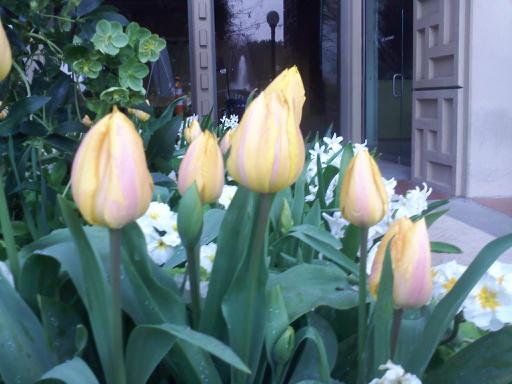
The soft pastel shades of these tulips brighten this somewhat shady landscape.

The mild winters that are so comfortable for us are not so desirable to tulip bulbs, which need to be chilled to perform as perennials. Consequently, they behave as brief season annuals locally. The most popular varieties have simple single flowers in white, yellow, pink, red, purple or pinkish orange. Double tulips are rather ruffled. Parrot tulips are larger and even more ruffled. As the names imply, lily-flowered tulips are shaped like small lilies, with pointy flared petals; and fringed tulips have finely serrate petals. Tulips stand between half a foot to two feet tall. Early types are already finished blooming. Late types, particularly if planted late, may bloom as late as early May.

Lettuce

Lettuce prefers spring and autumn weather.

Warm season vegetables are replacing cool season vegetables about now. Technically, lettuce, Lactuca sativa, is a cool season vegetable. It grows through spring and autumn though. The last of it can continue almost until May. Within the mildest coastal climates, it can continue later. By the time it finishes there, it is almost time to plant more for autumn.

After thousands of years of cultivation and breeding, lettuce is now remarkably diverse. Most popular varieties are leaf, head or romaine types. Leaf lettuce is mostly green, but can be bronze, reddish or irregularly blotched. Most varieties develop loosely ruffly foliar texture. Romaine and head lettuce is denser but larger. Some grow a foot high and wide.

One commonality among lettuce varieties is that they tolerate neither frost nor arid heat. Some are a bit more tolerant of one or the other, which can prolong their season. Some of the larger romaine and head types need nearly four months to mature, though. Only a single phase matures within each season. Smaller types might mature in about a month.

Hyacinth

Hyacinth is one of the earliest of spring bulbs, and is notably fragrant.

If their bulbs got into the garden early enough last autumn, Dutch hyacinth, which are hybrids of Hyacinthus orientalis, are now blooming with cartoon shades of red, blue, yellow, purple, pinkish orange, pink and white. The small, surprisingly fragrant flowers are neatly arranged on plump, bottle-brush shaped flower trusses up to eight inches tall. Their typically arching, rubbery, strap shaped leaves look like small lily-of-the-Nile leaves. Some types have more vertical foliage.

Like many bulbs and bulb like plants, hyacinth are unfortunately not reliably perennial in such mild climates. They prefer cooler winters. Consequently, they are typically grown only as annuals. However, I am aware of hyacinth that not only bloom annually, but have been multiplying nicely over the years in a few local gardens. Their flowers spikes are never as full as they were in their first season, but are appealing nonetheless. I actually prefer the less refined style of naturalized hyacinth.

French Roman or Roman hyacinth, Hyacinthus orientalis albulus, are still somewhat rare, but should be more common since they naturalize more reliably without cold winters. Each bulb produces a few flower stems with smaller and more loosely arranged pink, pale blue or white flowers.

Large hyacinth bulbs are easily forced to bloom suspended just above water by small stones in bowls, or individually in hyacinth glasses (vases that hold bulbs just above water). Forced bulbs should be kept in the dark until rooted, and can be moved out as foliage appears. They are as colorful as tulips and as fragrant as narcissus; but sadly, are not likely to survive after being forced.  

Celery

Celery season conforms to local climate.

It could be either a warm season vegetable or a cool season vegetable. Celery, Apium graveolens variety dulce, dislikes both frost and arid heat. It is a warm season vegetable where summer is mild but winter is not. It is a cool season vegetable where winter is mild but summer is not. Where winter is cold and summer is hot, it prefers spring and autumn.

Celery is a biennial, which grows vegetatively for its first year, and blooms for its second. Because it is ready for harvest in less than half a year, bloom is not a concern. Any that mature enough to bloom are too tough to eat. Celery appreciates organically rich soil. It needs regular watering. Growth is irregular if its soil becomes too dry, even temporarily.

Celery naturally grows as densely vertical foliar rosettes, or bunches. Its distended and elongated petioles are its primary edible parts. Its disproportionately small leaflets are also edible though. Mature celery grows about a foot and a half to two feet tall. It grows well from cell packs if only a few bunches are necessary. It also grows well from seed.