New Guinea Impatiens

New Guinea impatiens can be perennial.

Busy Lizzie had been unavailable for years because of a downy mildew epidemic. It has only recently been regaining availability and popularity. During its absence, New Guinea impatiens, Impatiens hawkeri, became more popular. Although a closely related species of the same genus, the two are actually very different. Resistance to mildew is important.

Besides that, New Guinea impatien is about as foliar as it is floral. Its bolder and slightly bigger flowers are notably less abundant than those of busy LIzzie. Also, its floral color range is limited to white, pink, red, lavender, magenta or orange. Its rich green or bronze foliage below compensates though. Many cultivars are variegated with yellow or salmon.

New Guinea impatiens are unfortunately a bit more expensive than most other annuals. The smallest that are available are in four-inch pots. They are unavailable in smaller and less expensive cell packs. They can grow about a foot wide and slightly taller if crowded. During winter, they deteriorate; but they can be tender perennials with shelter from frost.

Arizona Cypress

Established Arizona cypress needs no irrigation.

Although not native, Arizona cypress, Hesperocyparis arizonica, behaves as if it is. It is native to deserts and chaparrals of Mexico, New Mexico and, of course, Arizona. Hence, new specimens only require irrigation until they disperse their roots. Afterwards, they are satisfied with seasonal rainfall. They are more resistant to pathogens than other cypress.

Most modern Arizona cypress cultivars are bluish gray with densely conical form. A few are yellowish, pendulous or columnar. ‘Blue Ice’ is a strikingly silvery bluish gray cultivar of smooth Arizona cypress. Most old Arizona cypress trees exhibit significant variation because they grew from seed. Some develop irregular form or more greenish drab color.

In the wild, Arizona cypress can grow taller than sixty feet. Locally, few get forty feet tall, particularly since modern trees are compact cultivars. Most stay less than twenty feet tall, and some stay about half as wide as they are tall. They work well as informal evergreen hedges. Smooth Arizona cypress exfoliates rough outer bark to expose smooth red inner bark. It is Hesperocyparis arizonica variety glabra.

‘Citriodora’ Monterey Cypress

This cultivar is also known as lemon cypress.

            Supposedly, ‘Citriodora’ Monterey cypress, Cupressus macrocarpa ‘Citriodora’, can get more than thirty feet tall and nearly as wide. Yet, it grows slowly enough to function like small trees or large shrubs. Even if it eventually gets a bit too large, it is much more conducive to occasional pruning than typical Monterey cypress is, and can even be artfully pruned into informal hedges. (However, nonselective shearing deprives if of its naturally appealing form.)

            With its lemon yellow foliage, ‘Citriodora’ Monterey cypress resembles golden arborvitae, but is even brighter yellow and has distinctive cypress-like branch structure. Its older foliage within eventually turns darker green to add depth and enhance the structure. ‘Citriodora’ Monterey cypress looks best locally if at least partially shaded by larger trees during the afternoon.

Blue Gum

Blue gum easily outgrows home gardens.

Almost no one adds blue gum, Eucalyptus globulus, to a landscape intentionally. Almost everyone who is familiar with it understands why. It is much too big and much too messy. Even where space is sufficient for it to mature, it is innately hazardous. It sheds big limbs from very high up. It often disperses its roots too shallowly to maintain adequate stability.

However, blue gum inhabits a few home gardens. Some were already there as gardens developed around them. Some grew from seed from nearby trees. Blue gum naturalizes in some regions. Mature trees are tall enough to share their shade, debris and seed with a few gardens. The copious debris inhibits weeds, but also inhibits desirable vegetation.

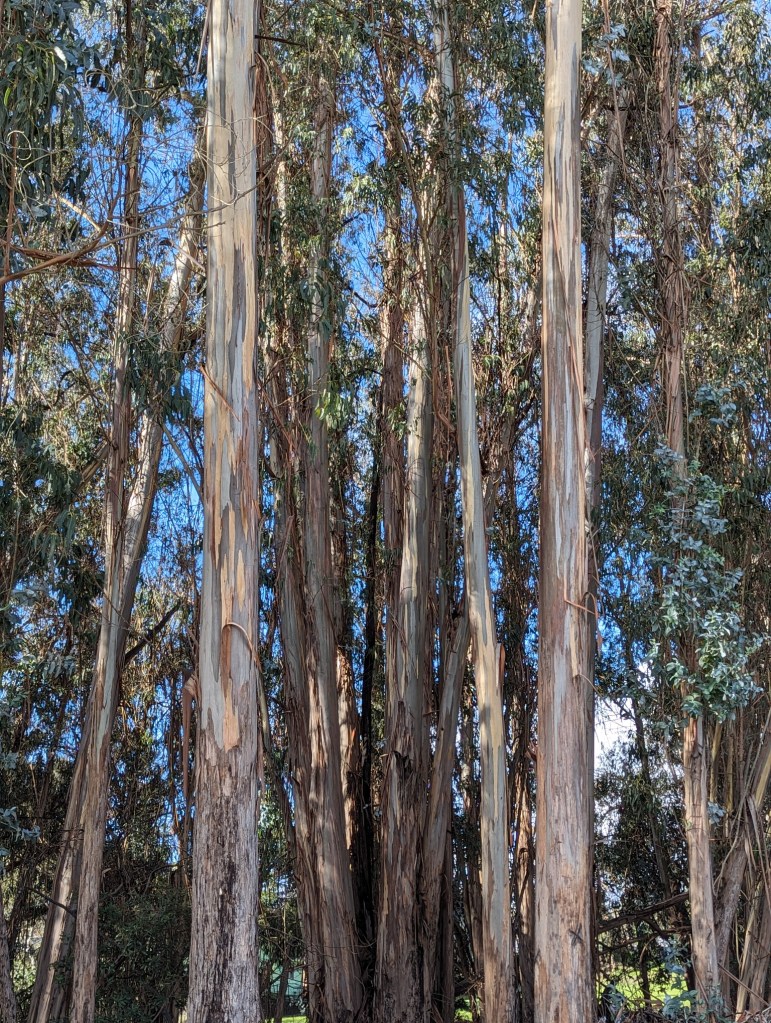
Blue gum in the wild is one of the tallest trees in the World. Naturalized trees commonly grow more than a hundred and fifty feet tall here. They stay shorter in windy situations. The tall and straight trunks constantly shed long strips of smooth tan bark. Fresher bark is tan, gray, greenish or even pinkish. The curved lanceolate leaves are quite aromatic. Ovoid juvenile leaves are bluish gray, and even more aromatic. Fuzzy staminate bloom is white.

Chrysanthemum paludosum

Chrysanthemum paludosum goes into the garden early here.

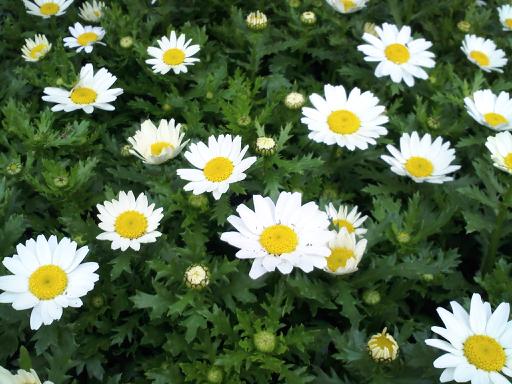
            In cooler climates, where winters are too harsh but summers are just right, Chrysanthemum paludosum is a warm season annual. Locally though, it gets planted about now like pansies, stock and Iceland poppies.  Chrysanthemum paludosum does just fine through late winter, and does even better as the weather gets warmer in spring. It can be replaced with real warm season annuals as weather eventually gets too warm and dry (lacking humidity) in summer. In cool and damp places, it can survive through summer. Chrysanthemum paludosum develops into six inch wide mounds of rich green and finely textured foliage adorned with small white daisy flowers with yellow centers.

Asian Taro

Asian taro leaves grow very big.

Both alocasias and colocasias are striking foliar plants. Alocasias generally develop big leaves that point upward. Colocasias generally develop even bigger leaves that hang downward. Alocasias are generally more colorful, perhaps with striking foliar patterns. Also, most tolerate more shade than colocasias. Of course, these are generalizations.

Asian taro, Alocasia odora, resembles colocasias as much as alocasias. Its big cordate leaves may point only slightly upward, and might sag downward. They can grow two feet long and a foot wide, on petioles as long as three feet. Collectively, foliage can get more than five feet tall. It is bright but monochromatic green, similar to that of Kermit the Frog.

Asian taro is only occasionally available from nurseries. Small plants are too delicate for nurseries to market too many of them for too long. Their dormant bulbs are more likely to become available with summer bulbs. They can be wider than three inches! They grow slowly though, especially while weather is cool. Foliage may not appear for two months.

Mexican Weeping Bamboo

Mexican weeping bamboo is more appealing in abundance.

Like junipers, bamboos have gotten a bad reputation from only a few of their problematic specie. Many of the traditional running bamboos really are too aggressively invasive. However, there are many clumping bamboos that are much more adaptable to confined and refined garden areas. Even these complaisant bamboos remain uncommon though, both because of the unpopularity of bamboos, and because they are not so easily produced.

            Mexican weeping bamboo, Otatea acuminata aztecorum, is certainly one of the more interesting of these clumping bamboos. Their limber inch and half wide stems are not nearly as rigid as those of most other bamboos are, and may bend down to the ground under the weight of their abundant and remarkably finely textured foliage. The four or five inch long leaves may be only an eighth of an inch wide. Both the stems and foliage move nicely in even slight breezes.

            Established plants are somewhat resilient to neglect, but can get rather yellowish and will likely stay less than ten feet tall without regular watering. With regular watering and monthly application of nitrogen fertilizer, such as lawn fertilizer, during warm weather, they can get twice as tall. Old canes should be pruned to the ground as they begin to deteriorate. There should be plenty of fresh new stems to replace them.   

Lime

Most ripe limes are greenish yellow.

Among citrus, limes are the most diverse. They include more species and hybrids than other types of citrus. Only a few of countless cultivars from centuries of development are available here. Yet, each of these few is very distinct from the others. Most provide juice for culinary application. At least one provides herbal foliage. Few limes are eaten intact.

Dwarfing understock is one commonality of almost all home garden lime trees. Not many grow more than twelve feet tall. With occasional pruning, most might stay less than eight feet tall. All have bright green evergreen foliage and small white flowers. Most have tiny but sharp thorns. Some are more bothersomely thorny. Fruit is green or greenish yellow.

‘Bearss’ lime is the most popular. Its ripe fruits are about three inches long, and resemble greenish lemons. ‘Mexican’ lime provides fruits that are about an inch and a half wide, on thorny stems. ‘Palestine’ lime is thorny also, with round and yellowish fruit that is edible intact. ‘Rangpur’ lime produces bright orange fruit because it is really a sour mandarine.

Horsetail

The allure is more in the form than in the bloom.

            It is no wonder that the many specie of horsetail have been around since the Carboniferous Age. They seem to be impossible to kill! Because they can be so invasive and persistent, they should be confined to planters or areas of the garden where they can be controlled. They should probably be kept away from thickly foliated areas where they can spread and mix with other plants unnoticed.

            Even though they are among the oldest plant specie, they seem well suited to modern architecture. Besides, the narrow areas between modern residences, walkways and driveways are confining by nature. Many modern buildings are even outfitted with awkwardly narrow planter areas that could use plants that get three or four feet tall without spreading out laterally, just as Equisetum hyemale, the most common species of horsetail does. The partial shade and potentially bad drainage in these confined spaces is not a problem.

            The hollow segmented stems are rich green with black or dark brown joints. Some specie of horsetail have symmetrical whorls of wiry stems radiating from their joints. Otherwise, no other foliage is evident. Small knobs on top of the stems produce rusty brown spores. The larger types of horsetail are more likely to become invasive. Equisetum scirpoides stays about half a foot tall and is relatively complaisant. I do not know the identity of the horsetail that I got this picture of; but it has unusually large spore ‘blooms’ and a more relaxed texture.  

California Sycamore

California sycamore develops massively gnarly trunks.

The tallest, largest and oldest trees of the World are all native to California. So are the rarest pine, rarest fir and largest oak. California sycamore, Platanus racemosa, is loyal to this tradition of distinction. Although not the tallest sycamore, it might be the grandest. It develops gnarly and sculpturally irregular form. Some develop multiple massive trunks.

Because of its scale, California sycamore is uncommonly available from nurseries. It is simply not proportionate to home gardens or even big landscapes. Most old specimens are older than the landscapes around them. They are somewhat adaptable to landscape irrigation. However, increased moisture increases potential for spontaneous limb failure.

California sycamore can grow a hundred feet tall with bulky trunks and limbs. Old trees may exhibit scars from shedding limbs throughout their long lifespans. The mottled bark is gray and tan, and roughens only slowly with age. The deciduous foliage of such large trees is very copious through a long defoliation. Foliar tomentum (fuzz) is quite irritating.