The thick clumps of evergreen grass-like foliage of mondo grass, Ophiopogon japonicas, make a nice lumpy ground cover for small spaces. Because it is rather tolerant of shade, and actually prefers partial shade to full sun, it works nicely under Japanese maples or highly branched overgrown rhododendrons. It gets only about half a foot deep. Narrow stems with small pale purplish blue flowers that bloom in summer are not too abundant, and are generally obscured below the foliage, but can actually get taller. ‘Silver Mist’ is variegated with white.
New plants are easily produced by division of large clumps. Overgrown or tired looking clumps can be shorn down at the end of winter, before new growth begins. Slugs and snails can be problematic.
The identities of the many different garden varieties are vague. Most are likely hybrids. A few might be simple species. Some that seem to be hybrids are really cultivars of simple species. Regardless, most flowering maples collectively qualify as Abutilon X hybridum. If all were hybrids, as their name implies, none would generate viable seed, as some do.
Flowering maple can grow somewhat fast, but tends to be lanky if it does so. It should be a bit fuller with slower growth or minor tip pruning. Several cultivars grow no higher than doorknobs, but others reach first floor eaves. Flowering maple demands regular watering and rich soil. It enjoys humid warmth, but may roast in arid heat with harsh sun exposure.
Bloom is sporadic from late spring until frost. The flowers resemble those of hibiscus, but are no more than three inches broad. Most are pastel tints of yellow, orange or pink, with prominently richer veining. Some are red, burgundy red or creamy white. The light green or variegated foliage may get a bit sparse through winter. Foliar lobes are quite variable, or lacking.
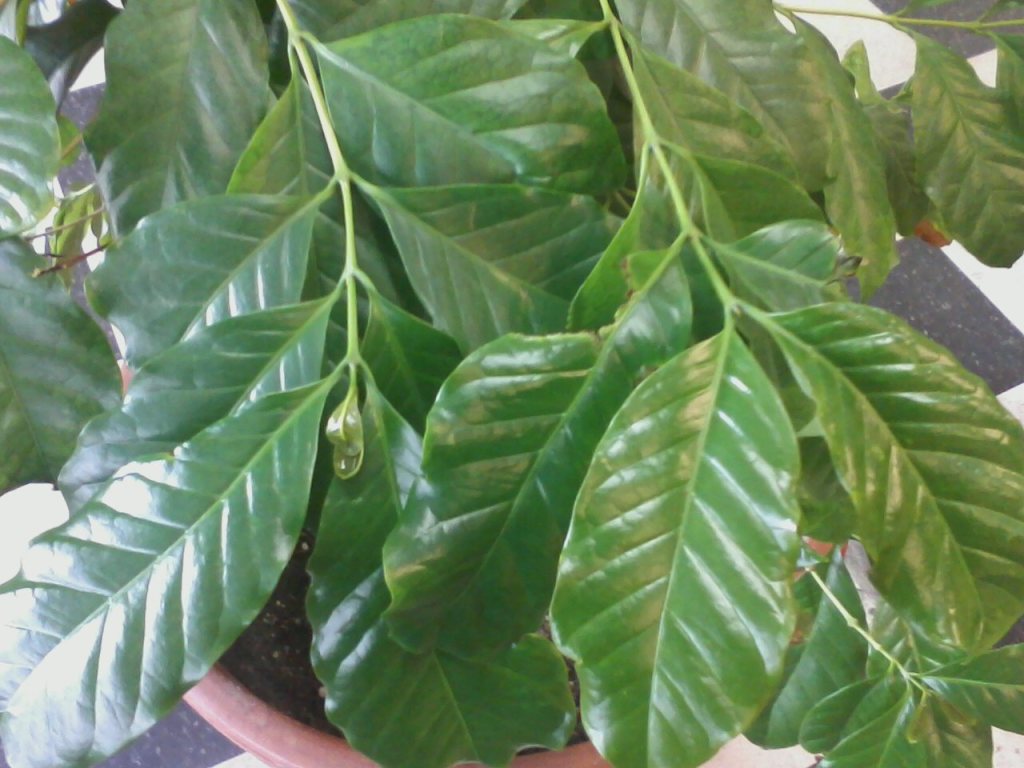
It looks more like a houseplant than the source of coffee.
The White Raven Coffee Shop, the best little pourhouse in Felton, has an interesting but old fashioned houseplant on the counter. This group of four small but rapidly growing coffee trees, Coffea arabica, was a gift from a loyal customer.
Mature plants can get to thirty feet tall in the wild. Fortunately, coffee trees are easy to prune to fit interior spaces. Pruning for confinement is actually better than relocating big plants outside, since they do not like cold weather and are sensitive to frost.
Like various species of Ficus, coffee is appreciated more for lush foliage that happens to grow on a tree that can be trained by pruning to stay out of the way, overhead or in other unused spaces or corners. The simple remarkably glossy leaves are about two and half inches long or a bit longer. The very fragrant small white flowers are almost never seen among well groomed houseplants, and only rarely and sporadically bloom among less frequently pruned larger trees in greenhouses and conservatories.
The half inch wide coffee fruit, which is known as a ‘cherry’, is even more rare than flowers among houseplants because of the scarcity of both pollinators and pollen (from so few flowers). Those fortunate enough to get flowers sometimes pollinate them with tiny paintbrushes or clean make-up brushes to compensate for a lack of insects about the house. The resulting bright red or somewhat purplish cherries barely taste like cherries and only make two coffee ‘beans’ each; not enough to bother roasting and grinding for coffee, but great for bragging rights.
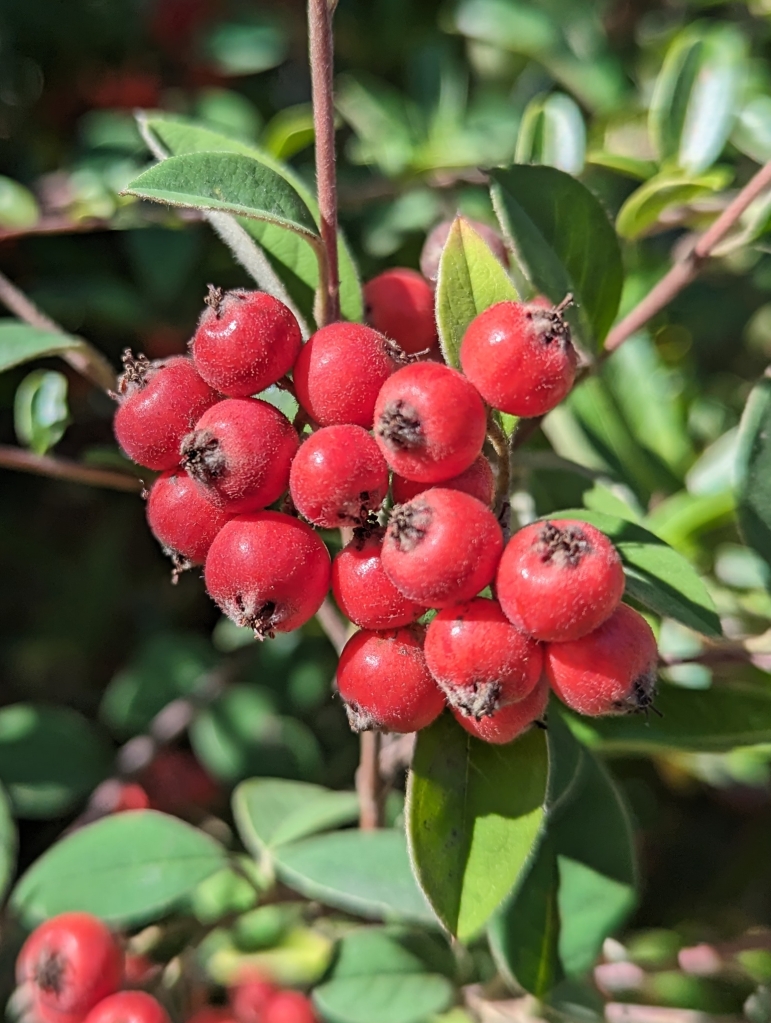
Silverleaf cotoneaster berries are subtly colorful.
Its prevalence within a few wild ecosystems suggests that it is native. In actuality, it likely naturalized here only after the Gold Rush. Silverleaf cotoneaster, Cotoneaster pannosus, is native to southern central China. It likely came here with the influx of Chinese laborers after 1848. It was a common component of the original landscapes of Golden Gate Park.
Nowadays though, silverleaf cotoneaster is rare within refined gardens. Modern cultivars and other species are more adaptable. Silverleaf cotoneaster naturally develops broadly outwardly flaring form. Pruning that damages its natural form causes awkwardly angular form. Ironically, undesirable feral specimens often develop the best form without pruning.
Silverleaf cotoneaster can get more than ten feet tall, and nearly twice as wide. Removal of old trunks to their bases promotes more vigorous new growth. Alternatively, removal of low growth promotes taller tree form on arching trunks. The small camo green leaves are unremarkable. The copious red berries that ripen for autumn are very appealing to birds.
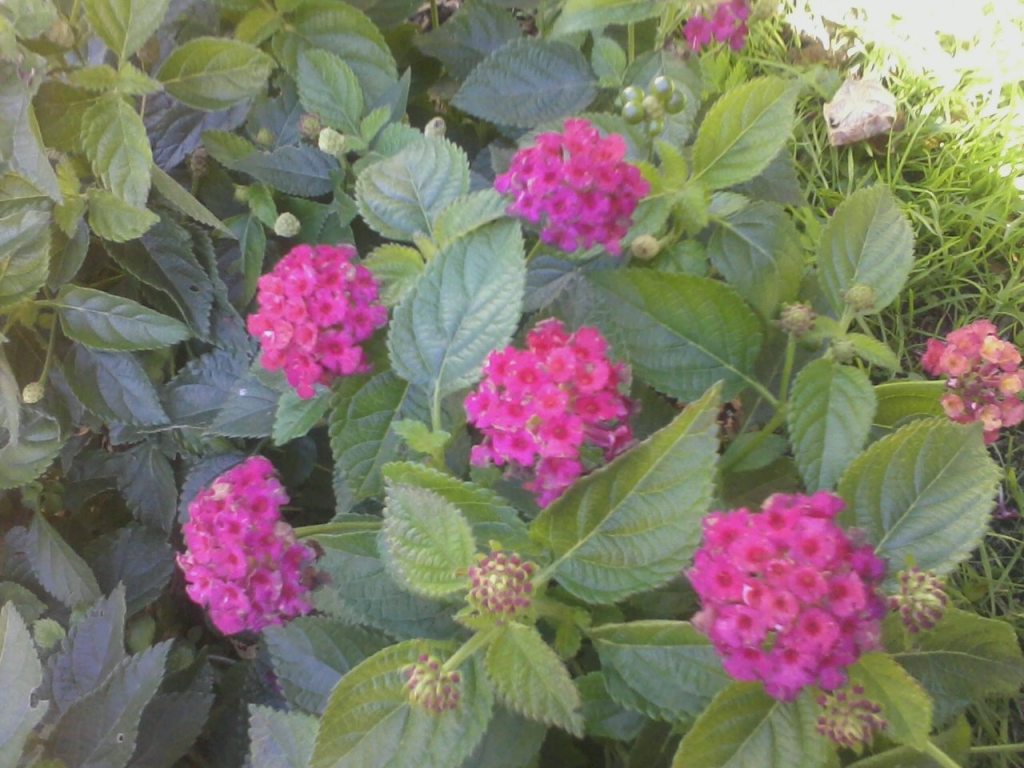
Even as most flowers of summer are finishing, the bright yellow, orange, red, pink and white blooms of Lantana camara continue to brighten gardens until the weather eventually gets too cool and damp for them to perform. This is quite impressive for a species that is endemic to the tropics of Central America, and has a taste for warmth. Blooms are actually one to two inch wide umbels of many small flowers. Individual flowers within each umbel may be different colors at different phases, so that each umbel may have blooms in as many as three different colors.
In the wild, Lantana camara can get almost six feet high and more than six feet broad. Garden varieties are of course much smaller and compact. Since Lantana camara does well in containers, a few cultivars that stay very compact and proportionate to container gardening have been developed, but unfortunately remain somewhat uncommon in nurseries. The potentially objectionably aromatic leaves are about two or three inches long and one or two inches wide, with minor serration and slightly sandy texture. Some dislike the foliar aroma, but many enjoy it.
Lantana camara is not too demanding, wanting only good warm exposure with no more than a bit of shade. Once established, it does not need much water, and can actually rot if watered too frequently, or if soil does not drain adequately. Excessive fertilizer will inhibit bloom. There are not many insects that bother Lantana camara, perhaps because it has an unpleasant flavor. It is actually toxic to animals that may try to eat it. However, butterflies really dig it.
Only a few counties within California lack native California black oak, Quercus kelloggii. Yet, it is not prominent where it is native locally. It generally inhabits mixed forests within the Coastal Ranges. It is rare among home gardens, and rarely available from nurseries. Within the Sierra Nevada, it is common enough to be harvestable as a hardwood timber.
With good exposure, mature California black oaks may get no taller than thirty feet. They can get twice as tall where they must compete with tall trees. The largest trees are higher than a hundred feet. Their elegantly upright trunks are generally less bulky than those of other oaks. Few are more than four feet wide. Gray bark darkens and roughens with age.
The deciduous foliage of California black oak is almost brownish drab green. It becomes brownish yellow prior to defoliation. Cooler weather enhances brighter yellow or orange color, but also accelerates defoliation. Foliage can linger into winter with milder weather. The handsomely lobed leaves are about four inches long, and bigger on vigorous stems. The docile roots are vulnerable to rot with frequent watering.
Boston fern is merely one of several cultivars of Nephrolepis exaltata. Its cultivar name is ‘Bostoniensis’. Variegated Boston fern, or tiger fern, is reputedly a cultivar of this cultivar. Its cultivar name is either ‘Variegata’ or ‘Tiger’. From a distance, it seems to be a yellower version of the original. Prettily intricate stripes become apparent with closer observation.
Variegated Boston fern is a bit smaller and a bit less vigorous than common Boston fern. Like all variegated cultivars, it works with a bit less chlorophyll. Mature potted specimens might get no wider or higher than three feet. Unvariegated Boston fern can be more than four feet from top to bottom. Both could be larger if their long fronds were less pendulous.
In home gardens, variegated Boston fern can get rather tattered through winter. It is likely to defoliate if exposed to even minor frost. This is why it is more popular as houseplants, usually in hanging pots. Such potted specimens rely on consistent watering. Diffused but bright sunlight is best. Occasional application of fertilizer enhances foliar color and vigor.
Georgia O’Keeffe made jimson weed flowers famous. Within the context of her paintings, they seem to be angel’s trumpet flowers. Californians know its species as sacred datura, Datura wrightii. It is as native here as where Georgia O’Keeffe observed and painted it in New Mexico. For refined gardens, though, it is rare. It lives almost exclusively in the wild.
There are a few reasons for this. Sacred datura is a sloppily sprawling perennial that can quickly grow eight feet wide. It is not reliably perennial though. It might perform for only a single season, and then suddenly die. The spectacular flowers close through the middle of the day. Seed capsules are annoyingly bristly. Worst of all, sacred datura is very toxic.
Otherwise, sacred datura is as appealing as Georgia O’Keeffe depicted it to be. Its grand flowers resemble those of angel’s trumpet. They stay open longer during cool and damp weather. Foliar color is creamy white, perhaps with a slight lavender blush. Fragrance is mild only because bloom is so close to the ground. Big specimens can get three feet tall. The foliage has a velvety texture.
One of the less common and certainly least familiar of junipers happens to be the most culturally and environmental significant juniper in North America, even though it is not even known as a juniper. Juniperus virginiana is instead known as the Eastern red cedar. It has a vast range, including every state east of Colorado, as well as Quebec, Ontario and even Oregon to the west. In some areas within and near the natural range, fire suppression has allowed Eastern red cedar to become invasive.
Mature trees are mostly less than fifty feet tall, but are the biggest evergreen trees in Kansas nonetheless. The largest Eastern red cedars can get almost ninety feet tall. Most are well branched from top to bottom unless pruned for clearance. The fibrous bark is ruddy brown, but not often seed from the outside.
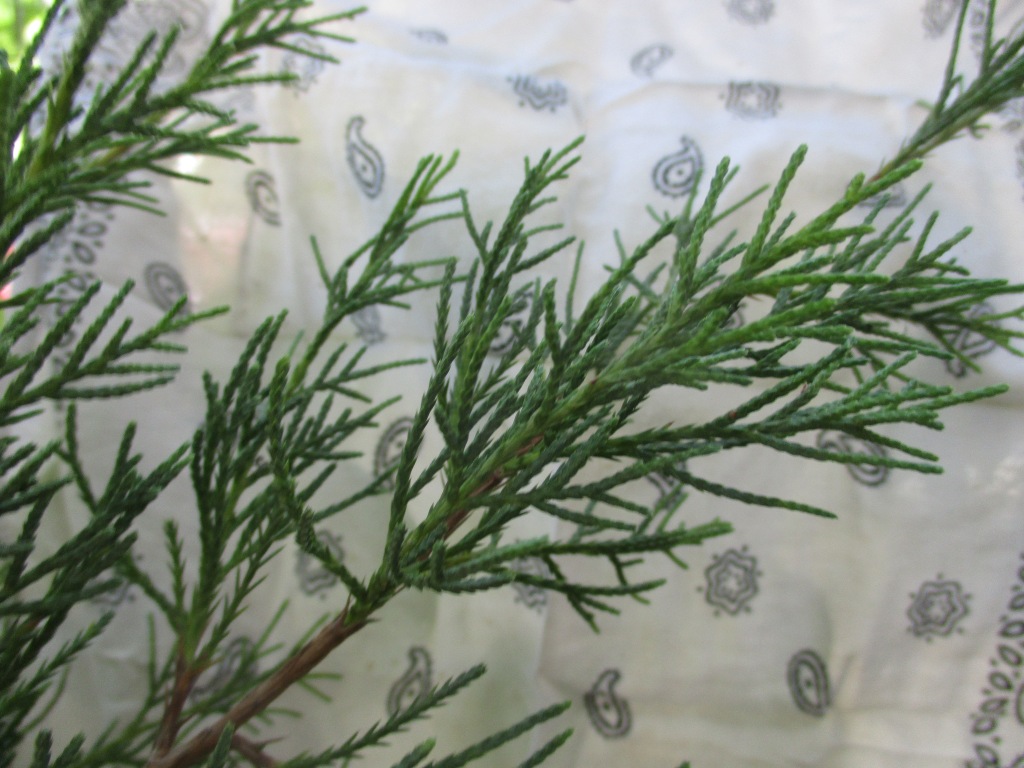
Foliage and fruit are rather variable. The prickly juvenile leaves of young plants and interior stems of mature plants can be rather annoying. The scale-like adult leaves are more typical of junipers. Male trees produce pollen that can be a significant allergen. Female trees produce sporadic, small berries in blue or purplish black, that are quite popular with certain birds through winter.
Prior to the discovery of the incense cedar in the west, Eastern red cedar was the common aromatic cedar that was used to make pencils and to laminate cedar chests and closets to protect woolens and natural fibers from moths. Since it is so repellent to insects and decay, it is commonly used as fence posts. Native American Indians also used posts of Eastern red cedar, painted red with blood of the animals they hunted, to mark the boundaries of their hunting ranges. The name of Baton Rouge, which means ‘red stick’, was actually derived from such marking posts.
During the Dust Bowl drought of the 1930s, and before becoming known as a potentially invasive species, Eastern red cedar was promoted by the Prairie States Forest Project as a resilient wind break. They tolerate drought, harsh exposure and inferior soil. They can be planted close together to fill out and gain height more efficiently. More information about Eastern red cedar can be found where I got much of this information, at the Great Plains Nature Center.
Maple sugar production has not always been exclusive to northeastern North America. In fact, it is not exclusive to sugar maple. Big leaf maple, Acer macrophyllum, also provides maple sugar in British Columbia. It is native from the southern extremity of Alaska to San Diego County. Most of its range is generally coastal but also includes the Sierra Nevada.
Bigleaf maple is one of merely two native maples here. It is more common within riparian ecosystems and at higher elevations. However, it is rare among home gardens because it is so vigorous and grand. Its aggressive roots eventually buttress, and are likely to ruin lawns and pavement. Autumn defoliation of big trees releases big volumes of big leaves.
Bigleaf maple can grow almost fifty feet tall and wide within sunny suburban landscapes. It can grow a hundred feet taller where it competes for sunshine within coastal forests! Its palmately lobed leaves are typically wider than six inches. They can be twice as wide on vigorous stems. Foliage turns yellow for autumn. Seedlings might be annoyingly prolific. Local climate is unfortunately not conducive to practical sugar collection and refinement.





 Tony Tomeo