Broom

Most broom is an aggressively invasive weed.

French, Spanish, Mediterranean and common brooms are the most familiar of the brooms because they are among the most invasive and aggressive of weeds in rural areas. Many other brooms (that are primarily within the two genera of Cytisus and Genista) that are tame enough for home gardens unfortunately share the bad reputation, even though many of the modern varieties are hybrids that do not even produce viable seed. Once established in sunny, well drained sites, brooms are not at all demanding.

Broom bloom is almost always bright yellow, although a few varieties of broom have white, pink, pale orange or even purplish flowers. Most have finely textured evergreen foliage. Others are foliated only for a short time in spring before they drop their foliage in early summer to reveal distinctive bare green stems. The most popular modern varieties are fluffy, low shrubs less than four feet tall. Some of the more traditional types get taller than ten feet.

Sword Fern

Sword fern can migrate surprisingly vigorously.

It seems to be related to Boston fern because it is. Sword fern, Nephrolepis cordifolia, is a less refined species of the same genus. It does not want to live as a docile houseplant. Instead, it prefers room to grow and spread in the garden. It has potential to spread a bit vigorously though. Containment protects adjacent smaller perennials or bedding plants.

Sword fern foliage is the same light and slightly yellowish green as that of Boston fern. It generally stands more upright though. Rather than hang softly from planters, like Boston fern does, it leans outwardly. Its pinnately compound fronds can grow almost two and a half feet tall. Pinnae might be about an inch and a half long, with a slightly grainy texture.

Sword fern is not particularly discriminating about exposure, moisture or soil. It can cling to trunks of Canary Island date palms and infest their canopies epiphytically. Sword fern is greenest with regular irrigation and shelter from harsh exposure though. Its evergreen foliage can discolor and partially defoliate when distressed. Grooming might be tedious. Healthy colonies may hide their old foliage.

Fruitless Mulberry

Fruitless mulberry is conducive to pollarding.

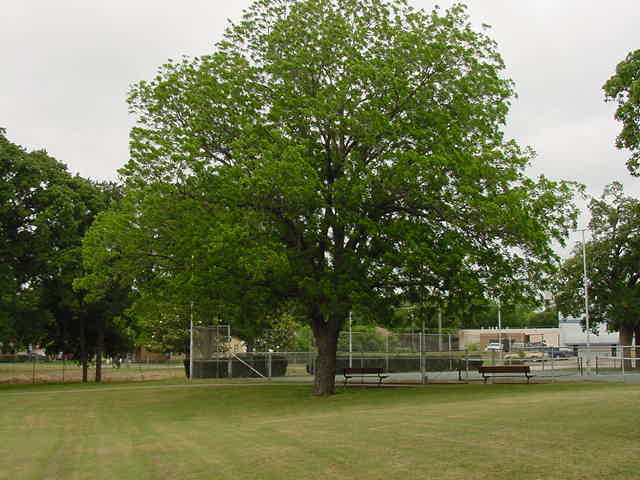
Even though silk never became a major commodity in North America, it indirectly made an impression on American gardening. The tree that was developed to most efficiently feed silkworms is now among the most popular of shade trees. The fruitless mulberry, Morus alba, wastes no resources producing fruit while providing only abundant foliage, which is the only sustenance for silkworms.

Young trees grow at a good rate to nearly thirty feet tall, and can eventually reach fifty feet. They are often pollarded (pruned severely back to the same burly ‘knuckles’ every winter), which causes them to regenerate stems at an alarming rate during summer. Shoots from mature pollarded knuckles have no problem reaching fifteen feet in all directions! Mulberries incidentally have the distinction of the fastest motion known to the plant kingdom, because they launch their pollen at more than half the speed of sound!

The serrate leaves are quite variable. Those of vigorous young shoots of pollarded trees are mostly about six inches long with rounded wide lobes, but can be nearly a foot long! They turn bright yellow and typically fall neatly from the tree within a limited time in autumn, facilitating raking. Leaves on slower growing stems of lightly pruned mature trees are mostly unlobed and less than six inches long. They begin to fall earlier in autumn and linger over a longer time, sometimes with slightly subdued autumn color.

Yarrow

Yarrow is a popular American wildflower.

It is endemic to every Californian County except for only Imperial County. It is endemic to every American State except for only Hawaii. Yarrow, Achillea millefolium, gets around! It is also endemic to many temperate climates of Europe and Asia. Apparently, it is not very discriminating in regard to climate or soil. It is as happy at the coast as it is farther inland.

Wild yarrow mostly bloom white or with pink blush. Modern cultivars bloom various hues of yellow, orange, red, pink or pinkish lavender. A few of the most florific modern cultivars are hybrids with other species. Phases of bloom might continue from spring until autumn. Tiny flowers form dense corymbs as broad as five inches, on stems as high as three feet.

Ferny grayish or light green yarrow foliage has a softly fine texture. However, it develops compact and mounded form. Individual leaves are tomentous and as long as six inches. Foliar aroma is variable among cultivars. Some cultivars may be objectionably pungent. Propagation by division of any overgrowth is easiest prior to the end of the rainy season.

Star Jasmine

Delightfully fragrant star jasmine can be either a ground cover or a climbing vine.

The strong fragrance of the inch-wide, star shaped flowers of star jasmine, Trachelospermum jasminoides, gets attention from quite a distance. Whether they bloom lightly in partial shade, or profusely enough to obscure nearly half of the foliage below, their crisp white shows up nicely against the rich waxy green of the simple two or three inch long, and inch wide leaves. Star jasmine is among the more complaisant of vines, so only climbs or creeps along the ground to about ten feet; perhaps twice as much when very mature.

Barberry

Modern barberries display bold foliar color.

Its abundance of small but very sharp spines are both a blessing and a curse. Barberry, Berberis thunbergii, can work like vegetative barbed wire. An intruder might get through its thicket growth of limber stems once. Its unavoidable thorny nastiness will dissuade a second attempt. Unfortunately though, the same thorny nastiness is unpleasant to prune.

Ironically, most barberry is aesthetic rather than utilitarian. Popular modern cultivars are bright yellow or dark purplish red. Variegation is still rare. Most cultivars are less than six feet tall. Some are very dense and less than two feet tall. Old fashioned green barberry that gets ten feet tall is now uncommon. Autumn foliar color is exquisitely red or orange.

Barberry works splendidly as a low shorn hedge, although it defoliates through winter. Its naturally billowy, flaring or upright form is even more splendid unshorn. Congested older specimens regenerate vigorously after winter coppicing. Small ovate leaves constitute a refined foliar texture. Tiny bright red berries are rarely observable before birds find them.

Sweet Flag

Sweet flag is a riparian perennial that performs well in saturated soil.

After many centuries of being grown for use in herbal medicine, sweet flag, Acorus gramineus, is still a popular evergreen perennial; but is now appreciated more for its low mounds of grassy foliage. ‘Ogon’, one of the most popular cultivars, has light yellow variegated foliage that contrasts well with deep green foliage, or brightens partially shaded spots in the garden. Individual clumps grow quickly to about eight inches tall and broad, and then spread slowly by producing more shoots. New plants are easily propagated by division. Sweet flag likes plenty of water, and does well in partially submerged pots in koi ponds, or poorly drained spots.

Lemon Cypress

Lemon cypress foliage is mildly aromatic.

Monterey cypress is a famously rugged tree that inhabits harshly exposed coastal cliffs. It grows fast to get big and gnarly with age. Lemon cypress, Hesperocyparis macrocarpa ‘Goldcrest’, is a more civilized cultivar. It might potentially grow nearly forty feet tall, but at less than a foot annually. Vertical trunks support compact and relatively columnar form.

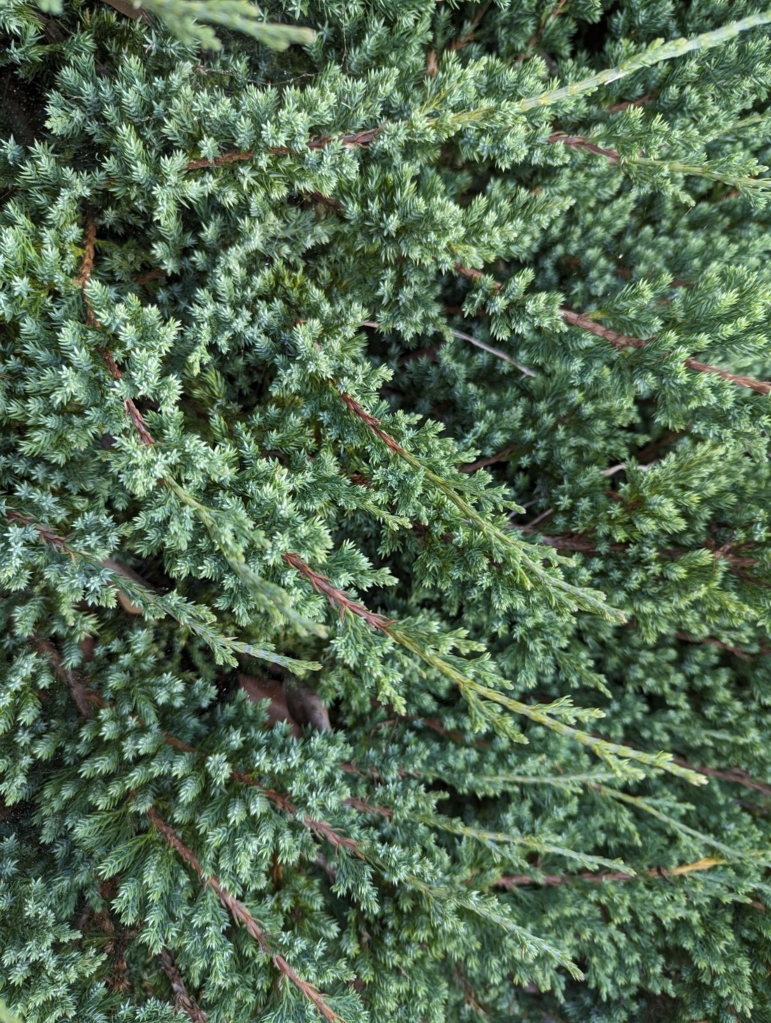
Lemon cypress foliage is densely evergreen, with tiny and tightly set scale leaves. New spring growth is impressively cheery yellow. It fades somewhat to yellowish chartreuse through summer. If the weather gets cool enough through winter, the foliage can get a bit more amber. The foliar aroma is coincidentally slightly lemony, to match the foliar color.

Once established, lemon cypress does not require much more than occasional pruning. It is satisfied with only infrequent irrigation, and might survive with none at all. Actually, it is susceptible to rot with generous or frequent irrigation. ‘Goldcrest Wilma’ is susceptible to foliar diseases within its even denser foliage. It stays compact enough for pots though (Incidentally, Hesperocyparis was Cupressus.)

Transvaal Daisy

Transvaal daisy is very popular within the floricultural industries.

After rose, carnation, chrysanthemum and tulip, the fifth most popular cut flower is the Transvaal daisy, which is also commonly known as the gerbera daisy, Gerbera hybrida.  The composite (daisy-like) flowers are typically about three to four and a half inches wide, in bright shades of yellow, orange, red, pink and white, with dark centers. They stand several inches high on bare stems, adequately above the lower, coarsely textured foliage. Transvaal daisies can bloom well for a month or more as potted houseplants in sunny spots, but rarely survive more than two months indoors. If planted in a sunny but not too harshly exposed spot in the garden as they begin to deteriorate, they can sometimes recover and continue to bloom as short lived perennials. They need good drainage but uniform moisture in organically rich soil.

Punchbowl Godetia

Bloom is brief for wild godetia.

All forty-one species of Clarkia that are native to North America are native to California. Punchbowl godetia, Clarkia bottae, inhabits almost all counties of Southern California. It is absent only from Imperial County. It also inhabits Monterey and San Benito Counties. Its name may allude to its floral shape, or its bloom in Devil’s Punchbowl near Valyermo.

Punchbowl godetia is an ephemeral annual that blooms briefly for spring. Bloom is early in some regions but late in other regions. Also, its schedule is variably from year to year. Because it does not transplant easily, it is rarely available from nurseries. It grows better from seed, which is available online. Within favorable situations, it self sows after bloom.

Bloom is delicate and airy, on limber and lightly foliated stems less than three feet high. Individual flowers are barely an inch wide. Floral color is slightly purplish pink with white centers and tiny red spots. It is variable though, so might be a bit more purplish or lighter pink. Leaves are very narrow. New seedlings do not compete well with other vegetation.