Canary Island Date Palm

Canary Island date palm is the biggest and boldest.

The biggest and boldest of the common palms is the Canary Island date palm, Phoenix canariensis, which can get more than sixty feet tall and nearly forty feet wide, with a full canopy of gracefully arching deep green fronds. A young tree actually spends the first many years as a shrubby plant while the base of the trunk develops. Fronds get longer and spread broader every year until the trunk gets big enough to elongate. Vertical growth then accelerates somewhat, but the canopy gets no broader.

Most trees are female, eventually producing ornately orange but messy clusters of inedible dates. Male trees eventually get a bit taller, but are not quite as graceful and bloom with unimpressive dusty tan flowers.

Old deteriorating fronds need to be pruned away close to the trunk. Petiole bases of the most recently removed fronds are often carved into ‘pineapples’ to leave a bit of support directly below the canopy. Removed fronds leave a distinctive pattern on the trunk.

Torch Lily

Torch lily might still be blooming.

Once it gets established in a garden, it will likely always thrive there. Torch lily, Kniphofia uvaria, is as reliable and resilient as lily of the Nile and African iris. It is as easy to divide for propagation too. Mature specimens can survive without any more water than they get from annual rainfall. They might appreciate some through the middle of summer, though.

Old fashioned torch lily blooms for summer or early autumn, so some are blooming now. Modern cultivars are more likely to bloom earlier. Densely conical floral trusses suspend many narrow and tubular flowers. They stand as high as five feet on otherwise bare floral stalks. Dense mounds of grassy basal foliage should grow no more than three feet high.

Flower buds are orange as they begin to bloom, and then fade with age to pastel yellow. Because floral spikes bloom upwards from the bottom, they turn yellow at the base while orange on top. They resemble candy corn. Some cultivars are paler white at the base, or more reddish orange at the tip. Others are uniformly orange, yellow or soft creamy white.

Pecan

Pecan is the Official State Tree of Texas.

Texas selected a distinctive state tree; the pecan, Carya illinoensis. It is happy in the south and middle mid-west, where naturally grows about seventy feet tall. It can get almost as large here, so is best in big spaces. Summers are a bit too mild for reliable nut production in autumn, but single trees can sometimes make plenty. Two different trees (to pollinate each other) can actually be quite productive, although not quite as well flavored as in warmer climates. The pinnately compound leaves have about eleven individual leaflets that are about five or six inches long. Shade is not too dark.

Leek

Leeks are a type of onion.

Leek, Allium ampeloprasum, is an old fashioned but traditional cool season vegetable. It is rare among home gardens, but has been in cultivation for thousands of years. It is one of the floral emblems of Wales, in conjunction with daffodil. In cooler climates, leeks may grow through summer for autumn harvest. They are only a cool season vegetable locally.

Leeks grow easily from directly sown seed, but are alternatively conducive to transplant. Therefore, they can start in flats while warm season vegetables are still producing. Then, they can transition to the garden early enough to mature before frost. Later phases which grow through winter are quite tolerant of mild frost. They might even be bigger and better.

Like several cool season vegetables, leeks are in no rush for harvest. Once mature, they can linger in their gardens for weeks without deteriorating or bolting. Like related onions, they prefer somewhat rich and loose soil. Until the winter rainy season begins, they need regular watering. Thrips can be more of a problem in other regions during warm weather.

Mexican Fan Palm

Mexican fan palm is also known as the skyduster palm.

It does not take long for Mexican fan palm, Washingtonia robusta, to get too big for most of the spaces it so often self sows its abundant seed into. The attractive lush foliage looks innocent enough, although the long petioles (leaf stalks) have nasty teeth. As trees get tall enough to get out of the way, they also get too big to manage, eventually reaching a hundred feet tall on elegantly curving trunks. No matter how tall they get though, their canopies always stay about eight feet wide. The problem is that the maintenance of such tall and aggressive trees can be costly.

Beards of old leaves can be allowed to accumulate on the trunks, but are combustible and can get infested with rats. Old leaves are more often pruned off, leaving a distinctive pattern of petiole bases. Old leaves can alternatively be ‘shaven’ to expose elegant bare trunks.

Kabocha Squash

Kombucha squash can last for months.

Pumpkins are the most famous winter squash. However, they are more familiar as decor than for culinary applications. For that, butternut and acorn squash are probably the most popular. Kabocha squash, though, is becoming about as readily available. LIke so many squash, it is a variety of Cucurbita maxima. It grows very well within local home gardens.

Kabocha squash vines sprawl over the ground, and can reach more than eight feet long. Alternatively, vines can climb trellises. Because their fruits weigh only about two or three pounds, they need no support. Slings may become necessary if unusually vigorous fruits grow more than five pounds. Powdery mildew can be problematic with congested vines.

Kabocha squash look like small and dark green pumpkins. Some are striped with lighter green or ivory white. Their flesh is yellow or orange, around a hollow interior full of seed. They take quite a while to cure after harvest though, from one and a half to three months. After curing, they can last even longer, and may even be fresh as summer squash ripens.

Redgum Eucalyptus

Redgum eucalyptus is famously adaptable and resilient.

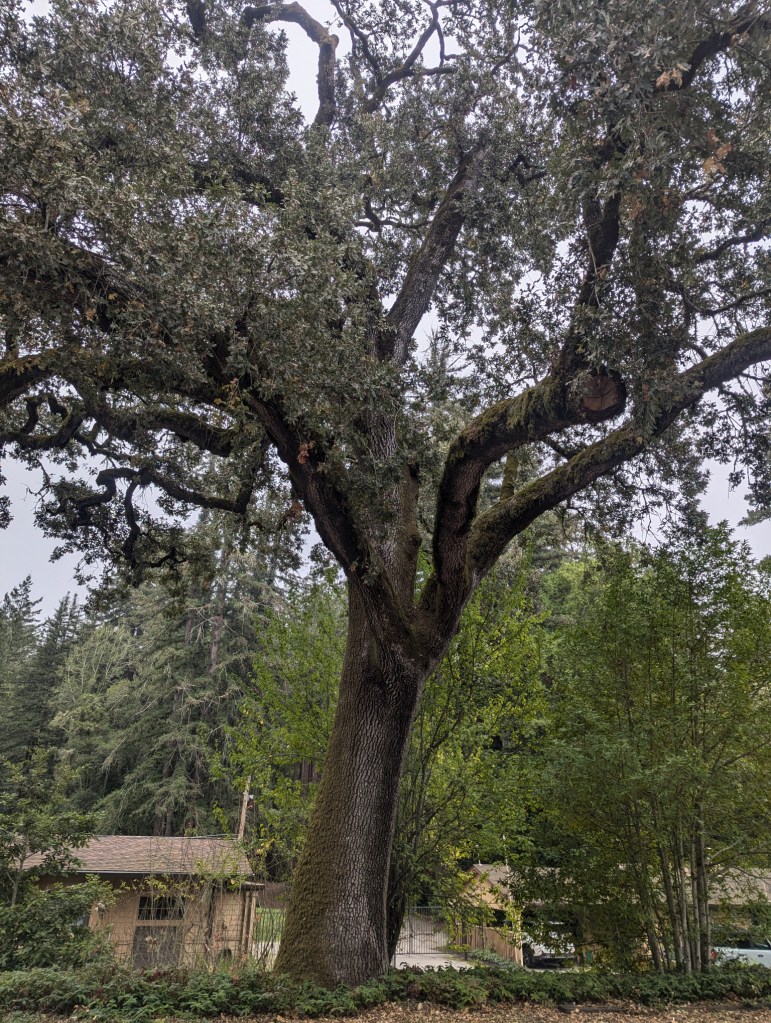
Although not quite as aggressive, sloppy, big or structurally deficient as the notorious blue-gum eucalyptus, the red-gum eucalyptus, Eucalyptus camadulensis, is one of the ‘other’ eucalyptus that give eucalyptus a bad reputation. It is realistically too big and messy for refined urban gardens, and can be combustible if overgrown or too abundant. It is consequently probably not available in nurseries, despite being one of the most common species of eucalyptus (second only to blue-gum) in California. Red-gum eucalyptus has the advantage of being one of the most resilient large scale trees for unrefined or semi-wild landscapes, and works well where it has space to grow in many of the local county parks.

Swiss Chard

Chard is both edible and ornamental.

Among the cool season vegetables that are now seasonable, this one is too cool. Swiss chard, Beta vulgaris subsp. vulgaris var. flavescens is as ornamental as edible. Its richly deep or bronzy green foliage is a splendid backdrop for cool season annuals. The same foliage is edible, either fresh or cooked. Yet, even as a vegetable, it is nicely ornamental.

The wide petioles and leaf veins can be white, yellow, orange, pink or maroon. Although varieties with simple green petioles are more productive, they are less popular. ‘Rhubarb Chard’ and ‘Ruby Chard’ develop deep red petioles and veins. ‘Rainbow Chard’ is a mix of varieties with petioles and veins of various colors. Some have darkly bronzed foliage.

Although a cool season vegetable, Swiss card performs very well for spring and autumn. It only succumbs to summer warmth. In cooler climates, it might succumb to severe frost. Since only external leaves are harvested, it retains its ornamental quality for a long time. Swiss chard like sunny exposure and rich soil. It wants water when winter rain is sparse.

Rosemary

Various cultivars conform to various forms.

Sprawling ground cover forms of rosemary, Rosmarinus officinalis, that get only a foot or so deep are the most familiar. Taller upright types that can get to six feet tall can be quite sculptural. There are several shorter shrubby types in between that can be allowed to grow wild or shorn into tight hedges.

All rosemary is densely foliated with small narrow leaves not much more than an inch long. It is used as an herb because it is so aromatic and flavorful. Tiny flowers bloom in various shades of blue through winter and spring, and sometimes again in autumn. Stems that root where they touch the ground can be dug and moved as new plants.

Wax Begonia

Wax begonia is actually a perennial.

Wax begonia, Begonia X semperflorenscultorum, exemplifies simplicity. Its floral color is white, pink or red. Its foliage is green, bronze or dark bronze. Each floral color combines with each foliar color for a total of only nine combinations. That must be enough, though. Variants of these nine simple options, including some with fluffier double bloom, are rare.

Wax begonia is most familiar as a common warm season annual. However, it is probably at least as popular as a cool season annual. Actually though, it is a short term perennial. Except for during the coolest winter weather, established specimens may bloom all year. After minor frost damage, most regenerate efficiently. They need only minimal grooming.

Mature wax begonia should not grow any higher or wider than a foot. As bedding plants, they blend together. Individually, they develop densely ovoid form. Flowers are small but abundant. Foliage and stems are succulent, with a waxy sheen. New plants grow easily from cuttings or division. Wax begonia prefers rich medium and very consistent watering. A bit of partial shade should be no problem, but a bit too much can inhibit bloom.