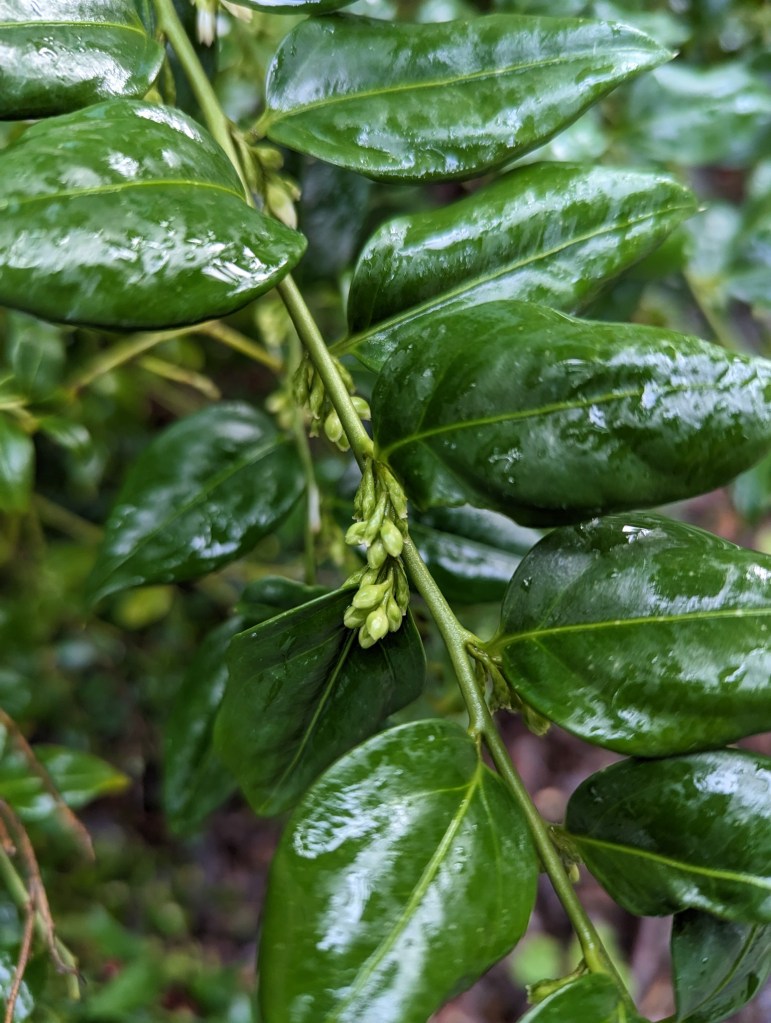
Mexican Orange

Mexican orange does not actually produce any fruit.

Remember when gardening took advantage of the great climate and soil of the Santa Clara Valley? Single story suburban homes with low suburban fences had generous sunny garden space. Now, multiple-storied homes on smaller parcels surrounded by big fences leave only minimal space for shady gardening. Rhododendrons, azaleas, hydrangeas and all sorts of ferns are more popular than the many fruit trees that were so much more common only a few decades ago.

‘Washington’, ‘Robertson’, ‘Valencia’ and ‘Sanguinelli’ oranges that have quite a history in local home gardens are now not much more common than the previously rare Mexican orange, Choisya ternata, which, although related, provides only mildly fragrant flowers without edible fruit. The modest white flowers are only about an inch to an inch and a half wide on loosely arranged trusses, but show up nicely against the rich glossy green foliage. They can bloom anytime, and happen to be blooming now because of the pleasant weather. Otherwise, they prefer to wait until late spring and early summer.

The trifoliate leaves (which are palmately compound with three smaller leaflets in a palmate arrangement) are about two or three inches long and wide. The individual leaflets are about one and a half to three inches long and nearly an inch wide. Foliage can get sparse on big old plants, as they eventually reach lower floor eaves. Occasional pruning of lanky stems can improve foliar density and keep plants as low as three feet. Mexican orange does not actually resemble real orange trees much, but provides nice glossy foliage that is occasionally enhanced by simple softly fragrant flowers.
Oxeye Daisy

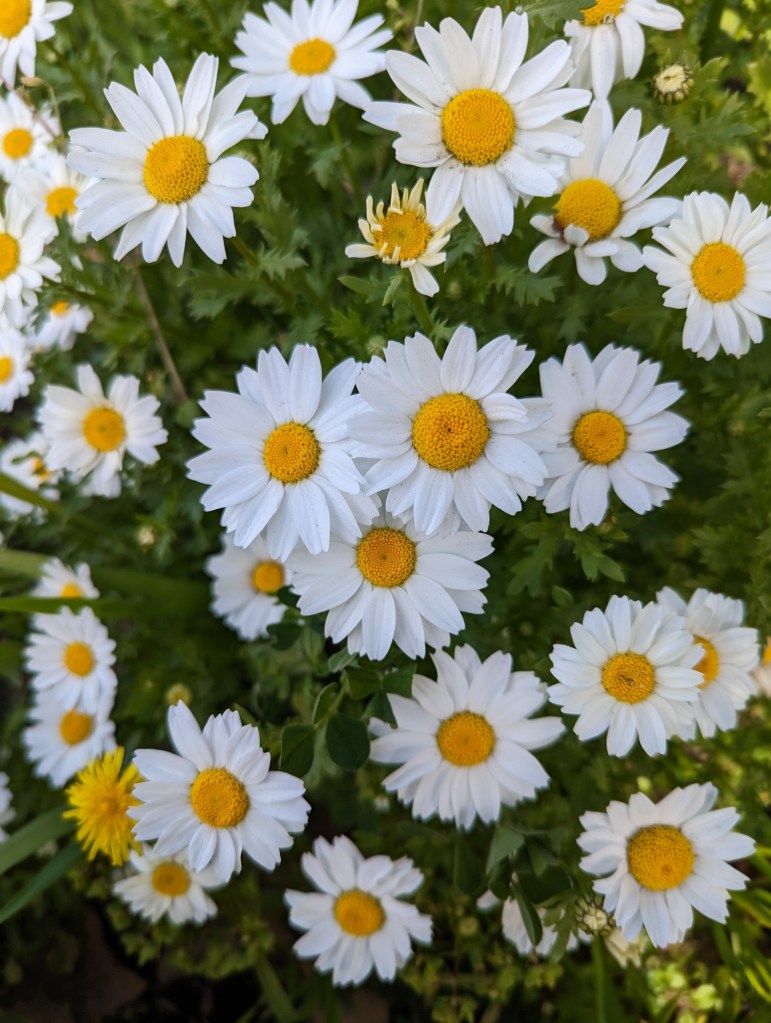
Oxeye daisy is actually a perennial.

Like several annual warm season bedding plants, oxeye daisy, Leucanthemum vulgare, is actually perennial. Also, some of the less extensively bred sorts disperse enough seed to naturalize and potentially become invasive. Increasingly popular modern varieties that are prudent with seed might not be true to type. Some might revert to more prolific forms.

Modern varieties should not get much higher than a foot and a half. They should also be more dense than the simple species, which gets a few feet tall. Foliage and form is quite variable among varieties. Stems are solitary or branched. They may be leafy or sparsely foliated above basal rosettes. Leaves might be lobed or serrate, with or without petioles.

The solitary, paired or tripled composite blooms of oxeye daisy are not so variable. They are classic daisies, with a dozen to three dozen clear white ray florets surrounding bright yellow disc florets. Without deadheading, fresh new bloom overwhelms deteriorating old bloom. Oxeye daisy is splendid as a cut flower. Spring bloom continues through summer, and can actually continue sporadically for as long as the weather is warm.

Japanese Black Pine

Japanese pine is more proportionate to confined urban home gardens than more common species.

Not many large specimens of Japanese black pine, Pinus thunbergiana, can be seen around the Santa Clara Valley. They can get taller than a hundred feet on straight trunks in their natural range on the coast of Japan, but locally, rarely get more than a quarter as tall on leaning and irregular trunks. They just are not quite as happy in the dry air here (minimal humidity). They are purported to be more tolerant of smog than most other pines that were so sensitive to the nasty smog of the 1970’s, but are more likely to become infested with insect pathogens as they get old.

With their angular and somewhat open growth, and classic pine foliage and cones, Japanese black pines are one of the more distinctive pines. Since they do not get too large, they can work well as sculptural specimen trees in small garden spaces and atriums. Even if they grow up above the eaves, their leaning trunks and outstretched lower limbs with rough gray bark are as distinguished as those of larger trees.

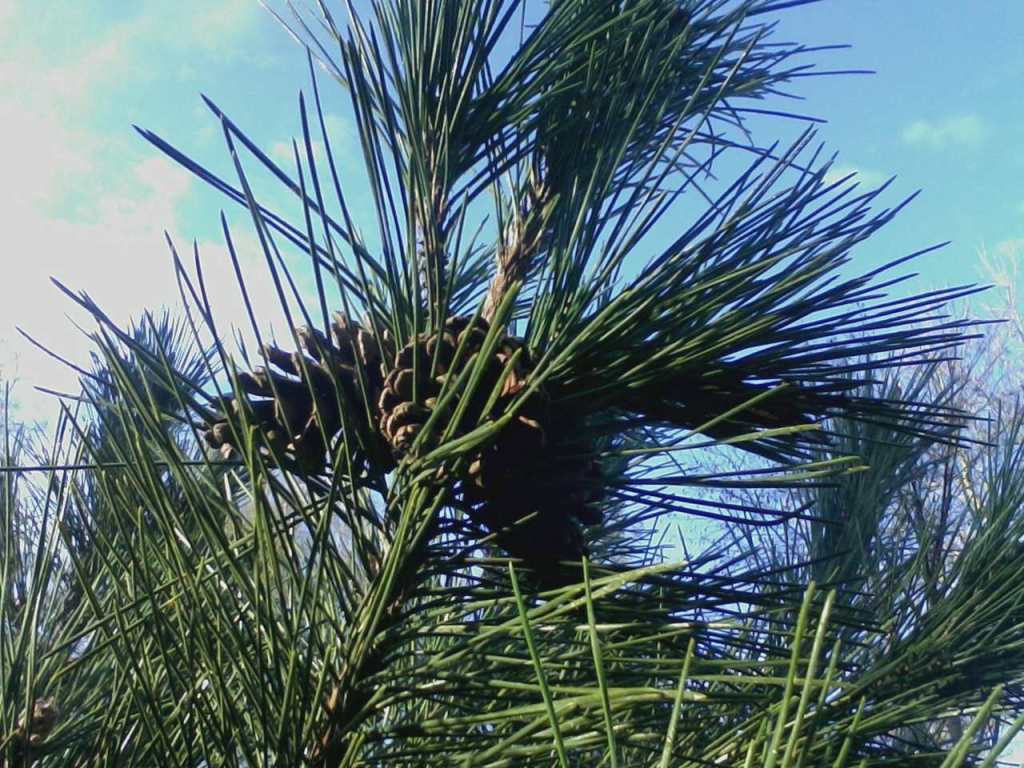
The paired somewhat stiff needles are about three or four inches long. The small but stout cones stay green through most of their first year of development, and then turn brown as they mature and open to disperse their seed in the second year. They are only about two inches long, but can become annoyingly abundant among aging trees.

Jade Plant

Jade plant is vulnerable to frost.

Wandering Jew, spider plant, various philodendron and jade plant were among the most popular houseplants of the 1970s. They are as easy to propagate as they are to grow, so were popular gifts for friends and neighbors. Jade plant, Crassula ovata, commonly grew too big to stay inside without pruning. It fortunately grows better than the others outdoors.

Jade plant does not grow fast, but can eventually get more than six feet tall, with densely rounded form. The succulent stems of such large specimens get quite plump, but remain rather fragile. The paired evergreen leaves are thickly succulent, and mostly a bit longer than two inches. Clusters of tiny pale pink or white flowers are not especially impressive.

At least one cultivar is variegated with irregular white stripes. Another is somewhat ruddy with relatively compact growth. Others exhibit tubular or curly leaves. Foliage can fade or develop narrow red edges in response to harsh exposure or heat. It is also susceptible to frost damage. Jade plant is mildly toxic, but also potentially appealing to dogs who chew.

Acacia dealbata

It is an aggressively invasive exotic weed, but at least it is pretty about it.

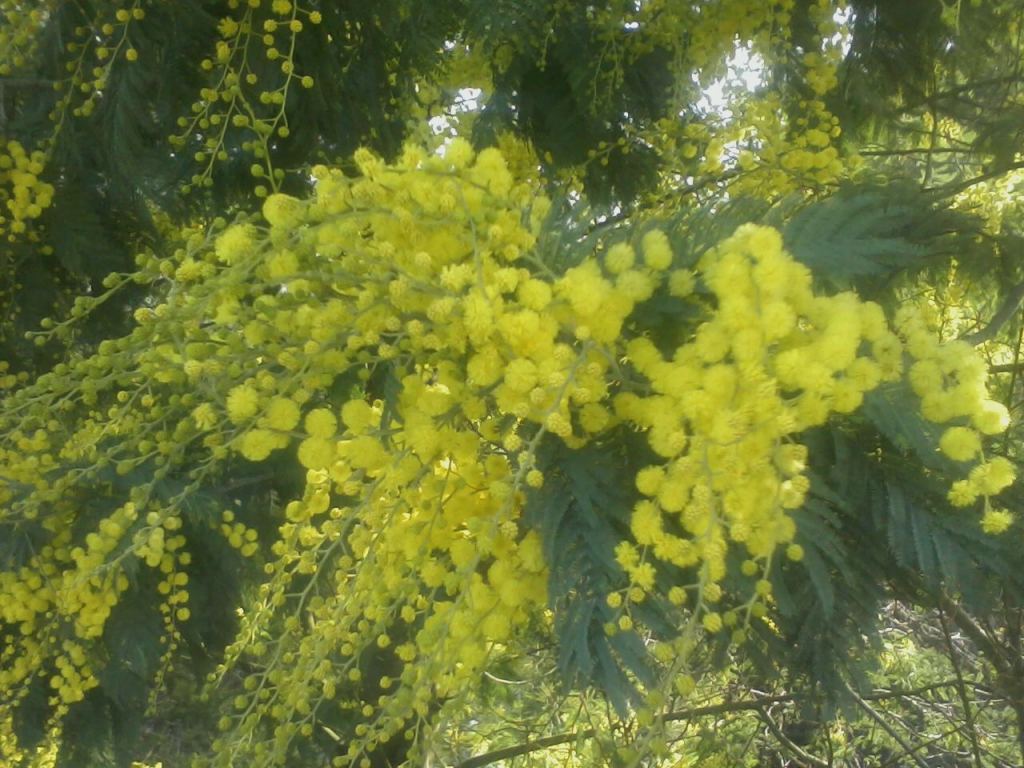
Some of the worst weeds in California are substantial naturalized trees. The most famous of these is probably the Tasmanian blue gum (eucalyptus), which gets very big very fast, and crowds out other trees and plants in the process. The silver wattle, which is most commonly known locally by the Latin name Acacia dealbata, is even more voracious and prolific. It may seem simple enough to cut down an invading Acacia dealbata before it gets too big, but the seedlings from the original tree may continue to invade unrefined landscapes or wildlands for years afterward.

Even urban Acacia dealbata that lack space to disperse seed are problematic. After only about thirty years, they begin to deteriorate, but can die a slow unsightly death for another ten years! Deteriorating trees are likely to fall without much warning. They can get  more than sixty feet tall, and typically fall intact, so can do considerable damage.

The only attribute of Acacia dealbatais that it can be so visually appealing. The somewhat gray, bi-pinnately compound foliage is very finely textured, and provides just enough shade without being too shady. (Bi-pinnately compound leaves are divided into smaller leaflets, which are also divided into even smaller leaflets.) Individual leaves are about three to five inches long. The fuzzy staminate (lacking petals) flowers that bloom in winter are so abundant that most of the foliage is obscured. The floral fragrance that is objectionable to some is appealing to others.

Flame Vine

Flame vine bloom before spring here.

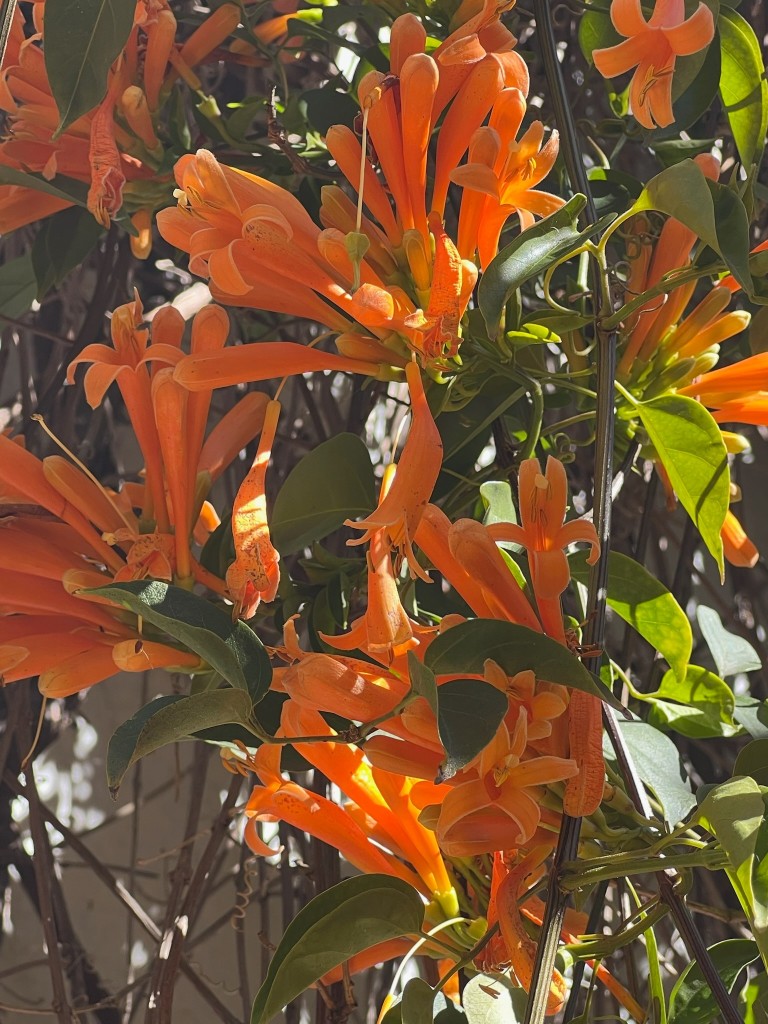
Like so many popular spring bulbs, flame vine, Pyrostegia venusta, may not delay bloom until spring as it should. Within the warmly sunny situations that it prefers, it is more likely to bloom during winter. It may wait until the end of winter or even the beginning of spring only where winter weather is cooler. Bloom is already finishing where winters are milder.

Bloom is spectacular, particularly while not much else blooms so copiously. It is about as profuse as bougainvillea bloom, but earlier. It is about as vibrant orange as poppy bloom, but earlier. With warmth, sunlight and regular watering, flame vine performs very reliably. Perhaps it should not be as uncommon as it is. Yellow blooming flame vine is quite rare.

Although a bit tamer than related red trumpet vine and royal trumpet vine, flame vine may be uncommon partly because it is so vigorous. If pruned to the ground after bloom, it can reach second story eaves to bloom there for the next season. It can grow absurdly high if it grows into trees. Its evergreen foliar tendrils can cling to and damage painted surfaces.

Tasmanian Tree Fern

Tasmanian tree fern is more tolerant of significant frost than Australian tree fern is.

The trunk of a tree fern is really just tough compressed roots growing downward through dead organic material left behind by earlier growth. The foliage and terminal shoot high on top is just like any other fern that never leaves the ground. Because such a trunk is porous, it is ideal for epiphytic plants that, in the wild, mostly cling onto trees instead of growing on the shadier forest floor. Even though most epiphytic plants are able to cling to just about anything, many prefer tree fern trunks because they can actually root into them.

The shaggy trunks of Tasmanian tree fern, Dicksonia antarctica, take decades to grow tall enough for smaller plants to be visible below the lush foliage, but are plump enough to host a rowdy party of  clinging epiphytes. Most get only about four or five feet tall, with the foliage standing a few feet higher, although some old specimens in Golden Gate Park are more than fifteen feet tall, and very old specimens in their native Tasmania can get nearly fifty feet tall.

The big lacy leaves spread about six feet wide, and can reach twice as wide in shadier spots. Shade also makes the foliage darker rich green. Like almost all ferns, Tasmanian tree fern like relatively rich soil and regular watering. Unlike other tree ferns though, it tolerates frost.

New Zealand Tea Tree

Frequent shearing might interfere with bloom.

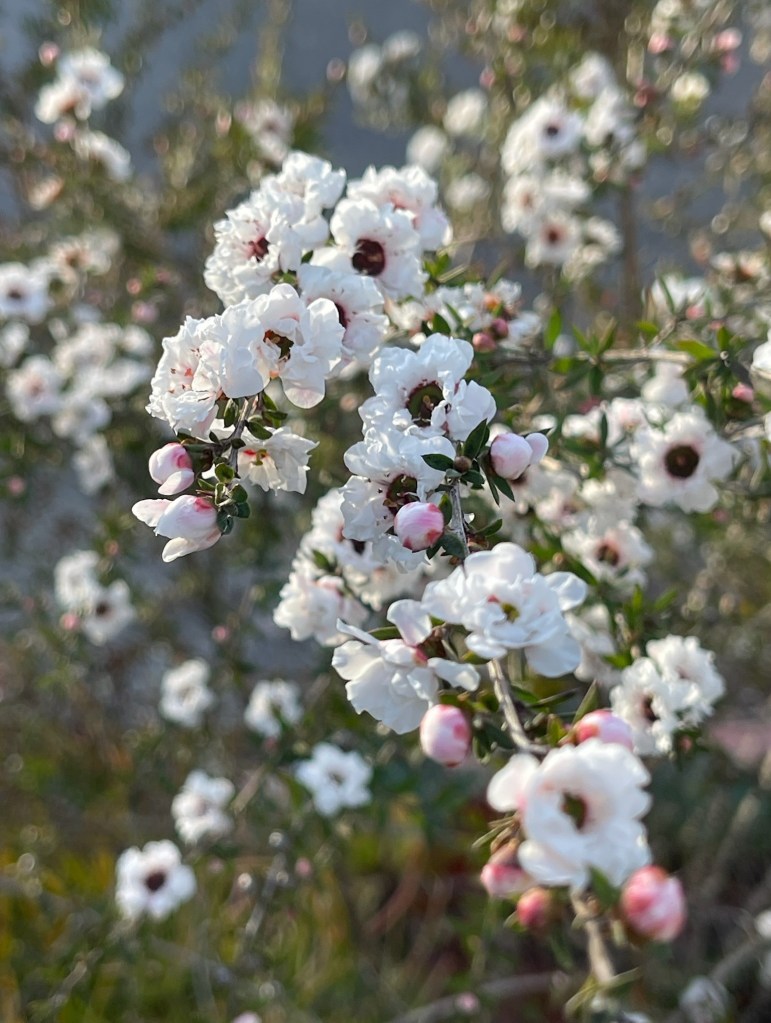
Bloom should probably be most profuse for late spring or early summer. In actuality, New Zealand tea tree, Leptospermum scoparium, blooms whenever and however it wants to. Now that it seems to be blooming prematurely, it might continue to bloom in phases until autumn. Minor bloom phases might even continue randomly through autumn and winter.

Floral color is white, pink or red, including deep ruby red. The tiny flowers are sometimes sporadic but sometimes quite profuse. A few cultivars have plump double flowers. Foliar color is olive drab green or bronze green. The finely textured evergreen foliage is slightly scratchy. Its tiny leaves have pointed tips. The fibrous brown bark is handsomely shaggy.

New Zealand tea tree works very well as a blooming informal hedge. Frequent shearing of formal hedges compromises both bloom and natural form. Elimination of lower growth exposes appealingly sculptural trunks supporting little trees. Some modern cultivars will not reach first floor eaves. Some reach second floor eaves. All demand sunny exposure.

Cork Oak

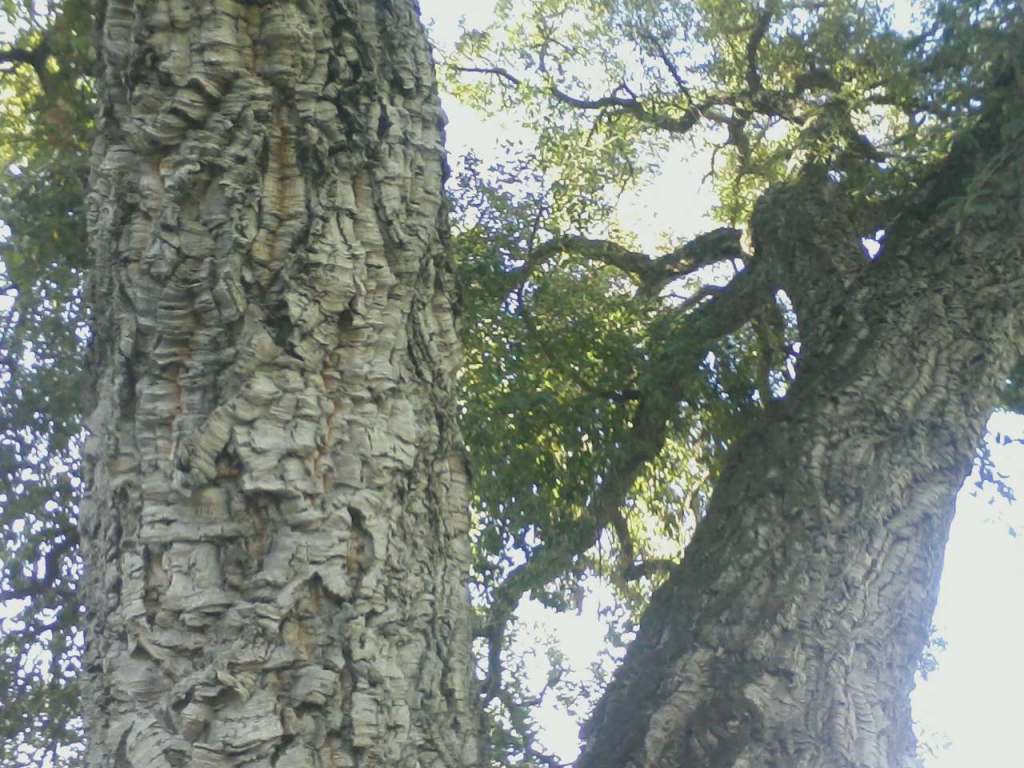
Cork oak develops sculptural trunks and branch structure with striking bark texture.

Portuguese neighborhoods in San Jose and other big cities might be identifiable by the presence of the otherwise rare cork oak, Quercus suber. After all, they are native to Portugal, as well as Spain, Sardinia, Corsica, Sicily and the coast of the Mediterranean Sea as far east as the eastern tip of Italy on the north, and the northwest corner of Libya on the south.

Like redwoods, cork oak is one of the few species of trees that survive forest fires by being less combustible. Their foliage and small twiggy stems may burn, but larger limbs and trunks are insulated by very thick cork cambium (bark). Most other trees that are adapted to burning either disperse their seeds as they burn in order to get a head start at reforestation afterward, or simply resprout from their roots.

 Ironically, this bark that is intended to help the trees survive was actually the reason why trees on the north coast of Algeria were so extensively and detrimentally harvested during French  colonialization. Corks made from the bark were needed for the wind industry in France. Fortunately, cork in Algeria is now harvested like it is in other regions, without harming the trees that produce it.

Compared to other oaks, cork oak is not too large. It can get a bit more than fifty feet tall and nearly as wide, but takes a century or more to do so. It can actually stay proportionate to urban landscapes for a very long time. Roots are mostly complaisant. The main problem with cork oak is that it drops its evergreen foliage constantly, and drops floral debris and acorns for a few months.

Gnarly trunks and limbs with spongy bark are the main appeal. The one and a half or two inch long leaves are not so interesting. They are barely convex, often with a few blunt lobes, and dull grayish green from below.

Sweet Box

Sweet box should bloom for winter.

Floral fragrance is likely the primary asset of sweet box, Sarcococca ruscifolia. However, the splendidly glossy and evergreen foliage is as appealing as that of any of the various boxwoods. It is darker and richer green, with orderly arrangement on nimble and arching stems. Individual leaves are small but larger than boxwood leaves, and with pointier tips.

Sweet box blooms during winter, with deliciously fragrant but tiny pale white flowers that are not much to see. They are unlikely to get credit for their impressive fragrance without close investigation for its source. Vigorous plants may produce a few rich maroon berries that contrast delightfully with the rich green foliage. Cut stems work well with cut flowers.

Because it is naturally an understory species, sweet box not only tolerates partial shade, but actually prefers it. Harsh exposure fades its foliage. The dense foliage on wiry stems adapts to low hedging. It is better with alternating cane pruning to remove old stems and promote fresh basal growth. Overgrown specimens respond quite favorably to coppicing. They grow to three feet high.