Anthurium

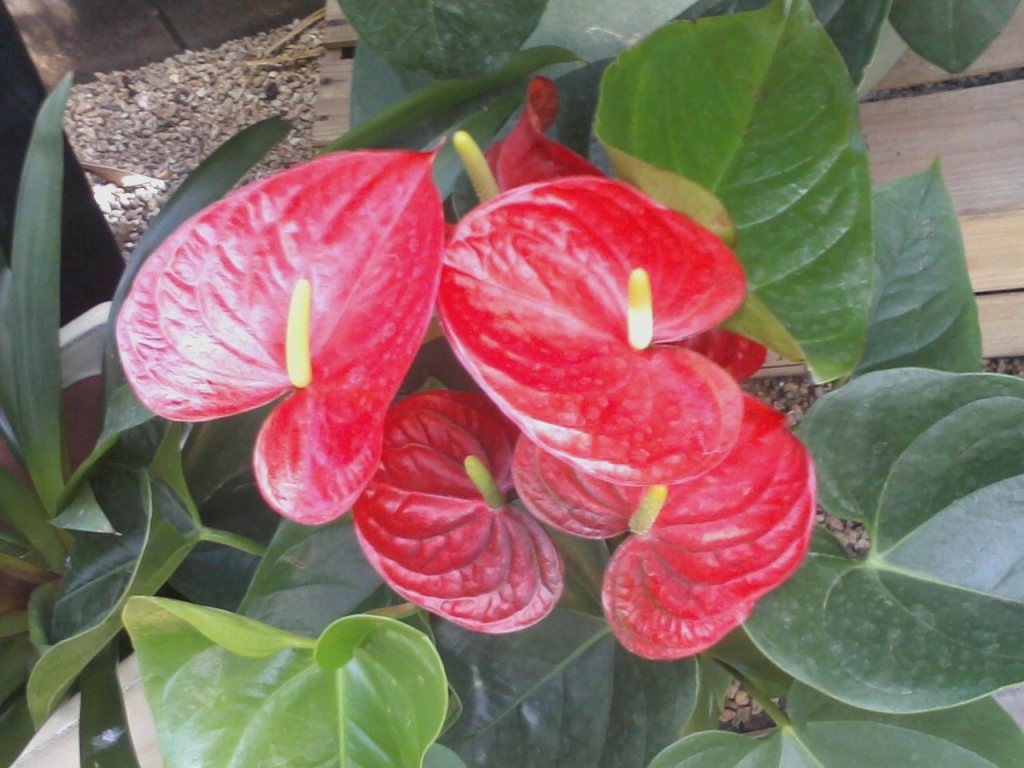
Anthurium seem to be upholstered with vinyl.

The diminutive and indistinguishably dense flowers of Anthurium are surprisingly pathetic relative to the flashiness of the ‘spathe and spadix’ structures that accompany them. The spadix is the generally conical structure that supports and is covered with the flowers. It is most often pale shades of white, yellow or green, but can be pink or purplish. The spathe is the solitary, colorful bract that surrounds the spadix. It is most often white, red or burgundy, but can be orange, pink or pale shades of yellow or green.

There are nearly a thousand known specie of Anthurium. Most but certainly not all have glossy foliage. Leaf shape and size is as variable as flower color. Most Anthurium are terrestrial understory plants that grow below higher canopies of tropical mountain forests of Central and South America. Others are epiphytes that cling to trees, or lithophytes that cling to rock outcroppings.

Around the home, they are mostly grown as houseplants as much for their rich green foliage as for their colorful blooms. In the garden they need shelter from direct sunlight and frost. Blooms, and perhaps other parts, are toxic.

Rocky Mountain Juniper

Rocky Mountain junipers get rather large.

Hollywood juniper had formerly been the only popular juniper of tree form. As it became less popular during the past few decades, cultivars of the once obscure Rocky Mountain juniper, Juniperus scopulorum, became more popular. Also, a few more modern cultivars became available. Now, the once overly common Hollywood juniper is quite uncommon.

Rocky Mountain juniper is naturally rather grayish for protection from the harsh exposure of the high elevations which it inhabits. Cultivars are grayer, bluish or silvery, and mostly develop symmetrically conical form. Old specimens that were initially conical eventually grow as small trees with rounded and relatively dense canopies, perhaps on bare trunks.

‘Skyrocket’ and ‘Blue Arrow’ are very narrow like Italian cypress that grow only fifteen feet tall. ‘Wichita Blue’ and ‘Moonglow’ are stoutly conical. ‘Blue Arrow’ and ‘Wichita Blue’ are bluish green. ‘Skyrocket’ and ‘Moonglow’ are silvery gray. Established specimens do not require much water, but develop better foliar color with warmth and occasional watering.

Sweetgum

Sweetgum colors with minimal chill.

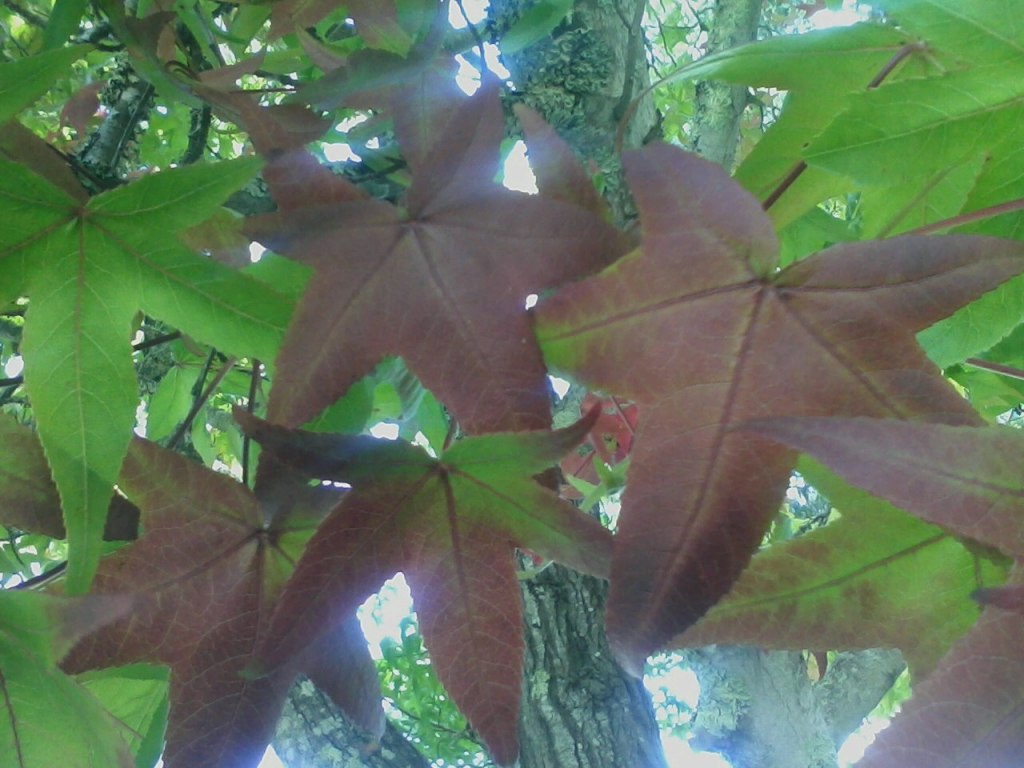
The excellent and remarkably brilliant shades of yellow, orange, red and burgundy of the foliage in autumn suggest that sweetgum, Liquidambar styraciflua, is from New England. However, it is native between New Jersey, Florida and the eastern edge of Texas, as well as isolated forests of Central America. It actually prefers mild climates to where winters are too cold. Mature trees are generally columnar (relatively narrow) and less than fifty feet tall where well exposed, but can get more than twice as tall to compete in forests.

Unfortunately, mature sweetgum trees can be somewhat problematic in urban gardens. Limbs are often weak enough to break in wind, or if they get too heavy from the weight of their own foliage. Also, the abundant round seed pods are outfitted with nasty spikes, like little maces almost two inches wide. They are painful to step on, and can actually be quite hazardous.

Dracaena Palm

Dracaena palm is a foliar plant.

By the end of the Victorian Period, dracaena palm, Cordyline australis, had become very popular, both as small trees and as foliar plants. The largest specimens were only about twenty feet tall and half as wide. Removal of trunks that grew too tall for short foliar plants induced fresh basal growth. The drab leaves grew three feet long and three inches wide.

Cultivars with bronzed foliage became more popular after the Victorian Period, although not as common as the original. They grew slower and stayed smaller. The many modern cultivars of the past few decades stay even smaller, with even more impressively colorful foliage. Most are purply bronze or variegated with creamy white, pale yellow, pink or tan.

Modern cultivars generally mature efficiently, but then attain height too slowly to function as small trees. Some do not develop substantial trunks. They are therefore more popular for their delightful foliar color and texture. Many generate appealingly pendulous foliage. However, a few eventually develop sculptural form with exposed corky trunks and limbs. Removal of unimpressive floral panicles prior to bloom removes floral frass before it gets messy.

Bower Vine

Bower vine bloom sporadically until cooler autumn weather.

Autumn needs to get a bit cooler before bower vine, Pandorea jasminoides, will be ready to stop blooming. It may not always bloom profusely, but it does bloom for a long time, beginning with warming spring weather. Flowers can be white, pink or white with pink throats, but are most often pink with burgundy throats. Even through late autumn and winter, the glossy evergreen foliage is appealing without bloom. Mature vines can climb more than fifteen feet high. Those with variegated foliage might stay somewhat smaller.

African Daisy

African daisy hybrids are generally sterile.

Old fashioned trailing African daisy was becoming too common by the time it succumbed to the Big Freeze just prior to Christmas of 1990. Shrubbier and more colorful cultivars of hybrids with similar species, particularly Osteospermum ecklonis, are now more popular. Such hybrids mostly lack species designation because their lineage is very complicated.

Mature specimens do not grow much wider than two feet, so do not migrate as efficiently as old fashioned trailing African daisy. Since they are hybrids, they do not produce viable seed either. However, if pressed into damp soil, peripheral stems generate roots to grow as new plants that extend the collective width. They also replace deteriorating old plants.

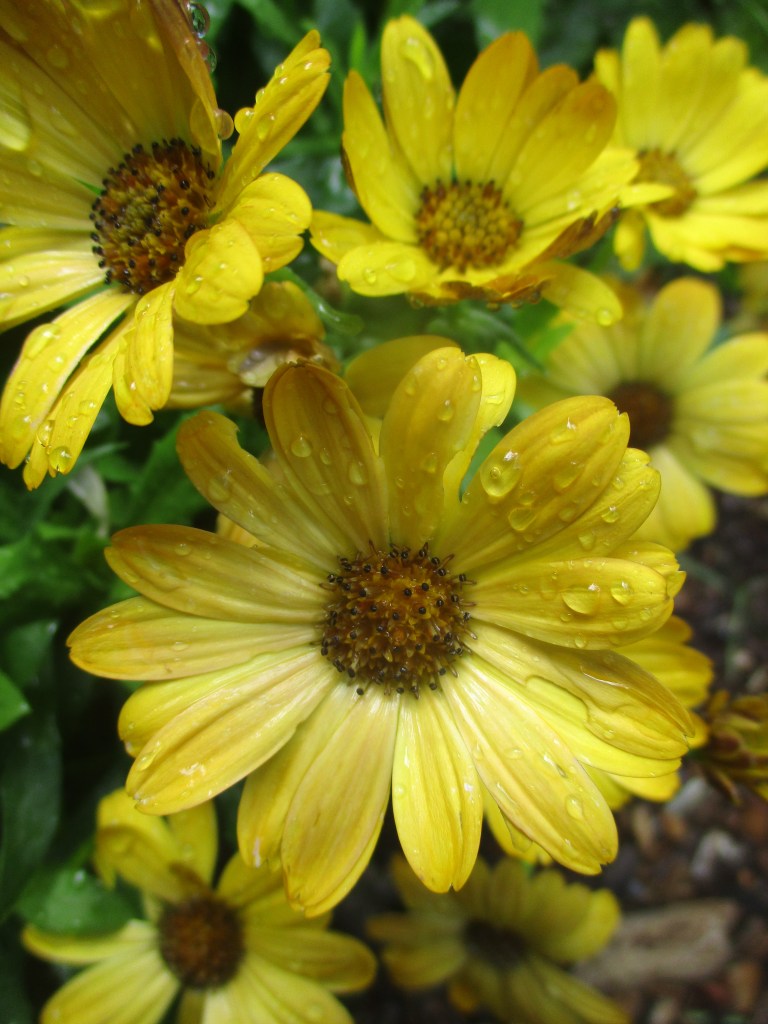
Sporadic bloom may be almost continuous between a few profuse phases, with the most profuse phase between winter and spring. Only the coolest and warmest weather inhibit bloom. It can be difficult to shear overgrown plants between phases without ruining a few flowers. Floral color is pastel hues of purple, lavender, red, pink, orange, yellow or white.

Pansy

Pansy is one of the most familiar of cool season annuals.

All sorts of shades and combinations of yellow, orange, red, purple and blue, as well as white and monochromatic black can be found among the many varieties of pansy, Viola X wittrockiana. Pansy flowers are mostly about two inches wide, with a pair of overlapping upper petals, a pair of side petals and a single lower petal. Even though they stand only about half a foot high, flowers hover slightly above the foliage.

Here where winters are so mild, pansies get planted in autumn to bloom through winter, and then get replaced with warm season annuals in spring. They can survive through summer, but do not perform so well while weather is warm. Deadheading (removal of deteriorating flowers) promotes continual bloom. Related violas typically produce more profuse but smaller flowers, which are actually physiologically different.

French Marigold

Marigolds bloom with cozy autumnal color.

The Maya cultivated marigolds long before the French. After all, the ancestors of modern French hybrid marigolds, Tagetes patula, are endemic to Mexico and Guatemala. French horticulturists merely developed the hybrids that are now most popular. The largest might grow a foot high and wide. Otherwise, almost all grow lower as compact bedding plants.

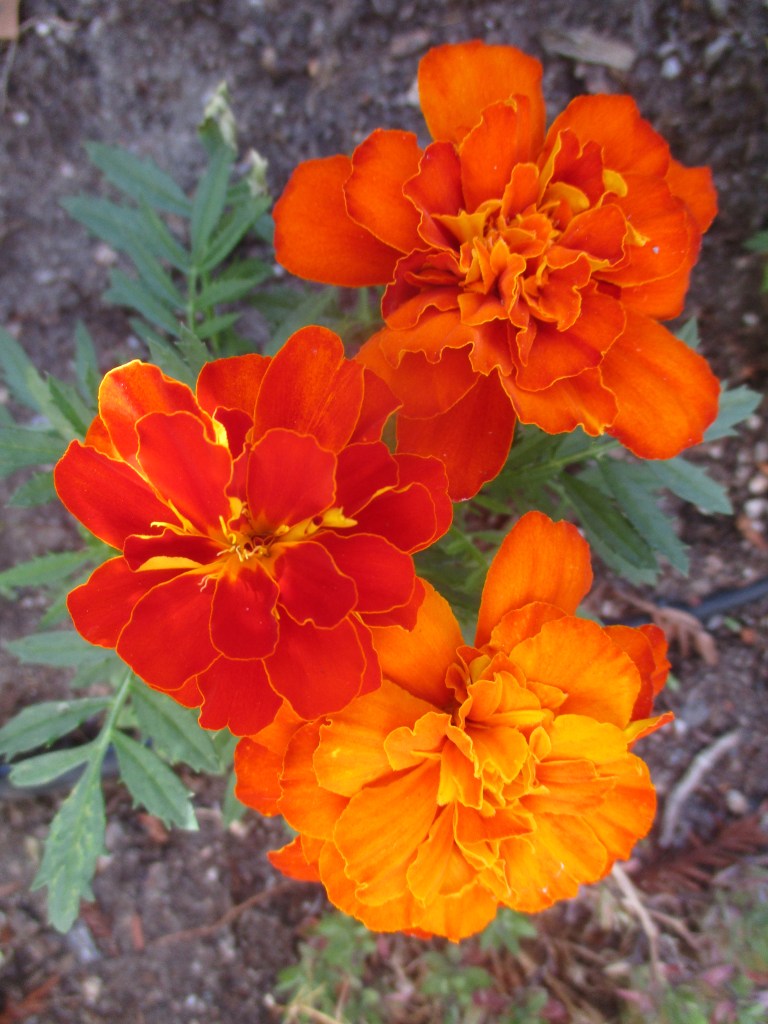
Although many varieties of French hybrid marigold are available, their floral color ranges only through yellow, orange and red. Ruddy brown is merely dark orange. Creamy white is merely very pale yellow. Combinations of color within this minimal range are amazing nonetheless. White is rare only because richer traditional colors remain so very popular.

French marigolds are technically warm season annuals. With frequent deadheading and grooming, they can bloom from spring until frost. However, since they perform best while young, they are more popular as a shorter term annual. They often replace warm season annuals that finish a bit early, while the weather is still too warm for cool season annuals.

Ponytail Palm

In its native ecosystem, ponytail palm grows as a small tree.

Some succulent plants and their friends do not mind being grown as houseplants. Ponytail palm, Beaucarnea recurvata, is one of those rare friends of succulents that actually prefers to be inside, at least during winter when they can be damaged by cool weather and moisture. Plants that are houseplants through winter and get moved out to the garden through summer should be protected from harsh direct exposure since their foliage is adapted to the home environment. Otherwise, ponytail palm likes the sunniest rooms in the house.

The weird distended caudex at the base of the stem is the most distinctive feature of the ponytail palm, which as actually neither a palm, nor outfitted with ponytails. However, almost like a palm, pruning a solitary top down will likely be fatal. (Pruning the terminal bud off the top of a palm will necessarily be fatal to the affected trunk.) Unlike (solitary) palms, ponytail palm can eventually develop multiple trunks, which can be pruned off if absolutely necessary.

In their natural environment, ponytail palms can get to be shade trees with sparse limbs terminating with tufts of narrow strap shaped leaves. Yet, as slowly growing houseplants confined to containers, they rarely get more than six feet tall after many years. They really need good drainage, and prefer to be watered only about twice to four times monthly.

Radish

All parts of radish are edible.

Everyone seems to be familiar with radish, Raphanus raphanistrum subspecies sativus. It has been so popular with so many cultures for so long that its origin is now impossible to identify. It likely originated in Southeastern Asia at least two thousand years ago. After so many centuries, it has become remarkably variable in regard to flavor, form and color.

Radish are generally cool season root vegetables, although their foliage and flowers are also edible. They can be red, pink, purple, yellow, green, black or white, with white flesh. Their form might be almost spherical, cylindrical or tapered like a carrot. Small types are only about an inch to three inches long. Some daikon radish can get as long as two feet!

Because radish are typically smaller than most other root vegetables, they mature faster. Therefore, their seed can get started in their garden slightly later. If they mature too soon, warmth may cause them to bolt, which ruins their flavor and texture. Subsequent phases extend production, by resuming production as previous phases exhaust their production.