Fiddle Leaf Fig

Juvenile growth is almost never seen locally.

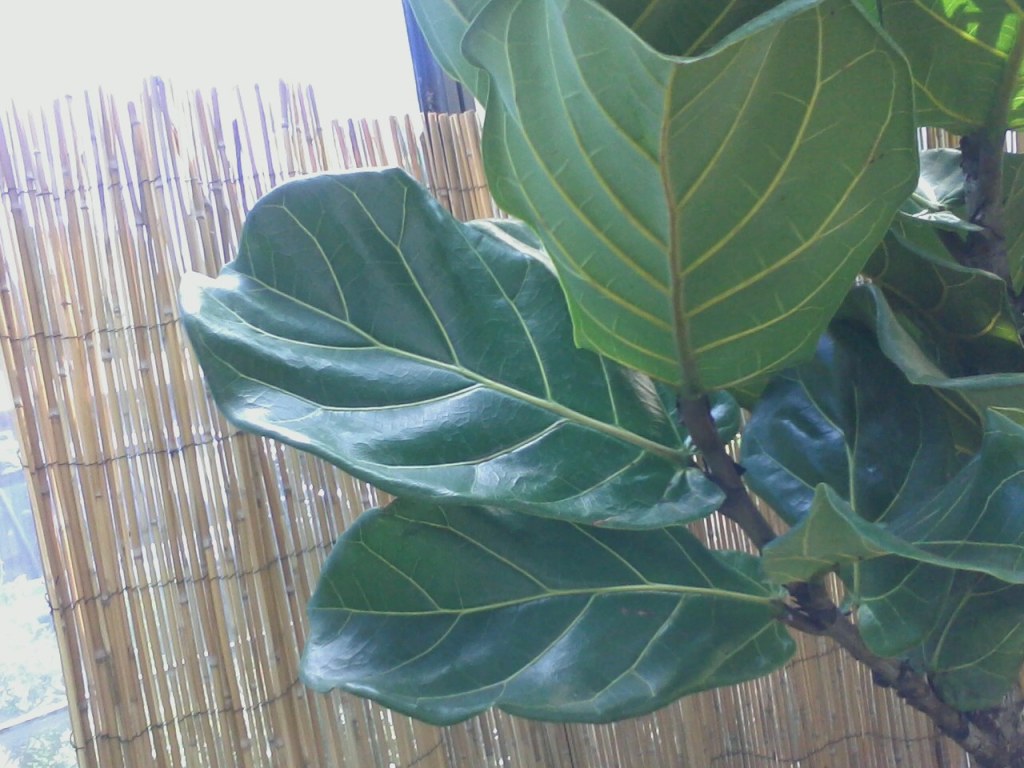
What a weird tree! Fiddle leaf fig, Ficus lyrata, is an uncommon but familiar large scale houseplant that we might not welcome into our homes if we knew how it behaves where it grows wild in the lower rainforests of Western Africa. Although it can grow upward from the ground like almost all other trees do, it often germinates and begins to grow as an epiphyte, within organic debris that accumulates in the branch unions of other trees. While suspended, it extends roots downward. Once these roots reach the forest floor, they develop into multiple trunks that overwhelm and crush the host tree as they grow.

The bold foliage is typically dark drab green, like the shades of green that were so popular for Buicks in 1970, with prominent pale green veins. Individual leaves are about a foot long and potentially nearly as broad at the distal (outward) ends, often with randomly wavy margins. Like fiddles, they are narrower in the middles, or actually more often narrower at the proximal (inward) ends. When pruning becomes necessary, the caustic sap should be soaked from fresh cuts with paper towels so that it does not drip and stain.
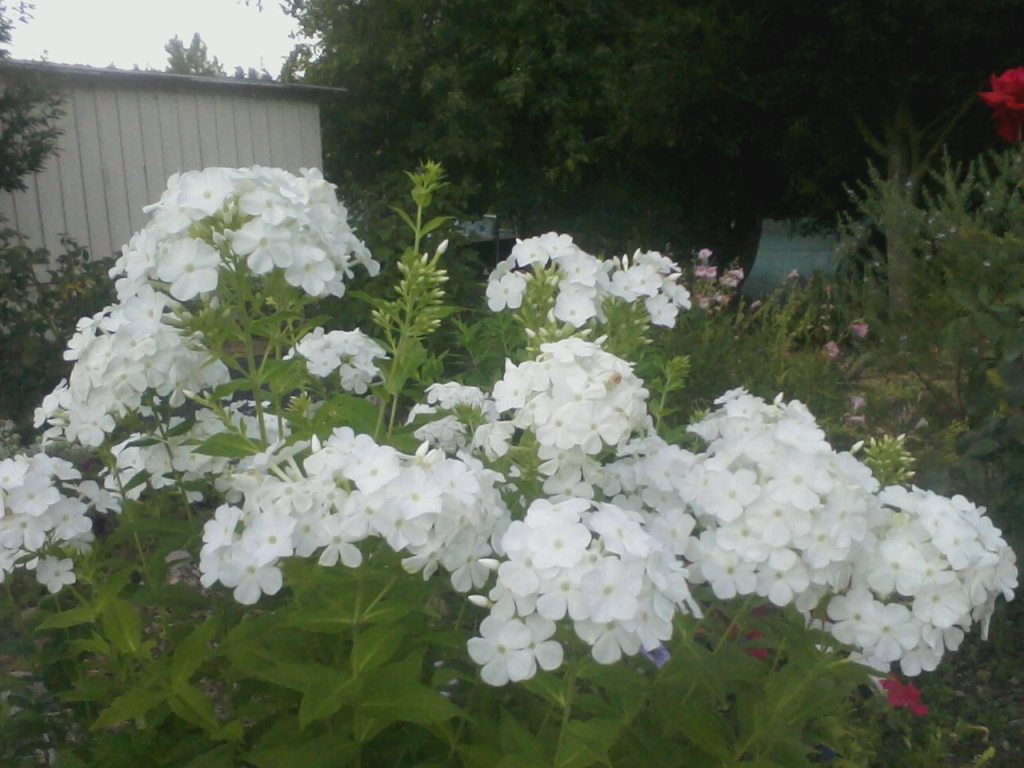
Garden Phlox

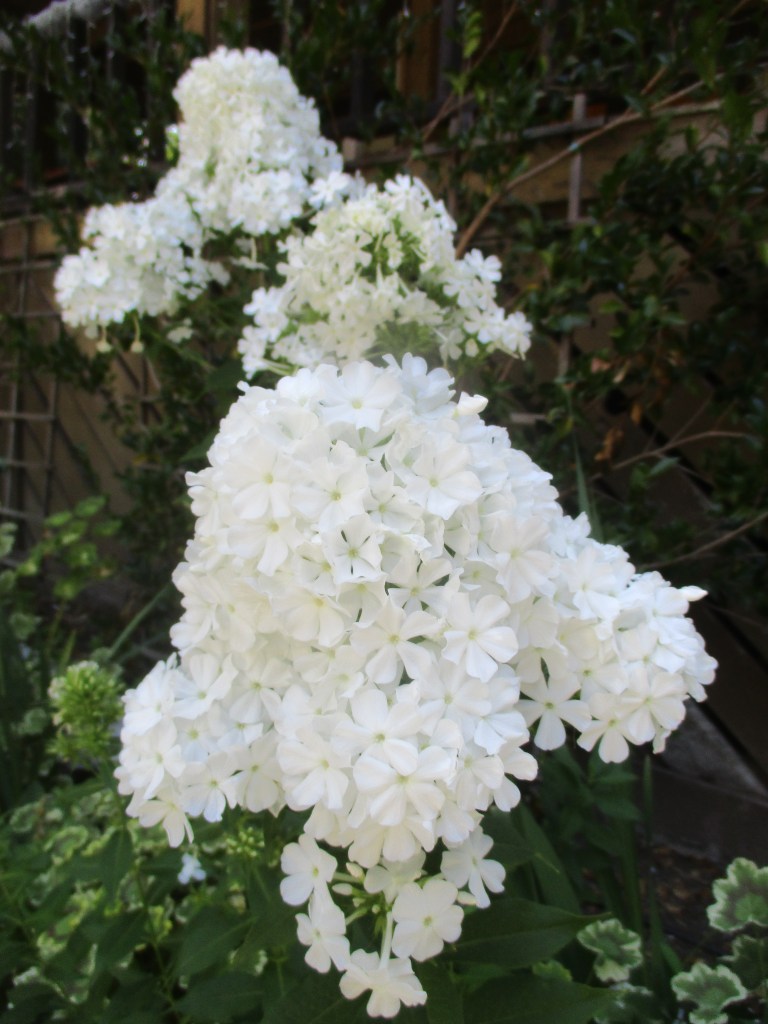
Pictures can not share the fragrance.

More than a dozen species of Phlox are native to various ecosystems of California. They are generally uncommon within refined home gardens though. The more popular garden phlox, Phlox paniculata, is native east of Kansas. It naturalizes in some regions, such as the Pacific Northwest. Locally, it might self-sow only where it gets water through summer.

Garden phlox can get as high and wide as three feet. Some modern cultivars should stay a bit more compact. Individual flowers are only about an inch wide, but bloom with many others on dense panicles that are as wide as six inches. This richly fragrant bloom is red, pink, white, pastel orange or pastel purple, and continues for almost a month of summer.

As its potential for naturalization suggests, garden phlox is not particularly demanding. It appreciates good exposure, but can tolerate a bit of partial shade. It enjoys richly organic soil but can survive within soil of mediocre quality if it is not too dense. Regular watering sustains bloom, but established plants can survive with minimal watering after blooming. Propagation by division of large or overgrown plants while dormant through late winter is very easy.

Garden Phlox

Garden phlox is more popular in other regions than it is here.

In eastern North America where it grows wild as a native, garden phlox, Phlox paniculata, is modest but classic perennial that gets more than four feet tall with pinkish lavender flowers from late summer through early autumn. Modern garden varieties are mostly somewhat more compact with pink, red, light purple or white flowers. Many have fragrant flowers; and some have flowers with lighter or darker centers. Butterflies and hummingbirds dig them all.

Locally, garden phlox probably looks best with slight shade or among other lush plants, only because humidity is so minimal. Otherwise, it would be just as happy out in the open. In well watered gardens with rich soil, it sometimes self sows a bit, but rarely naturalizes continually enough to revert to a more natural (wild) state like it can in gardens on the west coast of Oregon and Washington. Garden phlox can be propagated by division of mature plants either after bloom in autumn or in spring.

Thread Agave

Agave generally excel in chaparral climates.

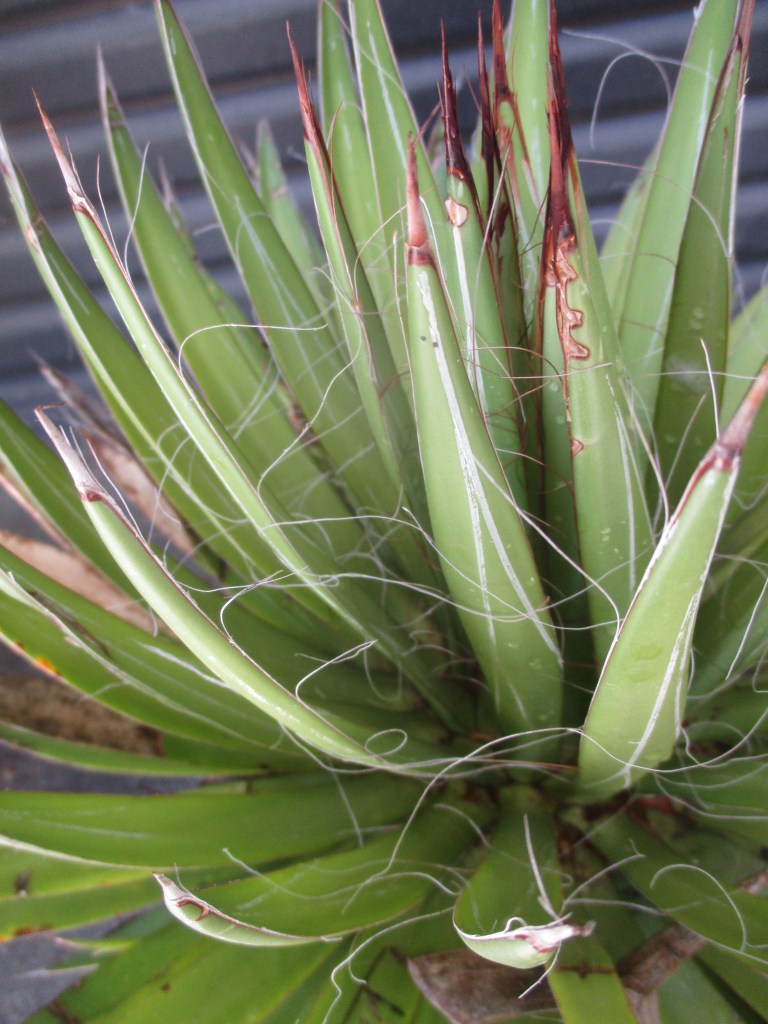
Many species of Agave and Yucca should probably be more popular here than they are. Several are endemic to desert or chaparral climates. Once established locally, they may survive without irrigation. Occasional watering through summer only improves their foliar color and vigor. Except for gophers that might attack from below, not much offends them.

The primary deterrent to their popularity is their dangerous foliar spines. Many species of Agave and Yucca grow too large to not become obtrusive within compact home gardens. Consequently, their striking but hazardous foliage can be difficult to avoid. Fortunately, a few species such as thread agave, Agave filifera, remain proportionate to home gardens.

Thread agave develops rounded foliar rosettes that are less than three feet wide and two feet tall. Evergreen leaves retain silvery impressions of adjacent leaves. Although growth is generally slow, vigorous floral stalks may grow rapidly to ten feet tall during summer, to bloom during autumn. Pups begin to replace original rosettes prior to monocarpic bloom.

Naked Lady

These naked ladies are not shy.

While so many flowers are finishing their bloom and leaving their drying foliage behind, naked lady, Amaryllis belladonna, is just beginning to bloom, naked of any foliage. Clusters of a few to several bright pink flowers stand on bare stems about two feet tall. Individual flowers are about two and a half to three and a half inches long, and resemble lily flowers. Foliage only appears after flowers deteriorate, and lasts only until weather gets warm late in spring. The strap shaped leaves are about a foot to a foot and a half long. Through summer, the two or three inch wide bulbs are dormant and bare, and seem to be dead with their tops visible at the soil surface, but retain fleshy roots below. They should therefore only be dug and divided if they get too crowded or need to be moved.

Irish Moss

Irish moss is darker than Scottish.

It is not actually moss. It is of the same family as carnation. Of course, any distinguishing characteristics of its family are difficult to recognize. Iris moss, Sagina subulata, has such exceptionally fine foliar texture and diminutive bloom. Its slim leaves are not much longer than a quarter of an inch. its tiny white flowers are barely wider than an eighth of an inch.

Irish moss is a luxuriantly dense and richly evergreen ground cover for confined spaces. It works well within small atriums and big pots that contain sculptural plants that lack low foliage. It is a popular accessory for Japanese maple and citrus within tubs. Since it gets no more than two inches deep, Irish moss can fill in between pavers and under benches.

However, Irish moss dislikes how pavement enhances harsh exposure. Although it does not require shade, it appreciates a bit of partial shade while the weather is warmest after noon. Also, it craves somewhat frequent watering to compensate for locally arid warmth. Scottish moss is the cultivar ‘Aurea’. It is lighter chartreuse green, but otherwise identical.

String of Pearls

Weird but elegantly pendulous string of pearls likes to hang around. It cascades nicely from hanging pots or tall urns.

It is difficult to see how string of pearls, Senecio rowleyanus, is related to much more colorful daisies and asters. The small, fuzzy and sickly white flowers are not much to look at, and only clutter the elegantly pendulous and oddly succulent foliage. The round leaves are light bluish green, so actually resemble peas more than they resemble pearls. The stems are so very thin and limber that they can only stand a few inches high, but can cascade to three feet!

Although evergreen, stems of outdoor plants can be cut back while dormant through winter to promote fresher growth in spring. The pruning scraps are very easy to propagate as cuttings. Roots are undemanding and sensitive to rot, so should be allowed to get nearly dry between watering. Bright ambient light without too much direct sun exposure is best. Incidentally, all parts of Senecio rowleyanus are toxic.

Ivy Geranium

Ivy geranium cascades splendidly from planters.

Venice in Italy is an ideal situation in which to demonstrate the potential of ivy geranium, Pelargonium peltatum. Because garden space is so minimal, potted plants that cascade from balconies above the canals are quite popular. Ivy geranium cascades so splendidly that some eventually reach the tops of downstairs windows from their upstairs balconies.

Ivy geranium can sprawl over shrubbery to seemingly climb a few feet high. Otherwise, it is unlikely to stand much more than a foot and a half high on the ground without support. If cascading over the edge of a planter, upward growth may be only several inches high. In window boxes, it obstructs minimal sunlight. However, it may hang six feet downward!

Ivy geranium propagates somewhat easily by cuttings of the almost succulent stems, but not as easily as zonal geranium. Its lobed, rounded and quite fragile leaves are about an inch long and two inches wide. Sporadic but continual bloom becomes more profuse for late summer and autumn. Flowers might be white, pink, red, lavender, purplish or striped.

Montbretia

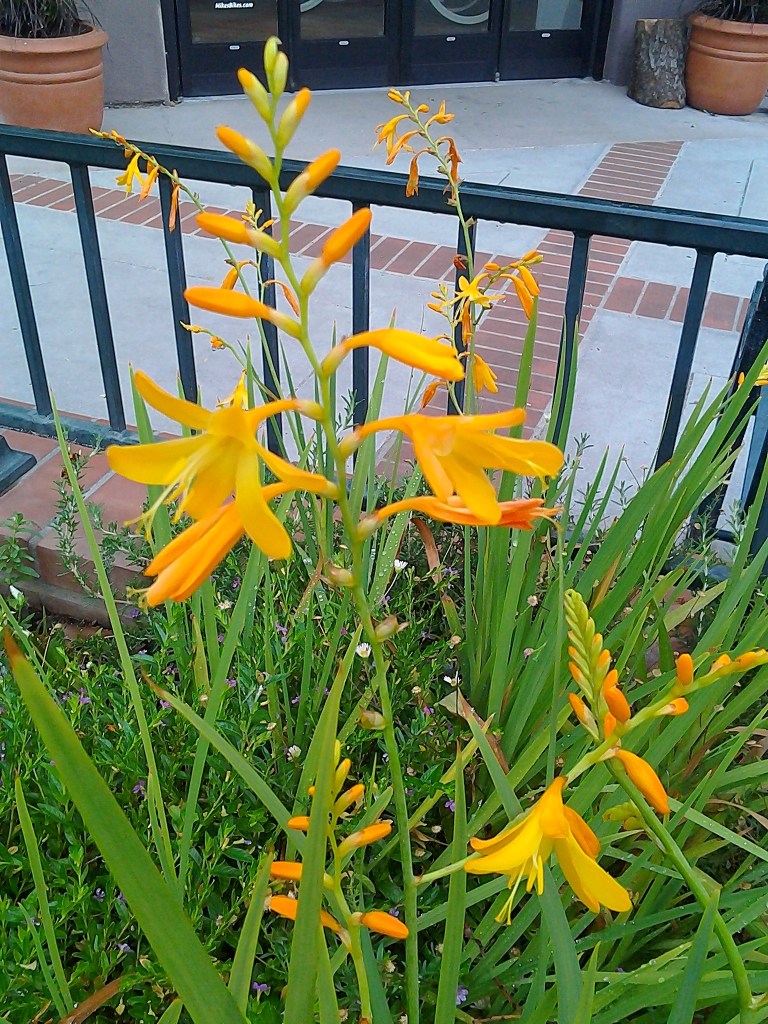
Bright orange montbretia is quite reliable and resilient, but can easily become a weed if not groomed of fading flowers.

Once they get into the garden, montbretia, Crocosmia X crocosmiiflora, may never leave. They sometimes survive the demolition of their original garden to emerge and bloom in the garden of a new home built on the same site. Bulbs (actually corms) multiply surprisingly efficiently to form large colonies that should eventually be divided if they get too crowded to bloom. Ungroomed plants sow seeds that may be invasive.

The one or two inch wide flowers are almost always bright orange, but can sometimes be reddish orange, yellow or pale yellow. The branched flower stems are two or three feet tall or a bit taller, and stand nicely above the grassy foliage. The narrow leaves are about half and inch to an inch wide.

Licorice Plant

Licorice plant can become vegetative mulch.

This is not the genuine licorice of confectionery. This more popular home garden licorice plant, Helichrysum petiolare, is more of an ornamental plant than a culinary herb. Its mild foliar aroma resembles that of genuine licorice, but is very faint. Without disruption of the foliage, the aroma is imperceptible. Since the foliage can be toxic, the flavor is irrelevant.

Licorice plant is popular for its appealingly silvery foliage. Some cultivars are variegated. ‘Limelight’ is strikingly pale silvery chartreuse. The small, rounded and evergreen leaves are distinctly tomentous (slightly fuzzy). The sprawling stems tend to disperse over older growth, and might get deeper than a foot and a half. Mature plants get wider than six feet.

Licorice plant is susceptible to extremes of temperatures. Within more severe climates, it appreciates a bit of partial shade during excessively warm and arid weather. Foliage can roast from harsh exposure. Where winters are cool, foliage appreciates shelter from frost. Roots are susceptible to rot with excessively frequent watering, or inadequate drainage.