Pumpkin

Brightly colored pumpkins ripen in autumn.

Actually, it is a fruit; a rather BIG fruit. It happens to be one of the more familiar of winter squash, but is not too commonly eaten. Although it makes excellent pie, and provides edible seeds and flowers, pumpkin is more popularly known as jack-o’-lanterns or Cinderella’s ride to the ball. Pumpkin is not for every garden, since each big and coarsely foliated annual vine needs regular watering, rich soil and considerable space to grow all through summer to produce only one or two big fruit in autumn.

Most pumpkins are big and round, and have smooth and bright orange skin. Those grown for jack-o’-lanterns are brighter orange, and not quite as meaty. Those grown for pie are often a bit smaller and meatier, with a rustier orange color. The biggest pumpkins get too huge to move easily, but lack flavor. The flavors and densities of many weird modern varieties are as variable as the green, red, pink, yellow and white hues of their skins. Some pumpkins have been developed specifically for their seeds, which are known as pepitas, or are used for production of pumpkin seed oil.

Kahili Ginger

Kahili ginger blooms as summer ends.

It is not the ginger that is so popular for culinary purposes, but it is the most popular for home gardens in the West. Kahili ginger, Hedychium gardnerianum, is so vigorous and easy to grow that it has potential to be invasive in ideal situations. Fortunately, it does not produce many of its sticky seeds locally. It therefore migrates primarily by dispersing rhizomes, which are not noxiously fast.

The delightfully fragrant bloom begins late in summer, and will finish soon. As many as forty small pale yellow and red flowers radiate from each cylindrical floral truss. Blooms stand neatly vertical, even if the stems supporting them lean. As cut flowers, they last only for a few days. Deadheading after bloom eliminates unwanted seed (if that is a concern), and unclutters the tidy foliage below.

However, with or without deadheading, the lush foliage is only temporary after bloom. It deteriorates as the weather cools through autumn. Cutting the herbaceous canes to the ground before they get too unsightly will expose some of the thick rhizomes. New canes will grow a few feet tall next spring and summer. On the canes, each leaf extends in the opposite direction of the leaf below it.

Tree Of Heaven

50923
Tree of Heaven or tree of Hell?

‘A Tree Grows In Brooklyn’ documents the resiliency and invasiveness of the common but typically undesirable tree of Heaven, Ailanthus altissima. Once a single female tree get established, the extremely prolific seeds get everywhere, including cracks in concrete. The resulting seedlings conquer wherever they are not dug out. If cut down, they just resprout from the roots.

Male trees smell horrible while blooming for about a month in spring or summer. They are pollinated by flies, so naturally smell like what flies like. The tiny yellowish or tan flowers hang on panicles that can be a foot and a half long. Female blooms are not as big, prolific or objectionably fragrant. However, stems, leaves and all other parts of both genders smell rotten when handled.

Tree of Heaven, which has earned the alternative names of ‘tree of Hell’, ‘stink tree’, ‘ghetto elm’ and ‘ghetto palm’, is no longer a tree that gets planted by choice. It is typically a tree that plants itself, and on rare occasion, happens to grow into a good situation. They should not be allowed to overwhelm more desirable trees, or get too close to concrete or other damageable features.

Young trees grow very fast to about forty feet tall. Older and slower trees do not get much taller, although sheltered trees can get twice as tall, with elegant gray bark. They do not live much more than fifty years. The big pinnately compound leaves are surprisingly pretty. On vigorous shoots, individual leaves can get as long as two and a half feet, with leaflets as long as six inches.

Glossy Abelia

50916
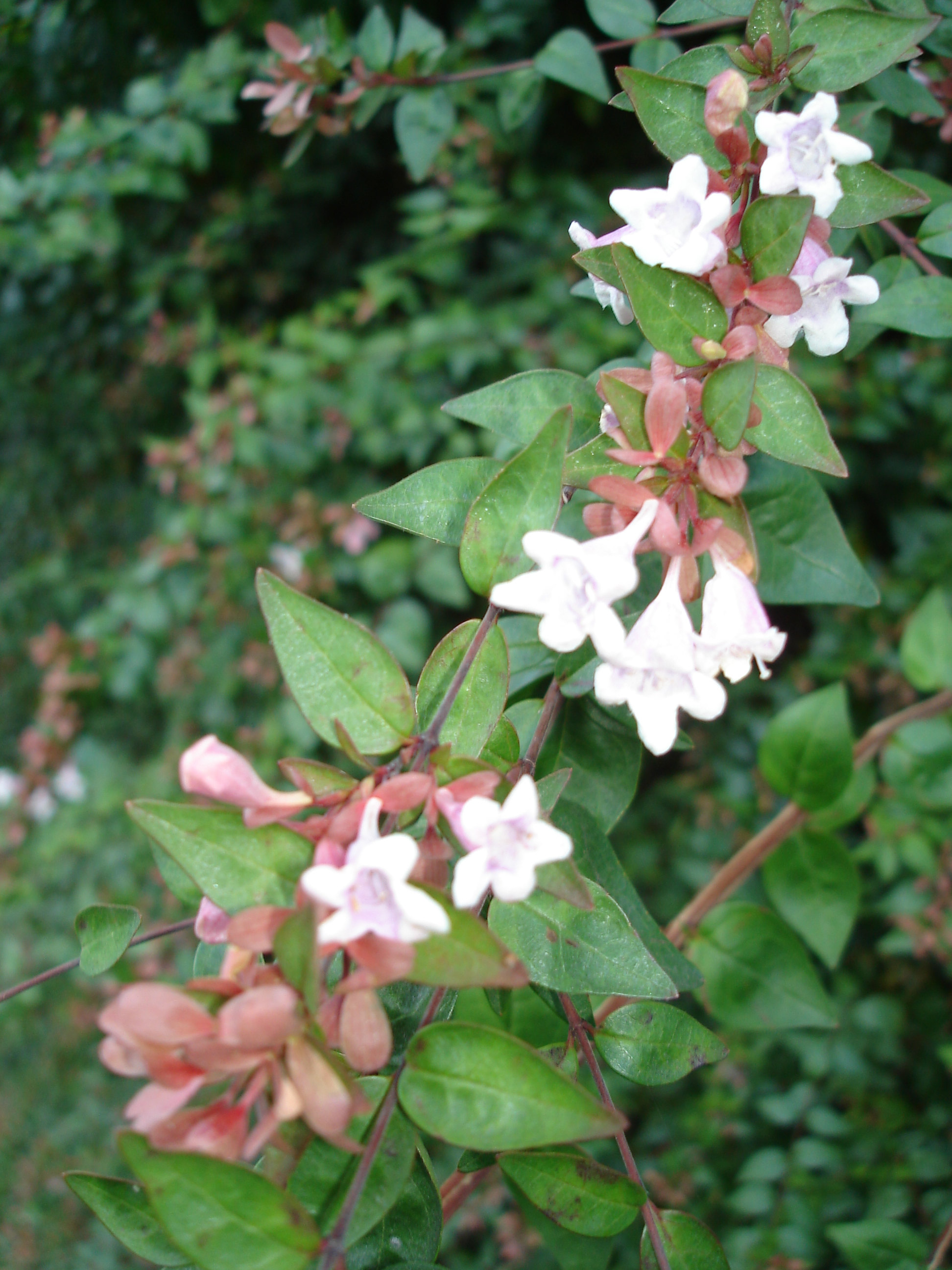
Arching boughs of pink abelia blossoms.

With indiscriminate pruning, glossy abelia, Abelia X grandiflora, will never develop its natural form, with elegantly long and thin stems that arch gracefully outward. Sadly, almost all get shorn into tight shrubbery or hedges that rarely bloom. If only old stems get selectively pruned out as they get replaced by fresh new stems, mature shrubs can get eight feet tall and twelve feet wide.

Against their bronzy green foliage, the tiny pale pink flowers that bloom all summer have a rustic appeal. In abundance, they can be slightly fragrant. The tiny leaves are not much more than an inch long. Vigorous young canes that shoot nearly straight out from the roots slowly bend from the weight of their bloom and foliage as they mature.

Partial shade is not a problem for glossy abelia, but will inhibit bloom somewhat. Young plants want to be watered regularly. Old plants are not nearly so demanding, and can survive with notably less water. If alternating canes is too much work to restore old and neglected plants, all stems can be cut back to the ground at the end of winter. New growth develops quickly.

Quince

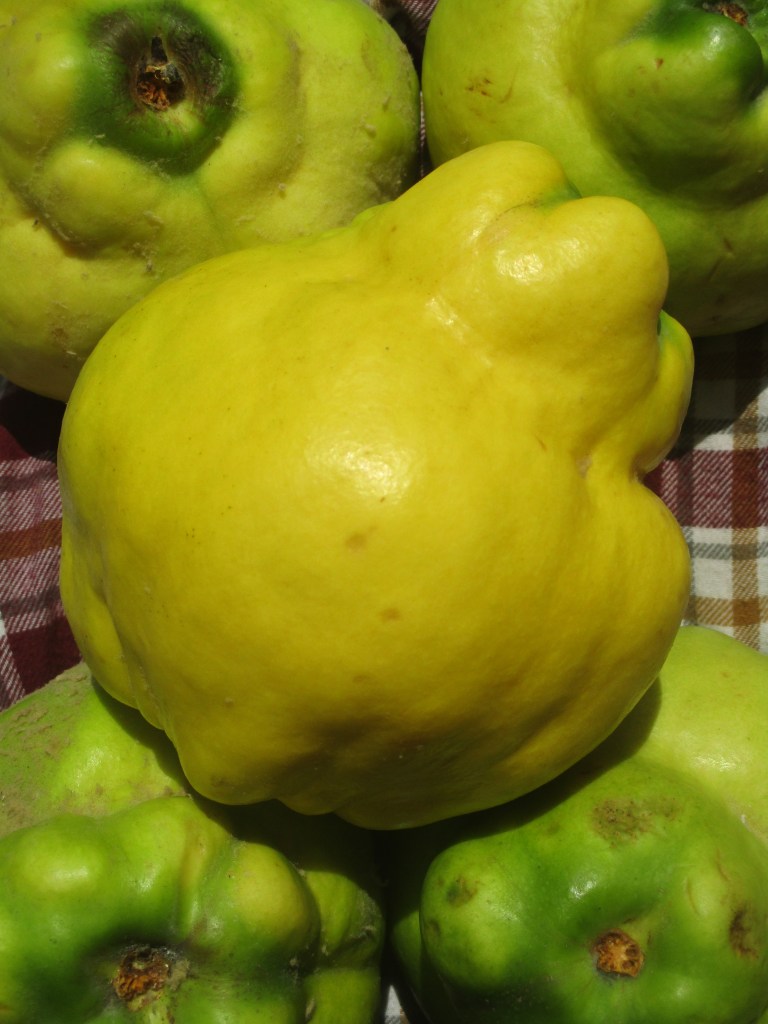
Quince fresh from coastal Santa Cruz!

The function of this formerly popular fruit tree has changed significantly to adapt to modern horticulture. The big but hard fruit of quince, Cydonia oblonga, is less perishable than the firmest pears or apples. Without canning or freezing, it lasts through winter in cool cellars. It also provides pectin for jellies of fruits that lack it. However, quince fruit is too hard to eat fresh, so should be cooked.

As food storage became less important, quince became less popular than more flavorful apples and pears, which are edible while fresh. Pectin is obtainable from apple cores and skins, or from supermarkets. However, quince are not completely absent from home gardens. They are now the unseen but common dwarfing understocks that limit the size of pear trees for suburban gardens.

The big lemony yellow fruits that are ripening now may look like very lumpy pears or apples. The largest sorts get as big as small cantaloupes. Developing fruit and new foliage are distinctly fuzzy. Fuzz can be polished off of alluringly aromatic mature fruit. Delightfully pale pink flowers are mostly obscured by new foliage in spring. The deciduous rounded leaves are two or three inches long.

The biggest of quince trees, which are very different from ornamental flowering quince, might get as high and wide as twenty feet.

Autumn Sage

50909
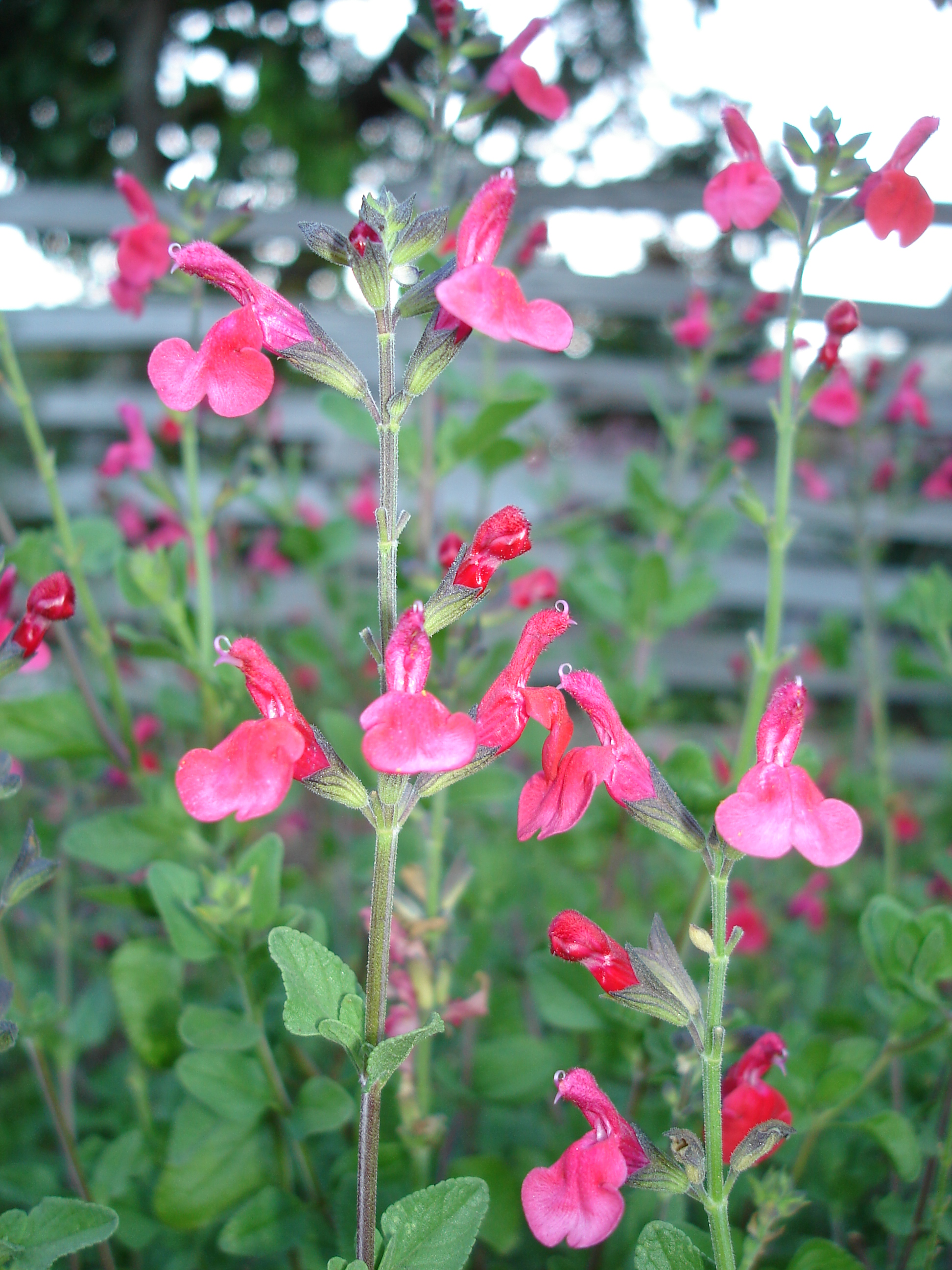
Salvia greggii is a modest sage.

Perhaps in the wild, it blooms in autumn. Where it gets watered in home gardens, even if watered only occasionally, autumn sage, Salvia greggii, blooms all through summer as well. If pruned back severely over winter, it starts to bloom even sooner in spring. The tiny flowers are red, rose, pink, peach, very pale yellow, lavender or white. Some poplar cultivars have bi-colored flowers.

Compact autumn sage that does not get much more than a foot tall is uncommon. Larger cultivars get four feet tall and broad, with more open growth. Most get about three feet high and a bit wider. Without severe winter pruning, stems can eventually get twiggy, with sparse foliage on the exterior. The tiny aromatic leaves are less than an inch long, and visually resemble oregano.

Even though it is not native to California, autumn sage is popular for native landscaping because it does not need much water. Just like native sages, it attracts butterflies and hummingbirds.

Lemon Bottlebrush

00916
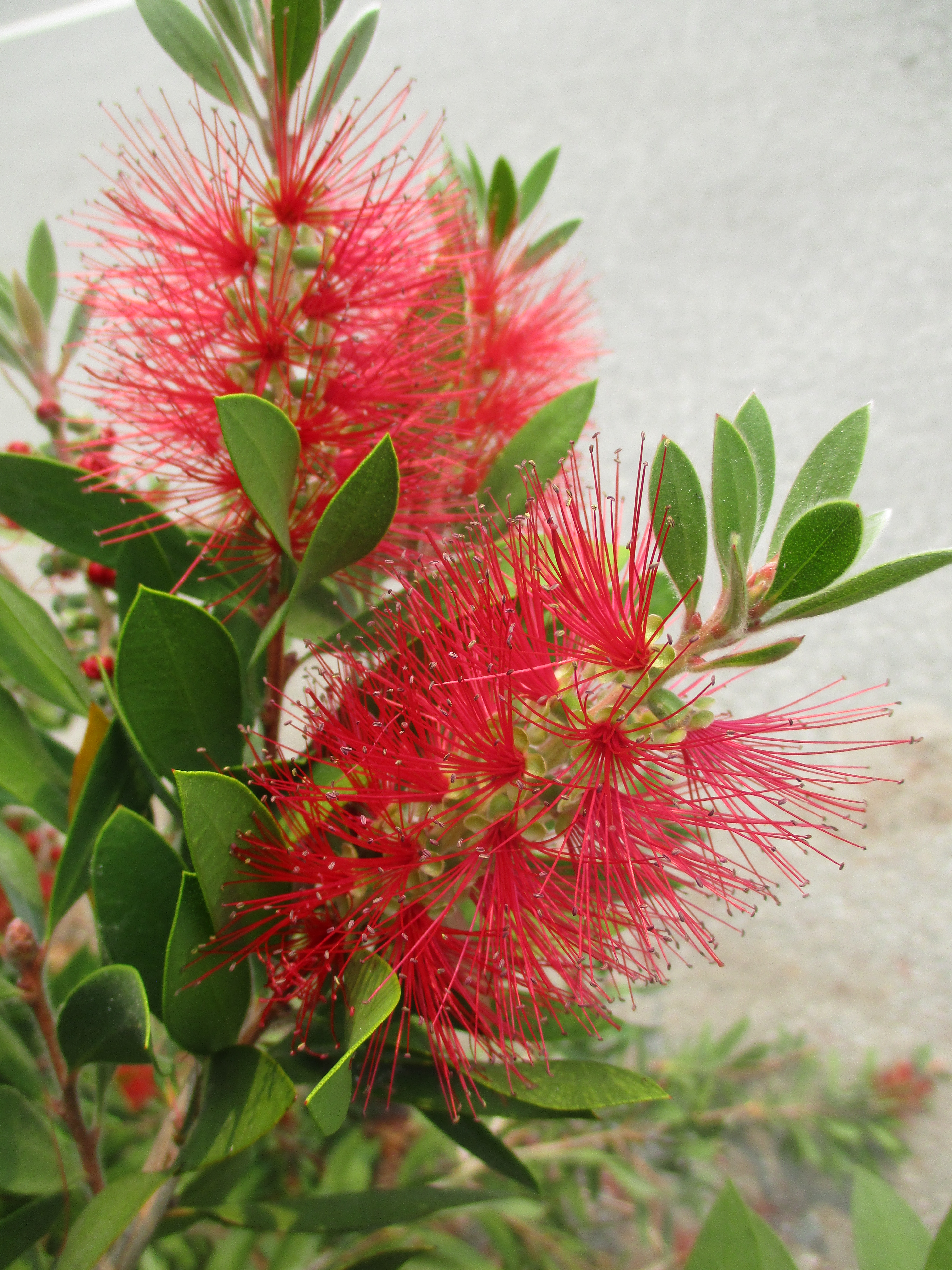
Hummingbirds enjoy red lemon bottlebrush bloom.

As its compact cultivars gained popularity over the years, the formerly common lemon bottlebrush, Callistemon citrinus, became passe. Most are mature specimens in old fashioned landscapes. It is unfortunate. Only lemon bottlebrush and weeping bottlebrush can grow as small trees. (However, lemon bottlebrush is now classified as Melaleuca citrina. Most Melaleuca get notably larger.)

If competing for sunlight, mature specimens of lemon bottlebrush can almost reach upstairs eaves. Well exposed specimens may not get much more than half as tall, with mounding form of about equal width. Removal of low growth to expose sculptural trunks and handsomely shaggy bark promotes higher growth above. Shearing of hedges should not be too frequent to allow some bloom.

Bright red bloom is sporadic through the year, and gets more abundant as summer becomes autumn. The small and staminate flowers are densely set in cylindrical ‘bottlebrush’ formation. These blooms are about two or three inches long, almost as wide, and popular with hummingbirds. Dense evergreen foliage is aromatic. Individual leaves are narrow and about two or three inches long.

Carob

50902+
John the Baptist really knows carob.

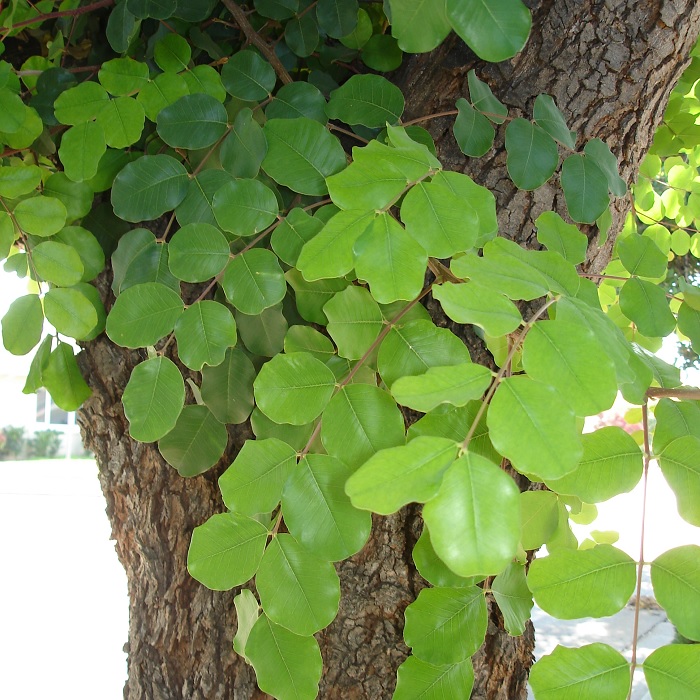
The locusts that John the Baptist ate out in the desert were not grasshoppers. They were the nutritious locust pods of the carob tree, Ceratonia siliqua. Their familiar sweet cocoa flavor was probably fine for a while, but the starchy texture must have gotten dreadfully monotonous. After all these centuries, carob is still grown for food and as a shade tree.

It takes a very long time for a carob tree to get taller than forty feet. Most are less than thirty feet tall, and not quite as broad. Their rounded canopies are very dense. The stout trunk and limbs are quite sculptural, with variably but handsomely textured bark. The five or six inch long evergreen leaves are pinnately compound, with very glossy round leaflets.

Unfortunately, the big chocolaty pods are abundant enough to be messy if not harvested. Trees that do not produce pods bloom in autumn with seriously stinky male flowers that attract flies for pollination. Some trees are both male and female, so are both messy and stinky. Because carob trees are grown from seed, their gender can not be predicted.

Since they are from the drier regions around the Mediterranean Sea, carob trees really do not crave for much water once they have dispersed their roots. They grow somewhat faster if watered generously a few times through summer, but will survive without it. Too much water will cause buttressed roots that will break nearby concrete.

Bird Nest Cypress

00909
Bird nests should be so refined.

Port Orford cedar is a grand tree. It is native to the southern coast of Oregon and the very northwestern corner of California. Mature trees in the wild are more than a hundred fifty feet tall. Some of the older big trees within landscapes are more than forty feet tall. However, the cultivar known as bird nest cypress, Chamaecyparis lawsoniana ‘Nidiformis’ is remarkably diminutive and shrubby.

Bird nest cypress grows slowly, and may never get more than five feet high and wide. Individual plants are mounding with rather flat tops. A row of plants eventually becomes a low informal hedge. Distinctively flat sprays of slightly grayish evergreen foliage exhibit a soft feathery texture. Unless pruned otherwise, abundant dense foliage obscures main limbs with fissured reddish brown bark.

Most cultivars of Port Orford Cedar, including bird nest cypress, are uncommon here. They actually prefer cooler and moister climates. Locally, they are sensitive to harsh exposure and wind while the weather is warm. A bit of partial shade is no problem. Established plants do not need much water, but should not get too dry for too long. Selective pruning, not shearing, sustains natural form.

Coffeeberry

50826
Coffeeberry must be and ‘acquired’ taste. (Ick!)

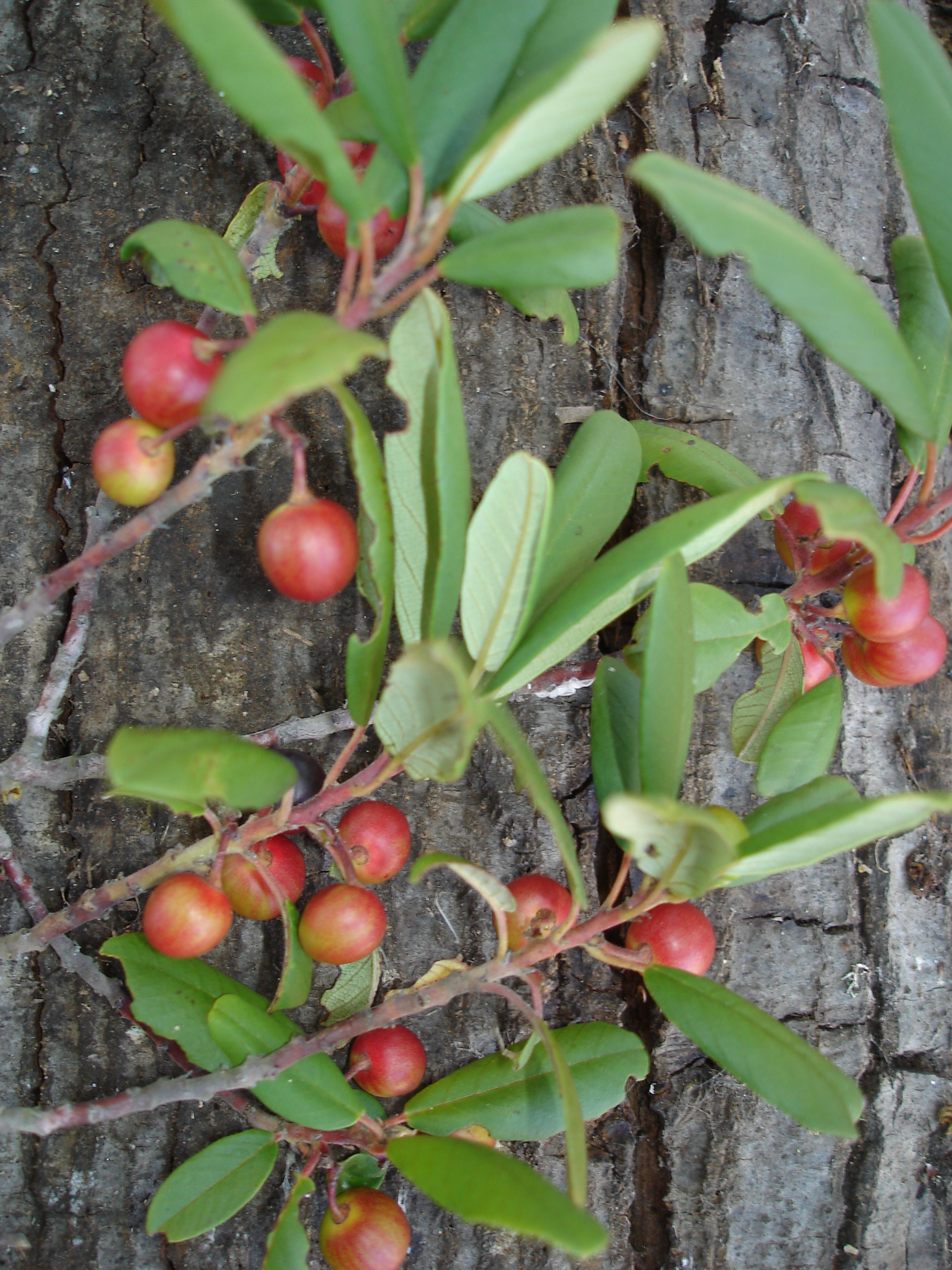
Before the 49ers of the Gold Rush discovered that the seeds of the native coffeeberry, Rhamnus californica (or Frangula californica), make a nice uncaffeinated coffee substitute, the native American Indians were eating the fruit and using the leaves and bark herbally. The black berries supposedly make good jelly, but do not last long, and are too bitter while still red or greenish.

Before the birds get them, the quarter inch wide berries are somewhat colorful, but are not very abundant. The small clusters of tiny greenish yellow flower that bloom in spring are not much to look at either. The army green evergreen foliage is the main appeal. New stems are somewhat ruddy. Old stems and main trunks have smooth gray bark.

Large coffeeberry plants in the wild can get more than ten feet tall, with relatively open branch structure. Garden varieties stay smaller, with compact branch structure. ‘Eve Case’, which is probably the most popular variety, stays less than six feet tall, and is densely foliated. ‘Mound San Bruno’ is even more compact, with smaller leaves. ‘Seaview’ is a groundcover.