Smokebush

00624Cliche is barely avoidable regarding smokebush, Cotinus coggygria. It provides rich foliar color from spring until autumn, with uniquely billowy bloom through summer. Then, it provides exquisite fall color until winter. Then, it provides sculptural form of bare stems until spring. Smokebush ‘has it all’. . . almost. All the spectacle distracts from a lack of floral fragrance. Will anyone ever notice?

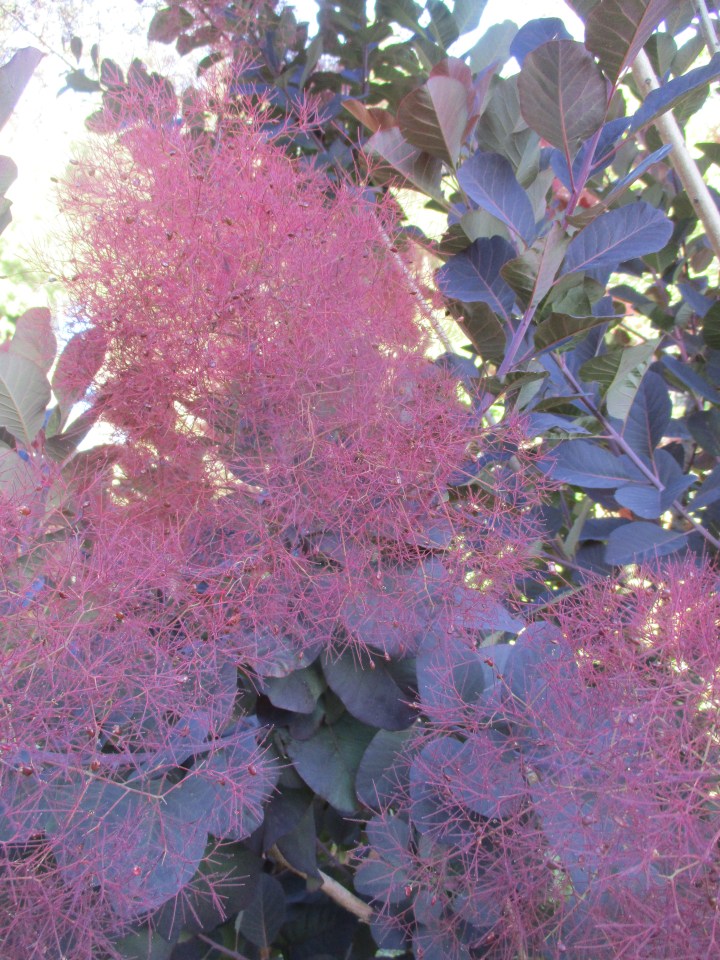
Foliage is rich purplish bronze, bright greenish yellow or olive green through spring and summer. Formerly common old fashioned cultivars with olive green foliage are now rare. Nowadays, most are rich purplish bronze. Fall color is fiery yellow, orange and red. The round leaves are about one to three inches long. Purplish to pale pinkish plumes of smoke-like bloom are a striking contrast.

The largest of smokebush grow at a moderate rate to more than fifteen feet high and wide. Most cultivars are more compact. They get wobbly in the ground if they grow too vigorously. Aggressive pruning during winter improves stability and enhances foliar color for the next season. However, minimal pruning of stable plants promotes bloom. Smoke tree wants full sun, but is not demanding.

Fan Aloe

50610
Some aloes should have more fans.

most aloes are tough perennials that do not need much water. Unfortunately, they do not have many fans. Maybe that is why fan aloe, Aloe plicatilis, makes it’s own. The plumply succulent leaves are distichously arranged, which is a fancy way of saying that they are either to the left or to the right, flaring out to form foliar fans.

Individual leaves are just as distinctive as their arrangement is. They are not tapered and pointed like those of other aloes. Instead, they are about an inch and a half wide from end to end, with weirdly blunt tips. They get almost a foot long. The soft gray color contrasts nicely with coral flower spikes that bloom at the end of winter.

It grows slowly, but fan aloe is one of the few aloes that eventually grows into a big shrub with several sculptural trunks on a flaring base. In their native habitat in South Africa, old specimens grow as small trees more than ten feet tall. Branches that need to be pruned away can be rooted as cuttings after the cut ends dry out a bit.

Rat Tail Cactus

00617
Not many cacti cascade from planters.

When first imported to Europe from the Americas, cacti were very strange. Their distended green stems do all the photosynthesis. Vestigial leaves develop into sharp protective spines. Vestigial stems develop into more formidable thorns. One of the first cacti imported is among the weirdest. Rat tail cactus, Aporocactus flagelliformis, develops pendulous stems that do not stand upright.

In the wild, rat tail cactus cascades from rocky ledges and crotches of trees. In home gardens, it cascades splendidly from elevated planters or hanging pots. Pruning scraps make good cuttings to plug into loose stone or broken concrete retaining walls. Rat tail cactus likes warmth, but also some partial shade from hot afternoon sunshine. Yellowish stems appreciate a bit of mild fertilizer.

Old stems grow longer than three feet if they get the chance. However, they discolor with age. Pruning them out from the base promotes healthier and more compact growth. Most stems emerge from the base, with minimal branching beyond the base. Bloom is slightly purplish pink. Individual flowers are about two inches long and slightly wider than an inch. They last for three or four days.

Zinnia

50603
zinnia

The lineage of modern zinnias is too complicated to describe. Most are still known as Zinnia elegans, even though they have been bred extensively with several other specie to produce an impressive variety of flower forms and colors. The shortest varieties get only a few inches tall. Big varieties get about two and a half feet tall.

The two to five inch wide flowers, which bloom in phases from spring until autumn, can be yellow, orange, red, purple, pink, salmon, peach, chartreuse or bronzy brown. Some are striped or freckled.

Some flowers look like colorful daisies, with big petals (ray florets) neatly and flatly arranged around prominent centers (disc florets). The overly abundant petals of pom-pom types make rounded blooms with nearly obscured centers. Most are fuller than the daisy types, but not as plump as pom-poms.

Zinnias are warm season annuals that like good exposure and rich soil. The paired leaves are slightly raspy, like kitten tongues, and can be susceptible to powdery mildew. Deteriorating flowers should be deadheaded, although a few can be left for seed.

Dragon Lily

00610
Dragon lily is striking and stinky.

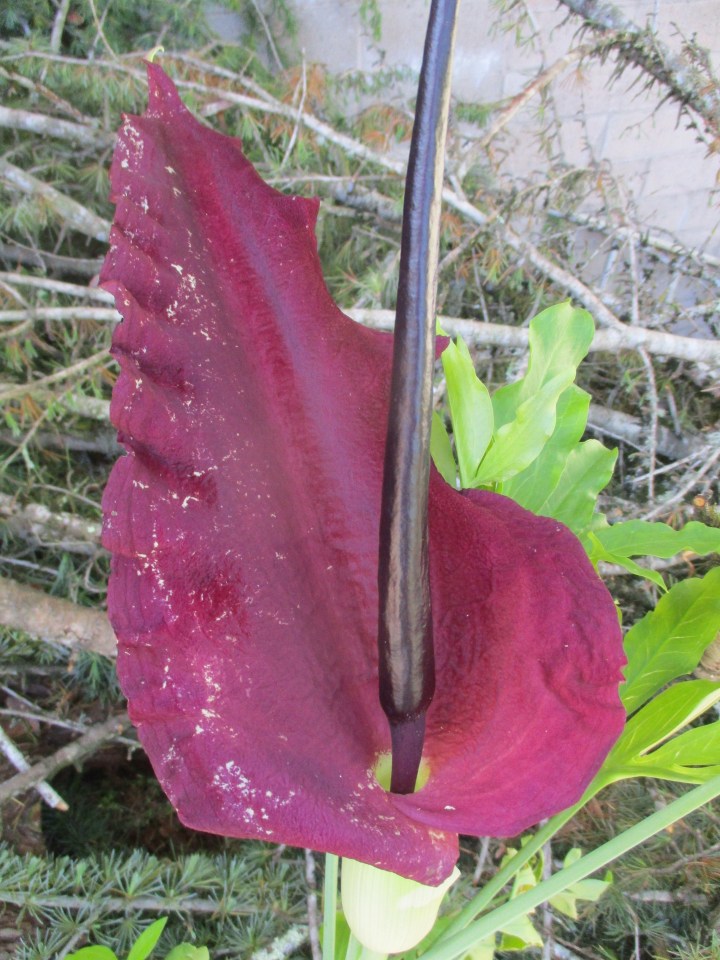
Dracunculus vulgaris make a sinister impression by botanical name alone. Common names include dragon lily, dragon arum, dragonwort, black dragon, snake lily, stink lily and voodoo lily. That makes it sinister enough to be compelling. Although rare in nurseries, dormant tubers are available in season by mail order. Alternatively, established colonies happily share a few dormant tubers.

Dragon lily is quite easy to grow. It appreciates rich soil and regular watering, at least until it gets established. Once settled in, it might be satisfied with only monthly watering until it goes dormant in late summer. Because it prefers humid climates, it wants shelter from wind here, and may like a bit of partial afternoon shade. It is so adaptable that it unfortunately naturalized in some regions.

The fragrance of dragon lily attracts insect pollinators that are drawn to dead animals. Those of us who enjoy unusual plants find it amusing. Everyone else thinks it stinks. Blooms that produce the fragrance are spectacular, with a big and flared purplish red spathe around a slender black spadix. They may stand nearly three feet tall, among lightly blotched and deeply lobed palmate leaves.

Catmint

50527
Catmint is mellow like old denim.

Not to be confused with closely related catnip, catmint is a resilient perennial for sunny and warm spots. Nepeta faassenii had always been the more familiar catmint. Modern varieties include a few other specie and hybrids. The various catmints work like the various lavenders or trailing rosemary, without getting so shrubby.

Unless they lean on something or climb through shrubbery, stems do not often get any higher than a foot as they spread to two or three feet wide. A few stems around the edges can grow roots through winter, to spread more the following year. New plants are easy to propagate by division of some of the rooted stems before spring.

The diagonal flower spikes that bloom most profusely as weather warms in spring are the color of faded blue denim. Some catmints bloom white or pink. The finely textured foliage is grayish green, although some varieties of catmint have chartreuse or greener foliage. Spent bloom can get shorn off to keep new foliage neat.

Trailing Lobelia

00603
Lobelia may bloom beyond next summer.

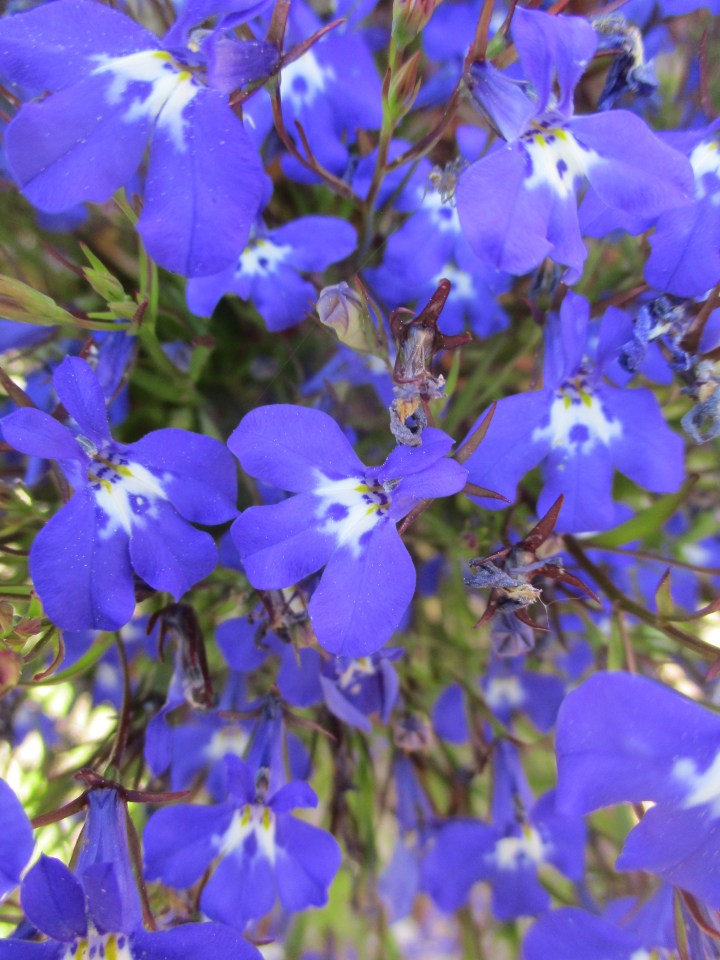
No other bedding plants exhibit such rich blue as trailing lobelia, Lobelia erinus. Cultivars with white, purplish pink, purple or sky blue bloom are still not quite as popular as the favorite cobalt blue bloom. Individual flowers are tiny but very profuse and uniform. Some have white centers. The narrow leaves are tiny as well, and finely textured. Some cultivars have dark purplish bronzed foliage.

Individual plants are only about three to six inches high and wide. Cultivars that are more rounded and densely foliated are excellent for edging. They are very popularly planted in single rows, and alternating with alyssum. Trailing types exhibit wispier growth that stays a bit lower and spreads a bit wider. They do not trail far, but cascades nicely from urns and hanging pots of mixed annuals.

Although grown as a warm season annual, trailing lobelia can survive as a short term perennial where winters are mild. Fresh new growth develops out of the centers of overwintered plants about now. If pressed gently into the soil just before they are replaced by new growth, scraggly outer stems can develop roots. They just might grow into new plants before the originals eventually die off.

Pin Oak

50520
Pin oak is not drought tolerant.

There are several oaks, especially natives, that do not need much more water than they get from rain. Pin oak, Quercus palustris, is not one of them. It is naturally endemic to areas that are damp or swampy for part of the year. It is more tolerant than others are to lawn irrigation, but is also more sensitive to drought.

Compared to other oaks, pin oak grows fast while young. It can get two stories tall in about ten years. Then, it takes more than twice as long to double in size. Old trees do not get much more than fifty feet tall, with trunks nearly three feet wide.

The deciduous foliage turns as brown as a grocery bag in autumn, and may linger late into winter, or until it gets replaced by new foliage in spring. The distinctively deeply lobed leaves are about two to five inches long, and about two thirds as wide. Each leaf has five or seven lobes. Each lobe has five to seven teeth.

Rockrose

00527
Rockrose is just beginning to bloom.

The first bloom is the best. At least it is purported to be. Many of us who are familiar with any cultivar of rockrose, Cistus, might disagree. Bloom begins in spring and continues through summer. The most profuse bloom can be anytime within that range. Some cultivars bloom sporadically but continually. Others bloom in more distinct phases. Cultivars that start later can bloom into autumn.

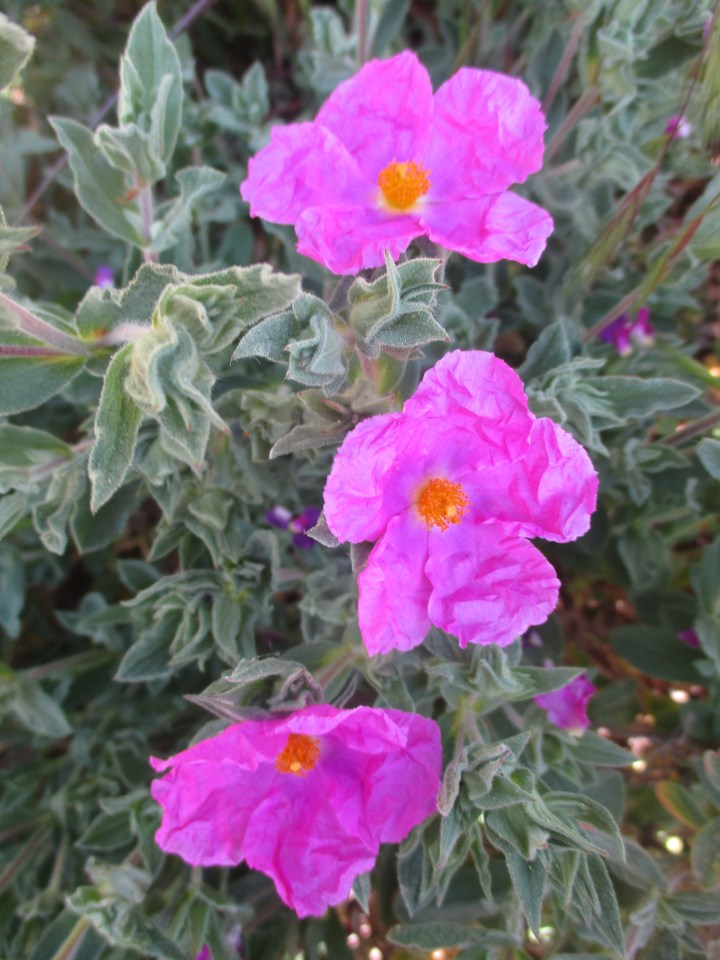
Bloom is white, pale pink, rich pink or purplish pink. Individual flowers have five petals and fuzzy centers. Flowers of some of the older cultivars have a prominent rusty red spot at the base of each petal. Smaller flowers are more profuse than larger flowers. The small evergreen leaves of most rockrose are somewhat grayish, with a matte finish. Foliage is aromatic when disturbed or warm.

Most rockrose are appreciated for their low and mounding form. If arranged in a row, they can grow into an artificial berm. Most get at least three times broader than tall. Few get taller than three feet. They all appreciate warm exposure. Once established they do not need much watering. Unfortunately, most rockrose do not live much longer than five years. Few survive more than ten years.

Bugle Lily

50513
Bugle lilies are like lean gladioli.

It would be accurate to guess that bugle lily, Watsonia pyramidata, is related to gladiola. It is not as impressive as gladiola is, but it is much more reliable. The relatively simple blooms become more abundant as bulbs multiply each year. Conversely, after blooming so flamboyantly in their first year, only a few gladiola bloom for a second year.

New bugle lily bulbs (corms) that were planted early last autumn grew through winter to bloom about now, in white and pastel hues of pink, rosy pink, lavender, orange and almost red. The small flowers are neatly arranged on narrow floral spikes that stand about three or four feet tall. The upright and narrow leaves get only about two or three feet tall.

After bloom, foliage slowly browns through warming summer weather, so should be cut to the ground when it becomes unsightly. While bulbs are dormant through summer, they do not need to be watered much, and can rot if soil stays too damp. Crowded colonies of bulbs can be divided and spread around as summer ends.