Sticky Monkey Flower

00520
‘Sticky monkey flower’ sounds too silly.

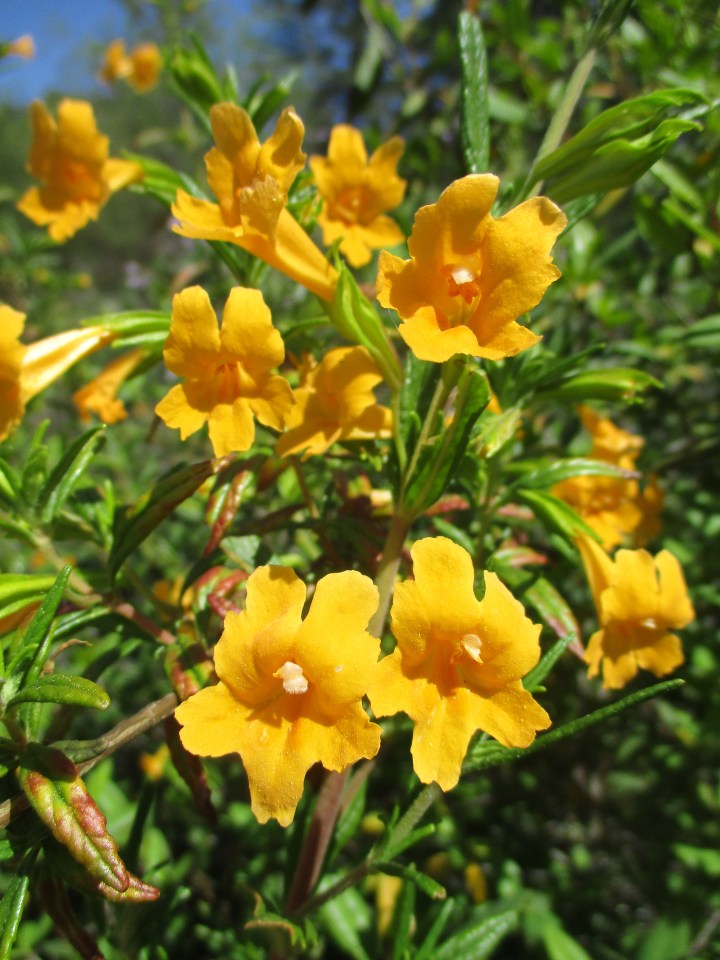
What a silly name this is! Sticky monkey flower, Diplacus aurantiacus (or Mimulus aurantiacus), is native to a broad range of ecosystems of California and the Northern Coast of Baja California. It is famously happy in situations that are too rocky or sandy for most other species. The resinous foliage really can be rather sticky during warm weather. The relevance to a monkey is a mystery.

Sticky monkey flower is more popular among hummingbirds and insects than anyone else. Those who welcome hummingbirds and insects into their garden happen to like it too. Honestly though, it might a bit too casual for refined landscapes. It works better in or on the outskirts of rustic gardens. If not already growing wild, cultivars and the straight species are available in some nurseries.

Bloom begins late in winter or early in spring, and might continue through summer, but is rarely impressively prolific. The bisymmetrical and tubular flowers are about three quarters of an inch long. Almost all are pastel orange, sort of like circus peanuts. Gold and yellow are uncommon. Supposedly, there are rare cultivars that bloom in red or white. Mature plants get more than three feet tall.
Mock Strawberry

50506
Potentially invasive mock strawberry fields forever.

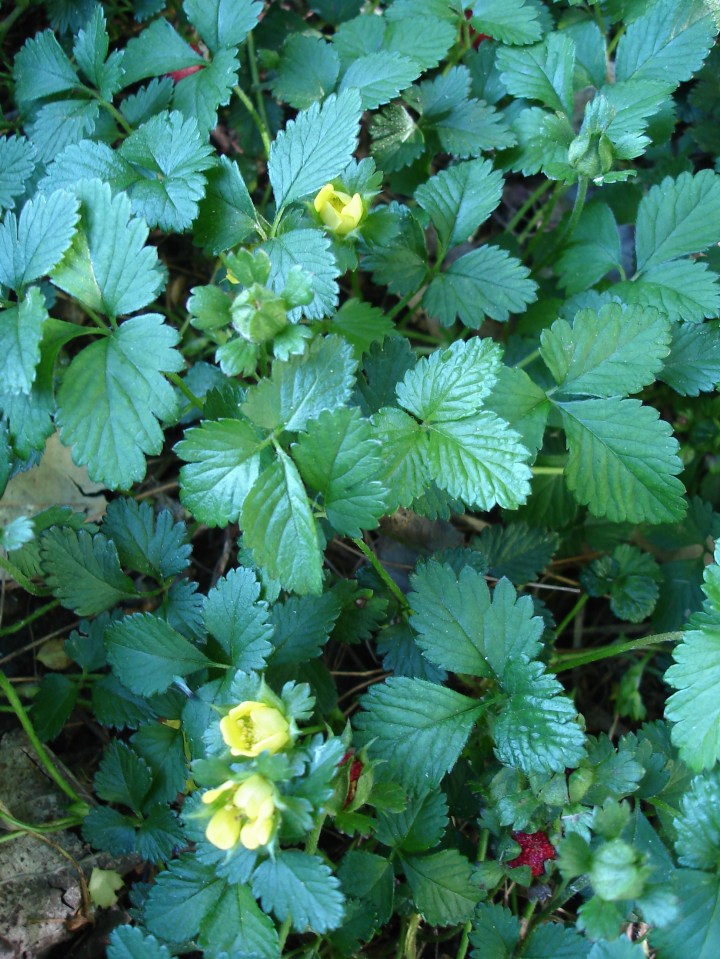
The small yellow flowers are the giveaway. Real strawberries have white or maybe pink flowers. Otherwise, mock strawberry, Potentilla indica, looks very much like wild strawberry, with similar small red fruits and neatly serrate trifoliate leaves (that are palmately divided into three leaflets). The berries are edible, but do not taste like much.

Like real strawberries, mock strawberry spreads efficiently by stolons. If watered occasionally and sometimes fertilized, it is probably a better groundcover than the common ornamental varieties of wild strawberry. It is invasive in some areas.

Mediterranean Spurge

00513
Peculiar bloom tops handsomely colorful foliage.

Seed for this species is all or nothing. The straight species of Mediterranean spurge, Euphorbia characias, seeds abundantly. It can actually be a bit too prolific. However, fancier and extensively bred cultivars either produce no viable seed, or produce only a few seed that are not true to type. Such seed grows into plants that resemble their ancestral species more than their direct parents.

Foliage of common Mediterranean spurge is slightly grayish green. Cultivars exhibit more distinctly grayish, bluish, yellowish or variegated foliage. Appealingly weird and generally greenish floral trusses bloom on top of upwardly arching stems about now. Mature plants are less than four feet tall and broad, with neatly rounded form. They slowly lean toward sunlight as they grow and bloom.

After old stems get cut to the ground in autumn, new stems develop through winter, to repeat the process. Established plants are surprisingly resilient to harsh exposure, warmth, wind and lapses of irrigation. They just dislike shade and constant dampness. However, even the healthiest live for only five to eight years. Those that toss seed can provide their own replacements before they go.

silver dollar gum

50429

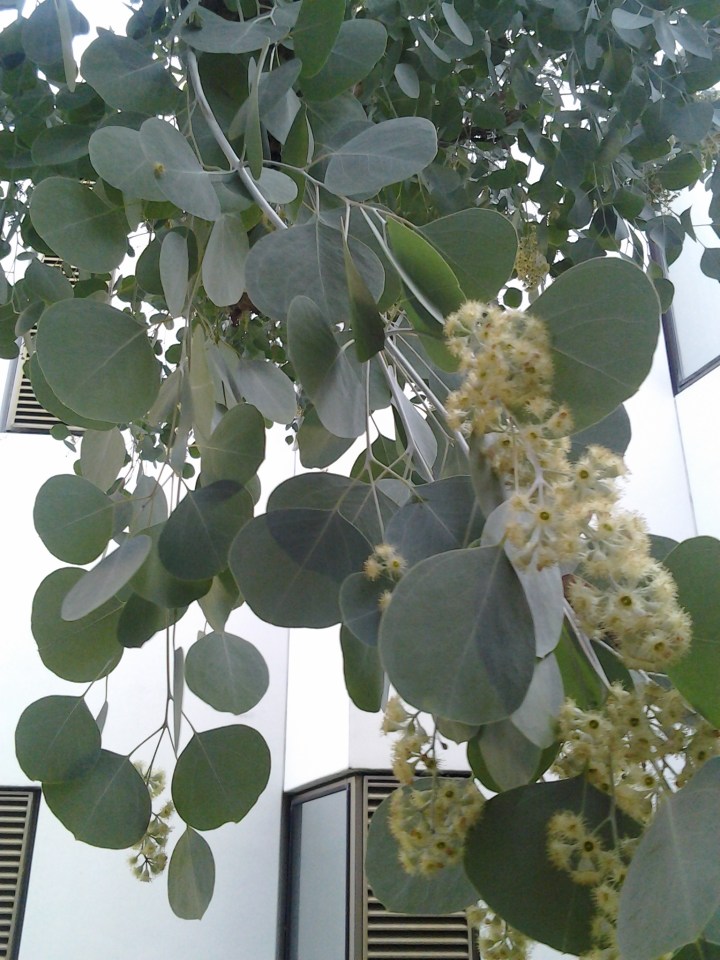
There are actually a few different eucalypti known as silver dollar gum. The most familiar and largest is Eucalyptus polyanthemos. Mature trees that were popularly planted through the 1960s are about forty or fifty feet tall. Some stay smaller. A few that compete with taller trees are more than sixty feet tall. Trunks and limbs are somewhat sculptural, with fibrous bark.

Grayish foliage on limber stems forms a billowy and rounded canopy that blows softly in the breeze. Juvenile leaves are nearly circular, and more silvery gray than adult foliage is, like silver dollars. Ovate adult leaves are about three inches long and half as wide. Tiny flowers with prominent white stamens bloom amongst the adult foliage in spring and summer.

Smaller trees are often pruned aggressively or pollarded so that they continually produce the more desirable juvenile foliage without bloom. The problem with this technique is that it must be repeated every few years or even annually. Otherwise, vigorous secondary growth can get too heavy and break away.

Forget-Me-Not

00506
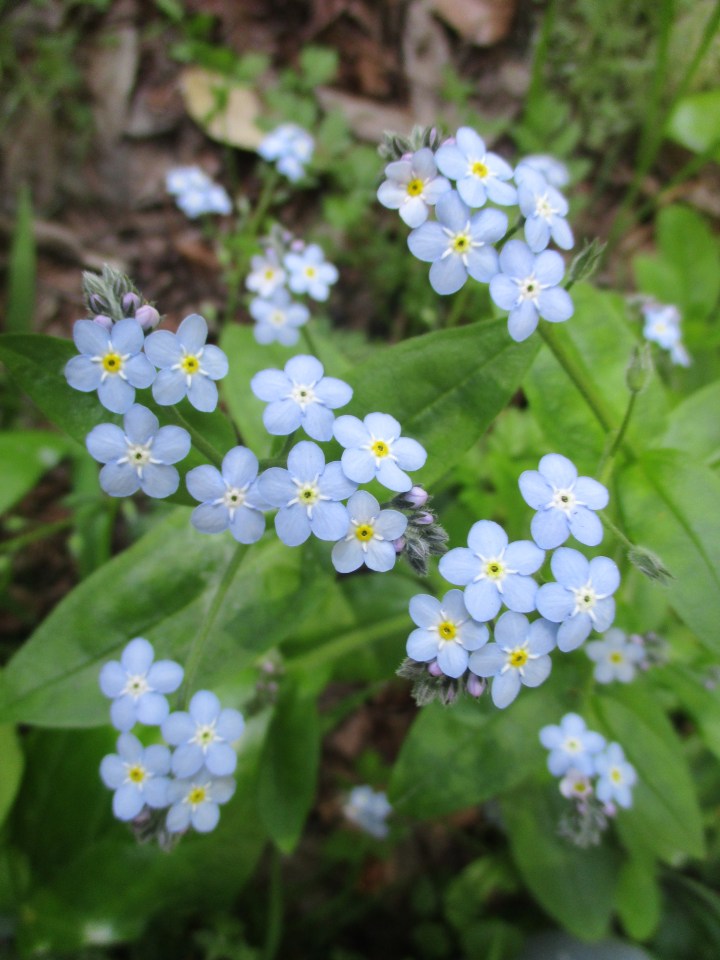
Blue like this is worth remembering.

Alaska, the biggest state in America, claims one of the most diminutive state flowers; their native alpine forget-me-not, Myosotis alpestris. Common woodland forget-me-not, Myosotis sylvatica, is the more familiar species here. It is not as common as the name implies though. Where naturalized, it stays within riparian or coastal situations, where the soil does not stay too dry for too long.

Forget-me-not is not notably popular in home gardens nowadays either. Of course, that only means that it is not often planted intentionally. Like violets and alyssum, it can proliferate where it gets a bit of water. Those who recognize it as more than a weed often leave it to provide delightful sky blue bloom until it succumbs to the warmth of summer. It is pleased to toss seed for the next year.

Common woodland forget-me-not is an annual, or at most, a biennial. Self sown seed starts to germinate through autumn, and grows into plants that can bloom before the end of winter. Manually sown seed wants to be in the garden early too, even if it grows slowly. New plants are too delicate to be commonly available in nurseries. Mature plants are less than a foot tall and two feet broad.

Natal Plum

50422
Lush foliage hides oddly branched thorns.

The very glossy and richly deep green foliage seem to be so soft and luxuriant. Simple bright white flowers enhance the appeal. However, closer examination of Natal plum, Carissa macrocarpa, reveals impressively nasty thorn structures that are doubly branched into pairs of paired rigid and sharp thorns. That is four thorns each!

To make matters worse, all parts of Natal plum that are not fruit are toxic. But hey, they all work together to be visually appealing, even if really unfriendly. The one or two inch long evergreen leaves are quite round and stiff. The star shaped flowers that bloom as long as the weather is warm are somewhat fragrant in the evening.

Some varieties of Natal plum can reach the eaves, but most stay lower. They do not need much water, and can tolerate a bit of shade. The rosy red fruit would be delightfully colorful if it were not so rare. Manual pollination, preferably with a different pollinator, produces more of the two inch long berries that are something like mildly flavored cranberries.

Pacific Coast Iris

00429
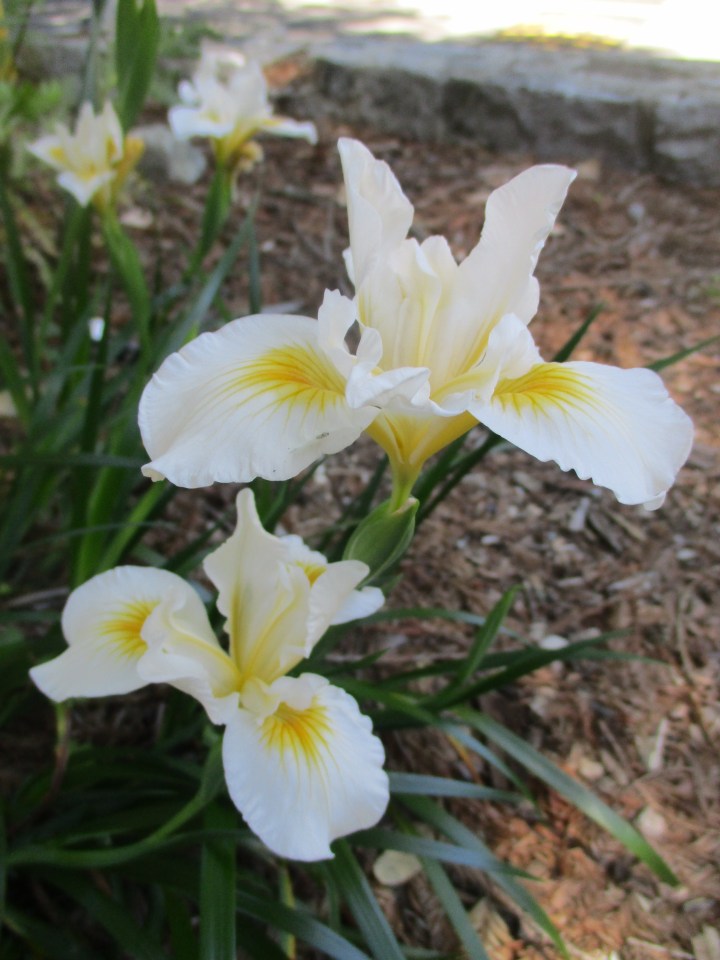
Bigger and bolder Pacific Coast iris.

Various species of iris that are native to exposed coastal hillsides are uncommon in nurseries. Even nurseries that specialize in native species grow only a few. Iris douglasiana was probably the most popular of these years ago. Its slender flowers are various shades of steely blue, like faded denim. Nowadays, most Pacific Coast iris are hybrids of various native and a few exotic species.

The color range of these modern hybrids is impressive. Many bloom with rich shades of blue, purple, burgundy, rusty red, orange, gold, yellow or rosy pink. Softer and pastel shades include coral pink, lavender, creamy white and bright white. There is even sky blue that is almost comparable to the color of well faded denim. Flowers are more substantial than those of their ancestors though.

Bloom is sometimes significantly early, or as late as May. Otherwise, it should happen about now. Each floral stalk supports about two or three flowers that bloom in succession. Floral stalks tend to lean outward from the center of mature plants, and curve to hold their bloom upright. Bloom typically stands less than two feet high. Their slender and arching dark green leaves stay even lower.

Blue Spruce Stonecrop

50415-
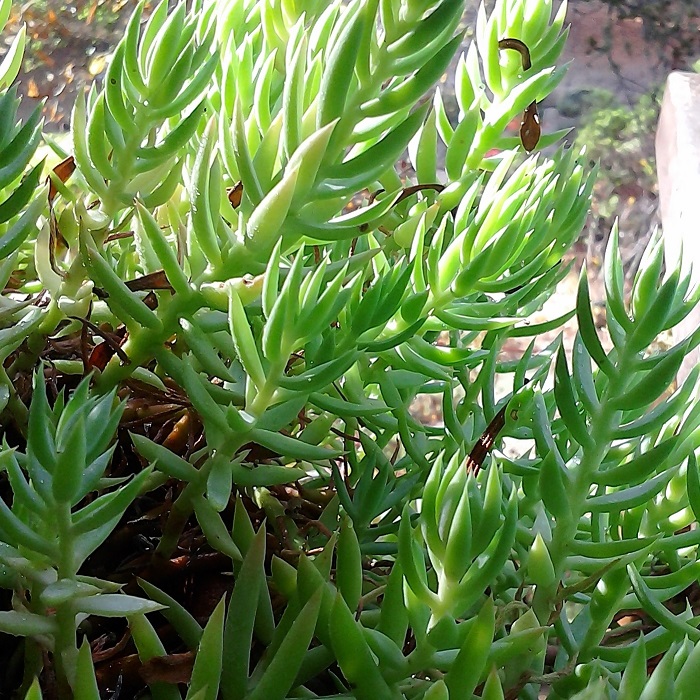
This stonecrop seems to be coniferous.

It may not be as useful as those marketing it say it is, but blue spruce stonecrop, Sedum reflexum ‘Blue Spruce’ is a nice grayish component to pots of mixed perennials. It contrasts nicely with golden foliage, and looks great with the chartreuse foliage of closely related ‘Angelina’ stonecrop. The limber stems cascade a few inches over the edges of tall urns and hanging pots.

The succulent leaves are quite small, and as the name implies, look like plump blue spruce needles. The succulent stems do not stand much higher than six inches before flopping over. They do not get much wider than high initially, but have a sneaky way of rooting where they touch the ground to cover more area. Yellow flowers bloom just above the foliage in summer.

What blue spruce stonecrop does not do well is uniformly cover large areas of hard or dry soil. It can spread nicely, but is patchy, with thin spots and thick spots. It is really only reliable as ground cover over small areas. It prefers to be watered occasionally, even though it does not need much water. It also likes relatively loose or friable soil, even though it does not need rich soil.

Indian Hawthorn

00422
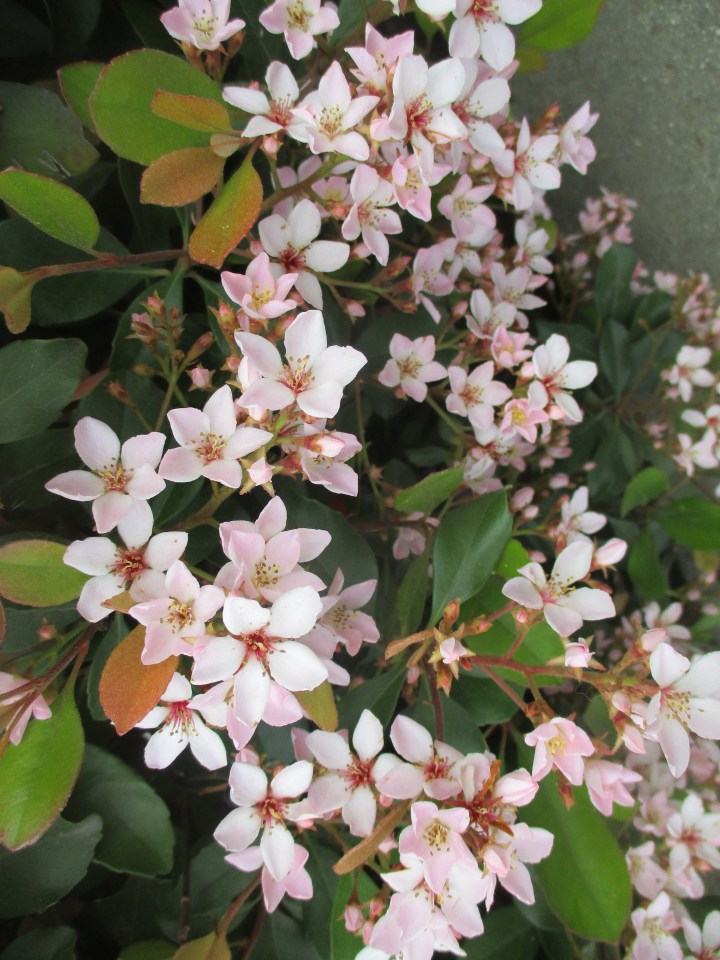
Indian hawthorn is an early bloomer.

Here on the West Coast of California, Indian hawthorn, Raphiolepis indica, was formerly popular as a foundation plant. The compact hollies that were used as such in the East never became very popular here. Back when rain gutters were prohibitively expensive, foundation plants diffused water as it fell from roofs. This limited erosion, and also inhibited splattering onto lower parts of walls.

Modern Indian hawthorn cultivars are now appreciated elsewhere in landscapes for profuse pink bloom in late winter or early spring. Sporadic bloom might continue through summer, with a minor secondary bloom phase in autumn. The most compact cultivars display slightly richer pink bloom, followed by mildly bronzed new foliage. At least one cultivar exhibits barely blushed white bloom.

‘Majestic Beauty’ is a cultivar that might be a hybrid with loquat. It can grow as a small tree more than ten feet high and wide. Other cultivars do not get half as big. Most get less than four feet high. They work nicely as low and plump hedges, but should be shorn after bloom. Full sun exposure and occasional irrigation should be sufficient. They are popular, because they are so undemanding.

Aleppo Pine

50408
Aleppo pine thinks it is native.

From coastal regions around the Mediterranean Sea, the Aleppo pine, Pinus halepensis, came to be right at home on and near the coast of California. Once established, it can survive quite happily on rainfall. Trees that get too much water can actually get too heavy with foliage, and may eventually get disfigured if limbs break.

Shade under an Aleppo pine is not too dark. The light and sometimes yellowish green foliage is rather wispy, comprised of thin paired needles that are about three inches long. The sculptural trunks almost always lean to one direction or another, and often divide into multiple trunks once they grow out of reach. Bark is light gray with light brown striations.

Young trees can get big rather fast. They tend to be somewhat conical, or at least upright, until they get to be about forty feet tall. Then, they tend to shed lower stems and develop irregular branch structure with rounded tops as their growth rate slows. Only a few old trees in ideal situations slowly get to seventy feet tall. Seedlings sometimes appear where they are not wanted.