Naked Lady

Naked lady is only rarely white.

From scarcely exposed tops of seemingly dead bulbs, floral stalks unexpectedly appear. Foliage only appears after bloom finishes. This is why Amaryllis belladonna is known as naked lady. It blooms unfoliated. Various varieties of the same species bloom with about the same vivid pink color. White variants are very rare. Floral fragrance is mild but sweet.

Naked lady flowers are about two feet tall on simple brown or green stalks. Fleshy seeds that develop after bloom are viable only while fresh and plump. Foliage begins to appear by later summer, and grows more with autumn rain. It resembles foliage of lily of the Nile, but is more fragile, and shrivels by late spring. Then, bulbs lay dormant through summer.

Naked lady bulbs are impressively resilient, but also quite sensitive. If possible, the best time to relocate them is supposedly between bloom and foliation. However, relocation is likely easiest during complete summer dormancy. Unfortunately, though, such relocation can interfere with subsequent bloom. Naked lady needs full sun exposure to bloom well, but requires no water.

Aeonium arboreum

Aeonium arboreum will grow about anywhere.

The once traditional Aeonium arboreum, with round, dense rosettes of slightly serrate, olive green leaves has become less popular than its more colorful varieties that have become more available over the years. ‘Atropurpureum’ has rich purplish brown foliage. ‘Zwartkop’ is even darker and stays more compact. Long and sometimes unkempt clusters of tiny yellow flowers that bloom in spring or summer are not much to look at against green foliage, but contrast nicely against dark foliage. Larger plants can get to three feet tall and wide, with foliar rosettes wider than six inches.

Like many succulents, Aeonium arboreum is so easy to propagate from cuttings, that small pieces that need to be pruned from established plants can be plugged into the garden wherever more of the same plants are desired. New cuttings like to be watered until they develop roots. Established plants are a bit happier with occasional watering, but can survive neglect just fine. After all, they are native to similar climates in the Mediterranean and northern Africa.

Sneezeweed

Sneezeweed typically blooms for late summer.

Contrary to its silly name, sneezeweed, Helenium autumnale, does not cause sneezing. Its flowers produce heavy pollen that relies more on pollinators for dispersion than wind. Its vibrant yellow, orange or red floral color attracts all sorts of bees, butterflies and such. Bloom may begin as early as the middle of summer, or continue as late as early autumn.

Sneezeweed is a perennial like black eyed Susan, but with a somewhat shrubbier form. It can grow three or four feet tall without growing any wider than two or three feet. Foliage has a rather fine texture with lanceolate and somewhat serrate leaves. Individual flowers are about two or three inches wide, and delightfully abundant. They are nice cut flowers.

Sneezeweed may self sow, but some cultivars are not true to type. For them, division is a more reliable method of propagation. ‘Pumilum Magnificum’ provides vivid yellow bloom. ‘Chippersfield Orange’ provides vivid orange and yellow flowers. ‘Kupfersprudel’ blooms with a bit more yellow than orange. ‘Bruno’ blooms with deeply rich ruddy brown flowers. ‘Butterpat’ provides rich golden bloom. Several cultivars are compact.

Our Lord’s Candle

Our Lord’s candle blooms with very tall floral stalks.

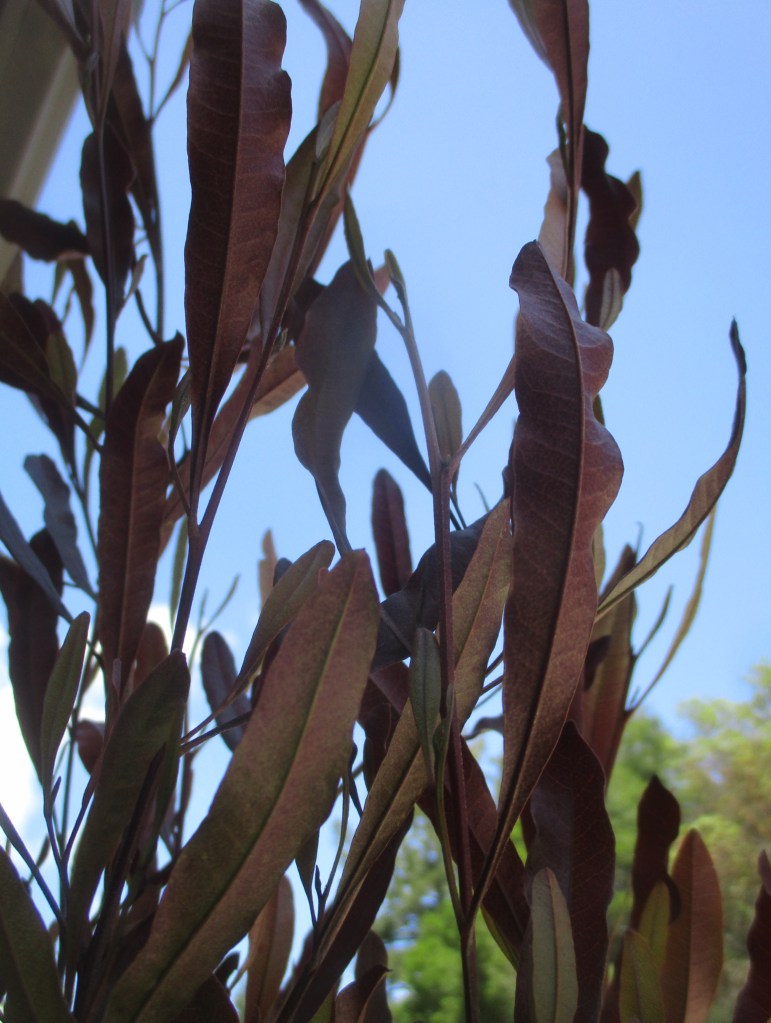
The one or two foot long and nearly inch wide leaves of our Lord’s candle, Yucca whipplei, certainly do not look as painful as they really are. The ridiculously sharp terminal spines can penetrate boot leather and administer a whole new experience of lingering pain! It is no wonder that, although native south of Big Sur, they are uncommon in home gardens.

Their three foot tall and six foot wide stemless clumps of dense foliage would be a very efficient barrier that does not obstruct view, but is not always permanent. Within only a few years, mature plants die after summer bloom. Their big flower stalks emerge like asparagus and grow nearly twelve feet tall, with the upper half of their height branching into hefty spikes of pale white bell shaped flowers one or two inches wide.

Arizona Cypress

Arizona cypress is distinctively grayish green.

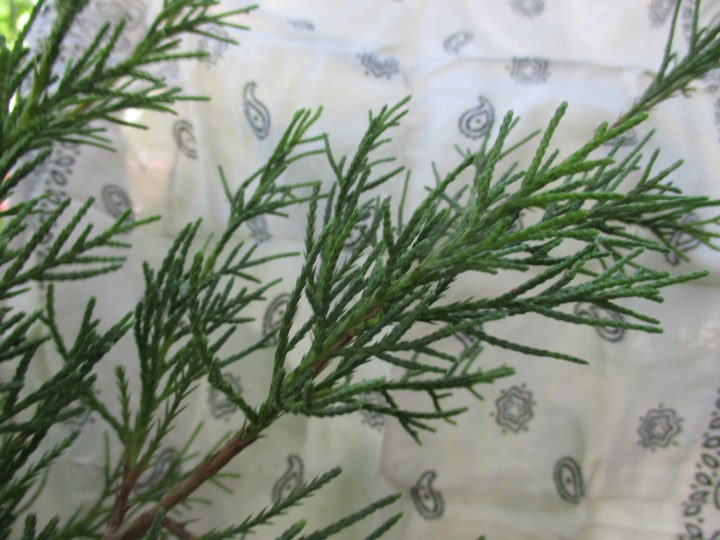
Classification of this species may be complicated. About five distinct varieties of Arizona cypress, Cupressus arizonica, occur naturally. Some may sometimes classify as distinct species. Some grow no higher than twenty feet, with stout and shrubby form. Some grow fifty feet high, with sculpturally irregular form. Botanists may not agree on their identities.

Old trees that mostly grew from seed are typically noticeably variable. Some exhibit nice bluish green foliar color. Others are more grayish green. Modern trees are mostly modern cultivars with strikingly uniform silvery blue foliar color. Some are supposedly conducive to hedging, which enhances foliar color. Although evergreen, foliage is freshest in spring.

Without hedging, Arizona cypress develops splendid natural forms. Whether sculpturally irregular or compactly shrubby, it may need only minor grooming. Its finely textured foliar debris disappears into any ground cover below. However, such foliage can have a mildly herbicidal effect on lawns. Arizona cypress trees in a row can be an effective windbreak.

Bear’s Breech

Bear’s breech can be a bit too sustainable, and difficult to get rid of.

Like some other Victorian perennials that are still happy after a century, bear’s breech, Acanthus mollis, can get to be too much of a good thing. It can become invasive where not contained. Once established, it is difficult to eradicate. The bold coarse foliage looks great while the weather is favorable, but then dies back after bloom when summer weather gets warm, leaving obvious voids where other plants were crowded out.

The good news is that bear’s breech does not require much attention at all. It is very easy to propagate by division or simply by digging a few thick roots while dormant or just as new foliage appears in autumn. Well watered plants can keep their foliage all year, so that they only need to be groomed of older foliage and spent flower stalks. Partial shade is not a problem; although snails can be.

Big arching leaves form bold mounds of glossy foliage about three feet wide. The distinctively lobed and toothed foliage has an appealing texture and deep green color. Elegant mostly white flower spikes stand nearly five feet tall late in spring into summer. Acanthus balcanicus (illustrated) is more compact, with more intricately textured foliage.

Garden Phlox

Garden phlox can be surprisingly fragrant.

Several species of Phlox are native California wildflowers. Yet, the more popular garden phlox, Phlox paniculata, is native only east of Kansas. It can self sow where it gets water, and is naturalized in the Pacific Northwest. It prefers rather rich soil and sunny exposure but is not very discriminating. A bit of partial shade might promote taller stems for cutting.

Mature garden phlox can be as tall and wide as three feet. Some modern cultivars stay a bit more compact. Dense panicles of small flowers may be as wide as six inches. Bloom is most commonly white, but may be pink, red, lavender or pastel orange. It is a splendid cut flower, with an alluringly rich fragrance. Bloom might continue for a month of summer.

Garden phlox is deciduous, so all canes die to the ground for winter. Mature colonies are then easy to propagate by division. Similarly, feral specimens that appear where they are unwanted are easy to relocate. Garden phlox can perform nicely in proportionately large pots and planters. It is uncommonly available from nurseries, but grows easily from seed.

Honey Locust

Honey locust is not too shady.

Where it grows wild in the eastern half of North America, honey locust, Gleditsia triacanthos, may not seem like it would be such an appealing shade tree. It is too thorny and messy to make many friends. As it matures and grows nearly seventy feet tall and half as broad, the thorny stems stay overhead and out of the way. However, a larger canopy makes more messy and sometimes unsightly foot long seed pods.

Modern cultivars of the thornless form Gleditsia triacanthos inermis are friendlier and not so messy. Mature trees only grow about half as tall as wild trees. Their main problem is their buttressing roots, which can displace pavement, but stay tolerably low for lawns. Honey locust is actually a good shade tree for lawns (if minor buttressing is not a problem) because it makes just enough shade without getting too dark for a lawn or other shade tolerant plants below. Pods are rare.

The big eight inch long leaves are bipinnately compound, which means that each leaf is divided into smaller leaflets, which are also divided into even smaller leaflets that are about half an inch long. Although individual leaves are actually quite large, the collective foliage is pleasantly delicate and lacy. This foliage turns yellow early in autumn and disintegrates as it falls, leaving minimal debris to rake. New foliage develops somewhat late in spring, along with inconspicuous flowers.

Petunia

Petunias appreciate rich soil or media.

Most popular modern petunia are hybrids of two primary species, and a few others. They classify collectively and simply as Petunia X hybrida. Although popular as warm season annuals, some can be short term perennials. They are only uncommon as such because they get shabby through winter. Yet, with a bit of trimming, they can regenerate for spring.

Petunia are impressively diverse. Their floral color range lacks merely a few colors. Also, flowers can exhibit spots, speckles, stripes, blotches, haloes or variegation. Flowers can be quite small, or as broad as four inches. Some are mildly fragrant. Some are quite frilly with double bloom. Cascading types can sprawl three feet while most are more compact.

Petunia are perhaps the most popular warm season annual. They can bloom from spring until frost, though they can get scrawny after a month or so. Trimming of lanky stems can promote more compact growth. Deadheading might promote fuller bloom for some types. Petunia enjoy sunny exposure, regular watering and rich soil. They perform well in pots. Cascading varieties are splendid for hanging pots and high planters.

 Passion Vine

Passion vine has the weirdest flowers.

My niece knows the weird flowers of passion vine as ‘flying saucers’ because they look like something from another planet. The most common species, Passiflora X alatocaerulea, has fragrant, four inch wide flowers with slightly pinkish or lavender shaded white outer petals (and sepals) around deep blue or purple halos that surround the alien looking central flower parts. The three inch long leaves have three blunt lobes, and can sometimes be rather yellowish. The rampant vines can climb more than twenty feet, and become shabby and invasive, but may die to the ground when winter gets cold. Other specie have different flower colors. Some produce interesting fruit. Passiflora edule is actually grown more for its small but richly sweet fruit than for flowers.