Pittosporum tobira ‘Variegata’

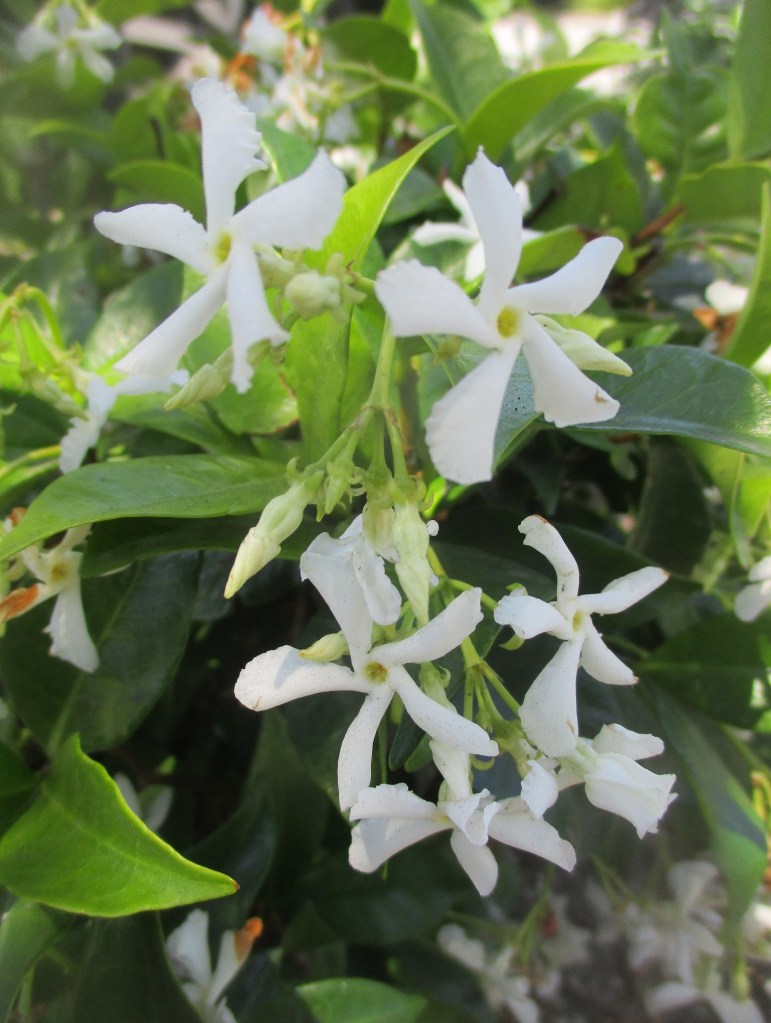
Pittosporum tobira ‘Variegata’ makes good hedges.

Almost all pittosporums appreciate sunlight and warmth. Pittosporum tobira ‘Variegata’ is no exception. However, it tolerates a bit of more partial shade than most. Furthermore, its grayish and creamy white variegation brightens shady situations. Its distinctively convex and glossy leaves are a bit flatter and broader where shaded. Shade inhibits bloom also.

Pittosporum tobira ‘Variegata’ is more popular as a foliar hedge anyway. Its small trusses of pale white flowers are neither prominent nor colorful. They can be delightfully fragrant in abundance, though. Stems are quite stout and can eventually grow more than six feet tall. They are resilient to frequent pruning and hedging, and can be cut back if necessary.

Pittosporum tobira ‘Variegata’ seems to lack a common name that is genuinely common. That is why its botanical name is most popular. Some know it as mock orange, but this is also a common name of Philadelphus. Some know it as Australian laurel, but it is neither a laurel nor from Australia. Regardless of name or origin, it is content with local climates. Once established, it is undemanding, and may need no watering.

Gopher Purge

Caustic sap deters gophers.

The common name may be derived from ‘gopher spurge’, since Euphorbia lathyris is within the family of plants known as ‘spurge’, and it is also purported to ‘purge’ the garden of gophers and moles. Like all related spurge, it has caustic opaque white sap that is very irritating to the skin and toxic if ingested. This offensive sap prevents anything from burrowing through the roots, but unfortunately does not prevent gophers and moles from going around. Therefore, a garden that is adequately protected may also be crowded by gopher purge.

Individual plants live for only two years, but produce enough seed to seem like perennials. Their mostly solitary stems can grow to nearly five feet tall with foliage that spreads up to a foot wide in the first year. Tiny yellow flowers that bloom in the second summer are not remarkable; and can set seed without getting much notice before the plant dies. Gopher purge can naturalize without becoming too invasive in regularly moist or somewhat shady parts of the garden. It prefers to be watered occasionally in drier and sunnier areas.

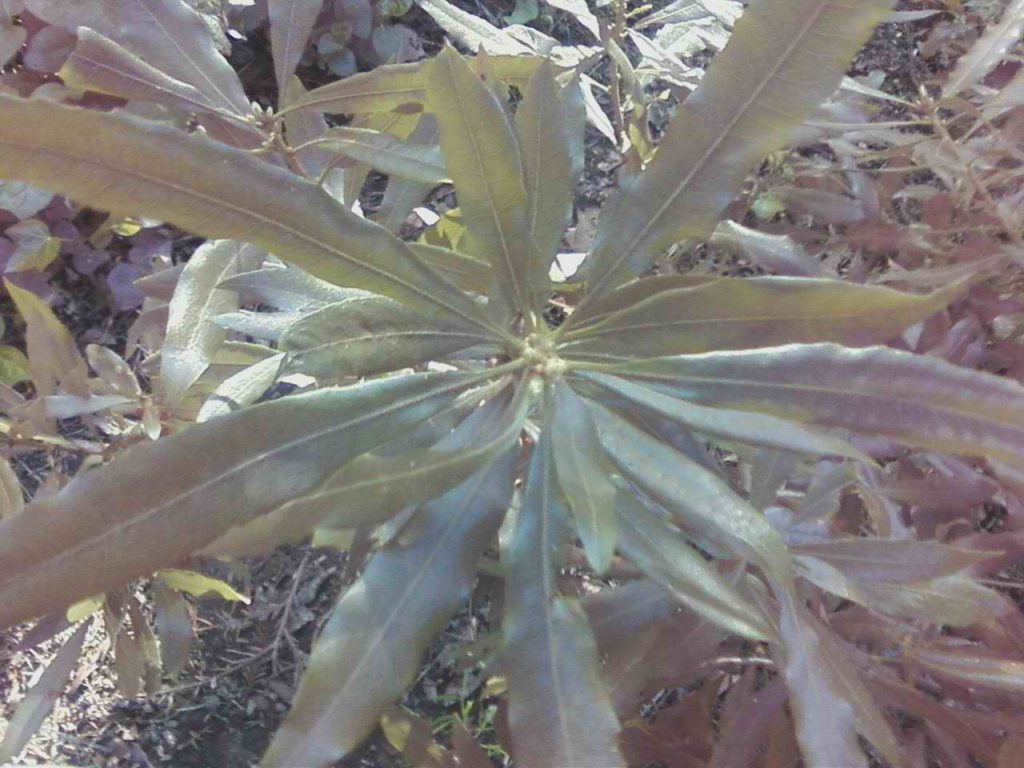
The foliage of gopher purge is strikingly symmetrical. Each pair of grayish or bluish green leaves is perpendicular to the pairs above and below it, in a four ranked pattern. Except for the newest upper leaves, each leaf pair is also arranged in a generally horizontal plane, perpendicular to the vertical stem. Gopher purge seems to have been assembled in the garden instead of grown there.

Californian Blue-Eyed Grass

Blue-eyed grass is not grass.

It is not a grass, and lacks eyes, but it is native to most of California and western Oregon. Blue-eyed grass, Sisyrinchium bellum, is related to iris, which actually sounds ocular. Its tiny flowers are typically rather purplish, but can be clear sky blue, or rarely white. Bloom continues through spring until summer dormancy. All foliage then dies back until autumn.

Blue-eyed grass develops small foliar tufts that expand quite slowly. It propagates easily from division of its thin rhizomes as it resumes growth in autumn. Plugging newly divided rhizomes adjacent to original foliar tufts accelerates expansion. Blue-eyed grass can self sow, but typically does so only sparsely. Its grassy foliage is typically less than a foot tall.

Although native and impressively resilient, blue-eyed grass appreciates a bit of moisture. However, it may never require irrigation, since it is dormant through the summer season. Irrigation might maintain foliage through much of summer, but if excessive, can cause rot. Blue-eyed grass prefers sunny and warm exposure, without contention from other plants.

Manzanita

Manzanita is Spanish for “little apple”.

Mature common manzanita, Arctostaphylos manzanita, can get more than fifteen feet tall and about half as wide, so can be rather large shrubbery or small trees. Pruning away lower growth exposes their interestingly sculptural and smooth cinnamon red stems and trunks. The rather stiff light green leaves make light shade that smaller plants can live with. Waxy pinkish buds bloom into small pendulous clusters of tiny white lantern like flowers as winter becomes spring.

Manzanitas prefer to be neglected. They should not be pruned too much, and certainly should not get shorn. Obtrusive stems should be pruned out completely, since stems that get cut back do not regenerate. New plants should only be watered once or twice weekly through the first summer. Mature plants plants only want to be watered monthly or even less. After all, they are native to the surrounding hillsides, so are very satisfied with annual rainfall.

Lungwort

Most lungwort blooms blue or purplish.

Its unappealing common name is less common than its more agreeable botanical name. Lungwort does not sound as pretty, or at least as official as Pulmonaria officinalis. It is an evergreen perennial, although its foliage likely desiccates through summer. New foliage replaces it during cooler autumn weather. Lungwort prefers cool and moist partial shade.

Mounds of foliar rosettes grow no deeper than a foot. They often stay only half a foot high as they spread as wide as two feet. Their lowest rhizomes produce adventitious roots so that they can sprawl even farther. Such growth is easy to divide. Foliage of most cultivars exhibits pretty lighter green or silver spots or blotches. Some is almost completely silver.

Lungwort blooms mostly for late winter and early spring. Trusses of daintily small flowers hover barely above their basal foliage. The most popular sort blooms with pinkish purple flowers that mature to blue. Others bloom with purple, pink, purplish red or white flowers. Although foliage is healthier within partial shade, sunshine promotes profusion of bloom.

English Daisy

Common English daisy can infest lawns.

Like pampas grass, periwinkle and the ivies, English daisy, Bellis perennis, has a bad reputation as an aggressive weed. The primitive species with single white flowers with bright yellow centers is very difficult to eradicate once it becomes established in lawns. The first phase of bloom in early spring can be profuse enough to resemble thin patches of snow that appear as the weather gets warmer instead of colder.

Varieties that are sometimes found in nurseries are much better behaved and more colorful. Their red, pink or white flowers are typically double, and stand on stems about three inches high. Their rich green, inch and a half long leaves make six inch wide clumps that are compact enough to mix with other small perennials in borders, urns or large pots. Deadheading (removal of fading flowers) is a bit tedious for so many small flowers, but promotes continued bloom. English daisy is very easy to propagate by division.

Bridal Wreath Spiraea

Bridal wreath spiraea resembles baby’s breath.

Flowering quince and forsythia set a precedent. Bridal wreath spiraea, Spirea prunifolia, somehow became old fashioned too. All three are only beginning to regain popularity. All are deciduous, so defoliate for autumn and remain bare through winter. They then bloom spectacularly on bare stems for late winter or early spring. Foliage develops after bloom.

Bridal wreath spiraea, like forsythia, develops many upright and arching basal stems. Its stems can grow taller than eight feet, although they are typically a bit shorter. Removal of old stems after bloom promotes growth of new stems, which bloom better. Indiscriminate pruning ruins their naturally upwardly flaring form. A slight bit of partial shade is tolerable.

Almost all bridal wreath spiraea are of the cultivar ‘Plena’. Their double flowers are fluffy but tiny, between just a quarter and a half inch wide. The simple species, and the variety ‘simpliciflora‘ with single flowers, are rare. Regardless of floral form, floral color is limited to white. Foliage might develop yellow color for autumn where autumn weather is cooler.

Kaffir Lily

Kaffir lily may look like a bright orange lily of the Nile.

Not much more than a decade ago, Kaffir lily, Clivia miniata, was known almost exclusively for big rounded trusses of boldly bright orange flowers at the end of winter or beginning of spring. Relatively recent breeding has extended the color range to include some softer shades of orange as well as many shades of yellow and reddish orange. Solomone Hybrids are various shades of yellow. ‘Flame’ is brilliant reddish orange. Some varieties bloom earlier in winter. Others bloom later in spring.

Individual tubular flowers are actually rather small, but are clustered like hydrangea flowers on strong stalks that stand as tall as a foot and a half. Bright red berries sometimes appear after flowers fade. The rather rubbery foliage is deep green. The individual strap shaped leaves are rather wide and can be nearly a foot and a half long. Belgian and French hybrids have heftier flower stalks and wider leaves. Established plants do not like to be disturbed, but may get too crowded to bloom well if not dug and divided every few years or so.

Tulip

A single tulip flower seems lonely.

As diverse as they are, popular varieties are a minority of countless hybrids of the genus. Most common and popular hybrid tulips qualify as the neo-species of Tulipa gesneriana. In other words, they are not an actual species. Most but not all are descendants of Tulipa suaveolens. More sustainable varieties of simple species are becoming more available.

The most popular of tulip are early spring bulbs that went into their gardens last autumn. Floral color ranges through pink, red, orange, yellow and white, mostly with dark centers. Their basal foliage is rather light green or perhaps almost grayish, with a rubbery texture. Most tulips stand singly on straight stems about a foot tall, but some can grow a bit taller.

Tulip bulbs enjoy organically rich soil with regular irrigation throughout their bloom cycle. They should get all the moisture they want from rain through their winter dormancy cycle. Tulip prefer a bit of chill in winter, so may not be as reliably perennial here as elsewhere. They are most spectacular in herds or large beds, but mix nicely with other spring bulbs. Simple tulips are among the most popular of cut flowers.

Harlequin Flower

‘Tricolor’ (obviously) means ‘three colors’.

Even though bulbs for harlequin flower, Sparaxis tricolor, are no longer commonly found in nurseries when it is time to plant them in autumn, naturalized bulbs are somewhat common in some older gardens. Where winters are mild and soil does not get too dry and compacted, they are happy to slowly multiply and bloom every spring. They seem to be blooming a bit early this year, since they typically wait until later in spring. The upright narrow leaves resemble those of gladiolus, but get no taller than a foot. Each flower stems rises a bit higher to display a few flowers that are about an inch and a half wide. Each flower has a yellow center surrounded by a narrow rusty brown pattern, which is also surrounded by a third color; which is orange, red, pink or purple.