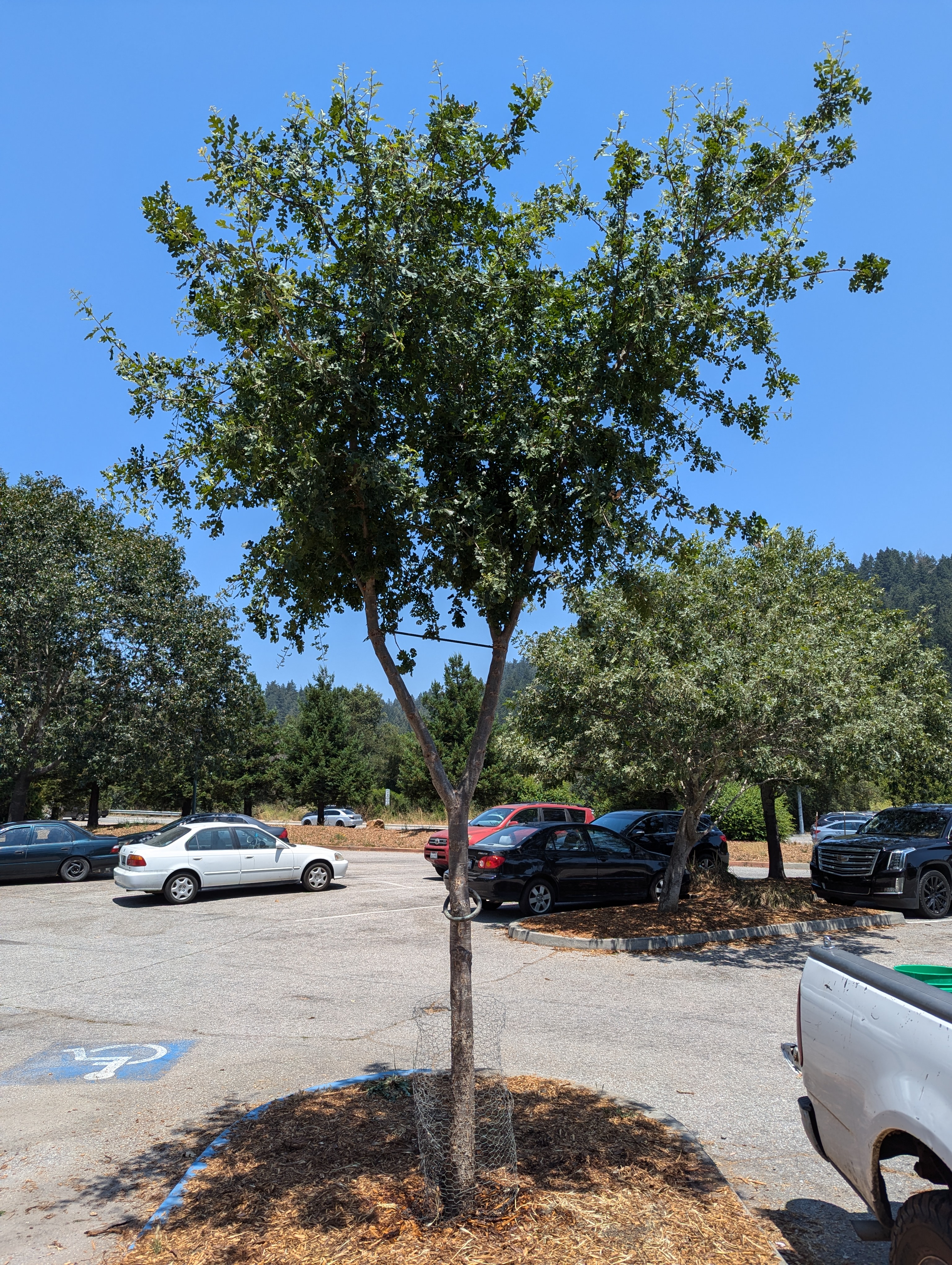
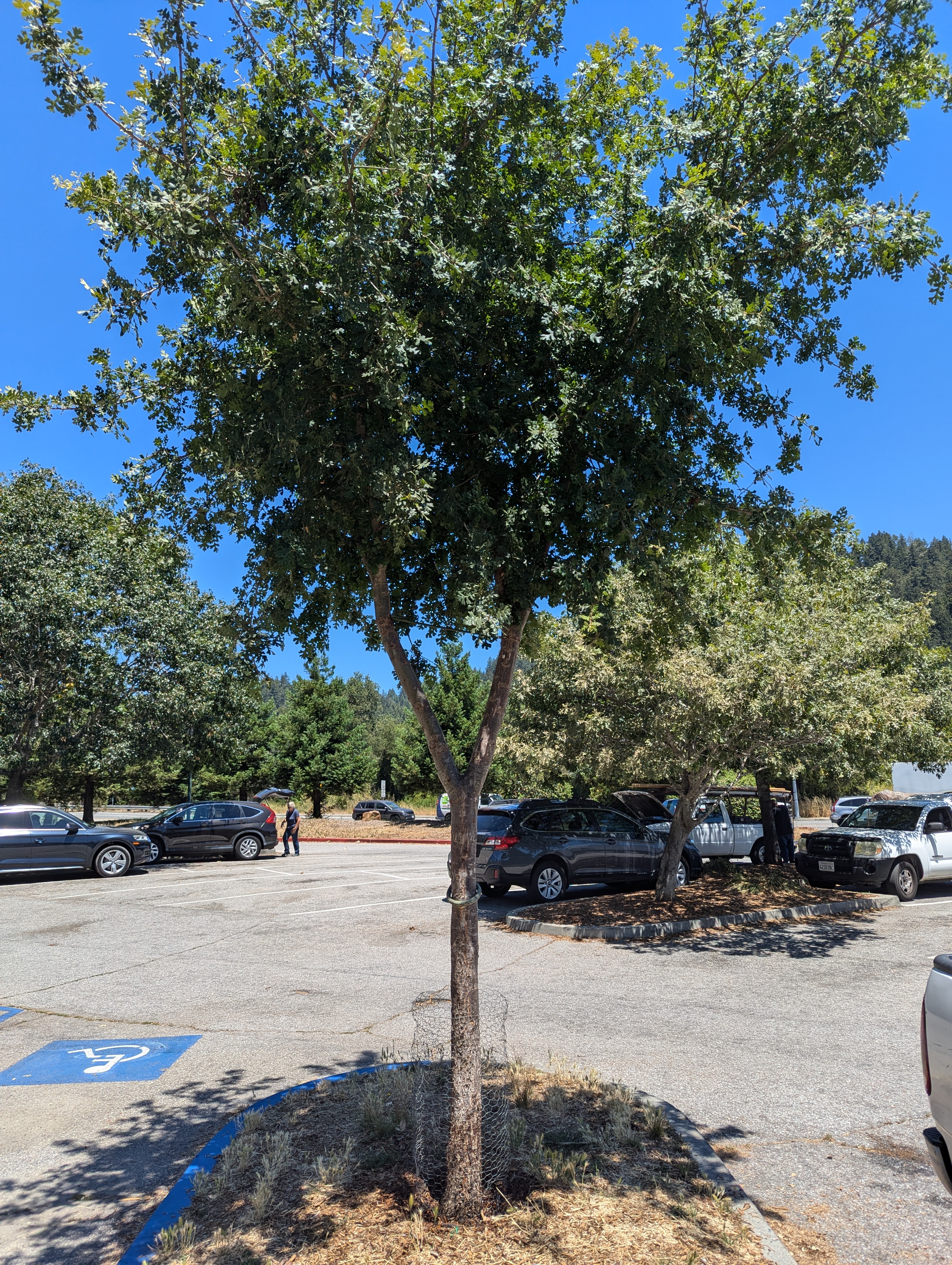
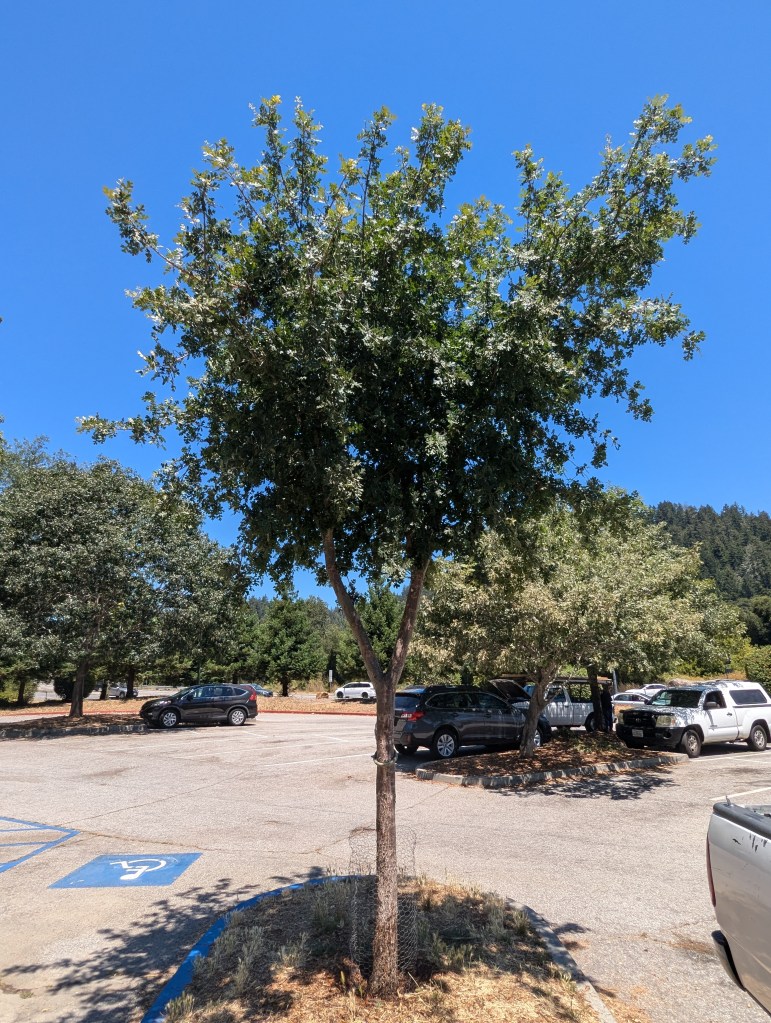
The young Memorial Tree in Felton Covered Bridge Park continues to grow at an impressive rate. It is still as remarkably healthy as it has always been. Now that the canopy has been directed upward and over the surrounding parking lot, it is maintaining adequate clearance without intervention. There is not much more to say about it. I suppose that I should conduct these updates in autumn, after growth has finished for the year, but prior to defoliation. For now, I will conform to the tradition of posting this update for the middle of July, as I have done for the past few years, but may also post another later, like I did last year. I was amazed by how much growth developed within the seven weeks between those two updates of July 12 and August 30 last year. Since the Tree is now too big for the size of pictures that I had been taking of it, I should zoom out for subsequent pictures as I did for the picture below, to show all of its expanding canopy. If I had planned it better, I should have taken a picture of the tree every summer from the same vantage.
Spring bulbs, with prechilling, were conducive to the technique of forcing bloom earlier. A few summer bulbs might still be responsive to it, although it is getting late for most. Now, it is about time for forcing bloom with certain dormant deciduous stems. Most are already beginning to bloom. Forcing bloom merely accelerates this process for cut flower stems.
Forcing bloom for dormant deciduous stems is actually simpler than for bulbs. It involves merely cutting stems that are about to bloom and bringing them indoors. The warmth of a home interior is what accelerates profuse bloom. Aridity of home interiors may accelerate the deterioration of this bloom. However, homes also provide shelter from wind and rain.
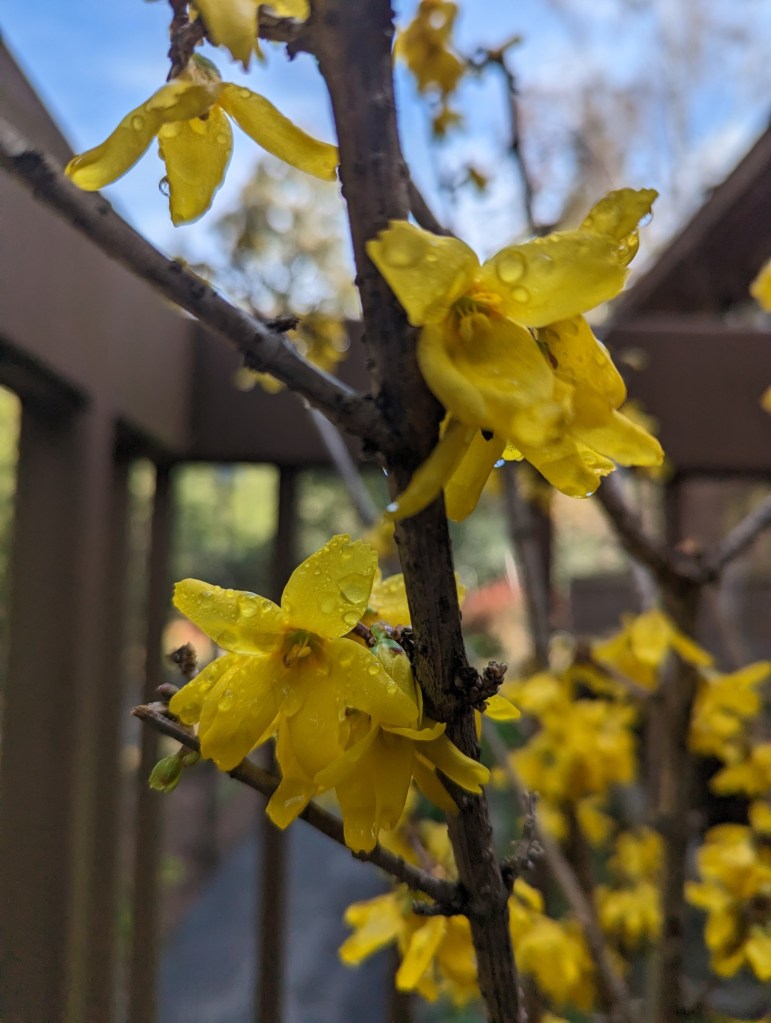
Witch hazel, flowering quince and forsythia are mostly done blooming locally. Otherwise, they are conducive to forcing bloom, and will be available next winter. Several flowering cherries and flowering plums are now about ready for forcing bloom. Redbuds are ready also, though some will be later. Flowering crabapples should bloom later in their season.
Several fruit trees are as conducive to forcing bloom as their fruitless flowering relatives. Their floral color and profusion are less extravagant only because of their breeding. Fruit is, after all, the priority. With planning, dormant pruning can involve leaving a few surplus stems to cut later. Then, cutting them about now should not compromise fruit production.
With precise timing, wisteria and lilac are conducive to forcing bloom. Technically, so are dogwood and several deciduous magnolias. They bloom relatively slowly though. A few flowers should therefore be blooming before collection of their stems. Evergreen species are less striking in bloom. Fringe flower and Oregon grape can perform elegantly though.
Forcing bloom is more popular where winters are cooler. This is partly because gardens lack floral color for so long through winter. Those who enjoy flowers are in more of a rush to bring some into their homes. Also, dormant vegetation is more reactive to warmth after colder winters. Warmth might not stimulate bloom as effectively after locally mild winters.
The present is merely the transition of the future into the past. Just as any point in space lacks all three spatial dimensions of height, width and depth, the present lacks temporal dimension. Yet, any moment in the present is the beginning of whatever happens next. Somehow, this becomes more obvious as one year relinquishes to the next, as 2024 just did for 2025. Happy New Year!
For Rhody and I, 2025 will be a wild ride, in more ways that I can describe in detail now. This was not planned to coincide with the New Year, but coincidentally began to develop as such as 2024 was finishing. I can explain the possibility of major but weirdly anticipated changes within my professional career if and when they develop, as I prefer to not do so now. I will only mention that it all could progress as I always knew it should, but that if it does, it will involve major challenges, including departure from some of my work that I enjoy very much.
For now, we are more concerned with even more major and weirdly anticipated changes to our domestic situation. Rhody and I will be going home. Of course, it is not that simple. It will be quite a while before we can do it, and it may not happen until 2026. To be brief, I am now planning construction of the new house next to where the old house was. I am not at all keen on a new house, but I knew decades ago that the old house would need replacement, and that I can not build an old house. Also, I am not at all keen on leaving here, but again, I always knew that this situation is only temporary.
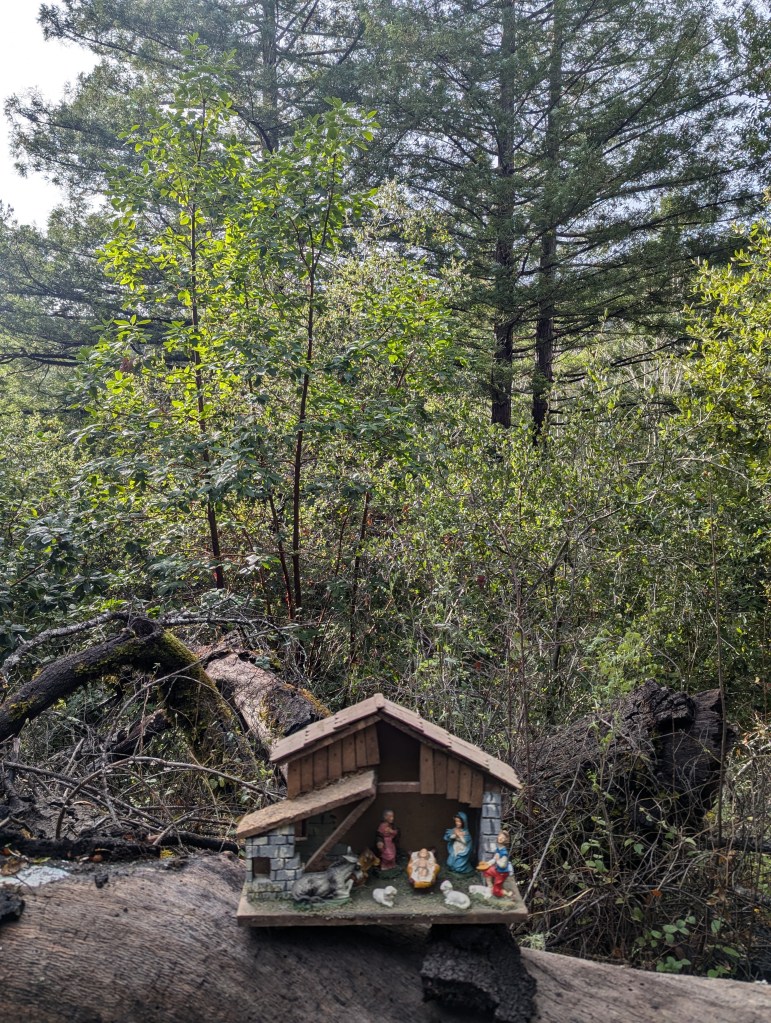
For Sunday Best last Sunday, I posted an odd picture of a Nativity in a forest. It was only labeled as ‘Home for Christmas’, without any other explanation. To provide more details, it shows my mother’s Nativity on Christmas morning about where the parlor of the new home will eventually be. The picture below shows a bit more of the still overgrown forest beyond.
Across the road from the homesite, the garden and orchard above it are in such horrible condition that their reclamation will take quite a while. The landscape at the homesite can wait, and ultimately, will be very minimal. The volume of vegetation that must be removed is daunting. As I mentioned earlier, I expect a wild ride in 2025.
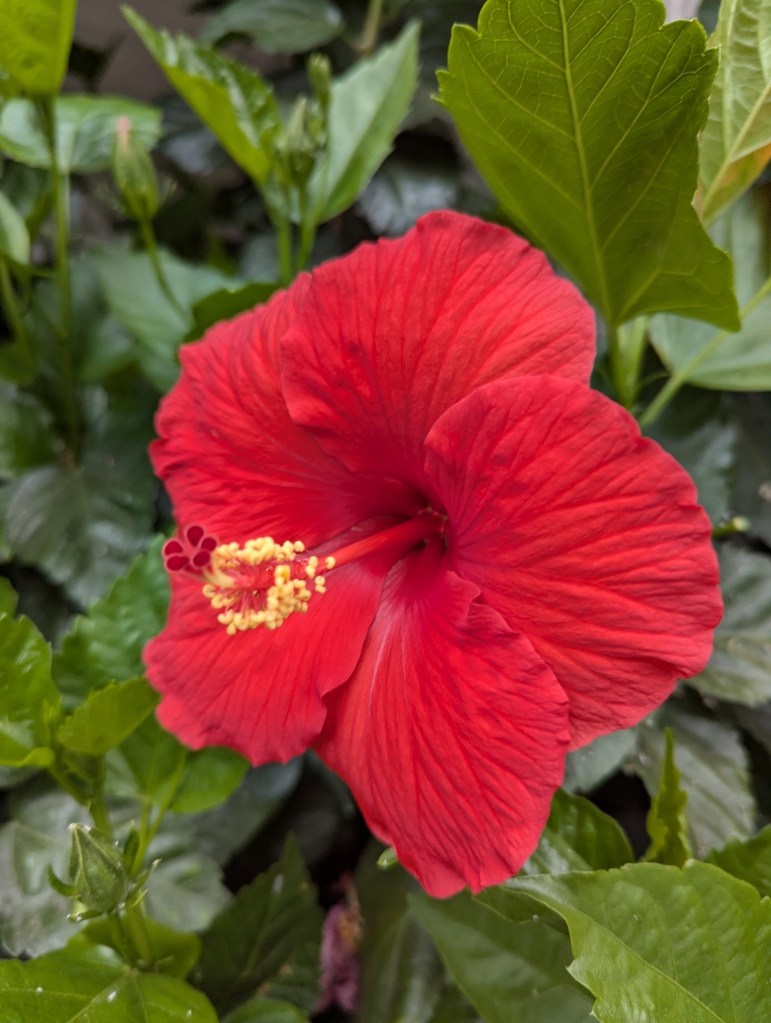
Hummingbirds and butterflies are quite fond of tropical hibiscus, Hibiscus rosa-sinensis. They are attracted to the bright yellow, orange, red, pink or white color of its bloom. They stay for the syrupy nectar that they find deep within the flowers. Tropical hibiscus attracts pollinators rather efficiently, but almost never generates seed. Most cultivars are hybrids.
Tropical hibiscus flowers are not overly profuse, but are about three or four inches broad. Fancy hybrids that bloom with broader flowers are not as vigorous as more typical sorts. Most cultivars bloom with somewhat ruffled single flowers. Some bloom with more ruffled double flowers. Both types of flowers have five garishly flaring petals. None are fragrant.
Tropical hibiscus grows as evergreen shrubbery about six to a bit more than ten feet tall. Pruning to remove congestion of inner growth promotes healthier outer growth. Besides, whitefly and scale insects often proliferate on crowded foliage. Leaves are mostly two to five inches long and two to three inches wide. Bloom continues from summer to autumn, mostly with warmth.
 Tony Tomeo