Six on Saturday: Bad Timing

Autumn seems to be a bit early this year. The weather is already cooler with a bit of rain. Although no more rain is in the forecast, neither is warm weather. Besides, even if warm weather resumes, it will not last long. Vegetation really should be getting ready for that. A few species, though, are behaving like it is spring or summer. Some were prompted to do so.

1. Platycerium bifurcatum, staghorn fern has been happy this year, but should not be so active now that the weather is cooling. New growth will be vulnerable to chill this winter.

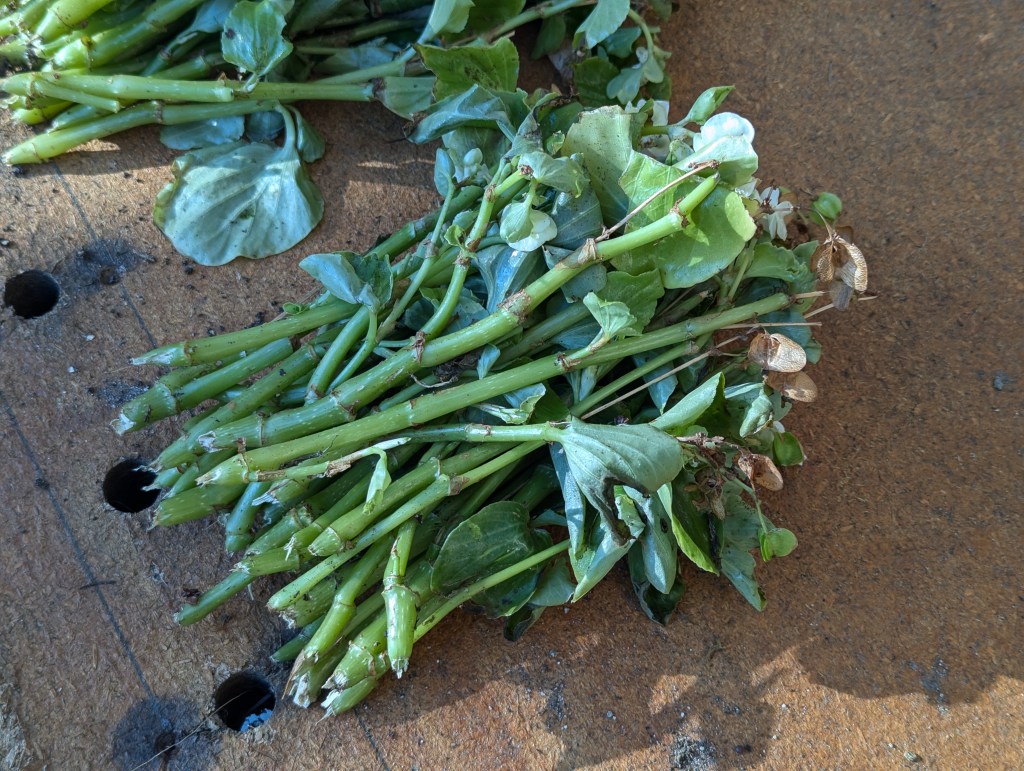
2. Solandra maxima, cup of gold vine cuttings are developing roots now that it will soon be too cool for them to grow. The pruning scrap just happened to become available now.

3. Prosopis velutina, velvet mesquite seedling had all summer to germinate, but decided to do so now. It is the only one of these ‘six’ that is not tropical, so it should know better.

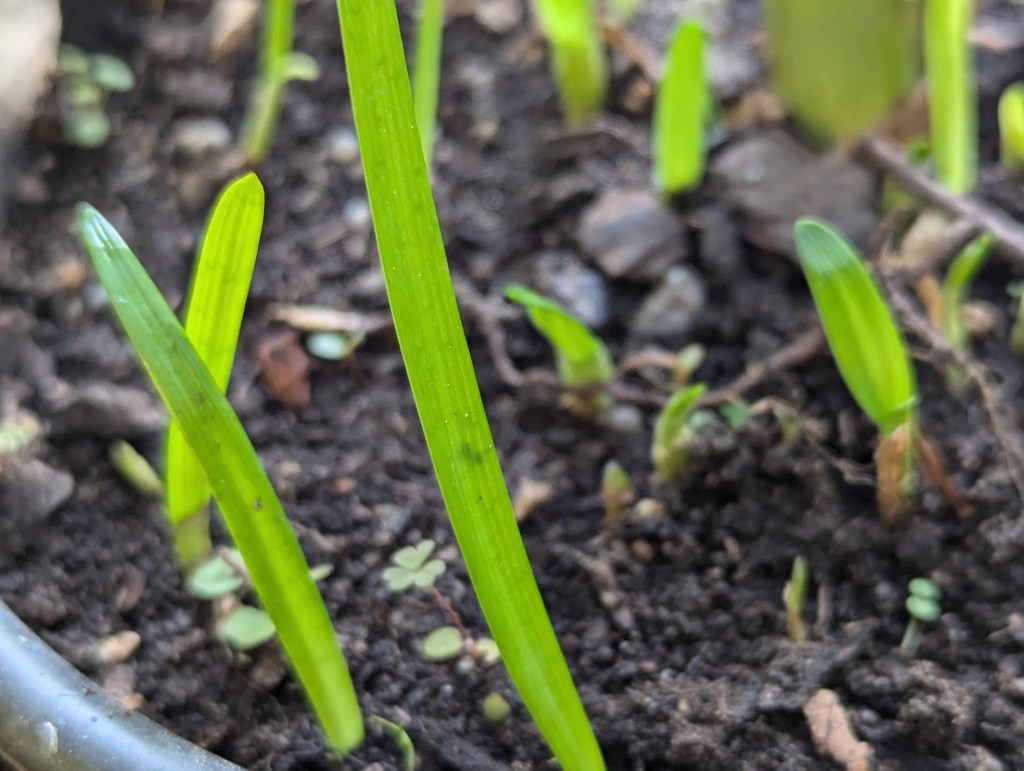
4. Mangifera indica, honey mango seed was sown after its fruits were eaten. Seasonality was not considered. Several seedlings are now growing just prior to autumn and winter.

5. Hibiscus rosa-sinensis, tropical hibiscus cuttings have been growing slowly but surely since the end of last winter, but just as they should be slowing, they are trying to bloom.

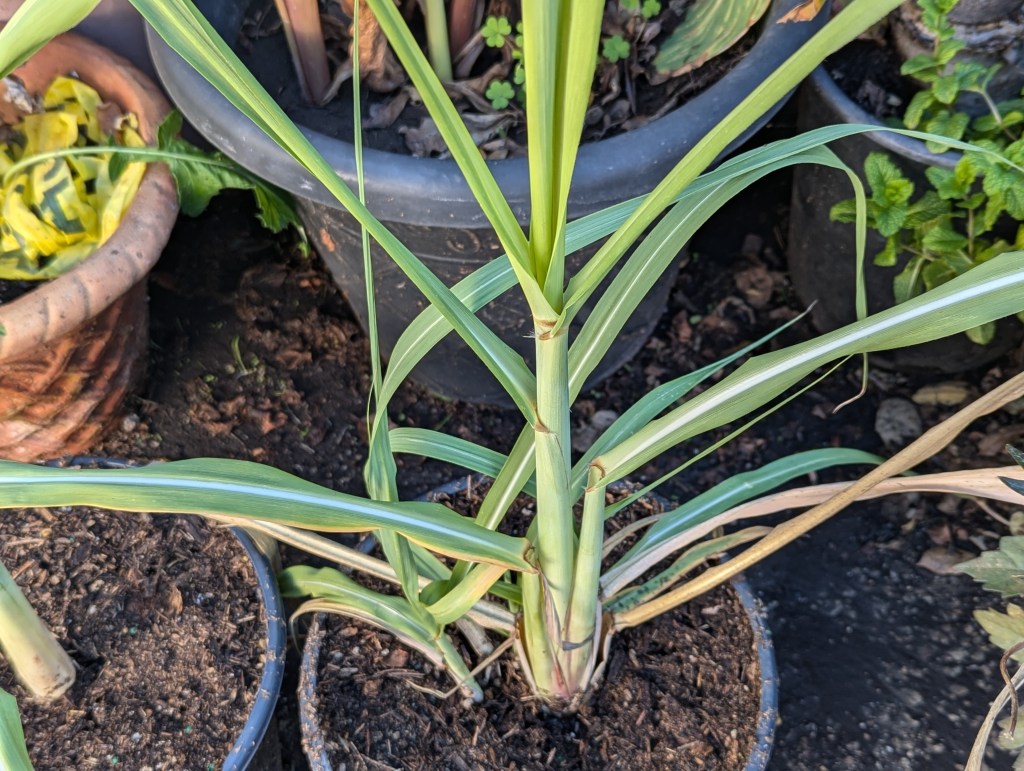
6. Alocasia macrorrhizos, taro is also trying to bloom just as it should be decelerating its growth for autumn and winter. It will be interesting to see how this late bloom proceeds.

This is the link for Six on Saturday, for anyone else who would like to participate: https://thepropagatorblog.wordpress.com/2017/09/18/six-on-saturday-a-participant-guide/

King Palm

Piccabeen palm or bangalow palms is known more commonly here as king palm.

Where it grows wild in rain forests of eastern Australia, the piccabeen or bangalow palm, Archontophoenix cunninghamiana, is a strikingly elegant tree that gets to about fifty feet tall on a clean, slender trunk. The six to ten foot long feather fronds (pinnate leaves) form a light but distinctive canopy about ten to fifteen feet broad. Smooth green petioles (leaf stalks) encase the upper few feet of crownshaft, eventually peeling away cleanly to reveal the smooth trunk as it grows below. A juvenile king palm does not bloom, but eventually flaunts adulthood with softly pendulous ‘graduation’ tassels of profuse but tiny purple tinged white flowers.
Locally, this palm is known more commonly as the king palm, and does best as a large houseplant or where it is protected from frost. Outdoors, it seem to be happiest close to the San Francisco Bay where it is somewhat insulated by all the water, but can unfortunately get smacked about by the wind there. A mature tree is somewhat more tolerant to frost than a young tree is, but can be damaged or even killed if it gets cold enough.
King palm fortunately does well in the partial shade of larger adjacent trees or buildings that might shelter it from frost. However, it can not be pruned down for clearance from higher trees, ceilings or any other overhead obstruction (including utility cables), so should be planted where it has plenty of room to grow vertically, or where no one will mind it getting removed when it gets too tall after many years.
Unlike most other palms, king palm does not transplant easily when mature. It has no problem getting planted from a pot to a larger tub or planter, or into the ground. Once in the ground though, it is there to stay.

Autumn Foliar Color

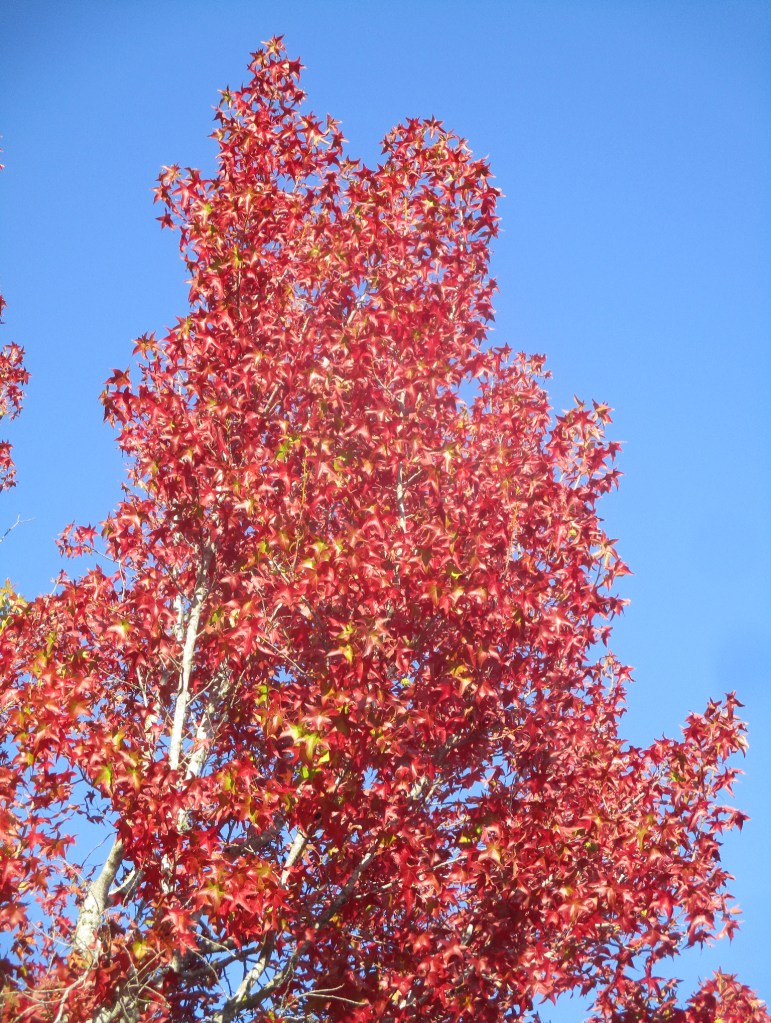
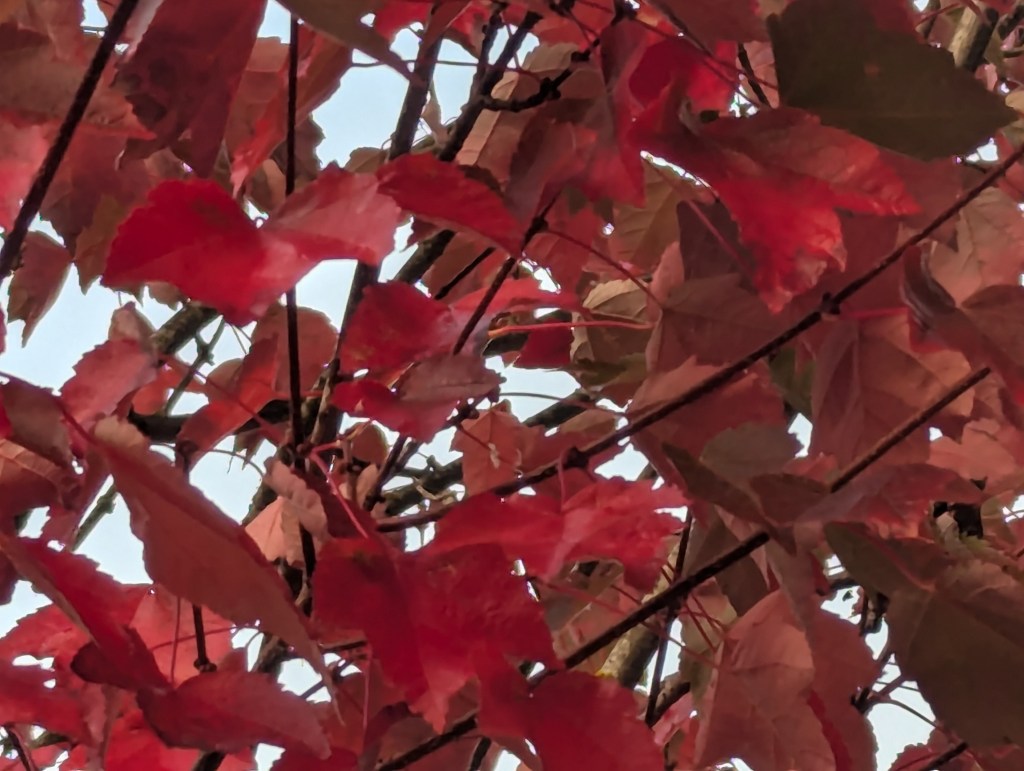
Red maple colors nicely, but the color does not last for long.

Spray paint is no way to get good autumn color in the garden. The healthy rich green king palm out front would look ridiculous and be very embarrassed, not to mention unable to breath, if it were painted yellow, orange and red, like the sweetgum trees that will soon be getting so colorful in the neighborhood now that the weather is getting cool.

Just like every other feature in the garden, autumn foliar color takes proper planning. Most of the plants with the most impressive autumn color happen to be substantial trees, so are not as easy to accommodate in as many situations as flowering annuals are. There are a few smaller shrubby plants and perennials that provide autumn foliar color, but almost all are deciduous, so defoliate to leave bare branches through winter.

Boston ivy (which is not really ivy) is probably the most colorful of climbing vines. It is a bit too aggressive for small spaces though, and damages painted surfaces and just about anything that it gets a hold of. It is best on concrete walls, which is why it is so prominent on freeway soundwalls and overpasses. Grapevine and wisteria are only moderately colorful.

Currant, crape myrtle, pomegranate, smoke tree and redbud are a few of the shrubby plants that provide good color in autumn. Crape myrtle and Eastern redbud are actually more commonly small trees. Many of the Japanese maples with good autumn color are small trees that stay smaller than most shrubbery.

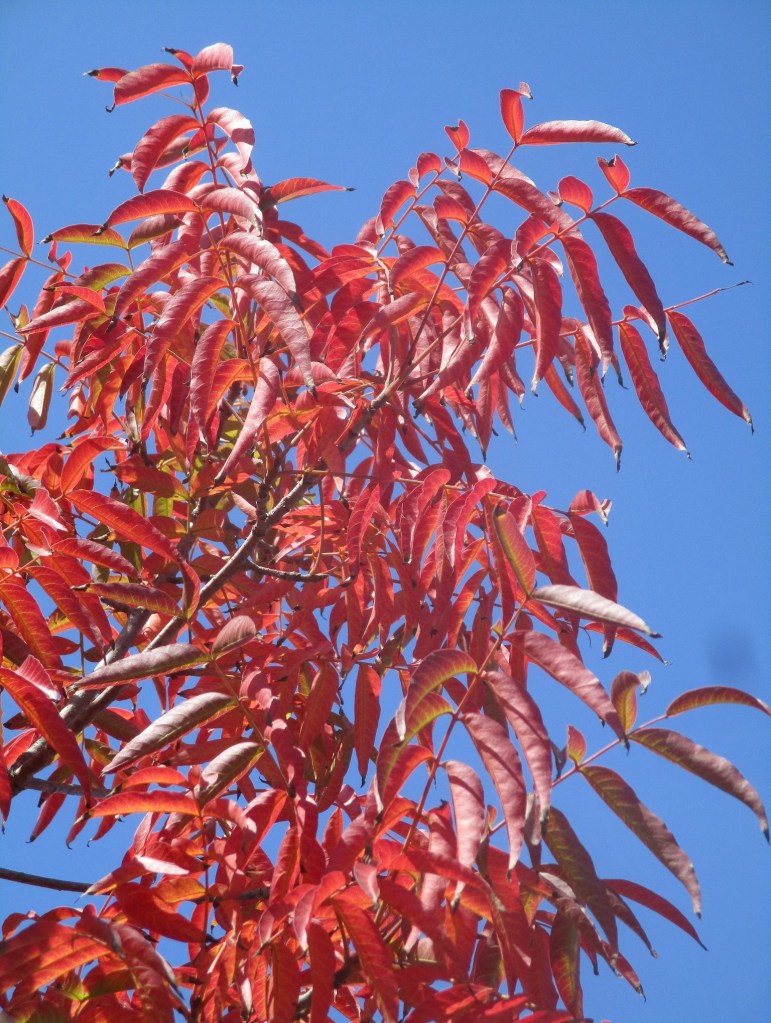
Sweetgum, Chinese pistache, flowering pear and maidenhair tree are the best trees for autumn color, though maidenhair tree turns only bright yellow without the oranges and reds that the others get. Where well exposed, Japanese persimmon is comparable to Chinese pistache. Fruiting pear, apple, apricot, plum, prune and almond trees are not quite as colorful.

Several of the North American and European maples are remarkably colorful, but do not hold their foliage as long as sweetgum does. Silver maple and box elder (maple) happen to be less colorful than the other maples. Various poplars and locusts, as well as tulip tree and black walnut can almost get as bright yellow as maidenhair tree does.

Pollen

For urban areas, the first rain of the season is typically icky. It mixes with all the crud and filth that has accumulated since the last rinsing rain of the previous spring. Damp roads smell like a mix of automotive fluids and wet tires. Asphalt roofs smell like tar. Even urban trees can initially smell like damp dust. It takes a while and a bit of rain for the crud and filth to rinse away.

This is the second rain of the season, and in a less than urban area. It does not smell objectionable, and is not notably cruddy. However, it still flows with an abundance of pollen that had not rinsed away already. Perhaps this pollen accumulated just since the previous rain, although not much has been blooming visibly at this time of year. It is impossible to say even what species dispersed so much pollen. Nonetheless, here it is, floating in the first few puddles to accumulate. Yuck!

It is no wonder that pollen is as effective at pollination as it is. It is impressively abundant and permeating. It is also no wonder that it is such a pervasive problem for those who are allergic to it.

Hopbush

Hopbush makes a nice informal hedge.

Its silly name is actually justifiable. The papery fruits of Hopbush, Dodonea viscosa, can be useful as a substitute for hops. Almost all hopbush are female, so produce such fruits. However, bloom and subsequent fruit production is variable. Vigorous plants are likely to produce less fruit. Also, some specimens might become male, and therefore be fruitless.

Hopbush is most popular as an informal evergreen hedge. It also works well as a formal hedge. With selective pruning, it can become a small tree with shaggy bark on sculptural trunks. It develops a narrowly upright form while young, but may eventually grow ten feet wide. It grows about twice as tall. Overgrown specimens are quite conducive to pruning.

Hopbush exhibits a uniformly fine foliar texture. Individual leaves are two or three inches long, but narrow. Foliar color is soft bronzy green. ‘Purpurea’ is more purplish bronze, but is not quite as vigorous. Roots are very complaisant, but do not disperse well if irrigation is too generous. Established hopbush is undemanding, so does not require much water. It tolerates soil of inferior quality too.

Botanical Nomenclature Should Simplify Horticulture

“Buick” is comparable to a genus.

The language of gardening can sometimes seem confusing. That is because so much of it is Latin. Some of it is Latinized Greek, or Latinized names of botanists. As confusing as it may seem, this botanical nomenclature is quite simple. It is, furthermore, more practical than the use of regional common names. Botanical nomenclature is practically universal.

Botanical nomenclature is not actually a language. It is a standardized system of naming botanical organisms, or plants. It is so standardized that it is the same everywhere in the World, in every language. Common names are different in different regions or in different languages. In that regard, common names can be more confusing than botanical names.

Botanical nomenclature is basically binomial, which means that it uses only two names. The first name is the general or genus name. The second name is the specific or species name. The genus name is capitalized, while the species name is not. Both are italicized. A species name is often an adjective that describes a characteristic or origin of its genus.

Many botanical names include a third variety or cultivar name. Such names are in single quotes, without italicization, but with capitalization. For example, Sequoia sempervirens ‘Soquel’ is ‘Soquel’ redwood. “Sequoia” is its genus name. “sempervirens” is its species name, which also describes it as evergreen. “‘Soquel'” is the particular cultivar or variety.

Botanical nomenclature is actually quite similar to automotive nomenclature. Italicization and lack of capitalization of the species names are the primary differences. For example, Buick, Chrysler and Mercury are all like genera. Electra, Imperial and Grand Marquis are all like species of these particular genera. Buick Electra is therefore like a botanic name.

Buick Electra ‘Limited’ is like a cultivar of Electra, which is more specific than species. Its family is General Motors, which is more general than genus. Botanical nomenclature has families too, although they are rarely mentioned. Sequoia sempervirens ‘Soquel’ is in the family of “Cupressaceae”. Botanical family names lack italicization but not capitalization.

Six on Saturday: Peeping

Autumn foliar color is scarce here, not because the weather is too mild, but because it is not such a priority within landscape design. A few species can develop such color as they do where autumn weather is cooler. Of course, some do not. Native California sycamore is a stately deciduous tree with striking form while bare through winter, but contributes minimal color.

1. Cornus florida, flowering dogwood is just beginning to exhibit foliar color for autumn. It performs surprisingly well in the Santa Cruz Mountains above the Santa Clara Valley.

2. Lagerstroemia indica, crape myrtle is also starting to exhibit foliar color for autumn. It may do so before the weather gets cool, as if it somehow knows what time of year it is.

3. Platanus racemosa, California sycamore does not know or care what time of year it is. It is more likely to yellow in response to hot and dry summer weather than to do so now.

4. Platanus X acerifolia, London plane tree is the sycamore with maple foliage. It is just beginning to yellow, but ultimately, does not do much more than that before defoliation.

5. Acer platanoides, Norway maple is the maple with sycamore foliage. This cultivar has bronze foliage through summer, so develops its yellow foliar color for autumn quite late.

6. Acer rubrum, red maple, like crape myrtle, can develop foliar color for autumn before cool weather, as if it knows what time of year this is. It defoliates relatively early though.

This is the link for Six on Saturday, for anyone else who would like to participate: https://thepropagatorblog.wordpress.com/2017/09/18/six-on-saturday-a-participant-guide/

Canary Island Date Palm

Canary Island date palm is the biggest and boldest.

The biggest and boldest of the common palms is the Canary Island date palm, Phoenix canariensis, which can get more than sixty feet tall and nearly forty feet wide, with a full canopy of gracefully arching deep green fronds. A young tree actually spends the first many years as a shrubby plant while the base of the trunk develops. Fronds get longer and spread broader every year until the trunk gets big enough to elongate. Vertical growth then accelerates somewhat, but the canopy gets no broader.

Most trees are female, eventually producing ornately orange but messy clusters of inedible dates. Male trees eventually get a bit taller, but are not quite as graceful and bloom with unimpressive dusty tan flowers.

Old deteriorating fronds need to be pruned away close to the trunk. Petiole bases of the most recently removed fronds are often carved into ‘pineapples’ to leave a bit of support directly below the canopy. Removed fronds leave a distinctive pattern on the trunk.