Alocasia or Colocasia?

Alocasia odora

‘A’ or ‘co’? What is the better prefix for ‘locasia’? There are certainly differences between the two, but information regarding such differences and characteristics is confusing and potentially misleading. It is amazing how much less information is available now that so much more information is so much more available than it has ever been before.

Alocasia generally develops big leaves that point upward. Colocasia generally develops big leaves that point downward. Alocasia prefers a bit of partial shade. Colocasia prefers more direct sunshine. Alocasia generally has more colorful leaves. Colocasia generally has bigger leaves. Of course, these are generalizations, and some species of each of these two genera seem to be species of the other genus.

Colocasia gigantea supposedly develops the biggest leaves and can get twenty feet tall. Alocasia macrorrhiza supposedly is the biggest of its genus and can get fifteen feet tall. It is difficult to know what to believe.

One the edge of a pond at work, we would like to grow whichever of these massive perennials develops the biggest leaves. If we grow Alocasia, we can put it in a partially shaded situation. If we grow Colocasia, we can put it in a sunnier situation nearby. If we grow Alocasia, we can put it a short distance from the edge of the pond. If we grow Colocasia, we can put it right at the edge of the pond. We only need to know which cultivar of which species of which genus we should grow.

I am inclined to grow Colocasia gigantea. We have a few months to decide, since we do not want to plant it during autumn or winter. We recently acquired this Alocasia odora. Also, another similar but unidentified perennial that seems to be a Colocasia must be relocated from another disproportionately compact landscape.
Six on Saturday: Los Angeles to Los Gatos II

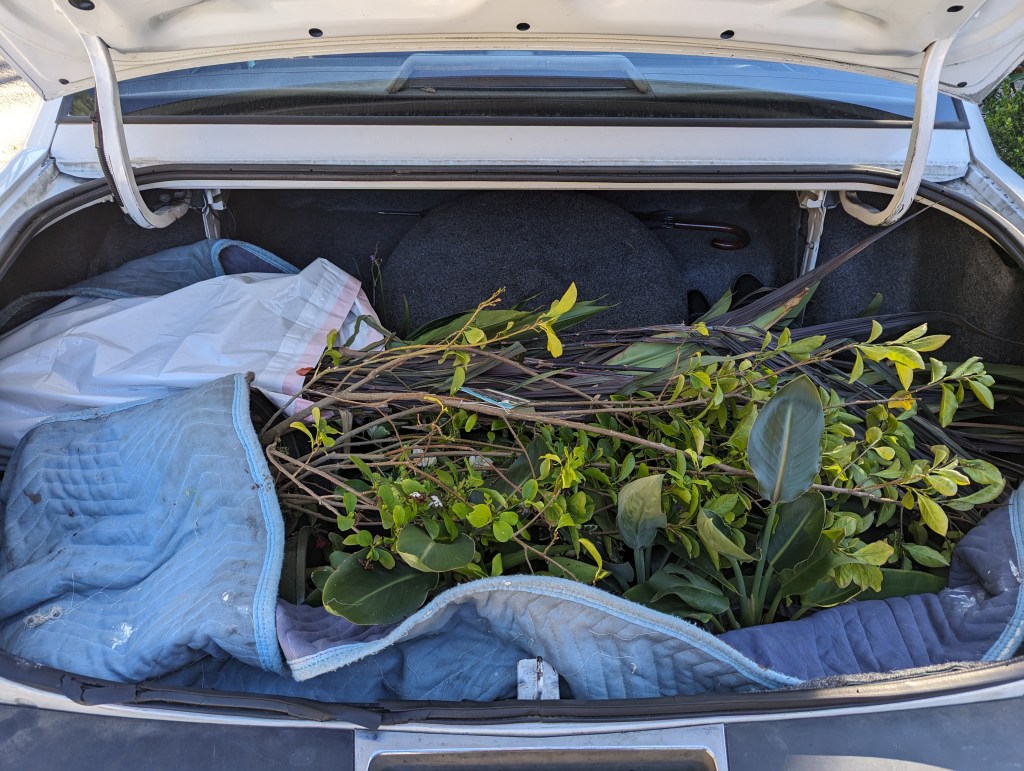
Ilex opaca, American holly would have been a better topic for Six on Saturday this week. Woodland Gnome of Our Forest Garden sent me six seedlings from Williamsburg! They are now happily canned. I will share their pictures next week. For now, these are a few of the many goodies that I brought from Southern California. I sadly needed to go there for a memorial for an old college friend.

1. Carson is a 1994 Buick Roadmaster touring sedan, not a pickup. He diligently brought all this from Southern California anyway. It includes so much more than these six below.

2. Pimenta dioica, allspice is apparently quite rare. Brent had me trim his so that I could process these scraps as cuttings. However, it is dioecious, so requires a mate to set fruit.

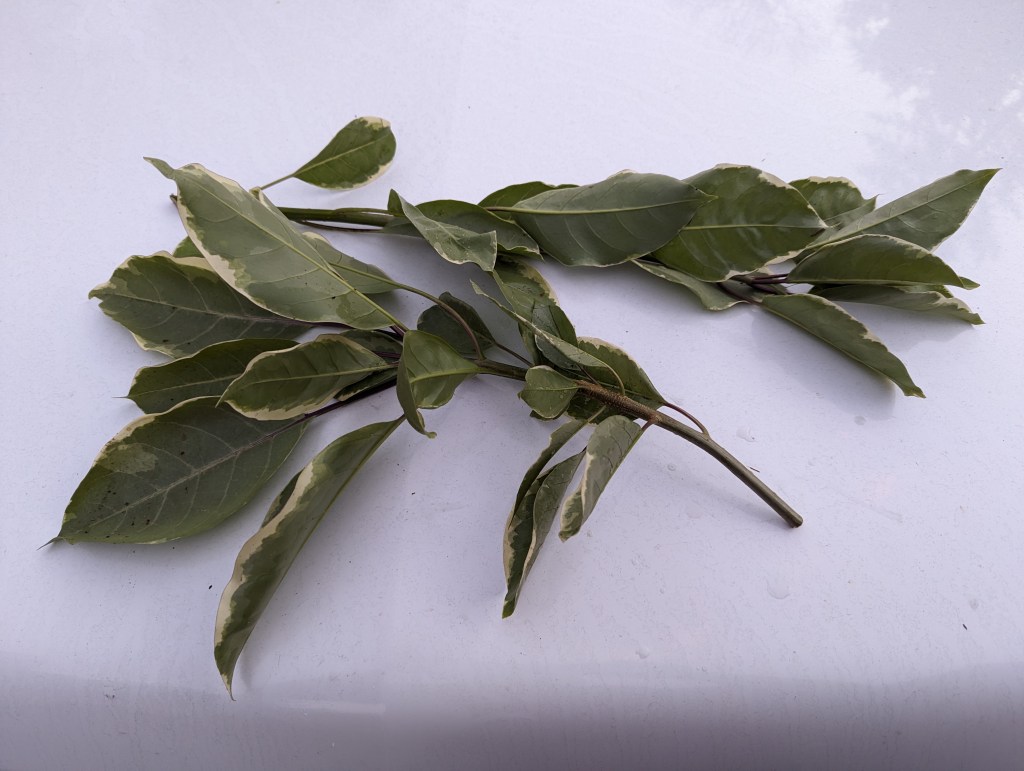
3. Solandra maxima ‘Variegata’, variegated cup of gold vine was acquired in accordance with one of our collegiate traditions; theft. I processed these two scraps into six cuttings. Incidentally, I was uninvolved with its initial acquisition. I will merely grow the cuttings.

4. Nephrolepis exaltata ‘Variegata’, variegated Boston fern or tiger fern is a smaller copy of the mature specimen that provided picture #4 of my Six on Saturday of last Saturday.

5. Hedychium coronarium ‘Variegatum’, variegated white butterfly ginger should bloom with white flowers comparable to those of white butterfly ginger from Woodland Gnome of Our Forest Garden. However, I suspect that it is actually ‘Tahitian Flame’ with peachy bloom. To its right, Alpinia galanga, galangal is a culinary ginger with mundane bloom.

6. Canna of an unidentified cultivar is likely the most important of all these acquisitions. It was acquired by the same means as the variegated cup of gold vine #3, but worse. It is from the Baptist Church that hosted the repast for the memorial of our deceased friend.

This is the link for Six on Saturday, for anyone else who would like to participate: https://thepropagatorblog.wordpress.com/2017/09/18/six-on-saturday-a-participant-guide/

Eastern Red Cedar

Eastern red cedar is rare in the West.

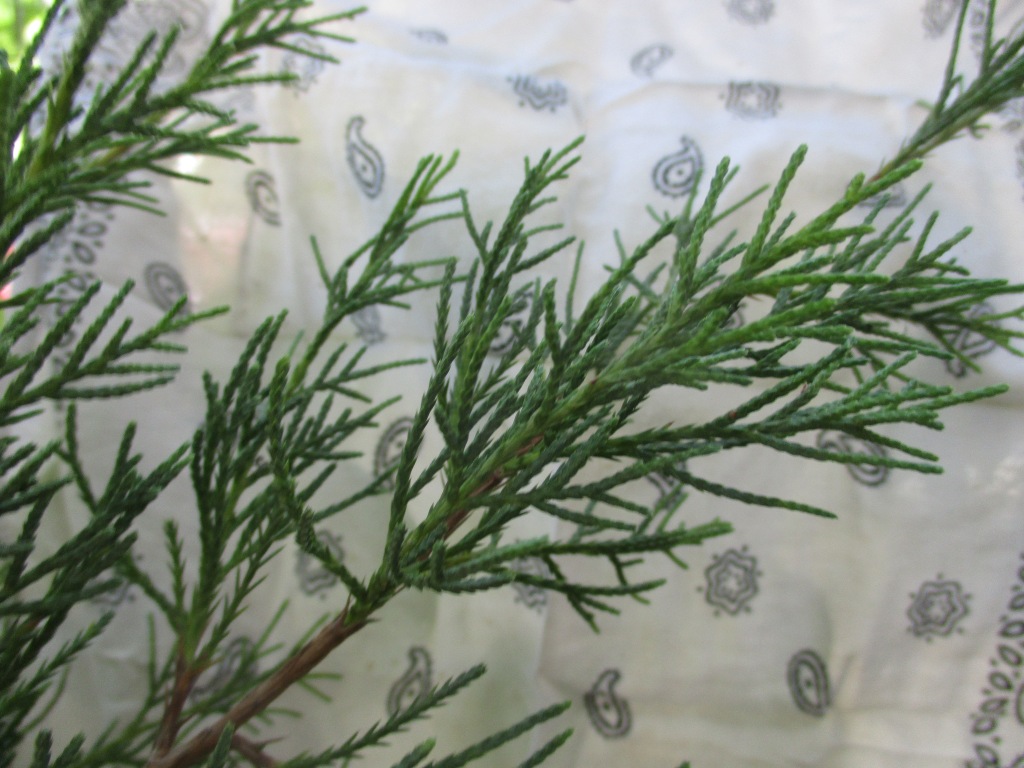
One of the less common and certainly least familiar of junipers happens to be the most culturally and environmental significant juniper in North America, even though it is not even known as a juniper. Juniperus virginiana is instead known as the Eastern red cedar. It has a vast range, including every state east of Colorado, as well as Quebec, Ontario and even Oregon to the west. In some areas within and near the natural range, fire suppression has allowed Eastern red cedar to become invasive.

Mature trees are mostly less than fifty feet tall, but are the biggest evergreen trees in Kansas nonetheless. The largest Eastern red cedars can get almost ninety feet tall. Most are well branched from top to bottom unless pruned for clearance. The fibrous bark is ruddy brown, but not often seed from the outside.

Foliage and fruit are rather variable. The prickly juvenile leaves of young plants and interior stems of mature plants can be rather annoying. The scale-like adult leaves are more typical of junipers. Male trees produce pollen that can be a significant allergen. Female trees produce sporadic, small berries in blue or purplish black, that are quite popular with certain birds through winter.

Prior to the discovery of the incense cedar in the west, Eastern red cedar was the common aromatic cedar that was used to make pencils and to laminate cedar chests and closets to protect woolens and natural fibers from moths. Since it is so repellent to insects and decay, it is commonly used as fence posts. Native American Indians also used posts of Eastern red cedar, painted red with blood of the animals they hunted, to mark the boundaries of their hunting ranges. The name of Baton Rouge, which means ‘red stick’, was actually derived from such marking posts.

During the Dust Bowl drought of the 1930s, and before becoming known as a potentially invasive species, Eastern red cedar was promoted by the Prairie States Forest Project as a resilient wind break. They tolerate drought, harsh exposure and inferior soil. They can be planted close together to fill out and gain height more efficiently. More information about Eastern red cedar can be found where I got much of this information, at the Great Plains Nature Center.

Fireplace Season

Firewood must be seasoned by now. Fresh wood will be seasoned for next year.

There are several reasons why fireplaces are not nearly as commonly used as they once were. Modern building regulations have prevented construction of newer fireplaces (except pellet stoves). Many fireplaces that were ruined by the Loma Prieta Earthquake were never replaced; partly because there are other more efficient sources of heat, and partly because of the concern of air quality. The fuel that was once relatively easy to obtain from orchards that were getting removed to relinquish their land for urban development has been exhausted.

Regardless, those of us who use fireplaces need to be certain that they do not become overwhelmed by trees or climbing vines. Cypress, cedars, pines and some fan palms are remarkably combustible and hazardous when they get too close to chimneys, particularly if the roofs below are covered with old fashioned cedar shingles.

All trees and vines should be pruned away from chimneys so that they are out of reach of sparks and heat. The more combustible trees should get more clearance than deciduous trees (that are bare through winter) need. Nearby Monterey pines, Cypress and any trees that tend to accumulate debris should be groomed of debris, even if their limbs are already pruned back for sufficient clearance.

Trees should also be pruned for clearance from roofs and gutters; and any accumulated debris should be removed. Even before the weight becomes sufficient to cause damage, the motion of limbs in the wind is abrasive to roofs. Older roofs, particularly cedar shingles, will deteriorate under any accumulation of organic debris, particularly as it gets wet from rain.

Horridculture – Diet

Dinnerplate dahlias should be about ten inches wide.

Mail order scams are a topic that I have been avoiding. I do not want to consider that some of a few items that I purchase by mail order may not be what they were sold as; and, if so, I will not know until they grow, bloom or produce fruit. Furthermore, I want to believe that if such items are not what they were sold as, that the situation is merely accidental.

This was no accident.

It began with the purchase of thirty rhizomes of ‘Red King Humbert’ canna last year. They were the cheap sort that become available after their primary season. I did not expect them to be of exemplary quality. Nor did I expect them to bloom. I only wanted them to grow a bit during the remainder of their season so that their rhizomes could survive winter dormancy to grow and bloom for the following season, which would have been last spring.

They grew as expected, but seemed to be virused. I tried to believe that the supplier would not send me virused stock, and that the striations of their foliage were normal. However, as growth resumed last spring, the foliage was very obviously virused.

Also, as they grew, they were very obviously not ‘Red King Humbert’. They grew only about two feet tall, and bloomed with scrawny orange flowers. ‘Red King Humbert’ gets about six feet tall, with big and billowy orangish red bloom.

The supplier gave me a credit for the expenditure, to spend on more of their products, I should have requested a simple refund. Instead, with the credit and a slight bit more for the difference in price, I purchased two dozen rhizomes of assorted dinnerplate dahlias.

As with the canna, I did not expect exemplary performance from these dahlias so late in the season. I only wanted them to survive and grow enough to store enough resources to survive their winter dormancy, to grow and bloom for the next season.

Most were completely necrotic and mummified upon arrival. Because this was after my experience with the canna, the supplier agreed to refund what I spent, but then only refunded a random amount of a dollar and a few cents. When I asked about the refund, I was informed that it was comparable to the cost of the one rhizome that I sent a picture of, as if I was expected to send a picture of every rhizome that I wanted a refund for. I explained that almost all of the rhizomes were comparable the the one that I sent a picture of, but received no more response.

I still have heard nothing about it. I decided to be satisfied with the few rhizomes that survived, and just accept the loss. The time that I had already wasted on pursuing a refund was worth more than any refund that I would have gotten.

So, . . . a few of the dinnerplate dahlia rhizomes survived and generated a bit of growth to partially recharge their resources prior to their next dormancy. Two actually bloomed. Apparently, these are very special dinnerplate dahlias. Instead of producing blooms that are about ten inches wide, the largest bloom is less than three inches wide. I have never seen such a dinky dinnerplate.

Big Leaf Maple

The sugaring maple of the West!

Maple sugar production has not always been exclusive to northeastern North America. In fact, it is not exclusive to sugar maple. Big leaf maple, Acer macrophyllum, also provides maple sugar in British Columbia. It is native from the southern extremity of Alaska to San Diego County. Most of its range is generally coastal but also includes the Sierra Nevada.

Bigleaf maple is one of merely two native maples here. It is more common within riparian ecosystems and at higher elevations. However, it is rare among home gardens because it is so vigorous and grand. Its aggressive roots eventually buttress, and are likely to ruin lawns and pavement. Autumn defoliation of big trees releases big volumes of big leaves.

Bigleaf maple can grow almost fifty feet tall and wide within sunny suburban landscapes. It can grow a hundred feet taller where it competes for sunshine within coastal forests! Its palmately lobed leaves are typically wider than six inches. They can be twice as wide on vigorous stems. Foliage turns yellow for autumn. Seedlings might be annoyingly prolific. Local climate is unfortunately not conducive to practical sugar collection and refinement.

Wood Still Warms Many Homes

Trees recycle quite naturally into fuel.

Fireplaces and wood stoves are not completely obsolete. They are merely less common than they were years ago. Modern building codes prohibit them within new construction. For some that incur damage from earthquakes, removal is more practical than repair. Not many people use fireplaces and wood stoves nowadays anyway. Nonetheless, a few do.

Sources of firewood have also changed. Displacement of orchards and forests by urban developments had been reliable sources. Such orchards are now gone. Forests are now farther away, and protected from harvest. Instead, most wood fuel is now obtainable from the tree service industry. Scrap from tree maintenance and removal converts to firewood.

Unlike uniform firewood from former orchards, scrap wood is variable. Orchards produce only one type of firewood from their unvaried trees. Firewood from forests involves only a few species that may remain separate for sale. Scrap wood can include any species that a particular tree service encounters. Except for larger volumes, separation is impractical.

The tree service industry provides less firewood than displaced orchards and forests did. However, nowadays, less firewood is necessary. There are many more homes here than years ago, but very few consume wood for heat. Residents who choose to burn firewood are now generally less selective. Yet, some might separate mixed firewoods accordingly.

Tree services prefer to leave firewood where it lands. They charge for removal of excess firewood. They typically cut logs to firewood lengths, but do not split them. Neighbors are therefore sometimes pleased to share wood from removed trees. Tree services sell wood that they must remove, after splitting and seasoning it. They typically charge for delivery.

Firewood for this winter must have seasoned by now. Most types should have sufficiently seasoned if cut and split before last spring. Fresh firewood can not season so late during increasingly cool and damp weather. Scrap from winter pruning can become firewood for next winter. Palms and other monocots do not produce actual wood that burns efficiently.

Unhappy Fishtail Palm

Now that the foliar color has improved, the foliar density is deteriorating.

Fishtail palm is never completely happy here. It is not much happier in Southern California. Even the happiest are discolored to a minor degree. Many are more significantly discolored. Some are so very discolored that they are visually unappealing.

No one seems to know why. I suspect that they would prefer more humidity. Perhaps they prefer more humid warmth. They may dislike the pH of the soil.

Furthermore, fishtail palms are monocarpic. Each trunk dies after bloom. Clumping sorts develop new trunks prior to the demise of a blooming trunk. Those that do not develop replacement trunks die completely.

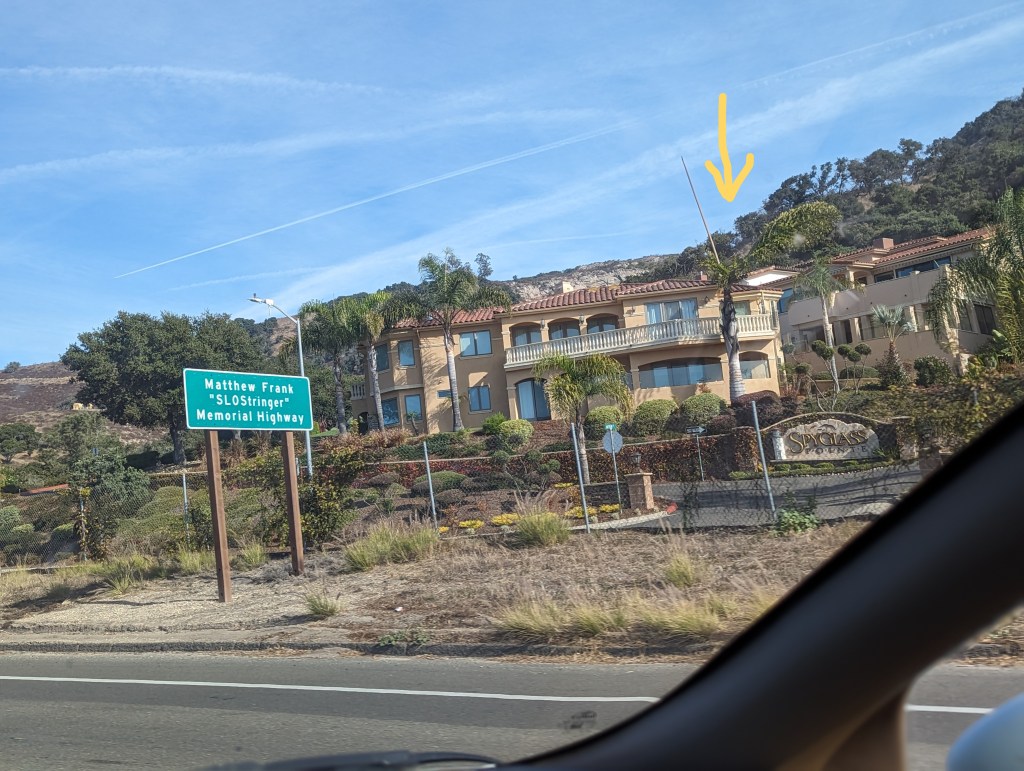
The illustration above is obviously not of exemplary quality. I took it from the car while driving. This was on northbound Highway 101, at the northern extremity of Pismo Beach. The palm to the upper left of the sign for Spyglass Pointe, with the yellow arrow pointing at it from above, is a fishtail palm. Until recently, it had been famously chlorotic.

Colleagues who drove through Pismo Beach typically asked me about this palm after seeing how chlorotic it typically had been. This it he least chlorotic that I have ever seen it. However, it may be naturally deteriorating after its primary bloom. Although I have not observed any bloom, I can see that new leaves are not developing on the same rate that They had in the past. This picture shows it with only a single open leaf, with another foliar spike extending from the terminal bud.

This particular fishtail palm is not very old. I can remember when the associated residential buildings were constructed less than two decades ago. landscapes and associated trees were added shortly afterward. Since then, the fishtail palm had been unhappy. This likely why fishtail palm is not more commonly available here than it is.

Mousers

Kitties are very proficient with mind control techniques.

Rodents have become a problem at home without Darla the mouser kitty. I do not know if Darla actually caught many rodents, or merely deterred them from inhabiting her territory. It is irrelevant. The absence of rodents was more important. Now that she has gone to live a domestic lifestyle in Santa Clara, rodents of various types are damaging some of the vegetation within the nursery, particularly young perennials.

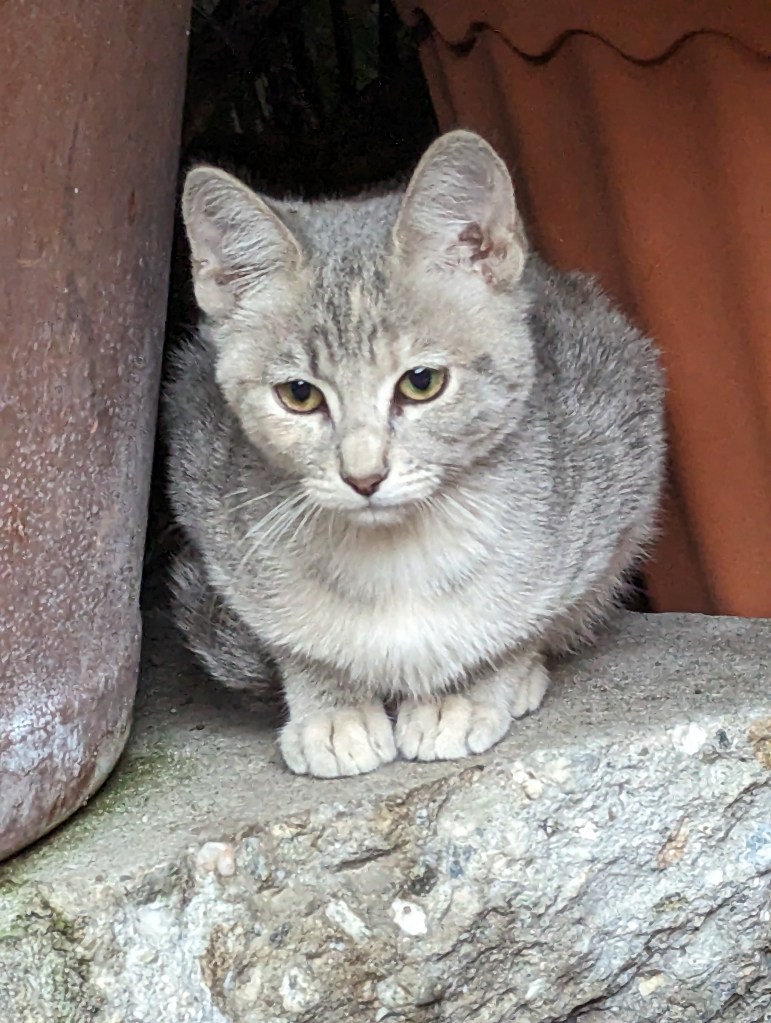
A pair of feral kitties are supposed to be relocating to our facility. They do not need to stay within the main building, although they will have adjacent shelter. I do not care how they intend to eliminate rodents and prevent them from returning. I only care that they do so. If they are half as effective as Darla was, I will be pleased.

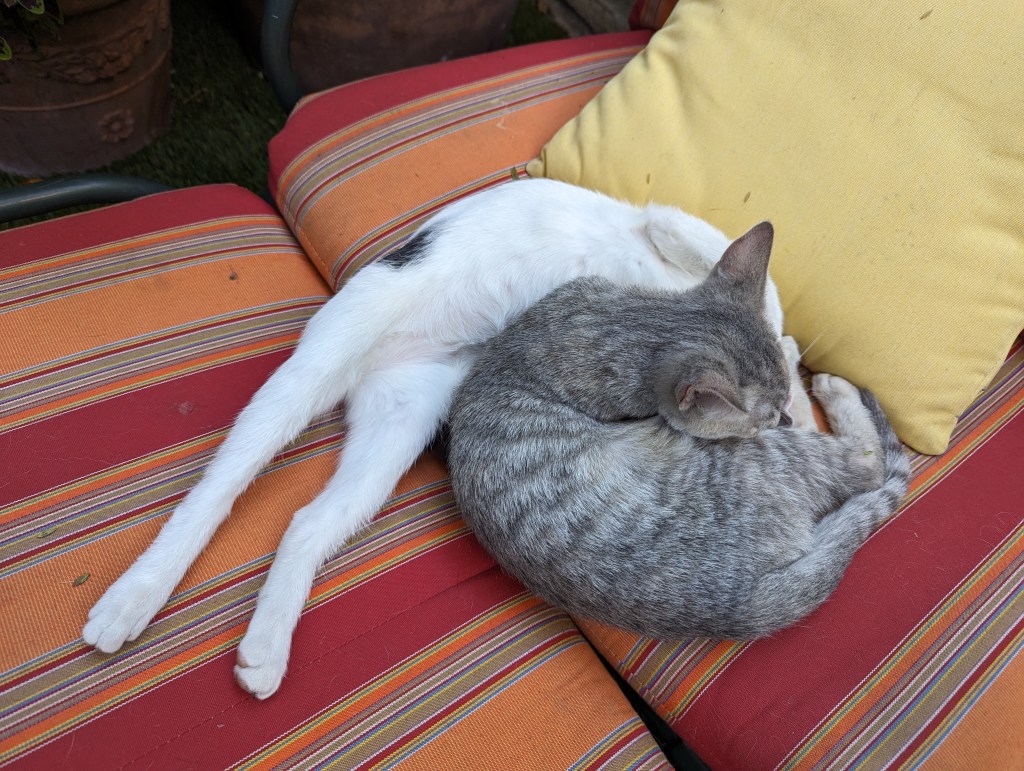
Brent, my colleague down south, recently procured three little kittens, supposedly to work as mousers like Darla did. They seem to be too friendly and playful though. I can not imagine them catching rodents. They certainly do not seem like the sort of kitties who rodents would fear. They are too playful and too nice.

If rodents avoid situations that are occupied by kitties, then any kitty could be effective. If rodents must be exterminated, then more diligent mousers would be necessary. I have no idea how instinctive mousing is for kitties. I suspect that it is different for each kitty, which is why some are better mousers than others.

At least these three little kittens are delightful. I mean, who would not appreciate such cute kitties in the garden? I regularly remind them that I am none too keen on kitties, but like all other kitties whom I have ever met, they do not care. They know how to get me to do whatever they demand.

Regardless of how weird kitties can be, they always seem to be dangerously cute.

Six on Saturday: Los Angeles to Los Gatos

Six on Saturday is hasty for me this Saturday. The last few days have been rather hectic. It is now about midnight on Friday. I am presently in Los Angeles, and will be returning to Los Gatos in a few hours. It is a long story. I did not get many pictures.

1. Washingtonia robusta, Mexican fan palm is the most familiar palm of the Los Angeles skyline. This one is very unique though. It grew under the onramp from the northbound Harbor Freeway to the westbound Santa Monica Freeway, on top of an embankment on northbound Toberman Street. It grew vertically until it encountered the underside of the onramp. It then crept along the underside of a merge lane toward the south. It resumed vertical growth after reaching the edge, and escaping from below. Countless commuters who drive past it, and perhaps also over it, are unaware of its extraordinary contortions.

2. Coleus scutellarioides, coleus is still performing nicely within Brent’s garden. Autumn is a bit later and significantly milder within Los Angeles than within Los Gatos or Felton.

3. Coleus scutellarioides, coleus is familiar among my generation because it was popular as a houseplant through the 1970s. It is likely more popular in home gardens nowadays.

4. Nephrolepis exaltata ‘Variegata’, variegated Boston fern or tiger fern is one of several species that I will bring back from Los Angeles because I can not procure it in Los Gatos.

5. Three little kittens are new residents of Brent’s garden. I doubt that they are related to those that Los Gatos is named after. They will eventually help with rodent management.

6. Rhody is normally terrified of kittens. He does not seem to be aware that they are just small cats. Now that we are about to leave, he is much more tolerant of their playfulness.

This is the link for Six on Saturday, for anyone else who would like to participate: https://thepropagatorblog.wordpress.com/2017/09/18/six-on-saturday-a-participant-guide/