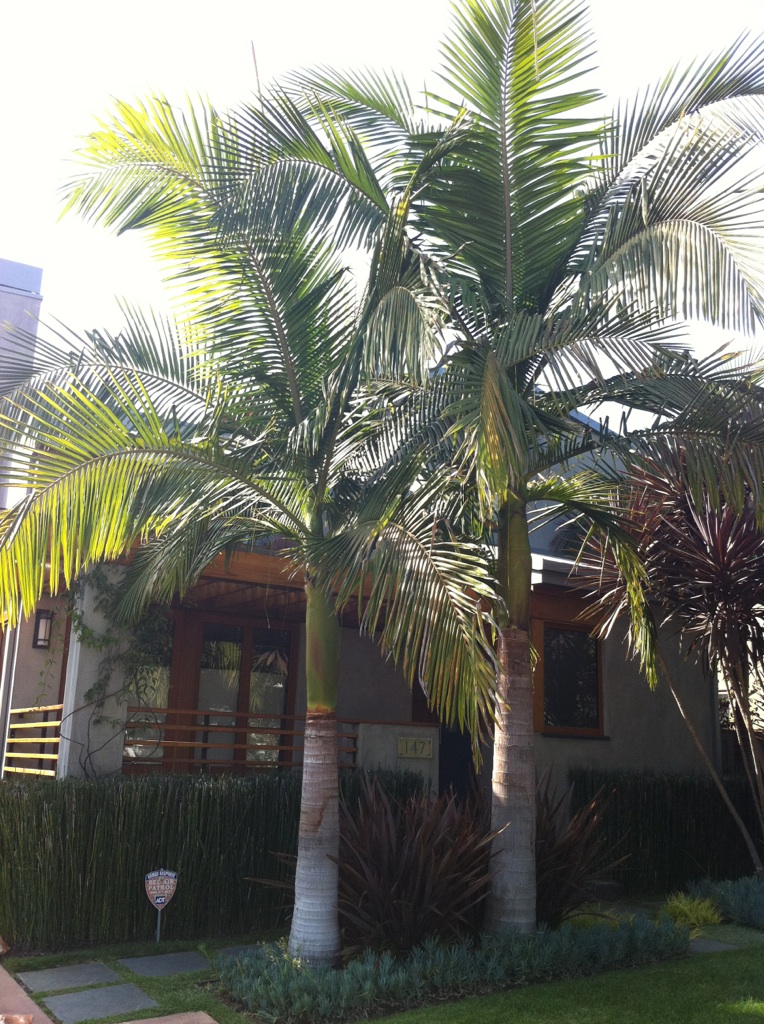
Canary Island date palm is the biggest and boldest.
The biggest and boldest of the common palms is the Canary Island date palm, Phoenix canariensis, which can get more than sixty feet tall and nearly forty feet wide, with a full canopy of gracefully arching deep green fronds. A young tree actually spends the first many years as a shrubby plant while the base of the trunk develops. Fronds get longer and spread broader every year until the trunk gets big enough to elongate. Vertical growth then accelerates somewhat, but the canopy gets no broader.
Most trees are female, eventually producing ornately orange but messy clusters of inedible dates. Male trees eventually get a bit taller, but are not quite as graceful and bloom with unimpressive dusty tan flowers.
Old deteriorating fronds need to be pruned away close to the trunk. Petiole bases of the most recently removed fronds are often carved into ‘pineapples’ to leave a bit of support directly below the canopy. Removed fronds leave a distinctive pattern on the trunk.
Only a few of the many different palms that can be grown locally are actually common. The Canary island date palm and the Mexican fan palm, which had historically been the most common palms, have unfortunately given palms a bad reputation. Both get too large for small gardens, and need costly maintenance when they grow out of reach.
Since the late 1980s, the formerly uncommon queen palm has become the most common palm. Although it too eventually grows beyond reach, it is still more proportionate to home gardens while young. It has a relatively narrow trunk that is partially ‘self-cleaning’ (which means that old fronds, or leaves, often fall off or can be easily peeled off).
The windmill palm and the Mediterranean fan palm, although no more common now than a century ago, are two of the better palms for home gardens, since they do not get too large, and are somewhat easy to maintain. The Mediterranean fan palm has several sculptural trunks that curve out randomly from the base. Sharp teeth on their petioles make pruning a challenge, but not impossible.
The windmill palm has a straight solitary trunk that is distinctively hairy where old fronds get pruned away. It eventually grows out of reach, but takes many years to do so. By that time, many people allow beards of old fronds to accumulate on the trunks overhead instead of bothering to keep them pruned.
The desert fan palm, which is the only palm that is native to California, is very similar to the Mexican fan palm, but is about twice as stout and half as tall, with a fluffier canopy. Because it grows slower and stays smaller, it would be a better palm for urban gardens, except that it does not like to be watered regularly when mature. It really prefers warmer and drier climates.
Pindo palm and Mexican blue palm would also be great palms for urban gardens, but grow rather slowly before getting big enough to get noticed. In some climates, pindo palm produces strange and messy, but sweet and tasty fruit. Mexican blue palm is one of the most resilient palms, and blooms with really cool long floral tassels that a can drag on the ground from short trees.
‘Feather’ palms, like Canary Island date palm, queen palm and pindo palm, have pinnate (and generally compound) leaves, with small leaflets arranged on solitary midribs. Their fronds must be removed as they deteriorate.
‘Fan’ palms, like Mexican fan palm, Desert fan palm and windmill palm, have palmate leaves, centered around the distal termini of solitary petioles. These are most often pruned away, leaving distinctive patterns of petiole bases, but can alternatively be left to accumulate into thick beards of thatch.
Mexican fan palms are sometimes ‘shaven’ of their petiole bases to expose elegant lean trunks, although the procedure is intensive and expensive. Desert fan palms and some Mexican fan palms drop their own beards naturally.
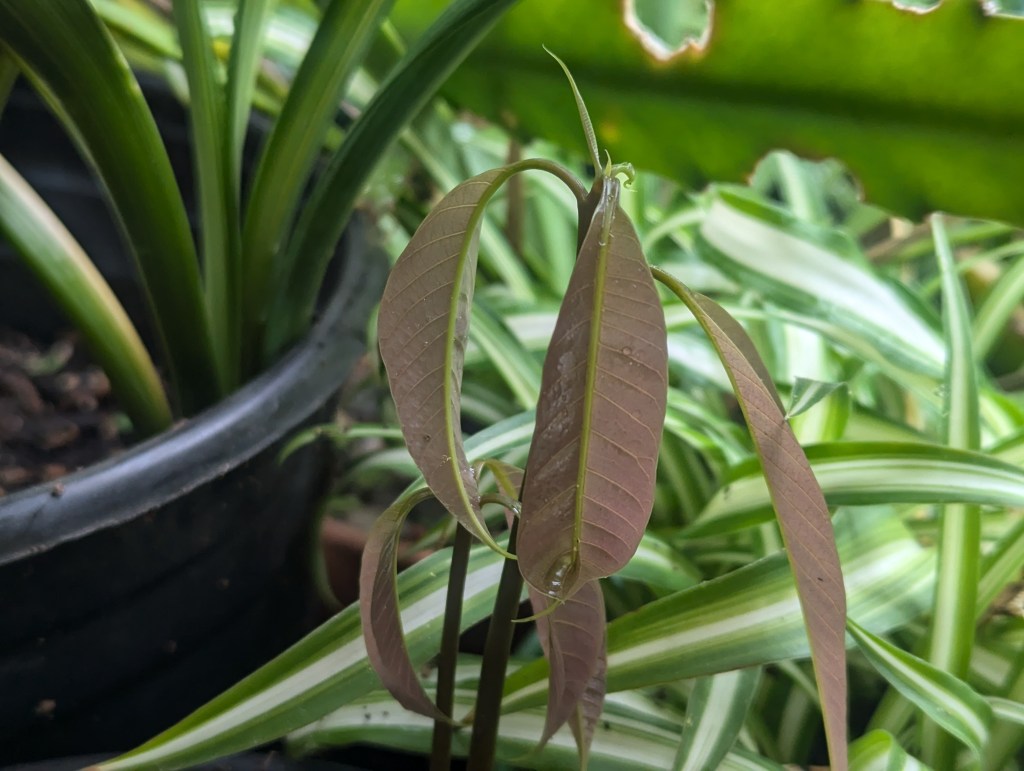
There are a few reasons to not grow avocado trees from seed. Such trees take a few years to produce fruit. Then, their fruit may be very different from the fruit that provided the seed. It is therefore better to purchase a grafted tree, or at least to graft a seedling. However, some of the best and most productive avocado trees have grown from seed. I have been acquainted with many such trees, and have never met even one that produced inferior fruit. (The primary problem that I notice with seed grown avocado trees is that they grow so tall while young that most of their fruit is out of reach, but that is another topic for later.) Anyway, this is my justification for growing mango trees from seed. I am told that they are much more likely than seed grown avocado trees to produce inferior fruit. I suppose that I will find out now. I am willing to try grafting them if their fruit is not good. They can at least become good understock. Yet, I am also wondering why I get into these situations. I should have known better than to grow something that I know nothing about.
Once it gets established in a garden, it will likely always thrive there. Torch lily, Kniphofia uvaria, is as reliable and resilient as lily of the Nile and African iris. It is as easy to divide for propagation too. Mature specimens can survive without any more water than they get from annual rainfall. They might appreciate some through the middle of summer, though.
Old fashioned torch lily blooms for summer or early autumn, so some are blooming now. Modern cultivars are more likely to bloom earlier. Densely conical floral trusses suspend many narrow and tubular flowers. They stand as high as five feet on otherwise bare floral stalks. Dense mounds of grassy basal foliage should grow no more than three feet high.
Flower buds are orange as they begin to bloom, and then fade with age to pastel yellow. Because floral spikes bloom upwards from the bottom, they turn yellow at the base while orange on top. They resemble candy corn. Some cultivars are paler white at the base, or more reddish orange at the tip. Others are uniformly orange, yellow or soft creamy white.
Pacific Coast iris eventually appreciates division.
Propagation produces more plants from minimal and readily available resources. Within home gardens, propagation is practical by seed, cutting, layering or division. Seed which is not available directly from the garden is generally not very expensive. Cutting, layering and division utilize what already lives within the garden. In other words, the stock is free.
Seeding produces genuinely new plants. Other forms of propagation produce genetically identical copies of their parent plants. Cutting compels pieces of stem to grow new roots. Layering does the same, but while pieces of stem remain attached to their parent plants. Division involves separation of portions of stems that already developed their own roots.
Most species that are conducive to division are substantial perennials. Flowering quince and lilac, though, are woody shrubs that produce dividable suckers. Most division should happen during late summer or early autumn. However, several species prefer late winter. Deciduous species, like lilac and flowering quince, prefer it during their winter dormancy.
Shasta daisy, lily of the Nile, daylily and coneflower prefer division during late summer. It is after their bloom and summer warmth, but before cool weather of winter. They disperse their roots through winter to resume growth even before spring. Bearded iris are ready for division a bit earlier, and resume growth by autumn. They are then ready for early spring.
Division of phlox and penstemon should be a bit later, when they get cut back. Bergenia blooms for winter, so should not be disturbed until late winter. Torch lily might bloom late, so also prefers to wait until late winter. New Zealand flax recovers from the process more efficiently after winter. It grows slowly during wintry weather, so is more susceptible to rot.
Daylily is easy to divide by simply digging and separating foliar rosettes from each other. Lily of the Nile is as simple but more work because of tough roots. Shasta daisy involves cutting apart clumps of its matted basal stems. Each clump, which may be cut away with a shovel, contains several such stems. Newly divided plants might bloom better because they are not quite so crowded.
Although the weather is predicted to be more typical, it was prematurely autumnish last week. It is a reminder that it really is time for Autumny and wintry flowers to come into season while summery flowers go out of season. This “Six on Saturday” is about some of such coming and going. (To comply with guideline #7 of the participant guide for Six on Saturday, I am limiting verbiage.)
1. Viola wittrockiana, pansy is traditional for winter floral color. It replaces petunia, and should last until petunia becomes seasonable again next spring. It is coming into season.
2. Petunia X hybrida, petunia is traditional for summer floral color. It replaced pansy as pansy finished its season last spring. It is going out of season now. Do you see a pattern?
3. Tagetes patula, marigold is traditional for autumn floral color. It was just installed as a narrow border for a small rose garden. For there, it is one of the more reliable annuals.
4. Pelargonium peltatum, ivy geranium, in eight or so baskets, hung from the eaves of a prominent building at work, but never flourished. They will be recycled somewhere else.
5. Dianthus caryophyllus, carnation does not do much through summer, but now begins to bloom as nights become cooler. I forget that it is here. I also forget how delightful it is.
6. Canna, canna blooms a bit less enthusiastically as the weather begins to cool, but can technically bloom until it gets frosted. If it does not get frosted, it can bloom continually.
Texas selected a distinctive state tree; the pecan, Carya illinoensis. It is happy in the south and middle mid-west, where naturally grows about seventy feet tall. It can get almost as large here, so is best in big spaces. Summers are a bit too mild for reliable nut production in autumn, but single trees can sometimes make plenty. Two different trees (to pollinate each other) can actually be quite productive, although not quite as well flavored as in warmer climates. The pinnately compound leaves have about eleven individual leaflets that are about five or six inches long. Shade is not too dark.
Despite the pleasant warm weather, it will be autumn soon. This is the time to get ready for cooler weather through autumn and winter. The plants in the garden do that on their own without our help. They somehow seem to know what time it is. We only need to clean up the mess and empty the gutters when deciduous trees start to drop their leaves later. Most of our work involves features that are not plants.
Winters are so mild here that some of our work often gets delayed until it becomes necessary. If needed, we can paint, stain and seal decks, fences, patios and anything else outside anytime the weather allows right through winter. Many of us leave patio furniture outside all year both because the weather is not too harsh on it, and because patios are usable spaces even through winter.
Firewood is also commonly neglected or not even needed, but for different reasons. Many fireplaces were damaged or destroyed by the Loma Prieta Earthquake decades ago, and never repaired or replaced. Modern building codes outlawed the construction of new fireplaces even prior to that; so newer fireplaces are instead pellet stoves. Those of us who still use old fireplaces and stoves have more difficulty obtaining wood now that the orchards are gone and the outskirts of town are so much farther from home.
The advantage of pellet stoves is that fuel (which looks like stove food) is always available so does not need to be accumulated, stored and seasoned. The fuel also burns cleaner. Synthetic logs (made from compressed wood byproducts and fuel) are an expensive alternative for conventional fireplaces and stoves, but also burn cleaner than wood, and are always available. They are lightweight and clean, so can be picked up at the store and brought home in the trunk of a small car whenever a fire is wanted in the fireplace.
Good old fashioned firewood is both more work and stigmatized because of pollution. Those of us who do not have firewood available within our own gardens can purchase it from some tree service companies. It is most commonly obtained already split and seasoned directly from the wood yard where the tree service company stores it. It can be delivered for a price. Some people even like to pay a bit extra to get it stacked.
Firewood obtained in this manner is typically a mix of random woods from trees found in local landscapes. There is often a preponderance of a particular type of wood. No one ever knows what to expect. The specific type of wood is designated only when a large tree or group of trees needs to be removed, and can be isolated from mixed wood. Palms and yuccas, known as ‘herbaceous trees’, do not produce effective firewood! A few pieces in a load of firewood should not hurt anything, but palm or yucca ‘wood’ should not be purchased. Mixed wood often contains some resinous wood and eucalyptus, which burns just fine, but produces a bit more soot that needs to be cleaned from chimneys.
Firewood should be obtained annually in quantities that are likely to be used each winter. It is perishable, and can rot if stored several years outside. Even if it does not rot, it can become infested with rodents if it stays idle too long. Besides, excessive firewood simply takes up space that could be used for something else.
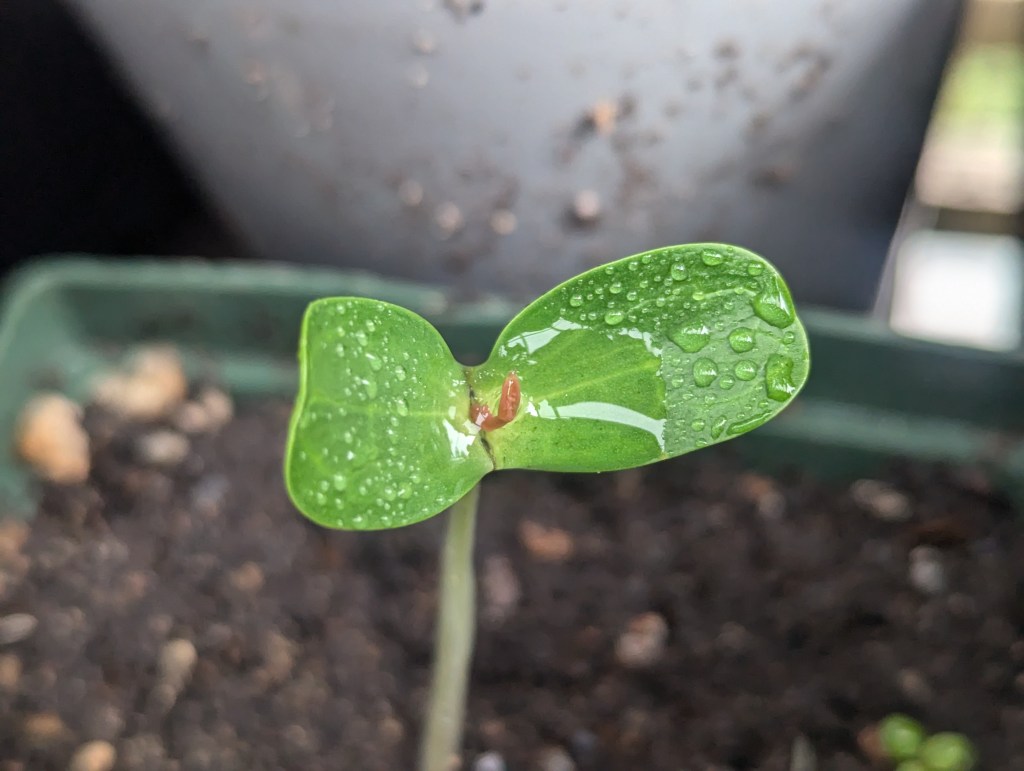
The Shrub Queen sent me seed for sea grape, Coccoloba uvifera. Naturally, it is now very important to me. I wanted to grow it before obtaining the seed. Now, I am obligated to grow it well! Some of the seed germinated readily. The problem is that slugs promptly ate the tops of the seedlings. Only one seedling survived without damage. It now has its first pair of leaves, and looks like a green butterfly. A second seedling that germinated shortly afterward retains one of its first pair of leaves, so could possibly survive. Hopefully, more seed will germinate later. Sea grape is dioecious; so the primary seedling is either male or female, and therefore unable to produce fruit without a mate of the opposite gender. Most sea grape are female; so even if the secondary seedling survives, there is more than a fifty percent probability that both the primary and secondary seedlings are female. If more seedlings germinate in the future, they will increase the probability that at least one will be a gender that is different from the others. Actually though, I would be pleased with only a single fruitless sea grape. The seed was such a generous gift.