Gophers

Do not underestimate the destructive potential of gophers!

Many of the yuccas that naturally live in deserts where forage may be scarce are equipped with an efficient defense system. Each leaf terminates with a nasty spine. Leaves are so abundant that the spines are impossible to avoid. It is amazing that these yuccas are as vulnerable as they are to gophers, who simple burrow below all the advanced defense technology to eat the starchy roots and any subterranean portions of stems.

Some of the techniques sometimes used to get rid of gophers are too dangerous to even discuss. Rodent poison (for rats and mice for example) is not only dangerous to other animals that may dig it up, but not often effective since gophers prefer to eat fleshy roots and stems. The only practical poisons can only be applied by licensed pesticide applicators.

New plants can be installed within ‘gopher cages’ that should exclude gophers from the root system at least long enough for the plants to get established. Gopher cages can be purchased ready-made, or can be constructed easily from chicken wire. They only need to be as deep as the planting hole, but can be wider for perennials that spread.

Gopher cages do not protect all roots, since some extend through the cage to disperse; but should protect enough roots to keep plants alive if outer roots get damaged. By the time the cages deteriorate, the plants within should be established enough to survive gopher infestation for a while; although even large plants can be killed by unrestrained gophers.

Properly used traps are the most practical means of controlling gophers. Traps should be installed in pairs, even though each pair typically catches only a single gopher. If possible, traps should be installed away from any gopher cages that may be present, since cages are difficult to work around, and nearly impossible to release from a sprung trap.

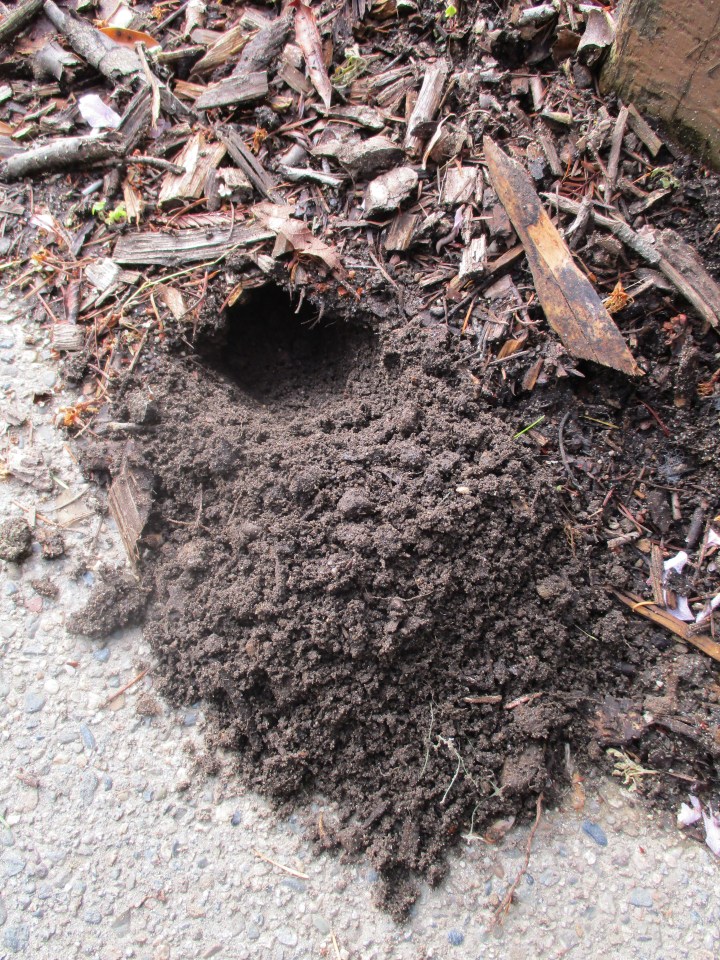
Once the entrance to a gopher run is found under a mound of freshly excavated soil, the entrance, which is typically filled with loose soil, should be excavated back as far as the main run, which extends perpendicularly to the right and left. The main run should be cleared of loose soil.

Each of the two traps can then be set and gently placed within the main run in each direction. A trap should be held by the spring end so that the claws and lever extend into the run. Wires attached to the spring end of the traps are easier and safer to pull the traps out with later, instead of digging the traps out. These wires can be attached to a stake to make them easy to find later.

The entrance hole should then be buried. Air circulation from outside will prompt the gopher to collect loose soil to plug the hole, and push the loose soil ahead, springing the trap prematurely.

The gopher within may not be interested in using the same entrance to expel soil, but will likely use the same run. Two traps are used because there is no way of knowing which direction the gopher will approach from. The unfortunate gopher can be removed in a day or so; so that the traps can be set into another run where fresh excavation has been observed.
Fountain

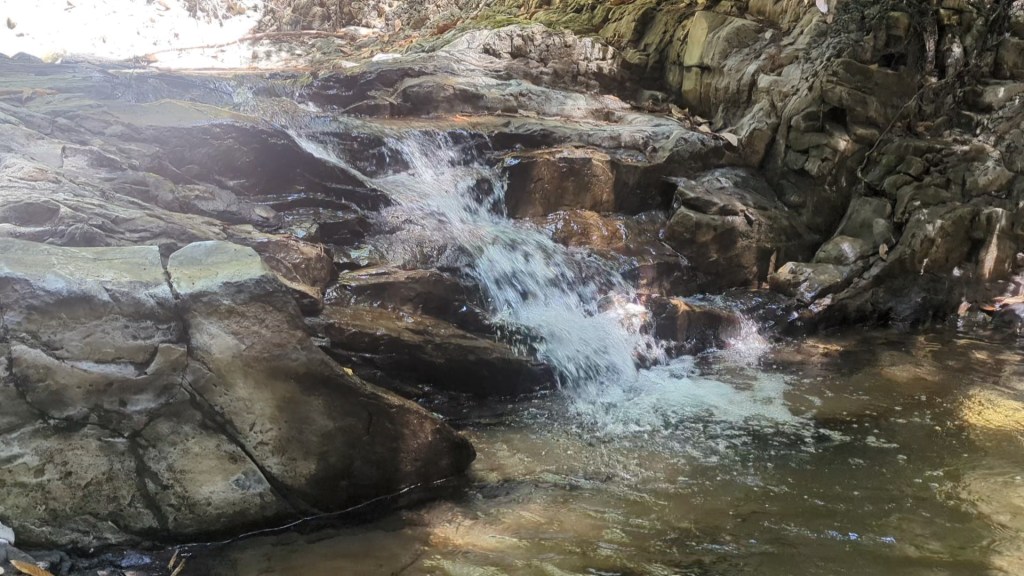
Life was very different where I lived in town in the 1990s. I miss that neighborhood and my garden there very much. However, it was an urban neighborhood, only a few blocks from the interchange of Highway 17 and Highway 85. My neighbors had me build a small solar powered fountain adjacent to a patio of our apartment building to obscure the ambient urban noise. I thought it was a silly component of the landscape, but everyone else was fond of it. Well, sadly, I left that home and garden many years ago, and relocated to a quieter neighborhood a few miles away. Except for a few lights at night on distant hillsides, I can see no other households. I do not hear much more from them than I can see. Air traffic to and from Mineta is the most traffic that I notice, if I notice. In fact, the noisiest noise in my garden is from this creek that flows through it. I flows all day at night, so does not stop when the sun goes down. I can not unplug it. It gets louder during winter. Perhaps I should build another solar powered fountain to obscure the noise.

Arizona Cypress

Arizona cypress is distinctively grayish green.

Classification of this species may be complicated. About five distinct varieties of Arizona cypress, Cupressus arizonica, occur naturally. Some may sometimes classify as distinct species. Some grow no higher than twenty feet, with stout and shrubby form. Some grow fifty feet high, with sculpturally irregular form. Botanists may not agree on their identities.

Old trees that mostly grew from seed are typically noticeably variable. Some exhibit nice bluish green foliar color. Others are more grayish green. Modern trees are mostly modern cultivars with strikingly uniform silvery blue foliar color. Some are supposedly conducive to hedging, which enhances foliar color. Although evergreen, foliage is freshest in spring.

Without hedging, Arizona cypress develops splendid natural forms. Whether sculpturally irregular or compactly shrubby, it may need only minor grooming. Its finely textured foliar debris disappears into any ground cover below. However, such foliage can have a mildly herbicidal effect on lawns. Arizona cypress trees in a row can be an effective windbreak.

Binding For Straighter Tree Trunks

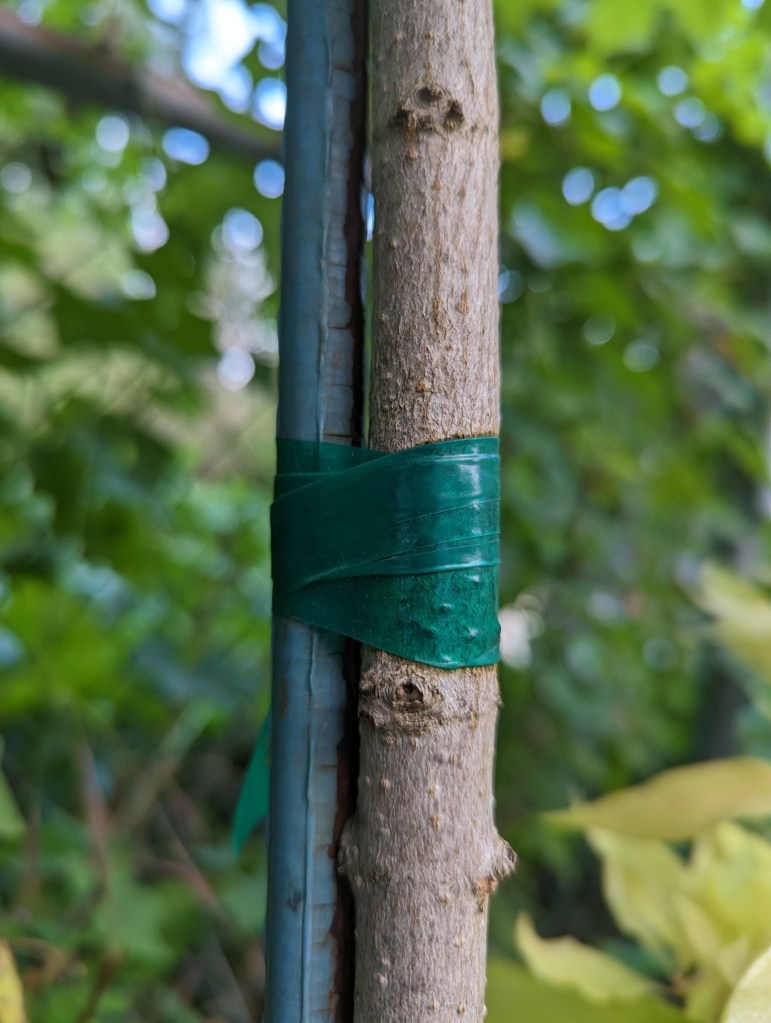
Proper binding promotes straight trunk growth.

Staking is not quite the same as binding with stakes. It is more for the benefit of the roots than the trunks, which is what binding is for. Staking should support new trees only while such trees disperse roots for adequate stability. As trees do so, stakes become obsolete. Actually, stakes that remain for too long may be detrimental to healthy tree development.

Binding with stakes promotes straight trunk growth. It is particularly practical for trees that naturally develop crooked or multiple trunks. It is a technique that is quite common within nurseries, although not home gardens. However, many trees retain binding stakes when they arrive from nurseries. For a while after planting, some continue to benefit from them.

However, binding may be more detrimental than staking if it remains for too long. Trunks that become reliant on any sort of supportive stake remain weak or limber. Also, tape that binds trunks to stakes can become constrictive as trunks grow. It is important to remove it before it begins to interfere with trunk expansion. Looser tape can be useful if necessary.

For example, California pepper tree naturally develops a few irregular and limber trunks. To produce trees with single and straight trunks, nurserymen bind single trunks to stakes. They then prune out other trunks and low limbs until main trunks attain an optimal height. Because they are still limber, trees remain bound to their stakes while available for sale.

However, such stakes provide only support for trunks. They do nothing for stability while trees disperse roots into their new gardens. Additional staking with heftier stakes may be necessary for that. Such stakes must extend into undisturbed soil below the roots of such new trees. If possible, it is better to merely replace binding stakes with supportive stakes.

The next best option is to replace tape that binds young trunks to stakes with looser tape. This maintains the straight form of such trunks without inhibiting their growth. Supportive stakes, in addition to binding stakes, maintain their upright posture. Most trees need only supportive stakes, realistically. A few trees, especially new palms, need no stakes at all.

Six on Saturday: Construction Site

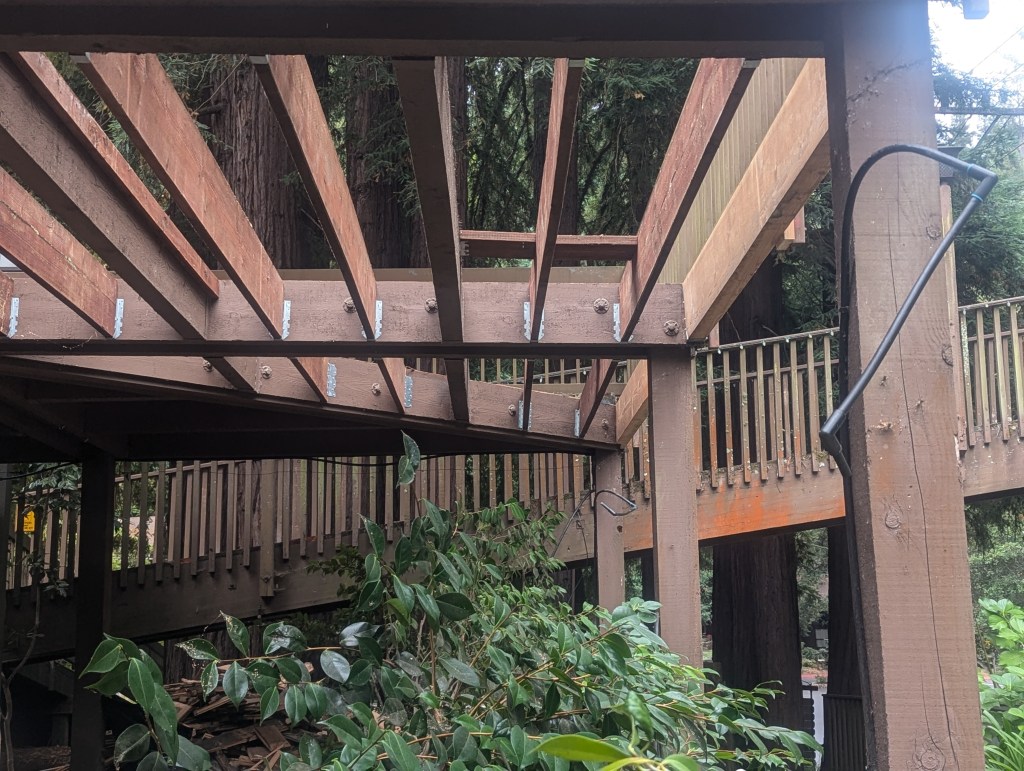
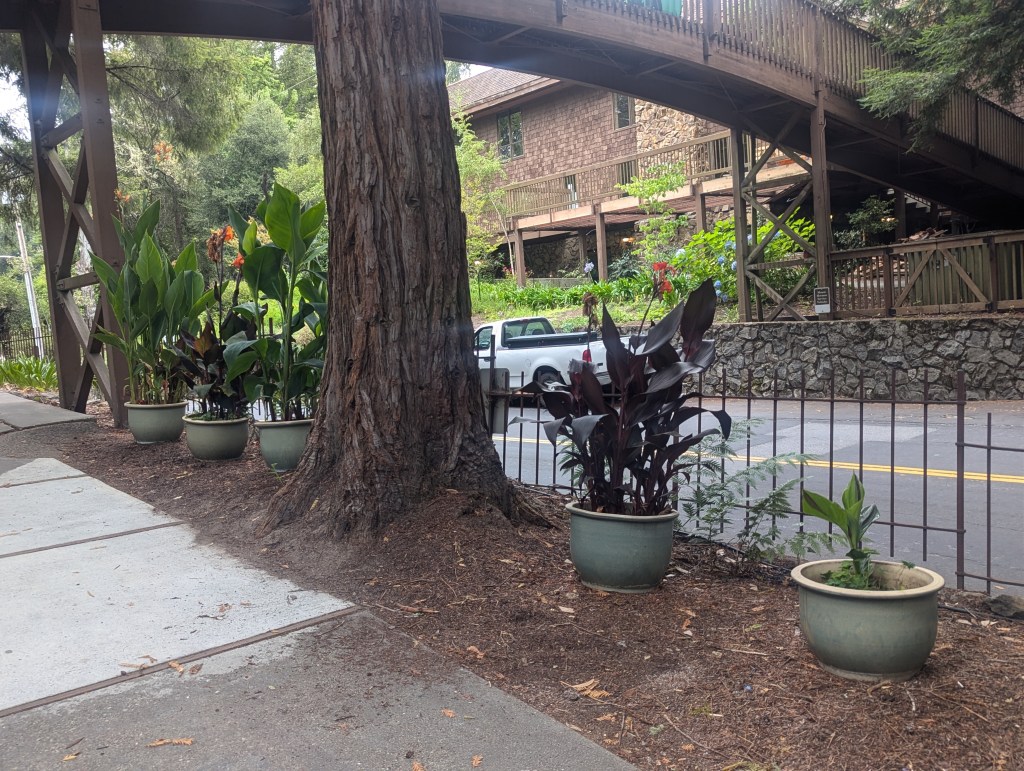
An old deck at work is presently being replaced. Potted cannas that resided on it needed to be moved. Camellias below it are in the way, but safe for now. It is quite a big project.

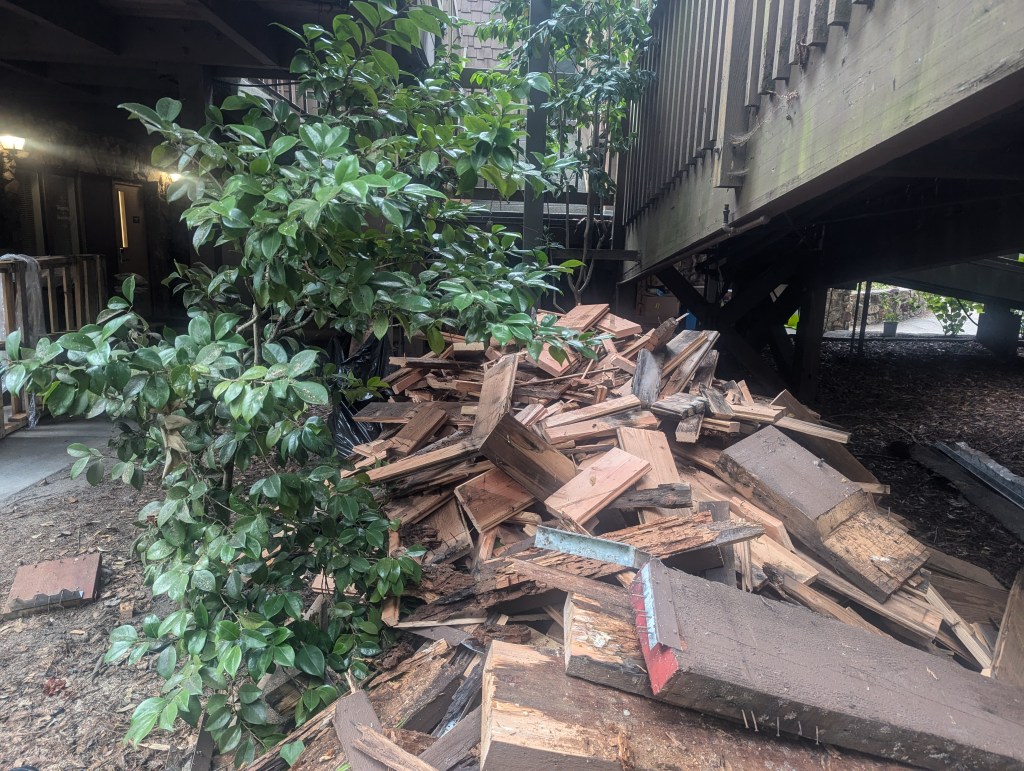
1. Camellia japonica, camellia under the old deck are temporarily getting more sunlight than they are accustomed to. There are about eight. This will not last long, though, until the new deck replaces the old. The disheveled irrigation tubing was for pots on the deck.

2. Camellia japonica, camellia at the far end of this row is somehow undamaged by this accumulation of debris from the dismantled deck above. I am impressed. Some extent of damage is expected from such a project, particularly with so many camellias in the way.

3. Canna indica, canna was looking good on the deck across the road in the background. Not only were they removed, but because of a realistic concern that they promote decay, they will not return to the new deck. For now, they were straightened into position here.

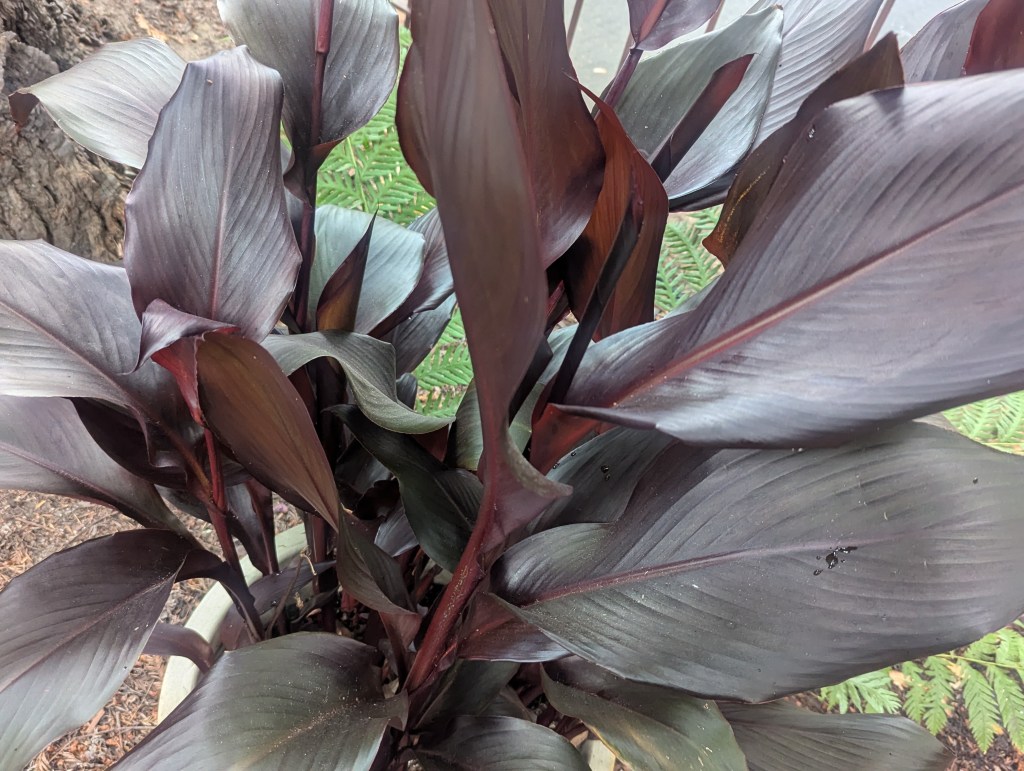
4. Canna indica ‘Australia’ canna is probably the boldest of the five even without bloom. The others are ‘Wyoming’, ‘Cleopatra’, ‘Stuttgart’ with an unidentified cultivar with large red bloom, and ‘Inferno’ with a notably tall but unidentified cultivar of Canna musifolia.

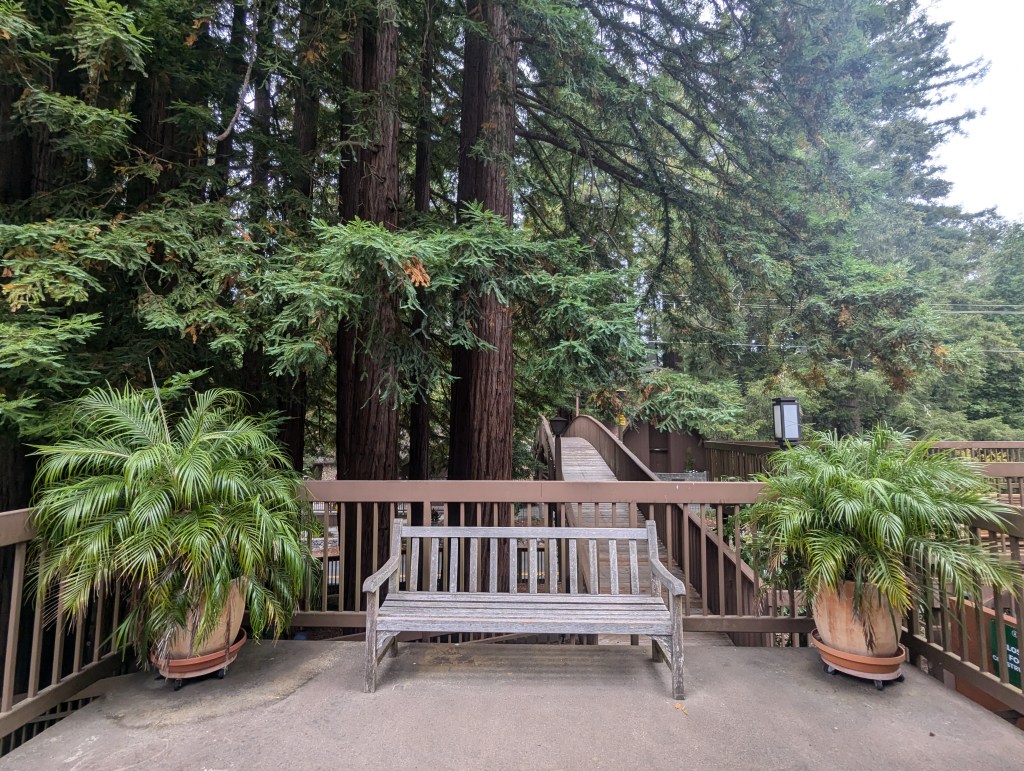
5. Phoenix roebelenii, pygmy date palm paired on another area of the deck will also need to be removed prior to a second phase of reconstruction. Unfortunately, I do not know if these big old pots can be moved intact. Both are deteriorated, fractured, and very heavy.

6. Pelargonium X hortorum, zonal geranium should also be removed, but from another situation. They were originally installed to hold posts for the signs that are now attached to the fence behind them. Now they just get bashed by parking cars. One is already gone.

This is the link for Six on Saturday, for anyone else who would like to participate: https://thepropagatorblog.wordpress.com/2017/09/18/six-on-saturday-a-participant-guide/

Bear’s Breech

Bear’s breech can be a bit too sustainable, and difficult to get rid of.

Like some other Victorian perennials that are still happy after a century, bear’s breech, Acanthus mollis, can get to be too much of a good thing. It can become invasive where not contained. Once established, it is difficult to eradicate. The bold coarse foliage looks great while the weather is favorable, but then dies back after bloom when summer weather gets warm, leaving obvious voids where other plants were crowded out.

The good news is that bear’s breech does not require much attention at all. It is very easy to propagate by division or simply by digging a few thick roots while dormant or just as new foliage appears in autumn. Well watered plants can keep their foliage all year, so that they only need to be groomed of older foliage and spent flower stalks. Partial shade is not a problem; although snails can be.

Big arching leaves form bold mounds of glossy foliage about three feet wide. The distinctively lobed and toothed foliage has an appealing texture and deep green color. Elegant mostly white flower spikes stand nearly five feet tall late in spring into summer. Acanthus balcanicus (illustrated) is more compact, with more intricately textured foliage.

Sun Scald

Vegetation needs sunlight, but sunlight can be excessive.

It was sad to see the removal of a rather mature but unstable Italian stone pine from the neighborhood. Fortunately, the arborist who removed it was careful to avoid damaging the garden below. Yet, after all the effort, the garden did not remain undamaged for long. The healthy bear’s breech (acanthus) and young Australian tree ferns that had been shaded by the dense canopy of the pine got roasted by the first warm weather.

These perennials got roasted because they were adapted to shade, but could not adapt soon enough to exposure to direct sunlight. This illustrates one of the main problems of topping trees and exposing the interiors of formerly shaded canopies. (‘Topping’ is the disfiguring removal of major portions of the upper canopies of trees.) Like perennials on the ground, foliage as well as stems and main limbs within the canopies of topped trees gets damaged by increased exposure. Although most perennials eventually adapt and recover, topped trees are often damaged too severely to recover.

Foliage can be replaced, but stems and limbs are not so expendable. Deciduous trees and most evergreen trees will replace damaged foliage within the first year. Deciduous trees that get topped while dormant in winter actually do not exhibit foliar damage, since foliage that emerges in spring will be adapted to the exposure that they grow into. However, formerly shaded stems that suddenly become exposed by topping are easily damaged by sun scald, which is like sunburn of the bark.

Sun scald deteriorates into open wounds which leave inner wood susceptible to decay. Minor sun scald of small limbs can eventually be compartmentalized (healed over) before it becomes too much of a problem. Major sun scald can destroy main limbs and even trunks, causing additional disfigurement to trees that were already disfigured by topping! Even if sun scald does not develop, the open wounds left from topping are often too large to be compartmentalized, so remain open to decay.

Regardless of sun scald, topping is more directly disfiguring, by removing well structured limbs and trunks, and causing the development of disfigured and structurally unsound limbs. Secondary growth that emerges in response to topping or severe pruning is weakly attached to the mature limbs that it emerges from because it did not grow together with the mature limbs. It breaks away easily in wind, or simply because it grows too vigorously and soon gets too heavy for weak unions.

Topping actually causes more problems than it is thought to remedy. In some situations, it is actually more practical to remove potentially hazardous trees than to make them more hazardous by topping them.

Which Mesquite?

Is this velvet mesquite, Prosopis velutina, or honey mesquite, Prosopis glandulosa? It is still too young to identify. I suspect that it is velvet mesquite because I found its seed in a landscape in Surprise, Arizona, and velvet mesquite is the most common species within landscapes there. Also, the foliage of the trees that provided the seed resembled that of velvet mesquite more than that of honey mesquite, with relatively smaller leaflets. The bark was medium brown, so was not quite as dark brown as I would expect for velvet mesquite, but more brown than tan, as I would expect for honey mesquite. This little seedling may not look like much now, but it is the only survivor of the many seed that I collected. Only a few germinated, and slugs ate them before they extended their first leave beyond their cotyledons. This seedling germinated last, and was promptly canned in a four inch pot that I brought inside at night for protection. I hope that, before the end of summer, it grows large enough to survive winter. It should. Regardless of its identity, I hope to eventually use its stems for smoking and, if it grows large enough, barbecuing.

Garden Phlox

Garden phlox can be surprisingly fragrant.

Several species of Phlox are native California wildflowers. Yet, the more popular garden phlox, Phlox paniculata, is native only east of Kansas. It can self sow where it gets water, and is naturalized in the Pacific Northwest. It prefers rather rich soil and sunny exposure but is not very discriminating. A bit of partial shade might promote taller stems for cutting.

Mature garden phlox can be as tall and wide as three feet. Some modern cultivars stay a bit more compact. Dense panicles of small flowers may be as wide as six inches. Bloom is most commonly white, but may be pink, red, lavender or pastel orange. It is a splendid cut flower, with an alluringly rich fragrance. Bloom might continue for a month of summer.

Garden phlox is deciduous, so all canes die to the ground for winter. Mature colonies are then easy to propagate by division. Similarly, feral specimens that appear where they are unwanted are easy to relocate. Garden phlox can perform nicely in proportionately large pots and planters. It is uncommonly available from nurseries, but grows easily from seed.