My niece knows the weird flowers of passion vine as ‘flying saucers’ because they look like something from another planet. The most common species, Passiflora X alatocaerulea, has fragrant, four inch wide flowers with slightly pinkish or lavender shaded white outer petals (and sepals) around deep blue or purple halos that surround the alien looking central flower parts. The three inch long leaves have three blunt lobes, and can sometimes be rather yellowish. The rampant vines can climb more than twenty feet, and become shabby and invasive, but may die to the ground when winter gets cold. Other specie have different flower colors. Some produce interesting fruit. Passiflora edule is actually grown more for its small but richly sweet fruit than for flowers.
My colleagues and I are rather proficient with communicating with the plants in the garden. Plants let us know when they want a particular nutrient, or are getting hassled by a particular pest. Those that produce fruit and vegetables also tell us when it is time to harvest. The only problem is that some horticulturists are not quite as receptive to information about ripening produce as we are to problems.
As my tomatoes ripen, I eat them whenever I want to, even if they are warm from hanging out in the sun. Any fruits or vegetables are fair game as soon as they are ready to get eaten. Although I will grow just about anything in my garden, I never bothered to learn how cook or even handle fruits and vegetables properly. For me, the best time to harvest is when I am hungry.
Those of us with more discriminating taste eventually become acquainted with the produce that we grow, so that we know when and how to harvest it to achieve the best quality. We learn how to translate the fragrance of a ripening melon, and to tap to determine density and consistency. Maturity of corn can be determined by their drying tassels, and confirmed by puncturing a few kernels. Color and texture of pea pods let us know when the peas within have achieved their optimum plumpness.
Renee of Renee’s Garden, which is perhaps my favorite supplier of vegetable and flower seed, describes some less obvious recommendations for harvesting produce at the website http://www.reneesgarden.com. While the weather is so pleasant through summer, it is best to harvest vegetables in the morning, while it is still cool in the garden. If harvested later in the day, vegetables can wilt because of evaporation of moisture and absorption of warmth. If harvesting in the morning is not possible, harvesting in the evening is the next best option.
Leafy vegetables like lettuce, chard, collard, basil and parsley, as well as pea, are particularly sensitive to getting harvested during warm weather. Green beans grow like weeds during warm days, but are slightly crisper if picked while cool. Vegetables in the cabbage family that are grown later in the year or early in the following year, such as cauliflower and broccoli, can likewise get limp.
Root vegetables like carrot, radish and turnip are not nearly as sensitive to warmth because they are so well insulated underground. They should be brought in out of the warmth and refrigerated (if preferred) quickly nonetheless. However, turnip greens and any other greens that are grown as root vegetables are just as likely to wilt as other leafy vegetables are.
Eggplant, pepper and zucchini are more resilient, but can potentially get limp if harvested a few days before getting eaten and left to linger in a warm and dry (minimal humidity) kitchen. Many varieties of tomato are best directly out of the garden; but many others actually get better flavor if harvested a bit early and left to finish ‘off the vine’. In autumn, when tomato plants stop producing, the last but nearly mature green tomatoes that run out of warm weather can finish ripening on the kitchen windowsill.
What a pathetic tropical hibiscus flower! It is only about two inches wide. It should be bright red instead of this faded terracotta pink. It even lacks foliage in the background. So, why did I take a picture of it? I was impressed by this flower because it bloomed on a cutting that is still in the process of rooting. I should have removed the bud when it appeared, to conserve resources for root growth. Instead, I let it bloom to see what would happen. This is the result. Knowing all that I know about it, I am somewhat impressed. Of course, I plucked the flower off after taking its picture. After all, I am a nurseryman, not a gardener. I want the cuttings to root as efficiently as possible. Actually, more of them than I expected seem to be rooting, so there may be a surplus of these particular hibiscus in the future. Cuttings of another cultivar that blooms yellow did not perform so well. Only three survived so far, and they are rather wimpy. I may need to go back to collect more cuttings for that one. I also would like cuttings from a cultivar that blooms orange.
Curve leaf yucca is one of a few species of the genus that is difficult to identify. It may be a distinct species, Yucca recurvifolia. It may be a naturally occurring variety of mound lily, Yucca gloriosa var. tristis or recurvifolia. Yet, it may be a natural hybrid of Yucca aloifolia and Yucca flaccida. To complicate all of this, its physical characteristics are inconsistent.
The evergreen leaves of curve leaf yucca are typically pliable, and curve downward. Yet, they can be quite rigid and upright. Foliar color is typically grayish green but can be olive drab. Stout but upright trunks can potentially develop, but may never do so. Only their tall floral stalks that bloom for summer are consistent. Individual flowers are small and white.
Curve leaf yucca enjoys warm and sunny exposures. Occasional watering through warm weather may improve vigor, but is unnecessary. Old colonies form large mounds that can slowly grow as high and wide as ten feet. With the exception of gophers, which eat roots, not much bothers curve leaf yucca. In fact, it can be very difficult to eradicate if unwanted. Pups may continue to develop from rhizomes for many years.
Understory plants, which tolerate various degrees of shade, are more popular than ever. Basically, smaller modern gardens amongst larger modern homes are shadier than ever. Densely evergreen trees that provide privacy for such gardens also provide more shade. Sunlight can be scarce. It may be helpful to know where to locate optimal sun exposure.
The sun moves from east to west as each day gets warmer. It does so more or less to the south of vertical. It is a bit farther to the south for winter than for summer. Such orientation and motion determine sun exposure within home gardens. Each side of a house, garage or fence faces one of such exposure or another. Eaves might provide shade from above.
Eastern exposure is good for plants that crave some direct sun exposure but not warmth. Azalea, rhododendron, andromeda and hydrangea prefer such exposures. They receive enough sunlight to bloom, but not so much that their foliage scorches. They enjoy partial shade before sunshine gets uncomfortably warm. Eastern exposures are sunny but cool.
Northern exposure is good for plants that do not require much sun exposure. Hydrangea may be somewhat lanky within such situations. Clivia, elephant ears, philodendrons and ferns may be better options. Upper floors and eaves significantly enlarge the shadows of northern exposure. Shadows are also larger in winter while the sun is lower to the south.
Western exposure is good for plants that crave both direct sun exposure and warmth. It is the opposite of eastern exposures, but is certainly no less sunny. It is merely warmer. Lily of the Nile, lavender, oleander and bougainvillea enjoy such sunny warmth. Some types of ferns and elephant ears may scorch with such exposure. Eaves delay direct exposure.
Southern exposure is good for plants that crave full sun exposure, but tolerate heat. Most plants that enjoy western exposure can also enjoy southern exposure. Many vegetables, with regular watering, are more productive with such exposure. Eaves provide shade for the warmest summer weather. They provide less shade while the sun is lower for winter.
These are a few plants that survived where my former home was abandoned, and where the new home is to be built. Some of them had been here since 2006 nineteen years ago.
1. Cereus peruvianus, night blooming cereus is from Brent’s former Miracle Mile garden balcony. I do not know why it is so spiny now. Maybe it is angry about being abandoned. Aeonium arboreum, common houseleek is from another friend’s garden near Monterey.
2. Crassula arborescens spp. undulatifolia, ripple jade, as well as the pinwheel aeonium below, remain unidentified. These names that I present here are merely guesses of their identities. Anyway, I procured this from a jobsite that I worked at in Hayward years ago.
3. Aeonium haworthii, pinwheel aeonium came from the same garden that the common houseleek came from near Monterey. The slope that it is attached to is actually too steep to stand on. Yucca recurvifolia, curve leaf yucca is from an old jobsite in Boulder Creek.
4. Aloe arborescens, candelabra aloe came from the home garden of an old friend in the East Hills of San Jose. It is higher on the same steep slope as the pinwheel aeonium and curve leaf yucca. It should grow better and produce pups for dividing with a bit of water.
5. Pelargonium graveolens, rose geranium impresses me most because it survived for so long, like the other perennials, but is supposedly not as resilient as they are. I found this in an old home garden in San Francisco, although I believe that it is common elsewhere.
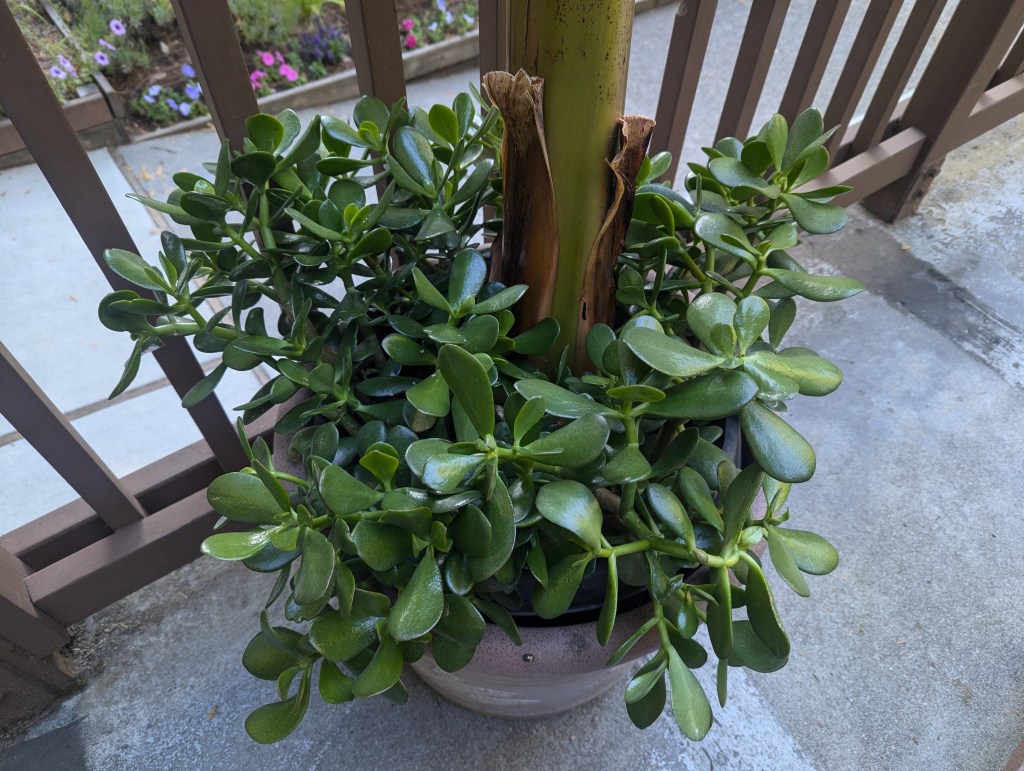
6. Iris pallida, Dalmatian iris is important because it is from the garden of my maternal maternal great grandmother in Oklahoma. I acquired it when I was about four. Crassula ovata, jade plant was from my former home in town, where I lived after the earthquake.
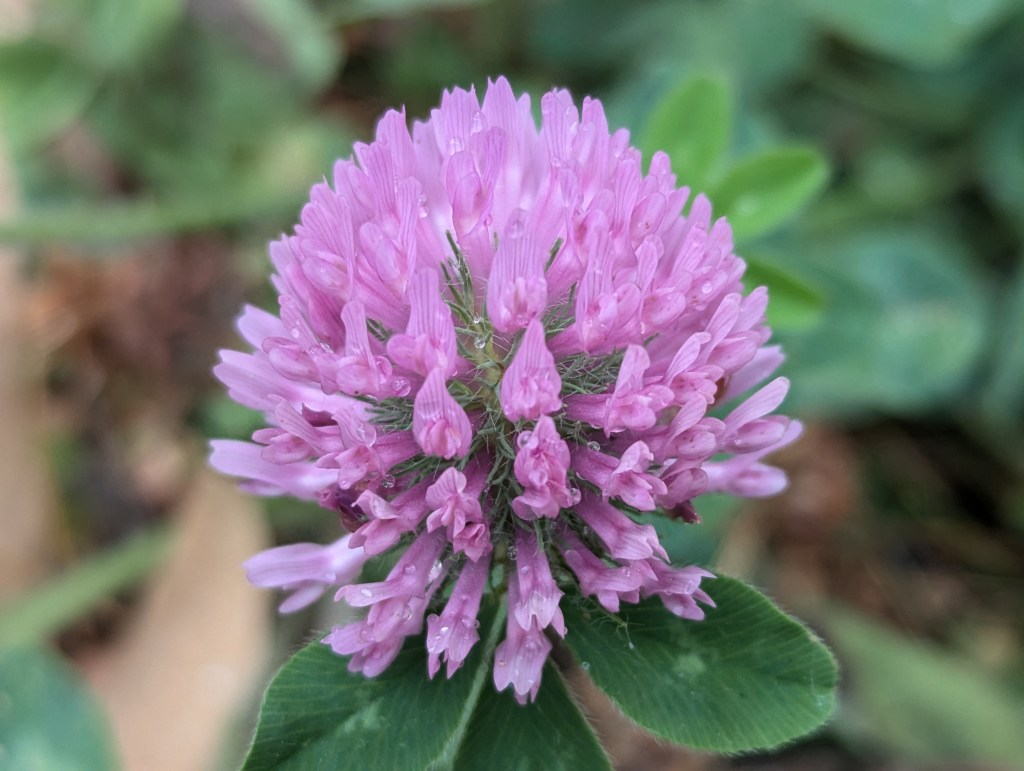
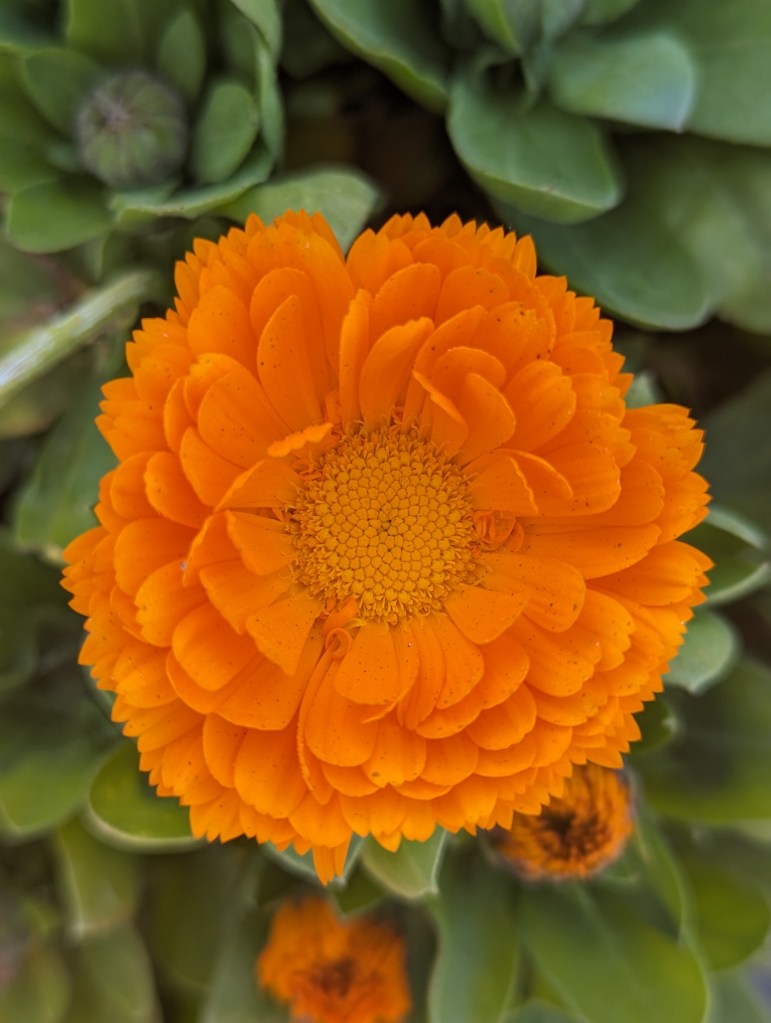
Once naturalized in the garden, chamomile, Matricaria recutita, can get to be too much of a good thing. Seed sown in at the end of winter or early in spring typically does very well in the first year. The new plants bloom abundantly by the middle of summer and eventually become rampant and sparse enough to get cut back by the end of the following winter. The largest and most productive plants can die at the end of their first year, but are only replaced by the formerly smaller plants that survive getting cut back through winter to get an early start the following spring. Self sown seed can fill in where last year’s plants do not, and can migrate into places where no one would have thought to plant them!
The finely divided, lacy foliage stands nearly two feet tall, and more than half as broad on somewhat floppy stems. The inch wide daisy flowers that are white around the edges of big yellow centers can be dried to make chamomile tea.
‘Snowball’, ‘Golden Ball’ and ‘White Stars’ are actually varieties of related Chrysanthemum parthenium that are sometimes sold as chamomile. Feverfew, chamaemelum nobile, stays dense and low, and can be a nice ground cover for small areas. I grew my favorite traditional chamomile (as well as feverfew) from seed from Renee’s Garden.
Even passion flower can make a nice, albeit colorless, tea.
When she was younger, my niece, who happens to be the most elegantly refined girl in Gilroy, enjoyed doing tea. She certainly had the technique, as well as two patient grandmothers, to indulge in this particular tradition properly. The only problem was caffeine.
She was such a young lady; and her Nana and Grandma refrained from the consumption of caffeine. Black tea, made from the fermented bud leaves of tea camellias, was not a good option. Even green tea, made from the same leaves but without fermentation, contains some degree of caffeine. Herbal teas were more practical, as well as appealing to the discriminating taste of a young lady of such impeccable refinement.
There are all sorts of herbal teas made from flowers, leaves and fruit that can be grown in home gardens. Mint, chamomile and lemon grass are perhaps the most well known. Peppermint, spearmint and the many other varieties of mint all have unique flavors. Lavender, particularly French lavender, and some of the many sages can be used to add a bit of their distinctive flavors, too.
Thinly sliced and dried ginger and licorice root make spicy teas that are also good remedies to a mildly upset stomach. However, flowering ginger is not as robust as herbal ginger is. Finely chopped dried berries, cherries, apricots and quince, as well as the rinds of lemons and oranges, add their fruity flavors. The extensive tea list at the White Raven in Felton features teas flavored with dried hibiscus flowers, pelargoniums and rose hips.
Experimenting with herbal tea is like cooking. Within reason, anything goes. Tea can even be made from the dried young shoots of Douglas fir! The only plants that can not be used as tea are those that are potentially toxic.
Tea can of course be enjoyed hot, cold, or even at ambient temperature. Herbal tea is almost always made from dried plant parts, but can be made from fresh parts as well. The various mints have different flavors if brewed from fresh bits taken directly from the garden instead of dried leaves. I actually like to add a few fresh leaves from rose scented geranium (pelargonium) to common sun tea made by leaving black tea to brew out in a jar in the sun.
While they are in season, I also like to add a thin slice of fresh quince, which is so strongly flavored that it is just as effective fresh as it is dried for sun tea or hot tea. Apples and crabapples are also nice, but with much milder, and perhaps even boring, flavor. I prefer to eat the apples and then drop the cores into tea. A Slice or two of richly flavored fig can be good in sweetened hot tea.
Oregon grape, Mahonia aquifolium, is the Official State Flower of Oregon. Fruit such as this develops after its bright yellow bloom. It is nothing like grapes, though. It is edible, but unimpressive alone and fresh. Locally, it is not abundant enough to bother with collecting for culinary application, such as jelly. Wild plants are both rare and scarcely productive. Landscape plants are not much better. That justifies growing it in a garden where fruit production can be promoted. Perhaps it requires specialized pruning, like other species that are grown for fruit. Perhaps, like cane berries, it would be more productive if its old canes get pruned out annually. I really do not know, and am therefore receptive to suggestion. I already intend to grow it, although it will take a few years to get enough fruit to do anything with. Not so long ago, I was similarly intrigued by the native but ignored blue elderberry, which I found to be as useful as black elderberry of the East. My blue elderberry jelly won more ribbons than I can remember at the annual Jelly Competition of the Boulder Creek Harvest Festival. A blue ribbon for Oregon grape jelly would be excellent!