Tangly Cottage Gardening made good use of obsolete water meter lids as stepping stones. Now that I procured quite a bunch from where I work part time, I can try something similar. Because they are rectangular and of standardized dimensions, they can alternatively function as contiguous pavers. I intend to eventually pave a small patio with them. Forty-three are identical, 20.75 inches long by 10.5 inches wide, which is approximately 1.5 square feet. One is slightly different, but of the same dimensions. Two are smaller. Because they are not exactly twice as long as wide, all must be set in the same orientation, but that will not be a problem. They can be arranged in five rows of nine, or nine rows of five, as an almost square patio of approximately 68 square feet, with approximately eight foot long sides. Only one lid will be different, and one lid, likely in a corner, will be lacking. If necessary, I can add the two smaller lids to awkwardly fill the otherwise lacking corner, or simply find another lid somewhere. More will be available later. Although it is not yet constructed, I am already pleased with this recycled cast iron patio.
Lineage can be difficult to identify. Most popular cultivars of angel’s trumpet, Brugmansia are hybrids. Many are hybrids of hybrids. Almost all are consequently identifiable by only their genus and cultivar names. They usually lack species names. Their original species were likely native from Venezuela to Chile or southern Brazil. No one knows definitively.
Angel’s trumpet is a big bushy perennial. Its trunks may be as substantial and persistent as those of small trees. Most popular cultivars can grow higher than eight feet. A few rare cultivars should grow larger. Leaves are about six inches long and half as wide, or larger on vigorous stems. Some cultivars have slightly tomentous foliage. A few are variegated.
Bloom is sporadic while the weather is warm, and can be profuse in phases. Flowers are commonly longer than six inches and wider than three. Most are very pendulous. Double flowers are quite frilly. The floral color range includes pastel hues of yellow, orange, pink and white. Several cultivars are nicely fragrant. All parts of angel’s trumpet are toxic.
Aroma and fragrance in a garden have two very different natural purposes. Aroma, which is foliar, repels insects or animals who may otherwise eat such foliage. Fragrance, which is floral, attracts insects and animals to pollinate such flowers. Aromatic foliage ironically appeals to people, particularly as herbs. The appeal of fragrant bloom is not so contrary.
With few exceptions, fragrant bloom is an asset to a garden. Although its primary function is to attract pollinators, people enjoy it also. The few exceptions are flowers that produce fragrances that are unappealing to people. For example, several species of Arum attract flies for pollination. Therefore, they exude foul fragrances that appeal specifically to flies.
Fortunately, most pollinators prefer fragrances that people also enjoy. Many of the richest and strongest fragrances appeal to a broad range of pollinators. Some more refined and distinctive fragrances attract specific pollinators. Fragrant bloom is most fragrant when its preferable pollinators are most active. A few bloom at night for their nocturnal pollinators.
Fragrant bloom is generally not as colorful as bloom that is less fragrant. It does not need to be. Color is merely another visual means with which to attract pollinators. Flowers that are both fragrant and colorful are mostly from competitive ecosystems. Angel’s trumpet is both spectacular in bloom and splendidly fragrant. Yet, its floral color is limited to pastels.
Some of the most fragrant bloom is that of bulbs that bloomed early last spring. Hyacinth, narcissus, freesia, lily and some bearded iris are both fragrant and colorful. Wisteria and pink jasmine are vines that were also fragrant and colorful last spring. Star jasmine is not quite as colorful, but is as fragrant, and still continues to bloom. So does angel’s trumpet.
Warming summer weather will now promote more fragrant bloom, even if it is not colorful. Pittosporum undulatum exudes an almost citrusy fragrance. Pittosporum tobira is slightly buttery. Sweet osmanthus and sweet box are proportionately more fragrant while young. Night blooming jasmine might be the sweetest of all, but more so during warm evenings.
Horticultural dysfunction can be, from one to six, annoying, frustrating, very infuriating, entertaining, confusing and pleasantly surprising. Much of this is more natural than it is dysfunctional.
1. Arundo donax, giant reed is not as giant as expected. Four potted specimens look like big grassy weeds amongst these lily of the Nile. They will be removed if they do not grow as fast as they famously should. They are here only temporarily for this summer anyway.
2. Rosmarinus officinalis ‘Prostratus’ creeping rosemary is not as prostrate as expected. I thought that it would cascade more limbry from the top of the wall rather than become fluffy but barely pendulous shrubs on top of the wall. In a row, they look like Soul Train.
3. Agapanthus orientalis, lily of the Nile are expected to bloom for summer. Here on the edge of a trafficked walkway, they are too tempting to kids with sticks. Fortunately, their evergreen foliage is a nice border even without bloom. We try not to be too discouraged.
4. Agapanthus orientalis, lily of the Nile is trying to bloom a bit more than expected, by fasciation. Perhaps it is trying to compensate for the destruction of so much other bloom nearby. Ultimately, a fascinated bloom will be no more substantial than a normal bloom.
5. Echinops sphaerocephalus, globe thistle is unexpectedly solitary. This is the first that I have grown since my second summer after high school, so I do not remember how they typically bloom. Yet, I expected a branched bloom stem. Maybe that is what it does next.
6. Helenium autumnale, sneezeweed was expected to bloom later in summer. This is the first for me, so I can neither complain nor question its timing. Two other varieties bloom red and orange. They, the globe thistle and others came from Tangly Cottage Gardening.
Neither lavender nor cotton, but a member of the Compositae Family.
The name is somewhat of a mystery. It is related to neither lavender nor cotton, but Santolina chamaecyparissus is known as lavender cotton nonetheless. The small, silvery gray leaves have a finely wrinkly texture, and are remarkably aromatic, like lavender. Though, the small and round bright yellow flowers look like daisies with the outer petals plucked off.
Unlike lavender and most other similar evergreen semiherbaceous shrubs, lavender cotton is adaptable to shearing, and is actually a classic component of traditional ‘knot gardens’, usually with another species of Santolina with green foliage to provide contrasting color. (Knot gardens feature small hedges with various foliar colors shorn into geometric and sometimes intricate patterns.) If regularly shorn, it is appreciated for its strikingly gray evergreen foliage, since it will not bloom.
Unshorn plants get about two feet tall and a bit broader, and will eventually need seasonal light shearing to remove fading flowers after bloom. Annual pruning at the end of winter keeps plants compact and neat without depriving them of their bloom. They otherwise eventually get bald in the middle and sloppy around the edges. (Some of us know about that.)
Good warm exposure and well drained soil is best. After their first year, lavender cotton does not need much water.
Kansas may not have the most unusual state flower, but it has the most, in the form of a sunflower. Only black eyed Susan of Maryland, sagebrush of Nevada, and Goldenrod of Kentucky and Nebraska have similar composite flowers, which are actually composed of many minute flowers known as ‘florets’. Yet, none are as large, and therefore not as abundant as the sunflower of Kansas.
Bluebonnet, yucca, lilac and red clover, the state flowers of Texas, New Mexico, New Hampshire and Vermont respectively all bloom with flower trusses that support many individual flowers. Composite flowers of the family Compositae are somewhat more efficient, with their individual florets so tightly arranged that they seem to be individual flowers. Sagebrush and goldenrod actually take this technique a step further, by producing trusses that support many composite flowers; an abundance of abundance!
Composite flowers are so efficient that they actually assign specific tasks to their various members. The outer florets around the margins of larger composite flowers are the ‘ray’ florets that function as petals. They are big, flashy and colorful, to attract bees and other pollinators, but are typically sterile, so can not produce seeds.
The smaller central ‘disc’ florets actually do the work of getting pollinated and producing seed. Because of the efficiency of the ray florets, they do not need to attract attention. They are low and dense, ideal landing pads for bees delivering and collecting pollen. They literally get pollinated as they get trampled.
The showiest composite flowers have disproportionately large ray florets, like chrysanthemums, dahlias, daisies, cosmos, black eyed Susans and echinacea. Some of the bulkiest and boldest chrysanthemums actually lack disc florets, and produce only colorful but sterile ray florets. The smaller and more colorful sunflowers have more prominent ray florets than the humungous and mostly yellow sunflowers that have more prominent and abundant disc florets.
Other composite flowers impress their pollinators in a more subdued style, by instead producing more appealing disc florets. Lavender cotton and some marigolds actually lack ray florets. Most composite flowers that use this technique are yellow or orange, and quite compact.
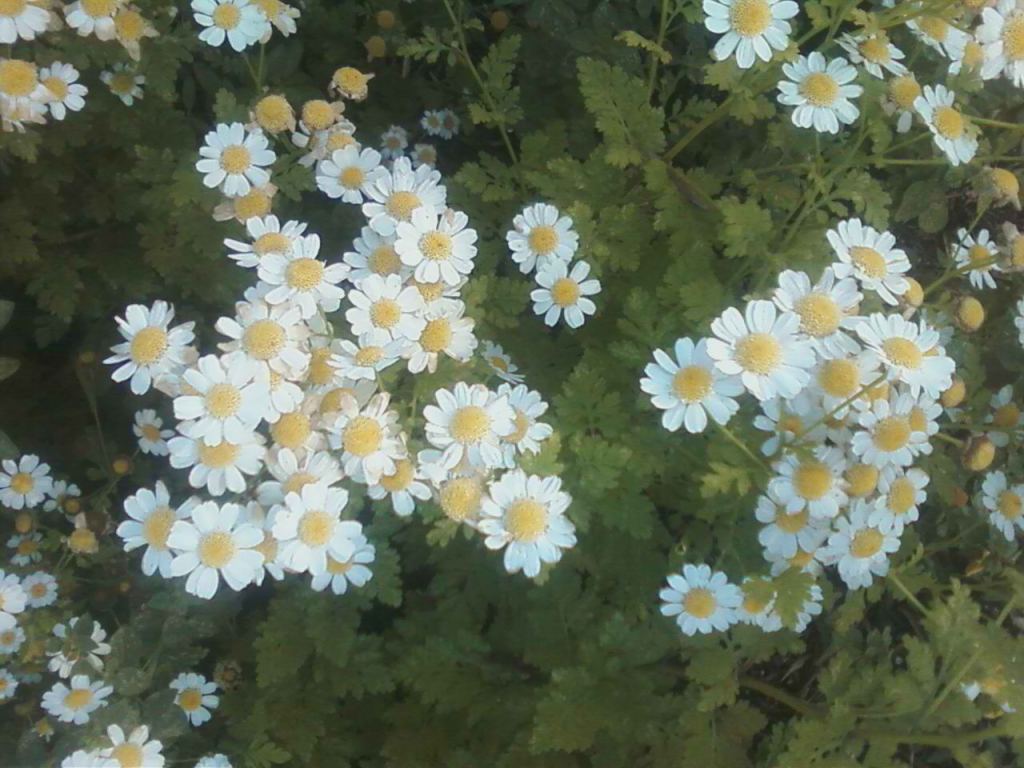
There are not many composite flowers that lack aromatic foliage. Daisies and chrysanthemums are actually objectionable to some. It is a wonder than there are insects that eat them! Feverfew and chamomile are instead appreciated for their aroma and flavor.
What color is this? It looks pink to me. A day earlier, though, it looked peachy orange. At various times last year and the year earlier, this same angel’s trumped bloomed more orangish orange, yellow and even white. I can not remember its schedule now, but I know that it has been weirdly variable. It is one of four cultivars of angel’s trumpet here, but the only one that will not decide on a color for its bloom.
One of the other four angel’s trumpets here blooms with double white flowers. My favorite, although relatively diminutive, blooms with single white flowers. The most vigorous is ‘Charles Grimaldi’, which blooms with single yellow flowers. A formerly fifth cultivar with big single pink flowers unfortunately rotted without replacements over winter a few years ago.
This particular angel’s trumpet grew from scrap that I took from a green waste pile at the curb of a job site in eastern San Jose several years ago. I took it because I found the pastel orange foliar color of the specimen that it was likely pruned from to be appealing. I had no idea that it would bloom with so many other comparably appealing floral colors.
Only riparian and aquatic vegetation tolerates sustained soil saturation. Chilean rhubarb, Gunnera tinctoria, almost qualifies as such. It enjoys such generous irrigation that it may perform well on a bank of a pond or stream. However, it should be sufficiently high on its bank to avoid constant saturation. Otherwise, it can rot, likely during its winter dormancy.
Chilean rhubarb is a spectacular foliar plants. Its humongous lobed leaves may grow six feet wide and eight feet tall. Although they succumb to mild frost, they regenerate quickly from rhizomes for spring. Leaves and petioles have a rather raspy texture, with small soft spines. Odd conical floral spikes that bloom about now might grow nearly three feet high.
Although not related to real rhubarb, Chilean rhubarb is as edible as its name implies. Its big petioles only need peeling to remove the raspy exteriors. Locally, Chilean rhubarb is more of a striking ornamental perennial. It is as appropriate to woodsy gardens as it is to sleek modern gardens. The absence of its bold foliage for winter is the main disincentive for its usage.
Only riparian species tolerate sustained saturation.
Irrigation must adapt to weather. It was unnecessary for exposed vegetation during rainy winter weather. It became necessary through drier spring weather. Now, it must adjust for increasingly warm and dry summer weather. This is not as simple as application of more water more frequently. Excessive irrigation causes soil saturation, which damages roots.
Soil saturation is unfortunately common within landscapes that gardeners maintain. The risk of desiccation is more of a concern to gardeners than wasteful irrigation. Desiccation is certainly more apparent than symptoms of saturation. Besides, gardeners assume the costs of neither water nor damaged vegetation. Chronic damage can become significant.
Soil saturation is less common within gardens that lack gardeners, but is not impossible. Soil within pots can become saturated if vigorous roots clog drainage holes. Water which lingers too long in saucers under pots maintains saturation. Irrigation that is too frequent, too generous or both maintains saturation. Of course, different soil types drain differently.
Soil saturation deprives roots of the aeration that they need to survive. A few species are somewhat tolerant of saturation, but fewer tolerate it for long. With few exceptions, newer roots avoid saturation, so disperse shallowly. For trees, this limits stability and increases their likelihood of displacing pavement. Even shrubbery might develop buttressing roots.
Roots that dispersed prior to saturation are vulnerable to rot as soil saturation increases. This not only destabilizes trees, but also compromises their health. Formerly healthy turf grass and ground cover become chlorotic. Some turf grass becomes infested with fungal pathogens, and perhaps moss. Flowers and fruits might shrivel before they develop fully.
It is impossible to prescribe ideal irrigation schedules and application rates for every site. Climate, soil type, slope, exposure and vegetation types are all considerations. Moisture requirements change seasonally and as vegetation matures. Only direct observation can help determine appropriate irrigation frequencies and rates. It is a very involved process.