It is difficult to document the lineages of the countless modern garden varieties that have been hybridized from ten species of Canna. Straight species that are popularly grown within their native ranges are rare here. Some species are grown for their thick edible rhizomes. Many are grown for edible foliage. Some are employed to absorb toxins from contaminated riparian environments.
Garden varieties that are popular here are grown merely for their aesthetic appeal. The lushly big leaves are typically rich green, but might be bronzed, dark purplish bronze, or striped with yellow, bronze, creamy white or peachy pink. Large varieties get taller than eight feet. Compact types stay less than three feet tall. All foliage dies to the ground after frost, and grows back fast in spring.
The flashiest parts of canna flowers are actually very specialized stamens known as staminodes, which mostly obscure the very subdued petals and sepals. Red, orange, yellow, pink, salmon or very pale yellowish white bloom may be spotted or blotched. Flowers might be thin and wispy, or rather floppy and lush. Canna are popularly known as canna lilies, but are not at all related to lilies.
Like something of bad science fiction, they are back. The earliest of spring bulbs that were so discourteously buried in shallow graves last autumn are making their presence known. Even before the weather gets noticeably warmer, their foliage emerges above the surface of the soil. Daffodil, narcissus, crocus and snowdrop are already blooming. Hyacinth, tulip and anemone will be next.
We know them as spring bulbs, or alternatively, as hardy bulbs. However, in this climate, many bloom through late winter, so are finished by spring. Also, many are technically not really bulbs. They might be corms, rhizomes, tubers or tuberous roots. They are hardy bulbs because they want to be planted through autumn so that they can get a bit of chill through winter before their early bloom.
Some spring bulbs require a bit more of a chill than they get in the locally mild climate. They bloom very well in their first season because they are pre-chilled before they are sold. Once dormant, they get dug and chilled in refrigeration to entice them to bloom well for subsequent seasons. That happens much later in the year though. For now, long before spring, we get to enjoy their bloom.
Summer bulbs, which are not so hardy, are what gets planted about now. Their planting is delayed, not just because they do not need chill, but also because they dislike it. If their foliage develops too early, it can be damaged by late frost. Once established, summer bulbs are more resilient to minor frost damage of premature foliage. They can therefore remain in the garden for many years.
Canna, dahlia and big old fashioned white calla are the simplest of summer bulb-like perennials to plant now. Those that are already established can be divided if crowded. The smaller and more colorful callas can be a bit more finicky. Gladiolus and various lilies are spectacular, but bloom only once annually, rather than throughout summer. They are also unlikely to establish as perennials.
Bulb-like perennials that bloom only once might be planted in phases to prolong their potentially brief bloom season.
Dragon fruit became a fad on the West Coast of California several years ago. They were probably always around, but had previously been rare. When they inexplicably became more popular and common, they did so down south first. Their popularity migrated to the Santa Clara Valley a few years later. It probably will not go much farther though, since they are sensitive to frost.
It is not a bad fad, at least relative to most others. Dragon fruit, which is also known as pitaya, happens to be very easy to grow and propagate from cuttings. Locally, it needs protection from frost, but no more than other popular tropical plants. It recovers from minor frost damage quite efficiently. Pruning scraps can be rooted and grown as more plants for friends and neighbors.
Of course, I dislike fads. I am not impressed by the fruit, which might lack flavor here where the weather does not stay very warm for very long through summer. The coarsely textured and floppy plants get big and awkward. They are typically trained up onto posts from which their many long stems hang downward. An exemplary specimen looks like Sigmund the Sea Monster.
This is a fad that I dislike enough to try. I want to see what all the fuss is about. These are my first two cuttings. The upper cutting produces red fruit. The lower cutting that is marked with a line to show how deeply it should be stuck into rooting medium produces white fruit. I will know where to release them into the landscape by the time they develop roots and start to grow.
This is so shameful that I probably should not be writing about it. Oh well. Perhaps in a few months, I will write about how these cuttings will be progressing.
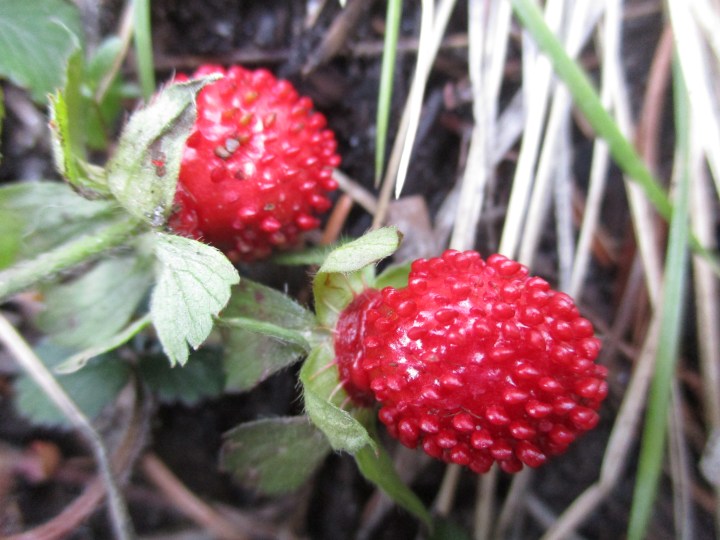
Under a bank of carpet roses that I am none too keen on, this grubby ground cover competes with more aggressive weeds. To me, it looks like common mock strawberry, Potentilla indica. I never gave it much though. It seemed to me that whoever had installed cheap and common carpet roses on that bank would have employed a comparably cheap and common ground cover.
The ground cover was more prolific in open spots that were too narrow for more of the roses, and from there, seemed to have migrated under the roses as a second layer of ground cover. It would not have been installed underneath intentionally. It did not occur to me that it may have grown from seed like so many other weeds there, or migrated in from the surrounding forest.
The white flowers did catch my attention though. I was not aware of a mock strawberry that bloomed with white flowers. I really was not concerned enough about it to investigate. This part of the landscape will be getting renovated soon anyway. The roses will be relocated to where they can not extend their thorny canes into an adjacent walkway. Agapanthus will replace them.
Now that I am seeing more of these odd strawberries, I am wondering if this low ground cover that I formerly had no regard for is actually the native wild strawberry, Fragaria californica. Not only should mock strawberry bloom with yellow flowers, but it should also produce more spherical berries. Now I will need to identify it before I either dispose of it, or merely relocate it.
I prefer to not salvage exotic species that exhibit potential to naturalize from landscaped areas into surrounding forests. If this ground cover is wild strawberry, it migrated from surrounding forests into a particular casually landscaped area.
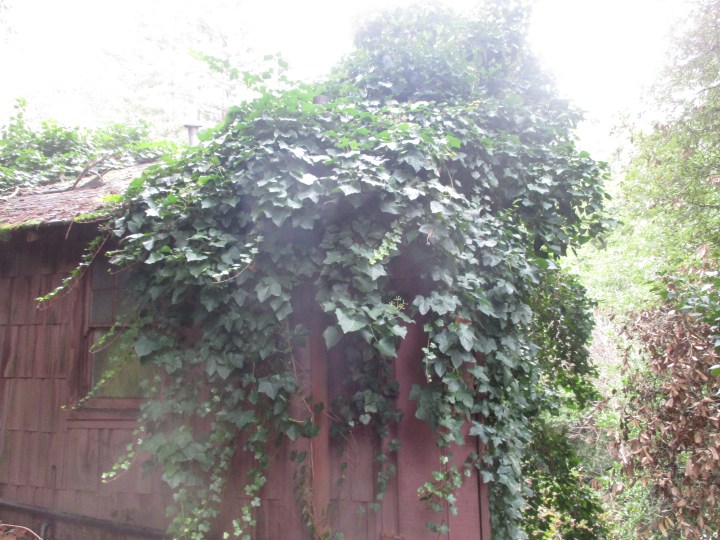
Poison ivy is not native here. Neither is English ivy. However, English ivy, Hedera helix, is an aggressively naturalized exotic species. Even after it had been designated as a voracious weed in the region, it was installed in some of the landscapes here many years ago. It is so common here now that we know it simply as the standard ‘ivy’. Algerian ivy was planted too, but it is not quite so aggressive.
1. English ivy grew up and over this abandoned building, and accelerated the deterioration of the old roof. It would be pointless to remove it now. The building will eventually be demolished.
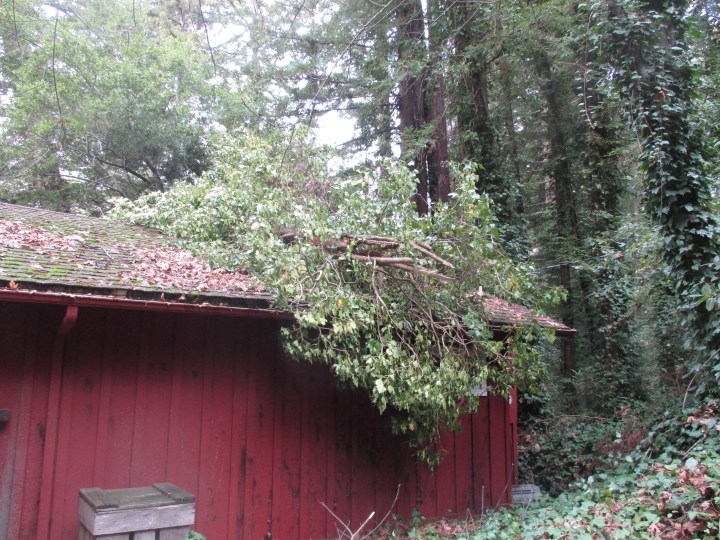
2. This building is not abandoned. No ivy was on this roof just a few days earlier. All this ivy did not grow up and over the building this aggressively since then, but fell from above. Surprise!
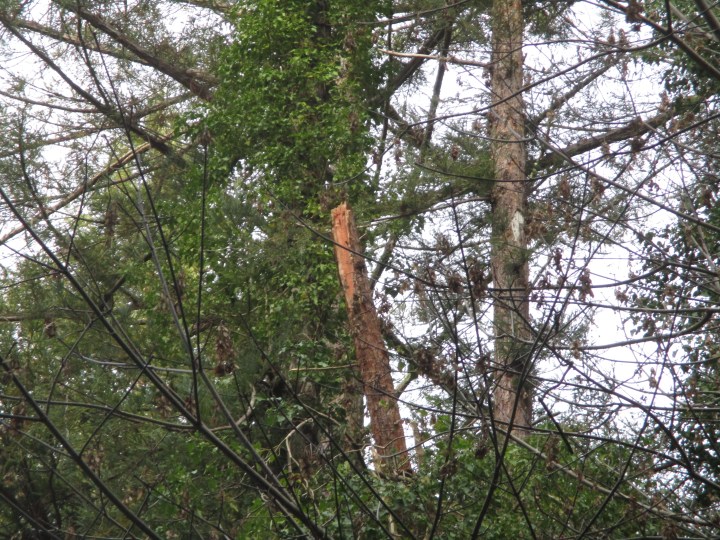
3. The yellow pointer shows where the dead redwood trunk that supported all the ivy broke and dropped the whole mess onto the roof at the bottom of the picture. It is about thirty feet up!
4. What a mess! This close up of the same broken dead redwood trunk shows another dead redwood trunk to the right, and a viable trunk with another dense ivy thicket in the background.
5. Surprisingly, this is the worst of the damage. It was likely impaled by the rotten redwood trunk. The ivy likely stayed connected to the rest of the thicket long enough to slow the descent.
6. Even after getting Ginsu with saws and shears, and getting bounce-house with debris, the pulpy redwood trunk and ivy was still a full load. That was a lot of weight to land on an old roof!
This is the link for Six on Saturday, for anyone else who would like to participate:
The deeply colored foliage of black mondo grass, Ophiopogon planiscapus ‘Nigrescens’, is about as convincingly ‘black’ as foliage can get. It is darker than bronze New Zealand flax, purple leaf plum or bronze coral bells. Only purple beech or chocolate coleus are comparable. The foliage is dark enough to contrast very well against lightly colored planters or gray concrete, so works well in urns or mixed perennials, and bordering walkways. If it gets enough sunlight, black mondo grass makes a nice small scale ground cover under Japanese maples.
Mature plants stand only about half a foot tall, and spread slowly. The happiest plants can get nearly twice as tall. The softly cascading leaves are only about a quarter inch wide. Small spikes of tiny pink flowers that sometimes bloom in summer would contrast nicely against the dark foliage, but are rarely seen above the foliage. Black mondo grass prefers rather rich soil and somewhat regular watering. However, as they disperse roots, older plants do not seem to mind too much if they briefly get a bit dry.
The easiest way to propagate new fig trees may seem to be violent, but it works. Basal shoots that grew last year from the roots near the trunks of ungrafted trees can simply be torn out of the ground with as many attached roots as possible. These shoots can then be planted directly wherever new trees are desired, and watered in. Larger shoots may need to be dug out, and might do better if pruned down to just a foot or two tall when planted. Smaller shoots can be potted to grow through next summer, and then get planted in the ground next winter.
Tearing the shoots off in this unpleasant manner is effective for two reasons. It gets the most roots for the shoots to help the grow into new trees. It also removes more of the burl growth that produces the shoots than simply cutting the shoots neatly. Even if copies of the original tree are not desired, the basal shoots must be removed anyway. Simply pruning them away leaves more burl growth so that more shoots grow back next summer. Ideally, well maintained trees should actually not produce basal shoots.
Fig trees are innately easy to grow from basal shoots or cuttings while dormant through winter. Basal shoots, even those that get pulled without any obvious roots, will develop roots more efficiently than stem cuttings that were never in contact with the soil. However, if no basal shoots are available, stem cutting work just fine. Furthermore, grafted trees (which are quite rare) can only be copied by cuttings from above the graft. Basal shoots from below the graft will only produce copies of the understock.
Just as unwanted basal shoots and cuttings from pruning scraps can be grown into fig trees, overgrown perennials in need of thinning can be divided to propagate more of the same. Lily of the Nile, red hot poker, daylily, mondo grass, African iris, terrestrial yuccas, some ferns and some grasses are not only easy to propagate by division through winter, but many perform better if divided every few years or so, before they get too crowded. The common giant yucca develops big trunks instead of clumping shoots, but can be propagated just as easily from big cuttings.
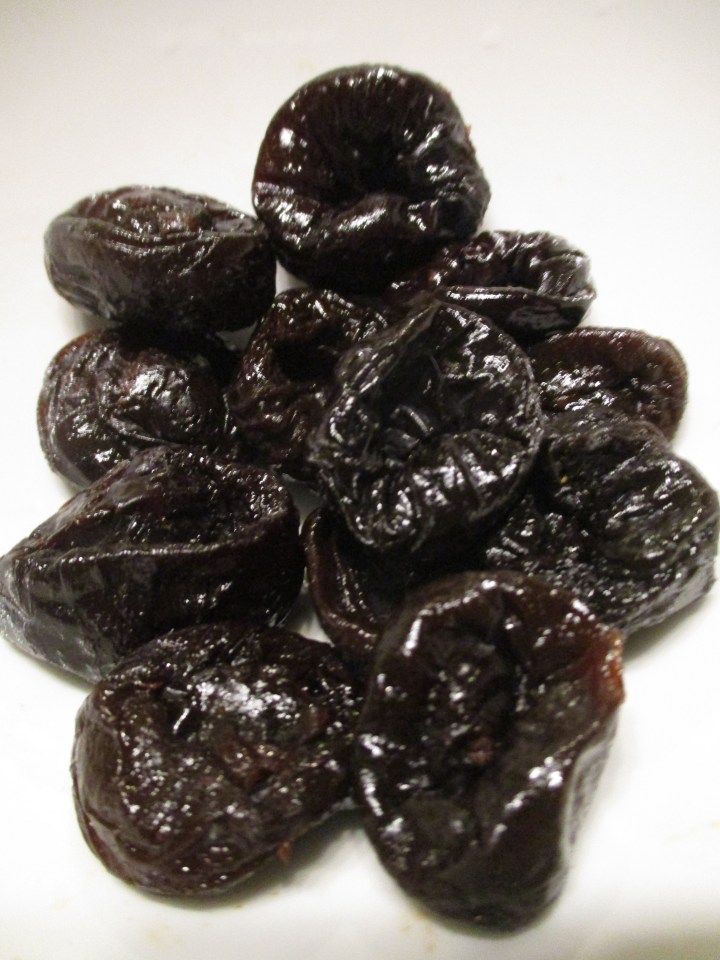
Dried prunes are experiencing something of an identity crisis.
Nomenclature used to be more predictably standardized than it is now. When I write about how it works, I compare it to the names of cars. For example, ‘General Motors’ is just a family. ‘Buick’ is a genus. ‘Electra’ is a species. ‘Limited’ is a variety. Well, my Sebring was labeled as a Chyrsler but made by Mercedes Benz. Modern horticultural nomenclature is no more accurate.
With all the promiscuity going on nowadays, it is impossible to know who the parent of some of our favorite plants are. Many are interspecific hybrids. Some are intergeneric hybrids. Some are so complicated that their species names are merely omitted; and no one seems to notice! That is like driving a Mercury LS without knowing or caring if it is a Grand Marquis or a Lynx.
So, now we can grow such aberrations of traditional stone fruit as as aprium, apriplum, pluot, plumcot, nectaplum, pluerry and peacotum. The first half of the names supposedly indicate who the promiscuous maternal parent is. The second half refers to the male pollinator. Parents who contributed fewer letters to the name were supposedly already hybridized prior to breeding.
For example, an apricot pollinated by a plum creates an aprium; and an aprium pollinated by a plum creates an apriplum. The apriplum gets an extra letter from plum ancestry because it is %75 plum and %25 apricot. A plum pollinated by an apricot creates a pluot; and a plum pollinated by a pluot creates a plumcot. There are, of course, many other complicating combinations.
Sure, the resulting fruit is very good; but is it any better than what it was bred from? If everyone could have tasted the simple, traditional and exemplary stone fruits that formerly grew in the vast orchards of the Santa Clara Valley, there would be no need for all this hooey. Besides, why is there all this interest in creating new and weird fruit while eliminating some of the old?
Prunes and plums, as I explained earlier, are two distinct types of fruits. Japanese plums are the richly flavored and typically more brightly colored fruits that were more popular in home gardens than in orchards, since they are not easy to transport. European prunes are the sweeter but mildly flavored freestone fruits that grew in orchards, generally for drying and canning.
Apparently, the name of ‘prunes’ was not appealing enough . . . or was actually considered to be unappealing. Almost twenty years ago, prunes were consequently reclassified as plums. Dried prunes are now known as dried plums, as if they are dried versions of the classic ‘Santa Rosa’ plums that so many of us grow in our home gardens. Some of them just might be! Who knows?!
Plum juice could be extracted from Japanese plums, which actually make excellently rich juice, but is more likely from fresh (not dried) French or Italian prunes. However, there is still such a beverage that is known as prune juice. It is extracted from, of all things, rehydrated dried plums . . . or dried prunes. These unfortunate fruits get dehydrated, rehydrated, and then juiced!
The juice of rehydraded dehydrated plums or prunes might be the only remaining application of the word ‘prune’. At least it is useful for that; in the sense that it designates the source of the juice as rehydrated dehydrated fruit of some sort, rather than fresh fruit of some sort. Whether such fruit is a plum or what was formerly known as a prune remains something of a mystery.
Most of us know what oranges are. The color is, of course, orange. They are very juicy and sweet. Cultivars that are most popular for eating fresh, particularly ‘navel’ oranges, are easy to peel and separate into segments. Those that are best for juicing, such as ‘Valencia’, are a bit smaller with thinner rind, so are a bit sloppier to peel and separate. Such ‘sweet’ oranges are Citrus sinensis.
Richly tangy blood oranges are of the same species, but have blushed or deep red pulp and juice. ‘Sanguinelli’, although rare here, is nonetheless the most popular of the blood oranges, and is a traditional citrus component of sangria. The juicy fruit is compact, with tightly fitting thin skin, comparable to that of ‘Valencia’. Rarer ‘Moro’ produces plumper fruit that is easy to peel and eat fresh.
Sour and bitter oranges, which are very rare here, are mostly Citrus auranticum. Sour oranges, such as ‘Seville’, are used for marmalades and confections. Bitter oranges are used for flavorings and fragrances, such as ‘Bergamot’ for Earl Grey tea. Both bitter and sour oranges were less rare a century ago, when some were appreciated for alluringly fragrant bloom and handsome foliage.
Citrus seem like such summery fruits. Chilled lemonade and lemon meringue pie are best during warm weather. There are certainly plenty of lemons that ripen randomly throughout the year, and plenty that last for months on their trees. Most limes, some grapefruits and ‘Valencia’ oranges will be around in summer too. Otherwise, most citrus are at their best right about now, through winter.
Mandarin oranges are traditional ingredients of well stuffed Christmas stockings. Where winters are cold and snowy, far from where they grow, they seem contrary to their natural ripening season.
Of all the citrus, they are the most perishable, so are best as they ripen. Their loosely fitting skins, that are so easy to peel, allow them to oxidize and dehydrate more readily than other citrus fruits.
Tangerines are just Mandarin oranges that were developed in North or South America. ‘Rangpur’ limes are actually sour Mandarin oranges that are somewhat less perishable because their skins happen to fit more firmly. Calamondins, which are odd but likely natural hybrids of Mandarin oranges and kumquats, are diminutive tangy fruits that do not last much longer than Mandarin oranges.
‘Bearss’ limes are preferably harvested right as they grow to mature size, but just before they ripen completely. Their flavor mellows as they ripen and yellow. Fortunately, they develop sporadically through an extensive season, so can be available any time fresh limes are desired. Grapefruits can be left intentionally to mellow on their trees after ripening, although this tactic can inhibit bloom.
Otherwise, many citrus fruits can last for more than three months on their trees without consequence. Some improve with mellowing. ‘Meyer’ lemons, which are a hybrid of an orange and a lemon, ripen like richly flavored lemons, and then mellow like very tart oranges. Since citrus fruits stop ripening when harvested, it is advisable to taste one before harvesting too many that are not ready.
Some ripened Mandarin oranges may have slight green blotches. ‘Valencia’ oranges may be slightly yellowish.