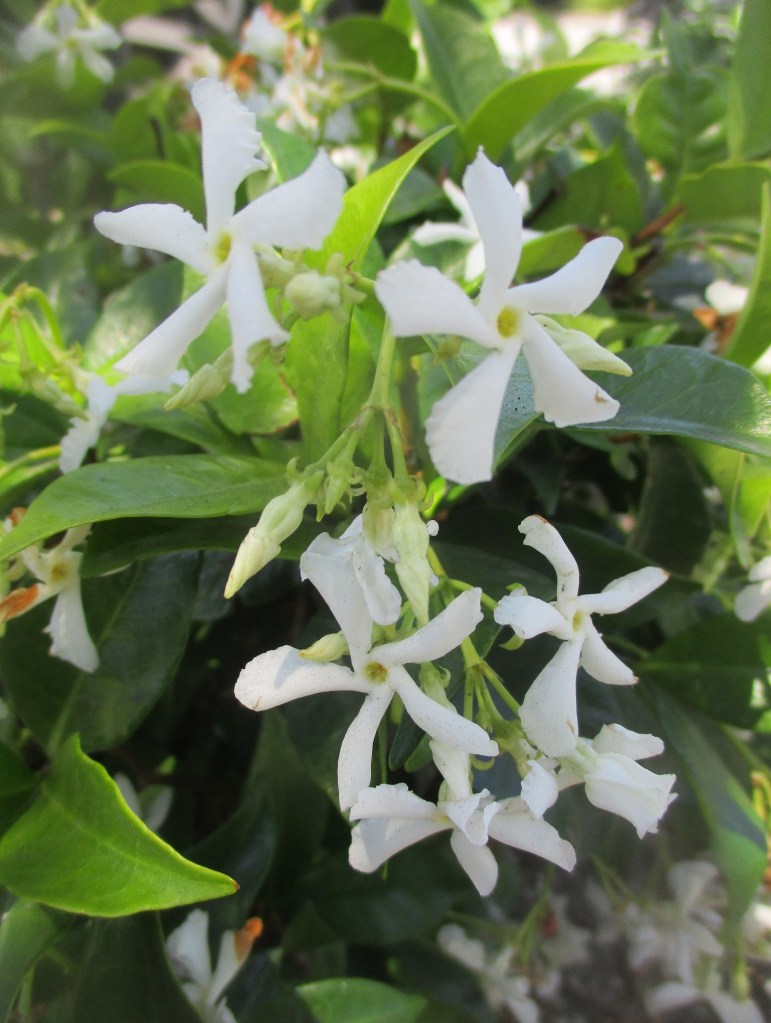
It is certainly a star within many gardens, but it is technically not a jasmine. Star jasmine, Trachelospermum jasminoides, is actually closely related to Plumeria. Its floral fragrance can be comparably rich with copious bloom, but is distinctly vanillish. Bloom is abundant for late spring and early summer. Sporadic bloom can start early and continue to autumn.
Without bloom, the distinctly glossy foliage is handsome alone. Individual leaves are not much longer than two inches, and not much wider than one. Their deep green foliar color and lustrous sheen almost seem artificial. Pruning or any disturbance of foliage or stems releases caustic and toxic sap. Twining vines ascend by wrapping around their supports.
Star jasmine can get two feet deep as a ground cover without support. It requires pruning to prevent it from overwhelming shrubbery or climbing into trees. It also requires frequent pruning around its edges. As a climbing vine, it grows fast to ten feet high, and can grow much higher a bit slower. It can become a neatly shorn faux hedge on a chain link fence.
Dormant pruning last winter did more than concentrate resources for flowers and fruits. It did more than eliminate superfluous growth, which many pathogens overwinter in. It also directed or concentrated resources for stems and foliage. Such growth now grows faster than some types of insect infestation. Aphid, though, are famously prolific and tenacious.
Hybrid tea roses very effectively demonstrate the advantages of dormant pruning. Those that lacked such pruning are more vulnerable to major aphid infestation now. Those that benefit from such pruning are significantly less vulnerable. Even with minor infestations, they may bloom well. Their vigorous stems grow at least as fast as aphid can proliferate.
It is too late for dormant pruning now. Furthermore, this is the beginning of aphid season. It continues until early autumn. Fortunately, aphid are usually not problematic for too long on the same hosts. Their natural predators often find and control them as their infestation culminates. They might continue to be present, but at a tolerable or unnoticeable degree.
Insecticides can be useful for severe infestation, but can interfere with natural processes. Some eliminate predatory insects that can naturally control aphid. If possible, it might be more practical to literally allow nature to take its course. Aphid are prolific, but essentially weak. Mildly soapy water kills them fast without killing many beneficial predatory insects.
Ants symbiotically cultivate aphid in exchange for their honeydew, (which is excrement). They protect their benefactors, and move them to ideal host material. Pruning citrus trees so that they touch nothing else can nearly block access to ants. Application of a barrier to their trunks, such as grease, blocks access more completely. Predatory insects still fly in.
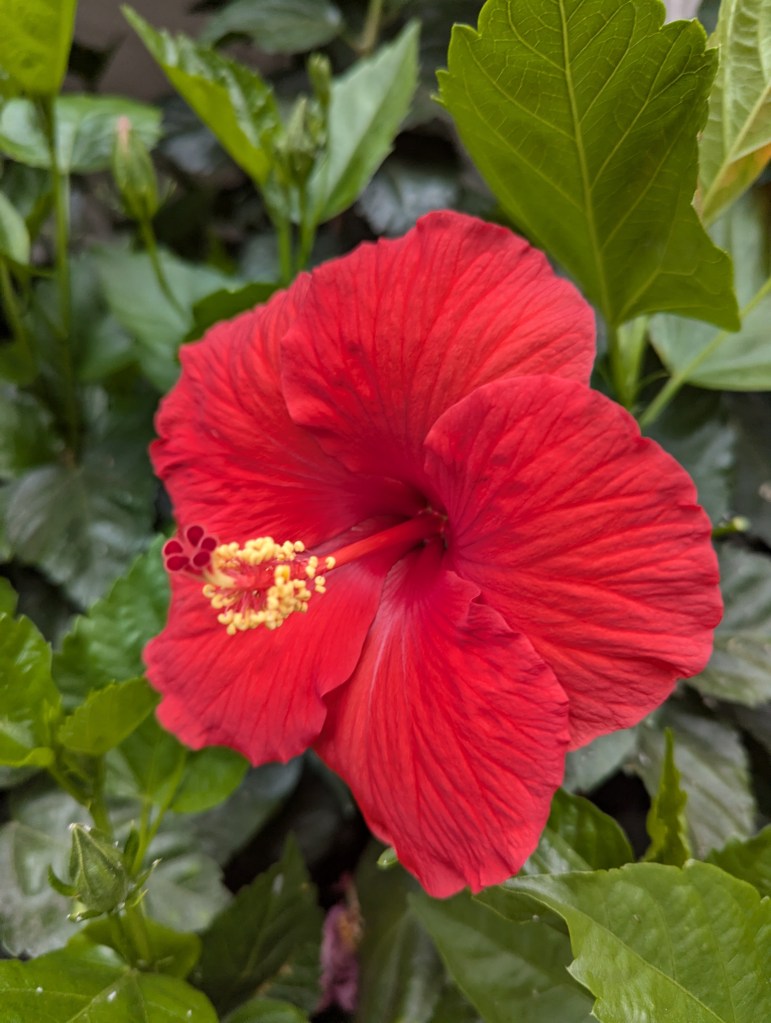
This technique is practical for many small trees, but not low shrubby roses and hibiscus. For them, aphid might be easy to blast off with a spray nozzle on a hose. This procedure neither removes nor kills all aphid, but it can limit their damage. Repetition of the process will likely be needed a few days later, and maybe a few times. Aphid might be persistent, though.
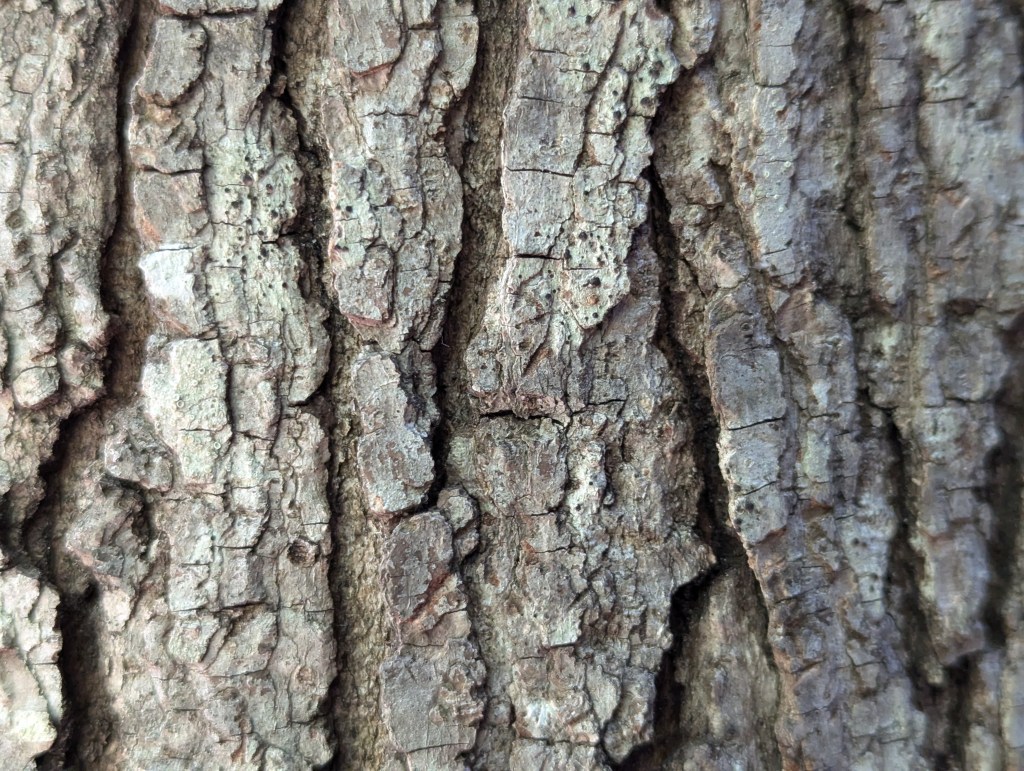
Bark was actually not Rhody’s suggestion. It was simply a convenient theme while it was difficult for me to get out to take other pictures. These are six trees that I worked around yesterday. I could recycle this theme for native species.
1. Sequoia sempervirens, coastal redwood is the Official State Tree of California, and the tallest tree species in the World. Although native, this particular specimen was grown in a nursery, and is the cultivar ‘Soquel’. It was installed into its landscape likely after 1989.
2. Metasequoia glyptostroboides, dawn redwood is the only of three species of redwood that is not native to California. It is also the only deciduous redwood. Sequoia gigantea, giant redwood, is also represented by a young tree, but I did not get a picture of its bark.
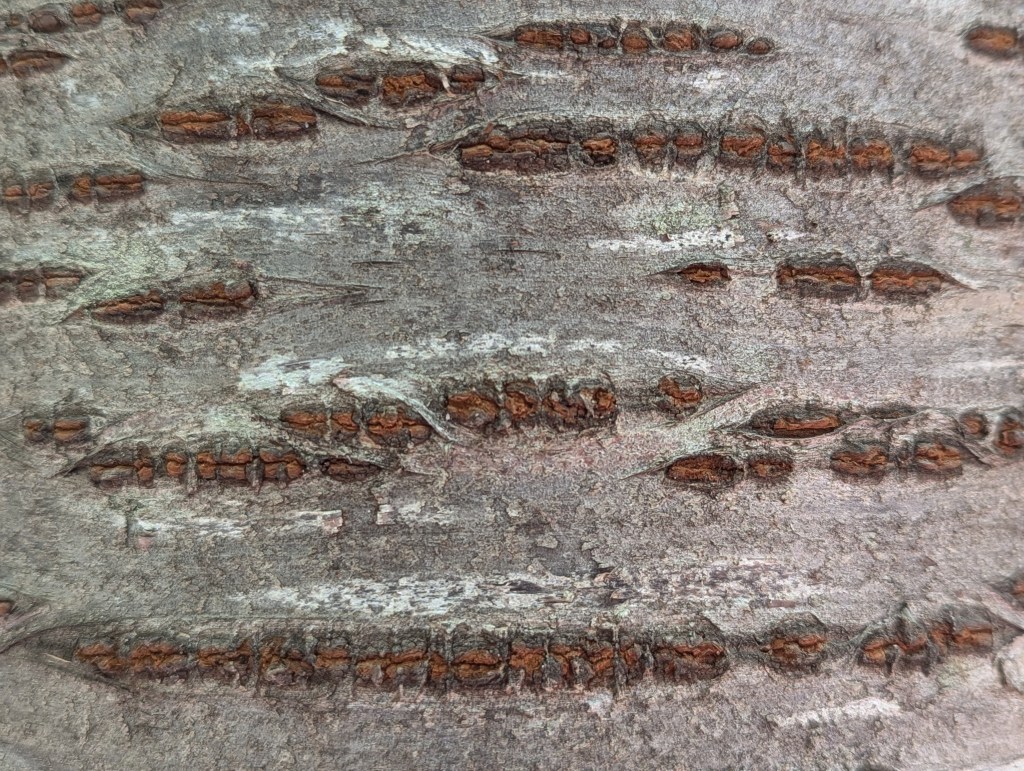
3. Prunus serrulata, flowering cherry seems to be the cultivar ‘Kwanzan’. Perhaps shade from surrounding redwoods, birches, sweetgums and dogwoods interfere with its bloom profusion. Individual flowers are a bit smaller than they should be for typical ‘Kwanzan’.
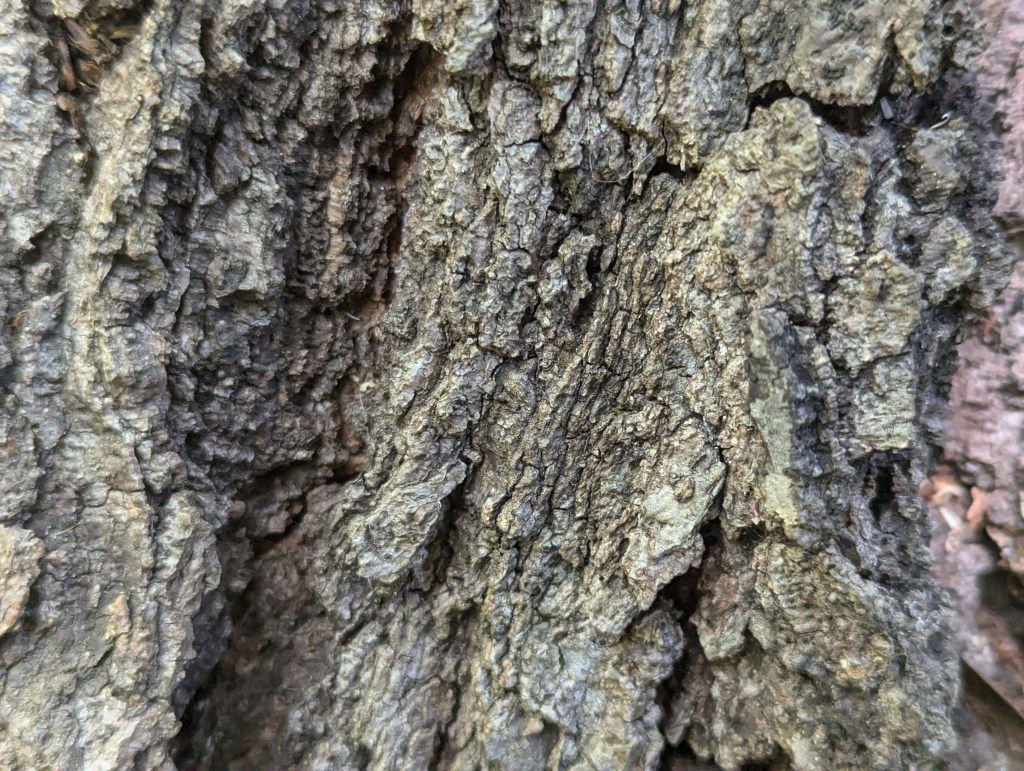
4. Betula pendula, European white birch has distinctly white bark, but also exhibits dark brown or black furrowed bark at the bases of large trunks. I tried to take pictures of both for contrast, but the white bark seemed too gray. I could have gotten both in one picture.
5. Liquidambar styraciflua, sweetgum bark goes through different phases as it matures. Young twigs initially exhibit smooth bark. Then, their smooth bark develops corky wings that grow as the stems grow. Somehow, mature bark shows no evidence of former wings.
6. Cornus florida, flowering dogwood is supposedly easy to identify by its ruff bark. I do not get it, though. Of these Six, only flowering cherry has more finely textured bark. This particular tree does not bloom so well, but produces spectacular foliar color for autumn.
Meriwether Lewis of the Lewis and Clark Expedition encountered the western native mock orange, Philadelphus lewisii, in 1806, and gave it his own name. It inhabits an extensive range that reaches from the northern Sierra Nevada to southern British Columbia to western Montana, but is somewhat sporadic within its natural range. It is the state flower of Idaho, and is commonly planted in state, national and even some county parks within its range and throughout the rest of California.
Partial shade is not a problem for mock orange, but full sun exposure promotes more abundant bloom. The simple, strikingly white flowers that bloom in spring are less than two inches wide with only four petals. However, their remarkably rich orange fragrance is unexpectedly powerful. The two inch long, forest green, deciduous leaves on arching limber stems are a nice backdrop. ‘Goose Creek’ has double flowers.
Because regular pruning or shearing of outer growth inhibits bloom and compromises natural form, mock orange is best where it has plenty of space to grow wild, or at least where the upper canopy can spread out naturally if the lower canopy gets pruned away to form a small tree with multiple trunks. After bloom, older deteriorating stems can be pruned out, to favor newer stems emerging from the base. Overgrown plants can be cut to the ground in winter, and will regenerate over the following summer to bloom in the second spring. Mature mock orange gets nearly ten feet tall and broad.
Back before gardening was cheapened to the degree that it is now, and before most of everything within reach was shorn into submission, many plants were pruned, or not pruned, as necessary to enhance their naturally appealing characteristics. New Zealand flax got planted where it had room to reach out, and only got ‘plucked’ as shoots ventured too far from the center. Lily-of-the-Nile got ‘chopped’ where it crept too far, and ‘thinned’ where it got too crowded to bloom.
Only hedges were shorn; and they were shorn properly, to be slightly narrower on top. Trees actually grew as trees above, and got pruned for clearance below. Vines were selectively groomed, but allowed to climb their trellises. Deciduous fruit trees got the specialized pruning that they require in winter.
Many different kinds of plants that produce generally vertical stems from the base were maintained by a pruning technique known as ‘alternating canes’. This procedure is almost opposite of removing watersprouts or suckers (watersprouts that develop below a graft union) to favor a primary stem. It is actually the removal of primary stems as they get replaced by their own basal watersprouts.
For example, glossy abelia is naturally rather limber with upright growth that spreads outward. Without pruning, it can become an overgrown mounding thicket. However, shearing deprives it of its naturally appealing form, and interferes with bloom. Instead, the technique of alternating canes removes older canes as they begin to deteriorate, allowing new canes to grow more vigorously, arching gracefully outward from the center.
Elderberries and pomegranates may not actually require regular pruning, but are easier to manage if some basal stems are allowed to mature and replace tall and awkward older trunks. The newer growth is more productive (after the first year), easier to reach, and simply looks better. Alternating canes also promotes bloom while preventing thicket growth of mock orange and lilac, particularly since they produce such abundant basal growth.
Heavenly bamboo (Nandina spp.) and real bamboo are two completely different and unrelated plants that both benefit from alternating canes. Heavenly bamboo likes to get its deteriorating or floppy older stems cut to the ground, to allow more space for fresh new foliage to unfurl. Bamboo simply needs old canes cut out as they die.
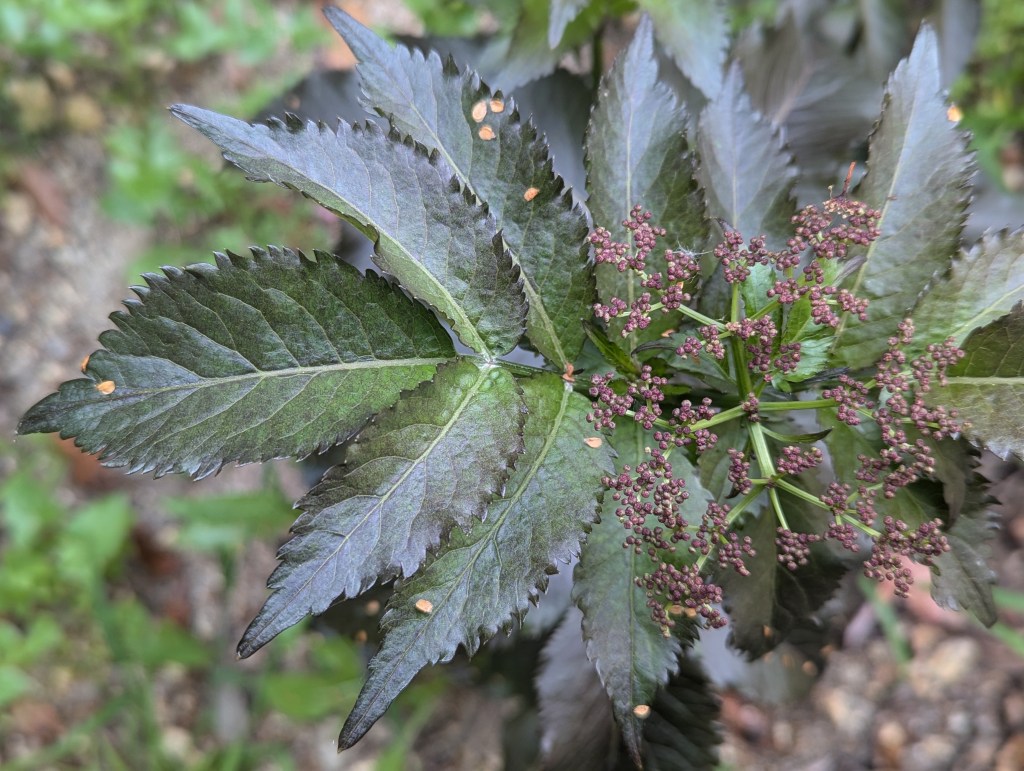
‘Black Tower’ European black elderberry is not very black yet.
Perhaps my explanation of the elderberry glut here was a bit brief last Saturday. Allow me to explain.
Sambucus caerulea, blue elderberry is native and grows wild here, so was innately the first on the scene.
Sambucus nigra ‘Black Lace’ European black elderberry arrived next. I do not know who procured it or why, but it was left here in a can before my time. I put it into a landscape just to get it out of the storage nursery. In other words, I was none too keen on it, so I just wanted to make it go away. Instead, because it was so popular with those who saw it in the landscape, I learned to appreciate it. Then, I figured that it would be even more appealing if it produces berries for birds, so I sought a mate for it.
Sambucus nigra ‘Madonna’ European black elderberry was almost the perfect mate. I would have preferred ‘Albomarginata’, but did not want to pay for it. ‘Madonna’ in a #1 can was available for only a few dollars because it looked so shabby two winters ago.
Sambucus racemosa, red elderberry was a gift from Tangly Cottage Gardening shortly afterward. They were a group of four seedlings, so needed no mate for pollination. Although they are supposedly native here, I had never seen them before, but want to grow them.
Sambucus nigra ‘Albomarginata’, ‘Atropurpurea’ and ‘Black Tower’ European black elderberry, and Sambucus racemosa ‘Lemony Lace’ red elderberry unexpectedly became available for a few dollars each just last winter because, like ‘Madonna’ European black elderberry two years prior, they were shabby while dormant. Without a plan, I procured all of them. ‘Lemony Lace’ red elderberry, the only red elderberry of the four, could be pollinated by the red elderberries that already came from Tangly Cottage Gardening. As I mentioned, ‘Albomarginata’ was the cultivar that I would have preferred to ‘Madonna’ that I procured earlier.
Sambucus canadensis ‘Nova’ and ‘York’ American black elderberry were the last acquisitions at the end of bare root season last winter. They are for fruit production in my home garden.
I would have been pleased with only ‘Black Lace’ and one other pollinator cultivar for it within the landscapes at work. For my home garden, I wanted only blue elderberry, red elderberry and American black elderberry. I would have preferred wild American black elderberry, but can not complain about the cultivars that I got. Collectively, we got much more than we bargained for.
Even for some understory species, shade can inhibit bloom. For Hosta, that would not be much of a problem. Its late summer bloom is merely an added bonus to its lushly colorful foliage. Actually, the foliage is more appealing without its tall floral spikes. Such bloom is prettier in a vase anyway. The hanging white or lavender flowers are an inch or two long.
Where summer weather is cooler, some Hosta can grow three feet tall and twice as wide. Locally, only a few of the largest cultivars can grow as wide as three feet during summer. Then, they defoliate by winter. Most have broadly rounded leaves, but a few have narrow or wavy leaves. Many have paler green, yellow or white variegation, or glaucous foliage.
Hosta is uncommon here, probably because it may be somewhat demanding. It requires very regular watering to avoid desiccation. It craves organically rich soil or potting media. Fertilizer can enhance lushness, but can burn foliage if just slightly excessive. Slugs and snails can ruin foliage. However, Hosta are understory plants that tolerate a bit of shade.
Shade influences every ecosystem. Where it is scarce, some vegetation adapts to harsh exposure to sunlight. Some develops glaucous foliar color to reflect some of the sunlight. Some develops tomentum, or foliar fuzz, to shade its foliar surfaces below. Where shade is abundant, understory vegetation adapts as efficiently. Essentially, it is made for shade.
Understory vegetation naturally grows beneath larger trees and shrubbery. It is therefore more tolerant of partial shade. Some tolerates significant shade. Ferns that inhabit forest floors beneath shady redwood trees are notable examples. So are most houseplants that originated from tropical rainforest. Naturally, most live in the shade of bigger forest trees.
Not all understory vegetation is diminutive. Some Japanese maple trees can grow rather large. However, they naturally inhabit forests of trees that grow larger. Some palms begin as understory vegetation to become the tallest trees of their gardens. Their foliage simply adapts as it becomes more exposed. Banana and tree fern foliage might adapt similarly.
Such adaptation is an advantage now that home gardens are becoming shadier. Modern homes are taller, so produce bigger shadows than older homes. They are closer to other tall homes with comparable shadows. Fences are higher to compensate for the proximity of homes. Garden spaces are more compact, with less space that is not partially shaded.
No vegetation survives without sunlight. Understory vegetation is simply more tolerant of partial shade than most other sorts. It is adapted to it, just as some vegetation is adapted to extreme exposure. Generally, understory vegetation is deep green, to absorb as much sunlight as possible. For the same reason, individual leaves are typically large and lush.
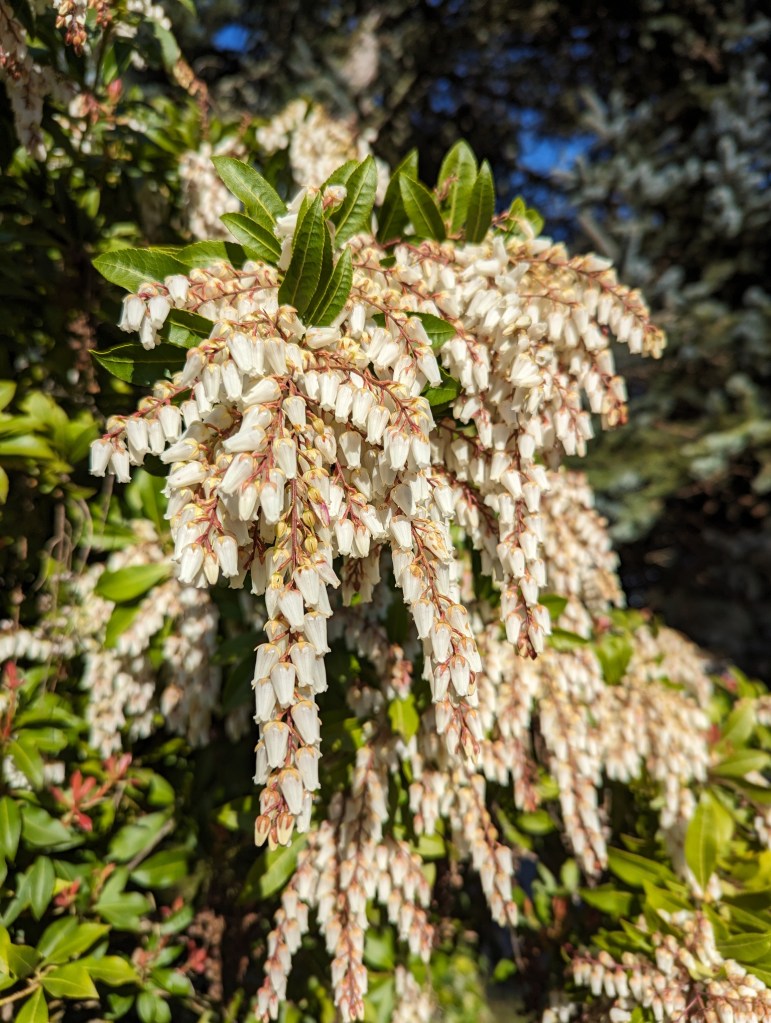
Cast iron plant seems to tolerate more shade than any other understory vegetation. Kaffir lily and hosta tolerate almost as much shade as some ferns. Rhododendron, azalea and andromeda prefer only partial shade. Excessive shade inhibits bloom. The same applies to camellia and hydrangea. Realistically, all species of understory vegetation are unique. Each tolerates a particular degree of shade that it is adapted to.






 Tony Tomeo