Only four species of Iris are native here. The problem with identifying them is that three of them can be visually similar. Only Iris douglasiana is reliably and distinctively blue. Iris longipetala and Iris macrosiphon are generally pale blue, but can be as pale white with pale yellow veins as Iris fernaldii. Without keying it out, I can only guess that this particular iris is Iris fernaldii. The others seem to develop slightly larger and denser herds with slightly more upright foliage. Iris fernaldii develops relatively smaller herds and more relaxed foliage that does not stand as upright. Even what seems to be large herds are typically groups of smaller herds. Their flowers can lay almost on the ground. they shrivel too soon after cutting to work well as cut flowers. Nonetheless, they are a delightful native wildflower that is blooming as freely as it can where it grows wild. I really should relocate those that grow where they are not wanted, rather than discard them with other weeds. They might compete with weeds and other less visually appealing naturalized vegetation within areas that are not landscaped. Actually, they might be appropriate for a few areas that are casually landscaped.
English lavender is likely the most common of this genus, with the most cultivars. French lavender is the primary culinary species. Spanish lavender, Lavandula stoechas, should likely be more popular than it is. All lavenders live for only a few years. Spanish lavender is more likely to self sow to replace itself, though. It can naturalize in favorable situations.
Spanish lavender is an evergreen shrub of irregular form, that grows as tall as three feet. Its finely textured foliage is grayish or drab green. Individual leaves are quite narrow and only about half an inch to an inch and a half long. Roots are not finicky about soil, but are likely to rot if irrigation is generous. Spanish lavender prefers warm and sunny exposure.
Bloom begins as soon as weather warms in spring and continues into summer. Sparsely sporadic bloom can continue until autumn. Dense floral spikes stand several inches over their foliage, on bare stems. They would not be very colorful if not for their few long upper bracts. Bloom is typically lavender, but may be bluish lavender, pink or very rarely white. It delights bees.
Floral fragrance attracts insect pollinators. Foliar aroma repels insect pathogens. It might repel other herbivores also. For organisms that lack olfactory perception, plants certainly make productive use of it. Fragrant flowers are as attractive in home gardens as they are to pollinators in the wild. However, aromatic foliage has the opposite of intended effects.
In other words, aromatic foliage is popular within home gardens because of its aroma. Its effort to be repulsive to some insects and herbivores makes it attractive to people. Some aromatic foliage has culinary or herbal application. Actually, almost all herbs are notably aromatic, with corresponding flavors. Mint, chive, thyme and sage are popular examples.
Window boxes became popular in ancient European towns because of aromatic foliage. Where garden space was scarce, they were convenient planter boxes for growing herbs. Also, prior to window screens, they sustained aromatic foliage that repelled mosquitoes. Trailing rosemary, ivy geranium and nasturtium are still very traditional accompaniments.
Rosemary has both culinary and aesthetic application. Culinary cultivars exhibit the best flavor. Landscape cultivars are either trailing or more densely shrubby. Some cultivars of fennel are similarly better for either culinary or landscape application. Bronze fennel has become popular for both. Varied lavenders are more popular as home garden shrubbery.
Native bay is very aromatic when its foliage is disturbed, but is not culinary bay. It is a big and obtrusive tree that is proportionate only to large landscapes. Culinary bay is another smaller species that is more proportionate to home gardens. Also, it has a distinct aroma. Incense cedar is another very aromatic native tree, but is quite rare within home gardens.
Most aromatic foliage can not exude its aroma like fragrant flowers exude their fragrance. Most does so only when disturbed. Some, such as that of many conifers and eucalypti, is beyond reach. It is therefore easy to dismiss within some landscapes. Lavender, lantana, diosma, rockrose and salvia stay within reach. Warmth and humidity amplify their aroma.
Camellia japonica seems to be too diverse to be a single species. Several of its countless cultivars seem to be either other distinct species or hybrids of other species. Regardless, they are all products of selection and breeding from within their single species, which is why the camellia pictured below is the only one of these six without an “X” in the middle of its name. The other five are hybrids, and three are the same hybrid species. However, one commonality of all six is that their cultivars are unidentified. I guessed a cultivar for the rose in the past. Columbine grew from a feral seed of a hybrid parent that apparently was not particularly sterile.
1. Iris X pacifica, Pacific Coast iris are hybrids of various native species, although mostly Iris douglasiana. Different cultivars can have different ancestry. These are unidentified.
2. Rosa X hybrida, rose is also an unidentified hybrid of unidentified ancestry. It seems to be a floribunda rose, with a few secondary floral buds behind each primary floral bud.
3. Iris X pacifica, Pacific Coast iris is my favorite color, but is actually not my favorite of the cultivars here. Blue, purple and burgundy red are too velvety exquisite to not prefer.
4. Aquilegia X hybrida, columbine grew in an awkward location from the seed of others that did not want to grow where planted. It stayed because it is the only columbine here.
5. Iris X pacifica, Pacific Coast iris in yellow is a bit more colorful than the white cultivar but not as richly colorful as the others. Blue, purple and burgundy red are done already.
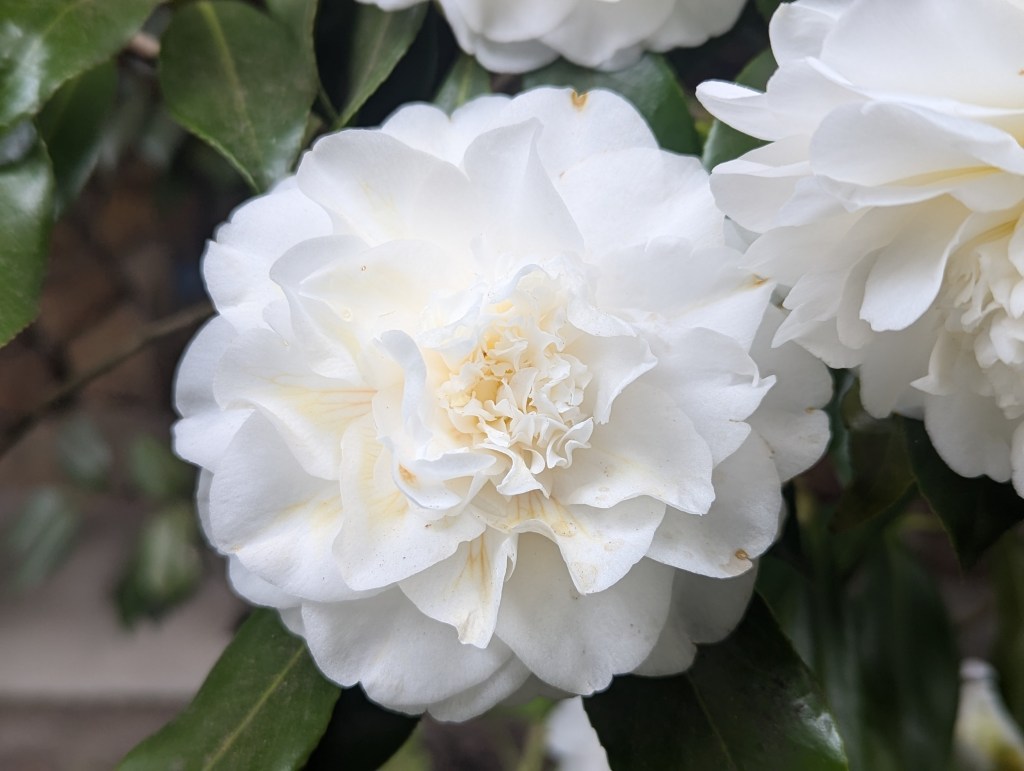
6. Camellia japonica, camellia is as unidentifiable as the other five of these six but is not an interspecific hybrid, which is why it lacks an “X” in the middle of the botanical name.
Pacific wax myrtle is the native version of bayberry.
From Washington to Southern California, the Pacific wax myrtle, Myrica californica, is native to coastal regions. It is the western counterpart to the bayberry, Myrica pen(n)sylvanica (or caroliniensis), of the East Coast. It makes a nice informal hedge with only occasional shearing, or an informal screen that only gets trimmed back when it gets too big. Mature plants can get nearly thirty feet tall in sheltered areas, but rarely get half as tall and wide, even if allowed to grow unimpeded. The glossy three inch long leaves are narrow with slightly undulate margins with small teeth.
Pacific wax myrtle functions something like glossy privet or some of the pittosporums that make good hedges, but is not so resilient to frequent shearing. Big stems that get cut back to not always produce new growth. The advantage of Pacific wax myrtle is that it is native, so does not want much water once established, so is happy in out of the way places that do not get watered or maintained. Like privets and pittosporums, Pacific wax myrtle can be pruned up as a small tree with multiple exposed trunks.
Like the many different kinds of physicians who work in a hospital, there are many different kinds of horticultural professionals who specialize in particular disciplines. Although too commonly considered to be ‘landscapers’, and even though many do not work directly with landscapes, there are nurserymen, gardeners, landscape architects, horticulturists and arborists, to name a few.
Arborists specialize in the horticulture of trees. Only a few decades ago, arborists were known as tree surgeons, since they perform surgery on trees. Of all the horticultural physicians that attend to concerns in the landscape, arborists and their associated technicians are the most qualified to properly maintain trees.
Expecting a gardener to maintain large mature trees is like expecting a pediatrician to perform major surgery. Even the most proficient and educated gardeners are too specialized with maintaining other plant material in the garden to also be specialized with arboriculture, or the horticulture of trees.
Arborists who are certified by the International Society of Arboriculture, or ISA, have successfully passed and examination of their arboricultural aptitude. Certification must be maintained by attendance to educational seminars, workshops and other relevant events approved by the ISA.
The website of the International Society of Arboriculture, or ISA, at www.isaarbor.com, is the best resource for finding certified arborists and the tree service establishments that they are affiliated with. Arborists can be found within particular regions by city or ZIP code, or identified directly by name or certification number.
The ‘Public Outreach’ category at the ISA website features links to www.TreesAreGood.org, and ‘Why hire an arborist?’, as well as a few other links for consumers. After all, the website exists not only for professionals, but also to help consumers find professionals and to make responsible decisions about their trees, from the time they get planted, throughout their lifetime, and until they get old and eventually need to be removed.
The www.TreesAreGood.org link has all sorts of information about trees and their maintenance. There are many and various articles about the benefits of trees, the value of trees, tree selection, planting new trees, proper pruning techniques, insects and diseases, tree hazards, why topping hurts trees, and even an article about palms. Incidentally, the Fun Facts link mentions that the tallest tree is the coastal redwood, the biggest tree is the giant redwood, and oldest tree is the bristlecone pine, all of which are native to California.
Trees are of course the most substantial components of a landscape. Some will be around for years. Some will be around for more than a century!
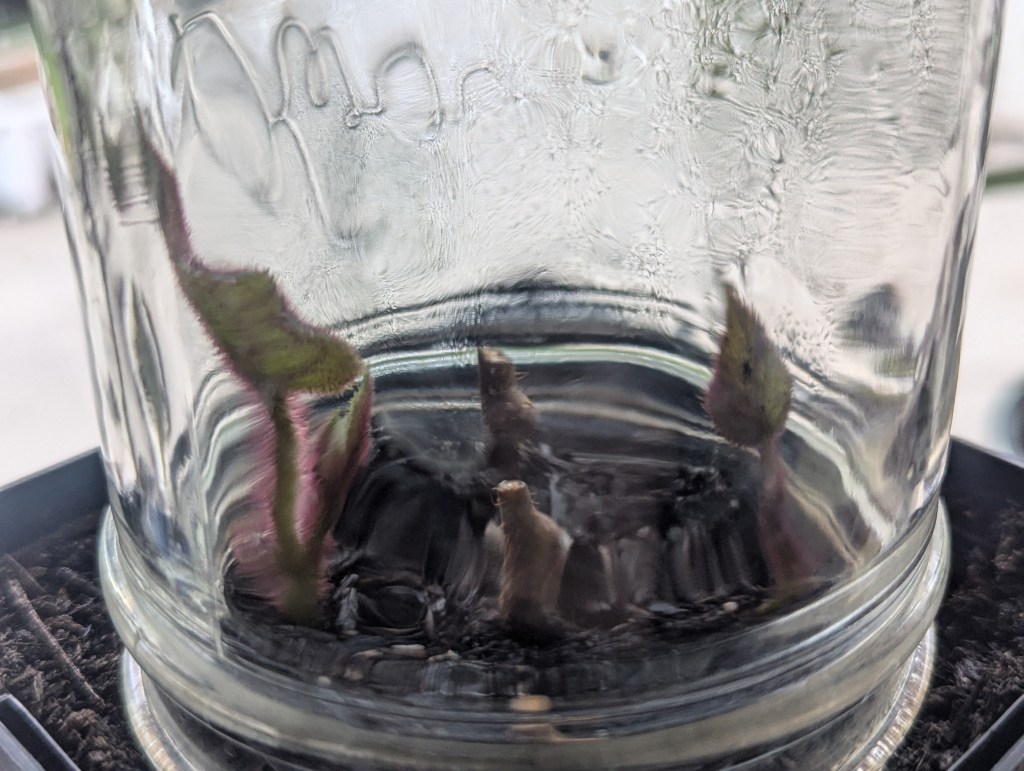
Flowers of all fruit need pollination for fruit to develop. Most are self pollinating. Some require pollination from another variety. Some are dioecious, so female flowers need pollination from male flowers. A few, such as figs and muscadines, are even more complicated, but they are topics for another article. For now, I am concerned with my female kiwi vine, which is growing like a weed, but would have been unable to produce any fruit without a male pollinator. It was not a planned acquisition. I grew it from cuttings from a bit of vine scrap that someone brought to dump in the debris piles here. Because it grew so well, I requested some male vine scrap from the same person who provided the female vine scrap. Obviously, since he grows the female vine in his home garden, he also grows a male vine to provide pollen. I wanted the scrap while it was dormant through winter, because that is when I prefer to start hardwood cuttings. By the end of winter, I figured that it was too late to start cuttings, and that I would need to wait to try next winter. Then, just a few days ago, the person who provided the female vine scrap brought me a small piece of the male vine, which was already foliated and growing! This presents a challenge, since I lack access to a greenhouse with bottom heat and mist. I cut the stem into five cuttings. Three have single axillary buds that are still dormant. Two are vascularly active terminal cuttings, which are merely short shoots that grew from two axillary buds that are still attached. All but the smallest leaves were removed from the terminal cuttings. So far, they seem happy under a jar. Now, I can only watch and wait.
Almost all pittosporums appreciate sunlight and warmth. Pittosporum tobira ‘Variegata’ is no exception. However, it tolerates a bit of more partial shade than most. Furthermore, its grayish and creamy white variegation brightens shady situations. Its distinctively convex and glossy leaves are a bit flatter and broader where shaded. Shade inhibits bloom also.
Pittosporum tobira ‘Variegata’ is more popular as a foliar hedge anyway. Its small trusses of pale white flowers are neither prominent nor colorful. They can be delightfully fragrant in abundance, though. Stems are quite stout and can eventually grow more than six feet tall. They are resilient to frequent pruning and hedging, and can be cut back if necessary.
Pittosporum tobira ‘Variegata’ seems to lack a common name that is genuinely common. That is why its botanical name is most popular. Some know it as mock orange, but this is also a common name of Philadelphus. Some know it as Australian laurel, but it is neither a laurel nor from Australia. Regardless of name or origin, it is content with local climates. Once established, it is undemanding, and may need no watering.
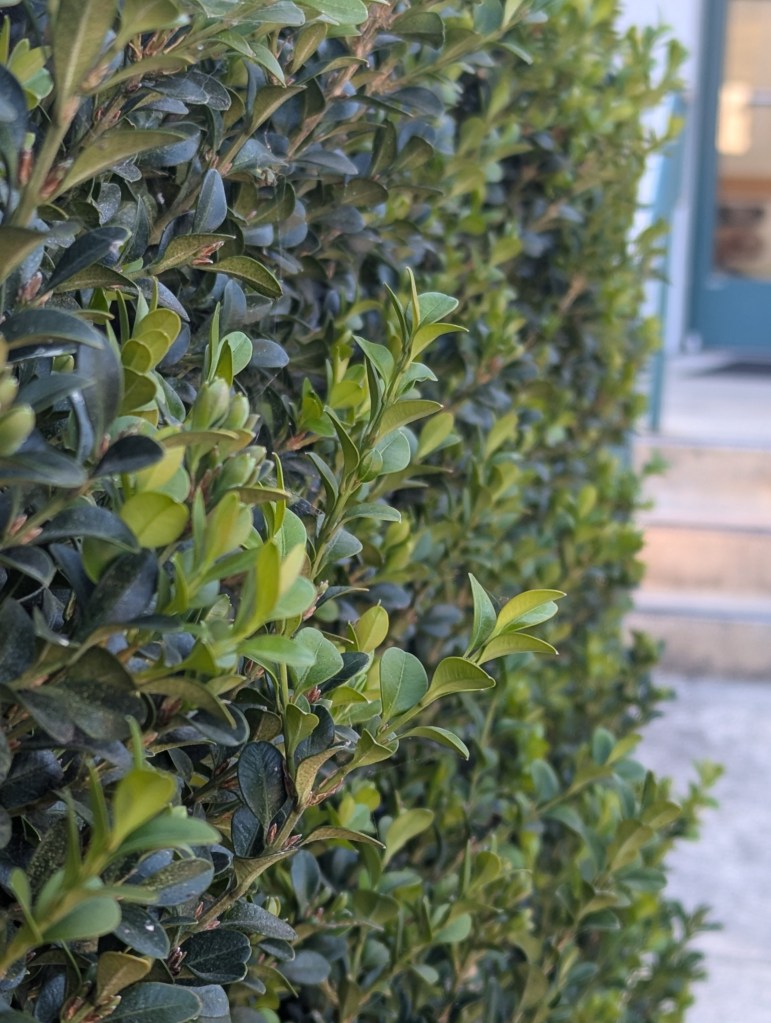
Motorized hedge shears are the most overused home garden power tools. They are very useful for hedging evergreen shrubbery into hedges and privacy screens. However, they too often shear vegetation that requires different types of pruning. They are fast and easy but not appropriate for all pruning applications. Even hedging is a specialized technique.
Unfortunately, the rules of hedging are too often ignored. Hedges are utilitarian features. Many provide privacy. Many obscure unwanted scenery. Some divide large gardens into smaller and cozier spaces. Most continue to function as they should even without proper maintenance. Consequently, problems associated with maintenance may not be evident.
Unshorn informal hedges are mostly simpler to maintain, but only if they remain unshorn. Ideally, they use species or varieties that mature to a desirable size and form. Therefore, they should not become too large or Obtrusive. Only a few wayward stems need pruning. Of course, species or varieties that grow too large for such application will need hedging.
Shorn or formal hedges are more likely to develop problems. They need regular hedging to maintain their size and strict form. Yet, even with the most diligent maintenance, many become overgrown. Many gain depth from front to back, to become obtrusive. Many gain more height than they should. Most become distended up high while subdued down low.
This happens because pruning cuts can be slightly farther out than they were previously. They are a bit farther out higher up because that is where most growth is. Hedging within former cuts can renovate overgrowth, but damages hedge facades. Fortunately, damage should be temporary. Severely overgrown hedges might require severe pruning, though.
As mentioned, hedges are utilitarian. They should perform their primary purpose without encroachment into usable spaces. Their typically evergreen foliage is generally external. Their interiors are generally bare stems and empty space. Therefore, a hedge can be as effective whether two or four feet from front to back. Four feet is merely a waste of space.





 Tony Tomeo