
Sunday Best – Winter Flowering Cherry
Perhaps flowers were not the best subjects. They are quite scarce about now.
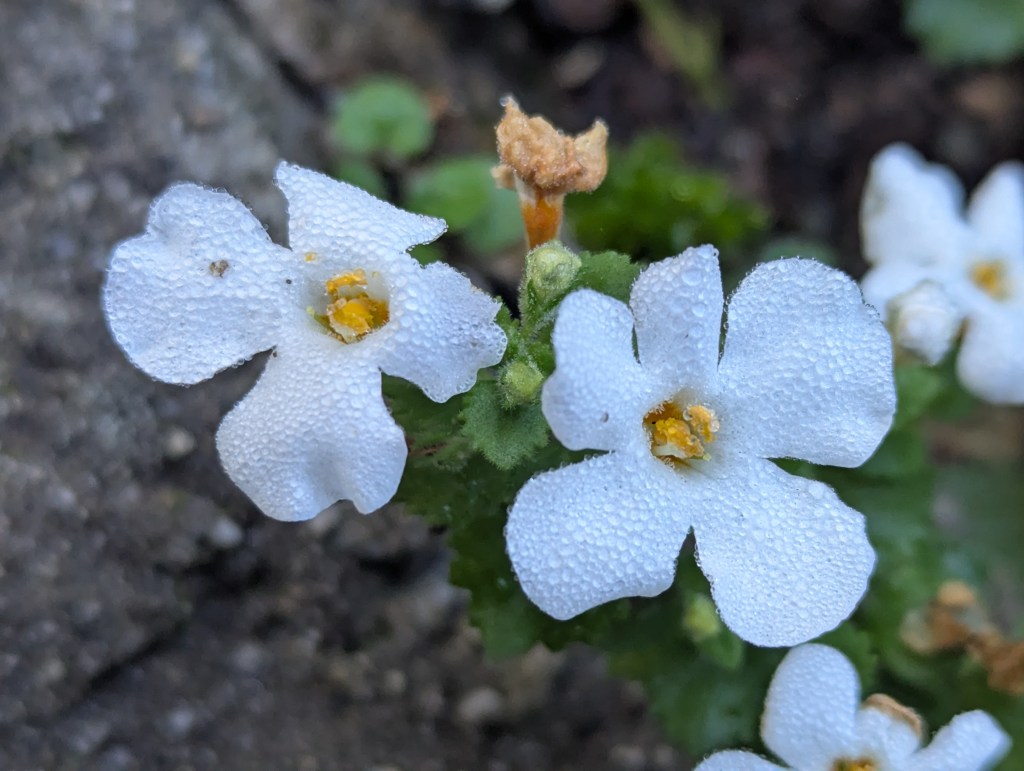
1. What is this? It grows like ground cover. Although it has not yet bloomed profusely, it blooms with a few flowers continually. I am not keen on it, but I want to know what it is.
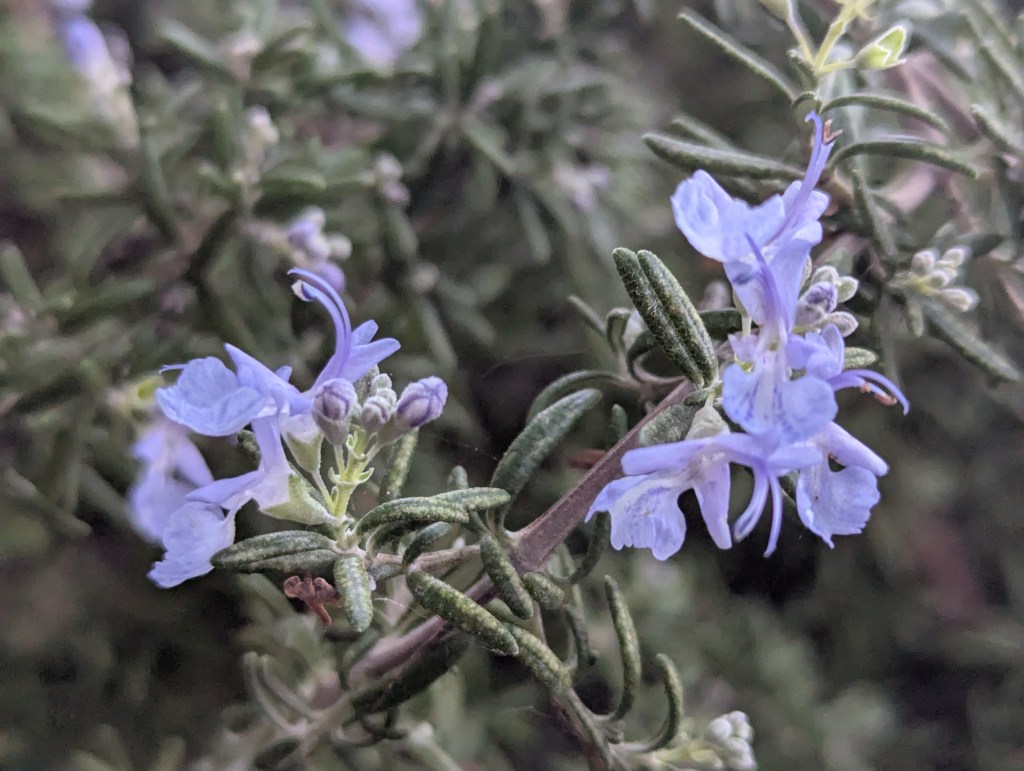
2. Rosmarinus officinalis ‘Prostratus’, trailing rosemary blooms a bit less during winter, but seems to never be completely without bloom. Hummingbirds are pleased with these.
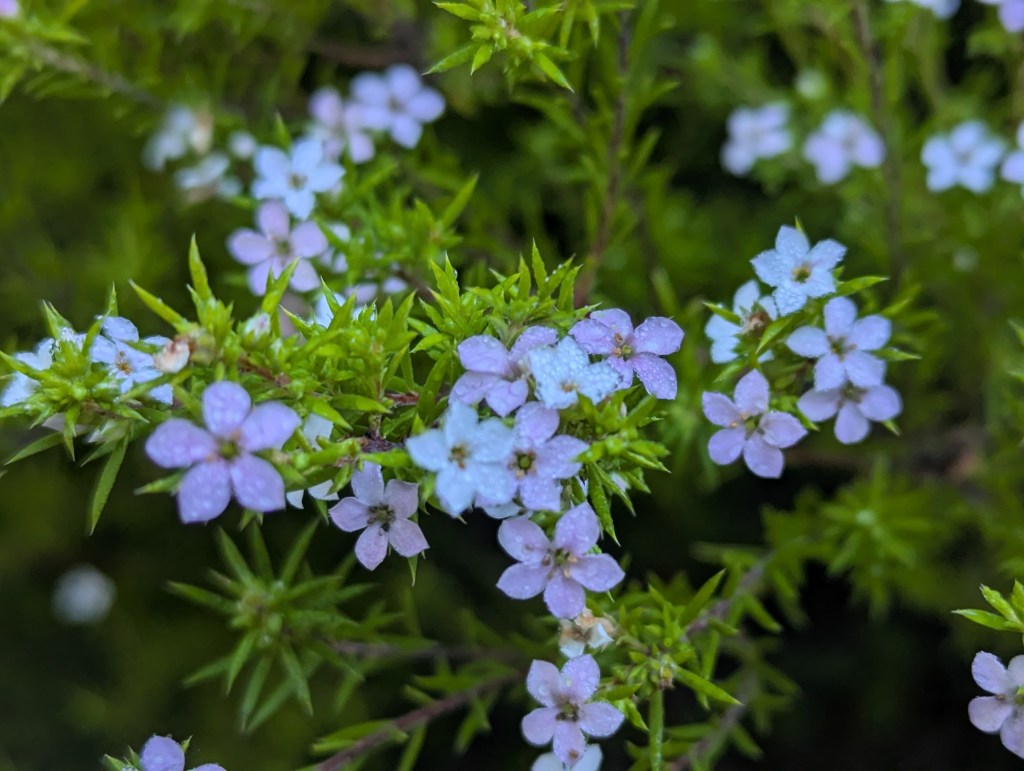
3. Coleonema pulchellum ‘Sunset Gold’ breath of Heaven probably should have stopped blooming by now; but I must not complain if it insists on blooming right through winter.
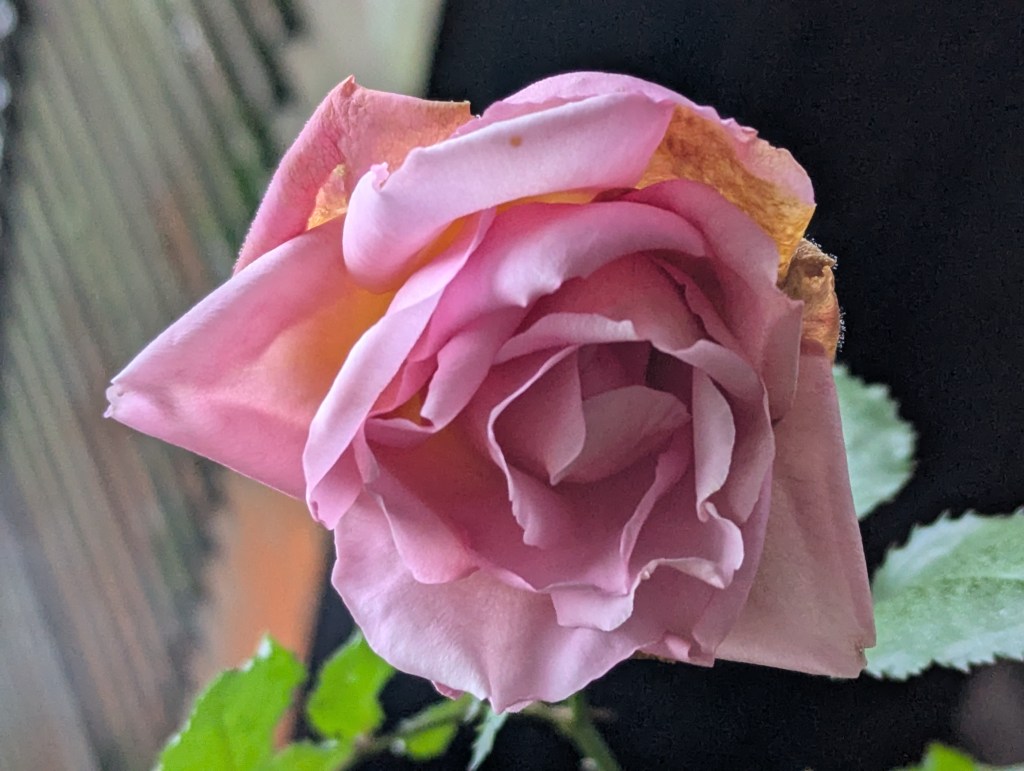
4. Rosa spp., rose bloom is finally succumbing to wintry weather. I do not know if this is because of the earlier rain or more recent chill. Other roses have been pruned for winter.
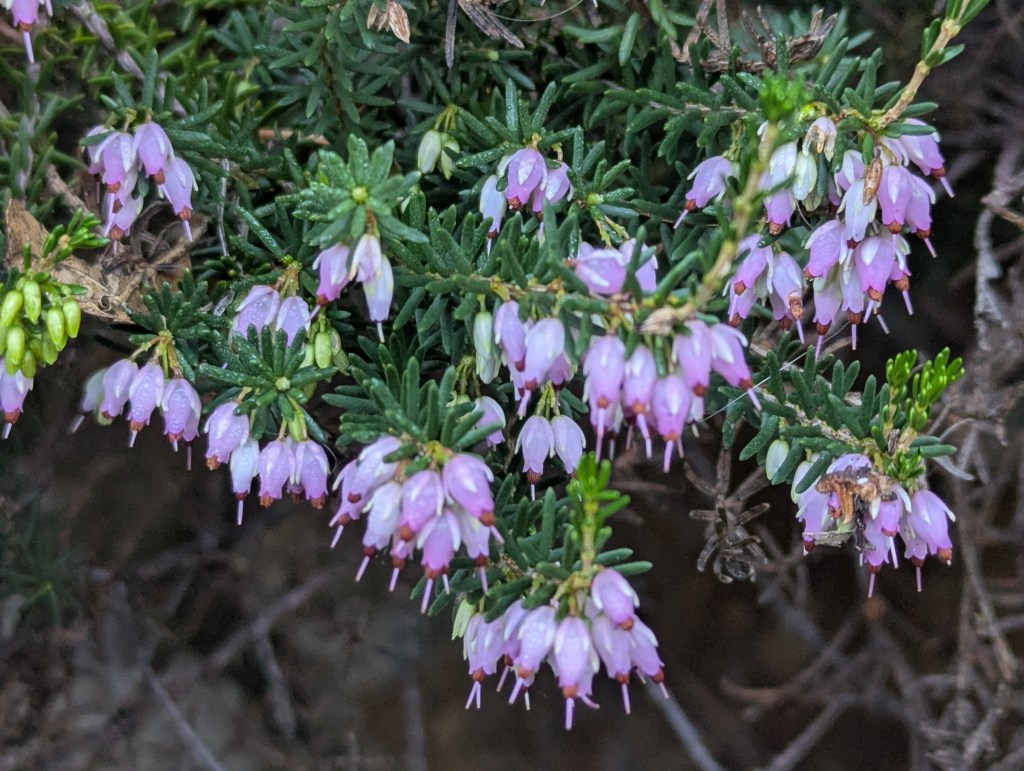
5. Erica spp., heath is happy to bloom through winter and perhaps into spring. I have no idea what cultivar this is, and I do not remember when it started blooming in November.
6. Rhody has been absent from Six on Saturday for quite a while. He is not easy to take a good picture of. This week though, it might have been easier than finding a sixth flower.

This is the link for Six on Saturday, for anyone else who would like to participate: https://thepropagatorblog.wordpress.com/2017/09/18/six-on-saturday-a-participant-guide/
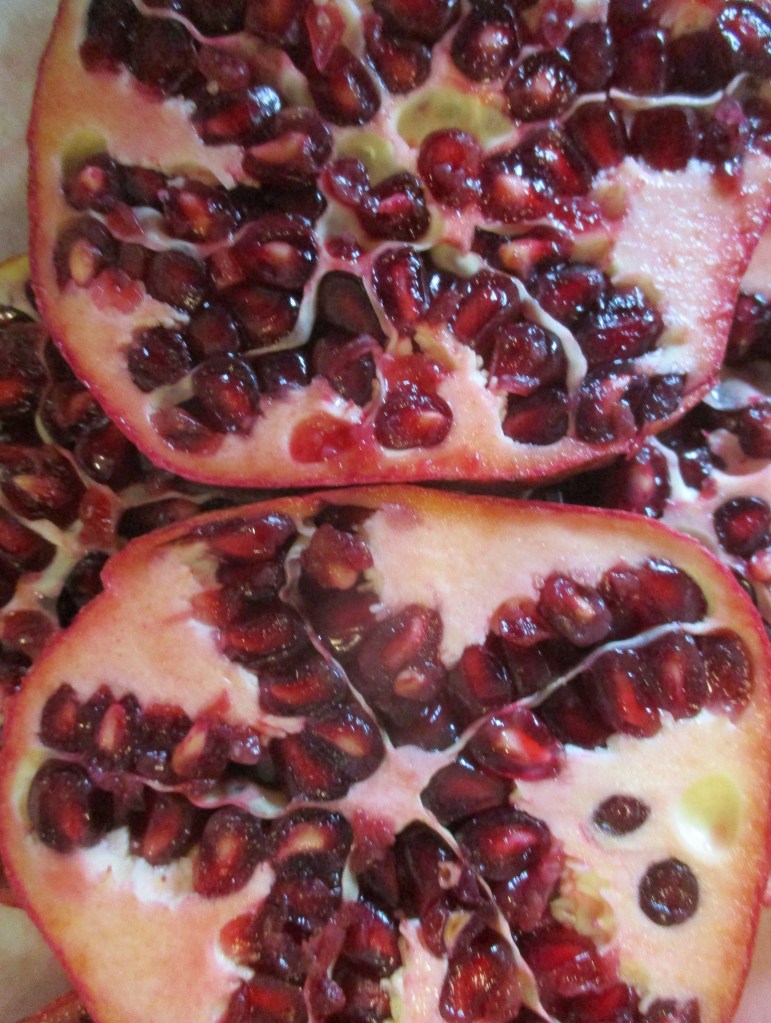
Not many fruit trees have been in cultivation for as long. After several thousands of years of breeding, there are quite too many cultivars to count. Pomegranate, Punica granatum, is now common in many regions throughout the World. It is particularly productive within Mediterranean climates, including locally. Bare root trees are now available in nurseries.
Without pruning, old trees can grow fifteen feet tall, with dense and thorny thicket growth. Fruit is easier to collect from tamer trees that are subject to regular thinning and pruning. Individual trees typically develop a few trunks, but can have only one. They may survive for centuries. Ruddy orange flowers bloom for spring. Foliage yellows prior to defoliation.
Pomegranate fruit ripens so late during autumn that it can linger after autumn defoliation. It is generally brownish red. Individual fruits are about three or four inches wide, but may be wider. They contain hundreds of seeds, which are surrounded by juicy and succulent flesh. Such flesh is generally garnet red, but might be purplish, pinkish or even colorless. Flowers are edible too.

Now, it is a bit more official. I have an appointment at 11:00 tomorrow morning, Tuesday, January 13, for the first episode of the KPCR Garden Report. I do not yet know if it will merely be recorded for later broadcast, or if it will be broadcast directly, but I suspect that it will be broadcast directly. More information about the KPCR Garden Report is cited by the recycled article below:
November 5, 2025 – Nothing is official yet. I am hopeful, though. I am currently in training to establish a new Garden Report on Pirate Cat Radio KPCR-LP 92.9 FM in Los Gatos, KMRT-LP 101.9 FM in Santa Cruz, KVBE-LP 91.1 in Portland, and online at KPCR.org. For me, it is daunting. However, those training me are confident of my ability. I have no problem talking about horticulture for an hour. My difficulty is operating the necessary electronics. It is not much, and actually looks quite simple. I am just not comfortable with it. I am intent on doing what I must, though. I miss my former Garden Report gardening shows on KSCO 1080 AM in Santa Cruz and KBCZ 89.3 FM in Boulder Creek. Ultimately, I would like to post recordings of the new Garden Report here on the blog, or at least post links to such recordings. I am told that is not difficult to do, if I record the shows, which is apparently standard procedure. I still need to find “intro” music for the beginning and end of each show, but I believe that I have a source for that. Goodness, although I know this should be easy, I am nervous!
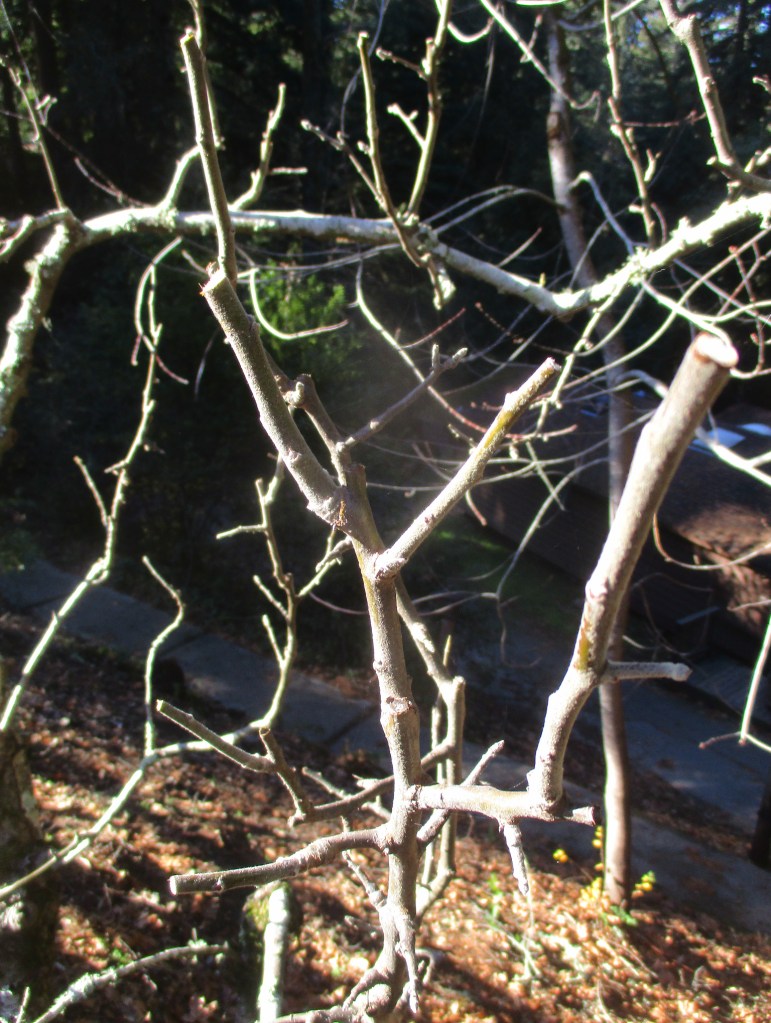
Bare root season begins now because bare root stock is so efficiently dormant for winter. Dormancy is the same reason that this is now also time for dormant pruning of fruit trees. It is comparable to anesthesia for surgery. Affected fruit trees waken from dormancy after winter with no idea of what happened. They then resume growth as if nothing happened.
Dormant pruning is important because of the unnatural breeding of most fruit trees. They have been bred to produce unnaturally large and unnaturally abundant fruit. Their fruit is so excessive that they can not support all that they could produce. Dormant pruning both limits production and concentrates resources. Resulting fruit is less abundant but bigger.
Bigger, better but less abundant fruits collectively weigh less than overly abundant fruits. Furthermore, dormant pruning improves structural integrity of affected trees. So, affected trees are able to support more weight but must support less. Ideally, they should need no propping for limbs that are too heavy with fruit. Limbs should not break from their weight.
Dormant pruning also directs and stimulates growth. It should prevent stems from getting so high that their fruit is beyond reach. Actually, most fruit should be within reach from the ground without a ladder. Vigorous growth is more resistant to pathogens than congested and less vigorous growth. There are actually quite a few advantages of dormant pruning.
Stone fruit trees and pome fruit trees are popular types that need dormant pruning. Stone fruit include apricot, cherry, nectarine, peach, plum and prune. They need similar pruning but to varying degrees. Peach needs more severe pruning because its fruit is so big and heavy. Cherry needs less aggressive pruning. Apple, pear and quince are all pome fruit.
Deciduous fruit trees are quite demanding, and reliant on timely dormant pruning. Those who would like to grow them should first be aware of their cultural requirements. Diligent research of pruning technique is helpful. Practical and annual experience is even better. Each year, it is an opportunity to observe how subject trees respond to dormant pruning.
Five of these six succulents have weirdly silly common names. I did not notice until after I got all of their pictures.
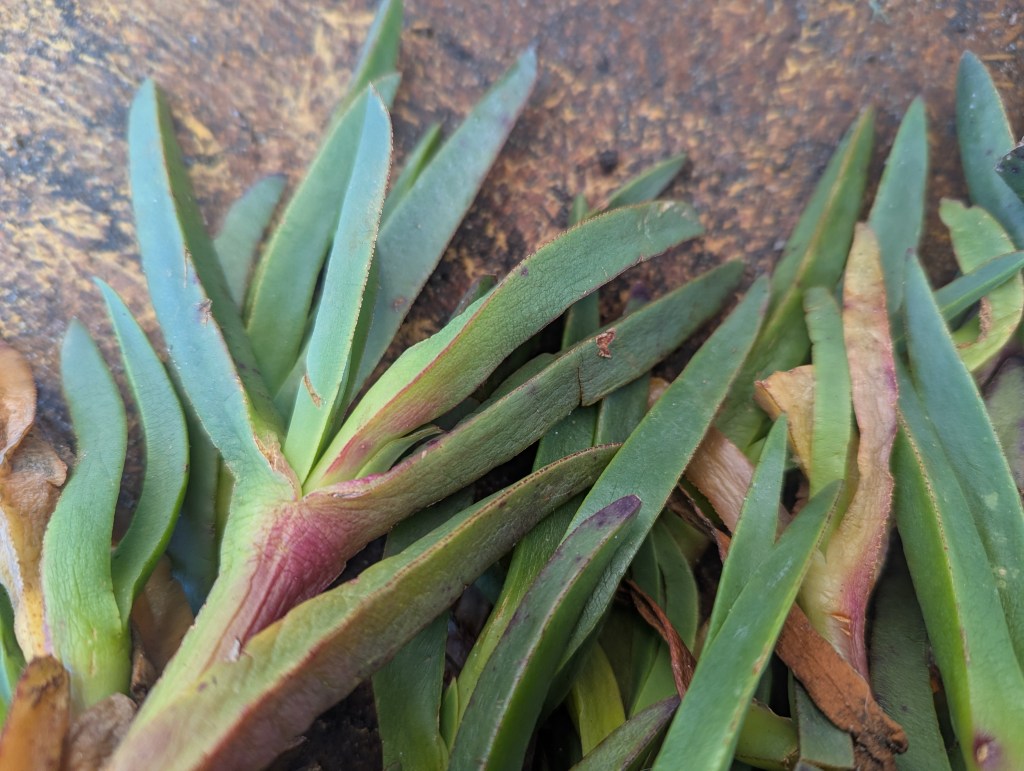
1. Carpobrotus edulis or Carpobrotus chilensis, pigface is a new acquisition that should help stabilize a sandy bank in one of our landscapes. It came from a beach in Santa Cruz.
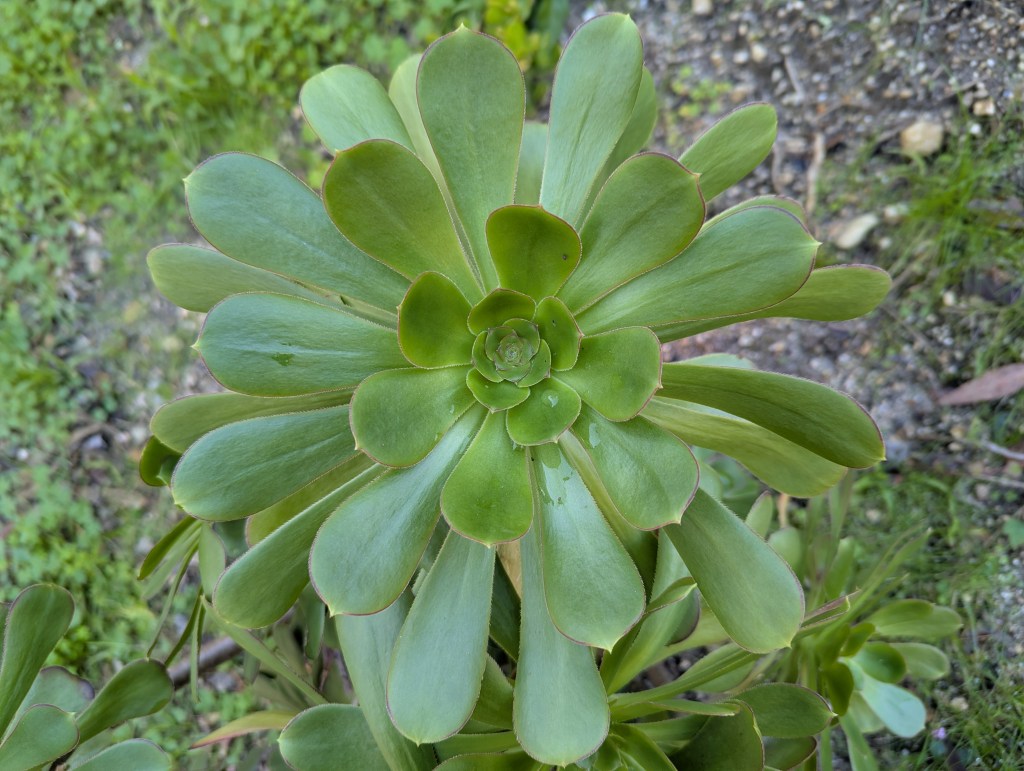
2. Aeonium arboreum, common houseleek not only has a silly name, but also has a silly form, with wide foliar rosettes suspended by lanky and otherwise awkwardly bare stems.
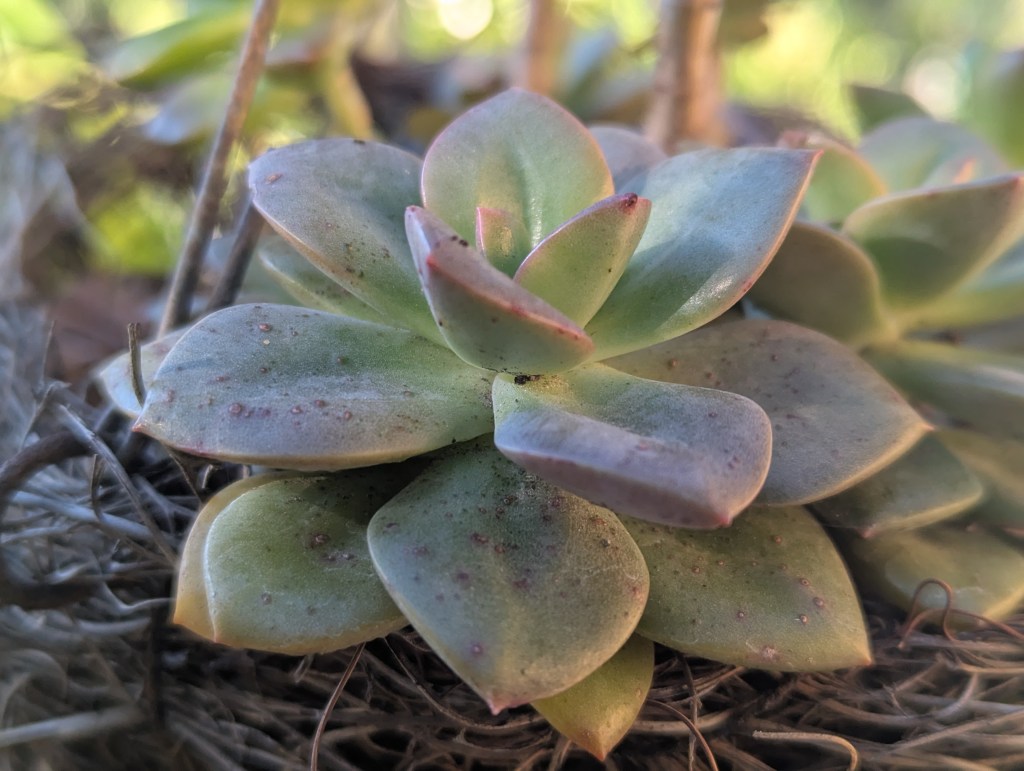
3. Graptopetalum pentandrum, bluebean is not actually within any of the landscapes. It is a diminutive specimen that remains potted in the nursery. I am unsure of its identity.
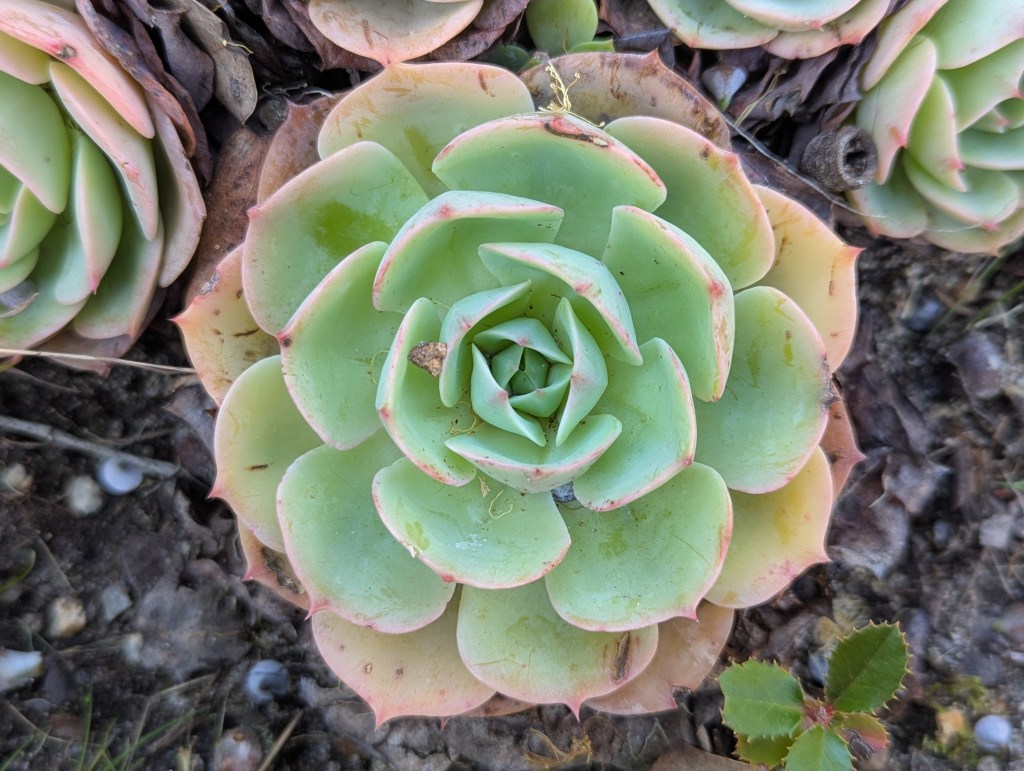
4. Echeveria elegans, Mexican snowball contrasts splendidly with the limey green of the common houseleek, which it grows at the base of. I would not mind more of these about.
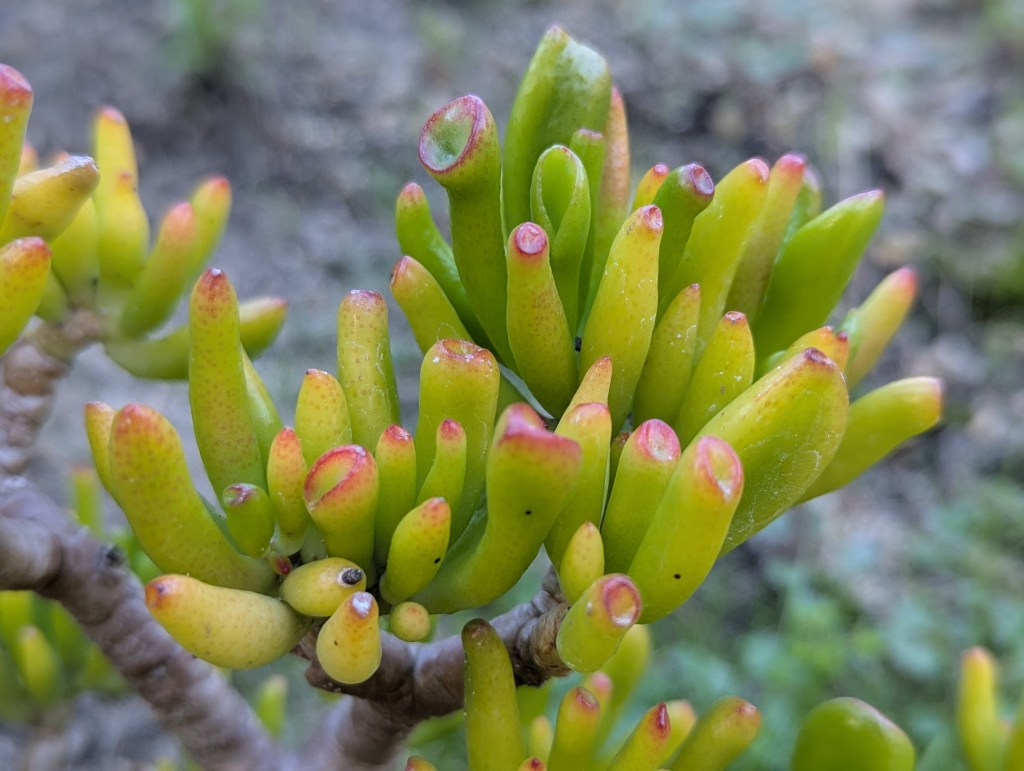
5. Crassula ovata ‘Hobbit’, Hobbit’s pipe, like common houseleek, is silly both in name, and in form, with these oddly tubular leaves. It is a lighter green than typical jade plant.
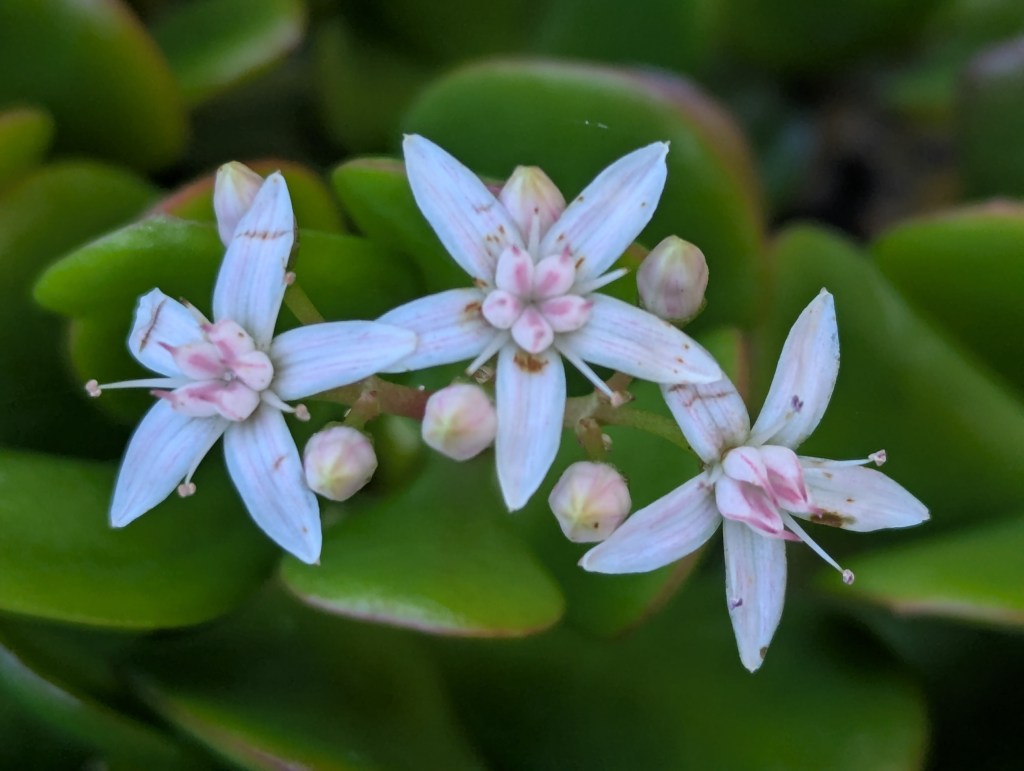
6. Crassula ovata, jade plant is the only one of these Six that lacks silliness. Its bloom is too cute in closeup view to omit, though. Besides, Six on Saturday is better with flowers.
This is the link for Six on Saturday, for anyone else who would like to participate: https://thepropagatorblog.wordpress.com/2017/09/18/six-on-saturday-a-participant-guide/
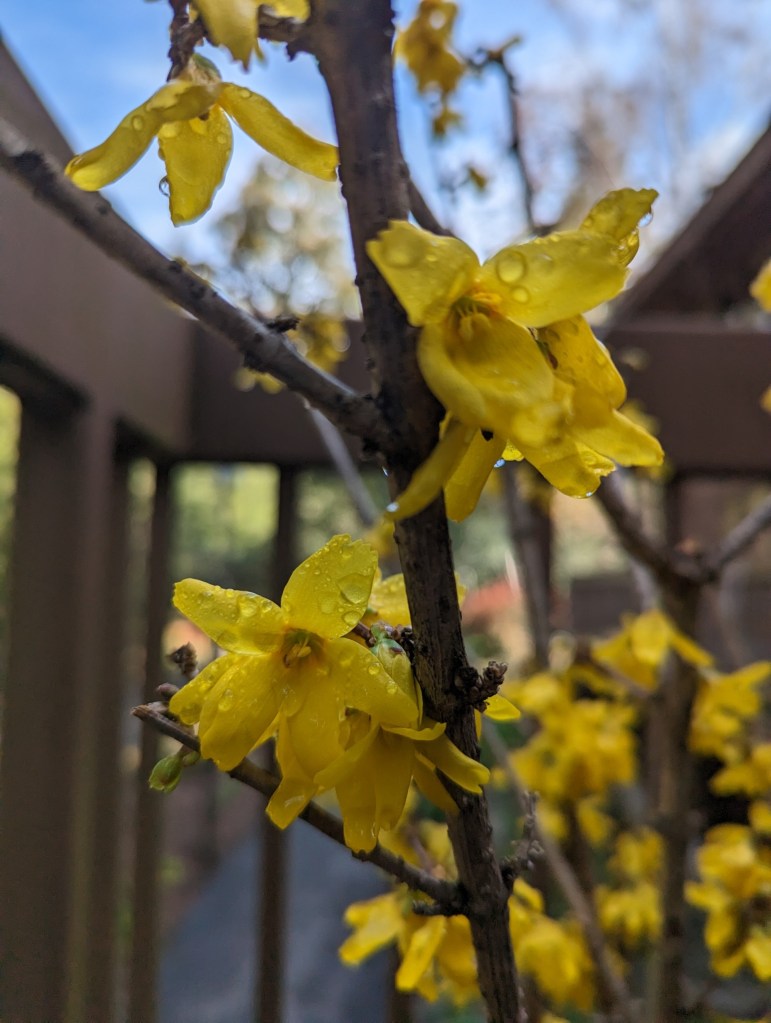
This may seem to be unseasonable for now. Forsythia, Forsythia X intermedia, does not bloom until early spring. However, this is the time to plant it as bare root stock. It is one of only a few fruitless ornamental species that is available as such. New specimens will not bloom much for spring. They grow through summer, though, to bloom for the next spring.
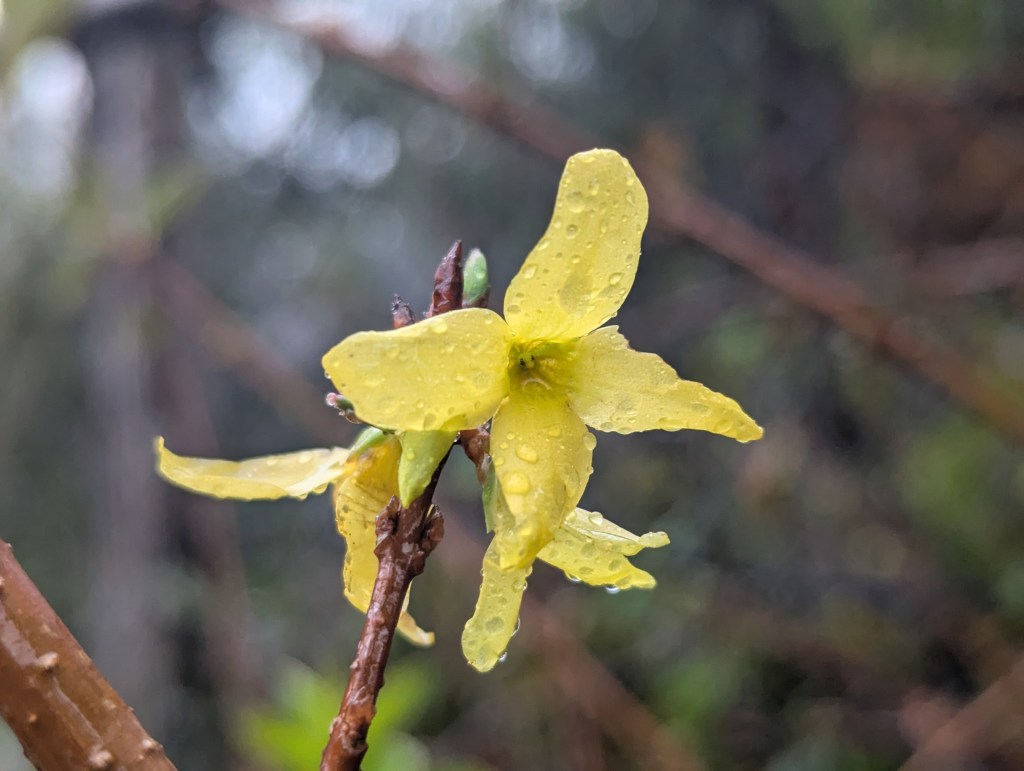
The famously bright yellow flowers of forsythia are small but very abundant. They bloom on bare stems before their deciduous foliage regenerates. The simple paired leaves are about two or three inches long. Mature specimens mostly do not grow more than ten feet tall unless partly shaded. Most branches arch upward and outward from their root bases.
Pruning should involve the removal of deteriorating older canes, to favor younger canes. Complete removal at their base promotes more vigorous new basal growth. Pruning can happen after bloom rather than before. Pruning of the exterior compromises the naturally outwardly flaring form. Complete coppicing eliminates all bloom for the following season.

Wintry weather, although unpleasant at times, has certain advantages. Most importantly, it provides rain here, and snow in the mountains for water reserves. Gardening would be very different with any less. Also, cool weather initiates dormancy for most plant species, giving them a time for rest prior to spring. This is what makes bare root season possible.
Bare root stock is exactly what it sounds like. It is available for sale without the soil that it grew in. Some comes with an individual bag of moist sawdust around its otherwise bare roots. Most merely rests with its otherwise exposed roots in damp sand at nurseries until purchase. Because it is so portable, much is available by mail order, or online purchase.
Bare root stock becomes available now because this is when it is dormant. It comes into nurseries as readily as Christmas trees relinquish their space. Because it is dormant, it is unaware of what is happening to it. Dormancy works like an anesthetic for major surgery. Ideally, bare root stock awakens in its new gardens without any idea how it arrived there.
There are several advantages to bare root stock. It is much less expensive than canned, or potted, nursery stock. It is less cumbersome to bring home from nurseries. Because its roots were never confined, they disperse readily into surrounding soil. For some types of plants, more varieties are available bare root. Several plants are only available as such.
Roses and fruit trees are the most popular of bare root plants. More cultivars of roses are available now than at any other time of year. Fruit trees include primarily stone fruits and pome fruits. Stone fruits include apricot, cherry, plum, prune, nectarine and peach as well as almond. Pome fruits include apple, pear, crabapple and Asian pear as well as quince.
Cane berries, including blackberry and raspberry, are also available with bare root stock. So are perennial fruit and vegetables like strawberry, rhubarb, artichoke and asparagus. A few deciduous but fruitless shrubs, trees, vines or perennials are sometimes available. These might include lilac, forsythia, clematis, wisteria, astilbe and deciduous magnolias. Grapevines and nut trees are also available.
 Tony Tomeo