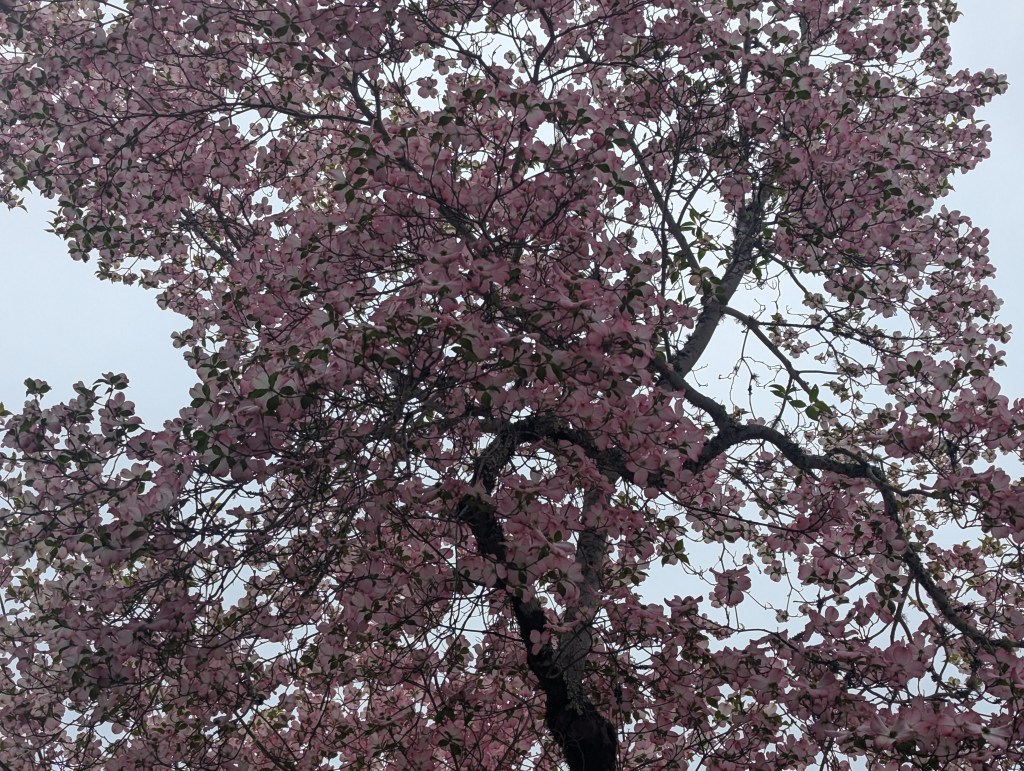
Sunday Best – Dogwood (with ruff bark)
Too many iris are blooming now to document. Therefore, I limited my selection to a few bearded iris, which includes one that is not within the landscapes at work. Perhaps some of the other species can be featured next Saturday. With so much in bloom, it is difficult to be selective.
1. Of these Six, only this one does not inhabit the Iris Garden at work. It inhabits a small roadside planter in front of the totally awesome White Raven Coffee Shoppe in Felton. I believe that it is more caramel and charcoal colored than it appears to be in this picture.

2. Of these Six, only this one is likely identified. It conforms precisely to the descriptions of ‘Rosalie Figge’, including its habit of blooming sporadically throughout the year, with abundant bloom about now. Another participant of Six on Saturday identified it as such.

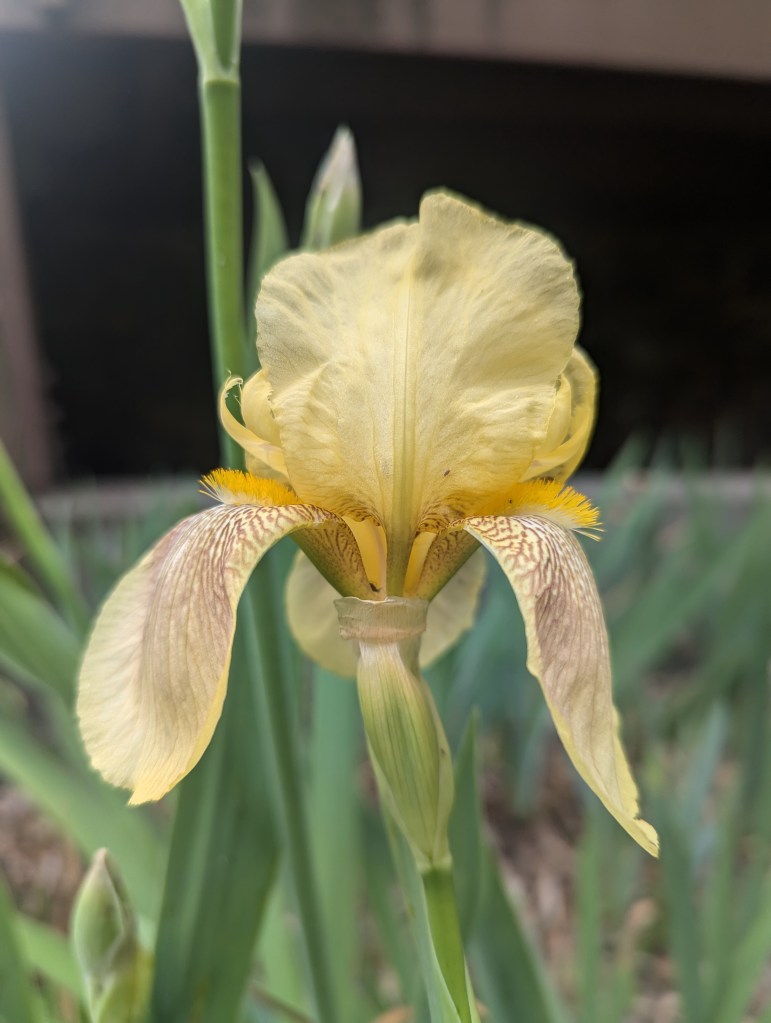
3. This relatively small pale yellow but nicely fragrant iris might be feral. It was found at a dumpsite for landscape debris, so could have grown from a deadheaded seed. It would likely be bigger and more colorful if it had grown from a discarded rhizome of a cultivar.
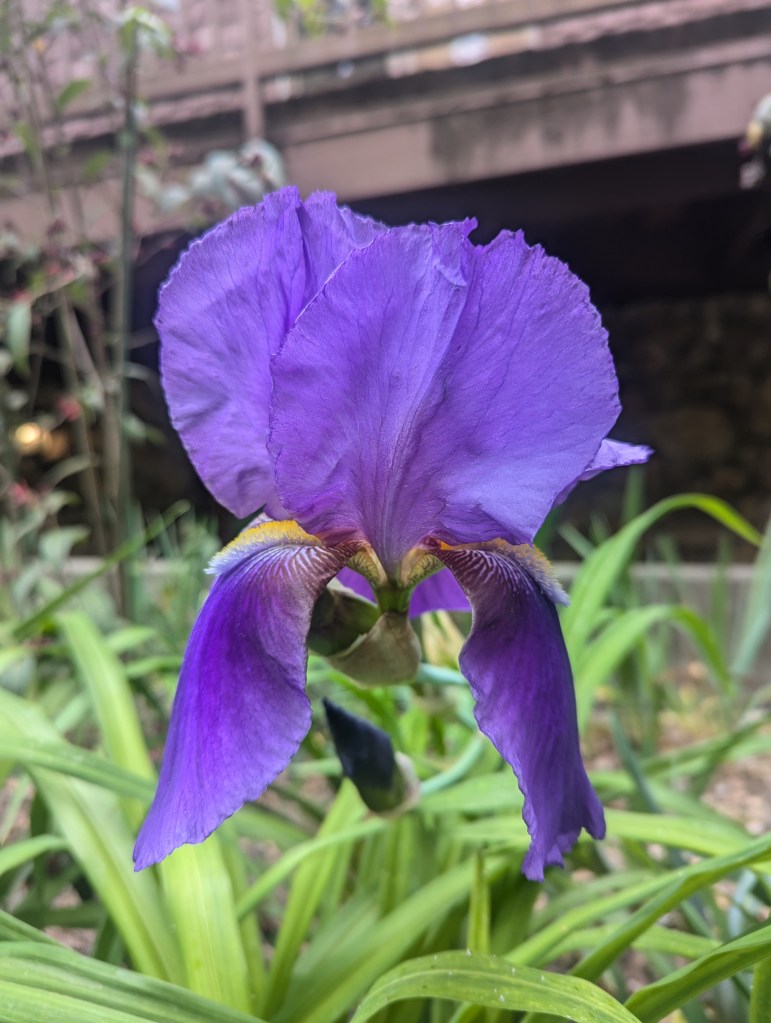
4. This big blue iris is as floppy as beagle ears, and is so heavy that its tall stems fall over if not staked. That is why its nearly horizontal stalk is obscured in its background behind it instead of visible below it. It is not actually as purplish as it seems to be in this picture.
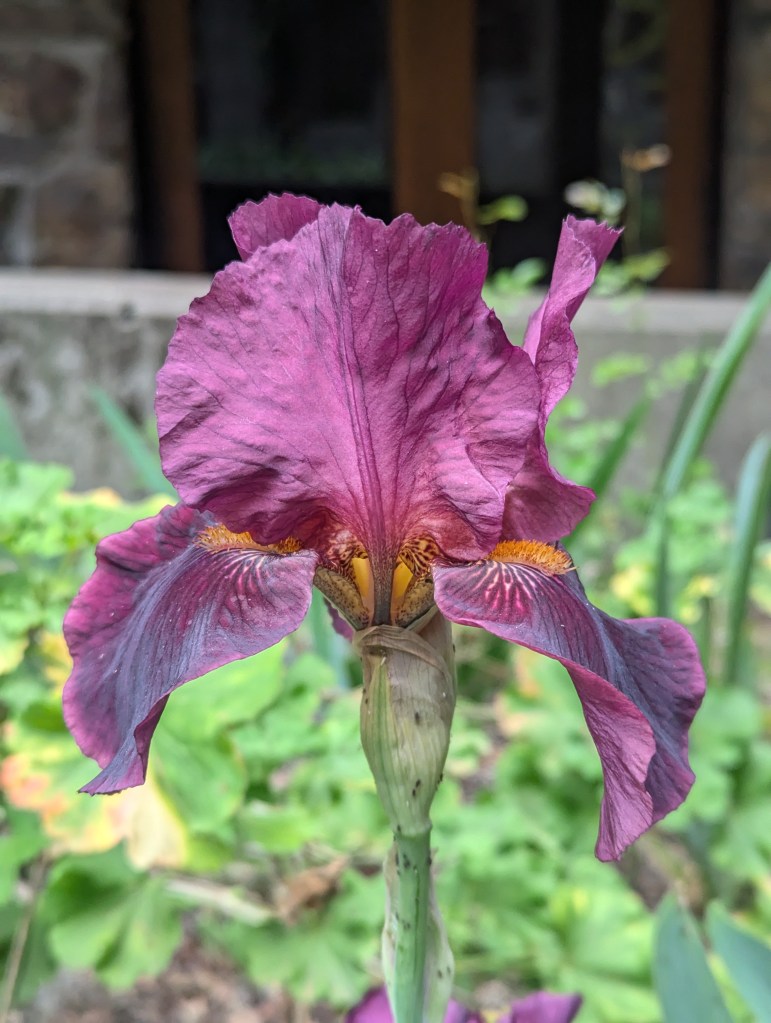
5. Although more billowy and likely a bit bulkier, this garish iris needs no staking. Its tall and rather thin floral stems are sturdier than they seem to be. This happens to be one of my favorite bearded iris in this particular group. It was originally a gift from a neighbor.

6. Color is again deficient. This bearded iris is not as purplish as it seems to be here. It is actually a rich burgundy red. I remember the origins of all the other iris here but can not remember how this one was acquired. I do not remember ever seeing it before this year.
This is the link for Six on Saturday, for anyone else who would like to participate: https://thepropagatorblog.wordpress.com/2017/09/18/six-on-saturday-a-participant-guide/
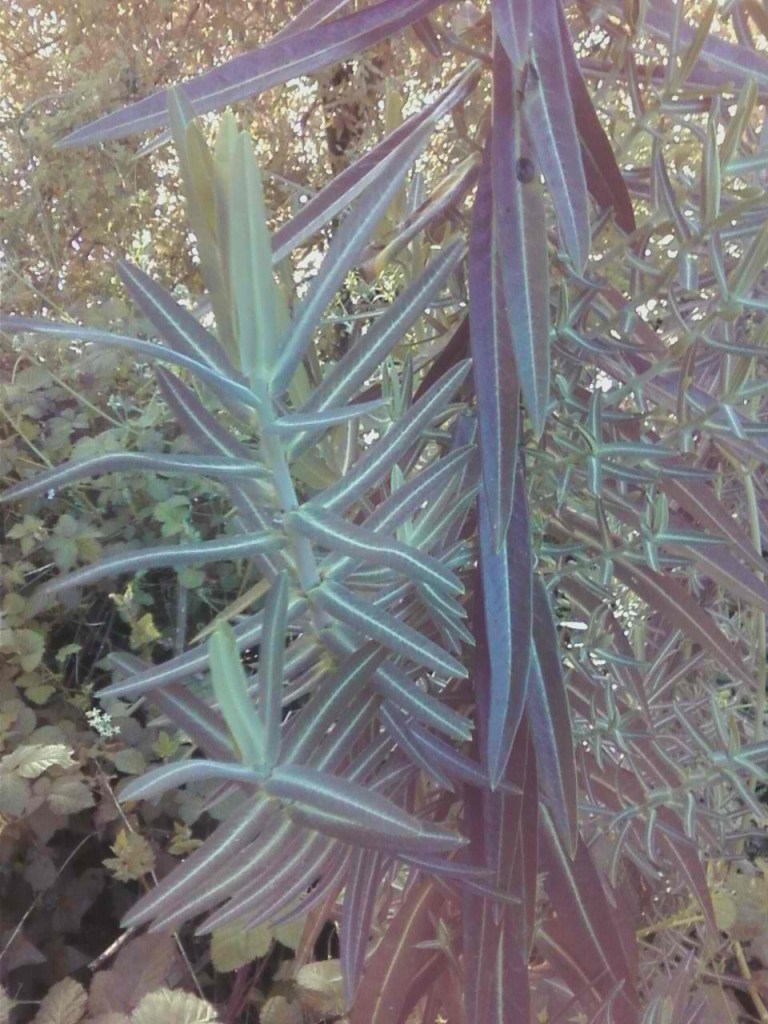
The common name may be derived from ‘gopher spurge’, since Euphorbia lathyris is within the family of plants known as ‘spurge’, and it is also purported to ‘purge’ the garden of gophers and moles. Like all related spurge, it has caustic opaque white sap that is very irritating to the skin and toxic if ingested. This offensive sap prevents anything from burrowing through the roots, but unfortunately does not prevent gophers and moles from going around. Therefore, a garden that is adequately protected may also be crowded by gopher purge.
Individual plants live for only two years, but produce enough seed to seem like perennials. Their mostly solitary stems can grow to nearly five feet tall with foliage that spreads up to a foot wide in the first year. Tiny yellow flowers that bloom in the second summer are not remarkable; and can set seed without getting much notice before the plant dies. Gopher purge can naturalize without becoming too invasive in regularly moist or somewhat shady parts of the garden. It prefers to be watered occasionally in drier and sunnier areas.
The foliage of gopher purge is strikingly symmetrical. Each pair of grayish or bluish green leaves is perpendicular to the pairs above and below it, in a four ranked pattern. Except for the newest upper leaves, each leaf pair is also arranged in a generally horizontal plane, perpendicular to the vertical stem. Gopher purge seems to have been assembled in the garden instead of grown there.
(This article is recycled from many years ago, so contains outdated information.)
Spring in Guadalupe Gardens on April 23 is the big local gardening event of the Santa Clara Valley! Not only will it be within Guadalupe Park, surrounded by the various Guadalupe Gardens, but Spring in Guadalupe Gardens gathers together an impressive variety of local gardening clubs and vendors. There will be workshops, lectures, trail walks and garden tours, as well as fun activities for children, music and entertainment.
The Heritage Rose Garden, which is the most extensive public collection in the United States of America, designed for the preservation of the ancestors of modern roses, will be in full bloom. The Historic Orchard is a tree museum of the many fruit and nut trees that inhabited the vast orchards that once filled the Santa Clara Valley; many of which can be productive in modern suburban gardens.
Representatives of many local gardening clubs will be at Spring in Guadalupe Gardens, with information about their respective expertise, as well as membership. The John E. Stowell Dahlia Society, the American Fuchsia Society and the Master Gardeners of Santa Clara County will all be there, to name a few. I will be at the Gardening Advice Booth throughout the event, to discuss any gardening issues and questions.
When I can get away from the Gardening Advice Booth, I like to see what I can purchase from the many vendors. There will be more than forty. Most of my fuchsias, and some of my aloes and cacti were obtained at Spring in Guadalupe Gardens. It is common to find many uncommon tomato plants and roses. There will also be garden art and paraphernalia. The Master Composters of Santa Clara County will be giving away free compost. One never knows what to expect at Spring in Guadalupe Gardens.
Earth Care Recycling will again host a free electronic waste drop off at the Visitor and Education Center, to collect all sorts of computer components, televisions, stereos, fax machines and telephones. Proceeds benefit the Guadalupe River Park Conservancy.
Spring in Guadalupe Gardens will be from 10:00 a.m. to 3:00 p.m. this April 23, just north of the Guadalupe Gardens Visitor and Education Center, which is located at 438 Coleman Avenue in San Jose. Admission and parking are free. Just follow the signs from Coleman Avenue or East Taylor Street. More information about Spring in Guadalupe Gardens can be found at www.grpg.org or by telephoning 298 7657.

Syringa vulgaris ‘Madame LeMoine’ French hybrid lilac bloomed bright white and right on time as March became April, and is not finished yet. It was somewhat of a surprise, since it remains canned until development of the landscape that it should eventually inhabit. It does not grow much while canned, so was not expected to be so spectacular in bloom. It is so spectacular that it was temporarily placed into a prominent position within another landscape, with its can mostly obscured by other vegetation, until it finishes bloom.
However, regardless of how spectacular it is, it reminds me that white is not necessarily the best color for all flowers. White happens to be my favorite color, and lilac happens to be among my favorite early spring flowers, but to me, lilac bloom should be lilac colored. I mean, it really should be that lavender or pastel purple color of traditional and formerly common old fashioned lilacs. The only advantage to this white floral color is that it would be appropriate to situations in which white is the most desirable color, or where lavender is undesirable.
Just as many flowers are at their best in white, some are best with other colors. Southern magnolia, lily of the valley, moonflower, gardenia, Easter lily and old fashioned calla are exclusively white, and would look weird in any other color. Gladiolus, tulip, hyacinth and rose can be all sorts of colors, but happen to excel at white. A few other flowers that can be all sorts of colors happen to not excel at white, such as bougainvillea, crape myrtle, English primrose, tropical hibiscus, wisteria and, of course, lilac. Both white crape myrtle and white bougainvillea happen to have been selected specifically for landscapes here, so perhaps white lilac is not so out of place.
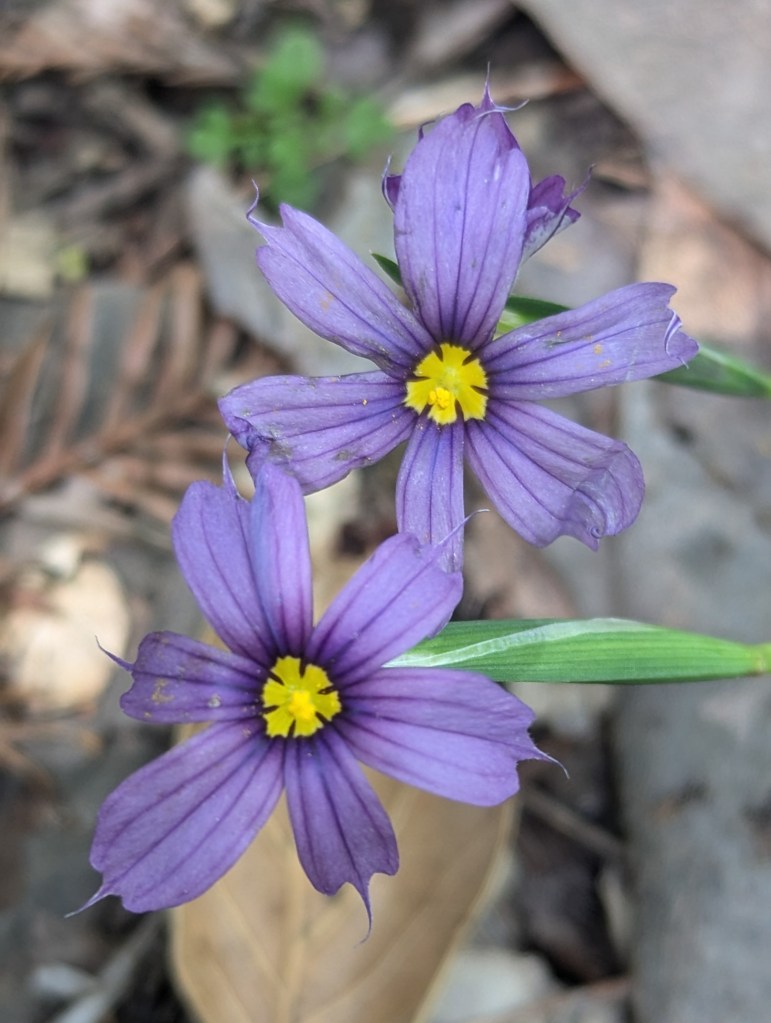
It is not a grass, and lacks eyes, but it is native to most of California and western Oregon. Blue-eyed grass, Sisyrinchium bellum, is related to iris, which actually sounds ocular. Its tiny flowers are typically rather purplish, but can be clear sky blue, or rarely white. Bloom continues through spring until summer dormancy. All foliage then dies back until autumn.
Blue-eyed grass develops small foliar tufts that expand quite slowly. It propagates easily from division of its thin rhizomes as it resumes growth in autumn. Plugging newly divided rhizomes adjacent to original foliar tufts accelerates expansion. Blue-eyed grass can self sow, but typically does so only sparsely. Its grassy foliage is typically less than a foot tall.
Although native and impressively resilient, blue-eyed grass appreciates a bit of moisture. However, it may never require irrigation, since it is dormant through the summer season. Irrigation might maintain foliage through much of summer, but if excessive, can cause rot. Blue-eyed grass prefers sunny and warm exposure, without contention from other plants.

Wildflowers are only part of the story. They are happy enough with the chaparral climate here to bloom for spring or summer. A few are naturalized exotic species, though. In other words, they are not native to California. They merely behave like they are, likely because they are from similar climates. Native species are happy here because they are at home.
More than the most abundant wildflowers are native. Many trees, vines, shrubs, annuals and perennials are also. They were here long before Spanish explorers imported the first exotic plants after 1542. They were as satisfied with local soils and climates then as they are now. This is why many are more suitable for home gardens than many exotic plants.
Native plants are less popular than exotic plants only because a few are a bit too natural. Since they are from chaparral climates, some may get a bit scraggly and dry by summer. They survive arid weather by being partially dormant through some of it. Most appreciate irrigation through summer. However, some are susceptible to rot with generous irrigation.
Conversely, there are several advantages to native plant species. They naturally require less irrigation than most exotic species. Once established, some expect none at all. Only species from other chaparral or desert climates might be less demanding. Landscapes of exclusively native species therefore conserve water. Some get all they want from rainfall.
Also, native species are more compatible with natural ecosystems. Any that self sow into nearby wildlands will be where they belong. They do not compete unfairly for pollinators that other native species rely on. Nor do they compete unfairly for possibly limited space and resources. Furthermore, they contribute habitat and sustenance to wild native fauna.
California poppy and sky lupine are probably the most familiar of native annuals. Various salvias and bush lupines may be the most familiar native perennials. California lilac and flannel bush are familiar native shrubs. California sycamore, coastal redwood and coast live oak are familiar native trees. Many native species are practicable for home gardens, and landscaping.
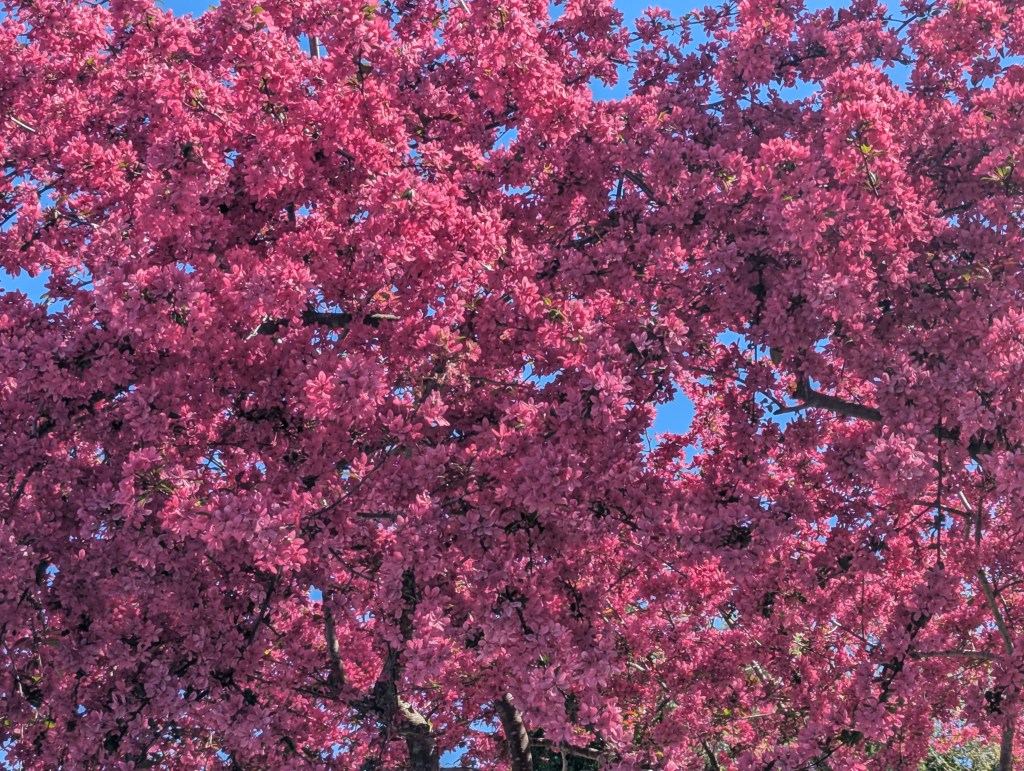
Azaleas make it difficult to limit this post to only six pictures. So many cultivars are now in bloom. However, azaleas also make it easy to comply with suggestion #7 of the Six on Saturday participation guide, which suggests minimal verbiage. There is not much to say about them, since I do not know much about them, or even what cultivars they are. I can only guess the identities of half of them. Even if I could identify the cultivars, I could not identify the species. I only know that all azaleas are of the same genus of Rhododendron. I suppose that, in this regard, they could qualify as a few more of Rhody’s rhodies.
1. ‘Hino Crimson’ happens to look very much like this. The small leaves are dark, but not quite bronzed presently. They were bronzed, but only during the coldest winter weather.

2. ‘Coral Bells’ happens to look very much like this. It is the most common azalea within the landscapes at work, and is remarkably reliable with its remarkably abundant bloom.
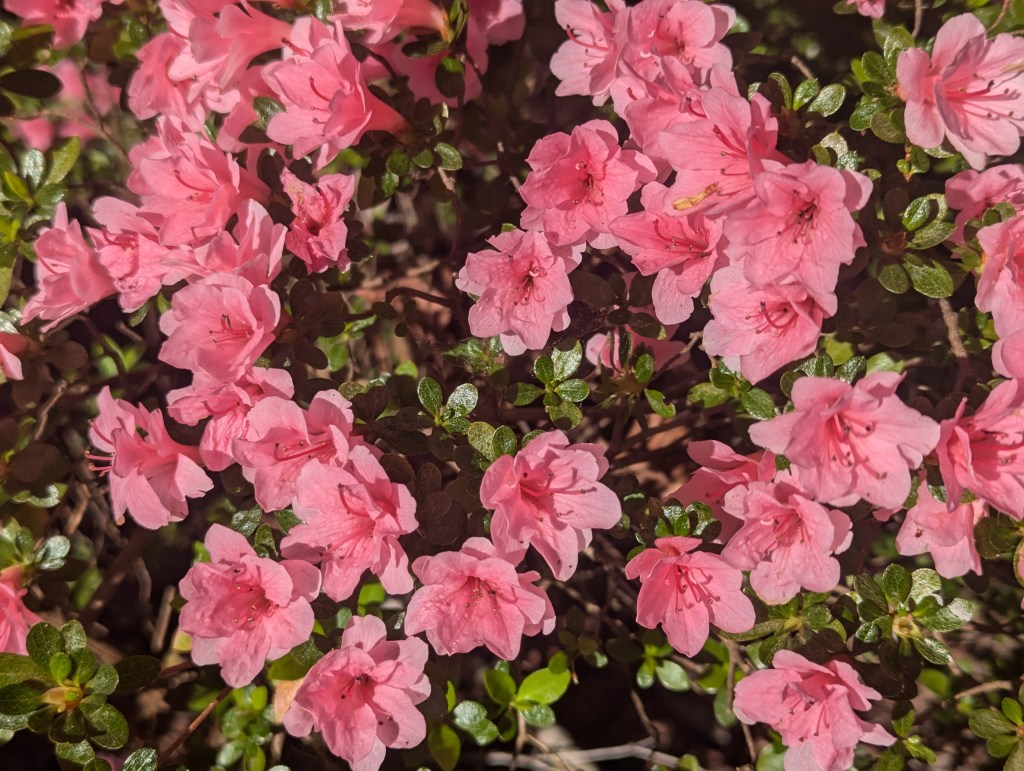
3. The bloom of this cultivar seems to be even more abundant because almost none of its foliage is visible beneath it. These flowers are little, but bigger than those of ‘Coral Bells’.
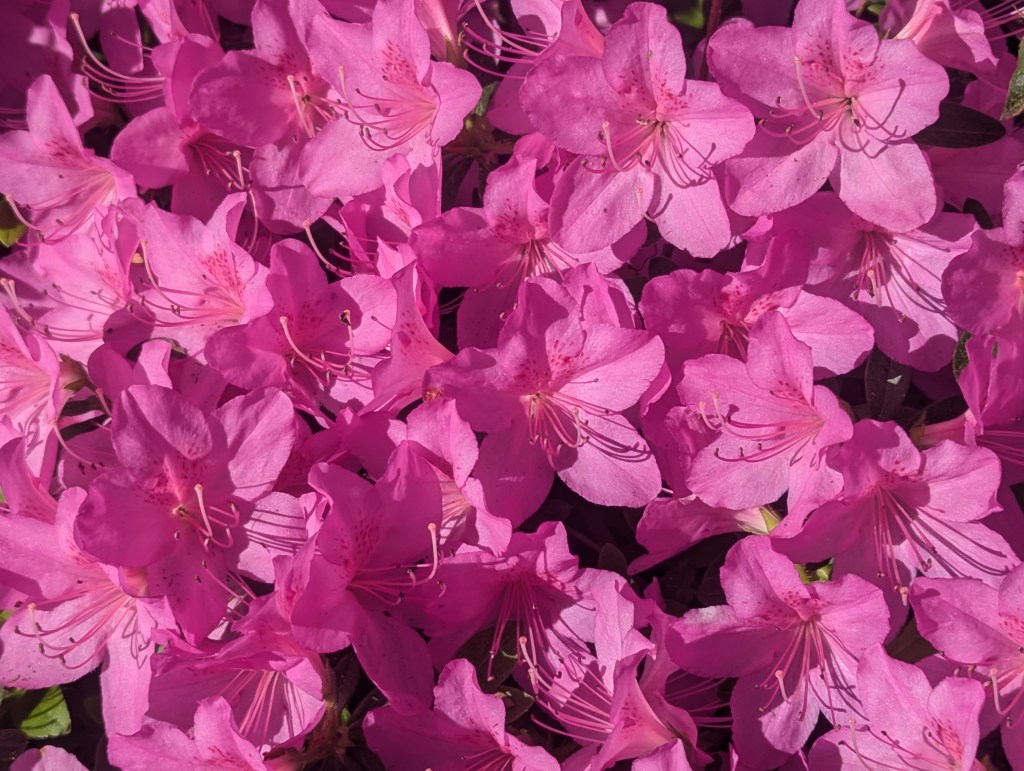
4. This azalea seems to be a ‘florist’ cultivar rather than a landscape cultivar. It was likely left by someone who worked in a nearby office years ago, and then found by a gardener.

5. Within the spacious landscapes here, each cultivar of azalea is installed in groups of at least a few individual specimens. Like the florist azalea, there is only one of this cultivar.

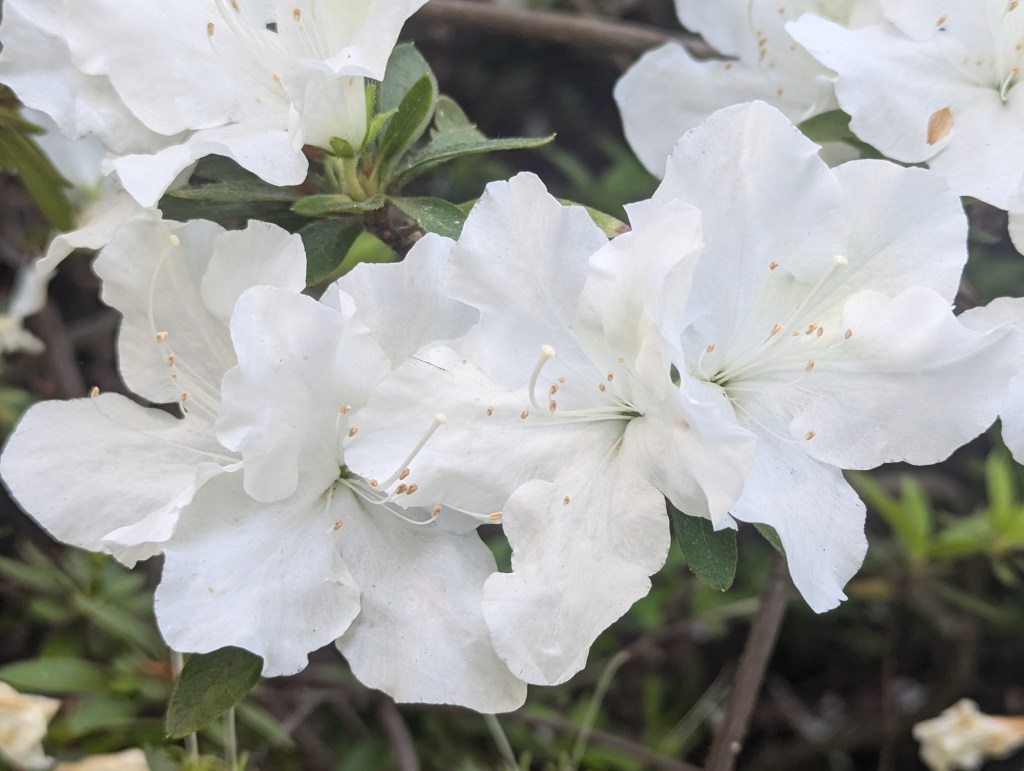
6. ‘Fielder’s White’, which is my favorite of the common azalea cultivars, happens to look very much like this. After restating this phrase thrice, I still can not identify any of these.
This is the link for Six on Saturday, for anyone else who would like to participate: https://thepropagatorblog.wordpress.com/2017/09/18/six-on-saturday-a-participant-guide/
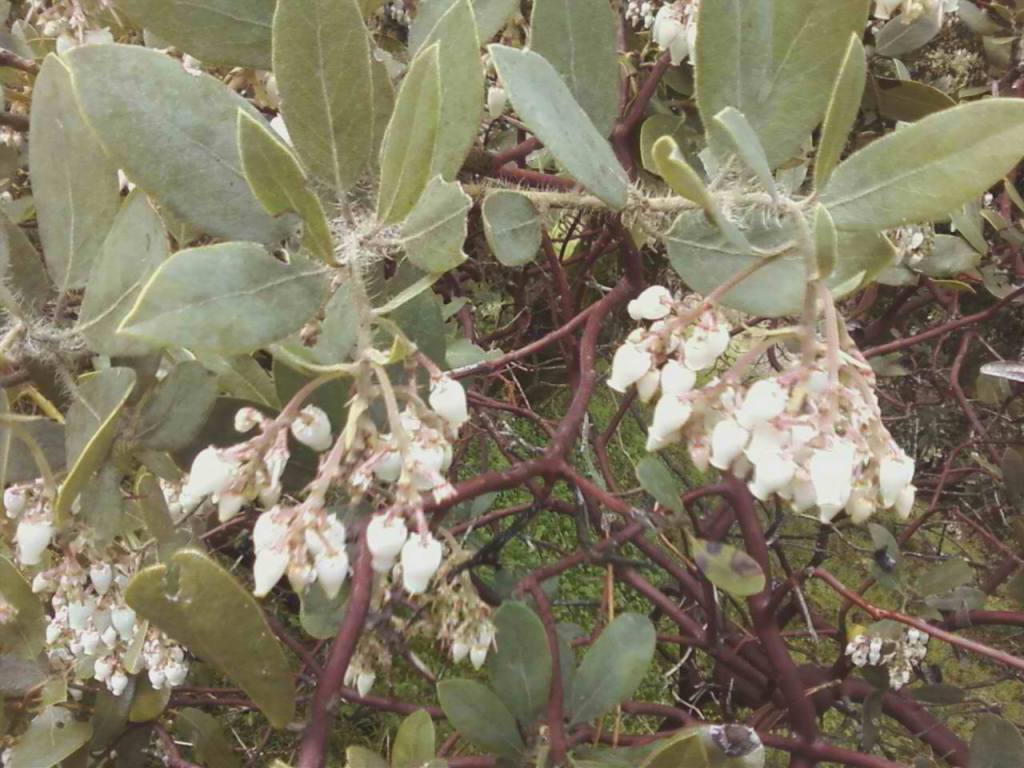
Mature common manzanita, Arctostaphylos manzanita, can get more than fifteen feet tall and about half as wide, so can be rather large shrubbery or small trees. Pruning away lower growth exposes their interestingly sculptural and smooth cinnamon red stems and trunks. The rather stiff light green leaves make light shade that smaller plants can live with. Waxy pinkish buds bloom into small pendulous clusters of tiny white lantern like flowers as winter becomes spring.
Manzanitas prefer to be neglected. They should not be pruned too much, and certainly should not get shorn. Obtrusive stems should be pruned out completely, since stems that get cut back do not regenerate. New plants should only be watered once or twice weekly through the first summer. Mature plants plants only want to be watered monthly or even less. After all, they are native to the surrounding hillsides, so are very satisfied with annual rainfall.
 Tony Tomeo