Not All Pruning Happens In Winter

If necessary, Oregon grape can be pruned to the ground now.

Spring has sprung; and winter has wenter . . . or whatever winter does to get out of the way of spring. Plants are more active now than at any other time of year. Deciduous plants that were dormant and bare through winter have already started to bloom and produce new foliage. Evergreen plants are now making new foliage to replace their tired old foliage that lingered through cold, wet and windy winter weather. 

Frost is very unlikely this late. It is safe to sow seeds for all sorts of warm season vegetables and annual flowers, like beans, okra, zucchini, nasturtiums and sunflowers. It is likewise time to plant small plants for certain vegetables and flowers that are too slow to start from seed, like tomatoes, peppers, eggplants, petunias and impatiens.

Winter was the time to prune almost all deciduous plants (which defoliate) and many evergreen plants while they were dormant. However, pruning of plants that are susceptible to frost damage needed to be delayed until about now, even if they had been damaged earlier. Premature pruning would have stimulated new growth, which would have been even more sensitive to subsequent frost.

Any lavender starflower, bougainvillea, marguerite daisy or blue potato bush foliage that was damaged by earlier frost can now be pruned away. New foliage should already be appearing. Also, any mushy frost damaged leaves of giant-bird-of-Paradise and banana can be removed, and should be replaced by new foliage as the weather gets warmer.

The end of winter and beginning of spring is also the best time for any necessary severe restorative pruning of plants that can be damaged by frost, as well as many heartier evergreen plants. It is late enough to avoid frost, while early enough to take advantage of the first new growth phase of the season.

For example, lavender starflower that is both overgrown and damaged by frost can be pruned back to the main stems now, instead of merely shorn to remove damaged foliage. If pruned earlier, it would have not only been more sensitive to frost, but would have remained unsightly as long as weather remained too cool for it to regenerate new foliage.

It likewise can not be pruned much later without wasting most of the new spring growth that is presently developing, which would be very stressful and delay bloom. Pruning severely now will be unsightly for the least amount of time before new growth regenerates and blooms. It would also be less stressful, since it coincides with natural dormancy and regenerative cycles.

Privets, junipers, oleanders, photinias, bottlebrush and pittosporums that need restoration should also get it now, not because they are sensitive to frost, but so that they recover as efficiently as possible as weather gets warmer. Besides, bottlebrush, pittosporum and some other plants are susceptible to disease if pruned during winter, because pruning wounds are easily infected during rainy weather.
Unexpected Lemon

‘Meyer’ lemon was never my favorite lemon. However, when I grew citrus trees in the early 1990s, it was the most popular of forty or so cultivars. There really is nothing else like it. Relative to other lemons, its fruit is distinctively less acidic, more richly flavored, and sometimes ridiculously abundant. All other lemons are more sour but less flavorful. Besides ‘Meyer’ we grew ‘Lisbon’, ‘Eureka’, ‘Variegated Pink’ and ‘Ponderosa’. Of these four others, only ‘Ponderosa’ is not a mutant of ‘Lisbon’, although its comparably mild flavor and robust acidity suggest that it is. All four grow as small but upright trees. Only ‘Meyer’ naturally grows broader than tall, sort of like shrubbery.

‘Eureka’ lemon inhabits one of the landscapes at work, where it produces enough average lemons for those of us who know about them. I grew cuttings from it for my own garden, but am concerned that, since they are not grafted onto dwarfing understock, they could eventually grow quite large. I also grew an ungrafted cutting of ‘Ponderosa’ lemon for the same landscape at work that the ‘Eureka’ lemon already inhabits, because it happens to be at the Ponderosa Lodge. ‘Ponderosa’ lemon grows with an upright form, but because it naturally stays smaller than ‘Eureka’ lemon and its relatives, I am not too concerned about it growing too large.

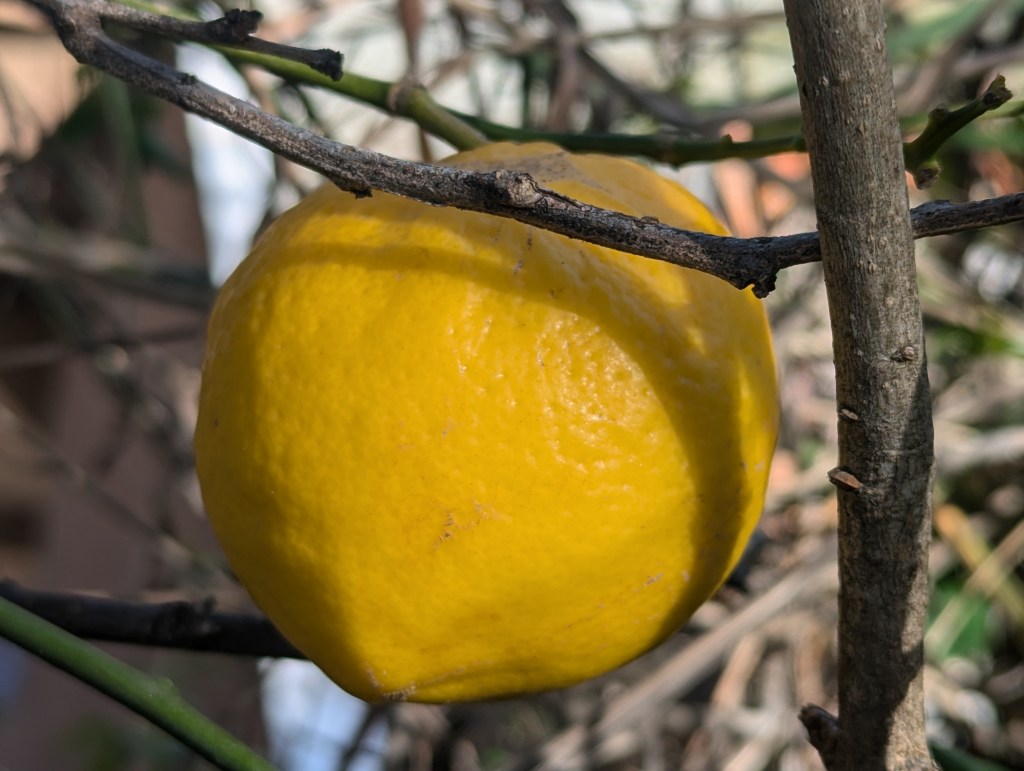
‘Meyer’ lemon came to my garden like a stray cat. Well, it is a bit more complicated than that, but it involved about as much planning. The history of how it came to its previous home is too extensive to describe here. To be brief, I installed it into a garden a few years ago because someone wanted it there after previous unsuccessful attempts to grow the same. Then, it needed to be removed prior to the sale of the home. I did not know what to do with it, so brought it here. I canned it and set it aside until space becomes available for it. I really did not expect it to do much until then. I sort of hoped that someone else would want it for their garden, but after we had been through so much together, I also sort of hoped that it would stay here. Anyway, while I was busy ignoring it in its partly shady and less than ideal situation, I noticed that it had produced this single lemon for me over winter. Well, I suppose that it will be a permanent feature of my garden now.

Bridal Wreath Spiraea

Bridal wreath spiraea resembles baby’s breath.

Flowering quince and forsythia set a precedent. Bridal wreath spiraea, Spirea prunifolia, somehow became old fashioned too. All three are only beginning to regain popularity. All are deciduous, so defoliate for autumn and remain bare through winter. They then bloom spectacularly on bare stems for late winter or early spring. Foliage develops after bloom.

Bridal wreath spiraea, like forsythia, develops many upright and arching basal stems. Its stems can grow taller than eight feet, although they are typically a bit shorter. Removal of old stems after bloom promotes growth of new stems, which bloom better. Indiscriminate pruning ruins their naturally upwardly flaring form. A slight bit of partial shade is tolerable.

Almost all bridal wreath spiraea are of the cultivar ‘Plena’. Their double flowers are fluffy but tiny, between just a quarter and a half inch wide. The simple species, and the variety ‘simpliciflora‘ with single flowers, are rare. Regardless of floral form, floral color is limited to white. Foliage might develop yellow color for autumn where autumn weather is cooler.

Watering Increases As Rain Decreases

Automated irrigation should help conserve water.

Rain is less abundant and less frequent now that winter has become spring. Humidity is decreasing. Temperatures are increasing. Moisture within both the soil and the air is less abundant than it had been. Irrigation that discontinued as the rainy season began should resume soon. Only supplemental watering compensates for the increasing lack of water.

Warmer and drier weather does more than simply deprive vegetation of natural moisture. It also accelerates new growth of formerly dormant or partially dormant vegetation. Such growth requires more moisture as it becomes less available. Increasing day lengths with intensifying sunlight enhance this need for watering. Although natural, it all seems ironic.

This recent need for watering is progressive. Rain still sometimes interrupts it, but will be less frequent as spring progresses. Rain will be very unlikely after later spring. Humidity will continue to decrease as temperatures continue to increase. Watering frequency and volume must increase accordingly. They might not begin to decrease until after summer.

Soil composition and texture also influence the increasing need for watering. Organically rich soils retain moisture more efficiently than sandy soils, for example. Gravely soils that drain well may necessitate frequent watering, even if less copious. Potted plants require frequent watering because they can not disperse roots. Hanging pots require even more.

Furthermore, different types of vegetation need different or specialized types of watering. Fibrous but shallow roots usually need frequent watering, even if they do not need much. Species with deep roots usually need watering less frequently. Some of them need more significant volumes of water than others. Some vegetation prefers only minimal watering.

With all these many variables, there are no simple formulas to determine watering rates. Manual irrigation is easiest to monitor, but is also tedious. Automated irrigation, although less tedious, requires more diligent monitoring. For any particular type of vegetation, soil should not remain too dry for too long. Also, vegetation should not exhibit any symptoms from desiccation.

Six on Saturday: Tangly Cottage Garden

Skyler and Allan, the people who live with Skooter of Tangly Cottage Gardening, invited Rhody and me to tour their home gardens while vacationing in the Pacific Northwest. It has become an annual event. I always leave with a trunk load of interesting and unusual species. I will post pictures of some of such acquisitions from this tour next week. These six pictures are from the home gardens of Tangly Cottage Gardening, although I did take rooted bits and a potted specimen of two of them. After taking these pictures, Rhody and I stayed for lunch and a visit, but did not leave too late to avoid driving in the dark. More pictures of our tour can be seen at Tangly Cottage Gardening.

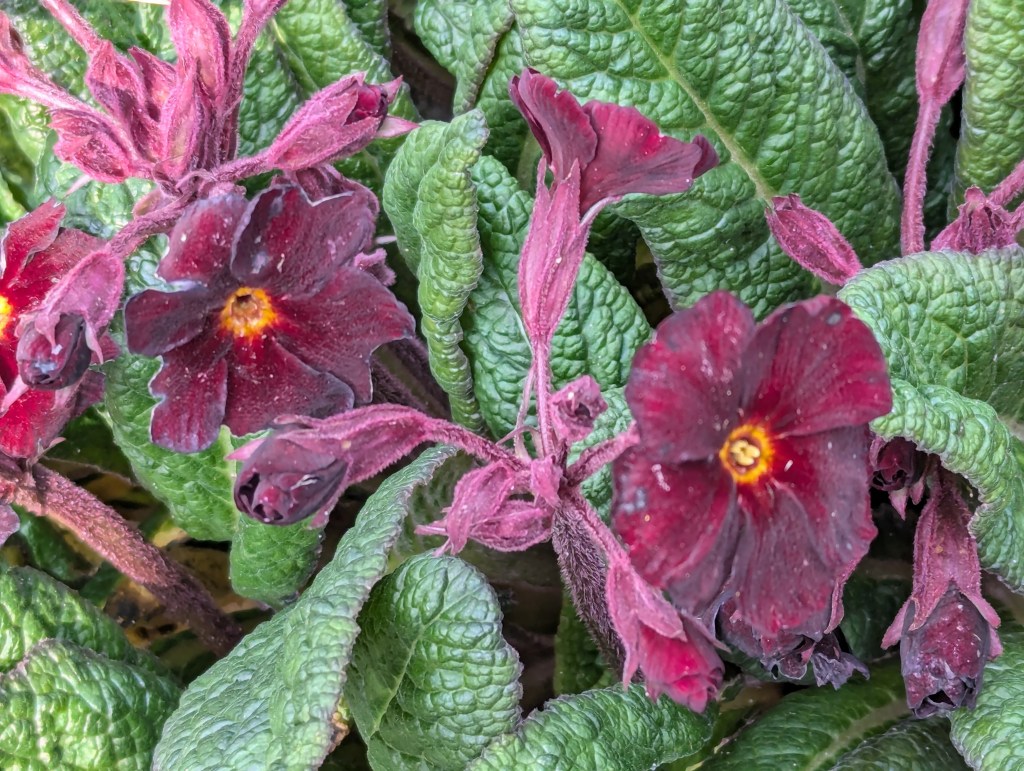
1. Primula X pruhonicensis ‘Old Port’ primrose exhibits luxuriantly rich burgundy floral color. This name is merely a guess, since I actually have no idea what cultivar this one is.

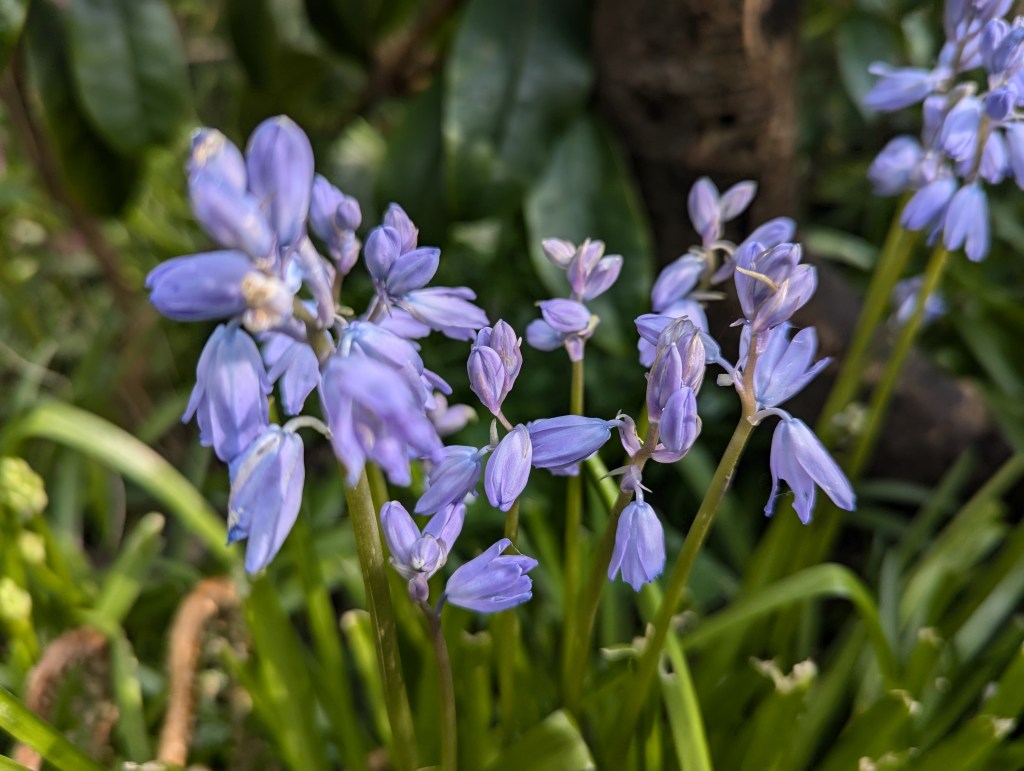
2. Hyacinthoides hispanica, Spanish bluebells is unfortunately a bit too aggressive here, which is why I have not tried it at home. It could be docile in a chaparral climate though.

3. Rubus spectabilis, salmonberry is native and grows wild in Ilwaco. I would have asked for cuttings if I had not already acquired it. I will compare its fruit to other cane berries.

4. Vinca minor ‘Alba Variegata’ periwinkle is not as invasive at home as it is elsewhere. I procured a few bits because I like its white flowers, and may learn to like its variegation.

5. Pulmonaria officinalis ‘Bowles’ Blue’ lungwort, along with cultivars that bloom white, pink and purple, were excellent acquisitions also! Its cultivar name is merely conjecture.

6. Skooter approved of my acquisitions from his Tangly Cottage Garden, which includes quite a bit more than periwinkle and lungwort. I will get pictures of them for next week.

This is the link for Six on Saturday, for anyone else who would like to participate: https://thepropagatorblog.wordpress.com/2017/09/18/six-on-saturday-a-participant-guide/

Kaffir Lily

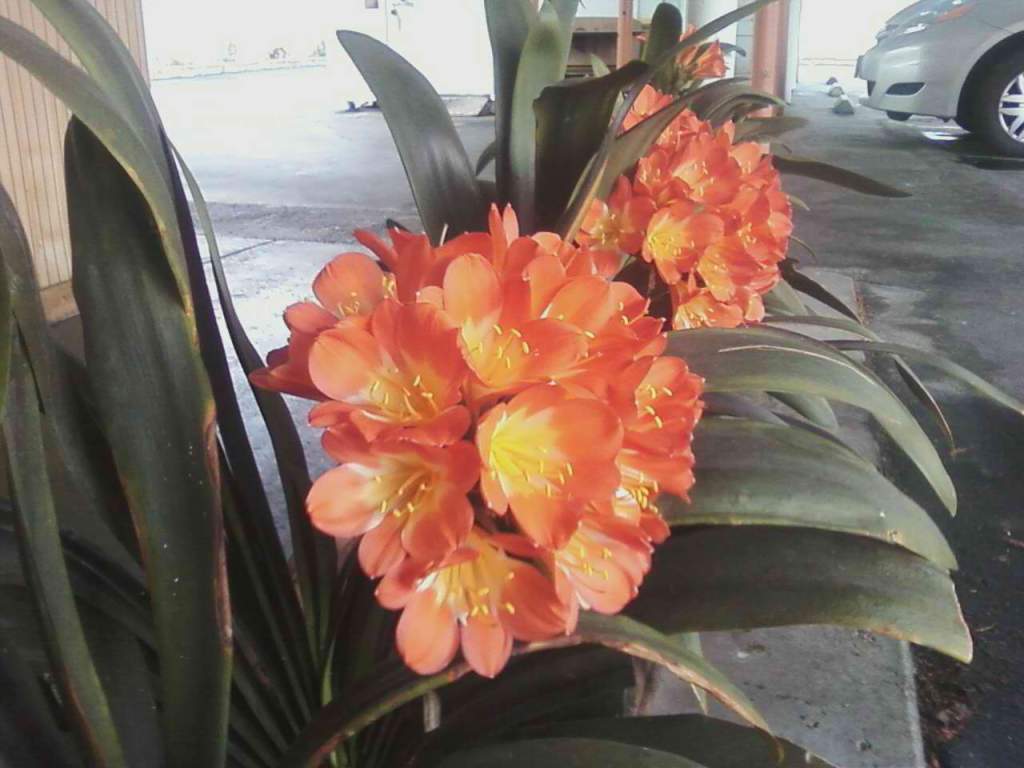
Kaffir lily may look like a bright orange lily of the Nile.

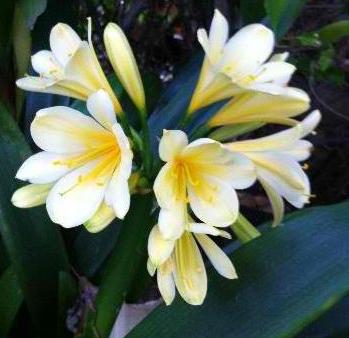
Not much more than a decade ago, Kaffir lily, Clivia miniata, was known almost exclusively for big rounded trusses of boldly bright orange flowers at the end of winter or beginning of spring. Relatively recent breeding has extended the color range to include some softer shades of orange as well as many shades of yellow and reddish orange. Solomone Hybrids are various shades of yellow. ‘Flame’ is brilliant reddish orange. Some varieties bloom earlier in winter. Others bloom later in spring.

Individual tubular flowers are actually rather small, but are clustered like hydrangea flowers on strong stalks that stand as tall as a foot and a half. Bright red berries sometimes appear after flowers fade. The rather rubbery foliage is deep green. The individual strap shaped leaves are rather wide and can be nearly a foot and a half long. Belgian and French hybrids have heftier flower stalks and wider leaves. Established plants do not like to be disturbed, but may get too crowded to bloom well if not dug and divided every few years or so.

Shade Tolerant Species

Kaffir lily is famously resilient to shade.

Most gardens have some sort of shade. Those that are not shaded by substantial trees likely have shadows from houses or fences. Big eaves of ranch architecture make big shadows. So do tall Victorian houses. Yet, the disproportionately small gardens of bulky modern homes with high fences are shadiest.

There are not many trees that do well in shade. Most of those that do are rather small ‘understory’ trees that naturally prefer to be in the partial shade of taller trees. The many different Japanese maples are perhaps the most familiar. Vine maple is a similar maple from North America. Many dogwoods are likewise understory trees.

Eastern redbud, parrotia, strawberry tree, sweet bay and various podocarpus are not necessarily understory trees, but are quite tolerant of partial shade. However, stems that reach beyond the shade are likely to thrive at the expense of shaded parts if not pruned for confinement. For example, a fern pine (podocarpus) can be happy on the north side of a house, but can develop such a thick canopy where it gets good sun exposure on top, that lower growth gets shaded out. All palms tolerate significant shade while young, but most eventually grow beyond it.

There is more shade tolerant shrubbery to choose from, since shrubbery is naturally lower and more likely to be shaded by trees. Rhododendron, azalea, camellia, hydrangea, pieris, fuchsia, aucuba and Japanese aralia are about as familiar as Japanese maple is. Heavenly bamboo (Nandina spp.), Oregon grape, mountain laurel, flowering maple and various hollies are also worth investigating. 

Because low growing perennials are naturally lower than both trees and shrubbery, many are naturally more tolerant to shade. Bear’s breech, cast iron plant, perwinkle, tradescantia, arum and forget-me-not can be so happy in shade that they can actually be invasive. Kaffir lily, bergenia, hosta, lily turf, ginger lily, coral bells and various ferns are much better behaved.

Foxglove, cyclamen and balsam (Impatiens spp.) are good annuals for shady spots. Cyclamen is actually a perennial that deteriorates during warm summer weather, but can regenerate as weather gets cool in autumn, to bloom through winter and early spring. Balsam does just the opposite, thriving through warm weather, but deteriorating with frost. Caladium and coleus can provide remarkably colorful foliage until frost. (Foxglove is actually biennial. Caladium grows from bulbs, but is rarely perennial.)

Despite their reputation as being aggressively invasive, both Algerian and English ivies can be resilient ground covers in significant shade. Baby’s tears likewise spreads as far as it gets water. Star jasmine is more complaisant, but only tolerant of moderate shade, and will not bloom as well as it does with better exposure.

Horridculture – Aquatic Vegetation

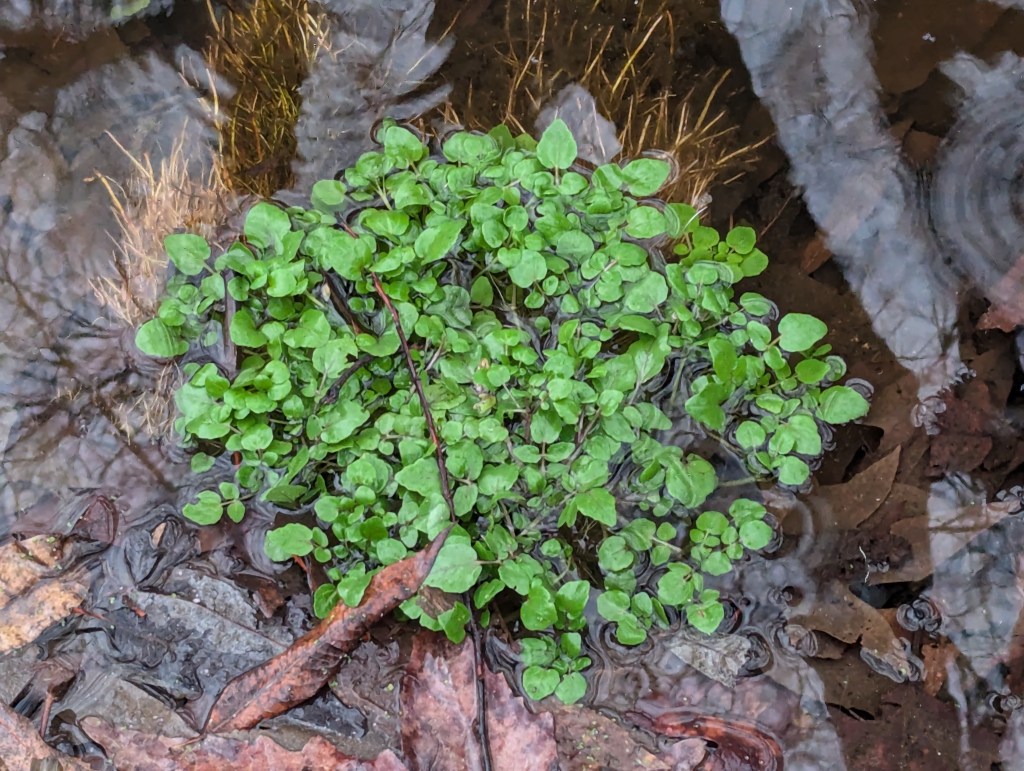
Watercress, Nasturtium officinale

Watercress, Nasturtium officinale, seems to be proliferating a bit more in the drainage pond than it did last year. It is difficult to compare, since I was not concerned about it enough to monitor it last year. I am likely noticing it more now because the duckweed, Lemna minor, deteriorated slower than it did last year, which maintained my interest in such infesting aquatic vegetation. I have been monitoring the cattail, Typha latifolia, also. Although none of these species are exotic, I do not want any of them to proliferate so much that they obscure the pond that they inhabit. That has been a problem with duckweed as long as the pond has contained water. I am aware that cattail also has potential to proliferate aggressively, although I believe that such proliferation would be easier to mitigate. I really do not know how watercress behaves, though. I can not remember ever seeing a pond anywhere completely overwhelmed by it. I doubt that, even if it does proliferate aggressively, that it would be as difficult to contend with as duckweed is. Perhaps it would compete with duckweed! Goodness; I never intended to get so involved with aquatic vegetation. It is not exactly the sort of vegetation that inhabits ‘land’scapes. Yet, the drainage pond is a feature of the landscapes here. We maintain the willows, cottonwoods, sycamores, oaks and Landon’s tree around it, so obviously, must maintain the aquatic vegetation within it as well. In that regard, I would prefer to grow a few more ornamental but less aggressive aquatic species, such as water lilies. Unfortunately, the few water lilies that we tried were tropical species that seemed to succumb to cool winter weather and overwhelming duckweed. I should try some native water lilies, but they might be a bit too prolific.

Tulip

A single tulip flower seems lonely.

As diverse as they are, popular varieties are a minority of countless hybrids of the genus. Most common and popular hybrid tulips qualify as the neo-species of Tulipa gesneriana. In other words, they are not an actual species. Most but not all are descendants of Tulipa suaveolens. More sustainable varieties of simple species are becoming more available.

The most popular of tulip are early spring bulbs that went into their gardens last autumn. Floral color ranges through pink, red, orange, yellow and white, mostly with dark centers. Their basal foliage is rather light green or perhaps almost grayish, with a rubbery texture. Most tulips stand singly on straight stems about a foot tall, but some can grow a bit taller.

Tulip bulbs enjoy organically rich soil with regular irrigation throughout their bloom cycle. They should get all the moisture they want from rain through their winter dormancy cycle. Tulip prefer a bit of chill in winter, so may not be as reliably perennial here as elsewhere. They are most spectacular in herds or large beds, but mix nicely with other spring bulbs. Simple tulips are among the most popular of cut flowers.