
Sunday Best – Flowering Quince (January 31)
Ericaceae is a prominent family here. Rhododendrons, azaleas and pieris inhabit several of the landscapes. Manzanitas, madrones and, within some situations, huckleberries, are common within the surrounding forests. Even two of my associates, although unrelated to Ericaceae, are named for two members of the family that are popular for landscaping. Half of my Six for this Saturday are azaleas. Just one other is another ericaceous species. Later, I can get better pictures of azaleas as well as rhododendrons. Several impressively large rhododendrons bloom spectacularly in season. Heather would be nice, but is quite rare. I know where abandoned fields of it grew wild, but I have never seen it available in nurseries.
1. Heath is a masculine name. It is of the Erica genus, though; and Erica is the feminine form of Eric. Heather is a similar but feminine name, but is of a different Calluna genus.
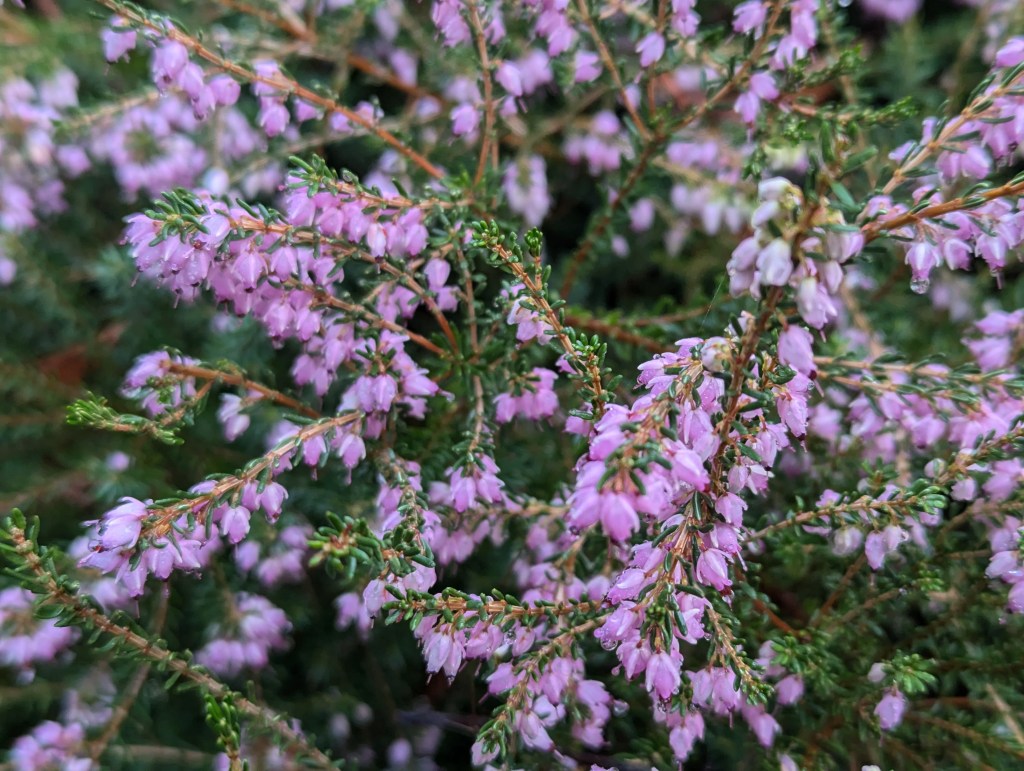
2. ‘Coral Bells’ Azalea, like all azaleas, is of the Rhododendron genus, so like heather and heath, is in the Ericaceae family. All of them are also related to madrone and manzanita.
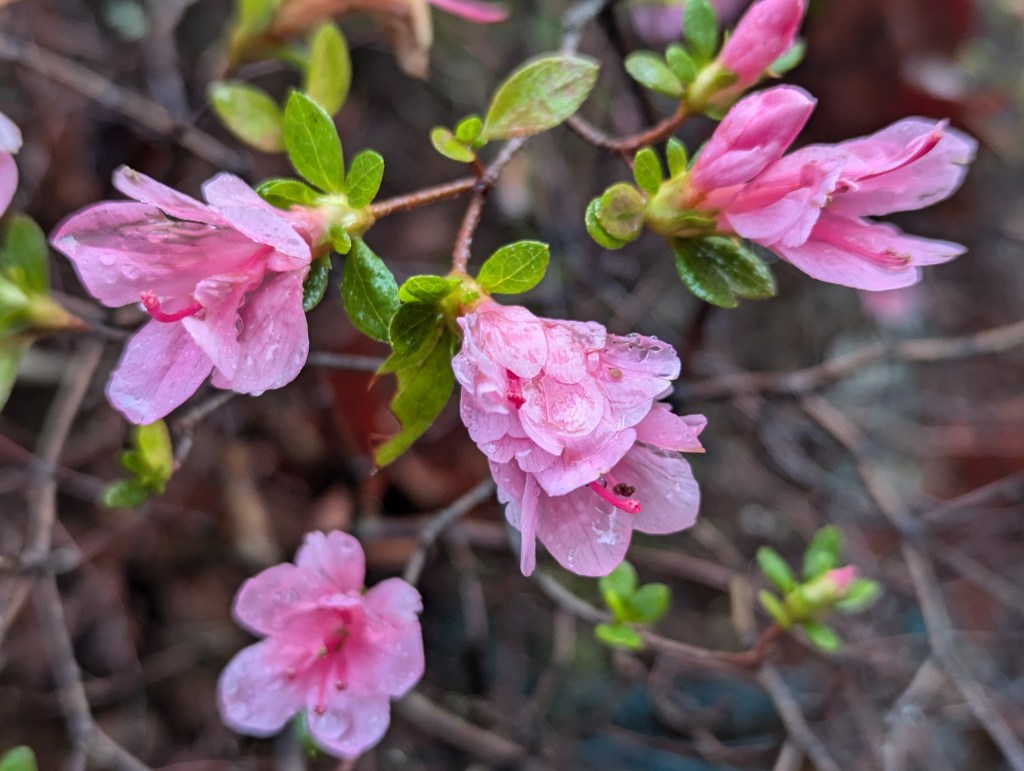
3. Azaleas generally bloom for early spring. These that bloom somewhat too early during the rainy season can get a bit thrashed. They would be prettier if they could delay bloom.

4. Florist azaleas are delightful as fully blooming potted specimens, but generally do not adapt well to landscapes. This specimen is floppy, but otherwise performs impressively.

5. Heather is named for Calluna, which, actually, I have not seen in many years. It grew as a cut flower crop in Montara more than half a century ago. It was abandoned by 1980.

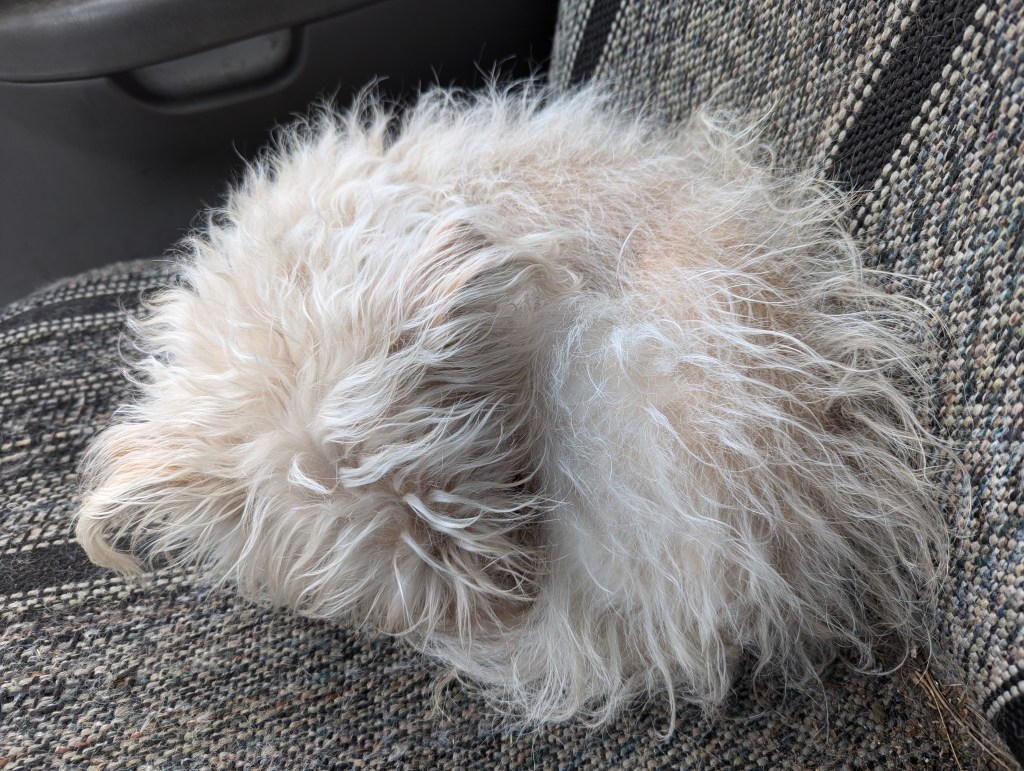
6. Rhody is short, and his name is short for Rhododendron. But of course, he is a terrier, so ignores me regardless of what I call him. He can actually ignore me in four languages!
This is the link for Six on Saturday, for anyone else who would like to participate: https://thepropagatorblog.wordpress.com/2017/09/18/six-on-saturday-a-participant-guide/
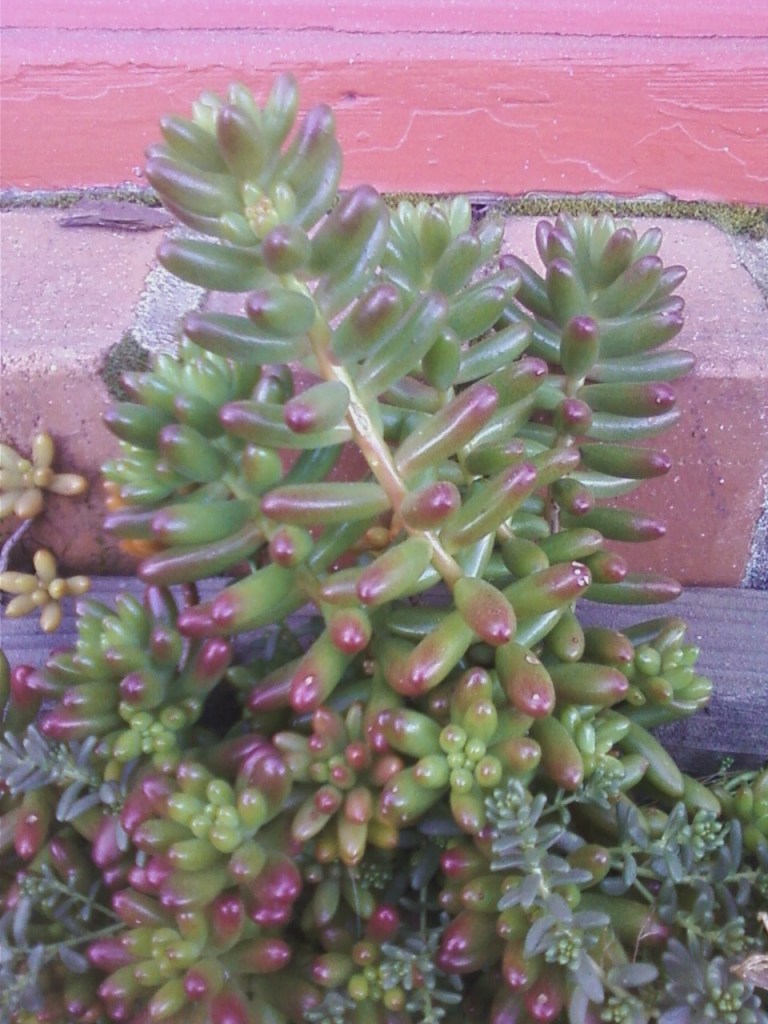
The tender succulent foliage of pork and beans, Sedum rubrotinctum, is as squishy as it appears to be, so is safest where it will not be disturbed. Although it sprawls around without getting much deeper than six inches, it does not fill in reliably enough to be a real ground cover over a large area anyway. It can instead add color and texture in small doses between larger plants or stones. It is a nice addition to urns of mixed perennials, rock gardens and dish gardens. It propagates very easily from stem cuttings or even leaves that break off, so can be tucked into gaps in stone walls.
The plump three quarter inch long leaves resemble jelly beans more than pork and beans, since they are green where shaded. More exposed foliage is more bronzy red or brown, especially at the tips. Small clusters of tiny yellowish flowers are held above the foliage on reddish brown stems in spring.
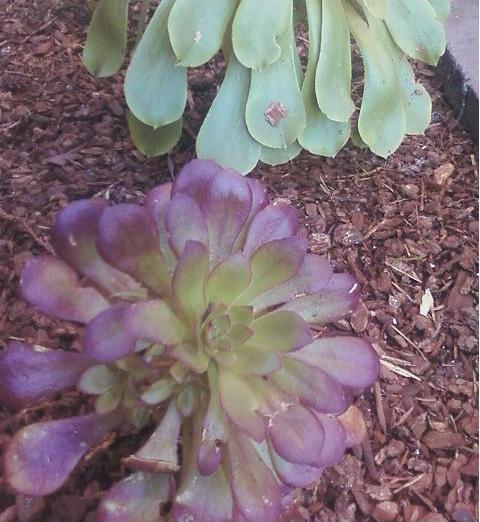
Rock gardens, as they are known now, evolved from more traditional alpine gardens that were designed to display specimens of small plants found in the mountains of Europe. These plants were mostly compact and slow growing to be adapted to the harsh climates and rocky soils of higher elevations, but do not compete well with more aggressive plants. They consequently need their own space, and are quite happy surrounded by rock or gravel to insulate the surface of the soil and control weeds. Slight slopes, as well as the abundance of rock, enhance drainage to replicate mountainous conditions.
Compact plants from all over the world now find homes in rock gardens. The compact nature of rock garden makes them practical for small spaces, particularly where slopes make other gardening difficult. Sculptural, colorful or lichen covered rocks, as well as garden sculpture, can be as ornamental as the plants that surround them. Larger stones can substitute for low retaining walls.
Plants for rock gardens do not need to be from mountainous areas, but should be compact. They must also be appropriate to the particular microclimate. For example, small succulents and cacti want to be as exposed in a rock garden as they would be in a real landscape. Lily-of-the-valley shrub conversely prefers sheltered cooler spots.
Trees for rock gardens are generally very small. Pendulous (weeping) and dwarf Japanese maples are more desirable than those that eventually grow into mid sized trees. Dwarf forms of spruce, eastern hemlock, cedar, fir and false cypress all work well. There are also several dwarf pines to choose from, including dwarf cultivars of Scots, Japanese red, tanyosho, mugho, white and pinon pines.
Dwarf forms of cotoneaster, hebe, holly, rockrose, germander and Japanese barberry have become as popular in rock gardens as the more traditional small heathers and heaths. There are several compact junipers as well. Some rock gardens plants grow into small shrubbery. Others sprawl about as mats or dense ground cover.
Thrift (sea pink), campanula, snow-in-summer, fleabane, coral bells, plantain lily, evergreen candytuft, carpet bugle (Ajuga spp.), and small herbs like thyme and oregano are some of the more popular perennials for rock gardens. Mat forming penstemon, columbine, cranesbill, saxifrage, rockcress and dwarf types of dianthus and primrose are more difficult to obtain, but worth trying. There are of course many small succulents like aeonium, echeveria, stonecrop (sedum) and ice-plant.
Crocus, grape hyacinth, snowdrop and wild freesia are the only common bulbs that are well suited to rock gardens. Uncommon dwarf cyclamen (not Cyclamen persicum), small types of narcissus and diminutive iris that can sometimes be found by mail order catalogues, online, or occasionally in nurseries that stock unusual plants are actually more proportionate to rock gardens than they are in more typical types of gardens.

Strelitzia nicolai, is giant bird of Paradise. Unlike the more familiar bird of Paradise, with basal foliage and its distinctive orange flowers, this species develops several tall trunks and less colorful but interestingly large white flowers. We recycled several into one of the landscapes here from a home garden in Morgan Hill about two years ago. Originally, they were three somewhat mature groups, with rather tall trunks. Then, they were divided into individual trunks and pups. Ultimately about sixteen were installed into the landscape, with a few spare pups canned as spares, just in case some of the others do not recover from their division. I predicted that those with tall trunks would not last long before replacing themselves with basal growth, and then shedding their unusually tall trunks. Not only are they not developing basal growth yet, but their upper foliage on top of their lanky tall trunks is actually growing and developing into new foliar canopies. They sort of look like silly palm trees that are getting less silly as they continue to grow. I mean that they actually look rather appealing, and probably look more appealing to those who do not know what they should look like. They seem to be pretending to be faux palm trees. I can do nothing about their behavior, and even if I could, I would not. I want to see what they do next. I suspect that they will eventually perform as expected. I also suspect that, because they are already so tall, that, for as long as they retain it, their upper foliage will never be as lush as it would be if lower. That is normal for the species, and how those who maintain such specimens know when to cull the taller trunks by cutting them to the ground.

Grecian bay is, as its name suggests, endemic to Greece and the Mediterranean region. California bay, Umbellularia californica, is native to California and southwestern Oregon. The two are very different. Although California bay can be useful for culinary application, it is twice as pungent. For replacing Grecian bay in recipes, half as much should suffice.
California bay also grows much larger and more irregularly than Grecian bay. With good sun exposure, it grows more than forty feet tall. Where it competes for sunlight in forests, it can grow a hundred feet tall. Domestic trees typically develop on single vertical trunks. Wild trees might develop several leaning trunks. Foliar canopies are densely evergreen.
California bay is uncommon within urban home gardens because it is so big and messy. It is more likely to inhabit rural gardens either by self sowing or by being there first. Some old trees that grew from stumps of older trees can develop basal decay. Stumps might be difficult to kill. Foliar and floral detritus inhibits smaller vegetation and seed germination. Some abhor the foliar aroma.
Horticulture is as diversified as horticultural professionals. Nurserymen grow horticultural commodities. Landscape designers plan installation of the commodities into landscapes. Landscapers construct the landscapes. Gardeners maintain them afterward. Florists use floral commodities. Arborists specialize in arboriculture, which is the horticulture of trees.
Arboriculture is necessary because trees are so substantial. Although most arborists can work with smaller trees, larger trees are their priority. Other horticultural professionals are neither qualified nor able to work with such trees. Similarly, arborists are too specialized to engage with landscape design or floristry. Arboriculture is truly an intensive discipline.
Many garden enthusiasts maintain their own trees while such trees are somewhat small. Some trees, such as dwarf citrus and Japanese maples, stay small. However, most trees eventually grow beyond reach from the ground. Even within gardens that lack gardeners, arborists might become necessary. This is certainly not something to be negligent about.
When pansies get tired in spring, gardeners can replace them with petunias for summer. Trees are completely different. They are the most substantial and persistent vegetation in their respective landscapes. Some can survive for a few centuries. The consequences of their neglect can be disastrous. Arboriculture is crucial to the safety of their environment.
The importance of arboriculture typically becomes more apparent during wintry weather. Rain destabilizes roots. Wind weakens the integrity of limbs and trunks. Generally, trees become messier and more hazardous than at other times of year. However, arboriculture is a concern throughout the year. Spontaneous limb failure is more likely during summer.
Besides, several procedures for certain trees are more appropriate during other seasons. Furthermore, mitigation of potential problems is easier before they become emergencies. Information about arboriculture is available from the International Society of Arboriculture or ISA. Their website, which also provides a list of certified arborists, is at isa-arbor.com.

“This” is the first word of each of these six entries for Six on Saturday this week. There is not much variation among the coast live oak, coastal redwood, California bay, California black oak, big leaf maple and whatever else might be visible in these pictures. Half these pictures happen to feature specific coast live oaks. Therefore, I omitted botanical names. I wanted to show some of what is happening at the new home site, but there is not much to show, and there may not be much to show for a while, except for Rhody.
1. This is where the old home was. The forest wasted no time reclaiming its space. I miss the old home very much, but it was too deteriorated to salvage. I knew it was temporary.

2. This is where the new home will be built. It is less than fifty feet to the west, and faces more to the west instead of south. The upstairs office studio will face into the redwoods.

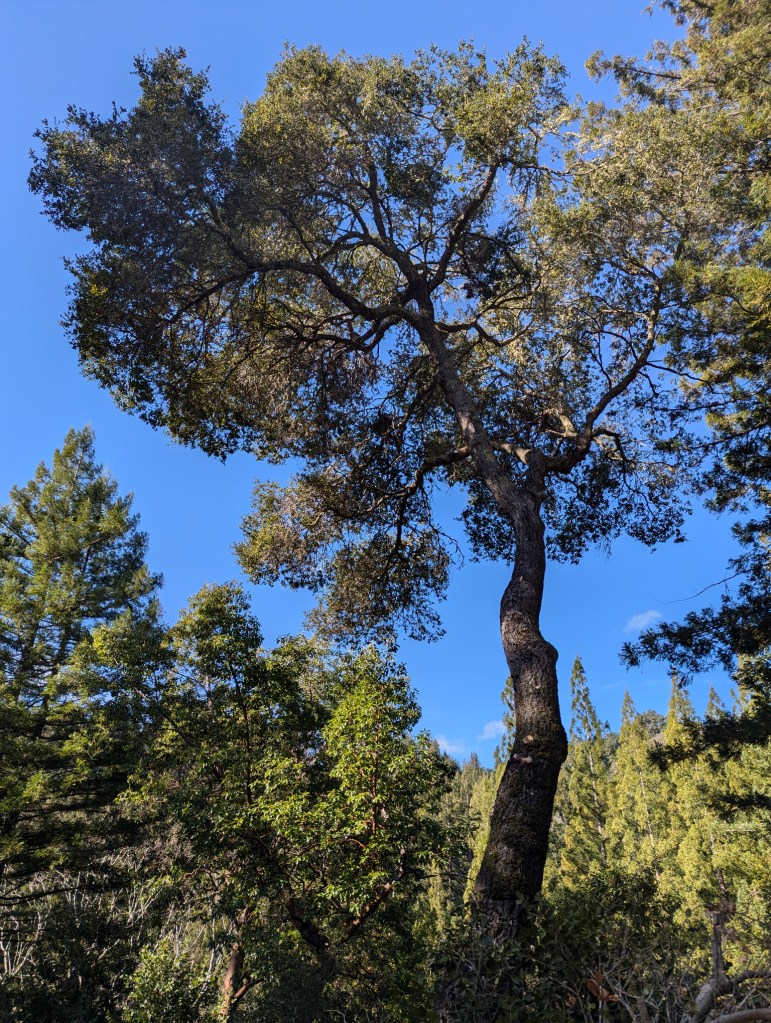
3. This lofty coast live oak stands high over the new home site, but leans to the north and away from where the house will be. It is the biggest of several big oaks in the grove here.
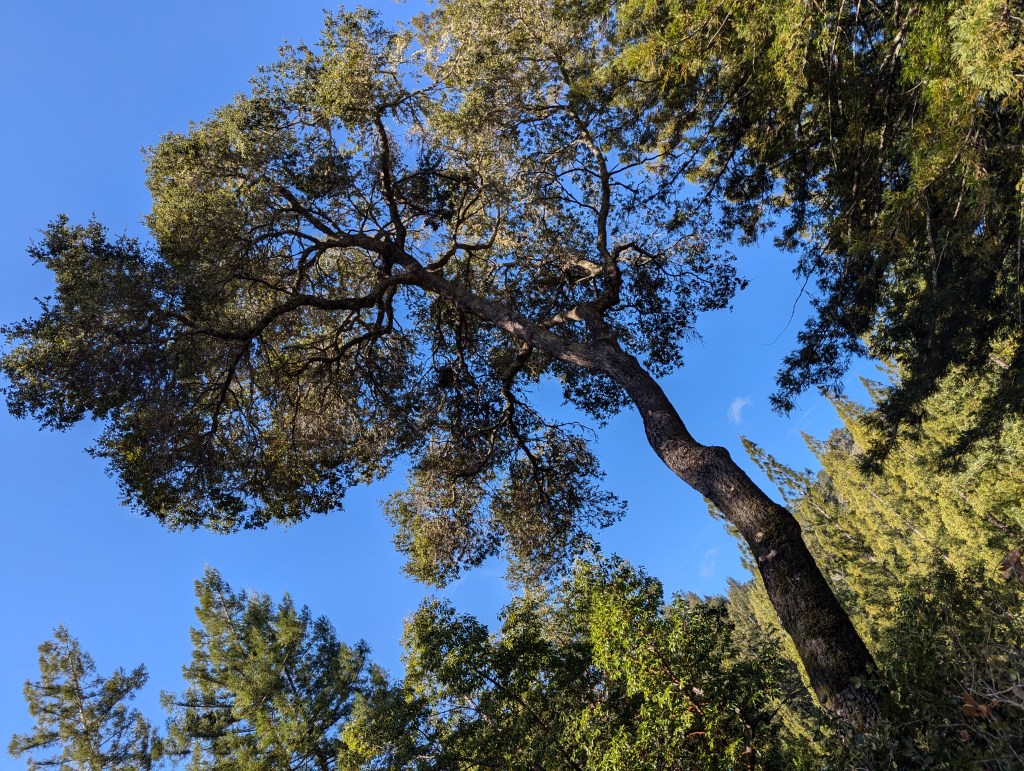
4. This silly coast live oak leans parallel to the driveway. The contrastingly vertical trunk to its right is the same that is on the right border of the first picture of the old home site.

5. This grand coast live oak arches elegantly over the driveway. It can be seen across the upper left corner of the previous picture. It is about perpendicular to the horizontal oak.

6. This is how I manage the overgrown and overly combustible vegetation here. It needs to be planned in accordance with the weather that has been too dry for much too long.

This is the link for Six on Saturday, for anyone else who would like to participate: https://thepropagatorblog.wordpress.com/2017/09/18/six-on-saturday-a-participant-guide/

If their bulbs were planted when they became available as summer evolved into autumn, Tazetta Narcissus and their hybrids should begin to bloom about now, a bit prior to related daffodil and jonquil Narcissus. In cooler winter climates, bloom must wait until early spring. The most popular variety, ‘Paper White’ blooms with about five or six small clear white flowers clustered on top of foot tall stems surrounded by vertical and somewhat rubbery, narrow leaves. Other varieties have white or yellow outer petals, known as the ‘perianth’, or orange or white centers, known as the ‘cup’. All are good cut flowers that are quite fragrant.
Because it is best to leave narcissus foliage to yellow and abscise (shed) naturally after bloom and as weather gets warmer, ground covers that are deep enough to conceal their deteriorating foliage are practical companions. (For example, deteriorating narcissus foliage can be stuffed under healthy English ivy, where it can be hidden without being removed.) Ground cover also keeps the soil from being bare during summer and autumn dormancy.
Mature clumps of narcissus bulbs only need to be dug and divided if they become so crowded that they do not bloom as much as they should. They are easiest to dig immediately after foliage dies back and lies on the ground, when they are dormant but still easy to find. Dug bulbs should then be stored in a cool dry place until it is time to plant them late in summer. Bulbs should be planted about five inches deep and about five to eight inches apart, with good sun exposure. The largest bulbs with multiple buds (known as ‘noses’) bloom most abundantly.
If they are happy in their location, narcissus easily naturalize, even if they do not get divided occasionally. They get most of the water they need from rain, since they are mostly dormant before dry weather in summer. Gophers and deer do not bother them.
 Tony Tomeo