Stone fruit classification can get confusing. All stone fruit are of the same genus, Prunus. This includes almonds, which are stones or seeds of inedible fruit. Prunes are European fruits that are conducive to juicing and drying. Plums are similar Japanese fruits for fresh consumption, but not for drying. The two are more different than peaches and nectarines.
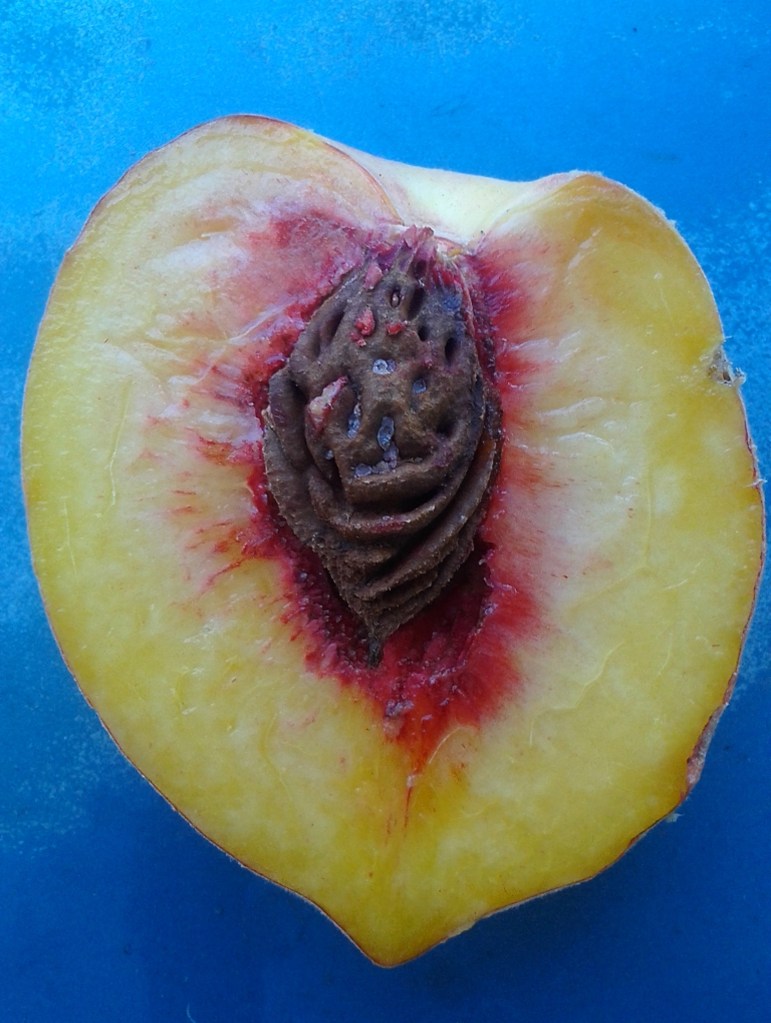
Nectarines, Prunus persicaria var. nucipersica, are simply peaches without fuzz. Cultural requirements are about the same for both. They need only very minor chill through winter to vernalize, and enjoy summery warmth. Trees are not very productive for their first year or two. Then, they may produce for only about twenty years. Thirty year old trees are old.
Both nectarine and peach trees require aggressive pruning while dormant during winter. Otherwise, they can not support the weight of their big and abundant fruit during summer. Semidwarf trees, which are the most popular, can potentially grow twenty feet high. They should stay half as high with adequate pruning. Most of their fruit should be within reach. Bare root trees initially disperse roots more readily than canned trees.
Gardening is dynamic. It must adapt as each season becomes the next. Autumn became winter. Then, suddenly, the Christmas Season became bare root season. Cut Christmas trees that did not sell became green waste. Formerly expensive live Christmas trees that did not sell became bargains. They must relinquish their spaces for fresh bare root stock.
The chronology could not be better. Christmas trees are seasonable while not much else is. Their season abruptly ends precisely as bare root season begins. Bare root season is contingent on the winter dormancy of all associated bare root stock. While dormant, such stock is unaware of what is happening. Otherwise, it would not survive such techniques.
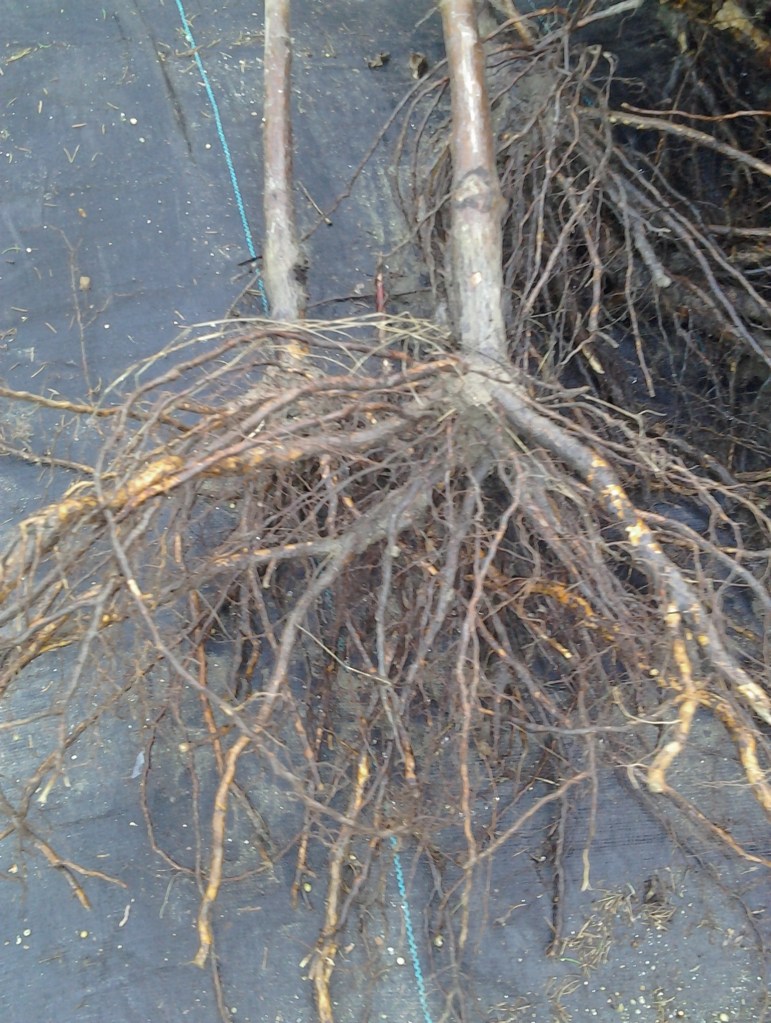
Bare root stock grows in the ground on farms. The roots become bare by separation from their soil during winter dormancy. They should be comfortable within the soil of their new gardens before dormancy ends. They disperse new roots into their new gardens as they resume growth after dormancy. Therefore, transition from farm to garden should be quick.
Some bare root stock arrives by parcel delivery with damply wrapped and bagged roots. More is available from nurseries, with its roots relaxing within damp sand until purchase. Some is available within individual bags of damp sawdust. Most bare root stock benefits from generally minor trimming or grooming. All benefits from prompt and proper planting.
Bare root season is the best time to procure and install several types of plants. Bare root stock is significantly less expensive than canned stock. It is also much less cumbersome to bring home from nurseries. Because bare roots were never confined within cans, they disperse more efficiently. Formerly canned root systems must recover from confinement.
Deciduous fruit trees and roses are the most popular bare root plants. More cultivars are available during bare root season than as canned nursery stock later. Several deciduous but fruitless trees, vines and shrubs are also available. So are a few types of berries and perennials, like rhubarb, asparagus and artichoke. Bare root season finishes with winter.
Is exclusive bloom becoming redundant? Well, one of these is actually foliar rather than floral, although it resembles real floral bloom enough to qualify for the title above. Most of these six are annuals.
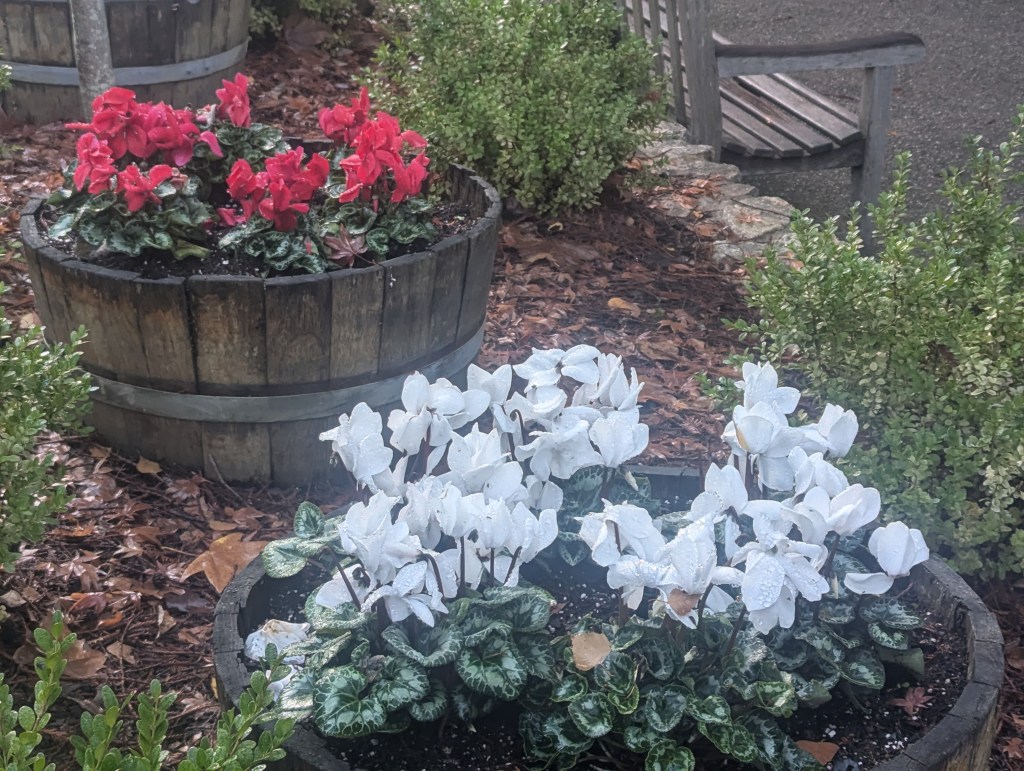
1. Cyclamen persicum, Persian cyclamen is now a Ghost of Christmas Past that will stay as long as it performs. If it does not mold by the end of the rainy season, it will hibernate by the warmly dry season. It is sadly exploited as an expensively cheap annual perennial.
2. Lobularia maritima, alyssum remains from last summer as a genuinely cheap annual that wants to be a perennial. Although it has potential to perform as a perennial, salvage after winter is less practical than replacement, especially since alyssum is not expensive.
3. Rosmarinus officinalis ‘Prostratus’ creeping rosemary is neither annual nor perennial like the others. It is instead a very prostrate shrub that sprawls as a ground cover. Bloom seems to be continuous, although not as impressive as bloom of annuals and perennials.
4. Viola X wittrockiana, pansy is probably the most popular cool season annual here. It has potential to be perennial, but like alyssum, it is easier to replace when it is in season than salvage after it was not in season. It gets thrashed through the warmth of summer.
5. Osteospermum ecklonis, African daisy tries to bloom as continuously as rosemary. Its flowers do not last for long while the weather is cool and damp, though, and might mold before they unfurl. Several cultivars with distinct floral colors bloom in the same garden.
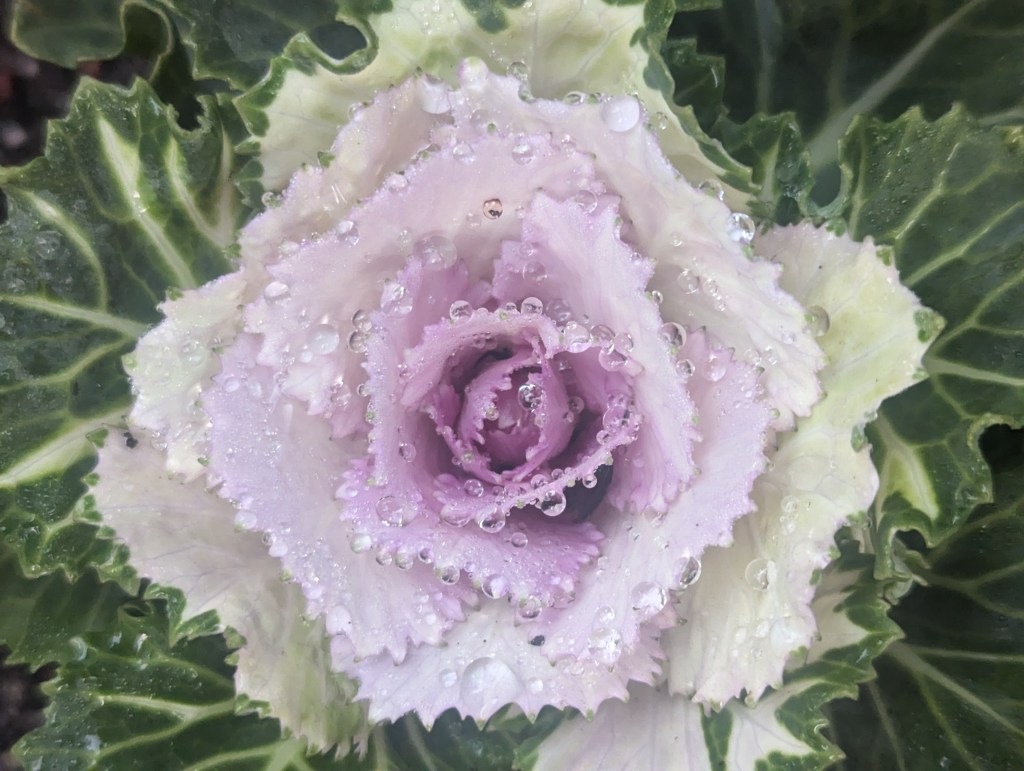
6. Brassica oleracea var. acephala, ornamental cabbage is the only one of these six that is foliar rather than floral. Actually, it deteriorates as it eventually blooms with warming summer weather. Yet, it is the biggest and boldest of these six even without floral bloom.
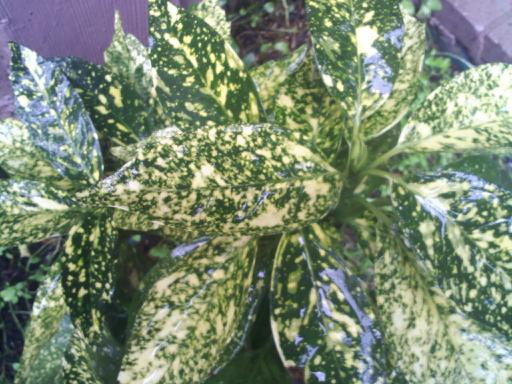
Gold dust plants actually prefers partial shade to full sun exposure.
Like so many hollies, the gold dust plant, Aucuba japonica ‘Variegata’, is grown more for its glossy foliage than for flowers or berries. The tiny dark red flowers that bloom in the beginning of spring are barely visible. Clusters of bright red half inch wide berries that ripen in autumn and winter are almost never seen without a male pollinator. Yet, the three inch wide and three to five inch long leaves are colorful enough with their splattering of light yellow spots. Gold dust plant grows rather slowly to about six to eight feet tall and wide, and does better in partial shade. Foliage can get roasted if too exposed to sunlight.
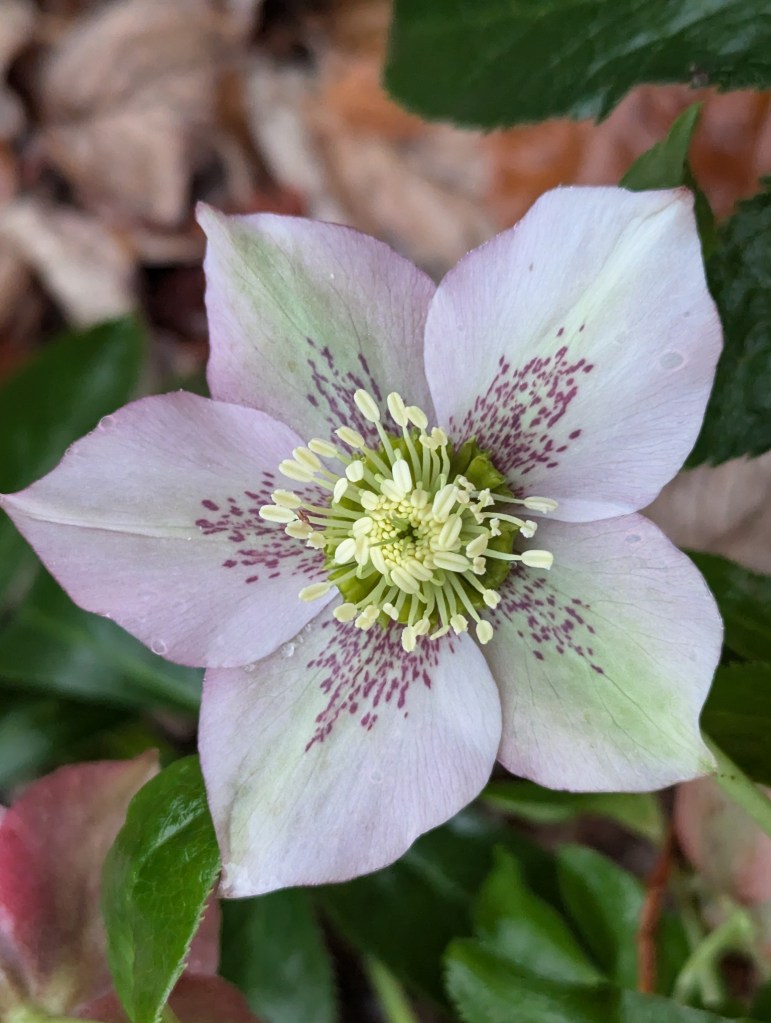
Hellebore may not tolerate much arid warmth, but is impressively tolerant of partial shade.
Suburban gardens are becoming shadier. More modern homes are taller than a single story, so make larger shadows. Taller and more fortified fences likewise create more shade. Smaller garden spaces of modern homes, or of older homes that have been added onto, have less sunny area away from the shadows of the associated homes and fences. Even large gardens of low profile homes lose sunlight as shade trees grow.
Most plants that prefer or at least tolerate shade are ‘understory’ plants; which means that they naturally live in the shade of larger plants. Consequently, most of the few trees that tolerate shade do not get very tall. Vine maple, dogwood, Japanese maple, Eastern redbud and many podocarpus are small to medium sized trees. All palms tolerate some shade, although most grow tall enough to eventually get above it.
Aucuba, boxwood, euonymus, Japanese aralia, holly, Heavenly bamboo and some pittosporums are among the evergreen shrubs that provide foliage in partial shade. Andromeda and Oregon grape have both appealing foliage and flowers. Sarcococca, daphne and gardenia flowers are not quite as showy, but are remarkably fragrant.
Rhododendron, camellia and mountain laurel provide some of the most colorful flowers in partial shade, and have good evergreen foliage while not blooming. Fuchsia and abutilon are rather lanky shrubs, but do have interesting flowers. Hydrangeas are deciduous, so can have good fall color after providing nice foliage and big billowy blooms through summer.
Both Algerian and English ivies, as well as star jasmine, are climbing vines that enjoy partial shade. (Although the ivies cling to whatever they climb, so should be confined to where they will not ruin paint or siding). Star jasmine does not bloom as well or nearly as fragrantly in shade as it does in sunny areas, but has good foliage nonetheless. Any of these vines, as well as periwinkle, is good ground cover for shady spots.
Cast iron plant and arum are not only tough perennials that produce rich deep green foliage in the shade, but can actually become invasive and are difficult to eradicate once established. Bear’s breech is comparable, with the advantage of striking flowers, but the disadvantage that it defoliates through warm summer weather. Various ferns are perhaps the most familiar and complaisant foliar perennials for shade. Lily turf is an evergreen flowering perennial, but realistically, has better foliage than flowers.
Clivia miniata, bergenia and hardier begonias are grown for their colorful flowers as much as for their rich foliage. Clivia miniata is like lily-of-the-Nile for the shade, but blooms with shorter bright reddish orange, red or yellow flowers instead of soft blue and white on tall stems. Some of the various campanulas are delicate shade tolerant perennials with pale blue or white flowers.
Cyclamen, primrose, viola, pansy, forget-me-not, foxglove and impatiens are seasonal annuals that do not mind partial shade. Cyclamen and primrose are actually perennials that can survive through summer to resume bloom the following autumn. Impatiens is actually a warm season annual for summertime that can survive as a perennial through winter.
This was much more awesome than gold, frankincense or myrrh!
Happy Birthday Jesus!
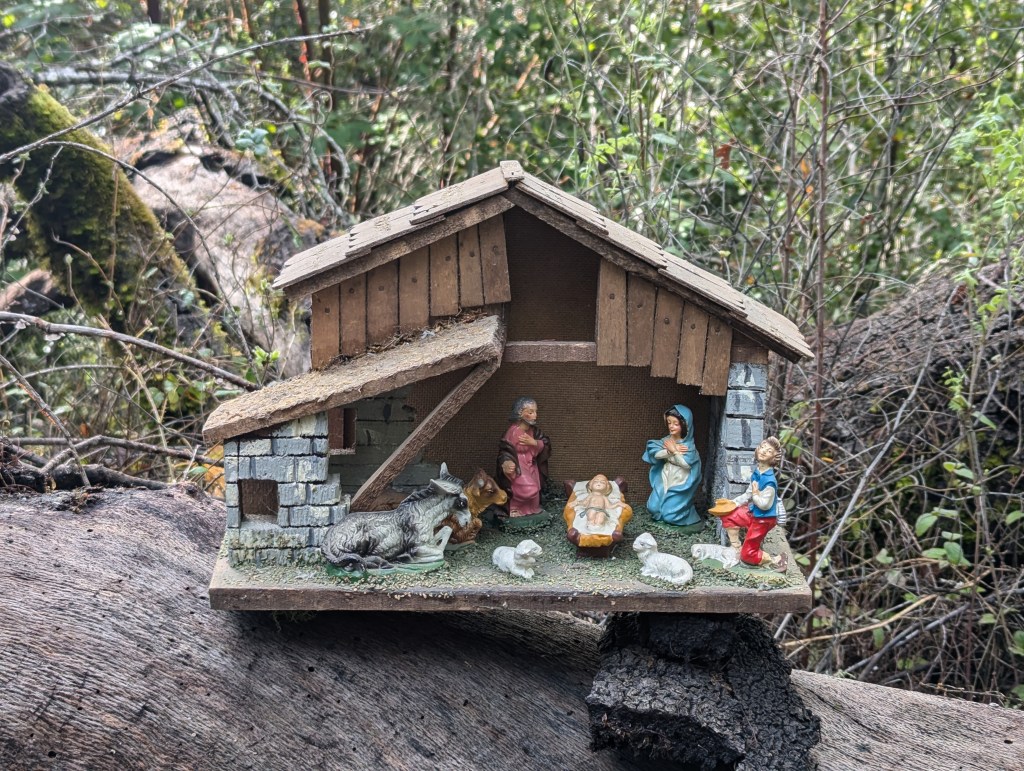
What is a suitable birthday gift for Someone Who has no use for anything worldly, but lived like He did? Gold, frankincense and myrrh seemed like good ideas in the beginning, although they were presented a year prior to His first birthday. Contrary to modern commercialism, a Lexus or Mercedes Benz might not be so appropriate for Someone Who preferred to come into town on a colt, and not the Dodge sort. Perhaps that is why it is customary to present gifts to others instead. Such gifts are Christmas gifts because so few have the same birthday.
Although overly elaborate or abundant gifts are a tradition that I find to be objectionable, I enjoyed many relatively minor gifts when I was a kid. Within my first few years, although I do not remember exactly when, I received my first tree, which was a seedling of Calocedrus decurrens, California incense cedar, from Amador County. A year or two afterward, I received a ‘Meyer’ lemon tree. During the same time, I received seed for many types of vegetables and a few flowers, as well as a set of child-sized gardening tools of premium quality. They lasted long enough for my mother to use the shovel to clean ash from the woodstove long after I graduated to a real shovel.
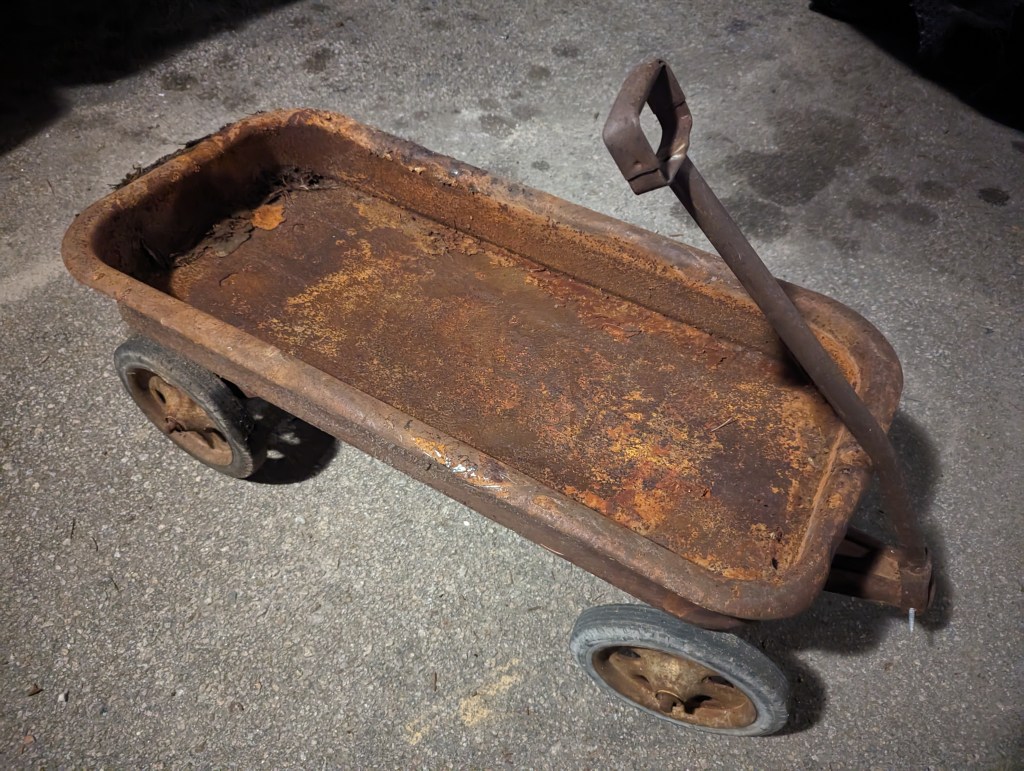
The most awesomely awesome Christmas gift that I received back then was my deluxe Radio Flyer wagon! It was my first luxury sedan that worked like a pickup! It was as durable as the other gardening tools. After I went to college, my mother used it to bring in firewood. It is out back right now, more than half a century after I received it new. It may continue to work in my garden as long as I do.
Where winters are too cool or damp for much else to bloom, hellebore are more popular. The most popular are Helleborus X hybridus, which are hybrids of a few similar species. Most are direct descendants of Helleborus orientalis. They are more resilient to frost than to arid warmth during summer. Actually, that is very likely why they are less popular here.
Locally, hellebore are useful for cool, damp or partly shady situations. However, they are not as substantial as ferns. Also, they can get a bit wimpy as the weather warms through summer. Although evergreen, they shed some of their older yellowing foliage. They grow most during late autumn, winter and perhaps early spring. They crave richly organic soil.
Floral color is typically subdued but interesting. Most common hellebore flowers are pale pink or almost grayish white with spots. Alternatively, they can be rusty red, maroon, pale green, yellow, gray or almost black. Some exhibit more or less spots, blotches, stripes or picotee edges. Double flowers are rufflier than single flowers are. All hellebore are toxic, and for some, can cause dermatitis.
Evergreen foliage and colorful berries might be more prominent than flowers about now. They should be. Evergreen foliage is, as implied, evergreen. Colorful berries need to be appealing to wildlife that disperses their seed through winter. Not so many winter flowers bloom, though. Most flowers want their bloom season to be favorable for their pollinators.
Flowers that do not rely on pollinators can bloom whenever they choose to. Yet, because they do not rely on pollinators, most waste no resources on floral color. Flowers are, after all, only colorful to attract pollinators. Therefore, if flowers that need no pollinators bloom now, most are easy to ignore. Flowers that are colorful now can probably justify being so.
Most colorful flowers bloom while their pollinators are most active, during warm weather. Some from cooler climates can bloom now simply because they do not know it is winter. Some from milder climates can bloom now because they do not know how cool winter is. Several winter flowers actually bloom now to exploit pollinators who are active in winter.
Winter flowers of some species of Salvia appeal very specifically to hummingbirds. Such species are native to regions where hummingbirds overwinter. Their floral colors are the sort that hummingbirds pursue. Their floral structure and nectar favor the eating habits of hummingbirds. They bloom during winter because that is when they expect their guests.
Camellias of various cultivars are among the most popular and reliable of winter flowers. Different cultivars bloom at slightly different times. Witch hazel cultivars can bloom nicely on bare stems where chill is adequate. Winter jasmine requires less chill and blooms as splendidly, but only with yellow. Oregon grape is also limited to yellow, but is evergreen.
Cool season annuals generally provide the most colorful of winter flowers. Unfortunately, most perform only until warmer spring or summer weather. Pansy, viola and primrose are the most familiar. Primrose becomes popular a bit later, and can continue as a short term perennial. Ornamental kale looks like big winter flowers, but is really big colorful foliage.





 Tony Tomeo