Six on Saturday: Another Saturday of Flowers

A Week Of Flowers’ at ‘Words And Herbs’ got me started. It finished two weeks ago, and I did not even participate, but it reminded me that I should exhibit more floral pictures. Although the original project featured any floral pictures from any time of year, these six are all from yesterday, and actually, all are from the same relatively confined landscape. Minor frost that damages some vulnerable species within nearby landscapes is somehow less bothersome within this particular landscape. Elsewhere, some flowers are not quite as fresh. The only other common lantana within another landscape here was already cut back to the ground because its foliage succumbed to frost. It seems to know to postpone regeneration until after frost, but will likely succumb to frost next winter also. Although frost is mild here, it does happen.

1. Lantana camara, lantana was already damaged by mild frost at a lower elevation and less than a mile away. Even while damaged, though, it was still trying to bloom like this.
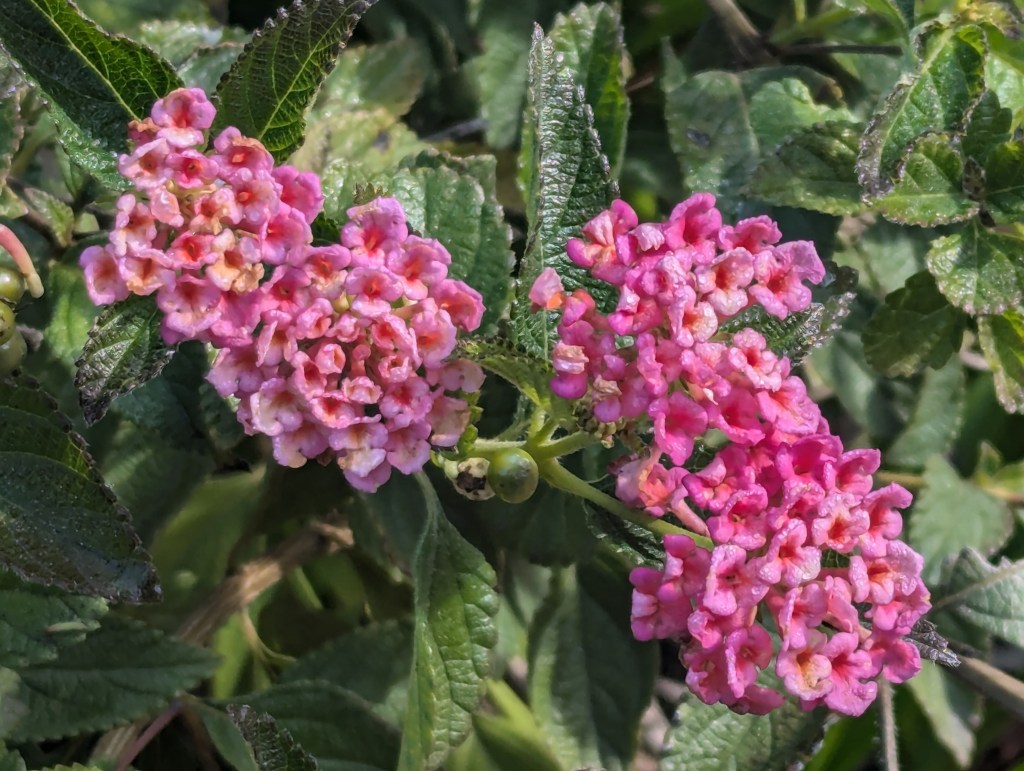
2. Lantana montevidensis, trailing lantana is purportedly slightly more resilient to frost than common lantana. However, its foliage can become very dark, as if it were damaged.
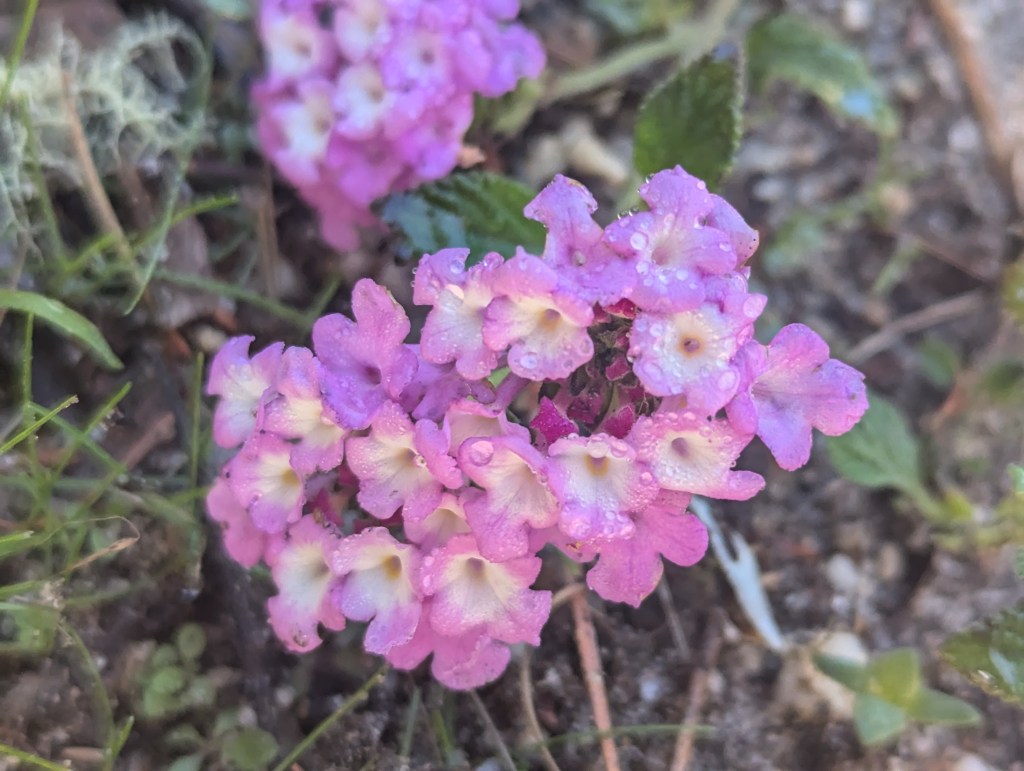
3. Tecomaria capensis, Cape honeysuckle is overrated. Its orange floral color is nice, but its flowers and floral trusses are too small and too scarce to display the color adequately.

4. Leonotis leonurus, lion’s tail bloom seems to resemble that of Cape honeysuckle, most likely because both attract sunbirds as pollinators where they are native in South Africa.

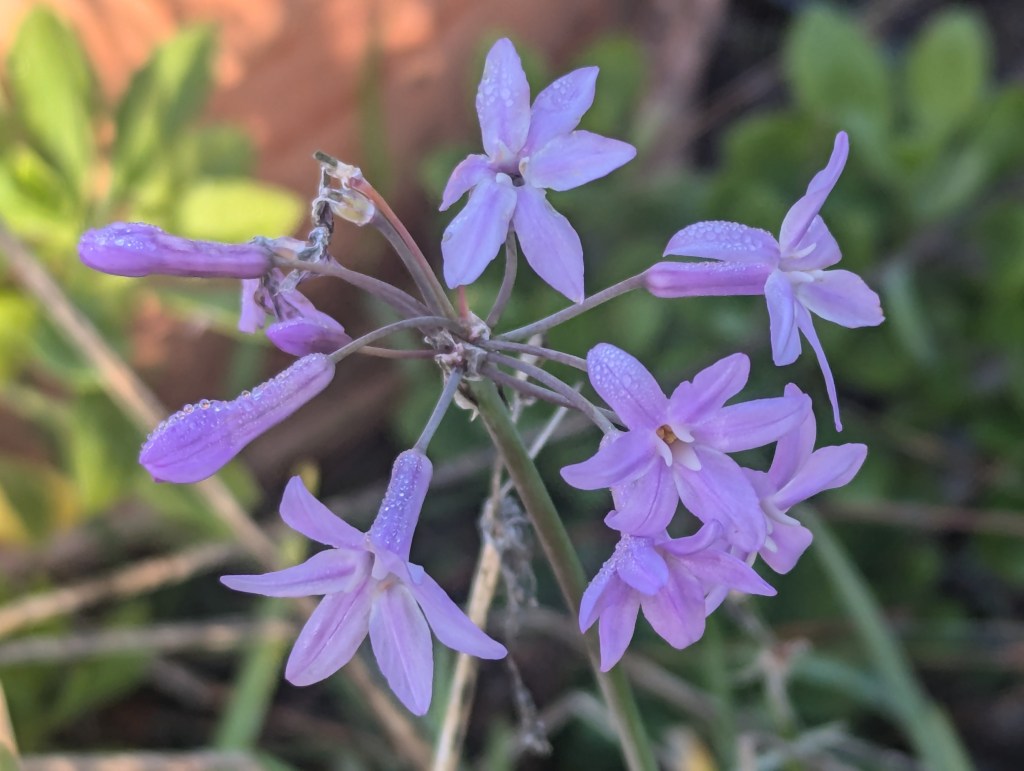
5. Tulbaghia violacea, society garlic is not among my favorite perennials, but is resilient and undemanding. This specimen has been abandoned for years, but constantly blooms.
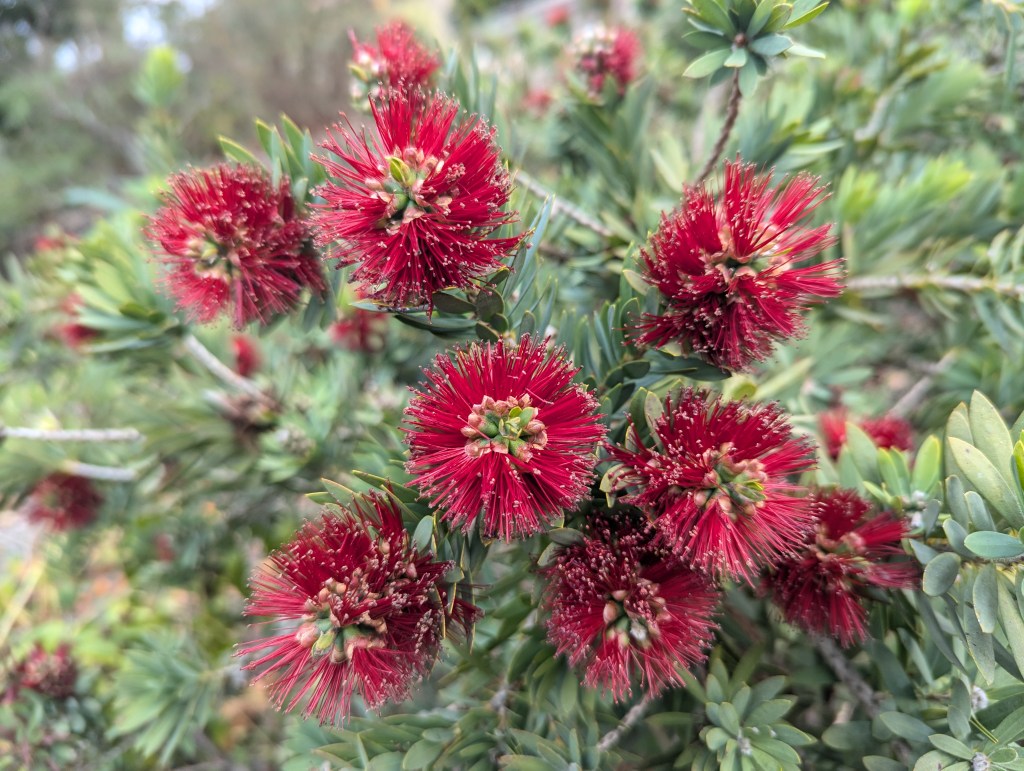
6. Callistemon viminalis ‘Little John’ bottlebrush is now Melaleuca viminalis. I learned it as a cultivar of Callistemon citriodora that is more proportionate to compact gardens.
This is the link for Six on Saturday, for anyone else who would like to participate: https://thepropagatorblog.wordpress.com/2017/09/18/six-on-saturday-a-participant-guide/
Pink Melaleuca

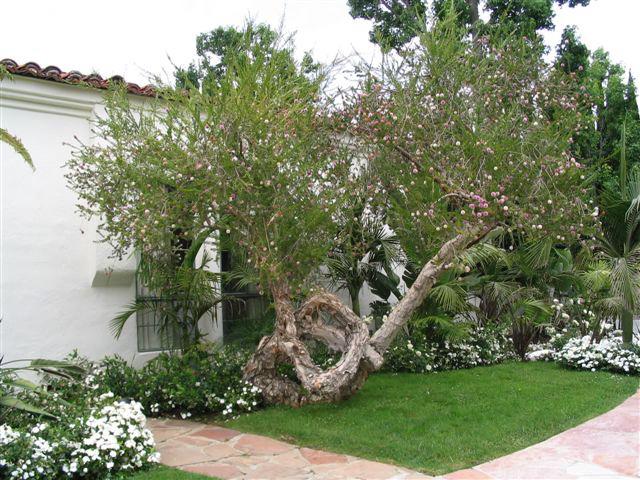
Pink melaleuca can be impressively sculptural.

            Golden Gate Park in San Francisco has some of the most impressive mature specimens of pink melaleuca, Melaleuca nesophila, outside of their native homeland in Australia. Although most are naturally less than twenty feet tall and wide, their disproportionately bulky trunks are remarkably gnarled and sculptural, as if they have been growing there for centuries. Pink melaleuca actually grows and develops trunk and limb structure rather fast while young, without ever becoming too obtrusively large. Spongy pale tan bark covers the distinguished trunks and limbs like a thick parka.

            Sculptural small trees are not the only function of pink melaleuca. They also make nice informal hedges and screens, and can be shorn occasionally if necessary. The round inch long leaves are quite thick. Round inch wide trusses of small staminate flowers bloom slightly purplish pink and fade to pale white through most of the year, except where shorn. (Staminate flowers are showy because of distended stamens instead of petals.) Hummingbirds are grateful for the flowers while not much else blooms through winter. Hard seed capsules that remain in dense cylindrical formation on twigs after blooms are long gone are sometimes used as dried flowers. Like all melaleucas, pink melaleuca is easy to care for, and tolerant of harsh exposure, inferior soil, minimal watering and neglect.

Big Shrubbery or Small Trees

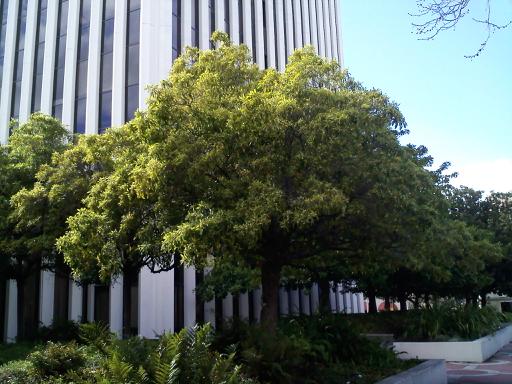
Pittosporum undulatum is a large shrub that can become a small tree.

            Shrubbery behaving badly can be a problem. Many seemingly innocuous shrubs get planted in situations where they do not fit, and soon get too big for the space available. Others do not get shorn or pruned as they should, or simply get neglected, and eventually get overgrown. Many others have sneaky ways of sowing their seeds in awkward places where they would not otherwise get planted by anyone who knows better.

            Most home improvement shows on television would simply recommend removing obtrusive, overgrown or inappropriate shrubbery and replacing it with something more proportionate, appropriate and stylish. What a waste! Hidden within overgrown shrubbery, there are sometimes potentially appealing small trees that only need to be released from thickets of overgrowth.

            Overgrown Australian tea tree, sweet olive (Osmanthus fragrans), xylosma, glossy privet, ‘Majestic Beauty’ Indian hawthorn, and larger types of oleander, holly, pittosporum, cotoneaster and juniper are often easily salvaged by aggressive selective pruning rather than indiscriminate pruning for confinement. Lower growth that has become obtrusive, disfigured or otherwise unappealing can be thinned or removed to expose substantial sculptural trunks within. Upper growth that is out of the way can be left intact or thinned as necessary, but should not shorn or pruned indiscriminately. This creates informal small trees with distinctive trunks from what had been overgrown shrubbery.

            Some shrubbery may need some time to grow out of its former confinement, and may be somewhat unsightly during the process. As they develop though, they should require less maintenance, since most of their growth should be up out of the way instead of where it is in constant need of pruning for confinement. 

            Many small trees that often get shorn into shrubbery would similarly do better with selective pruning to enhance natural branch structure and eliminate congested thicket growth. Japanese maples, redbuds, smoke tree, English hawthorn, crape myrtle, parrotia, loquat, strawberry tree, Pittosporum undulatum, and small types of magnolias, acacias, and yew pines (Podocarpus spp.) are notorious for getting shorn into unmanageable shrubbery. Pineapple guava, photinia, toyon, hop bush, larger types of bottlebrush and smaller types of melaleucas are more conducive to being shorn and pruned as large shrubbery, or can be pruned into small trees if preferred.

Tornado

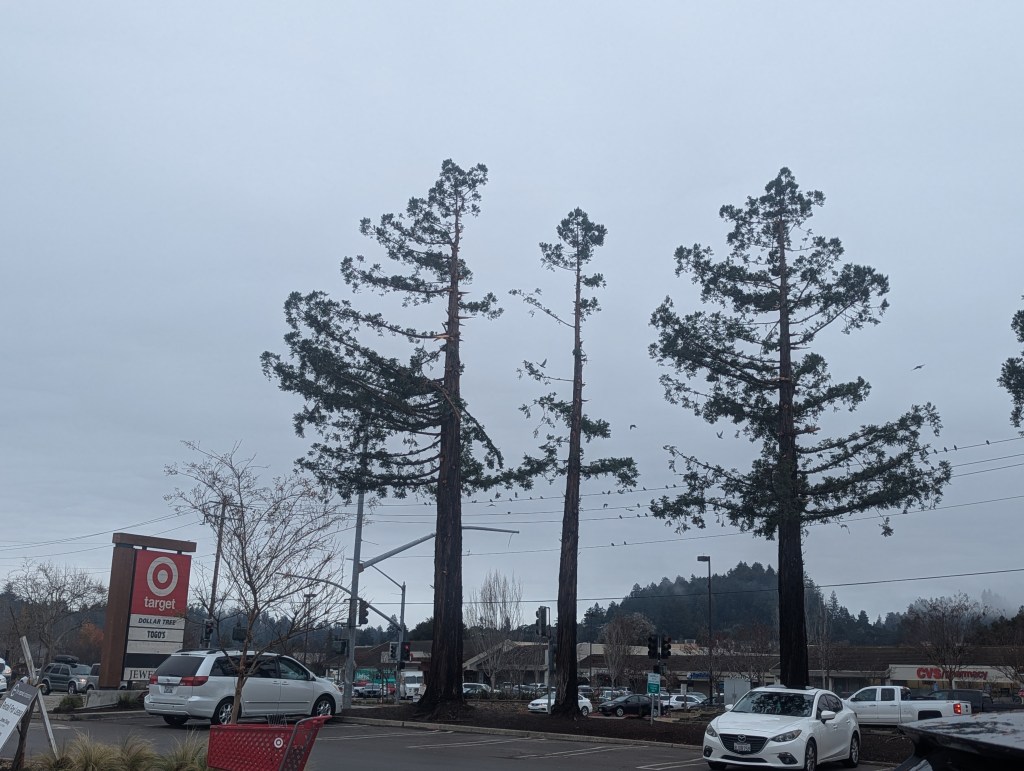
The tornado that stripped these redwoods landed right on Target. Notice the sign to the lower left.

The weather here may seem boring to those who are acquainted with other climates. It gets neither too warm nor too cold. Rain is limited to the relatively short rainy season. Humidity is minimal. Snow is so extremely rare that I can remember it only once in the Santa Clara Valley during my lifetime, and it was only half an inch deep. Tornadoes are about as rare, or at least they were. I can now remember two here, which is twice as many occurrences of snow that I can remember. Shortly after half past one last Saturday, rain, which had been falling for a while, suddenly became torrential, then instantly stopped, then instantly became torrential again. I stepped outside with Rhody to observe, and noticed Heather, Rhody’s feline ‘associate’ who prefers to stay inside during such stormy weather, had also come outside to observe, and was staring to the south. When I looked to see what she was looking at, I saw that not only were dark clouds speeding to the east, but that a portion of them was backtracking, as if swirling. My comment to Rhody and Heather was something like, “Well, at least tornadoes do not happen here.”. A few minutes later, a tornado did happen, right on Target, literally. It landed right on the Target store in Scotts Valley, less than two miles away. It was rated as an EF1 tornado, which apparently means that it was rather minor. It lasted for five minutes, though, while travelling only about a quarter of a mile. That is much slower than the clouds that we observed only a few minutes earlier. Fortunately, injuries were minimal, although a few cars were tossed. Utility cables, streetlamps and traffic signals were thrashed. So was much of the vegetation of the urban landscape.

English Holly

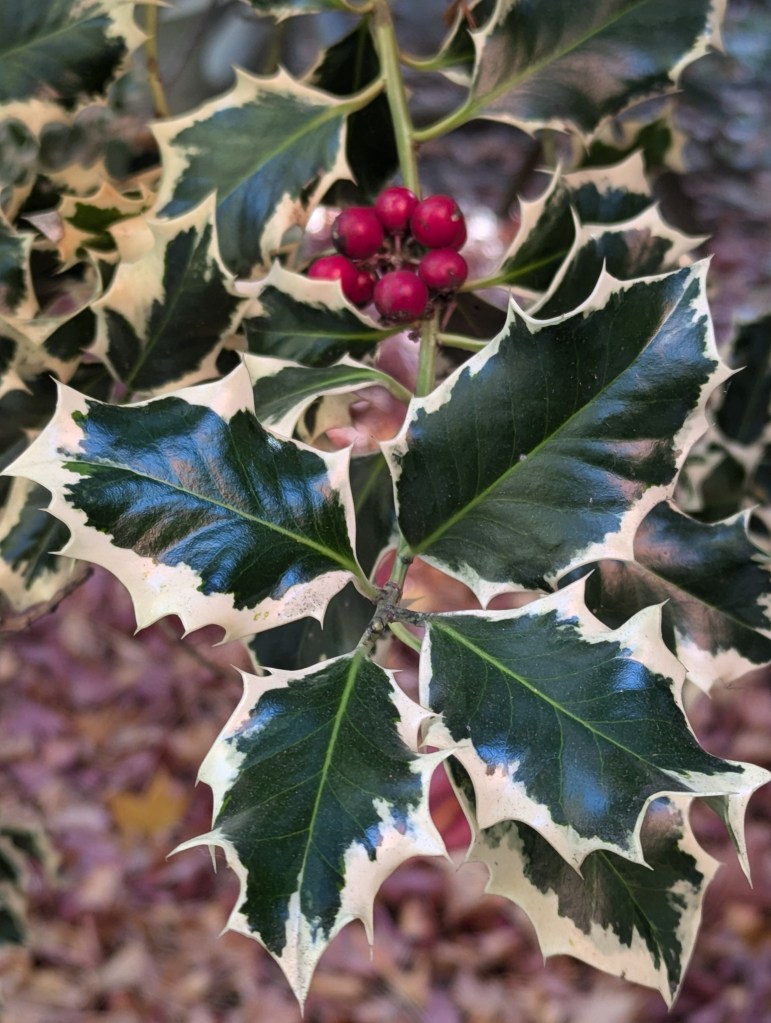
English holly can be handsomely variegated.

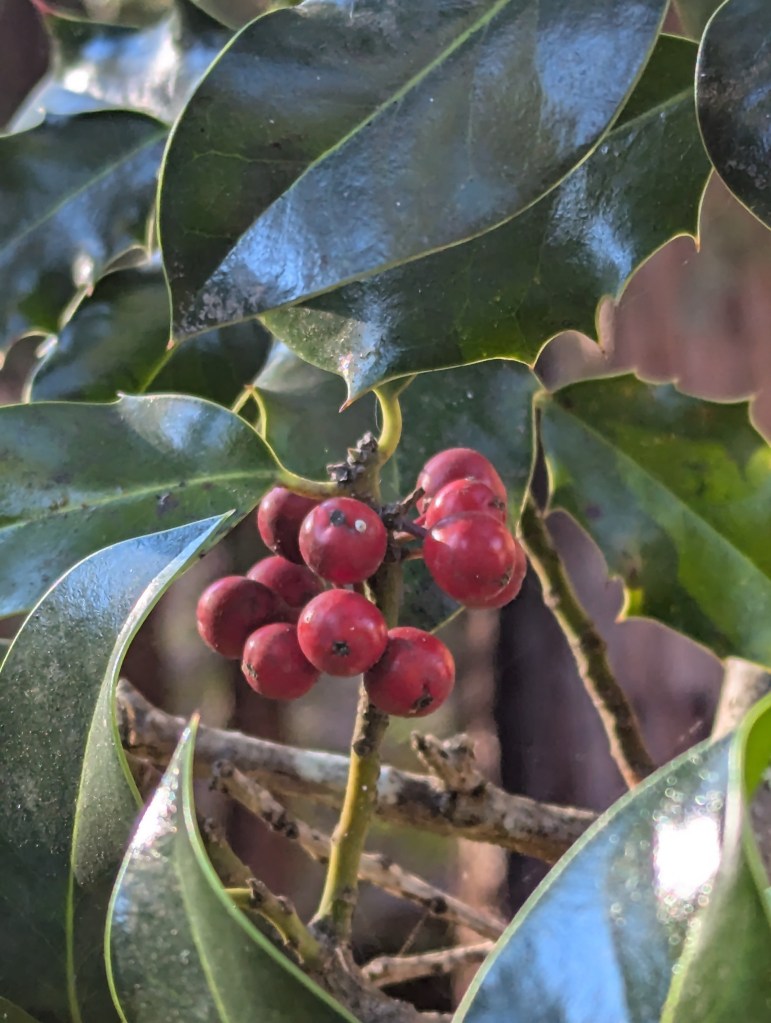
Hollies produced more bright red berries while they were more popular many years ago. Formal and perhaps lengthy hedges of exclusively female cultivars were common. A few or solitary male pollinators grew nearby, often as obscure small trees. Nowadays, males are oddly rare. Not many horticultural professionals are aware that hollies are dioecious.

English holly, Ilex aquifolium, is both the most and least favorite holly. Some who grow it appreciate its distinctively intricate foliar texture. Others detest the unpleasant prickliness of the same foliar texture. No other holly is as spiny, although most are somewhat prickly. All hollies exhibit dark green foliar color, remarkably glossy foliar sheen and rigid foliage.

English holly can grow as a small tree with a dense canopy. With pruning, most stay less than ten feet tall. Cultivars with white or yellow variegation grow slower and stay smaller. Berries are common amongst naturalized colonies which naturally include both genders. Nurseries occasionally sell cultivars of both genders, potted together to mature together.

Foliage Surpasses Flowers For Christmas

Hollies contribute more foliage than berries.

Winter bloom might be limited. Wintry berries, dried flowers and the remains of summery bloom can be more abundant. Evergreen foliage is as abundant as it always is. After all, it is evergreen. That is most likely why it is so popular for home decor through Christmas. It is the primary component of wreaths and garlands, and, technically, of Christmas trees.

Flowers are more scarce where winters are cooler. They are also more desirable indoors while the weather is too cool to be outdoors. Evergreen foliage effectively compensates. While flowers are less scarce here, the most traditional evergreen foliage is more scarce. It is simply less popular within home gardens locally. Also, less of it grows wild in forests.

Most cut evergreen foliage consequently grows on farms like certain popular cut flowers. Many of such farms are in the Pacific Northwest, where such foliage grows most readily. Many types of fir, spruce and pine that are popular for wreaths are naturally happy there. Western red cedar, which is the primary component of garland, is a native species there.

However, locally available cut evergreen foliage can be as delightful as traditional types. A few types are native species that grow wild beyond cultivated home gardens. More are exotic species within refined landscapes. Douglas fir is both traditional as well as native to many regions of California. A few native pines can substitute for more traditional types.

Redwood, cypress and juniper are likewise alternatives for traditional evergreen foliage. Some are natives or relatives of native species. Deodar and Atlas cedars resemble blue spruce. Arborvitae may substitute for Western red cedar, and is actually the same genus. English holly, although rare, and more rarely produces berries, is occasionally available.

Christmas trees are the ultimate form of cut foliage. Unlike other foliar decor, they almost exclusively grow on farms. Their cultivation is very impractical for refined home gardens. Collection of other cut foliage should not damage its source. Some may be from pruning scraps. Christmas trees, though, are much more than a few stems. They are entire trees, containing all their stems.

Sunday Best – Rhody

This is my first Sunday without writing anything more than this brief explanation about why I wrote nothing more than this brief explanation, . . . and why Rhody looks rather damp and concerned. A tornado landed less than two miles away, in Scotts Valley, just a moment before I got this picture. He knows about Toto of Kansas.

Cutting Back

No, not this sort of cutting back. I will be cutting back on posting to this blog. I realize that I have expressed my intent to do so on several occasions in the past, only to resume my habit of posting daily, but now I am a bit more compelled to comply with these intentions. Although I can technically continue to post daily, some of the writing, which is really what occupies the vast majority of time that is devoted to blogging, will be omitted. My garden column will continue to post in two parts on Mondays and Tuesdays. Old articles from my garden column will likewise continue to post in two parts on Thursdays and Fridays. The garden column articles get written regardless, so may as well appear here like they do in their newspapers. Old articles were already written, so do not necessitate too much effort to recycle them here. Therefore, Wednesdays, Saturdays and Sundays are the only days that I actually write for. I can continue to write for the Horridculture theme, or actually, any random topic for Wednesdays. I can also continue to participate with the Six on Saturday meme for Saturdays, since it involves more illustration than writing, which, as previously mentioned, is what occupies too much time. However, I will discontinue my second posts for Saturdays at noon, which were not very interesting anyway. This should be the last of them. Also, instead of writing posts for Sunday, I should merely post illustrations, without much text, if any, perhaps similar to the Silent Sunday and Wordless Wednesday themes at the blog of Eliza Waters.

Six on Saturday: A Saturday Of Flowers

‘A Week Of Flowers’ at ‘Words And Herbs’ finished a week ago, but as I said last week, it reminded me that I should share more floral pictures.

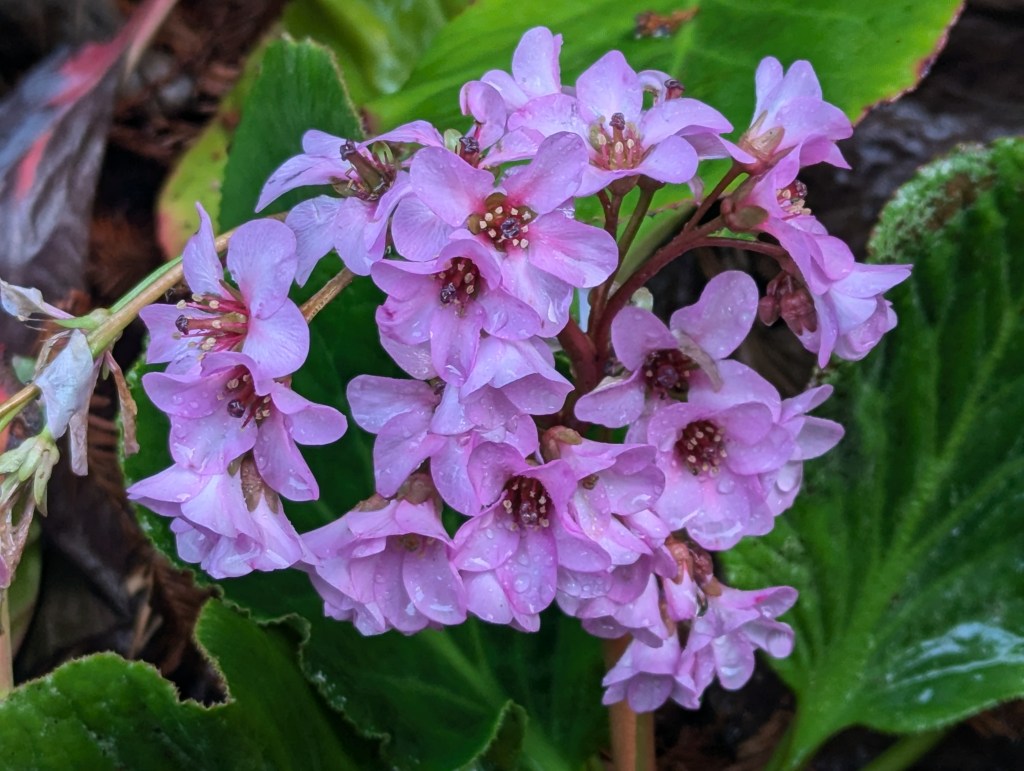
1. Bergenia crassifolia, pigsqueak is as popular as it is because it is so easy to propagate merely by relocating rhizomes that migrate where they are not wanted. These eventually creep onto a low retaining wall around their area, providing more to relocate elsewhere.

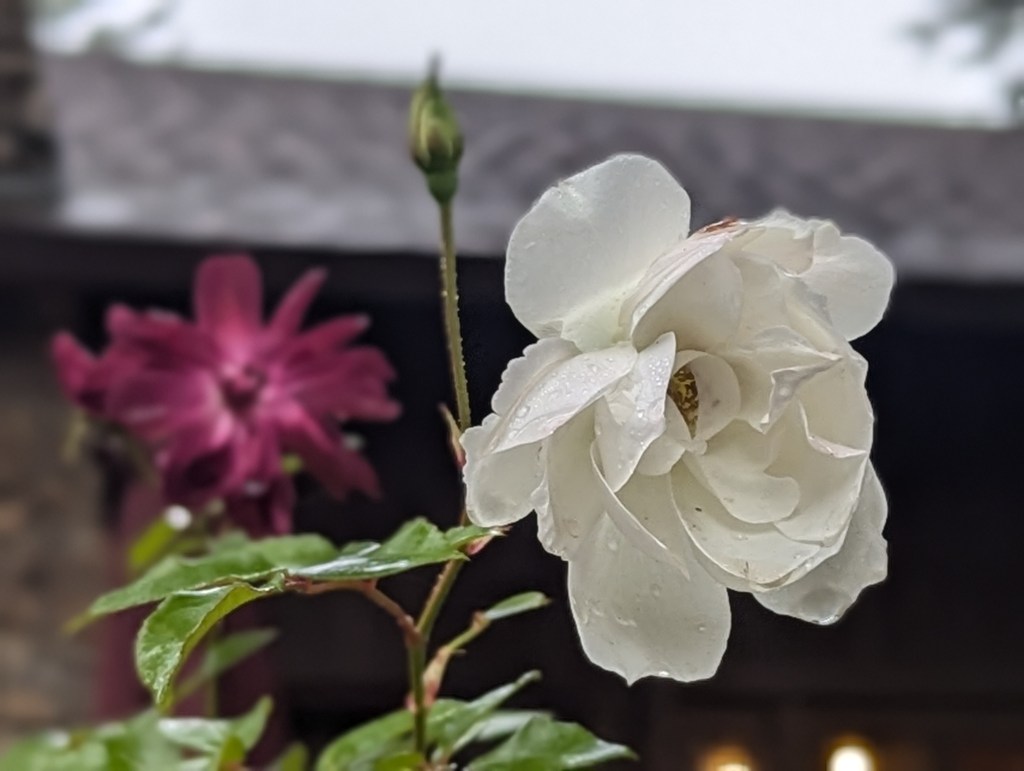
2. Rosa spp. ‘Iceberg’ rose should finish bloom anytime. That bud to its upper left is not likely to open now that the weather is cool for winter. ‘Burgundy Ice’, in the background, is grafted onto the same rose tree with this ‘Iceberg’. I think that they look odd together.

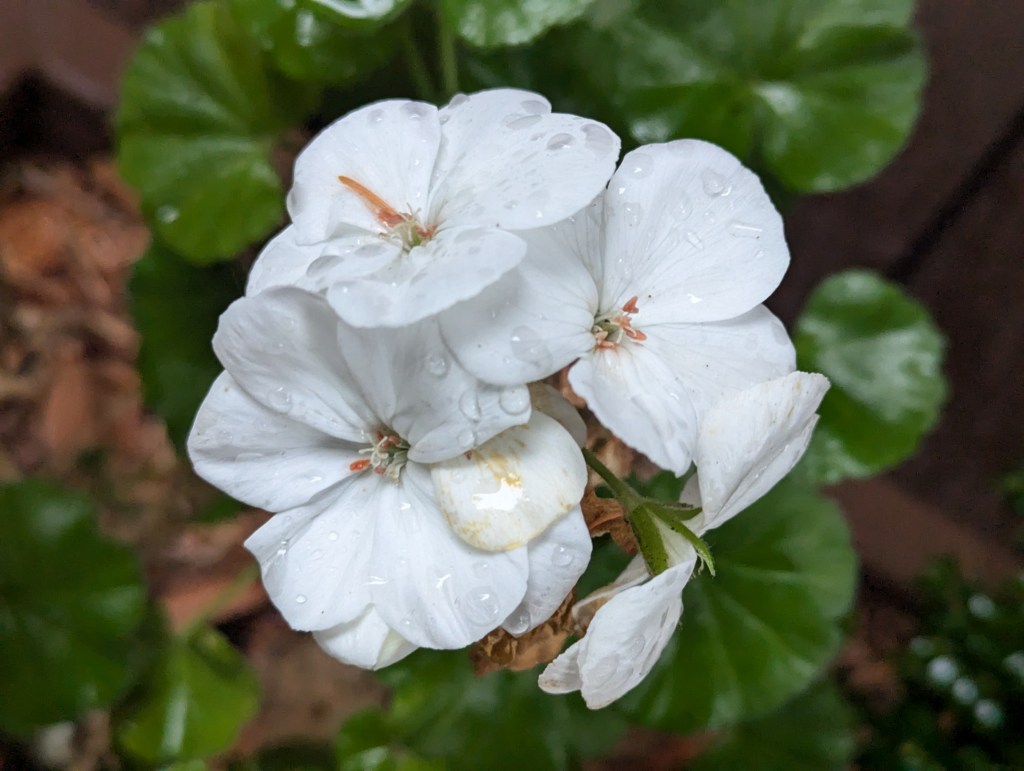
3. Pelargonium hortorum, zonal geranium is getting overgrown enough to look shabby, but should not be pruned back until the end of winter. If it gets pruned back now, it will look even shabbier until it resumes growth as weather gets warmer at the end of winter.

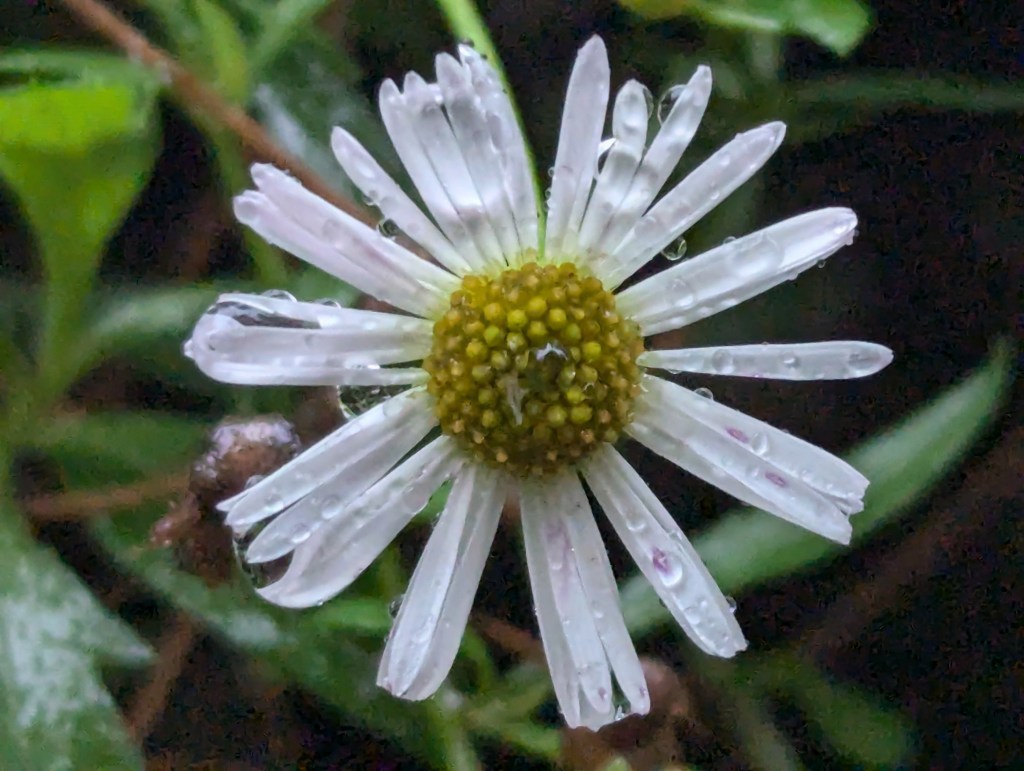
4. Erigeron karvinskianus, Santa Barbara daisy flowers seems to be a bit lean in partial shade. Santa Barbara daisy can be an annoying weed, but within our landscapes, is more often an asset, adorning otherwise bare stone walls. I pull it out to refresh it after winter.

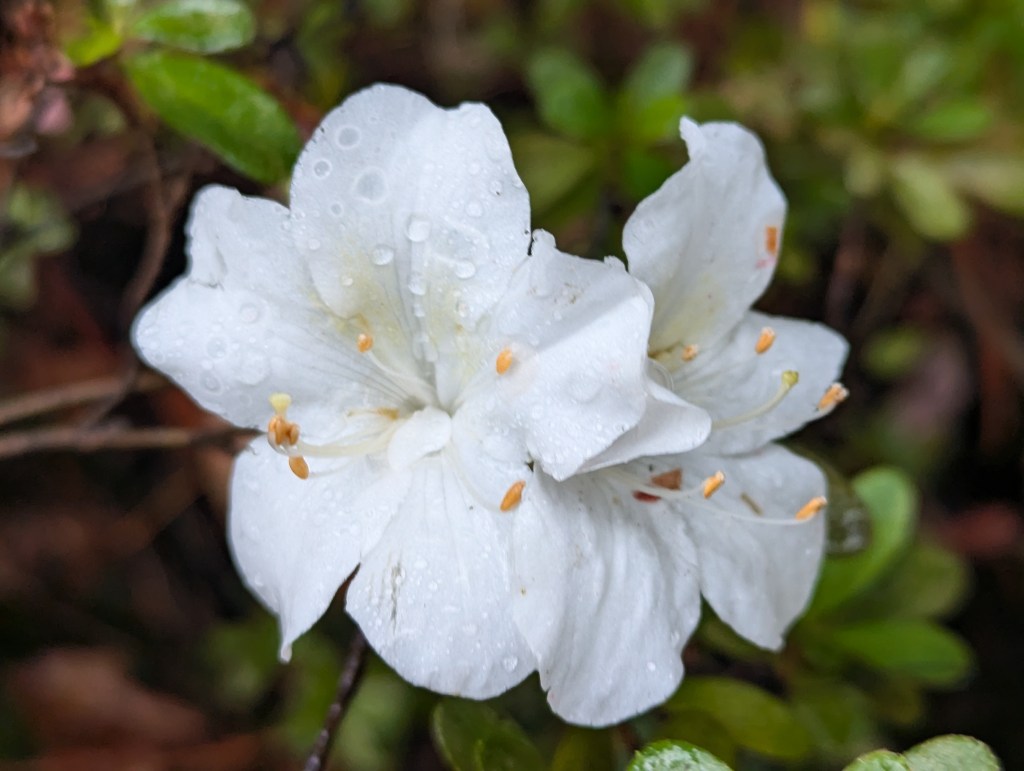
5. Rhododendron spp., azalea blooms lavishly for spring, but this particular unidentified cultivar also tosses out these few premature flowers for winter. Incidentally, it is merely coincidental that most of these Six bloom white. I just got pictures of what is prominent.

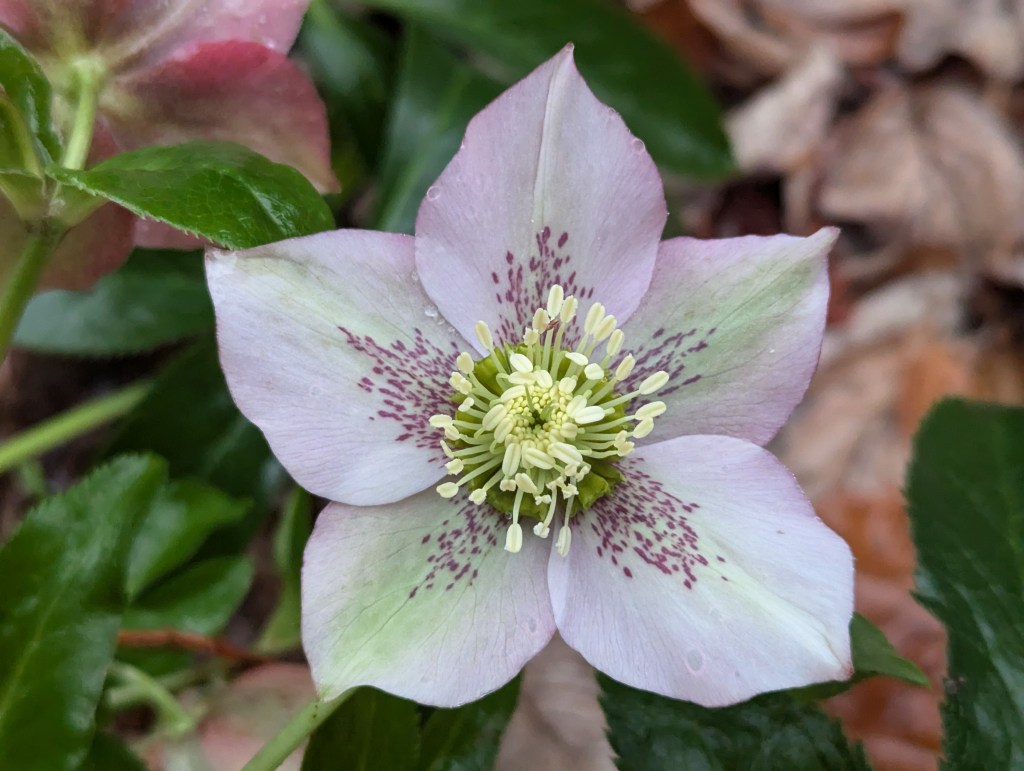
6. Helleborus X hybridus, hellebore is happy to self sow, but not as happy to perform. It does not bloom much. When it does, most of its flowers are spotty and grungy. Even the foliage is shabby. This flower, although pallid and weirdly blushed, is a delightful rarity.

This is the link for Six on Saturday, for anyone else who would like to participate: https://thepropagatorblog.wordpress.com/2017/09/18/six-on-saturday-a-participant-guide/
Cotoneaster

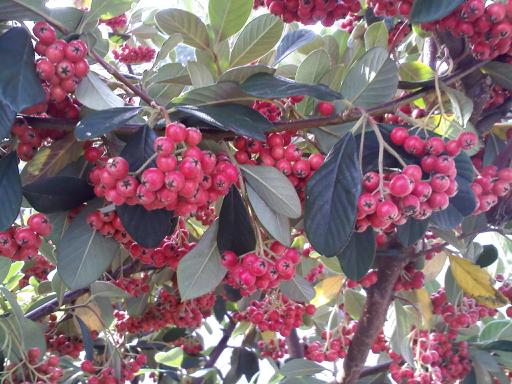
Cotoneaster berries can be as colorful as hawthorn berries, but with evergreen foliage.

            Unlike the more popular low growing cotoneasters that are grown as groundcover, the large Cotoneaster lacteus can be grown as large informal hedges or small sculptural trees with multiple trunks. Their limber arching branches can get more than eight feet high and broad. Cotoneaster lacteus are at their best where they have space to grow wild and unshorn, since indiscriminate pruning deprives them of their naturally graceful form; although selective pruning of lower growth exposes trunks and enhances the forms of those grown as small trees. Once established, they do not need much attention or watering anyway.

            Abundant two inch wide clusters of small white flowers in spring are not remarkably showy, but develop into comparably abundant clusters of bright red berries in autumn and winter, much to the delight of overwintering birds. The simple two inch long leaves of Cotoneaster lacteus have pale green and slightly tomentose (fuzzy) undersides.