Horridculture – Deferred Road Maintenance

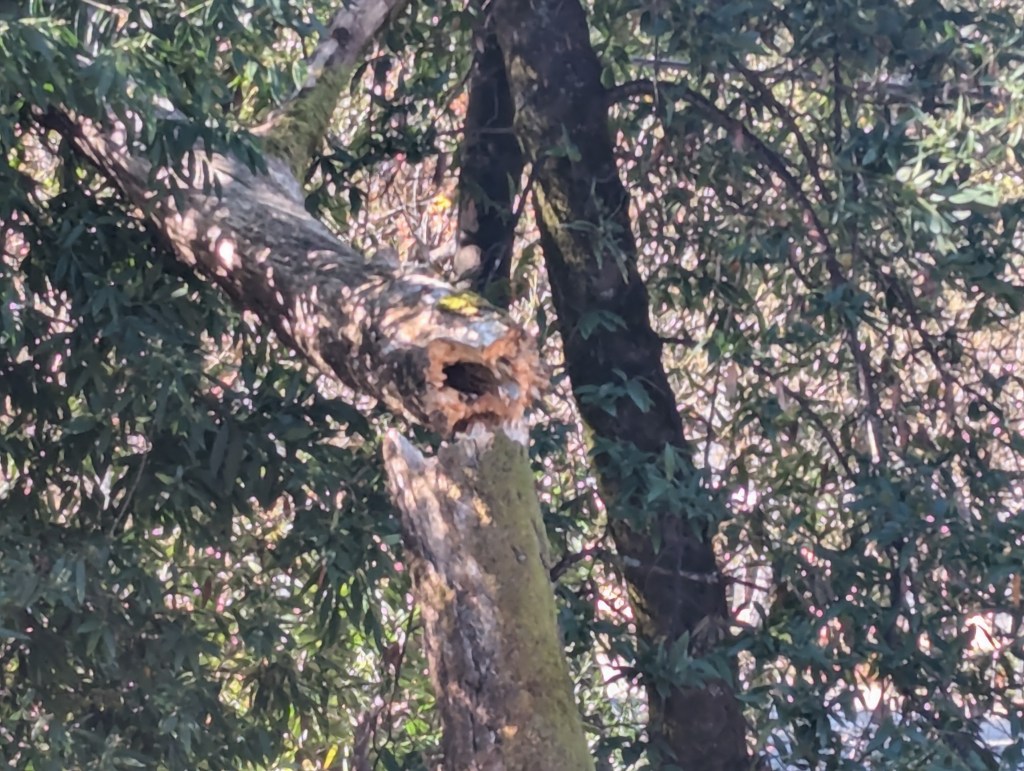
It is not on the road yet, but will be soon. This box elder has been deteriorating for several years. Only a few viable watersprouts remain within about ten feet of the ground. All limbs above are gone, leaving only this decomposing trunk. Several more similarly deteriorating trunks, with more or even less of their associated canopies remaining, are barely standing nearby. Most succumbed to an unidentified pathogen a few years ago. Some were dead prior to that. This one is special because such a significant portion of its upper trunk has broken off, and now remains suspended by the unbroken portion of the same trunk and the collective canopy of adjacent bay trees. This would not be such a concern if this broken portion of the trunk was not suspended so closely to the busy road below. (The picture above shows where the trunk broke. The picture below shows its proximity to the road below.) I suspect that when the broken portion of trunk eventually falls through the canopy of bay trees, the heavier basal end will fall first, and guide the lighter upper portion to land closer to the base of the remaining trunk, and safely away from the road, but I can not be certain until it actually happens. Those who maintain the road will not remove the broken portion of trunk until this does not actually happen, and the debris instead falls into the road. I can do nothing about it because I can not direct how the broken portion of trunk will fall once it is dislodged, and the traffic on the road is nearly constant during the day. It would be safer with a crew to stop traffic while the trunk is removed, and even better if they remove all of the several decaying trunks.

Blue Palo Verde

“Palo verde” translates to “green stick”.

If “verde” translates to “green”, then what color is blue palo verde, Parkinsonia florida? It is simply a bit more bluish green than other species that are a bit more yellowish. Its bark contains chlorophyll to photosynthesize without foliage. Blue palo verde is deciduous so defoliates for winter. Then, it defoliates in response to dryness through much of summer.

Blue palo verde in the wild may develop and retain foliage only during early spring. With landscape irrigation, it can retain some foliage through summer. It can also produce a bit more prior to late autumn defoliation. However, frequent irrigation promotes vigorous but structurally deficient growth. Few blue palo verdes thrive for a century within landscapes.

Blue palo verde can grow almost forty feet tall, but typically grows only about half as tall. It naturally grows as large shrubbery. Removal of lower growth exposes sculptural trunks for small tree form. With staking, trees can develop single trunks. Light yellow flowers are tiny but profuse during spring bloom. Blue palo verde is the Official State Tree of Arizona.

Precipitation Should Continue Through Winter

Red sky at morning, meteorological warning.

Deciduous foliage gets colorful with autumn chill. Then, it gets messy. Then, with a bit of precipitation, it gets even messier! It seems like a waste as it all succumbs to rain and, in other climates, snow. It is sensible, though. Deciduous vegetation will be less vulnerable to stormy weather without it. Weather will be getting increasingly stormy through autumn.

This is how the Mediterranean climate here operates. The dry season that begins during spring continues until autumn. The relatively shorter rainy season centers around winter. Therefore, most precipitation occurs during winter. Spring and autumn are brief transition seasons that tend to favor the dry season. Almost no precipitation occurs during summer.

Spring and autumn transitions between rainy and dry seasons are innately variable. The rainy season tends to finish early during spring, but may not. It sometimes pauses before resuming. It may do so more than once. Conversely, the rainy season tends to begin late during autumn, but may begin earlier. Occasionally, precipitation begins disturbingly late.

Generally, the first significant storm with significant precipitation begins the rainy season. This may be difficult to believe with typically significant time between the first few storms. Yet, with cooler weather, elevated humidity, and shorter daylength, moisture lasts longer. Precipitation, even if merely drizzling fog, will likely dampen gardens before they get dry.

Irrigation obviously does not need to be as generous as it was during summer. Until next spring, some vegetation will require none at all. Not only will weather provide and retain more moisture, but vegetation uses much less. Refraining from manual irrigation is easy. Adjustment of automated irrigation systems actually requires more effort and awareness.

As deciduous species defoliate for winter, some other species might get more vivacious. Cacti, agave, and some yuccas that lack irrigation become more turgid with precipitation. Remaining palo verde foliage is likely to become greener and fresher prior to defoliation. Most xeric species utilize moisture from precipitation as it becomes available seasonally.

Which Houseplant?

Peperomia obtusifolia?

Peperomia obtusifolia, baby rubber plant is what I suspect this to be. I can not be certain. I do not work with houseplants. I can barely remember that we studied only a few cultivars of Peperomia that happened to be popular back when we were in school during the late 1980s’. The modern cultivars that are popular now were not even developed back then. I do not remember ever getting acquainted with the simple species, which this seems to be. That makes it even more perplexing. Where did someone get this copy of the simple species that has become so rare relative to popular modern cultivars as well as formerly popular cultivars? The rarest of modern cultivars is not as rare as this original. It is an exemplary specimen, too. It is at least two feet wide and stands more than a foot tall in its wide but shallow pot. Someone has maintained it meticulously for several years. Perhaps it grew as a cutting from an even older specimen that was grown before it became so rare so long ago. Perhaps someone appreciated this original simple species as it was losing popularity to more colorful modern cultivars back then. Realistically, without any of the fancy variegation of modern cultivars, the simple green original is undoubtedly more vigorous, and perhaps significantly so. It is therefore more sustainable than cultivars, and more likely to survive and perpetuate itself by cutting for many years. Alternatively, it could have originated as a reversion from a modern cultivar. Someone may have been impressed enough by its relatively vigorous simple green foliage to grow a copy from a cutting. Perhaps relatively vigorous simple green growth merely overwhelmed and replaced original but less vigorous variegated growth. These are merely guesses about its identity, which remains a mystery.

Which Mesquite?

Prosopis velutina, velvet mesquite?

Prosopis velutina, velvet mesquite is supposedly the most popular mesquite within landscapes, such as the landscape in Surprise in Arizona in which I encountered this mesquite. This particular specimen conforms to the description of the species. However, both Prosopis glandulosa, honey mesquite, and Prosopis pubescens, screwbean mesquite, are also somewhat popular within landscapes, and, except for the distinctly twisted beans of screwbean mesquite, both are visually similar to velvet mesquite. All three species are native to the region of Surprise. Because beans that I collected from below this particular specimen were merely somewhat warped, rather than distinctly twisted, I doubt that this specimen is a screwbean mesquite. Also, because the leaflets are relatively short with relatively rounded tips, I doubt that this specimen is a honey mesquite. Therefore, I suspect that this really is velvet mesquite. Although I would prefer to grow honey mesquite, I would be quite pleased to alternatively grow velvet mesquite, or realistically, any mesquite that is useful for smoking. I do not smoke enough vegetables or meats to be so discriminating about the sources of the smoke involved. Besides, if I were so discriminating, I could purchase honey mesquite seed online. For now, I will grow the seed that I collected from below this particular mesquite tree, regardless of its species. The handful of beans that I collected must contain several seed. I have no idea of how many of them will be viable, but will find out. Some of the beans have small holes in them from larval insects who undoubtedly ate some or all of the seed within, but I collected them regardless, merely because they were available. Because the seed are difficult to separate from their beans, I may not bother. I suspect that they will germinate and grow through their bean pods as the pods decay under a shallow layer of medium. Scarification of seed supposedly accelerates germination, but there is no rush. I do not even know where to plant any seedlings that might eventually grow. Although no mesquite are native here, velvet locust, as well as the other two species that this could possibly be, are surprisingly native to nearby counties. Because they are also native to harsh desert climates, I suspect that they prefer the drier and warmer of local climates. I therefore intend to grow them in exposed ridgetop areas with well drained and perhaps somewhat sandy soil.

Six on Saturday: White Saturday

Black Friday was yesterday. White Saturday seems appropriate today. Actually though, I lacked six pictures after a two week commitment from which I returned less than a week ago. These six were cut flowers where I was at. It is a long story. Apologies for this lapse of any personally relevant horticultural topics.

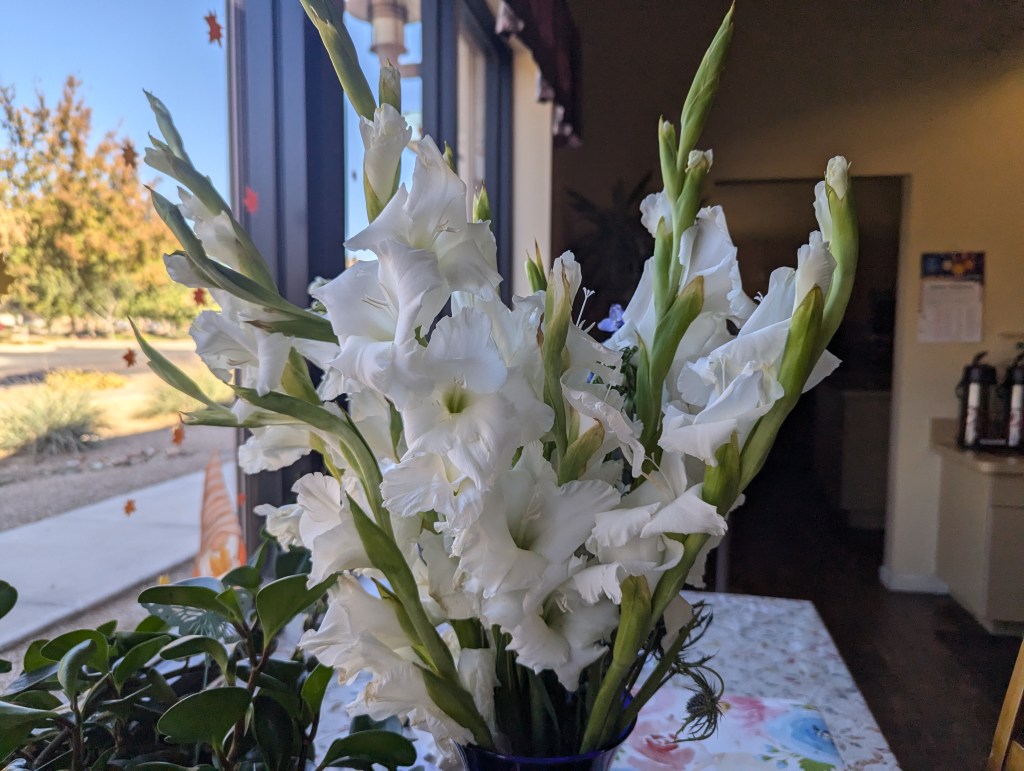
1. Gladiola is one flower that really excels at white! Except for the few at work, I have not grown them in many years. I grew some in yellow and orange in the old neighborhood in 2000 or so. They were fancy hybrids like this, so were not reliably perennial for too long.

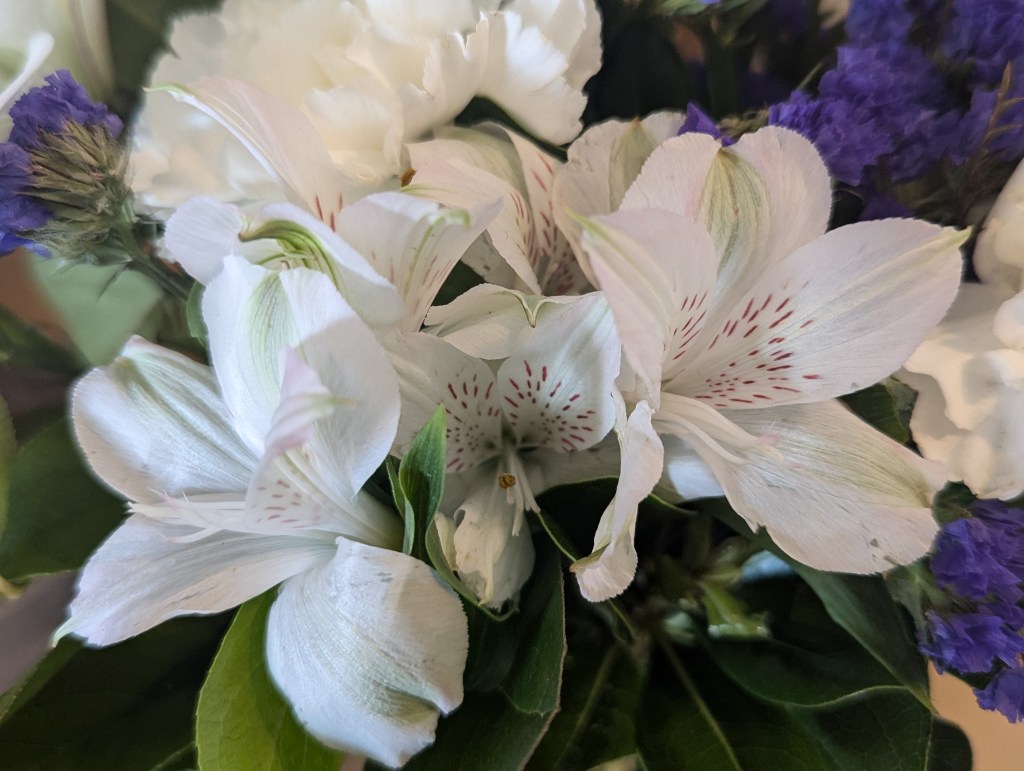
2. Peruvian lily was one of the first cut flower crops that I worked with after my first year of college, for the summer of 1986, when they were new and trendy. White had not been developed back then. I am impressed by how white this variety is, with only minor spots.

3. Carnation is one of the most ubiquitous of cut flowers, but is also the only one of these six that I have never grown. I have worked with only bedding types and sweet William in landscapes at work. I did not get close enough to notice how fragrant this carnation was.

4. Rose is the most popular of cut flowers, although it does not seem to be as ubiquitous as carnations do. I can not remember ever not growing them. I acquired some that are in my garden now while I was in high school in about 1984 or 1985 and brought them here.

5. Chrysanthemum that grow in the landscapes at work were formerly potted plants that were left with us to be recycled. We selected none intentionally. They might be more fun like that. Anyway, this particular cut white chrysanthemum is impressively humongous!

6. Lily was a secondary cut flower crop that I worked with for the summer of 1986, along with the primary crop of Peruvian lily, which is not actually a lily. We grew Asiatic lilies, and we grew white lilies, but not white Asiatic lilies such as this. I am happily impressed.

This is the link for Six on Saturday, for anyone else who would like to participate: https://thepropagatorblog.wordpress.com/2017/09/18/six-on-saturday-a-participant-guide/

Strawflower

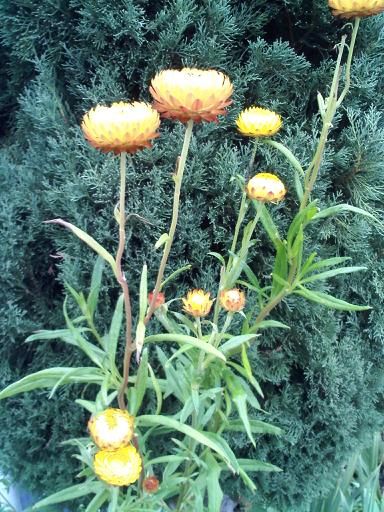
Strawflower retains its color and form, although not foliage, as it dries.

Just like cosmos, zinnias and other related flowers, strawflower, Helichrysum bracteatum, seems to be at its best as its bloom season ends. Bloom started in summer and should finish now that weather is getting cooler. The two and a half inch wide flowers last in the garden until they get ruined by rain. They are excellent cut flowers, and even better dried flowers.  

Strawflower can be white, pink, red, orange or yellow. Their seed should be sown directly where they are wanted in spring. Mature plants are about two and half feet tall and a foot wide, with three or four inch long and somewhat narrow leaves. Dwarf varieties are not as good for dried flowers, but are fuller and look better in the garden. 

Alternatives For Fresh Flowers

Form develops as color fades.

There are so many choices for flowers to grow for cutting between spring and the end of summer. For autumn and winter though, the choices are somewhat limited. Of the few things that bloom this time of year, there are fewer that are good cut flowers, and even fewer that bloom continually or profusely enough to provide an abundance of flowers until other flowers start to become available again in spring. Besides, who wants to go out to the garden in wintry weather to get flowers to bring into the home?

Many plants have other parts that are showy enough to substitute for cut flowers in the home. Cut foliage, stems, seedpods and even bark can be useful. Some flowers can be dehydrated to last all year, but look nothing like they do while fresh; and the process is somewhat involved. The most convincing alternative to fresh flowers is probably dried flowers.

Not many flowers dry well. Almost all simply turn brown and deteriorate. Only a few remain intact and also keep some of their color. Roses and hydrangeas are commonly dried, although their colors fade and they become shriveled. Yarrow and baby’s breath likewise change their appearance as they dry, but not quite as much. It is not so obvious as their tiny flowers shrivel.

The best dried flowers look somewhat fresh when they are actually dried. Strawflower, statice, globe thistle and globe amaranth are four of the best examples. These flowers are actually rather ‘crispy’ while they are still fresh, and only become crispier as they dry. If left in the garden, the flowers deteriorate only because of exposure to weather, and eventually rot in winter rain.

Simply as fresh cut flowers, strawflower, statice, globe thistle and globe amaranth flowers last longer than just about any other flower. They can even be separated from mixed bouquets and dried as the other flowers deteriorate and get discarded. They only need the lower portions of their stems that were originally soaking in water to be cut off if significantly deteriorated.  

However, most dried flowers probably look best if dried immediately after getting cut, since their foliage yellows more as it dries slowly. Lightweight flowers, like baby’s breath and statice (except bulky perennial statice) can be arranged fresh but without water, and simply allowed to dry as they are arranged. The only potential problem with this technique is that flowers may be difficult to separate and recycle later.

Flowers are more often laid out to dry individually and then arranged afterward. Globe thistle and globe amaranth are rather pliable and can wilt while drying, which can change the shape and consistency of a formerly fresh floral arrangement. Once dried though, their stems remain firm, and they can then be arranged more permanently. Most flowers are adequately dry in about a week indoors (or outdoors in warm dry weather).  

Because strawflowers are rather bulky on soft stems that may wilt, they dry with straighter stems if hung upside down while drying. The biggest flowers should be hung singly. Smaller flowers can be hung in small bunches. This works for heavy flowers like roses, and wide flowers like yarrow as well.

Horridculture – Saturation

Saturation is almost a universal problem within almost all of the landscapes that I inspect that are ‘maintained’ by mow, blow and go ‘gardeners’. Without exception, all of such landscapes are outfitted with automated irrigation systems. Some of such systems are scheduled to apply much more water than they should for more time than they should. More typically, irrigation is applied much too frequently. Sometimes, irrigation is both too abundant and too frequent. Such excessive irrigation maintains unhealthy saturation within the soil. Roots are unable to disperse their roots into such saturated soil, and many roots that try ultimately rot. Some trees try to compensate by dispersing roots close to the surface of the soil, but because they are unable to disperse their roots deeply, they lack stability. Also, their shallow roots damage pavement and compete with other vegetation. What is even more egregious about saturation within ‘maintained’ landscapes is that, almost without exceptions, the so-called ‘landscape’ companies that ‘maintain’ them, likely after installing them, brag about their ‘water-wise’ and ‘sustainable’ landscape maintenance techniques. They install irrigation systems that could be quite efficient if they were to operate properly, but then never operate them properly. They install drought tolerant species that can survive with minimal irrigation, but then kill them with excessive irrigation. They replace the deceased plant material, only to kill and replace it again. They do not mind wasting water that their clients pay for, any more than they mind wasting plant material that their clients pay for. In fact, replacement of plant material is profitable for them, since they get paid for procedures associated with removal and installation. Realistically though, they are probably as oblivious to the profitability of their technique as they are to proper technique. In other words, they simply do not care.

Toyon

Native toyon berries appeal to birds.

Hooray for Hollywood! It was formerly Hollywoodland because of the California holly that still grows wild there. California holly is not actually holly, though. It formerly classified as hawthorn and two different photinia. It then became two other species of the genus that it is now. Ultimately, but perhaps just temporarily, it became toyon, Heteromeles arbutifolia.

Toyon is native to all but a few counties of California. It is therefore quite happy within the chaparral climates here. Once established, it needs no more water than it gets from rain. Occasional irrigation enhances foliar color and vegetative growth. Excessive or frequent irrigation can cause roots to rot. Fire blight can sometimes become a significant problem.

Toyon is unlikely to grow more than twelve feet tall with sunny and warm exposure. It can grow more than twice as tall if it competes for sunlight with larger vegetation. The simple evergreen leaves are narrow and somewhat serrate. Billowy trusses of tiny white flowers bloom for early summer. Trusses of bright red berries feed birds through autumn.