Wintry Berries Are Already Colorful

Most wintry berries are bright red.

Seed of most vegetation here finishes developing by late autumn to be ready for winter. It wants to germinate while soil is damp, and before it gets dry after spring. Some needs to vernalize with a bit of chill to be ready to germinate prior to spring. Some offers incentive to birds or other wildlife to disperse it. It develops within colorful fruits and wintry berries.

Both migrating and overwintering birds enjoy wintry berries while other food gets scarce. Squirrels and other wildlife are likely to indulge as well. Seed within such fruit is resilient to digestion. In fact, many of such seed germinate better after digestion softens their hard exteriors. For them, digestion by their vectors is comparable to vernalization by weather.

This is why wintry berries are so colorful. They want to be visually appealing to birds and other vectors who disperse their seed. Their vectors need no more persuasion than that. They instinctively recognize a free meal when they see it. While they eat well, vegetation which feeds them benefits from dispersion of its seed. It is a mutually beneficial situation.

Birds and wildlife are not exclusive beneficiaries of ripe wintry berries. Many people who enjoy gardening appreciate their vibrant color. Such color is particularly appealing where floral color is deficient during winter. Many who enjoy gardening instead prefer any birds who eat such berries. Unfortunately, wintry berries will not last long after birds find them.

Wintry berries are already developing color, a month or so before the beginning of winter. Some may become more prominent as autumn foliar color eventually diminishes. Almost all wintry berries are bright red, but some are rusty red, orange or even golden. Greenish pittosporum berries are not so prominent. Elderberries are uncommon in home gardens.

Firethorn is the most prominent of wintry berries here. Various cotoneasters are likely the second most prominent, with rustier red color. Toyon berries are more colorful than those of cotoneaster, but are less common. English hawthorn can retain its berries longer than its deciduous foliage, but is rare. Because they lack pollination, most hollies are fruitless.

Parasite

Cuscuta spp., dodder

Dodder is likely the second most common parasitic vegetation here. Only mistletoe is more common. Yet, it is very rarely encountered within home gardens. When it does appear, it seems to do so spontaneously, with its source difficult or impossible to identify. Its many species can also be difficult to identify, since most are so visually similar. This species seems to be a bit greener than most, which are typically somewhat yellowish or even orangish. Only its genus of Cuscuta is known. If its wiry twining stems resemble those of bindweed, it is because the two are related. Unlike bindweed, dodder lacks, leaves, roots and perhaps a few other otherwise important parts that it does not need because it draws resources from its hosts, which, for this example, is red yucca. Most are yellowish or orangish because they do not need chlorophyll to photosynthesise for themselves while they rely on their hosts to do so for them. Dodder looks like something from science fiction. Not only does it parasitize its hosts, and exploit them for their resources, but it is also very invasive and persistent. Like mistletoe, it is difficult to remove completely from its hosts, and any small bits that remain regenerate efficiently. Its seed remain viable for many years. Even if visible dodder growth is completely eradicated, it may have tossed seed that can grow two decades later! Because dodder is parasitic and mingles so thoroughly with its hosts, herbicides are impractical for its eradication. Sometimes, infested host vegetation is too thoroughly infested to be salvaged. Dodder has an extensive host range, so can infest other species in the landscape even after original hosts are removed. Dodder may look interesting, but should not be allowed to grow wild. When removed, it should be disposed of rather than composted.

Ocotillo Cuttings

Fouquieria splendens, ocotillo

Fouquieria splendens, ocotillo has been an elusive species that I would like to try to grow, even if only to determine that it will not survive for long in my climate. I suspect that there are a few reasons why I have never observed it outside of desert or warm chaparral climates. I know that it is very susceptible to rot if irrigated even slightly excessively, and within some climates, any irrigation may be excessive. If I can grow cuttings, I will put them in stony and very well drained soil on an exposed ridgetop above my garden, where they will get no irrigation. The piece of cane that was given to me a few days ago, and that I mentioned this morning, is about three feet long, with a single offshoot that is a few inches long. Cuttings should supposedly be between four and six inches long. I tend to make short rather than long cuttings, so would be inclined to cut them four inches long, for a total of about ten cuttings, including the offshoot. I am tempted to cut thirteen cuttings, three inches long, but will try to confirm with the recommended four inch minimum. I do not leave many cuttings out for their ends to dry, but will make an exception for these, since that is what is recommended. I will refrain from scarifying the sides of the proximal ends of the cuttings, just because the stems are somewhat wide, with correspondingly wide basal cuts. Rooting hormone powder will be applied, also as recommended. Fortunately, winter is the best time for starting such cuttings. However, they develop roots slowly, so may not be ready for plugging for two years. I can wait. I will continue to maintain these ocotillo cuttings until they either root or rot.

Six on Saturday: Weeding & Pilferage

Pilferage annoys me. I certainly do not want to annoy anyone else with it. Fortunately, I only want to pilfer weeds that should be removed from their landscapes anyway. Several of these six were unwanted feral seedlings, which technically qualify as weeds. Seed that was not removed could have grown into more feral seedlings if I had left it. Although the red yucca pup was not a weed, it was crowded. Ocotillo was a gift, so was neither a weed, nor pilfered. Now, I have even more to grow.

1. Hesperaloe parviflora, red yucca produces quite a bit of seed. I found some which the gardeners neglected to deadhead. I wrapped it too neatly to unwrap to get a picture of it.

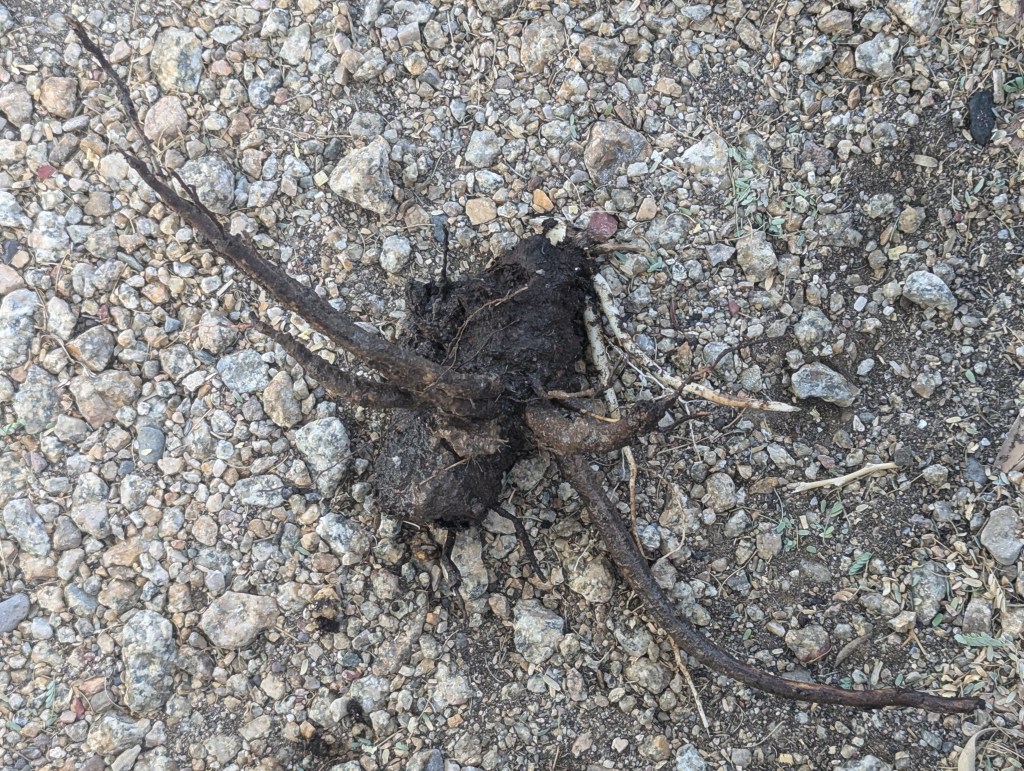
2. Hesperaloe parviflora, red yucca should be easier to grow by division. Unfortunately, this one shoot that I managed to divide is almost totally rotten from excessive irrigation.

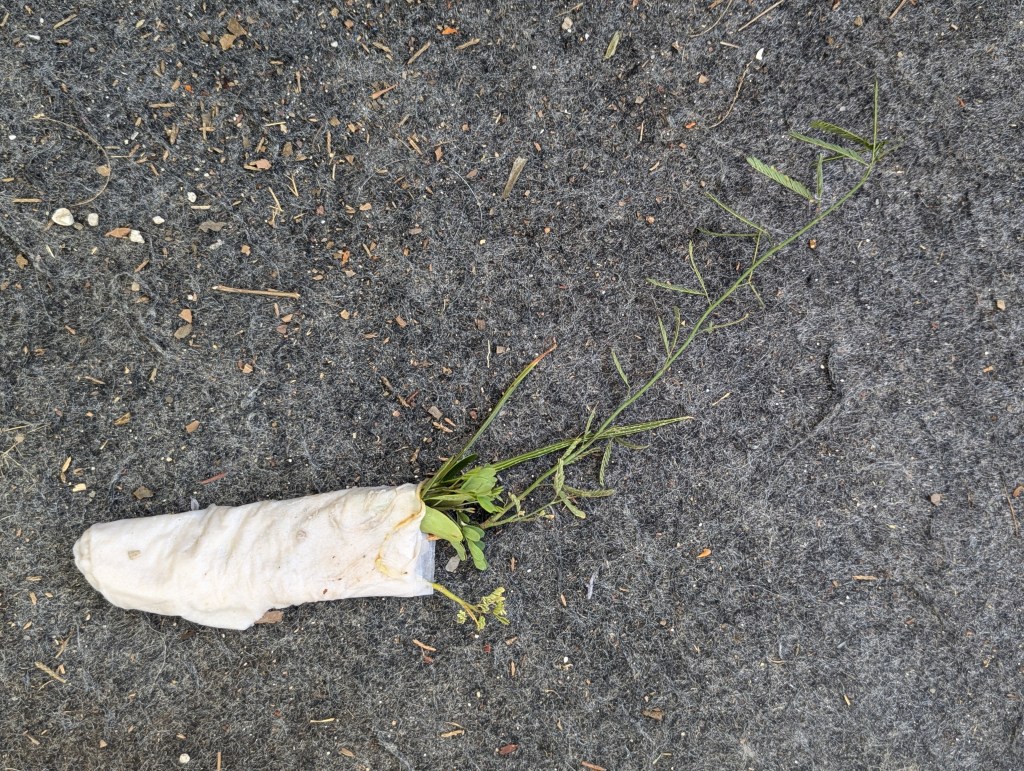
3. Calliandra californica, Baja fairy duster is the only species in this bundle of seedlings that I can identify. It is the biggest one which extends to the upper right. The bundle also includes seedlings of both or either Parkinsonia florida, blue Palo verde and or Prosopis velutina, velvet mesquite, as well as a single seedling of an unidentified species of palm.

4. Parkinsonia florida, blue palo verde is easier to identify when it larger than seedlings. However, because I am unfamiliar with it, I am still uncertain if these are actually them.

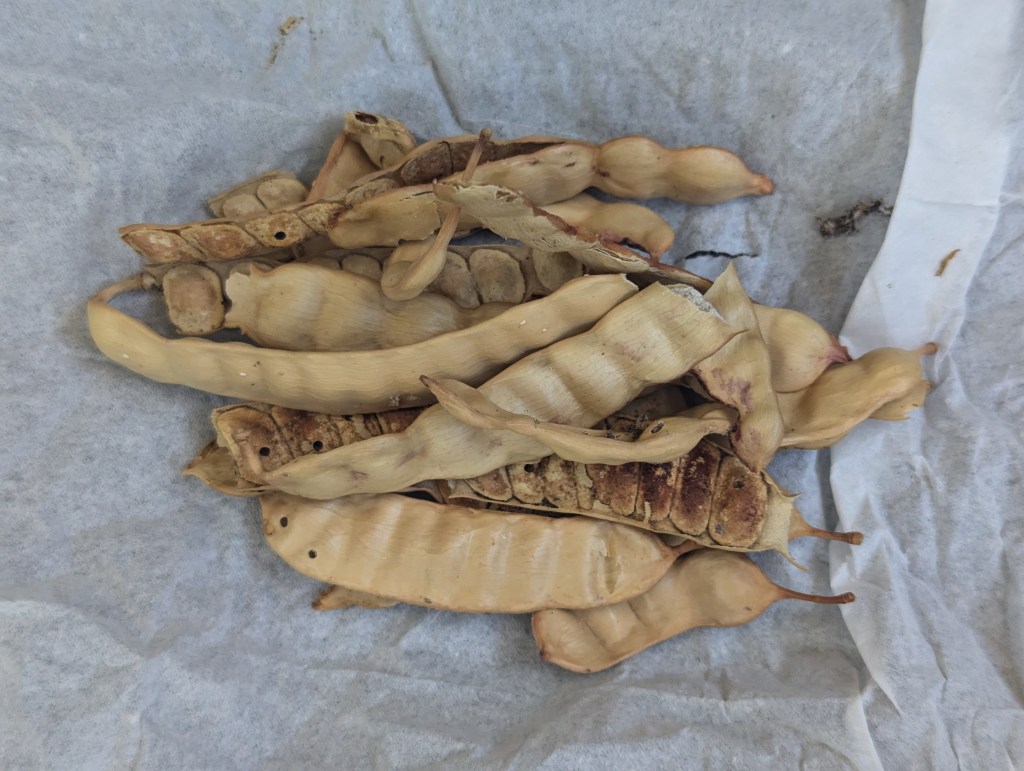
5. Prosopis velutina, velvet mesquite left these seed pods on the ground. Small holes are from insect larvae that ate some of the seed within. A few viable seed would be adequate.

6. Fouquieria splendens, ocotillo was a gift, so was not pilfered. This cane is about three feet long, so can become several cuttings when I determine how long cuttings should be.

This is the link for Six on Saturday, for anyone else who would like to participate: https://thepropagatorblog.wordpress.com/2017/09/18/six-on-saturday-a-participant-guide/

Western Cottonwood

Western cottonwood is better in the wild than within refined gardens.

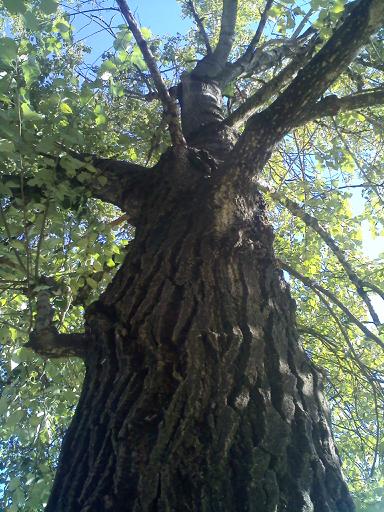
The brilliantly clear yellow autumn color of Western cottonwood, Populus fremontii, is best in the higher elevations and inland areas of its extensive range, which spreads from the coast of California to the Rocky Mountains and as far south as Mexico. Although it thrives in local riparian areas, particularly Coyote Creek and Guadalupe River, mild temperatures in both summer and winter do not allow it to get as colorful as it does in Nevada. It is almost never planted intentionally, but has a sneaky way of sometimes growing from seed in well watered gardens.

The bad news is that Western cottonwood grows big, fast and aggressively. The shallow roots displace pavement, compete with other desirable plants and damage septic and drainage systems. Large trees produce an abundance of annoyingly fuzzy seeds that adhere to anything. After causing so much damage, Western cottonwoods survive only a few decades, leaving big deteriorating carcasses that need to be removed before collapsing. Consequently, Western cottonwood is really suitable only for large open areas or in the wild.

Mature trees can be more than fifty feet tall and more than half as broad. Their somewhat thick leaves are almost triangular, with paired angular lobes on the sides and blunt tips. ‘Nevada’ is a male cultivar that does not produce fuzzy seeds.

Autumn Foliar Color Within Mild Climates.

Pistache does not need much chill to develop exquisite foliar color.

Cooler climates may not have so much annual flower color to choose from at the end of summer, but have more autumn color from trees and a few shrubs and vines. The weather is of course different every year, so autumn color is never predictable. Just as some of the typically colorful trees may not be so spectacular every year, some of the more mundane trees may be surprisingly colorful if the weather is just so.

In milder climates, sweetgum (Liquidambar), flowering pear and Chinese pistache are generally the most reliable for the most color as the weather gets cooler. All three exhibit a good range of color, from clear yellow, through orange and bright red. Sometimes, particular colors are more prominent, or even exclusive. For example, Chinese pistache can be completely orange without yellow or red. Some cultivars of sweetgum specialize in particular color ranges. For example, ‘Burgundy’ turns dark red or purplish red without much yellow or orange.

In cooler climates, maples color well. Sugar maple is perhaps the most colorful, comparable even to sweetgum. Unfortunately, it does not hold onto its foliage as tightly, and soon looses it to slight wind or rain. Red maple colors just as reliably, but is more red and brown with less yellow and orange. Norway maple typically turns yellow or somewhat orange. Silver maple turns only dingy yellow, but gets big enough to make quite a show.

The best bright yellow is probably provided by maidenhair (Ginkgo biloba) tree. Birch, honey locust, tulip tree, fruitless mulberry, some willows and poplars can be comparable if the weather turns cool suddenly. Redbud, dogwood, hawthorn and flowering cherry are more subdued shades of yellow, but are grown more for their spring flowers anyway. Persimmon probably provides the best brightest orange foliage, followed by abundant and comparably bright orange fruit!

Some ash, some oaks, Chinese tallow tree, parrotia and dawn redwood all provide their own flavors of autumn color. Dawn redwood and pin oak actually turn simple brown, which some people think makes the trees look dead! Raywood ash turns a nice burgundy red or purplish. However, the old fashioned Modesto ash (which is a type of Arizona ash) turns as bright yellow as fruitless mulberry does. Not all crape myrtles have good fall color, but some are as colorful as sweetgum is. Various hazels, spiraeas and viburnums are colorful shrubbery in autumn. Wisteria vines, which are known more for their colorful spring flowers, turn yellow.

Horridculture – Queen Nefertiti

Ancient Egyptian influence within a modern landscape

Queen Nefertiti, during the fourteenth century BC, was the most famous and most influential Queen of Ancient Egypt. She wore a cool hat too. It was sort of cylindrical shaped, but also tapered so that it was wider on top, sort of like a funnel. So, not only was Queen Nefertiti very influential during her time, but she remains influential in modern mow, blow and go gardening. So-called ‘gardeners’ everywhere still shear shrubbery into the shape of Queen Nefertiti’s cool hat! Not many species of shrubbery are exempt. Just about any get shorn into a sort of cylinder shape that is wider on top, sort of like a funnel, but also tilted in one direction or another, just like Queen Nefertiti’s hat tilts toward the back. Such shearing typically deprives blooming shrubbery of its bloom, but bloom is apparently not a priority, as long as the ancient Egyptian form is maintained. The picture above includes four oleanders, a Texas sage and what seems to be two trailing lantana. The Texas sage and trailing lantana are more cylindrical than hat shaped, but the hat shape of the three oleanders is impossible to deny. It is such a universal technique that is performed so precisely wherever vegetation is maintained by mow, blow and go gardeners that it seems to be taught in classes as standard procedure. I am significantly more educated in horticulture than most mow, blow and go ‘gardeners’, but I somehow missed this in my curriculum. Instead, I learned that vegetation should be allowed to exhibit its natural attributes, such as form, texture, bloom and so on. If I wanted a herd of ancient Egyptian hats in my garden, I would probably construct something that resembled ancient Egyptian hats from an inert material that never needs shearing or irrigation.

the Original
a modern version of an ancient Egyptian fashion show

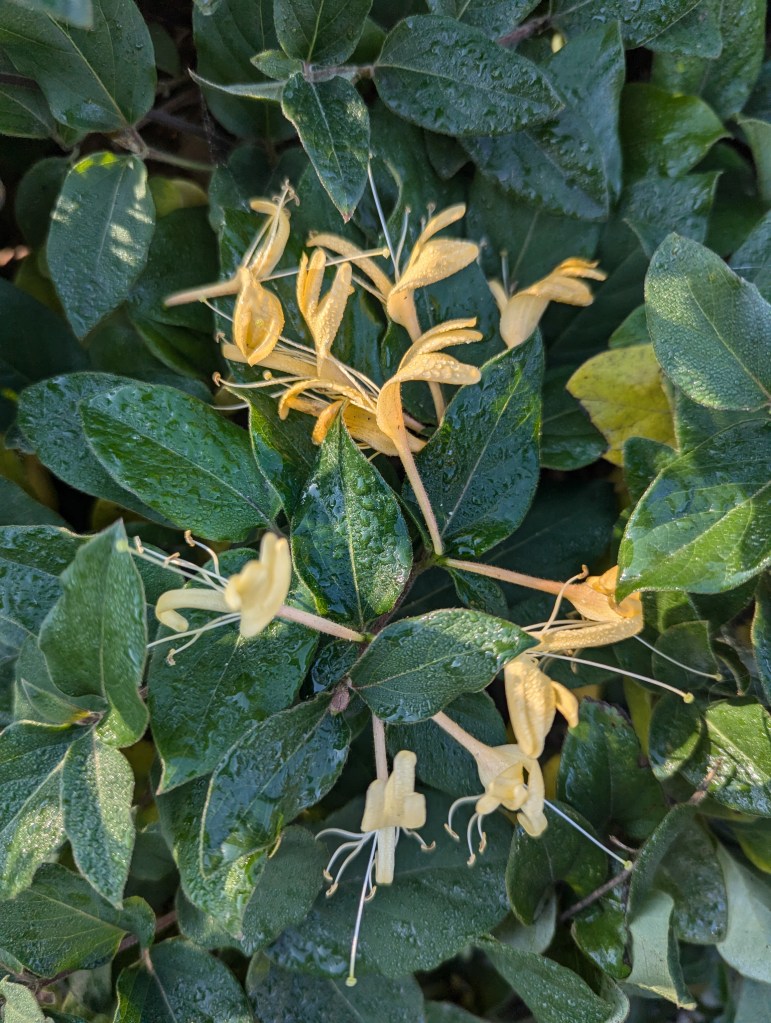
Japanese Honeysuckle

Honeysuckle is more fragrant than colorful.

Bloom should be most abundant during late spring and summer. Within this mild climate though, it often continues sporadically through autumn. Japanese honeysuckle, Lonicera japonica, is presently blooming nicely in some areas. Its trusses of ribbony creamy white flowers fade to pale yellow. Although unimpressively colorful, they are alluringly fragrant.

Japanese honeysuckle here is almost exclusively Hall’s Japanese honeysuckle. It might be recognizable by a cultivar name of either ‘Hall’s Prolific’ or ‘Halliana’. Some botanists consider halliana to be a variety rather than a cultivar. (Variety names are neither quoted nor capitalized like cultivar names.) ‘Purpurea’, with dark but not purplish foliage, is rare.

Japanese honeysuckle, like star jasmine, is a vine that can be a ground cover. As a vine, It can climb more than thirty feet high. Unfortunately, it sometimes overwhelms shrubbery and small trees. Its twining stems can constrict the stems of other vegetation that it wraps around. As ground cover, it can get three feet deep. Leaves are two or three inches long.

Dried Flowers Were Formerly Fresh

Some faded bloom retains striking form.

All sorts of flowers bloom through autumn as well as winter. Honeysuckle still exudes its richly sweet summery fragrance. Honestly though, most flowers bloom for spring or early summer. They finished a while ago, and are now going to seed. Even flowers that bloom repeatedly do so less now. This is when floral design can get creative with dried flowers.

Straw flower, statice and globe amaranth are among the most familiar of all dried flowers. While still fresh, they already seem to be dry. They do not seem to change much as they dry. They neither fade nor wilt very much. Only their stems sag. If they hang upside down as they dry, their stems remain straight as they stiffen. Their foliage is likely unimportant.

Rose and hydrangea are among less conventional dried flowers that actually look dried. They fade and shrivel, but somehow develop a distinct visual appeal. Amaranth, celosia, lavender and globe thistle fade and wilt only somewhat. Because amaranth stems curve downward anyway, they need not hang to dry. Lavender stems can dry before collection.

Pampas grass and cattails are big and bold dried flowers that were popular in the 1970s. Hairspray should contain dislodged fuzz that otherwise escapes pampas grass bloom. It can also prevent cattail bloom from bursting to disperse its fuzz. Cattails typically grow in marshes, where they are difficult to reach. Pampas grass foliage inflicts nasty paper cuts.

Some dried flowers are better dried than fresh. Some are mere by products of bloom that deteriorated earlier. Dried floral trusses of lily of the Nile, without their seed capsules, are quite striking. So are dried floral spikes of New Zealand flax and some yuccas. They are merely deadheading debris otherwise. Even dried queen Anne’s lace is worth recycling.

Dried flowers do not necessarily need to be of floral origin. Dried bird of Paradise leaves develop weirdly twisty form. Colorful deciduous leaves can be as colorful in the home as in the garden. So can firethorn and cotoneaster berries. Twigs of ‘Sango Kaku’ Japanese maple and red twig dogwood provide color with form. These are only obvious examples. There are many more to experiment with.

Santa Cruz II

Begonia boliviensis ‘Santa Cruz’

Begonia boliviensis ‘Santa Cruz’ is significantly bigger than it was when I wrote about it three months ago. If I had known that it would have performed so well, I would have groomed it for better form. It grew upright at first. I just let it do so because I wanted to make a cutting from the tip when it got pruned back. However, because it leaned over and branched as it should, it did not get pruned back. It could have developed a better and lower form if I had tended to it better, but I am too pleased with it now to complain that it is a bit more upright than it should be. I do not mind that I did not get a cutting from the primary stem that I did not cut back because there are now many more stems that I can get cuttings from, simply be grooming out a small bit of superfluous growth from within. I could get many more than I want if I were to actually prune this specimen back for winter. It is getting to be too exemplary to cut back for winter, though. Nor do I want to leave it out to get frosted, as I might do with other begonias. The horticulturist who procured it will shelter it from frost, and perhaps groom it a bit after winter, but otherwise try to retain as much of this growth as possible for a head start next spring. I am curious to see what it does. Will it shed most of this growth as it resumes growth from below next spring; or will it grow from near the tips of where it stopped growing this year? I did not expect to be so impressed by this modern cultivar of Begonia.