Because they do not like warm weather through summer much, sweet William, Dianthus barbatus, is appreciated more as a cool season annual from autumn into winter and even into spring. They can also be planted early in spring for color before summer warmth. They can sometimes survive as perennials in sheltered areas, particularly if mixed and hidden amongst other perennials and annuals. Deadheading (removal of deteriorating flowers) prolongs bloom.
New plants are easy to propagate from division, cuttings or layering of tired older plants. (Layering involves rooting prostrate stems by burying them slightly and them separating them when they have developed roots.) By the time the old plants become too deteriorated to salvage, the new cuttings or layers should be ready to replace them. New plants like to start out in rich and well drained soil, but not watered too much since they can be susceptible to rust and fusarium wilt.
The white, pink, rosy pink, red, somewhat purplish or bicolored half inch wide flowers form rather flat dense trusses on top of short stems. Minute but abundant green bracts fill the spaces between the individual flowers. The rich green leaves below are about an inch to two and a half inches long. Mature plants of the more common varieties are typically less than a foot tall and wide. More compact and larger varieties are available as seed.
Some irrigation becomes temporarily obsolete through the rainy season.
Now that it has started to rain, what should be done with automatic watering systems? In almost all situations, automatic irrigation systems should be adjusted to accommodate for moisture provided by rain. If rain is sufficient to provide enough or too much water, irrigation can be discontinued until needed again when the rain stops a few months from now.
If the first few storms are discontinuous enough with warm and dry weather mixed in between, lawns and plants that want more substantial watering may need to be watered a few times until the rain becomes more reliable. However, because of cooler temperatures and shorter days, plants do not use nearly as much water as they did during the summer anyway, so do not need to be watered nearly as much as they were only a month or so ago.
Deciduous plants that are losing their leaves need the least moisture, since they can not lose any moisture through evapotranspiration (evaporation from foliar surfaces). The very few plants that bloom or even start to grow during winter use a little bit more water than those that really are dormant, but are still likely get all they need from rain even without getting watered.
Flowering annuals, particularly left over warm season annuals that continue blooming late, may get moldy with too much rain. Their flowers and some of their foliage can turn to mush until there is a break in the rain. Removal of damaged flowers and leaves slows the spread of the mold but does not cure it. Good air circulation among well spaced plants and in exposed areas helps inhibit mold. Regardless, moisture from abundant rain can eventually cause mold to be a problem.
In fact, the only plants that are not likely to get all the water that they need from rain are those that are in pots and planters under eaves or in the home as houseplants. Nonetheless, sheltered plants that are outside should still get much less water now than they do during the long and warm days of summer. These plants are either dormant or at least more sedate because of the shorter cooler days through winter. Houseplants may likewise use less water because the home environment is also cooler.
However, if the heating system of the home decreases humidity, some large houseplants may actually want a bit more water through winter! Humidity fluctuates most in older deficiently insulated homes that are heated by wood stoves or fireplaces; since these homes get humid without a fire burning, but then get much drier with a fire.
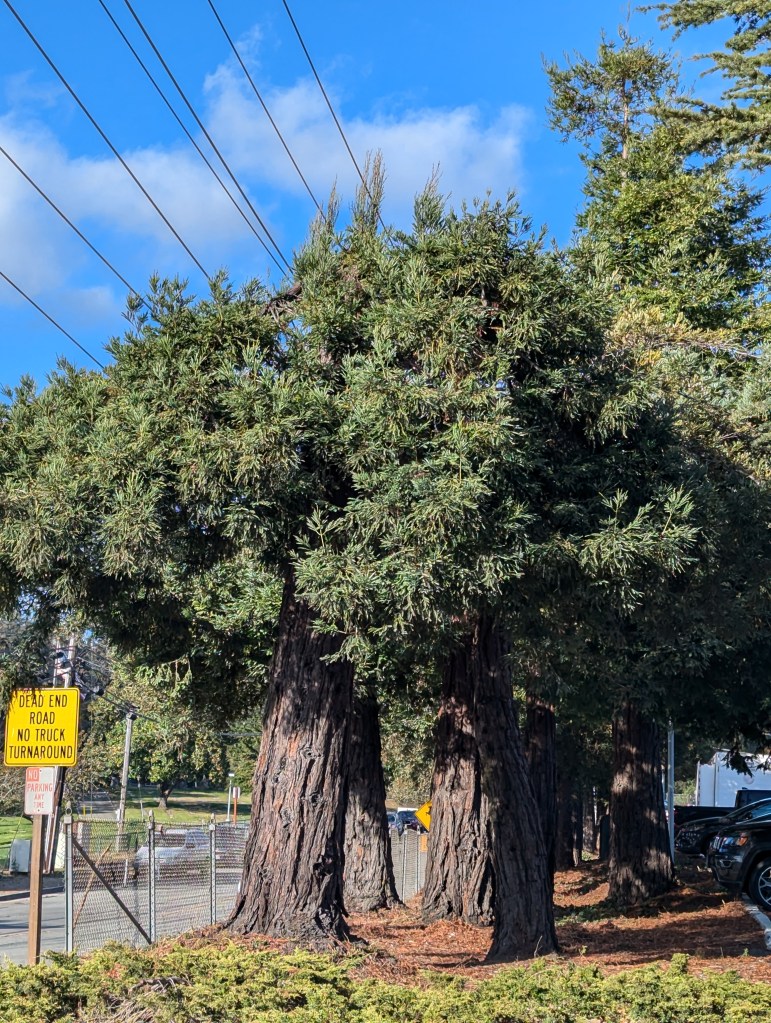
Appropriately, this picture was taken on Halloween. The ‘DEAD END’ sign and cemetery beyond, which are visible to the lower left of the picture, were also coincidental. The several headless redwood trees are the primary topic. Obviously, they were decapitated because of the electrical cables above. Otherwise, redwoods with such healthily plump trunks would be rather tall by now. After all, coastal redwoods are the tallest trees in the World. Unfortunately for them and those who are now appalled by their disfigurement, reliable and safe electrical service is more of a priority than poorly situated trees. It is no fault of the trees. Nor should this atrocity be blamed on those who executed it. Their only better option would be complete removal of the subjects, and perhaps replacement with smaller trees that will not grow tall enough to get too close to the electrical cables above. Maintenance of clearance of the vigorously upright redwoods from the cables above is a chronic problem that must be morally challenging for the arborist who must perform the necessary procedures. However, removal of several such significant trees would be very objectionable to the Community, which is very likely why these trees remain, regardless of their severe and irreparable disfigurement. Application for permits for their removal requires posting of such intentions on the trunks of the subject trees, to which neighbors would very likely protest. None of this would be such a problem now if only trees that are more appropriate to this particular situation were installed instead! Did the landscape designer who designed this landscape even visit the site during the design process, or was it all done on paper in a remote studio? Why did those who installed these trees not foresee this problem and modify the landscape plan and species selection accordingly?
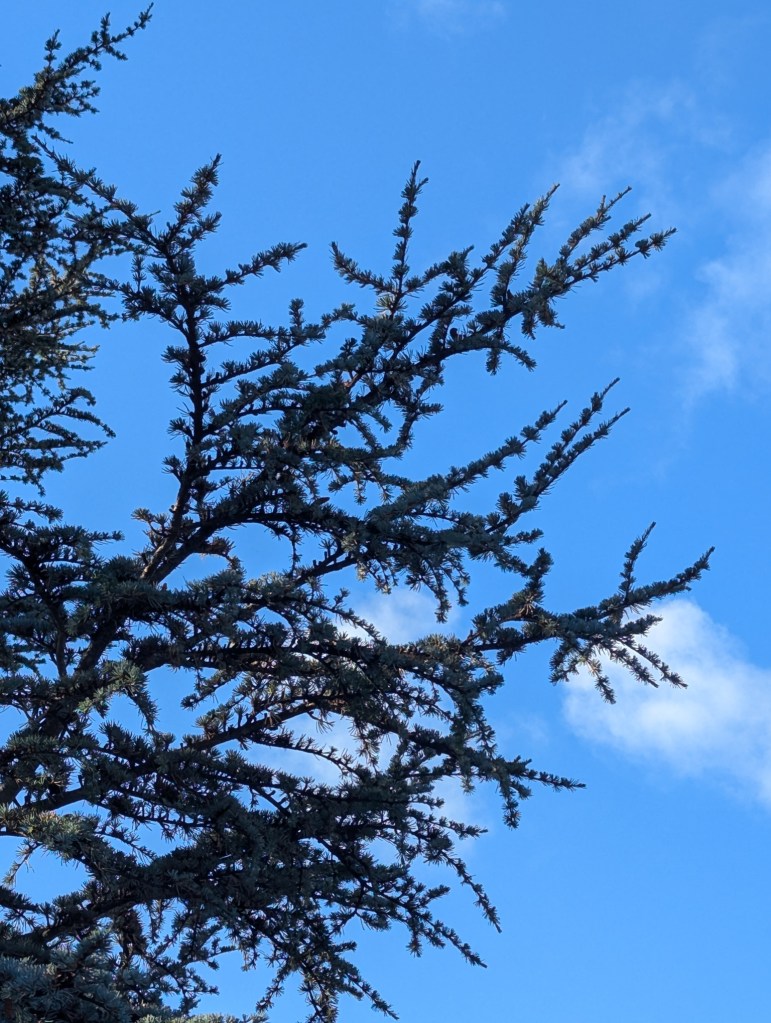
No other coniferous tree develops such distinctively irregular form. Very few exhibit such distinctively steely grayish blue foliar color. Blue Atlas cedar, Cedrus atlantica ‘Glauca’ is no simple shade tree. It is a striking trophy tree that is worthy of prominent display within grand landscapes. It is ideal for traffic circles, without other trees to obscure its boldness.
Blue Atlas cedar is also sufficiently resilient for traffic circles and other difficult situations. Arid warmth, even if enhanced by pavement, roofs or walls, should be no problem. Once established, blue Atlas cedar does not crave much irrigation. It should be able to survive with none. Excessively frequent or copious irrigation is more likely to become a problem.
Blue Atlas cedar can grow a hundred feet tall in the wild within its native range. It should not grow much more than half as tall with good exposure within landscapes. Trunks may slowly grow to almost six feet wide. Canopies can eventually grow wider than thirty feet. ‘Glauca Pendula’ is weeping blue Atlas cedar, which is smaller but even more exquisite. ‘Aurea’ with gold tips, is very rare.
Firewood was much more popular only a few decades ago. It was readily available from displaced orchards and nearby forests. Fireplaces and even a few woodstoves were not yet so uncommon. People were more motivated to cut and split firewood. More than now purchased it already cut and split. For heating, gas and electricity were more expensive.
Firewood is not so readily available nowadays. Forests are not so nearby. Orchards that were subject to displacement in the past are now completely gone. Most firewood that is available for purchase is a byproduct of arboriculture. Yet, it may not be much less costly than gas or electricity for warmth. Gas or electricity are more convenient and less messy.
Fireplaces and woodstoves are not so common nowadays either. Modern building codes prohibit them from new construction. Repair is rarely justifiable for any that incur damage from earthquakes. Because most are very rarely if ever in use, their removal is generally more practical. The many more households that are here now utilize much less firewood.
However, firewood is not obsolete. It is a renewable resource that very literally grows on trees. Some households consume only very minor volumes from their home landscapes. Some households purchase more significant volumes of it from tree service businesses. In some communities, it is available from woodcutters who harvest it from private forests.
Regardless of its source, firewood for this autumn and winter must be seasoned by now. In other words, after cutting and splitting, it needed time to dry thoroughly. Otherwise, it is difficult to ignite, produces excessive smoke, and burns inefficiently. Palm, cordyline and yucca trunks are not suitable for firewood. They burn fast, but do not produce much heat.
Average home gardens do not produce much firewood. However, removal of a single big tree can instantly provide an abundance. Tree services prefer to leave such wood where it falls. They usually cut it to fit fireplaces but do not split it. Those with an abundance are often happy to share, especially if they use none. It occupies space, and eventually rots.
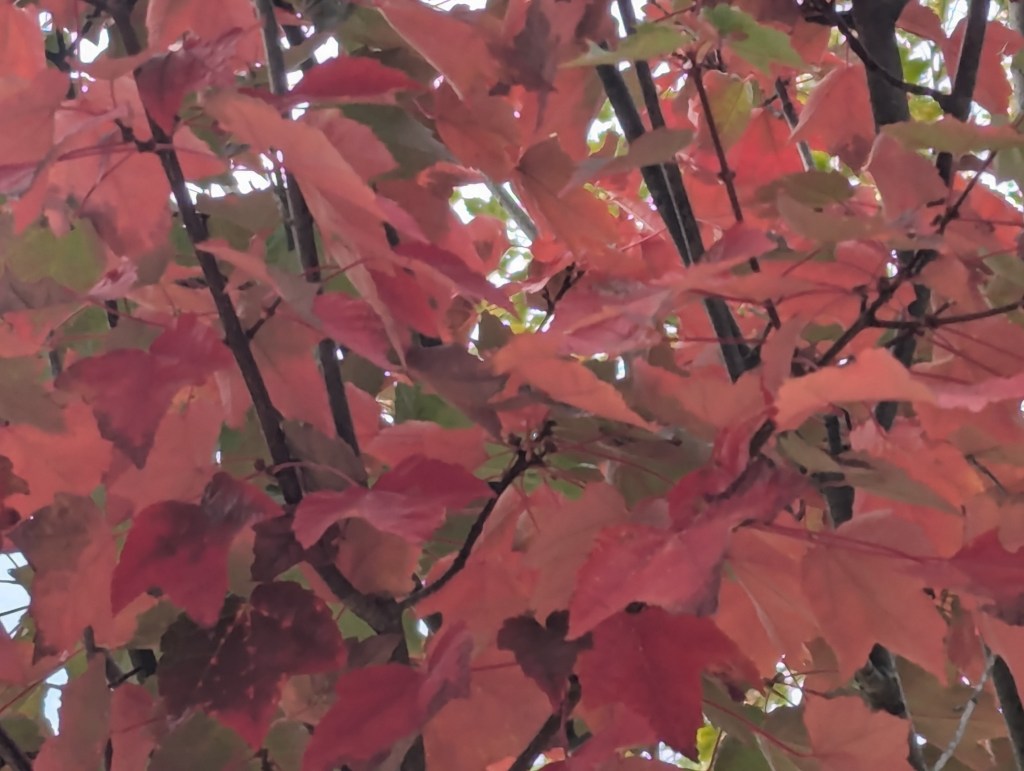
Acer platanoides ‘Schwedleri’, is Schwedler’s maple, which is an old fashioned cultivar of Norway maple. It is not a red maple. However, because its new foliage initially emerges with deep burgundy red color, it is often mistaken for red maple, particularly where red maple is uncommon. Its deep burgundy red foliar color does not last long before developing deeper purplish bronze color, with tiny contrastingly greenish yellow flowers. For autumn, the foliage turns yellow. Schwedler’s maple was a common street tree for the many large tracts of suburban homes that were built within the Santa Clara Valley during the late 1950s. Although it has not been available from nurseries for the past few decades, at least two similar but more modern and darker bronze cultivars of Norway maple are becoming more available. Modern cultivars are generally sterile, so are not invasive like the simple species has been within some ecosystems that are more favorable to naturalization than that of the Santa Clara Valley. The Norway maple in the picture above is not ‘Schwedleri’ but looks very much like it.
Acer rubrum is the real red maple, not just because of its often bright red autumn foliar color, but primarily because of its red floral buds that emerge immediately prior to foliation in spring. However, prior to autumn, its foliage is simple green. Red maple was rare here prior to 1990, and by the turn of the Century was still only mildly popular in the Santa Clara Valley. It could be more popular than it is, and realistically, performs better as a street tree than cultivars of Norway maple. Although not as colorful as bronzed cultivars of Norway maple are through summer, its vibrant yellow, orange and typifying red autumn foliar color is superior, even in response to only mild chill.
This is what taking sides looks like. The right side was taken completely off, leaving only the left. The view from the other side would show that the left side was taken completely off, leaving only the right. It is not such a good picture because it is difficult to distinguish the extent of the damage from what is going on in the background. Realistically though, a better picture would be even worse, since the extent of the damage would be more obvious. The justification for such damage here is more obvious, since, obviously, this is a bad situation, with no room for balanced growth. Although survival is possible, this is not what nature intended. Natural growth should be an asset, and efficiently directed to where it can be useful, which would most likely be much more balanced than this. Incidentally, this is a coastal redwood, which is the Official State Tree of California. This sort of pruning would be just as damaging to Western hemlock, Douglas fir or blue spruce. For that matter, it would be just as damaging to longleaf pine, Western white pine or Ponderosa pine. Ultimately, it is bad technique for any tree in any situation.
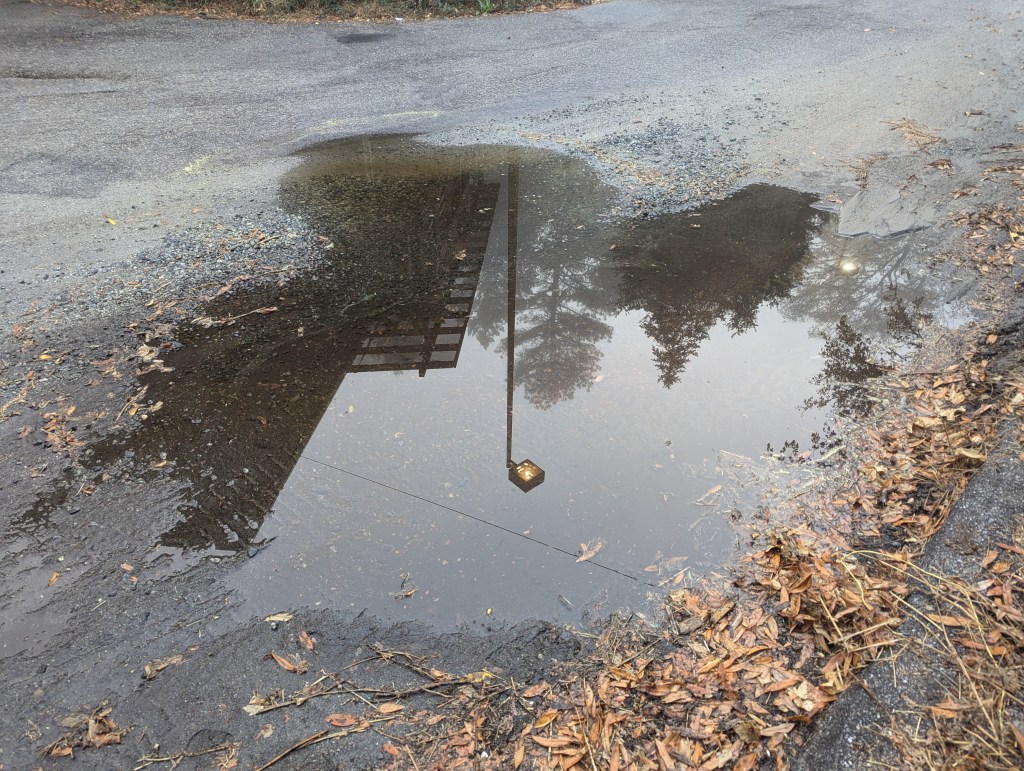
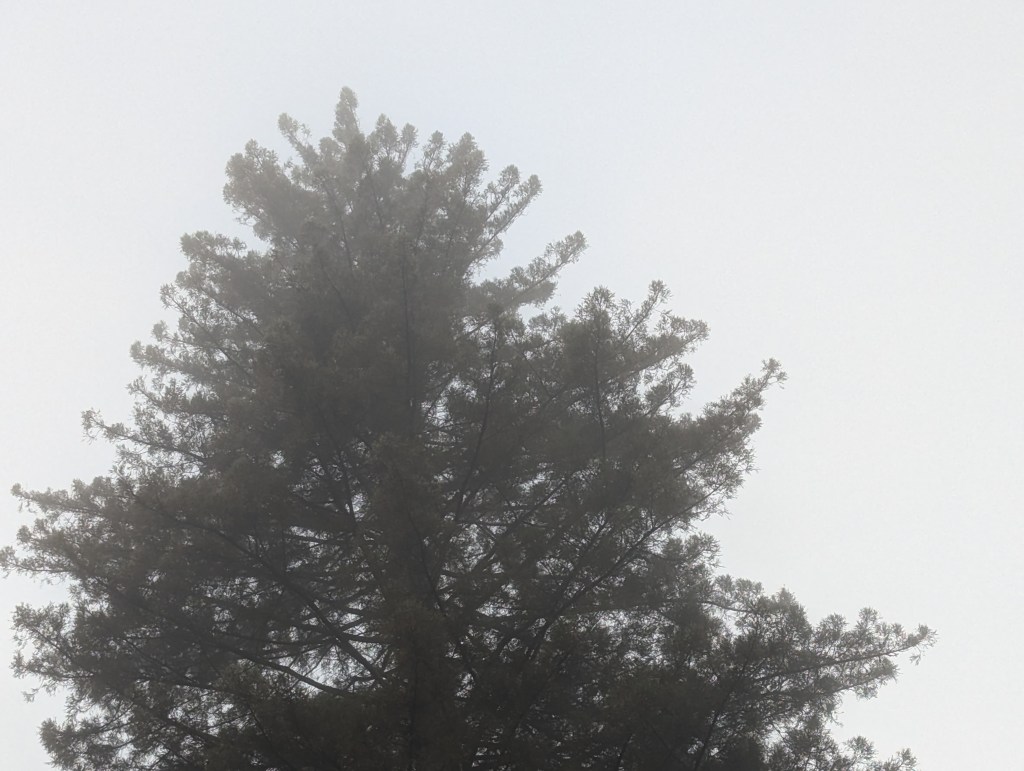
Astronomical autumn began more than a month ago. It is about a third done, with about two thirds remaining. Meteorological autumn can start at any time. Sometimes, it starts, but then pauses before restarting a bit later. Sometimes, the first rain is the beginning of the rainy season, which typically continues through winter. A bit of rain arrived between Wednesday and Thursday, and a bit more is here now, but no more is in the forecast for next week. Regardless of future weather, some flowers bloom, or at least try to, as late as they possibly can. Of course, some actually prefer to bloom even later and during winter. Apologies for the lack of focus of pictures #4 and #6.
1. A ‘chance or rain’ in the weather forecast here is generally not taken too seriously until something like this happens. It is a genuine puddle. It is wet, and full of water from rain.
2. Sequoia sempervirens, coastal redwood seems to enjoy this damp weather. It actually enjoys all weather, but appears to be more refreshed by any interruption of arid warmth.
3. Lemna minor, duckweed is even weirder with this border of white foam that develops as the first rain washes away pollen and dusty crud that accumulated since the last rain.
4. Hedychium coccineum X coronarium ‘Peach Delight’ ginger lily, which was blooming for last Saturday, is trying to bloom again. I already doubted its ability to follow through.
5. Brugmansia X cubensis ‘Charles Grimaldi’ angel’s trumpet looks like Carl’s Junior ate too much of its own food. I added this because of response to angel’s trumpet last week.
6. More interestingly, it produced this seed pod. Such hybrids should be sterile. I can not help but wonder if seed is true to type. If so, propagation by cuttings is easier than seed.
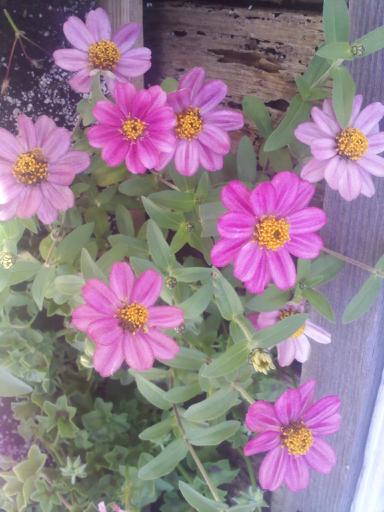
The longer and cooler nights of autumn will soon finish the season for zinnias. (Most, but not all of the common zinnias are of the species Zinnia elegans.) They are really at their best while the weather is warm through summer and the beginning of autumn. As the garden warms up at the end of next spring, new seedlings can be planted, or zinnia seed can be sown. They like rich soil and regular watering, but are susceptible to mildew in humid spots. Sunny areas with good air circulation are best.
Like related chrysanthemums, zinnias are quite variable. Although the simpler forms remain more popular; double, cactus flowered and crested forms are also available. Flowers can be less than an inch wide to more than five inches wide. Their color range includes white, yellow, orange, salmon, pink, red, rose, purple, lavender and even green. The narrowly oval leaves can get to about four inches long. Compact types stay about a foot tall and wide. Large types get twice as wide and more than three times as tall.
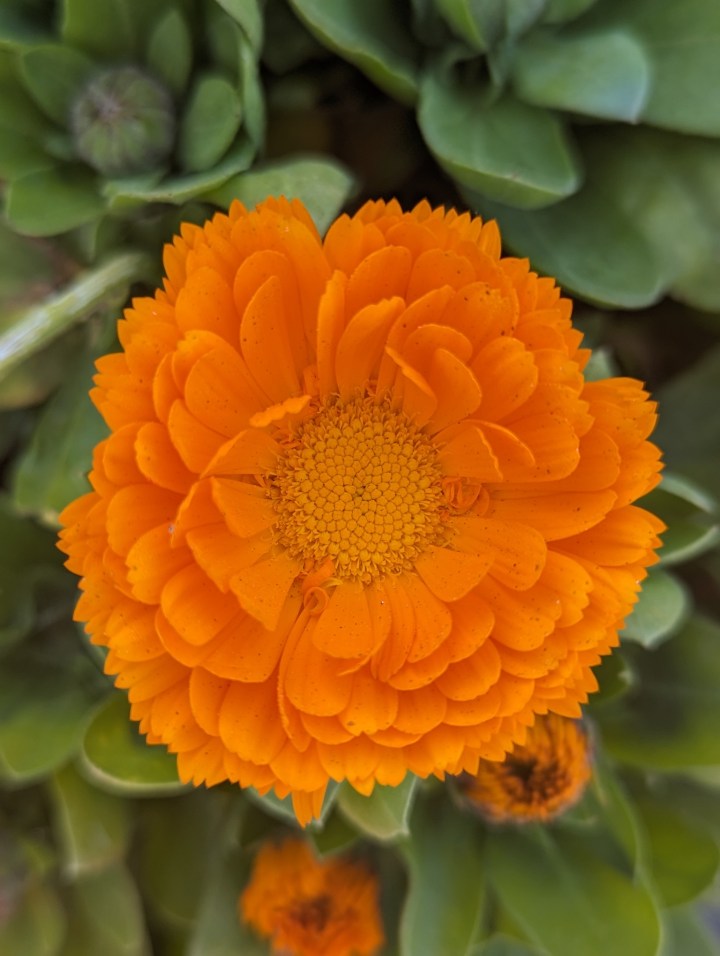
Calendula dislikes summer warmth and may not last completely through winter, but should last as long as marigold.
What was probably the last of the warm weather for the year really got the zinnias going again; but only for their leaves to become dusted with powdery mildew in the subsequent long cool nights. No matter how good the zinnia flowers still look, it is time for cool season annuals.
In mixed plantings, cool season annuals can be ‘plugged’ (as seedlings or small plants) or sown (as seed) among the warm season annuals so that they are ready to perform as the warm season annuals succumb to cooler weather. Of course in more uniform beds, warm season annuals will eventually need to be removed to make space for their cool season replacements.
Pansies and related violas are likely the two most popular cool season annuals. They fill in nicely as bedding plants or are nice components to mixed plantings. They perform best early in the season while the weather is still a bit warm, but should last until the weather gets too warm the following spring.
Primroses and Iceland poppies can take a bit more effort since they need ‘deadheading’ (removal of deteriorating flowers) to continue blooming. Primrose can also be hazardous to anyone who happens to be allergic to them, causing skin irritation comparable to that of poison oak! Some primroses are very brightly colored, while others are more subdued and elegant shades of pink and white. Iceland poppies are mostly pale shades of orange, yellow, pink and white on wiry stems.
Chrysanthemums, which are actually perennials, are the most variable of the cool season annuals, with a wild range of colors and flower forms. The varieties most popularly grown as annuals stay low and compact. Taller types make good cut flowers, but are not so practical for bedding. The related African daisies, which are incidentally similar to the ground cover of the same name, lack the variety of flower color and form, but are easier to grow; particularly as a perennial long after other cool season annuals are gone.
Calendulas are another simpler chrysanthemum relative that are more proportionate to typical annuals, since they get only a few inched deep. They would probably be more popular than they are if they provided more colors than their marigold like orange and yellow. Unlike chrysanthemums and African daisies, calendulas really are annuals, so do not last long into warm weather.
Red, white, pink and rosy pink flowers among rich green foliage can be provided by sweet William (dianthus). They not only tolerate a bit more shade than some other cool season annuals, but are also likely to survive sporadically as perennials where protected from warm exposure through spring and summer.
Stock is the best cool season annual for fragrance. It smells like carnations, but much stronger. Short varieties are good bedding annuals, and even better for mixed plantings. Taller varieties are great cut flowers.







 Tony Tomeo