Apologies for recycling an old article again. I am working too late tonight to write something new. It is half an hour from tomorrow morning.
Windmill Palm
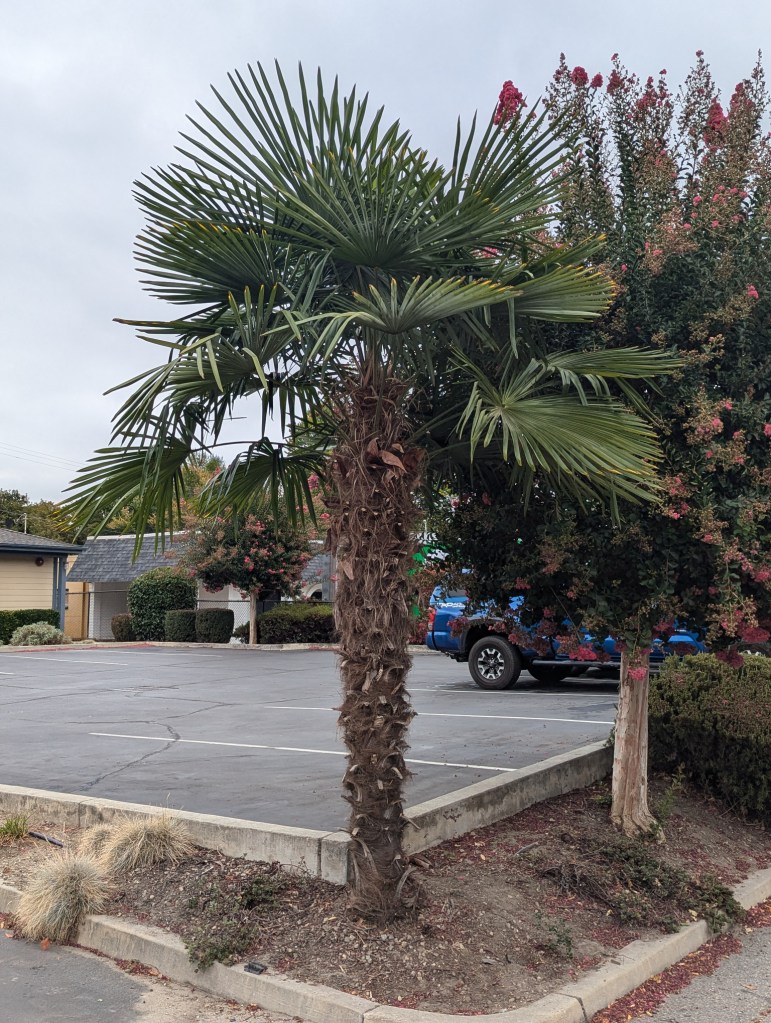
Palms take commitment. Some of the most popular grow too big for their situations. Most grow so tall that only arborists can maintain them. None are conducive to pruning to limit their natural height. Individual palm trunks rely on their single terminal buds, which grow only upward. Diversion is not an option for any palm that encroach into electrical cables.
Windmill palm, Trachycarpus fortunei, is one of the more complaisant of palms. It can not grow around utility cables, but otherwise does not grow obtrusively big. Young trees can grow fast to fifteen feet tall, but then grow slowly to double their height. Only a few elderly trees grow as tall as forty feet. Their foliar canopies are generally less than ten feet wide.
Trunks of windmill palms are distinctively shaggy. Pruning dead fronds as closely to their trunk as possible promotes a neater appearance. Because growth decelerates with age, trunk shag is typically wider higher up. Trunks are about half a foot wide, but seem twice as wide since they are so shaggy. Gathering seed from pollinated female trees is simple.
Gathering Seed To Grow Later

Deadheading, or the removal of deteriorating bloom, is contrary to the purpose of bloom. It conserves resources for subsequent bloom or vegetative growth. It neatens associated vegetation. Deadheading is certainly justifiable. However, it eliminates most seed before it can develop. Seed is the priority of bloom. Gathering seed can be a good compromise.
Techniques for gathering seed are as variable as bloom and subsequent seed. For some popular annuals and perennials, it is as simple as deadheading. Their seed develops as fast as their bloom deteriorates. Seed is easy to shake from dried stems of rose campion, campanula and columbine. Cut stalks of lily of the Nile must dry for their seed to mature.
Gathering seed from vegetable fruits can be a bit more complicated. Some are mature as soon as their containing fruits ripen. For example, seed from ripe chile peppers are ready for drying and storing immediately. However, zucchini must mature too much to be edible for its seed to finish developing. Furthermore, squash seed is likely to not be true to type.
This is often a consequence of cross pollination from other varieties of the same species. Progeny of very different parents inherit genetic qualities of both parents. Similarly, many extensively bred varieties exhibit reversion. Their progeny can be more similar to distant ancestors than direct parents. Reversion may be progressive through a few generations.
Reversion is less likely among hybrids only because most hybrids are sterile. Gathering seed from them is generally either futile or impossible. Some hybrid canna develop seed capsules that contain no viable seed. Seedlessness is an advantage of seedless hybrid watermelon. Viable seed of the few hybrids that could produce it is wildly unpredictable.
Most mutations, such as variegation or dwarfism, are not inheritable. Seed of variegated Kaffir lily therefore grows into unvariegated specimens. Some seedlings mature through a juvenile phase prior to bloom. This is why avocado seedlings grow so lean without fruit in their first few years. Ultimately, gathering seed is most practical for simple wildflowers, annuals, perennials and some vegetables.
WWF
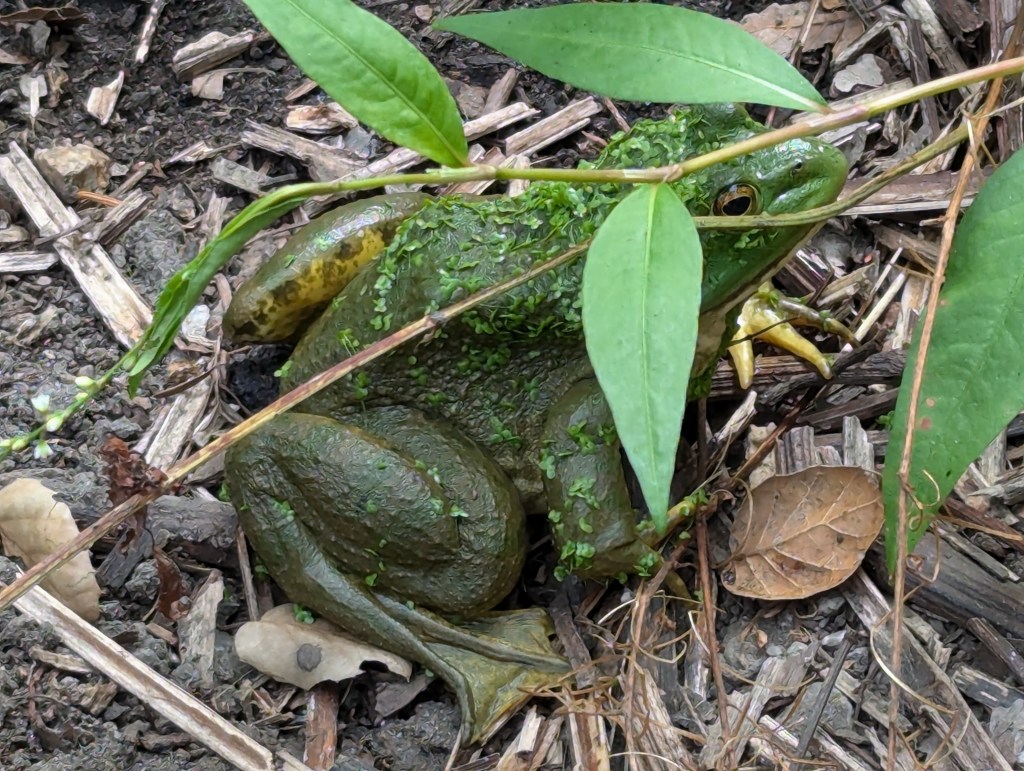
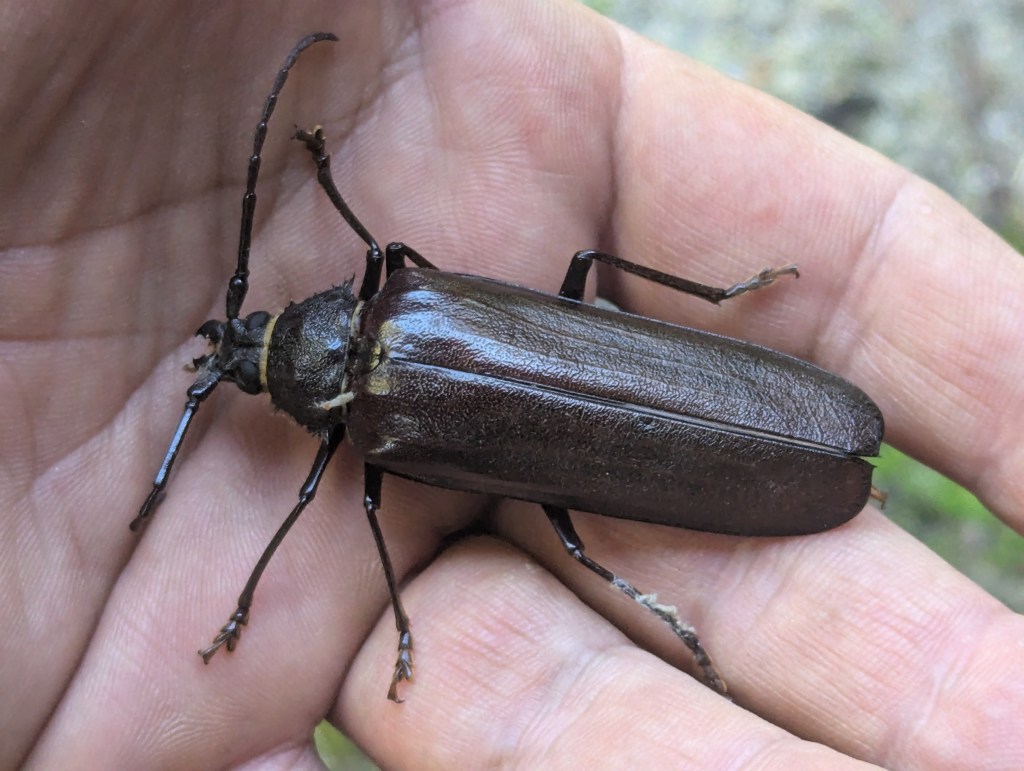
The World Wrestling Federation is now known as World Wrestling Entertainment because the World Wildlife Fund was already known as the WWF. The dude in the picture above could go either way. Apparently, he, or she, is some sort of aggressively invasive exotic bullfrog. Nonetheless, he or she still qualifies as wildlife, and now inhabits the drainage pond that is within a cultivated landscape that is adjacent to natural forest ecosystems. I mentioned his or her presence to a biologist who then informed me of how much damage this particular species can do to any natural ecosystem that it infests. I then realized that the tree frogs that had been so loud through spring had been silent all summer. Although they naturally get quiet by summer, they are not normally so completely silent. I am now concerned that the bullfrog might eat small fish who might inhabit the pond. Duckweed obscures activity below most of the surface of the pond. I would not mind if the bullfrog ate the duckweed. He or she probably does, but there is just too much of it. This species of bullfrog is omnivorous, so will eat anything that it can get its big mouth around, including mollusks and insects. That could be beneficial, but might also include beneficial insects. Actually though, I am more concerned about any baby fish than insects. Besides, when I met the insect in the picture below, I was actually somewhat concerned about the unwelcome bullfrog. I do not want his or her demise to be as violent as the appearance of this insect suggests it could be. I have no idea what this insect is, but it looks like it should have a Volkswagen hood ornament. Getting it together with the bullfrog could be an event for the WWF!
Banana Republic
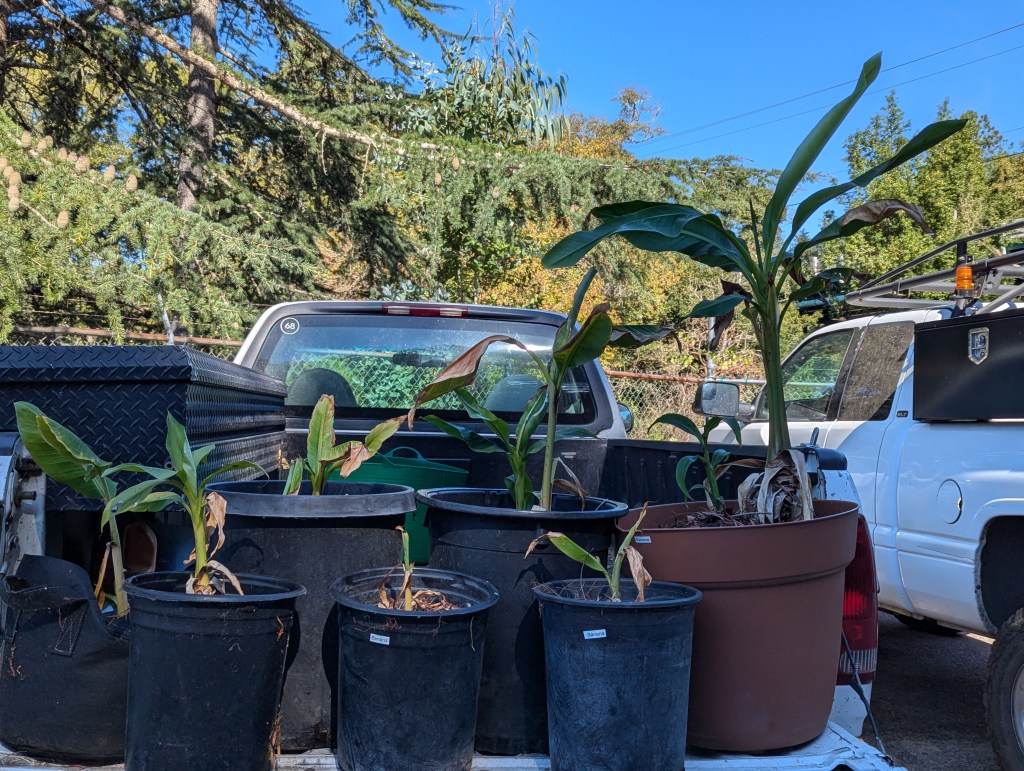
Yes! We have more bananas! I can explain. Although there are as many as twenty cultivars of banana here, almost all are individual pups or tissue culture plugs. (Of these twenty, three are unidentified. Of these three, one is likely a redundant copy of one of the other cultivars, one seems to be completely necrotic without possibility of recovery, and only one is notably distinct.) All but a few arrived earlier this year, so have not yet generated pups. ‘Double Mahoi’ has doubled by generating a single pup. ‘Golden Rhino Horn’ arrived as a pair, and one of the pair is only now beginning to generate another pair of pups. Otherwise, there are no spare pups to share. The only spare pups of ‘Double Mahoi’ and ‘Golden Rhino Horn’ (the one which lacks new pups) may be leaving in the next few days. Whatever remains of these two will most certainly go to another colleague at the end of winter. Another colleague would like to add any spares, regardless of cultivar, to his garden. However, until just now, I could not help in that endeavor. The few in the picture above just arrived from Gilroy because they were in need of a new home. The pup to the far left is ‘Blue Java’, which is also known as ‘Ice Cream’, is redundant to a copy that is already here, so can be shared with a colleague. The others, which are sufficiently numerous for all of us to get copies, are unidentified, which merely means that if they produce fruit, it will be a surprise. Even if their fruit is not palatable, their foliage is good for forage and compost. For the colleague who would like to add any spares regardless of cultivar, they can live in a riparian area of his garden that is too steep, damp and shady for gardening. These pups may not look like much in the picture, but their corms are quite plump, so will provide an abundance of foliage after they get into the ground and the weather warms after winter. Soon afterward, they will generate more pups, but we can worry about that later.
Six on Saturday: Yoshino
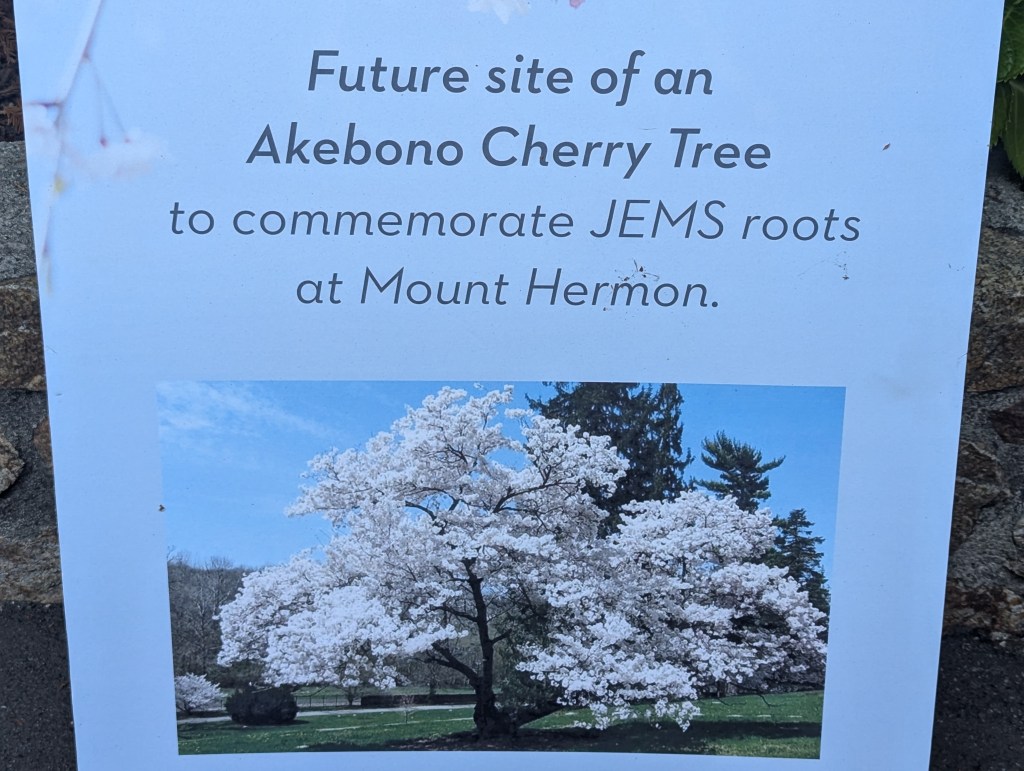
Yoshino is such an elegant name! It is the middle name of one of my nieces. A few of the flowering cherry trees here are very likely cultivars of Yoshino flowering cherry. Another recently arrived. It is a Commemorative Tree from the Japanese Evangelical Missionary Society, which we know simply as ‘JEMS’, for three quarters of a century of involvement with Mount Hermon Christian Conference Center. Its cultivar name is ‘Akebono’. We do not install many trees here, and we are more concerned with cutting trees down, but this tree is very special. It is situated very prominently on the central Mall at Mount Hermon where its spring bloom will be spectacular. It already seems to be a venerable Historical Tree that lacks only age. Now that it is here, it will acquire that eventually.
1. The Japanese Evangelical Missionary Society, or JEMS commemorated three quarters of a century of involvement with Mount Hermon with this gift of a flowering cherry tree.
2. Unfortunately though, the pair of tiny flowering cherry trees that I installed to replace a very deteriorated and elderly pair of the same is already obsolete before it got to grow.
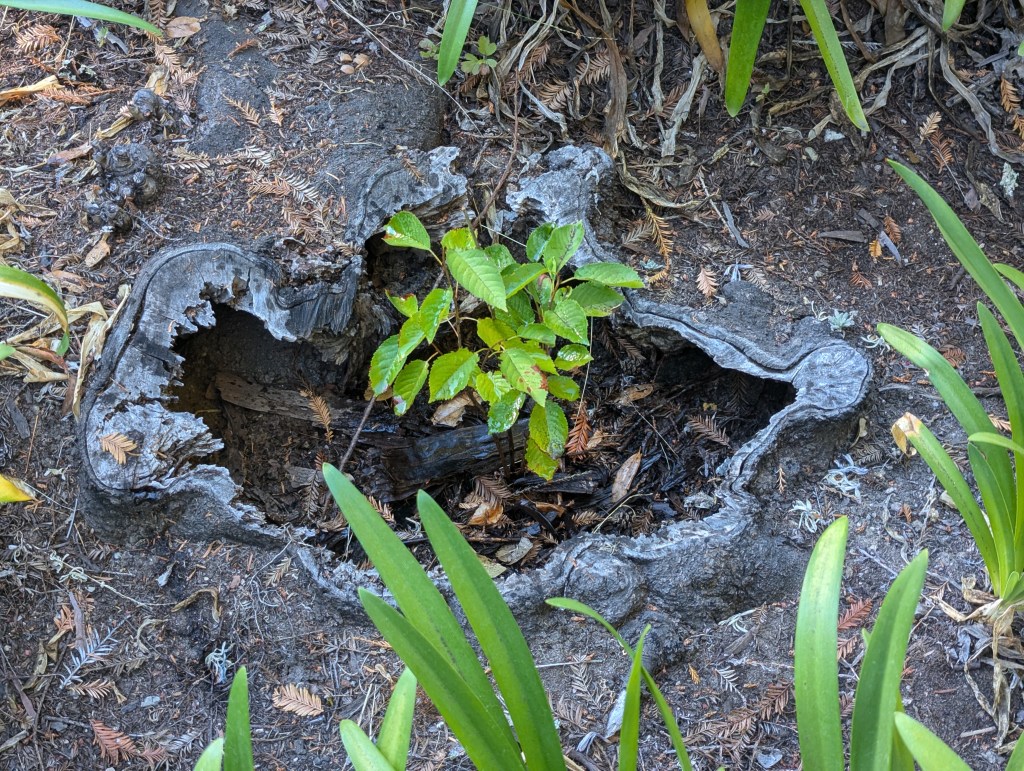
3. This pair of tiny flowering cherry trees grew from suckers from the original ungrafted pair, so are genetically identical, and are installed within the stumps of the original pair.

4. The new Commemorative Flowering Cherry Tree is much more prominent and better situated than the original pair, which was there prior to some of the adjacent pavement.

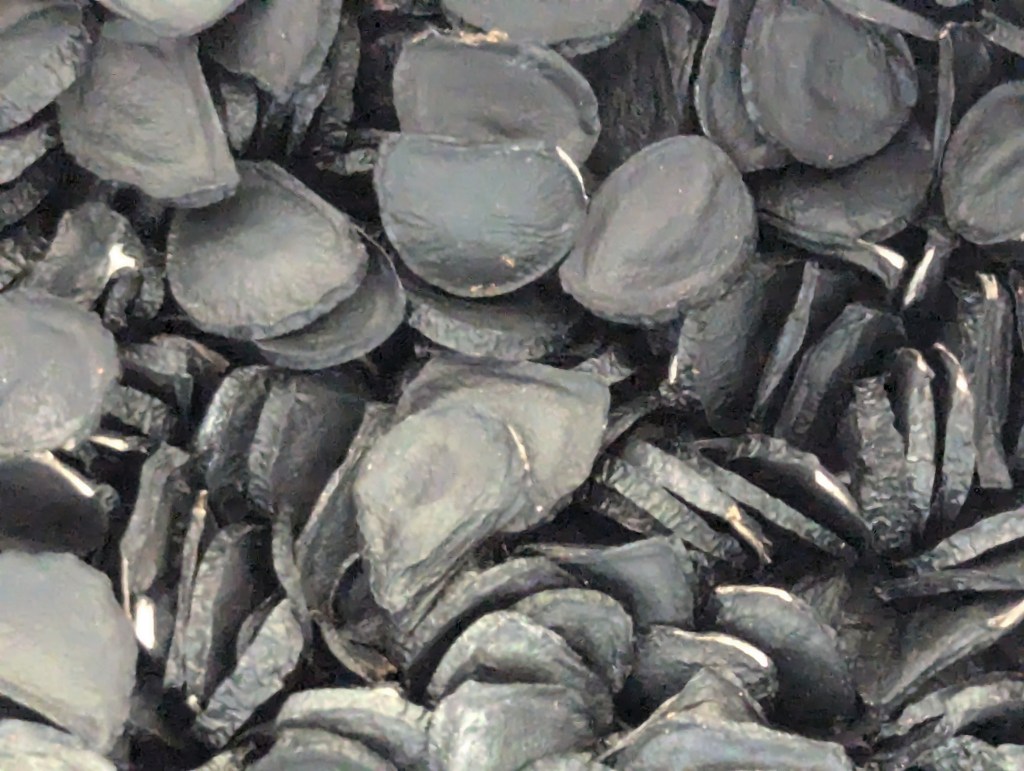
5. In other news, seedpods from (Hespero)Yucca whipplei, chaparral yucca, supposedly without its specialized pollinator, generated quite a few of what seems to be viable seed.
6. Also, Hedychium gardnerianum, kahili ginger that bloomed prematurely for the first several days of August is blooming again and more appropriately for the end of summer.

This is the link for Six on Saturday, for anyone else who would like to participate: https://thepropagatorblog.wordpress.com/2017/09/18/six-on-saturday-a-participant-guide/
Black Chokeberry

The recent popularity of fruits that contain antioxidants is restoring the popularity of an old classic deciduous shrub with an odd name. ‘Black chokeberry’ obviously does not sound very appetizing, so is more commonly known by its Latin name Aronia melanocarpa, or simply ‘Aronia’. It has always been popular within its native range east of the Appalachians and just north of the Canadian border, and is becoming more popular everywhere else since becoming available from mail order catalogues. Although it is not well rated for local climates since it prefers cooler winters, it can sometimes be found in local nurseries.
Shiny, black chokeberries are about half an inch wide, and ripen about now. They are purported to taste something like cranberries. Mine taste more like pithy crabapples so far; but I do not mind. I grow the three or four foot high shrubs just as much for their remarkable autumn color later in the year. The rather unremarkable inch or two wide trusses of small white flowers that bloom in spring can be slightly fragrant.
Pruning is rather simple, as long as chokeberries do not get shorn. Vigorous stems that may get considerably taller than four feet may be pruned back to promote shrubbier growth. Aging stems can be cut to the ground in winter, and will be readily replaced by new sucker growth.
Colorful Autumn Fruit Is For The Birds
It is hard to ignore the slight bronzing of flowering pear trees in the neighborhood. The recent warm weather after such a mild summer may detrimentally accelerate the development of autumn foliar color, as well as the ripening of some of the colorful fruit that adorns gardens through autumn and winter. Sadly, there have been reports of scorched persimmons as well.
Despite their deviation from a more typical schedule, many of the plants that provide the most colorful fruit start to do so about now, just as birds want to fatten up for winter. My favorites of these provide fruit that I like to get before the birds do. I have already harvested gooseberries, currants and grapes, and am in the process of getting to the elderberries and black chokeberries. Pomegranates will ripen later in autumn. Citrus and persimmon will be ready later in winter, followed by loquat. Natal plum produces randomly all year.
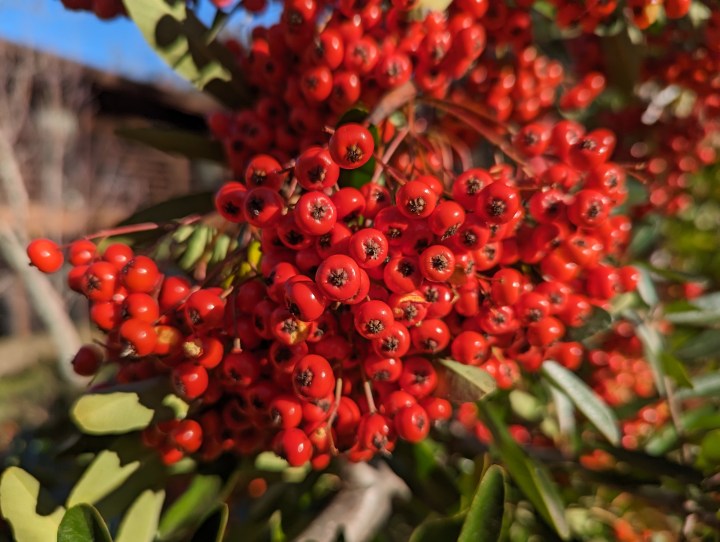
Even fruit that I do not want looks good and keeps the birds happy though. Firethorn is probably the showiest and most popular of these, since it produces such abundant bright red berries that linger into winter. Some have orange or even yellowish berries. Cotoneaster and toyon are similar, but not so flashy. English hawthorn makes similar berries, but grows into a larger tree. Fruiting crabapples were harvested in early summer; but the ornamental, albeit sparse fruit of the flowering crabapples will linger after the leaves fall. Plants that provide abundant fruit that is popular with birds may not be so desirable near where cars are parked outside though, since well fed birds can be rather messy.
I am particularly fond of persimmon, pomegranate, English hawthorn and crabapple trees for other reasons as well. Persimmon trees will provide some of the best orange and red autumn foliar color. By the time it falls, there is plenty of comparably bright orange fruit to replace it! Pomegranate blooms with few but bright reddish orange flowers in summer. English hawthorn and crabapple trees are among the most abundant of spring blooming trees. Some of the flowering crabapple trees bloom with unique shades of bright pink and nearly red.
Heavenly bamboo, Oregon grape (Mahonia) and California pepper tree are not often grown for their colorful fruit, but sometimes like to show it off. Oregon grape is striking because the fruit is so dark purplish black. California pepper tree makes pendulous trusses of small pink berries. Snowberry is an uncommon native that makes few but striking white berries.
See Anemone II

Sniveling works! Perhaps I should say that it can potentially be effective, and is sometimes more effective than expected. I certainly do not want to make the impression that I recommend it. Nonetheless, and contrary to the typical ‘Horridculture’ theme for Wednesdays, I can not deny recent favorable developments that, although not direct results of my snivelling about my lack of a white Japanese anemone, Anemone (or Eriocapitella) hupehensis, two weeks ago, somehow seem to be relevant to it. Firstly, someone at work brought me a pair of copies of an unidentified cultivar of Japanese anemone that is described as being very similar to that which is already here, with slightly pinkish pale gray bloom. Although not the right color, it is the right species. I intend to grow both the new and the old, and even if they are indistinguishable from each other, will continue to grow both because of their different but important origins. Secondly, a new landscape at a new home in the neighborhood includes several specimens of the most enviable and splendidly white ‘Honorine Jobert’ Japanese anemone! Those installing the landscape are completely unaware of the significance, and, as might be expected from such ‘landscapers’, actually told me that these Japanese anemones are the native bush anemone, Carpenteria californica. Why argue? I now know where I can get copies of ‘Honorine Jobert’ Japanese anemone after it has grown through next year. The other horticulturist here is acquainted with those who will live at the new home seasonally, so will have no problem procuring copies for me. As I intended to do with all of the now overly abundant canna and bearded iris, I plan to limit the number of cultivars of Japanese anemone to the original that was already here, the recent gift that might be the same as the original, and the ‘Honorine Jobert’ that I have yet to acquire.
Mustard

Mustard is not easy to classify. It is a cool season vegetable here, although it grows until summer gets too hot. In cooler climates, it is a warm season vegetable. Whether warm or cool season, it provides more than greens. For agricultural applications, it is also a cover crop and livestock fodder. Its seed and seed oil have culinary and medicinal application.
Also, some consider mustard to be a wildflower, and some consider it to be a weed. Most but not all species that naturalized here are of the genus Brassica. None are native. Wild turnip and wild radish are similar and are also naturalized, but not as aggressively. Their bloom may be pink or creamy white. Most mustard varieties display bright yellow bloom.
Garden varieties of mustard have milder flavor and finer texture than wild sorts. They are sometimes available as cell pack seedlings, but grow like weeds from seed. Varieties for mustard seed might only be available online or from mail order catalogs. Mustard greens develop bitter flavor with age or bloom. Bigger lower leaves can develop coarser texture.
 Tony Tomeo