Like the majority of cedars, Eastern redcedar, Juniperus virginiana, is not really a ‘cedar’. According to its genus name, it is a juniper. That may be why it is less common here than within its native range. Even in its native range, most grow wild rather than in cultivation. Junipers gained an unfavorable reputation after becoming overly common decades ago.
Eastern redcedar has traditionally been more utilitarian than merely aesthetic. It can be a delightful Christmas tree, either cut or potted. While old cedar closets are native incense cedar, cedar chests are Eastern redcedar. Baton Rouge derived its name from a red stick demarcation pole. Indigenous people traditionally used Eastern redcedar for such poles.
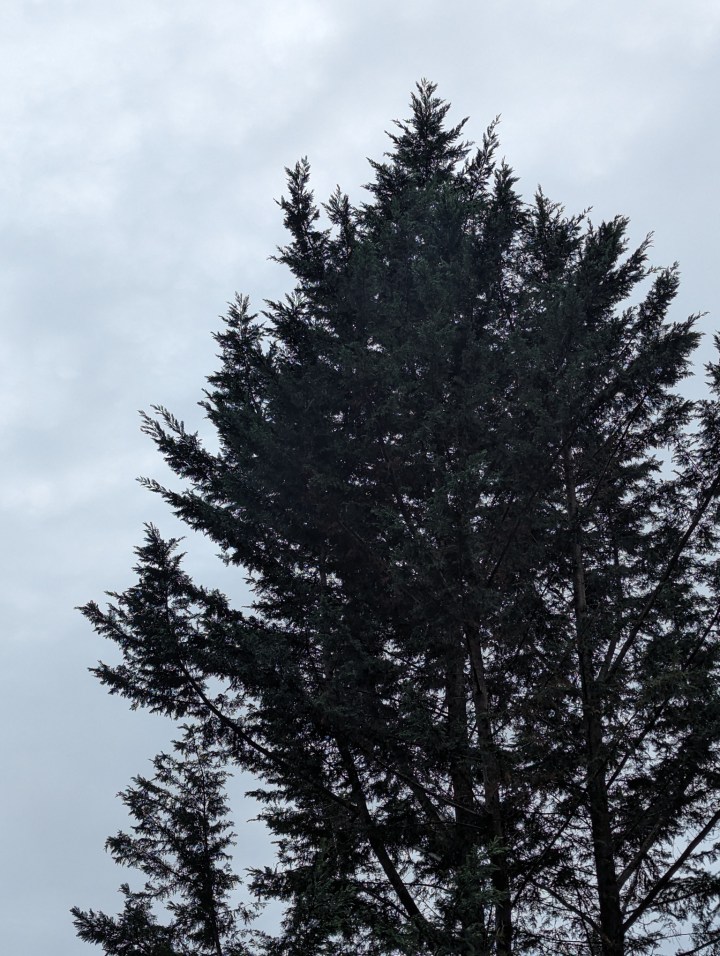
Wild Eastern redcedar trees are variable and range in height from fifteen to fifty feet high. Cultivars develop compact conical or columnar form. Some are grayish or golden green. The small evergreen foliar scales, particularly juvenile foliage, can be somewhat prickly. The rusty red to grayish brown bark can display a handsomely fibrous or shaggy texture. The ‘silicicola‘ variety of Eastern redcedar is rare.
There should be no stigma associated with cut Christmas trees. They grow on farms, not within natural ecosystems, as some believe. Like cut foliage, cut flowers and vegetables, they are an agricultural commodity. They generate no more greenwaste than an average lawn. Yet, potted Christmas trees are popular as an ‘environmentally responsible’ option.
Potted Christmas trees, however, can be more of an environmental detriment. Only those that perform for a few years consume less resources than cut Christmas trees. Almost all deteriorate too much during their first summer for a second Christmas. Therefore, they do not perform any more perpetually than cut trees. They are, however, costlier and smaller.
The expense of potted Christmas trees is proportionate to the resources which they use. Proportionately, they require more fertilizers, pesticides and infrastructure than cut trees. This is also relevant environmentally. So is their synthetic growing medium, plastic pots, and for some, mylar wrapping. Transportation is more efficient only for the smallest sorts.
Regardless, for many households, potted Christmas trees remain after Christmas. Some of the most expensive sorts are fortunately more likely to be practical sorts. They may be compact types that are conducive to confinement within big pots. If so, they may function as Christmas trees for a few years. Afterward, they might fit nicely into their home garden.
This includes a few cultivars of spruce as well as fir and even pine. Dwarf Alberta spruce is easy to accommodate in both pots and gardens. Large specimens are expensive and rare though, so few need accommodation now. Blue spruce is more practical as a potted Christmas tree, but grows larger. Eastern redcedar can stay in a large pot for a few years.
The most common potted Christmas trees are Italian stone pine and Canary Island pine. These are the small sorts with cheap ornaments and mylar wrapping. They too often lack identification or description of how large they grow. Consequently, those who plant them too often provide inadequate space. Such big trees can be very destructive as they grow.
The ‘Week of Flowers’ theme was fun for the past several weeks, but the beginning of the rainy season is rather important locally. I suppose I should have gotten more interesting pictures instead of rotting stumps, a leaky gutter and a bare cottonwood tree. Hopefully, they are not as bad as this sounds. If the first five are, the sixth might compensate. There really are no flowers, though.
1. Winter is the rainy season here. It is probably appreciated more than in other climates because it is the only time that significant rain falls. If a thunderstorm passes through in summer, it might start a fire without enough rain to put it out. Anyway, gutters still leak.
2. Rain was sufficient to finish defoliation of this grand cottonwood out back. The foliage had been bright yellow for quite a while. It does not need much chill to develop splendid color. Windy weather typically dislodges the last of it. This year, rain finished it off first.
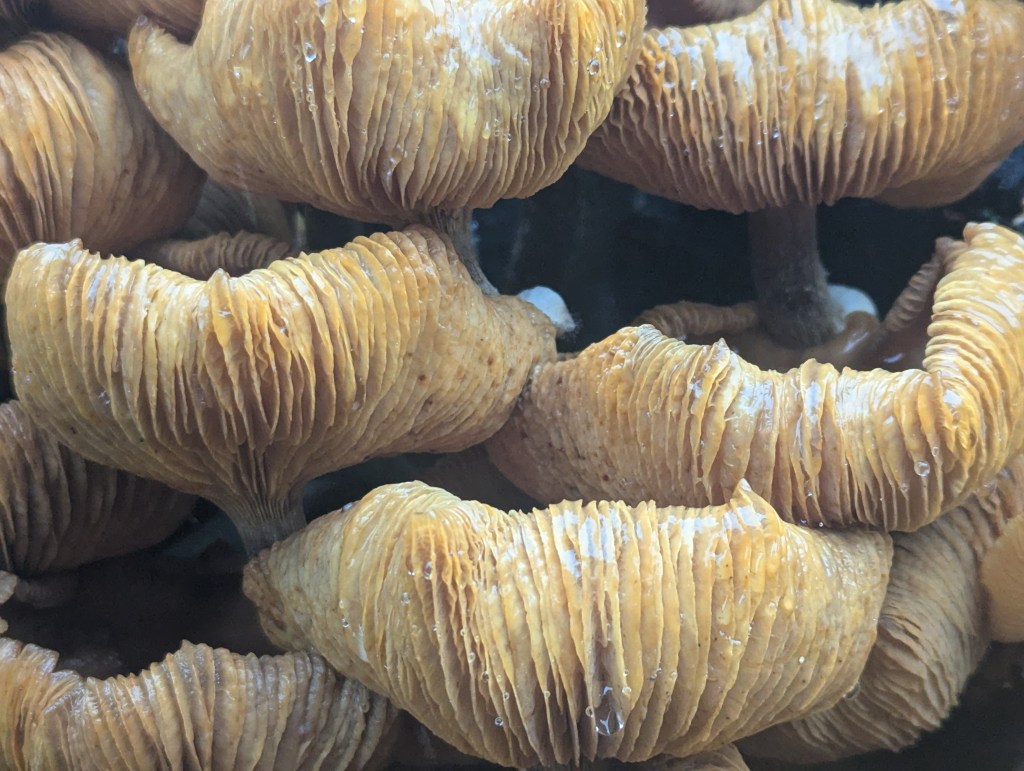
3. Mushrooms grow as the forest dampens through the rainy season. These are growing from a coast live oak stump that has been rotting for several years, but is somehow quite sound. I have been unable to dislodge it, even as the roots rot enough for the soil to sink.
4. Mushrooms that are growing from a rotten toyon stump are weirder, but could be the same sort at a more advanced state. I should recognize them since they do this annually. Some hideously big mushrooms grew elsewhere, but are already melting into black goo.
5. The madrone stump that was maintaining the integrity of the top of this embankment has been rotting for many years. Actually, I am impressed that it remained intact as long as it has. It looks worse from the other side. I could post a picture of that on Wednesday.
6. Heather would not cooperate for a picture against the clear sky between rainy weather a few days ago. She really just wanted to roll around on the sunny pavement, which was still damp and probably cold. She is impressively tolerant of this sort of embarrassment.
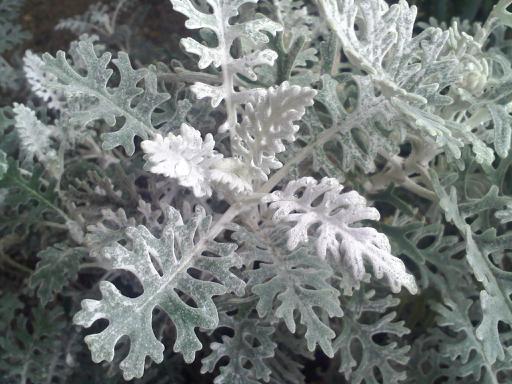
Such silvery foliage contrasts exquisitely with bronze foliage.
The relaxed trusses of small yellow composite (daisy-like) flowers of dusty miller, Senecio cineraria, can bloom at any time except when winter gets too cold. They are still blooming now. Yet, who cares? Dusty miller is grown more for its fuzzy white foliage than for bloom. It actually looks best and fluffier if occasionally shorn and pruned to remove blooming stems before they bloom. Individual leaves are intricately lobed. Mature plants get taller and wider than two feet. Dusty miller likes full sun exposure, good drainage and moderate water. Too much water causes rot and discoloration.
Some live Christmas trees grow too big for home gardens.
They appear to be so simple and innocent now, shorn strictly into conical form and perhaps adorned with any remnants of their Christmas time employment, but living Christmas trees can potentially become big problems. Italian stone pine, which is one of the most popular living Christmas trees, can get nearly eighty feet tall and sixty feet wide, with massive trunks and limbs! Regardless, they often get planted in small gardens and tight situations after Christmas because they do not seem like they would do any harm.
Most living Christmas trees can eventually become large trees. Canary Island pine, Aleppo pine, Monterey pine and Afghan pine are the most notorious since they are the most common, and also because they are not so easily recognized while they are young Christmas trees. Their juvenile foliage is more softly textured and often lighter colored than their more substantial adult foliage.
These most common living Christmas trees do not like to stay potted for very long, and are not very conducive to subsequent shearing. Consequently, many do not survive through their first summer, and those that do often get planted in the garden without much thought. Until recent years, they were seldom labeled; so few people knew how big they could get.
Coastal redwood, giant redwood, deodar cedar and Arizona cypress as living Christmas trees are neither as common, nor as likely to not get recognized as trees that eventually get quite large. They need their space nonetheless. Fortunately, they are generally somewhat more practical for some spacious gardens than the large pines are.
Scotts pine, Austrian black pine (rare), Japanese black pine, Eastern red cedar (juniper), Rocky Mountain juniper, some arborvitae and the various spruce are some of the best living Christmas trees. They grow somewhat slowly, are more cooperative with pruning and can live in tubs long enough to function as Christmas trees for a few years. When they eventually get too large for their pots, they are not so likely to get too large for the garden.
Whether a Colorado blue spruce being retired after ten years of service or an Italian stone pine being retired after only a single Christmas, a living Christmas tree needs some help with the transition from pot to garden. Any circling roots should be severed when the pot gets removed. Otherwise, roots become constricted as the circling roots grow and expand.
Much of the dense foliar canopy should be thinned out to compensate for confinement of roots. Besides, much of the shorn growth is actually disfigured and will eventually get replaced and shed as new growth develops above the original canopy. Formerly pruned spruce, redwood, deodar cedar and most pines may need minor trimming of the upper new growth to promote a single leader (that will develop into the main trunk).
It is best to plant living Christmas trees rather soon after Christmas so that they can loiter in the garden through winter. Rain and cool temperatures keep them from desiccating as their roots start to disperse before new foliage starts to emerge in spring. Newly planted living Christmas trees should be watered somewhat regularly during their first year because their roots take some time to disperse adequately.
The present is merely the transition of the future into the past. Just as any point in space lacks all three spatial dimensions of height, width and depth, the present lacks temporal dimension. Yet, any moment in the present is the beginning of whatever happens next. Somehow, this becomes more obvious as one year relinquishes to the next, as 2024 just did for 2025. Happy New Year!
For Rhody and I, 2025 will be a wild ride, in more ways that I can describe in detail now. This was not planned to coincide with the New Year, but coincidentally began to develop as such as 2024 was finishing. I can explain the possibility of major but weirdly anticipated changes within my professional career if and when they develop, as I prefer to not do so now. I will only mention that it all could progress as I always knew it should, but that if it does, it will involve major challenges, including departure from some of my work that I enjoy very much.
For now, we are more concerned with even more major and weirdly anticipated changes to our domestic situation. Rhody and I will be going home. Of course, it is not that simple. It will be quite a while before we can do it, and it may not happen until 2026. To be brief, I am now planning construction of the new house next to where the old house was. I am not at all keen on a new house, but I knew decades ago that the old house would need replacement, and that I can not build an old house. Also, I am not at all keen on leaving here, but again, I always knew that this situation is only temporary.
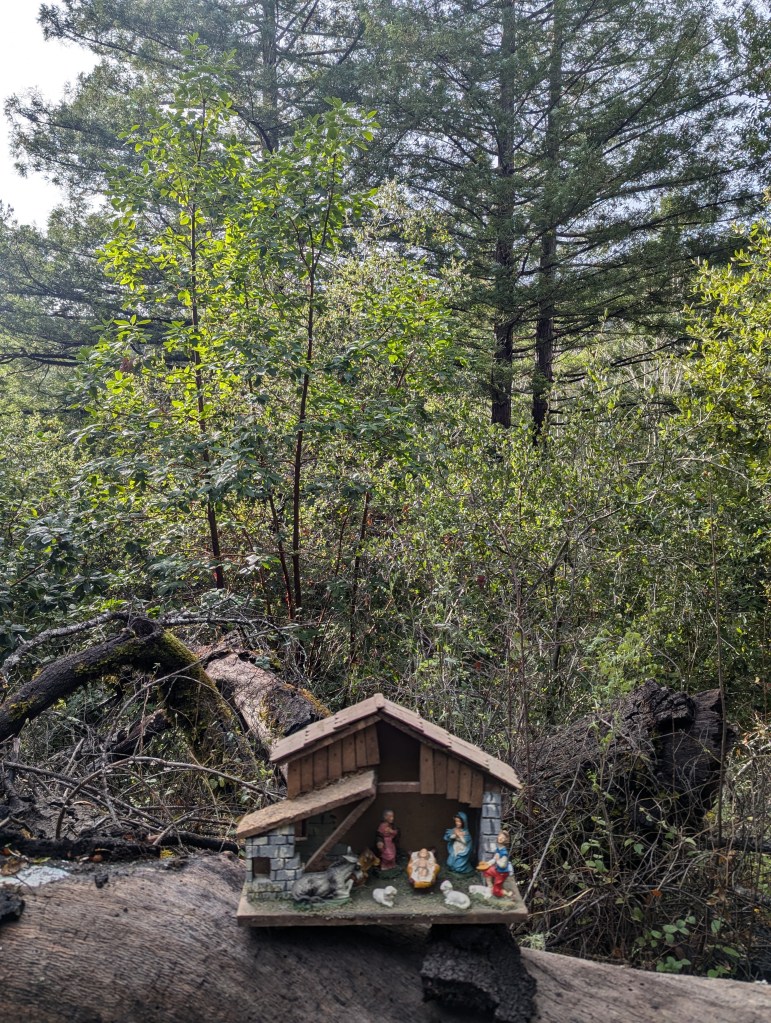
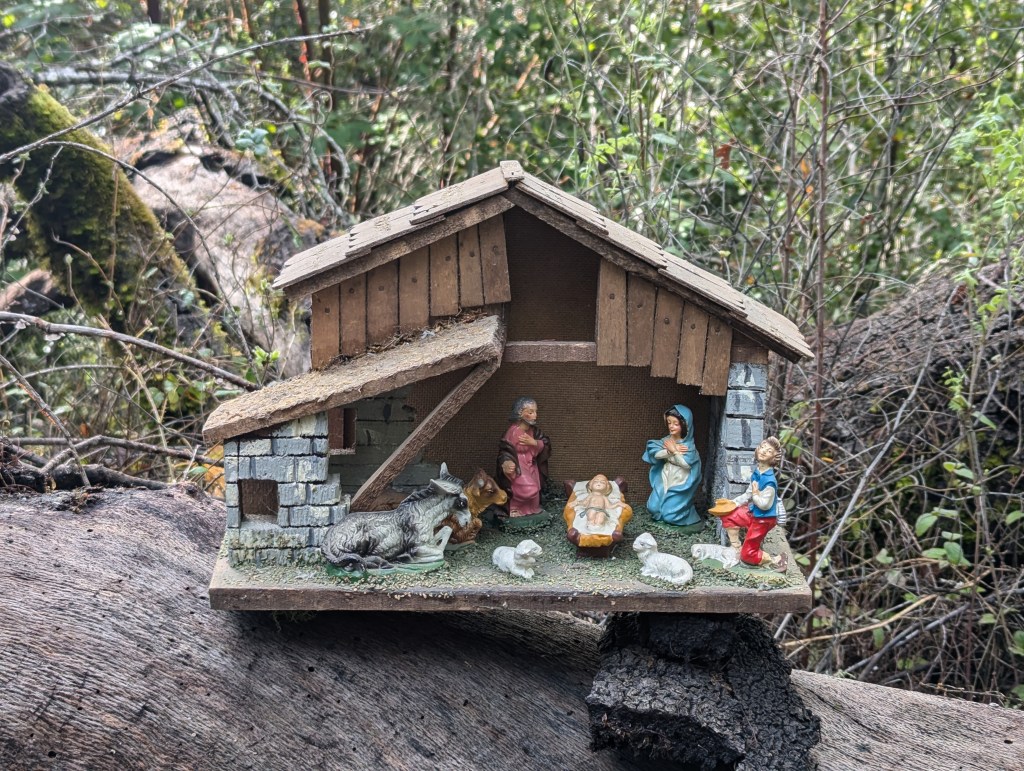
For Sunday Best last Sunday, I posted an odd picture of a Nativity in a forest. It was only labeled as ‘Home for Christmas’, without any other explanation. To provide more details, it shows my mother’s Nativity on Christmas morning about where the parlor of the new home will eventually be. The picture below shows a bit more of the still overgrown forest beyond.
Across the road from the homesite, the garden and orchard above it are in such horrible condition that their reclamation will take quite a while. The landscape at the homesite can wait, and ultimately, will be very minimal. The volume of vegetation that must be removed is daunting. As I mentioned earlier, I expect a wild ride in 2025.
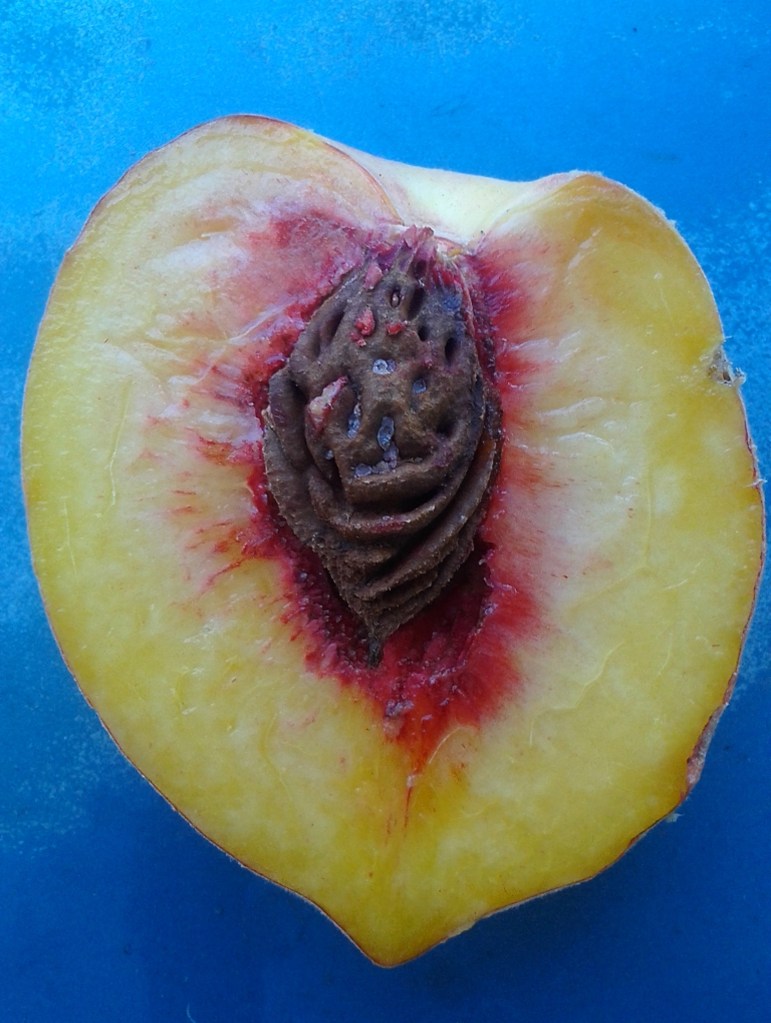
Stone fruit classification can get confusing. All stone fruit are of the same genus, Prunus. This includes almonds, which are stones or seeds of inedible fruit. Prunes are European fruits that are conducive to juicing and drying. Plums are similar Japanese fruits for fresh consumption, but not for drying. The two are more different than peaches and nectarines.
Nectarines, Prunus persicaria var. nucipersica, are simply peaches without fuzz. Cultural requirements are about the same for both. They need only very minor chill through winter to vernalize, and enjoy summery warmth. Trees are not very productive for their first year or two. Then, they may produce for only about twenty years. Thirty year old trees are old.
Both nectarine and peach trees require aggressive pruning while dormant during winter. Otherwise, they can not support the weight of their big and abundant fruit during summer. Semidwarf trees, which are the most popular, can potentially grow twenty feet high. They should stay half as high with adequate pruning. Most of their fruit should be within reach. Bare root trees initially disperse roots more readily than canned trees.
Gardening is dynamic. It must adapt as each season becomes the next. Autumn became winter. Then, suddenly, the Christmas Season became bare root season. Cut Christmas trees that did not sell became green waste. Formerly expensive live Christmas trees that did not sell became bargains. They must relinquish their spaces for fresh bare root stock.
The chronology could not be better. Christmas trees are seasonable while not much else is. Their season abruptly ends precisely as bare root season begins. Bare root season is contingent on the winter dormancy of all associated bare root stock. While dormant, such stock is unaware of what is happening. Otherwise, it would not survive such techniques.
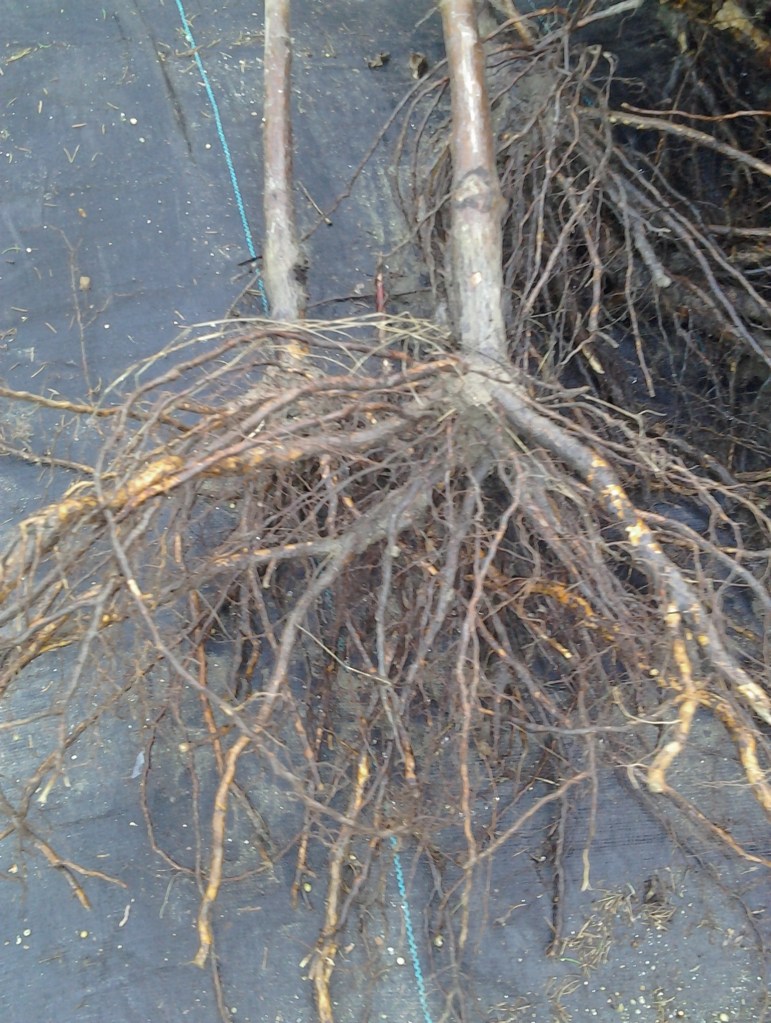
Bare root stock grows in the ground on farms. The roots become bare by separation from their soil during winter dormancy. They should be comfortable within the soil of their new gardens before dormancy ends. They disperse new roots into their new gardens as they resume growth after dormancy. Therefore, transition from farm to garden should be quick.
Some bare root stock arrives by parcel delivery with damply wrapped and bagged roots. More is available from nurseries, with its roots relaxing within damp sand until purchase. Some is available within individual bags of damp sawdust. Most bare root stock benefits from generally minor trimming or grooming. All benefits from prompt and proper planting.
Bare root season is the best time to procure and install several types of plants. Bare root stock is significantly less expensive than canned stock. It is also much less cumbersome to bring home from nurseries. Because bare roots were never confined within cans, they disperse more efficiently. Formerly canned root systems must recover from confinement.
Deciduous fruit trees and roses are the most popular bare root plants. More cultivars are available during bare root season than as canned nursery stock later. Several deciduous but fruitless trees, vines and shrubs are also available. So are a few types of berries and perennials, like rhubarb, asparagus and artichoke. Bare root season finishes with winter.