Japanese Aralia

Japanese aralia is both prehistoric and futuristic.

The popularity of Japanese aralia, Fatsia japonica, has spanned more than just a few decades. The big, glossy leaves of this lush foliar plant adorned the home of the Flintstones in Bedrock many thousands of years ago, as well as the office of Mr. Spacely of Spacely Sprockets, where George Jetson works, some time in the future! It is just as happy in most types of soil as it was in the front yard at the Flintstone Residence, and is just as happy in large containers as in Mr. Spacely’s office. As long as it is protected from harsh exposure or reflected glare (like it might get from large lightly colored walls or tinted windows), Japanese aralia does well in full sun, or can be just as happy in the shade of larger trees. 

Although it does not grow too rapidly, Japanese aralia eventually gets nearly eight feet high and wide, and commands a bold presence. Their deeply and symmetrically lobed leaves can get as broad as a foot and a half, on long petioles (stalks). The foliage of ‘Vairegata’ emerges with a yellow border that turns pale white. ‘Moseri’ stays quite compact.

Plants grown for their foliage can be maintained by cutting oldest stems to the ground as they deteriorate, so that newer stems can replace them. Excessive basal watersprouts can be cut or ‘peeled’ off if they get too crowded. Alternatively, lower growth can be pruned away as it develops to elevate the canopy and expose interior stems. However, individual stems do not last indefinitely, and will eventually need to be replaced by any convenient watersprout. The most deteriorated plants can be rejuvenated by getting cut to the ground just before spring.

Botanical Names ‘Should’ Be Universal.

Is it naked lady, amaryllis lily, belladonna lily, Jersey lily, resurrection lily, August lily or March lily?

No horticulturist has yet identified the flowers that Mickey Mouse picked from the porch at the home of Minnie Mouse to give here when she came to the door. Most of us agree that they are a black and white variety of ‘posy’, since they look so similar to those that Popeye picks in the same manner for Olive Oyle, before being smacked aside by Bluto, who then takes the flowers and presents them to Miss Oyle as ‘posies’. However, real posies look nothing like the daisy like flowers of cartoon courtship. Perhaps these flowers will remain as unidentified as the variety of the yellow tulips that the Pink Panther replaces with an also unidentified pink variety of tulips.

Misidentification of plants is probably more common now than ever. Plants are becoming available from other regions, where they may be known by common names that are very different from familiar or local common names. Even Latin or ‘botanical’ names, which should be universal, are not always perfectly reliable, since they are so often based on variable common names. The problem with misidentification is that we sometimes get plants that are very different from what we were expecting.

When purchasing plants or seeds online, it is always best to confirm that the Latin names are what they should be, since they are still more reliable than common names. Misidentification is more likely if the Latin name does not correspond to any of the known common names of the particular plant.

For example, seed that is described as that of ‘swamp maple, Acer saccharinum’ most likely really is Acer saccharinum, even though it is more commonly known locally as ‘silver maple’. The common names, both ‘swamp’ and ‘silver’ maple are regional, but are both correct. However, seed of ‘Norway maple, Acer macrophyllum’ should not be trusted, since the common name does not correspond to any of the several common names associated with the Latin name. It may actually be one or the other, but there is no way of knowing which.

It should not be assumed that plants that are known primarily by their Latin name can not be misidentified; since it actually sometimes happens. Yucca aloifolia that has naturalized on the Gulf Coast of Texas is known to many as Yucca gloriosa!

Horridculture – Hackers (again)

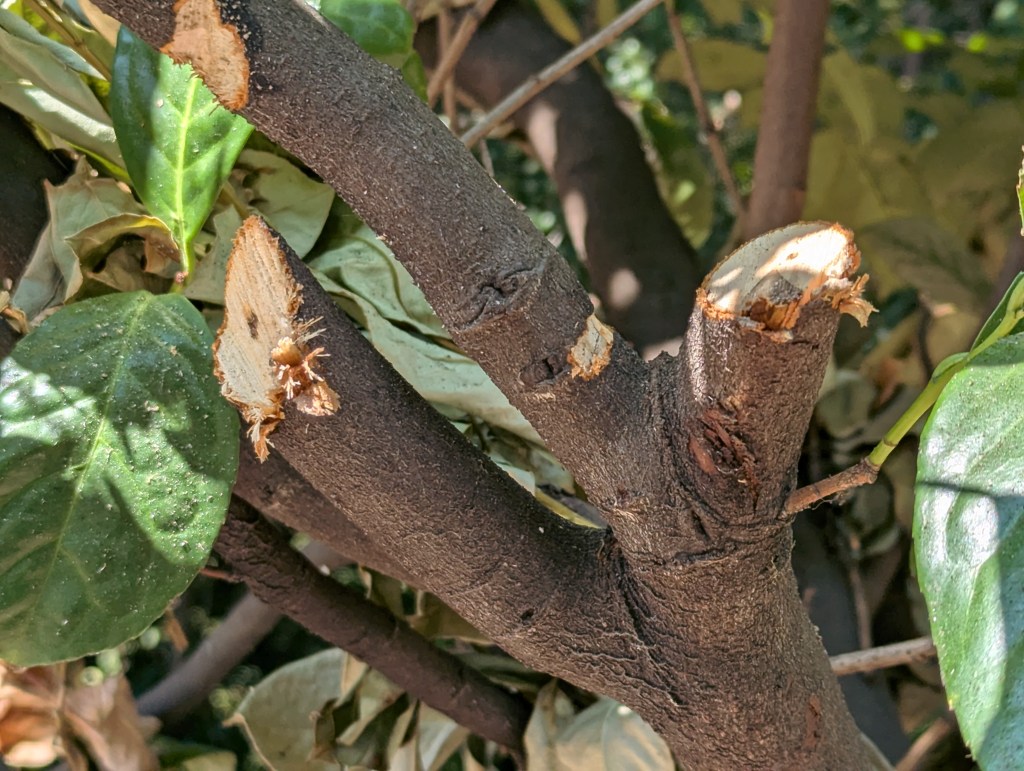
Is it really too much work to not leave such stubs while destroying a hedge?!

It has been quite a while since I posted anything that qualifies for the theme of ‘Horridculture’. Such topics are not only unpleasant, but have become redundant and passe. They are annoyingly frequent reminders of how several of the horticultural industries attract too many of those who either lack practical experience or simply do not care about their work. I can not even remember how many times I wrote about hackers, which is why I did not assign a number to this title. I can see that I addressed this issue as recently as February. Nonetheless, because this particular incident involves a Prunus laurocerasus, cherry laurel hedge that we have been renovating for a few years, it is difficult to ignore. The formerly severely overgrown hedge had been responding somewhat slowly but otherwise adequately to its renovation, all behind a reasonably presentable facade. Actually, until recently, the facade had become tidier and denser than it had ever been before. Then, a tree service was hired to clear some adjacent unmanaged vegetation. The objective was to remove vegetation from an area that is to be paved for dumpsters. There was no concern for the quality of the work, since remnants of such vegetation can be managed or removed later. The problem is that those who performed the task also removed a significant portion of the facade of the hedge beyond the area from which unmanaged vegetation needed to be removed. What is worse is that it was done so horridly. I do not remember seeing any proper cuts. All involved stems were stubbed and gashed. I can only guess that whoever did this expected the hedge to be removed later. I can not be certain of that, since complete removal within one process would have been less work than such thorough disfigurement. I mean that someone put a great deal of effort into disfiguring the hedge this severely. Fortunately, the hedge will eventually recover. I removed the stubs and neatened what remains, and will try not to look at it for the next several months. The tree service that did this actually removes unwanted trees for us efficiently and safely. Their arborists are quite experienced and qualified for what they do. I just do not want them to do anything else.

Someone put a great deal of effort into this degree of damage.

Bedding Dahlia

Bedding dahlias can perform as perennials.

Dahlias are as variable as related chrysanthemums. Rare tree dahlias can grow ten feet tall from the ground annually. Most popular dahlias grow less than half as high with more lavish bloom. Bedding dahlias are less than a foot and a half tall with smaller but profuse flowers. They are popular as warm season annuals, but can be perennial like the others.

Bedding dahlias are neither as ornate nor as diverse as those that are better cut flowers. They compensate with foliar density and floral profusion. Their flowers are less than five inches wide, and could be about half as wide. Their floral color range is limited to yellow, orange, red, pink and white. Floral variegation can add another color of the same range.

Bloom continues through summer and autumn, until frost. Deadheading promotes better bloom. Dormant tubers may remain in their gardens through winters here. They could rot, though, while their soil remains cool and damp. If dug and stored for winter, they prefer to return to their gardens prior to spring warmth. Dormant tubers propagate well by division.

Summer Warmth Continues Into Autumn

Dog days of summer are over.

The locally mild climate might be rather boring. Winter weather is not very cold. Summer weather is only sometimes very hot. Then, warmth does not often last for very long. Such climate might seem to be deficient in seasons. Summer seems to be the primary season, with just a few cool weeks of winter. Spring and autumn seem to be only brief transitions.

According to the position of Sirius, the Dog Star, the dog days of summer are done. They are the hottest days of the year for several climates of the Northern Hemisphere. The last was the eleventh of August. The final day of summer is the twenty-second of September. Such dates are less relevant here than elsewhere, though. Warm weather may continue.

Indian summer is more typical here than not. In some other climates, it is unusually warm and dry weather that continues into autumn. In this particular climate, it is not so unusual. Another difference is that it does not occur after earlier frost, as it might elsewhere. Some climates here lack frost anyway. Locally, warm weather is more lingering than fluctuating.

Some vegetation knows how to exploit such weather. Indeterminate tomato varieties can continue to be productive until a first frost. If they started soon after a last frost, they could get sloppy with rampant growth. That should not be a problem if production is the priority. With phasing as late as August, determinate tomato varieties can also produce until frost.

Most popular canna cultivars are hybrids of tropical and montane species. Because they are tropical, they are not accustomed to distinctly cool winter seasons. Because they are montane, they survive mild frost. Therefore, they grow until frost, and then resume growth as soon as they can afterward. Dahlia is similar, but maintains dormancy through winter.

Photoperiod also influences growth. Days gradually shorten through summer regardless of the duration of warmth. Some species are more responsive to this than others. Later in summer, crape myrtle can slowly begin to develop autumn foliar color. It does not require much chill to become strikingly colorful for autumn. It can do so while cannas still bloom and tomato plants still produce fruit.

Out with the new, in with the old

Canna ‘Cannova Mango’

Canna ‘Cannova Mango’ is a relatively recent introduction to the landscapes here. I inadvertently brought it back from Southern California about two and a half years ago, without realizing that it is exactly the sort of modern cultivar that I am not at all keen on. It is new. It is improved. It blooms with a strange but trendy color. The problem is that it performs too well to not be an asset to the landscapes. Because it is so short and compact, it starts blooming early, while old fashioned Canna are still only foliar. Because it replaces older stalks with newer stalks so efficiently, it is rarely without bloom until frost. Other cultivars of the series bloom yellow, lemon (which is implied to be distinct from yellow), orange shades (?), red golden flame (?!), rose, scarlet with bronze foliage or orange with bronze foliage. The tallest are less than five feet tall. Regardless of my disdain for modern cultivars, I do not doubt that all of them perform as impressively as ‘Cannova Mango’. Nonetheless, I prefer the older and formerly common sort. A relatively compact cultivar that stays less than about four feet tall with simple green foliage and billowy but simple red bloom has been relocated through a few landscapes here since the early 1980s. Although not many rhizomes survive, I intend to grow more of it, even if not so much within the landscapes at work. Its bloom begins a bit later, and is neither as profuse nor as continuous as that of ‘Cannova Mango’, but it has history here. Besides, its more relaxed foliar texture and bloom somehow seem to be more compatible with the surrounding forested setting than the almost too refined modern cultivars, with their perfectly compact form, overly profuse bloom, and strangely modern floral color.

Unidentified old fashioned red Canna with green foliage.

Yucca whipplei Seed

Yucca whipplei seed is likely more rare in cultivation than in the wild.

Yucca whipplei, which is now known as Hesperoyucca whipplei, should not be so difficult to procure. It is the most common species of the genus within the next few hundred miles south of here, and was quite common in the hills around San Luis Obispo, where Brent and I studied horticulture at California Polytechnic State University (Cal Poly). I should have taken pups from wild specimens within the region, but I know of no one with wild specimens within their gardens. I can only see them from a distance, and, although within view, they are far enough away to necessitate quite a hike to get to. I never bothered to procure pups from specimens that I encounter directly in the Santa Monica Mountains north of Beverly Hills because they might be a different variety, or related to such a variety. Contrary to dramatic bloom, seed of the species is supposedly rare because the larvae of its very specialized pollinating moth devour almost all of the seed that develops from successful pollination. (The moth pollinates a flower only to provide seed for its larvae to eat.) Seed should be even more rare here because the specialized pollinating moth has no business so far from the natural range of its sustaining species. Somehow, a specimen that bloomed at work produced these few seed capsules. Someone else besides the specialized pollinating moth apparently took interest in its bloom. Although I have no idea what variety of Yucca whipplei the particular specimen is, I am pleased with the seed, and will try to grow them if they are viable when their capsules dry. (I hope that removal from their deteriorating stalk does not compromise their development.) Furthermore, I will get at least one pup from the original parent now that it will generate a litter after its monocarpic bloom. It is likely the variety that I want and am most familiar with anyway, because that particular variety happens to be the most common. Of course, I will procure a pup from a wild specimen within the region of San Luis Obispo if I ever get the opportunity to do so, just in case it is any different from what is growing and now blooming here.

Six on Saturday: Off Color

Perennial pea, lily of the Nile and dahlia displayed aberration of color earlier and started a trend.

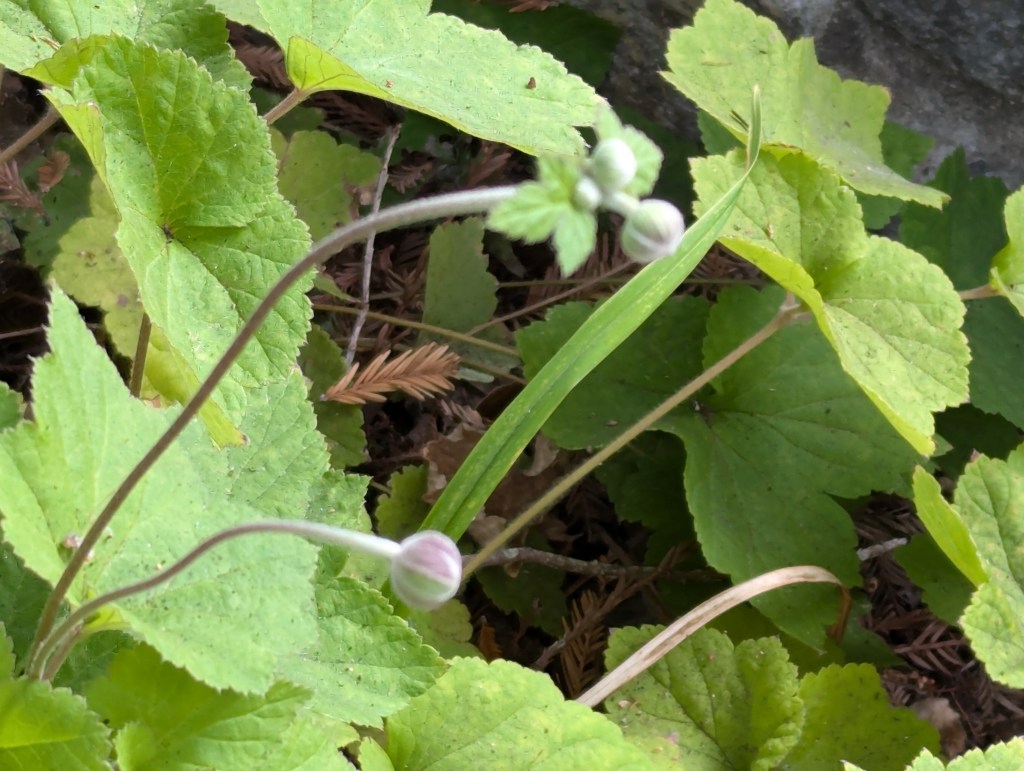
1. Eriocapitella hupehensis, Japanese anemone is enviable in other gardens. I neglect to remember that a minor bit of it survives in one of our landscapes. I ignore it because it is such a grungy almost grayish white without enough blush to be pink. I should see how it blooms now and then relocate it to a better situation where it might develop better color.

2. Hypoestes phyllostachya, polka dot plant is typically spotty with either white or pink. Two of seventy-two cell pack plugs exhibited this darker pinkish red. I got copies of it to perhaps grow as houseplants, at least until they will be happy in the garden next spring.

3. Chrysanthemum X morifolium, florist’s chrysanthemum seems to change color like a dahlia that I got a picture of last week. I thought that it bloomed orange last year, which was a surprise after it bloomed rusty red two years ago. I must not remember accurately.

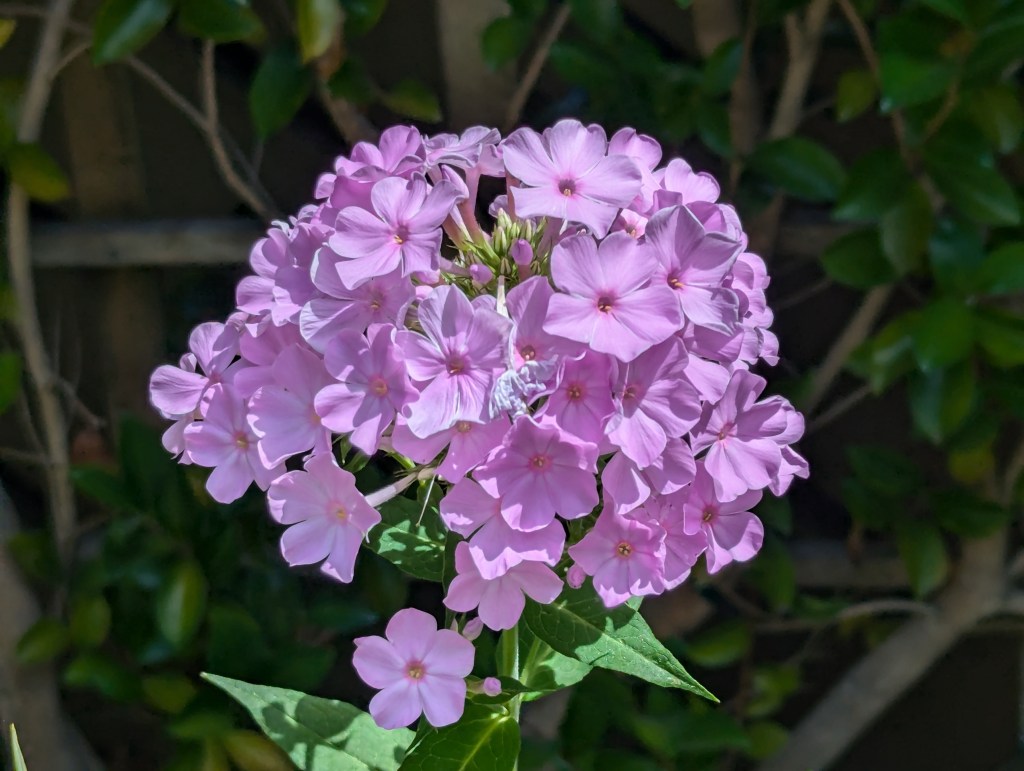
4. Phlox paniculata, garden phlox has bloomed exclusively white since it arrived here by unknown means a few years ago. Although I have been very pleased with its white color, and white happens to be my favorite color, I am also pleased with this new pink variant.

5. Amaryllis belladonna, naked lady did the opposite. It had always bloomed exclusively bright pink. Then, I found and isolated a few bulbs of a white blooming variant last year. An associate found two more in the same location this year. I like it much more in white!

6. Rhody is canine so lacks perception of red, which is the basis of these off colors. Most have more than they should, and one has none. Rhody sees them only as shades of gray.

This is the link for Six on Saturday, for anyone else who would like to participate: https://thepropagatorblog.wordpress.com/2017/09/18/six-on-saturday-a-participant-guide/

Blue Marguerite

Not many flowers are as blue as blue marguerite is.

            Like all sorts of daisies, gazanias, ice plants and so many of the familiar flowers in the Compositae family, blue marguerite, Felicia amelloides, is endemic to South Africa. Their flowers are the colors of the flag of Sweden though, with clear blue petals around bright yellow centers. These inch wide or slightly wider flowers bloom on well groomed plants most of the time, except during cool weather. Plants that do not get dead headed (groomed of deteriorating flowers) take breaks between bloom phases. The simple inch long leaves seem to be glossy, but almost have the texture of a cat’s tongue.    

            Mature plants may be taller than a foot and broader than four feet. Their somewhat woody stems are not as substantial as they should be, so can break easily, leaving awkward holes in otherwise well rounded shrubs. Unfortunately, the healthiest plants may live for only a few years. Distressed plants actually last a bit longer. Aggressive pruning at the end of summer or just before spring can restore old deteriorating plants for a while.

            Blue marguerite likes well drained soil, good sun exposure and somewhat regular watering. It is most often used as a colorful and shapely perennial, but is colorful enough for pots and urns of mixed perennials or annuals.

Sustainability Sometimes Needs Help

Some perennials naturally last longer than others.

            As much as I like to remind everyone of how easy it is to perpetuate many of their perennials for ever, and to share with their friends, neighbors, children, grandchildren, great grandchildren and so on, there are just some perennials that are not meant to last. I do not mean that they can not last; only that they are not as easy to sustain as others are. For most of these not so easy to sustain perennials, the original plants actually die completely, so will only be sustainable if replacement copies are propagated by cuttings or layers before the demise.

             Many of the very easy to grow daisies and daisy relatives are actually not as self sustaining as they should be. Clumping gazanias can actually rot out in the middle after a few years. Before this happens, it is rather easy to propagate replacement plants from division of mature clumps, or to take small cuttings, even though clumping gazanias do not often need to be pruned. Alternatively, side shoots can be layered (pressed into the soil to form roots) right next to parent clumps. Only a few replacements are necessary, but without them, clumping gazanias eventually die out.  

            Even trailing gazanias can eventually die out. Because they sometimes need to be pruned around the edges, there is a regular supply of material to make cuttings to patch bald spots. To get bigger cuttings, I actually like to delay edging until the plants look shabbier than they should around the edges; but my neighbors do not mind. (At least they do not tell me if they mind.)

            Shrubby marguerite daisies (not blue marguerites) and euryops likewise need to be replaced every few years. If there is enough space, outer stems that lay on the ground can be layered. It is best to bury each layered stem in a small hole, and then hold it down with a stone or brick. The layered plants may not be so symmetrical when the parent plants die out, but should fill out nicely. The fourteen euryops in the long park-strip in front of my home did not have enough space for layering, so died a slow, miserable and unsightly death until I finally removed them. If I had planned better, I would have taken cuttings to replace them.

            It is a surprise when pink breath of Heaven (Coleonema or Diosma pulchrum) or coyote brush dies suddenly, because they are really woody shrubs. (Although coyote brush is actually of the family Compositae like gazanias and daisies, etc.) Various ceanothus live longer, but not much longer. These woody shrubs are not so easy to layer, and quite difficult to root from cuttings, so often get replaced with new plants from the nursery, or different plants.