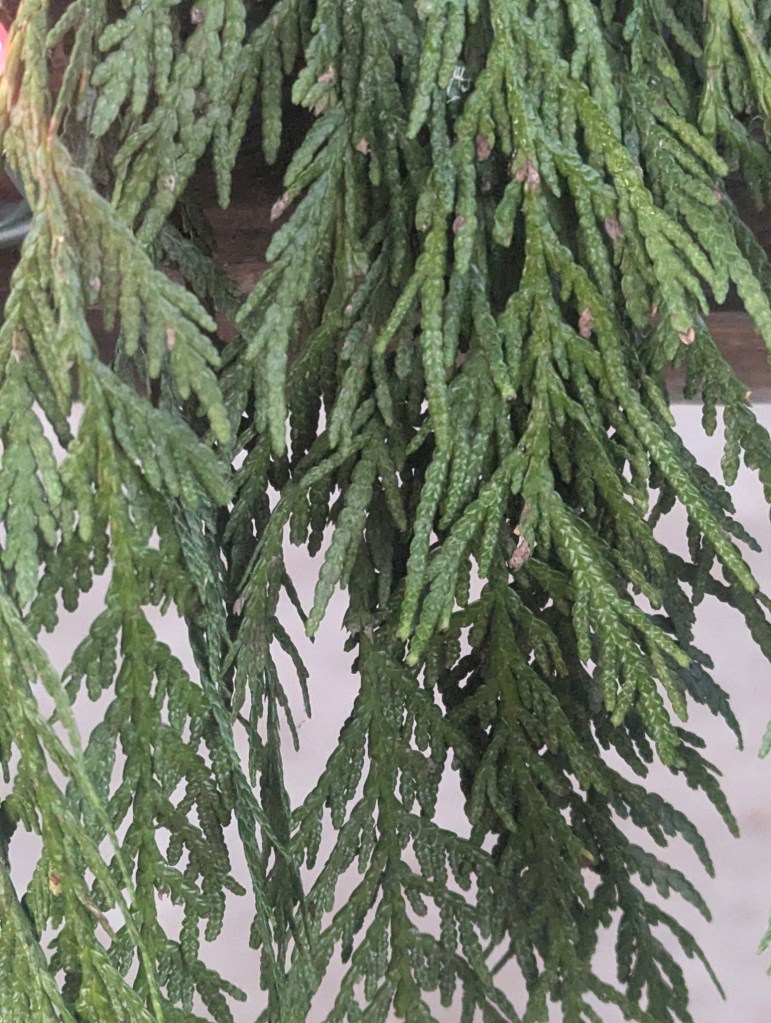
This coniferous evergreen is more appealing as seasonal foliar decor than it is practical. Western red cedar, Thuja plicata, is the most common component of Christmas garlands. Also, it is very popular for wreaths of mixed evergreens. It is the same genus as common arborvitaes. However, this particular species is notably rare among local home gardens.
Western red cedar is native to the Pacific Northwest. Its range extends south to the north coast of California, and east to western Montana. It therefore does not adapt efficiently to the arid warmth of local chaparral climates. Even with generous irrigation, its foliage can be vulnerable to desiccation. The healthiest specimens here are within coastal climates.
Like some other trees within its native range, western red cedar typically grows very big. It can easily reach a hundred and fifty feet tall, and can grow taller than two hundred feet. Although it does not grow as fast as redwood, it eventually needs about as much space. Western red cedar, here, is appropriate only for large landscapes within coastal climates. It is too obtrusive for compact home gardens.
Even here, climate is not perfect. It may sometimes seem to be too warm during summer. However, it might not be consistently warm and humid enough for some tropical species. Winter chill may be inadequate to vernalize some species or certain cultivars of species. However, recently frosty weather has already damaged some vegetation in some areas.
Frost limits what performs well in home gardens in two extremes. Some species prefer a bit more than they experience here. Others prefer less. For example, peony prefers more, while vanilla orchid prefers none. Peony is only marginal where weather is exceptionally frosty by local standards. Vanilla orchid can be offended by minor chill even without frost.
Climates and microclimates limit frost just as frost limits what performs in home gardens. Some coastal climates here only very rarely or perhaps never experience frosty weather. Other climates farther inland or at higher elevations experience frost almost every winter. Within such climates, eaves or canopies of big trees can provide shelter from minor frost.
Vegetation within home gardens should be appropriate to its particular climate. Varieties that are vulnerable to frosty weather are likely safe where frost never occurs. Conversely, they will obviously be susceptible to damage where frost does occur. The best means to avoid such damage is appropriate selection. Climate will not accommodate bad choices.
Gardening could be slightly less interesting without a few bad choices, though. Besides, some of such choices are justifiable with the right perspective. Canna, for example, dies back harmlessly to dormant rhizomes after frosty weather. It wastes no time regenerating as weather warms. Some tropical species may grow in pots to move to shelter from frost.
Tenting can shelter some specimens that are too big to move, or are in the ground. Outer foliage that already succumbed to frosty weather can shelter inner growth. Therefore, if it is not too unsightly, it should remain through winter. Besides, premature pruning is likely to stimulate new growth. Such growth would innately be vulnerable to subsequent frosts.
Cranberries have been elusive. I know of no one who grows them here. Furthermore, I am told that no one grows them here because they do not grow here. I am not convinced. They grow well in portions of western Oregon. Some of the riparian climates here are not too different from climates there. I am determined to try growing cranberries, even if I can grow only a few. Just this year, I procured seed that should vernalize through winter. If they grow, they will be comparable to those that grow wild within their native range, rather than a cultivar.
Blueberries were uncommon decades ago. I can remember, when I was a kid, being told that no one grows them here because they do not grow here, just like I am told in regard to cranberries. Well, nowadays, blueberries, although still uncommon, are not rare, and are actually somewhat popular among those who want to grow them. I grow a few only because I acquired them from a garden that they needed to be removed from. Otherwise, I would prefer to try cranberries. I can not complain about the blueberries, though. They are still here after a few years because they are reasonably productive.
Huckleberries, or at least one species of huckleberry, are native. Although quite rare within home gardens, and more typically grown as an alternative to boxwood rather than for berries, they can produce a few berries. They might be more productive if cultivated more for berry production than merely for aesthetic appeal. I have collected enough berries from wild colonies of huckleberry to make jelly, which is encouraging. It is also encouraging that the native huckleberry is Vaccinium ovatum, which is the same genus as both blueberry and cranberry. I wonder how different their cultural requirements are.
There are too many bridges to count here. Several roads and trails, and a historic narrow gauge railroad cross over two creeks and two streams within a relatively confined area. This particular suspension bridge is for a hiking trail that crosses over Zayante Creek at the downstream edge of its confluence with Bean Creek. Bean Creek, which is to the upper right in the picture below, flows through the farm on the outskirts of Scotts Valley. Zayante Creek, which is to the left in the picture below, flows through my neighborhood on the outskirts of Los Gatos. Ferndell Creek, which is just a stream from a nearby spring, also flows into this same confluence, but is not visible to the right of the picture below.
All of these creeks and streams sustain even more diverse ecosystems than those of the redwood forests above, and the chaparral pine forests a bit father above. Redwoods grow like weeds here. The redwood in the picture below is what is known as a ‘virgin’ because it was not harvested for lumber when most others were clear cut harvested to sustain development of the San Francisco Bay Area, and to rebuild San Francisco after the Great Earthquake and Fire in 1906. It was most likely rejected because it was too small to bother with at the time. Only a century later, it is massive! The cables that are now embedded into its bark formerly supported an older suspension that the newer bridge replaced many years ago. Although redwoods are not necessarily a riparian species, and can actually be resilient to drought, they do enjoy this abundance of moisture. The many other trees that inhabit these ecosystems with them grow very tall to compete for sunlight, and in some situations are excluded by their dense growth.
1. Salvia chiapensis, Chiapas sage blooms as long as the weather is warm. Then, it takes so long to realize that the weather is no longer warm that, by the time it finishes the last of its bloom, the weather is beginning to get warm enough for it to resume bloom again.
2. Cestrum fasciculatum ‘Newellii’, red cestrum blooms about as continuously. It should have finished blooming about a month ago, but will likely continue until more sustained cool weather just like it did last year. After pausing briefly, bloom resumes before spring.
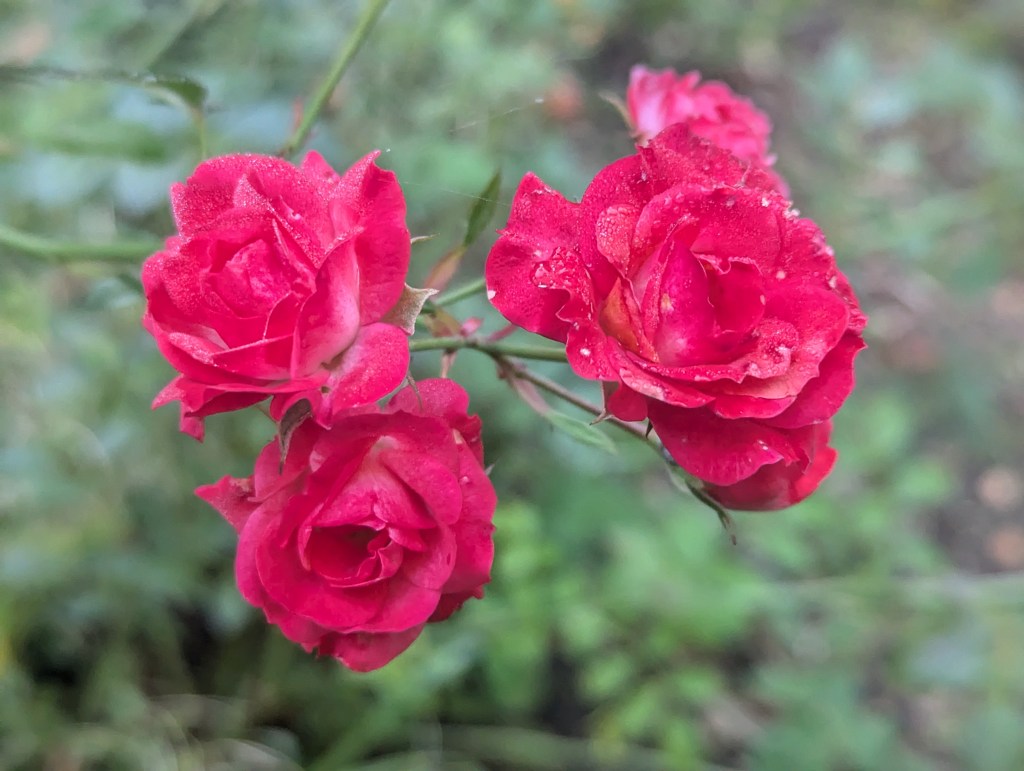
3. Rosa spp., carpet rose will eventually stop blooming and defoliate just long enough to get pruned back to the ground. It grows back like weeds, but such vigorous growth takes some time to decelerate enough to bloom, which might not be until the middle of spring.
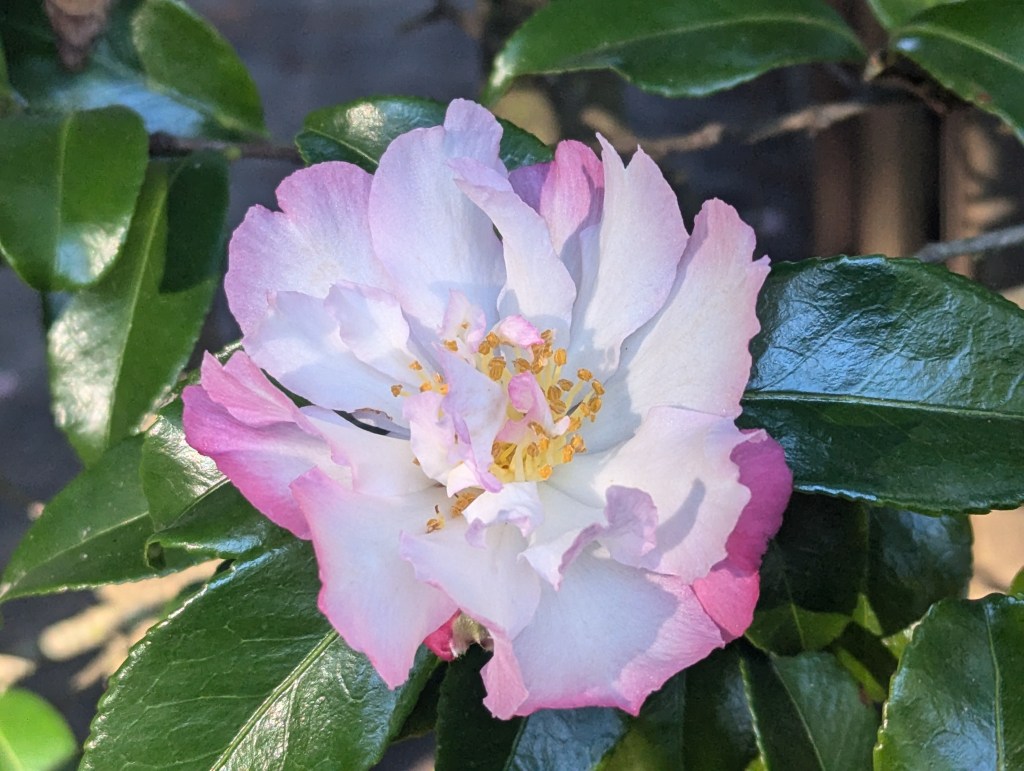
4. Camellia sasanqua, sasanqua camellia has become more of a small tree than a shrub. These flowers are too high up to appreciate individually, but are impressive in profusion. I thought that it is ‘Navajo’, but it now does not seem pink enough, and is a bit too ruffly.
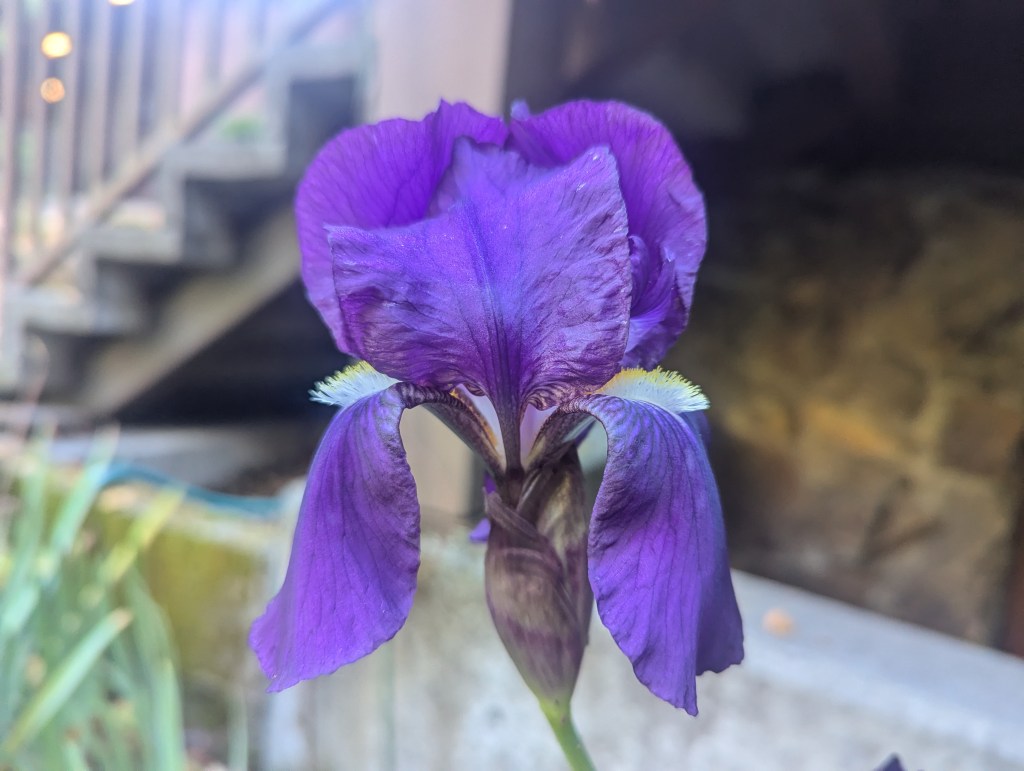
5. Iris X germanica ‘Rosalie Figge’, unlike any other bearded iris here, blooms whenever it wants to, even during the coldest or rainiest weather, with ruins such bloom. I am not certain of its identity. Someone here on Six on Saturday suggested this name, and it fits.
6. Iris unguicularis, Algerian iris from Skooter’s garden, which is perhaps more properly known as Tangly Cottage Gardening, is now blooming to prove that it actually is winter. I am very pleased that it is such perfect blue, without purple, and blooms during winter.
From spring until autumn, semperflorens begonia, which is also known as fibrous, bedding or wax, begonia, is a warm season annual. They actually start to deteriorate as the weather gets cool this time of year. However, they do not necessarily need to be pulled out as their season ends. In sheltered locations or with protection from frost, they actually survive through winter as perennials. They are so easy to propagate by cuttings or division of overgrown plants that tired older plants can replace themselves with their own babies before they get too ugly.
The small flowers of semperflorens begonia can be white, red, or various shades of pink in between. Foliage is more often green or bronze, but can be reddish or variegated. The largest plants get only a foot tall. Denser dwarf types are half as tall. Semperflorens begonia likes rich soil and regular watering (when it is not raining). They prefer partial shade, but will take full sun if mixed with other plants that keep things cool and humid.
Gardening tasks may be a bit less demanding now, but are no less important.
With cooler and rainy weather, and shorter days, gardening is not what it was a few months ago. It is more comfortable to stay inside when the weather is not so pleasant. Besides, gardening when the garden is too wet gets muddy, and can damage lawns and bedding areas. Even while the weather is pleasant, there is not enough daylight left to get much done at the end of the day.
The good news is that gardening is not as demanding in autumn and winter as during spring and summer. Plants are either dormant or are growing only minimally. Pruning and hedging is therefore not so necessary. Lawns likewise do not need to be mown as often. Without much blooming, there is less need for deadheading. With rain bringing more moisture than the garden needs, and cooler temperatures inhibiting evaporation to take moisture away, watering is rarely a concern.
The bad news is that there are a few things than should be done in autumn and winter that should not be delayed to spring. For example, early spring blooming bulbs should be planted as they become available in nurseries so that they can get a good chill through winter and disperse their roots as soon as possible. Also, evergreen trees that may be a bit awkward on their trunks should be staked before winter winds. (Deciduous trees do not get blown around much without their foliage.)
Eventually, or sooner, the weather will get cold enough to necessitate protection from frost. Marginal plants are probably safe under eaves or taller evergreen trees. Sensitive plants that are not in pots that can be moved to shelter should be tented when threatened by frost. Tenting can be as simple as tarps suspended above the foliage by stakes, and only needs to shelter plants from exposure.
As deciduous fruit trees lose their foliage, they will be ready for winter pruning. This is very important for apricot, peach, cherry, nectarine, plum, prune, apple, pear and related trees, since they should not be pruned once they start to bloom in spring. Maples and birches should also be pruned while completely dormant in winter, since they bleed so profusely if pruned in spring or summer.
Weed seedlings may start to appear with winter rain. They do not grow as rapidly now as weeds do in spring, but have a sneaky way of growing in more places because of the uniform availability of water in places that would be dry without rain. Fortunately, they are easy to pull while the soil is damp. Seedlings of any desirable plants should be identified first so that they can be distinguished from weed seedlings and not pulled.
Falling leaves should be raked from lawns and ground cover, not because they are unappealing in the garden, but because they block out sunlight and promote rot. Raking should not be done immediately after rain though, since lawn and ground cover are so easily damaged while soil is wet and muddy.
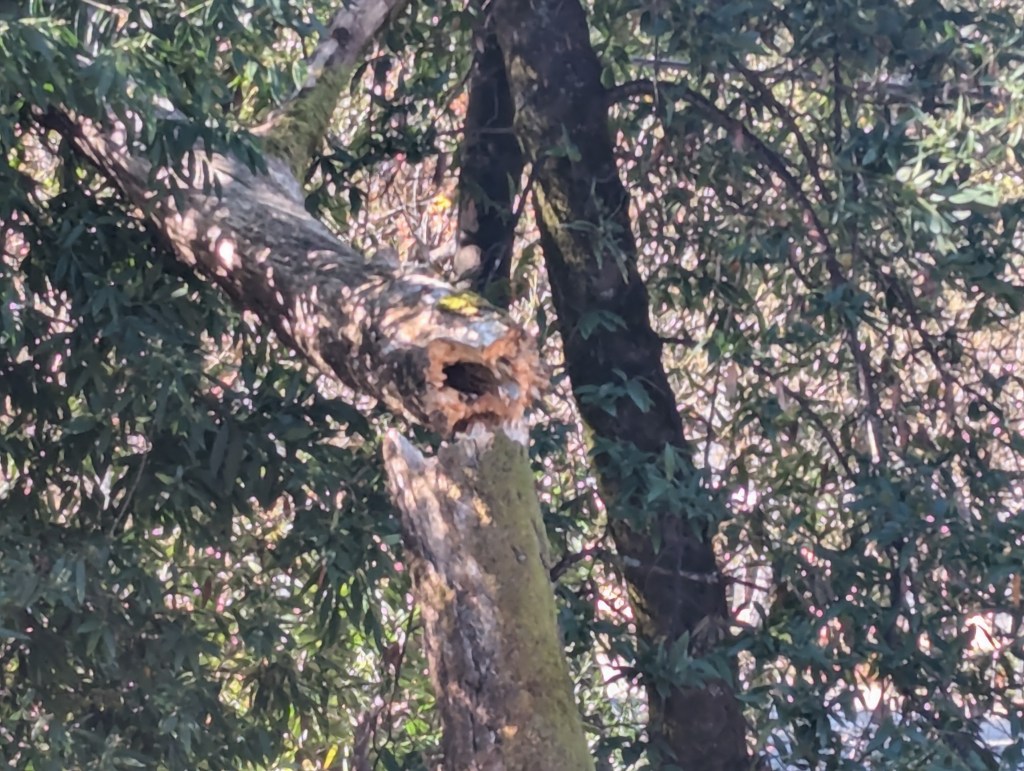
It is not on the road yet, but will be soon. This box elder has been deteriorating for several years. Only a few viable watersprouts remain within about ten feet of the ground. All limbs above are gone, leaving only this decomposing trunk. Several more similarly deteriorating trunks, with more or even less of their associated canopies remaining, are barely standing nearby. Most succumbed to an unidentified pathogen a few years ago. Some were dead prior to that. This one is special because such a significant portion of its upper trunk has broken off, and now remains suspended by the unbroken portion of the same trunk and the collective canopy of adjacent bay trees. This would not be such a concern if this broken portion of the trunk was not suspended so closely to the busy road below. (The picture above shows where the trunk broke. The picture below shows its proximity to the road below.) I suspect that when the broken portion of trunk eventually falls through the canopy of bay trees, the heavier basal end will fall first, and guide the lighter upper portion to land closer to the base of the remaining trunk, and safely away from the road, but I can not be certain until it actually happens. Those who maintain the road will not remove the broken portion of trunk until this does not actually happen, and the debris instead falls into the road. I can do nothing about it because I can not direct how the broken portion of trunk will fall once it is dislodged, and the traffic on the road is nearly constant during the day. It would be safer with a crew to stop traffic while the trunk is removed, and even better if they remove all of the several decaying trunks.
If “verde” translates to “green”, then what color is blue palo verde, Parkinsonia florida? It is simply a bit more bluish green than other species that are a bit more yellowish. Its bark contains chlorophyll to photosynthesize without foliage. Blue palo verde is deciduous so defoliates for winter. Then, it defoliates in response to dryness through much of summer.
Blue palo verde in the wild may develop and retain foliage only during early spring. With landscape irrigation, it can retain some foliage through summer. It can also produce a bit more prior to late autumn defoliation. However, frequent irrigation promotes vigorous but structurally deficient growth. Few blue palo verdes thrive for a century within landscapes.
Blue palo verde can grow almost forty feet tall, but typically grows only about half as tall. It naturally grows as large shrubbery. Removal of lower growth exposes sculptural trunks for small tree form. With staking, trees can develop single trunks. Light yellow flowers are tiny but profuse during spring bloom. Blue palo verde is the Official State Tree of Arizona.
Deciduous foliage gets colorful with autumn chill. Then, it gets messy. Then, with a bit of precipitation, it gets even messier! It seems like a waste as it all succumbs to rain and, in other climates, snow. It is sensible, though. Deciduous vegetation will be less vulnerable to stormy weather without it. Weather will be getting increasingly stormy through autumn.
This is how the Mediterranean climate here operates. The dry season that begins during spring continues until autumn. The relatively shorter rainy season centers around winter. Therefore, most precipitation occurs during winter. Spring and autumn are brief transition seasons that tend to favor the dry season. Almost no precipitation occurs during summer.
Spring and autumn transitions between rainy and dry seasons are innately variable. The rainy season tends to finish early during spring, but may not. It sometimes pauses before resuming. It may do so more than once. Conversely, the rainy season tends to begin late during autumn, but may begin earlier. Occasionally, precipitation begins disturbingly late.
Generally, the first significant storm with significant precipitation begins the rainy season. This may be difficult to believe with typically significant time between the first few storms. Yet, with cooler weather, elevated humidity, and shorter daylength, moisture lasts longer. Precipitation, even if merely drizzling fog, will likely dampen gardens before they get dry.
Irrigation obviously does not need to be as generous as it was during summer. Until next spring, some vegetation will require none at all. Not only will weather provide and retain more moisture, but vegetation uses much less. Refraining from manual irrigation is easy. Adjustment of automated irrigation systems actually requires more effort and awareness.
As deciduous species defoliate for winter, some other species might get more vivacious. Cacti, agave, and some yuccas that lack irrigation become more turgid with precipitation. Remaining palo verde foliage is likely to become greener and fresher prior to defoliation. Most xeric species utilize moisture from precipitation as it becomes available seasonally.