Sky lupine grows wild here. (This may actually be arroyo lupine.)
If California poppy were not the State Flower of California, sky lupine, Lupinus nanus, might be. Even though the perfect blue of sky lupine is the opposite of the perfect orange of California poppy, both of these brightly colorful flowers have several similarities, and are often sown together in autumn or winter for their early spring bloom. Both are native to western North America, but are very commonly displaced by exotic (non native) plants. As natives, they can easily self sow if competing specie are controlled. Both are satisfied with annual rainfall. As long as they are not watered too much in poorly draining soils, they are not too discriminating about soil. They do want full sun though.
Sky lupine is an annual that does not get very large, no more than two feet high and half as wide. It seems to be more colorful where it is kept less than a foot high by good sun exposure and wind. The finely textured, palmately compound foliage (divided into smaller leaflets that are arranged in a palmate pattern) gives it width, but only the lower half of its height. The upper half is its narrow spikes of small, neatly arranged ‘pea-shaped’ flowers.
Weeds pull up relatively easily while the soil is still damp from winter rain.
My garden may lack the sort of ‘riot of color’ that landscapers like to promote to achieve the other popular cliché of a ‘tranquil garden retreat’, but is the victim of a different kind of violence. The desirable plants and undesirable weeds are about as compatible as the terms ‘riot’ and ‘tranquil’ are. Recently, the weeds have been gaining ground in the ongoing battle between the two. In another heroic effort to help the plants that I want in my garden, I will soon venture onto the battlefield to do what I can to defeat the weeds. The native sky lupine, California poppy, California fescue and some sort of native iris would otherwise be displaced by the invading oat grass, oxalis, burclover and sowthistle.
Different weeds invade other areas. Perennial weeds like nutsedge, dandelion, Bermuda grass, bindweed and brambles (blackberry) are among the worst in most areas. Annuals like purslane and spruge can be just as troublesome though. I really dislike the various twining vetches, even though they are good for the soil. Pampas grass, giant reed, blue gum eucalyptus, black acacia and Acacia dealbata are the largest weeds and the most difficult to battle.
All of the weeds that I need to contend with pull out easily while the soil is still damp from winter rains. If I do not pull them now though, they will be difficult to pull as the soil dries. Broom, the nastiest weed in my garden, comes out relatively easily now, but is ridiculously hard to pull from dry soil. Brambles and poison oak also come out easier now like the rest of the weeds, but are of course always difficult to handle.
Sometimes, if I do not have enough time to pull all the weeds in an area, I at least like to keep them from spreading if possible. If I cut annual oat grass down with a weed whacker before it blooms and sets seed, it is unable to reproduce to replace itself before it dies at the end of its season. This also works for sowthistle. Dandelion is perennial, so does not die at the end of its season, but will not spread so aggressively without its flowers or seed.
This has not worked so well with other weeds. Spurge sets seed before I catch it. Yellow oxalis and nutsedge reproduce more profusely by offsets than by seed. Bermuda grass is a creeping perennial that does not mind if it loses its seed. Burclover and bindweed are so low to the ground that pulling them is the only option. Broom and the various weed trees may initially be deprived of their seed, but are harder to pull when they regenerate after getting cut back.
Regardless of what it takes, this is the best time of year to get weeds under control. Later in the season, they will have had time to set seed or get more established. As the soil dries and gets baked by the sun, pulling weeds, or in some cases, digging them, becomes more difficult.
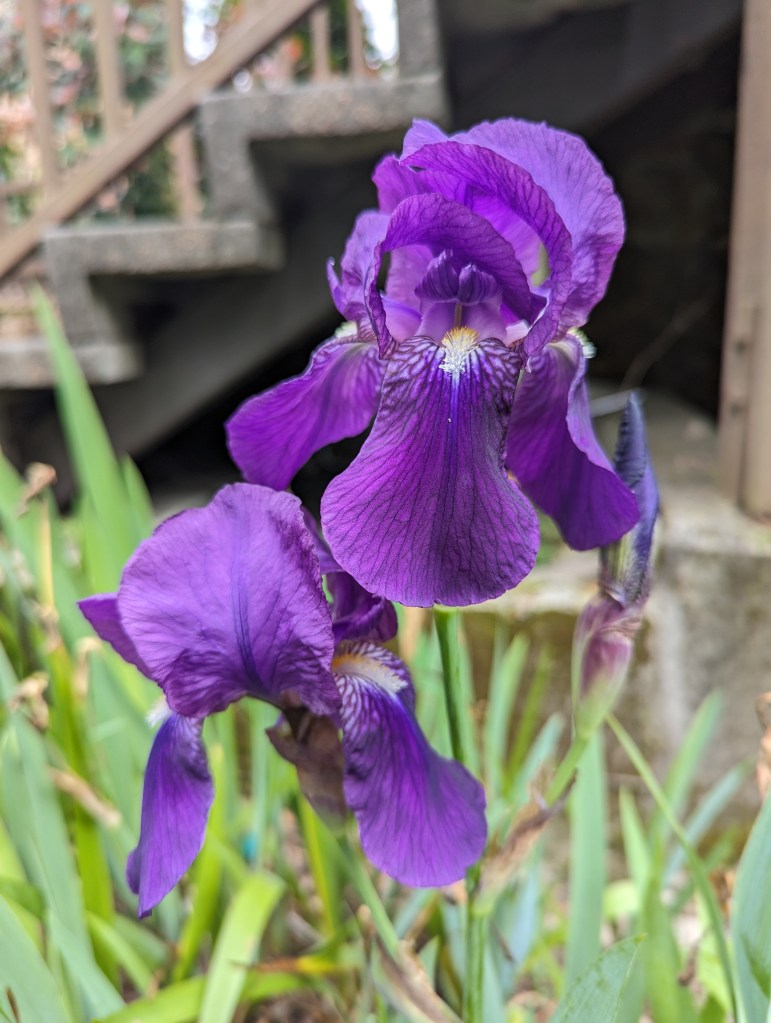
There may be no other flowers that exhibit such a diverse range of floral colors. Bearded iris, Iris X germanica, classifies as a hybrid of Iris pallida and Iris variegata. The genus of Iris derives its name from the Greek word for rainbow. As the name implies, it includes all colors of the spectrum. Floral form, height and, for some, fragrance is also quite variable.
About sixty thousand cultivars of bearded iris are supposedly documentable. It is difficult to estimate how many lack documentation. The smaller miniature cultivars are only a few inches tall. The tallest cultivars may grow four feet tall. Although they classify as summer bulbs, they are fleshy rhizomes that bloom for spring. Some will bloom again for autumn.
Bearded iris multiply whether or not anyone wants them to. Their rhizomes branch in two directions after bloom. Besides that, side shoots develop randomly from plump rhizomes. Congested rhizomes may bloom less. Division during summer promotes bloom. Division may happen annually or every few years. Bearded iris prefer sunny and warm exposure.
Early spring bulbs that went into their gardens last autumn are now blooming. Some are already done. Some summer bulbs should begin to bloom as the last spring bulbs finish. A few of them might bloom as late as autumn. Ultimately, like the earliest of spring bulbs, all eventually finish. As they do, their deteriorating flowers will necessitate deadheading.
Deadheading is simply the removal of deteriorating blooms. For many species, it diverts resources from fruiting into other growth. Many species can utilize diverted resources for subsequent bloom. Many become more intent on blooming again after deprivation of any prior fruiting. Spring bulbs instead utilize all their diverted resources for new bulb growth.
For spring bulbs, it is the most practical response to deadheading. Most bloom only once annually. Therefore, they can not divert resources directly to subsequent bloom. Instead, they prioritize vegetative growth of bulbs to grow and bloom for the next spring. They are patient. Reproduction remains their priority. They merely regroup before another attempt.
Because of extensive breeding, many spring bulbs can not produce viable seed anyway. Of course, this does not prevent them from trying. Even seeding or fruiting structures that contain no viable seed can be unappealing. For them, deadheading is merely aesthetic. Some complicated hybrids that might produce viable seed are unlikely to be true to type.
Elimination of viable seed that is not true to type is as practical as it is aesthetic. Without deadheading, such seed can grow into feral progeny. Such ferals may be more similar to remote ancestors than to their direct parents. They can be aesthetically inferior, but more prolific. Eventually, less desirable feral bulbs may displace their more desirable parents.
Because they are small but abundant, some freesia avoid deadheading. Resultant ferals are more fragrant but less colorful with pale white bloom. They are more prolific, so might eventually displace their parents. Common grape hyacinth and snowflake are too florific to deadhead, but are true to type. Actually, they can become invasive in some situations. Montbretia are very likely to be invasive.
Rhody is very proficient with Rest & Relaxation. He has been doing quite a bit of it since we left on vacation at midnight last Monday morning. He rode about eight hundred seventy miles mostly on the rear deck so that others on the road with us could observe him doing so. Since arrival in Western Washington, he has been snuggling with others whom he encounters while also engaging in similar activities. This illustrations demonstrates how expertly he engaged in rest & relaxation in Skooter’s Garden.
Although not as proficient as Rhody is, I also have been engaging in a significant rest & relaxation. This is why I have not written as much as I typically write about horticultural topics during the past several days. Although I am aware that I must compose my gardening column by Wednesday, I have deferred most other writing. If it seems otherwise, it is only because my gardening column posts in two sections on both Mondays and Tuesdays, and old articles are recycled for both Thursdays and Fridays. My negligence is more apparent only on Wednesdays and weekends. I should return from vacation on Thursday or Friday, so might resume more typical blogging before too many notice.
Rhody, Carson and I are finally on vacation in Western Washington. As usual, departure was delayed. Now that we are here, and not at work, I have not been taking pictures like I should have been. Consequently, I am deficient of pictures for Six on Saturday. Four of these six, or two thirds, are not even relevant to horticulture.
1. Sasquatch, who is also known as Bigfoot, is a celebrity of the Pacific Northwest; and is a species that is commonly considered an individual. This was in Canyonville in Oregon.
2. Portland in Oregon is the City Of Roses. This is its South Waterfront district, south of Downtown. Incidentally, most roses prefer the climates of San Jose to those of Portland.
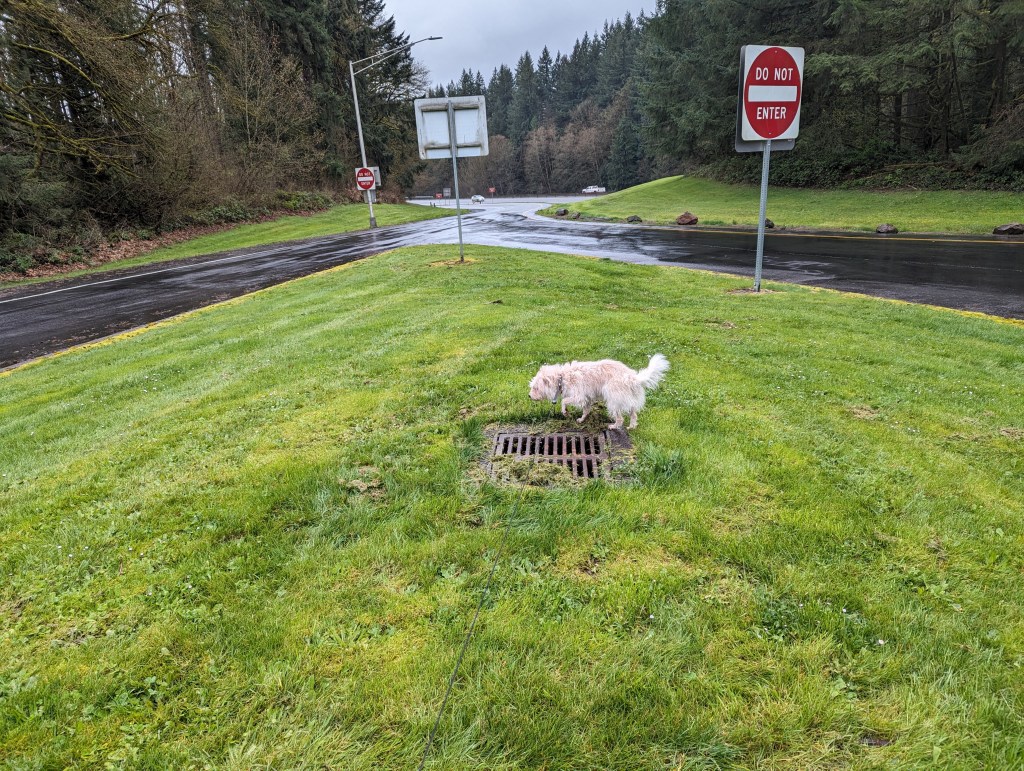
3. Rhody enjoys rest stops. They allow him to renew his ownership of Oregon. This is the Toutle River Rest Area, on northbound Highway 5, north of Castle Rock in Washington.
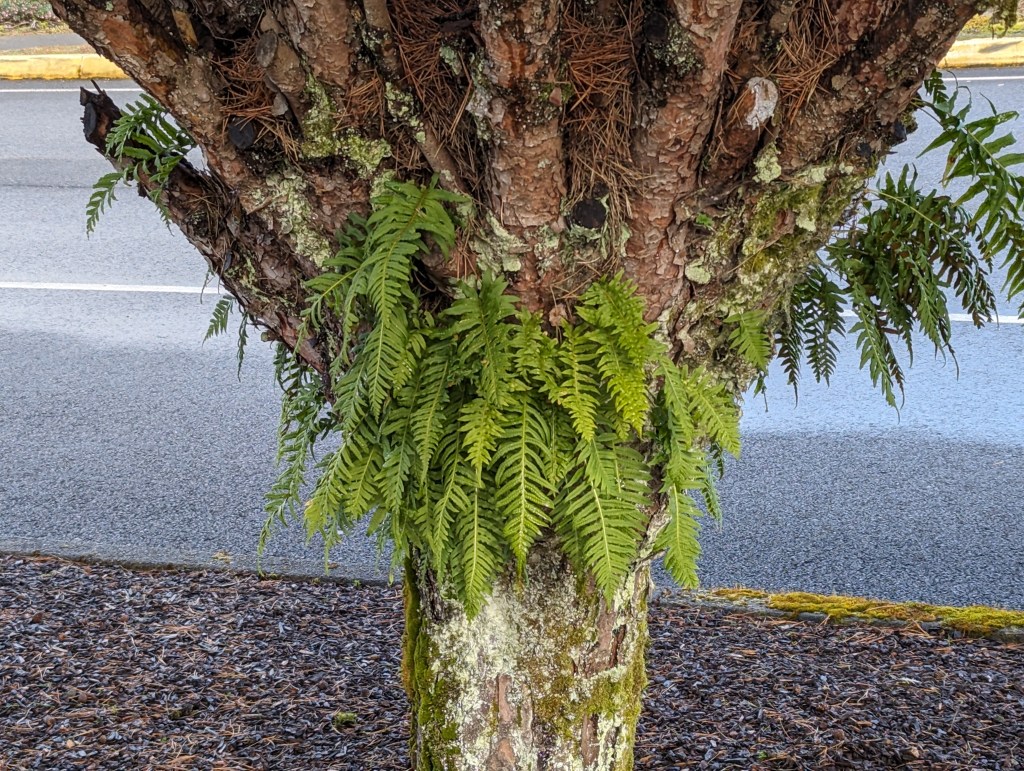
4. Ferns are common within the coastal climates of the Pacific Northwest. I do not know what this fern is. The pine may be a Japanese red pine. It is in Raymond in Washington.
5. ‘Black Gamecock’ Louisiana iris is to the left within the big box to the right. It was the priority, to replace what the gophers ate last year. There is more now than then! The rest of this vegetation is a dozen or so additional perennials from Tangly Cottage Gardening! I will get individual pictures of some of them as I process them when I get back to work. The unidentified variegated foliage to the far right seems to be variegated Japanese iris.
6. Skooter approves of my exploitation of his garden. He must know that I intend to take better care of his Louisiana iris than I did last year. He was on a sunny porch at the time.
It is more like an iris (of the floral sort, not the ocular sort) than a grass.
Contrary to its common name, blue eyed grass, Sisyrinchium bellum, is not a grass at all, but is like a diminutive iris. The modern cultivars that are more commonly found in nurseries are somewhat more colorful than the wild plants that are native to coastal areas between about Santa Barbara and Portland. Yet, even these are rather subdued, with small half inch wide blue or light purple flowers delicately suspended above bluish grassy foliage that may be as low as only a few inches, and is rarely higher than a foot. They bloom best in sunny but not too hot areas. Once established, blue eyed grass is not too demanding, but naturalizes and slowly spreads more reliably if watered occasionally through summer. However, they can rot if watered too generously or too frequently.
(This article is from 2010, so contains irrelevantly outdated information, but the link to the website below is accurate.)
The big Pacific maples outside my window never seem to get enough rest through the brief winters. Not too long ago, their leaves turned yellow and fell during autumn. Their branches were bare for only a short time through the middle of winter. Now their buds are popping open to remind me that it is now early spring. Gardening can no longer be put off because the weather is too cool and rainy to go outside, or for that matter, because it is too cool for the various plants to be actively growing and in need of much attention. Gardening now becomes a rush just to keep up with all that is going on, and to not miss out on the many excellent gardening events this time of year.
The San Francisco Flower and Garden Show, the grandest of these events, has already begun and will continue though March 28 at the San Mateo Event Center. More than 70 seminars feature topics such as sustainability in the garden, edible gardening, new plants, garden design, container gardens and water conservation. Guests can also learn how to create bonsai, build trellises, grow orchids, prune properly and how to determine what plants are best for each garden. Sproutopia has fun and educational activities and entertainment for young children.
There are also many displays exhibiting everything from garden sculpture to victory gardens. The pocket parks and container garden display shows the potential of gardening with limited space, or with little time to devote to gardening. The Bonsai Society of San Francisco is exhibiting impressively mature bonsai specimens, and demonstrating bonsai techniques. Flower Lane exhibits floral design by California Garden Clubs. Hot Plant Picks displays some of the most recently introduced or developed plants. Some are still too new to be available in nurseries yet.
Gardens for the Future, the twenty display gardens that are the most prominent component of the San Francisco Flower and Garden Show, illustrate themes ranging from simple and refined to opulent and lush. ‘Velvet Daggers3’ may be my favorite because it “suggests that we seek out new applications of simple technology” and “demonstrates the beautiful qualities of xeric plants” (yuccas perhaps!?). ‘Pulling Up Daisies’ defies conventional thirsty lawns and consumptive landscaping, suggesting evolution of environmental compatible landscaping with natives. “The use of native plants makes ‘Native Garden 3.0’ a model of sustainability.” These are merely three of my favorite gardens. There are seventeen others that are worthy of more theatrical descriptions!
The San Francisco Flower and Garden Show will be open from 10:00 a.m. to 8:00 p.m., except on Sunday, March 28, when it will close two hours earlier at 6:00 p.m.. It is at The San Mateo Event Center, which is located at 2495 South Delaware Street in San Mateo. Admission is $20 for all five days, or $4 for youths sixteen years old and younger. Children four years old and younger are free. Student admission is $15 with valid student identification. After 3:00 p.m., or 2:00 p.m. on the last day, half day admission is $12. More information can be found at www.sfgardenshow.com.






 Tony Tomeo